Gardens · white garden winter structure summer bloom
Plan a White Garden from Winter Structure to Summer Bloom
Build a white garden from evergreen and deciduous framework first, then layer white-flowering perennials and shrubs so the palette reads clearly from late winter into summer.
Published Last updated
In this guide
- Begin with structure because white alone is not enough
- Put winter structure on paper before choosing white flowers
- Use late-winter and spring whites to connect the bones to the bloom season
- Hold the summer layer to fewer, larger white statements
- Build one source-bounded white border for Zone 6
- Let summer foliage and maintenance support the palette instead of competing with it
- Edit the white garden by season, not by impulse
- Audit white as a changing value, not one color
- Design ideas
Begin with structure because white alone is not enough
A white garden becomes magical when it feels deliberate, but it becomes flat the moment white is treated as the only design principle. The RHS guidance on white gardens is helpful precisely because it treats the palette as atmosphere, not as an excuse to buy every available white flower. The garden still needs weight, repetition, rhythm, and places for the eye to rest. In winter, that means visible structure. In summer, it means bloom masses supported by foliage and shape rather than floating in a bright blur.
This is why a white garden should begin in the leafless season or at least be drawn from a winter view. What will hold the composition when flowers are absent? Which lines stay visible in frost? Which evergreen or woody forms keep the garden legible from indoors? If those questions have no answer, the white flowers will later feel scattered, because the garden will have no quiet armature to hold them in place between bloom waves.
The same principle protects the palette from sentimentality. White reads strongly against dark backgrounds, glows in low light, and can soften a space, but it also shows every gap in timing. Structure absorbs those gaps. The design therefore starts with the bones: evergreen mounds, branchwork, deciduous shrub framework, and the negative spaces between them. Only after that can the blooms be assigned in a way that feels calm rather than vacant.
A good white garden is therefore less about purity than editing. Every plant must earn its place twice: once as shape and once as bloom. If either performance is weak, the whole composition thins out because the palette has so little visual noise to hide behind. The reward for that stricter standard is clarity. A restrained border of strong forms and well-timed white flowers often feels richer than a busier planting filled with more species.
Put winter structure on paper before choosing white flowers
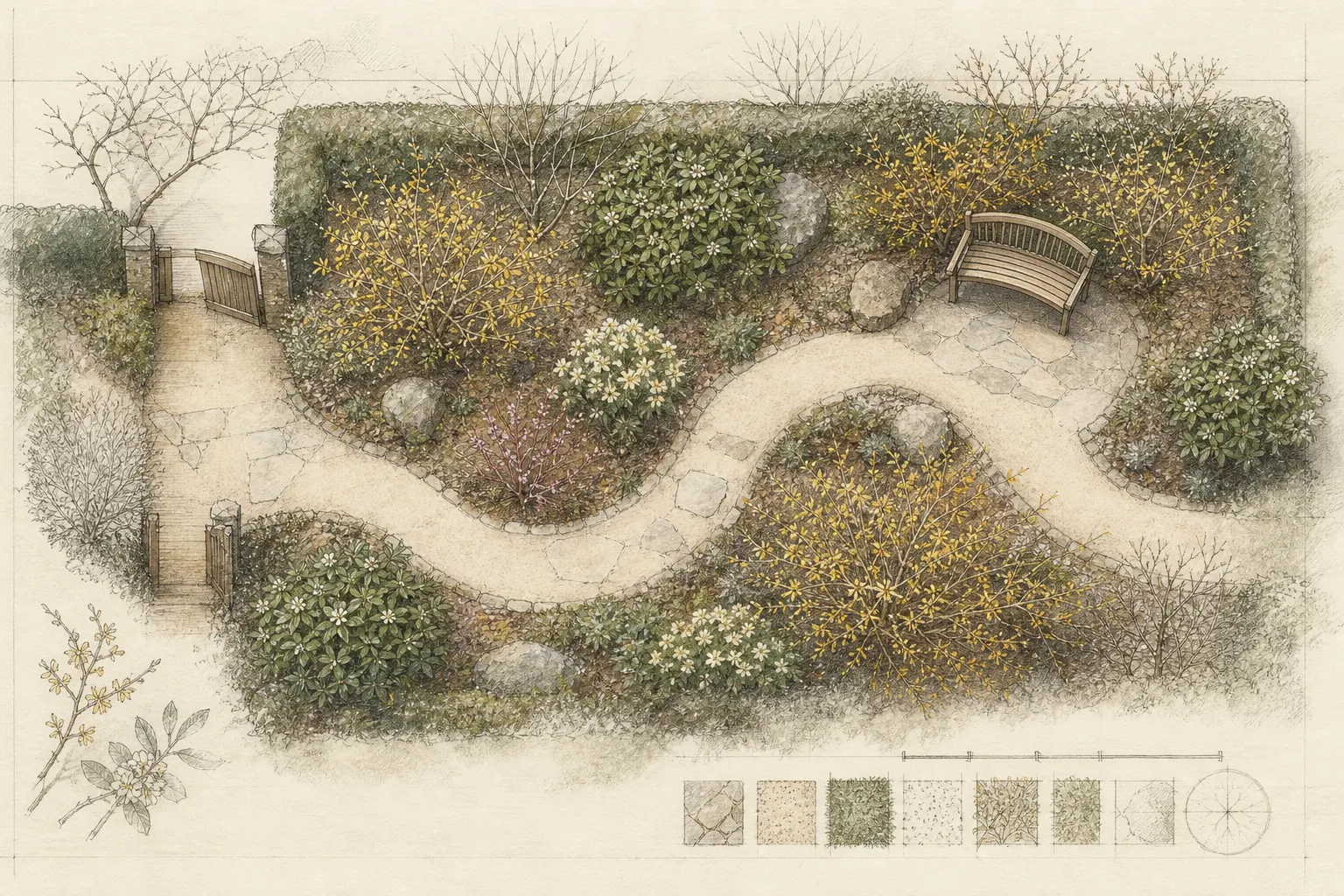
Draw the border as it appears in January, not as it appears in a nursery catalogue. Mark paths, windows, borrowed views, walls, and the shadows cast by trees and buildings. Then place the structural layer at mature size. The discipline here comes directly from sound landscape planning: major masses, circulation, and usable maintenance space belong on the plan before the decorative layer is chosen. A white garden needs that discipline more than most because the palette leaves little room for compositional noise.
Evergreen structure does not need to dominate the border, but it must remain legible. A low mounded yew such as Taxus × media 'Densiformis' typically grows 3 to 4 feet tall and about 5 to 7 feet wide, which makes it useful as a winter mass rather than a clipped edge. One or two such forms can anchor a medium border, provided their mature width is drawn honestly and they are not expected to behave like narrow punctuation. Structure fails when it is undersized for the role or overpruned into nervous little lumps.
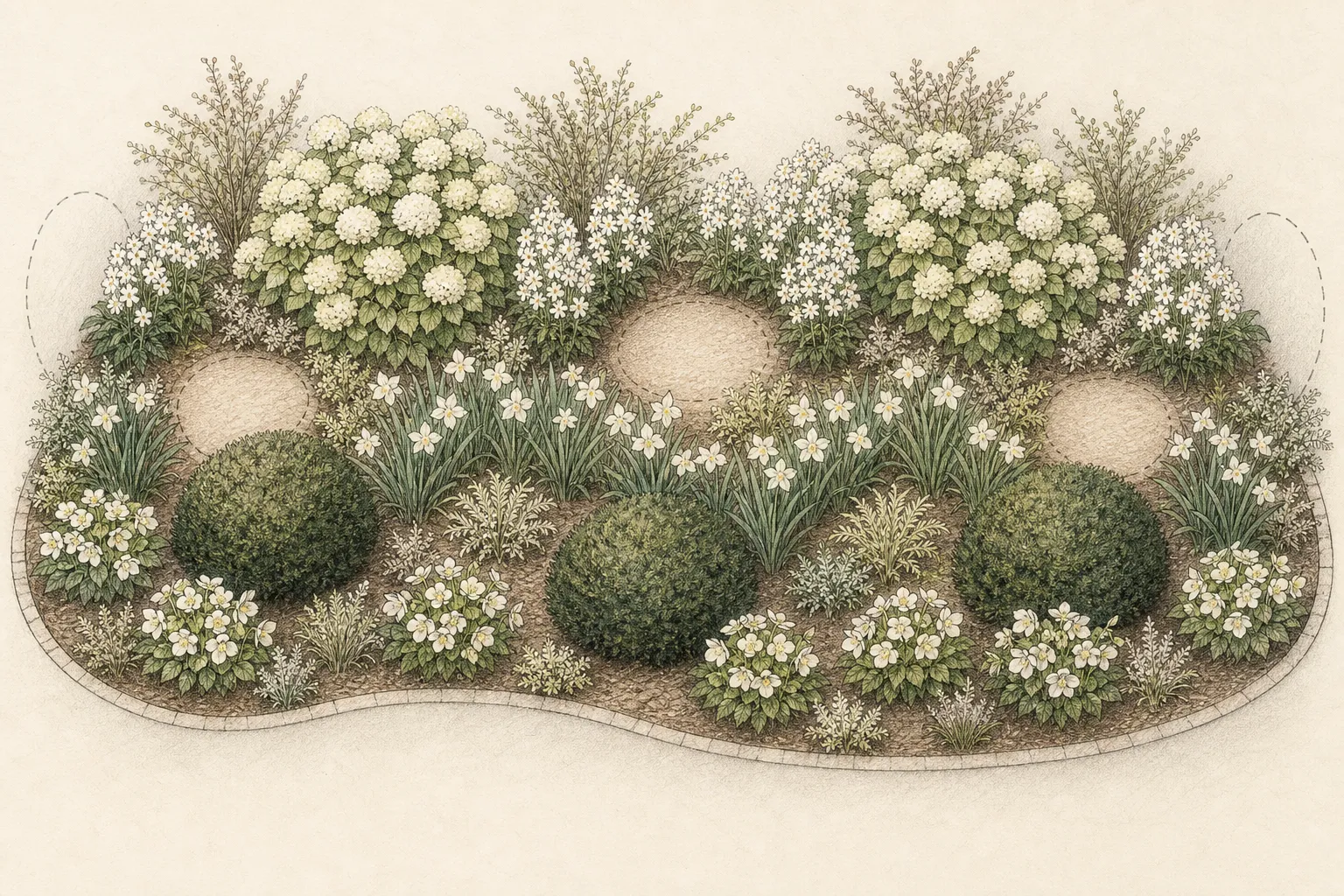
The woody flowering layer should also be drawn in winter shape, not just in bloom. Hydrangea arborescens 'Annabelle' reaches about 3 to 5 feet in height and 4 to 6 feet in spread, and its rounded framework matters in every season, not only when the white heads open. A plan that places these shrubs only by their summer flowers will usually crowd the winter view. The winter plan keeps the border from collapsing into pure seasonal thinking.
Use late-winter and spring whites to connect the bones to the bloom season
The most convincing white gardens do not jump from evergreen structure straight to midsummer shrub bloom. They bridge the gap with lower, earlier flowers that are strong enough to be seen yet quiet enough to support the framework already in place. Helleborus niger, for example, grows roughly 9 to 12 inches tall and 12 to 18 inches wide, which allows it to sit close to paths and under the shoulder of larger shrubs without erasing the winter shape around it. It is a flower that keeps the eye low and near the architecture.
White narcissus can then lift the border into spring. Narcissus 'Thalia' grows about 1 to 1.5 feet tall with a spread around 0.5 to 0.75 feet, making it useful as repeated vertical notes between lower hellebore clumps and later summer perennials. Because the flowers rise on clean stems, they brighten the border without thickening the base. This is important in a white scheme, where too many broad masses at one level quickly blur together.
These early layers should be repeated more often than they are diversified. One white hellebore every three feet and a ribbon of mixed bulbs is less convincing than a few repeated hellebore drifts and a narrower rhythm of one reliable narcissus cultivar. White works by echo and interval. The earliest flowering plants are where you establish that pattern, not where you break it.
Use the spring handoff to reinforce spacing discipline. If narcissus foliage is repeatedly buried by later growth, the summer layer is too close or too dense. If the hellebore groups disappear completely once bulbs and shrubs begin to rise, the low late-winter layer was under-scaled for the border. White gardens become more coherent when these seasonal overlaps are read as design feedback rather than accepted as unavoidable blur.
Hold the summer layer to fewer, larger white statements
Summer is where many white gardens lose their composure. The temptation is to add a dozen white-flowering perennials because they all seem to belong. In practice, the stronger move is to let one rounded shrub mass and one upright perennial rhythm carry most of the summer display. Hydrangea arborescens 'Annabelle' supplies the rounded white volume. Phlox paniculata 'David', reaching roughly 2 to 4 feet tall and 2 to 3 feet wide, contributes an upright, repeated line that reads clearly above the lower spring layer.
These two roles are different enough that they prevent the border from becoming one white cloud. Hydrangea provides the broad summer anchor. Phlox lifts the eye in repeated, narrower columns and extends bloom through a different texture. The winter structure is still present underneath, but it no longer needs to carry the whole garden. The white palette succeeds because the summer layer is not a pile of equivalent forms competing at the same height.
This is also where the background earns its keep. White flowers show best against dark foliage, shadow, or evergreen mass, which is another reason to keep the structural layer visible behind them. A white garden in front of pale paving or a washed-out fence often looks more diffuse than serene. The composition needs contrast to stay legible, even when the flower palette stays restrained.
The summer layer should also leave breathing space for the spring bulbs below. A border can be peak-beautiful in July and still poorly designed if the hydrangeas and phlox leave no room to find, water, or remember where narcissus foliage needs to ripen in April. In a white garden, this practical spacing matters aesthetically too, because the clean sequence from low spring white to high summer white depends on each season keeping its own tier.
Build one source-bounded white border for Zone 6
Consider a 22-foot by 10-foot border in USDA Zone 6 with part sun, shelter from the harshest west wind, and evenly moist, well-drained loam. This is a worked composition, not a universal list. The border is viewed both from a nearby path and from indoors in winter. It needs to look intentional before any flower opens, then move through white bloom without becoming congested by midsummer. The climate boundary matters: substitute locally where heat, winter wet, or light differ materially from this setting.
Set three Taxus × media 'Densiformis' mounds as the winter armature, each allowed to reach its natural 3 to 4 foot height and roughly 5 to 7 foot spread rather than clipped into a narrow strip. Between and in front of those mounds, place drifts of Helleborus niger and repeated groups of Narcissus 'Thalia'. The hellebores keep a low winter-to-spring layer; the narcissus rise cleanly above them in March and April. At the back or middle-back of the border, position two 'Annabelle' hydrangeas with honest room for their 4 to 6 foot spread.
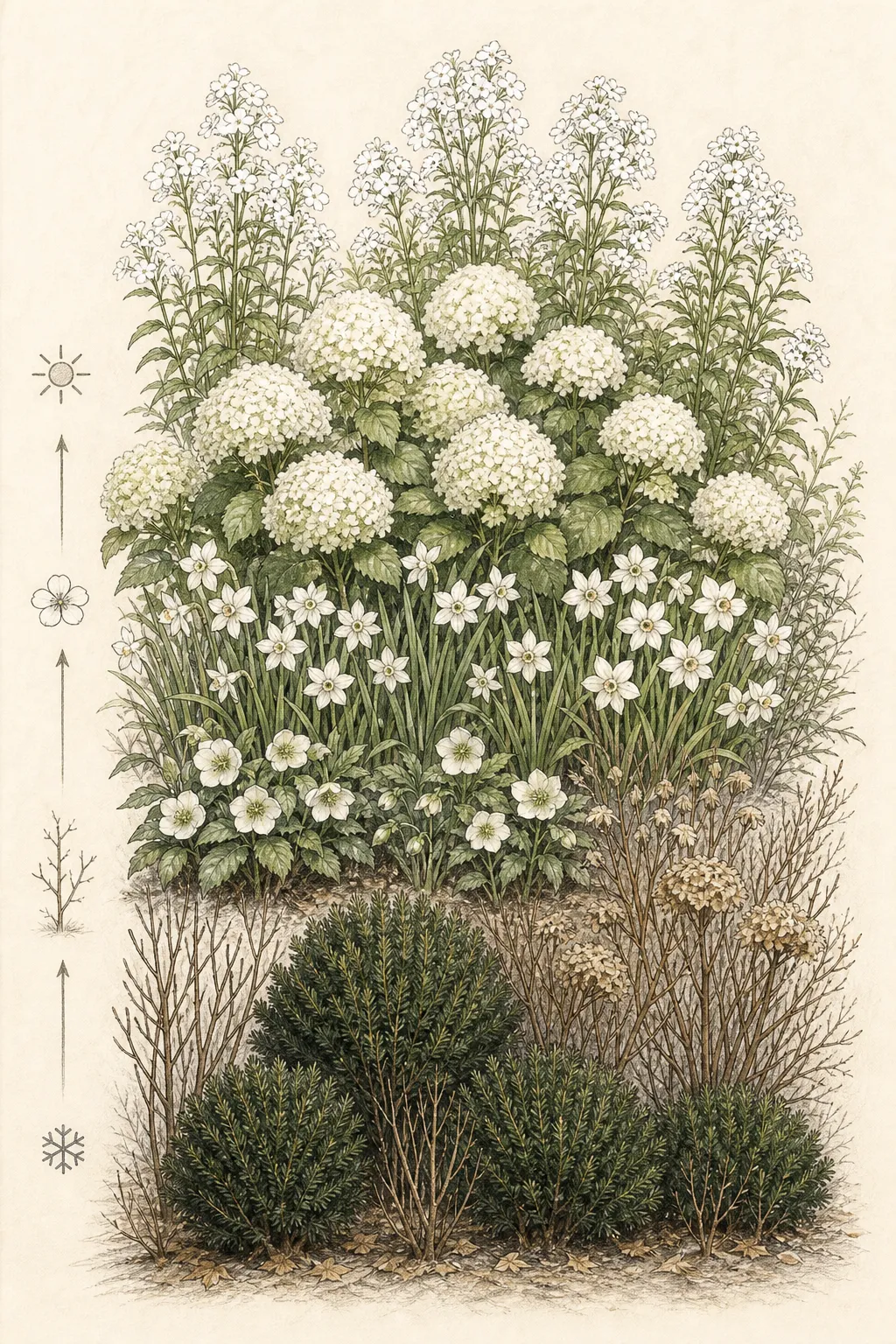
Thread Phlox 'David' through the summer gaps between shrub masses, keeping the repeated phlox groups slightly forward of the hydrangeas so the upright white panicles can read separately. The result is not a tapestry of white species. It is a small set of roles: evergreen winter mounds, low late-winter flowers, clean spring stems, broad summer shrub bloom, and upright summer repeat. In hotter, drier, or more exposed regions, the same sequence may need different taxa, but the role logic should stay intact.
Let summer foliage and maintenance support the palette instead of competing with it
A white garden is often praised for calm, yet calm is hard to maintain if the maintenance logic is chaotic. Leave room between masses so hydrangea pruning, phlox staking or thinning, and bulb foliage ripening do not force emergency trampling through the border. White makes every maintenance scar visible. A design that depends on squeezing through plants to reach the back line will quickly lose its composure, because the garden will always be slightly disrupted by the work required to keep it going.
Foliage should support the flowers and structure rather than trying to introduce a second visual argument. Blue-green, dark green, or quietly glossy foliage can all work, but the palette benefits from repetition more than novelty. One reason the suggested group of yew, hellebore, narcissus, hydrangea, and phlox is useful is that the foliage moves through a narrow range of greens and textures. The white flowers remain distinct because the leaves are not shouting for attention.
This is also why a white garden should resist the urge to fill every summer gap with another white-flowering annual. Temporary fillers can be useful in the establishment years, but too many of them make the border look restless. The better response is usually to let the structure, soil surface, and measured spacing remain visible until the permanent plants mature. White gardens get stronger as they become more disciplined, not more populous.
Edit the white garden by season, not by impulse
Photograph the border in winter, at hellebore bloom, at narcissus bloom, and again in midsummer. The same fixed viewpoints will tell you whether one layer is missing, one white mass is too dominant, or one part of the border goes visually empty between seasons. White gardens are easier to refine than mixed-color borders because the variables are fewer. That advantage is wasted if every weak moment is answered with a new plant instead of a measured edit to repetition, scale, or timing.
A successful edit may be very small. One more group of Narcissus 'Thalia' can bridge a spring gap more effectively than an unrelated new tulip. Moving a phlox group a few feet can restore the separation between the upright summer layer and the rounded hydrangea mass. Reducing a bulky companion can let the winter yew mounds read again. The most useful revisions protect the role sequence already established rather than restarting the border from the nursery bench each year.
That seasonal edit is the real promise of a white garden. Because the palette is narrow, each refinement has a visible effect. The winter structure should look more convincing each year, and the handoff to spring and summer should become clearer rather than more crowded. When the bones remain trustworthy, the white blooms feel effortless even though the design behind them is disciplined.
The best evidence of success is not only the summer photograph. It is the fact that the garden still reads in January, still feels composed in March, and still has enough calm in July that a single white bloom can stand out instead of dissolving into glare. A white garden is a sequence, and the sequence improves when each season is edited against the same quiet framework.
Audit white as a changing value, not one color
Photograph candidate whites together in the light the border receives. Cream, green-white, blue-white, and pink-flushed flowers may harmonize in soft morning light but separate at noon. Silver foliage cools a composition, yellow-green warms it, and dark evergreen backgrounds make small white flowers legible from farther away.
Connect those shifts through repetition instead of demanding an exact color match. Repeat one leaf shape, flower form, or interval while allowing the whites to change with season. The rhythm gives the eye a route and prevents the summer peak from becoming a collection of unrelated pale specimens.
Plan decline as carefully as bloom. Brown seed heads, collapsing petals, and yellowing bulb foliage are conspicuous in a restrained palette. Let later foliage screen ripening bulb leaves, choose some plants with durable seed structures, and make deadheading access part of the layout.
At season's end, compare fixed-view photographs with the winter plan. Remove only what breaks structure, timing, or maintenance capacity; do not fill every temporary gap. Open ground supplies useful winter contrast and gives repeated plants room to mature.
Design ideas
- Style
- Restrained four-season white border built from evergreen mounds, low spring drifts, and broad summer repeats
- Space
- Medium ornamental border or side view garden seen from both path and house
- Climate
- Worked composition for USDA Zone 6 with part sun, protection from the harshest west wind, and evenly moist but well-drained loam. The border assumes that the evergreen structure can hold winter views without severe burn, that hellebores and narcissus can flower cleanly in spring, and that hydrangea and phlox can bulk up through summer without irrigation extremes or heavy disease pressure. Hotter, drier, wetter, or shadier sites need locally suitable substitutions that preserve the same structural and seasonal roles.
- 1Three structural mounds first
Begin the border with a small number of evergreen or woody masses large enough to be read in winter. Their mature size should be drawn honestly so the white bloom layers later sit on top of a stable armature, not on a row of clipped placeholders too small for the view they are meant to anchor. Space them as an uneven rhythm rather than a hedge, preserving dark intervals where pale flowers and winter stems can remain distinct.
- 2One low late-winter layer
Use hellebores or another compact winter-to-spring white plant in repeated groups close to the viewing edge, where their flowers connect the winter bones to the first bulbs. The low layer should be visible from indoors and should still read when the weather keeps people from stepping deep into the border.
- 3A narrow spring stem rhythm
Repeat one white narcissus or another clean spring bulb in measured intervals so the border gains vertical lightness without thickening the lower layer into one broad white mass. The spring stems should rise through the structure, not obscure it.
- 4Two summer forms, not six
Let one rounded shrub and one upright perennial carry most of the summer display. White gardens stay calmer when the summer layer is built from a few repeated forms rather than many equal voices, especially once midsummer light intensifies the brightness of every flower.
- 5Dark background where possible
Use evergreen foliage, hedging, or shadow behind at least part of the white layer so flowers remain legible in bright conditions and do not wash out against pale hardscape. Contrast is part of the white palette, not a violation of it.
- 6A four-season photo set
Keep fixed photographs from winter, early spring, late spring, and summer. They reveal whether the border truly holds the white sequence you planned or whether one season still depends on guesswork, impulse buying, or plants that only work from one angle.
- 7Room for bulb aftermath
Preserve enough open ground and maintenance access that spring bulb foliage can ripen without being smothered by the later summer layer. The white sequence breaks down when the next tier arrives too aggressively for the previous one to finish.
- 8One calm axis from indoors
Choose at least one indoor viewpoint and align the winter mounds, spring drifts, and summer masses to it. White gardens often feel strongest when one axis remains legible even on grey days, not only when the whole border is viewed from outside.
Plants in this guide
Related reading
Sources
- Discover the magic of white gardens. Royal Horticultural Society. Source record · Accessed 2026-08-19.
- How to have a beautiful winter garden. Royal Horticultural Society. Source record · Accessed 2026-08-19.
- 19. Landscape Design. NC State Extension. Source record · Accessed 2026-08-19.
- Taxus × media 'Densiformis' - Plant Finder. Missouri Botanical Garden. Source record · Accessed 2026-08-19.
- Helleborus niger - Plant Finder. Missouri Botanical Garden. Source record · Accessed 2026-08-19.
- Narcissus 'Thalia' - Plant Finder. Missouri Botanical Garden. Source record · Accessed 2026-08-19.
- Hydrangea arborescens 'Annabelle' - Plant Finder. Missouri Botanical Garden. Source record · Accessed 2026-08-19.
- Phlox paniculata 'David' - Plant Finder. Missouri Botanical Garden. Source record · Accessed 2026-08-19.