Bigleaf Hydrangea
Hydrangea macrophylla
A field guide to bigleaf hydrangea: identify its bud-bearing wood, provide morning light and steady moisture, and protect the framework that carries summer flowers.
Published Last updated
At a glance
- Light
- Morning sun to part shade
- Water
- Consistent moisture; not saturated
- Soil
- Moist, fertile and well-drained
- Hardiness
- Zones 6–9
- Bloom
- Early to late summer, depending on cultivar and climate
- Height
- 3–6 ft · 90–180 cm
In this guide
Overview
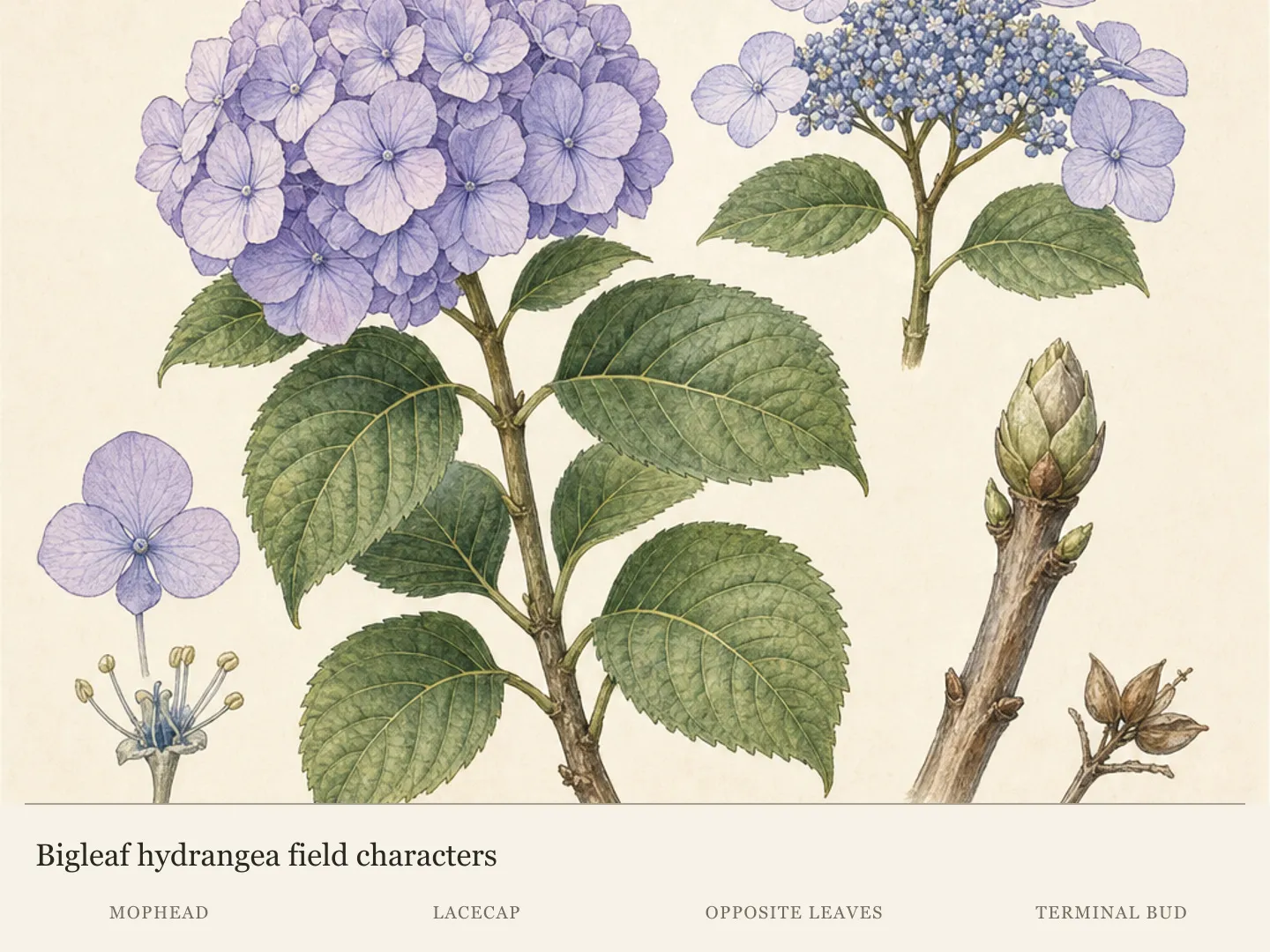
Bigleaf hydrangea is a rounded deciduous shrub with broad serrated leaves and terminal flower clusters in mophead or lacecap form. The showiest florets are sterile, while the smaller fertile flowers are more visible in lacecaps. Mature size varies sharply by cultivar, so the plant label is part of the site plan rather than a disposable nursery detail.
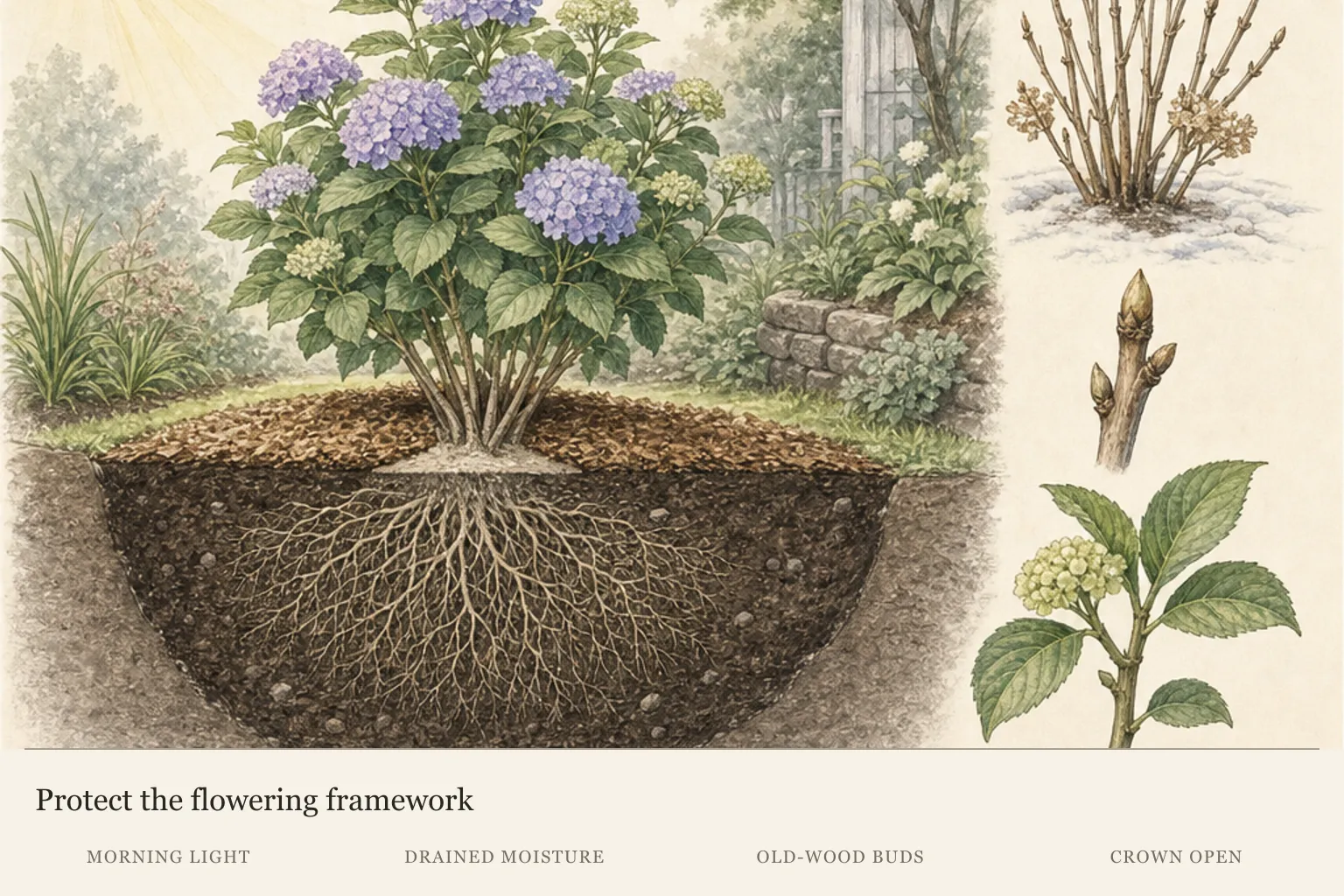
Traditional cultivars initiate flower buds on older stems during the previous growing season. Those buds must survive winter, late freezes, browsing and pruning before they open. Reblooming cultivars can also form flowers on current-season shoots, but that trait does not make every pruning time equally useful.
Morning sun with protection from intense afternoon exposure is a practical starting point in warm regions. The root zone should remain evenly moist while still draining after irrigation or rain. Deep shade can reduce flowering, while abrupt hot sun and dry soil increase wilt and leaf-edge scorch.
Flower color in many blue, purple and pink cultivars reflects soil chemistry and aluminum availability; white cultivars generally do not follow the same color response. Test the soil before changing pH, make adjustments gradually and treat plant health as a separate decision from flower color.
Use bigleaf hydrangea as a specimen, loose hedge or repeated shrub group where its mature spread and seasonal framework can remain. A narrow foundation strip that requires annual hard cutting works against the plant's old-wood flowering habit.
- Family
- Hydrangeaceae
- Range
- South-central Japan to Izu Ōshima and the Kazan Islands
- Soil pH
- 5.5–7.5
- Spread
- 3–6 ft · 90–180 cm
Planting & careHow to grow bigleaf hydrangea
This profile covers Hydrangea macrophylla in temperate Northern Hemisphere gardens. Cultivars vary in mature size, cold tolerance and whether they flower on old wood, new wood or both; confirm the label before pruning. Zone 5 culture requires a protected site and does not guarantee flower-bud survival.
- 1Confirm cultivar and mature size
Record the cultivar, expected height and spread, hardiness and old-, new- or reblooming wood habit before choosing the permanent site.
- 2Observe light and drainage
Choose a position with useful morning or dappled light, afternoon protection in hot regions and no persistent ponding after rain.
- 3Prepare the full root area
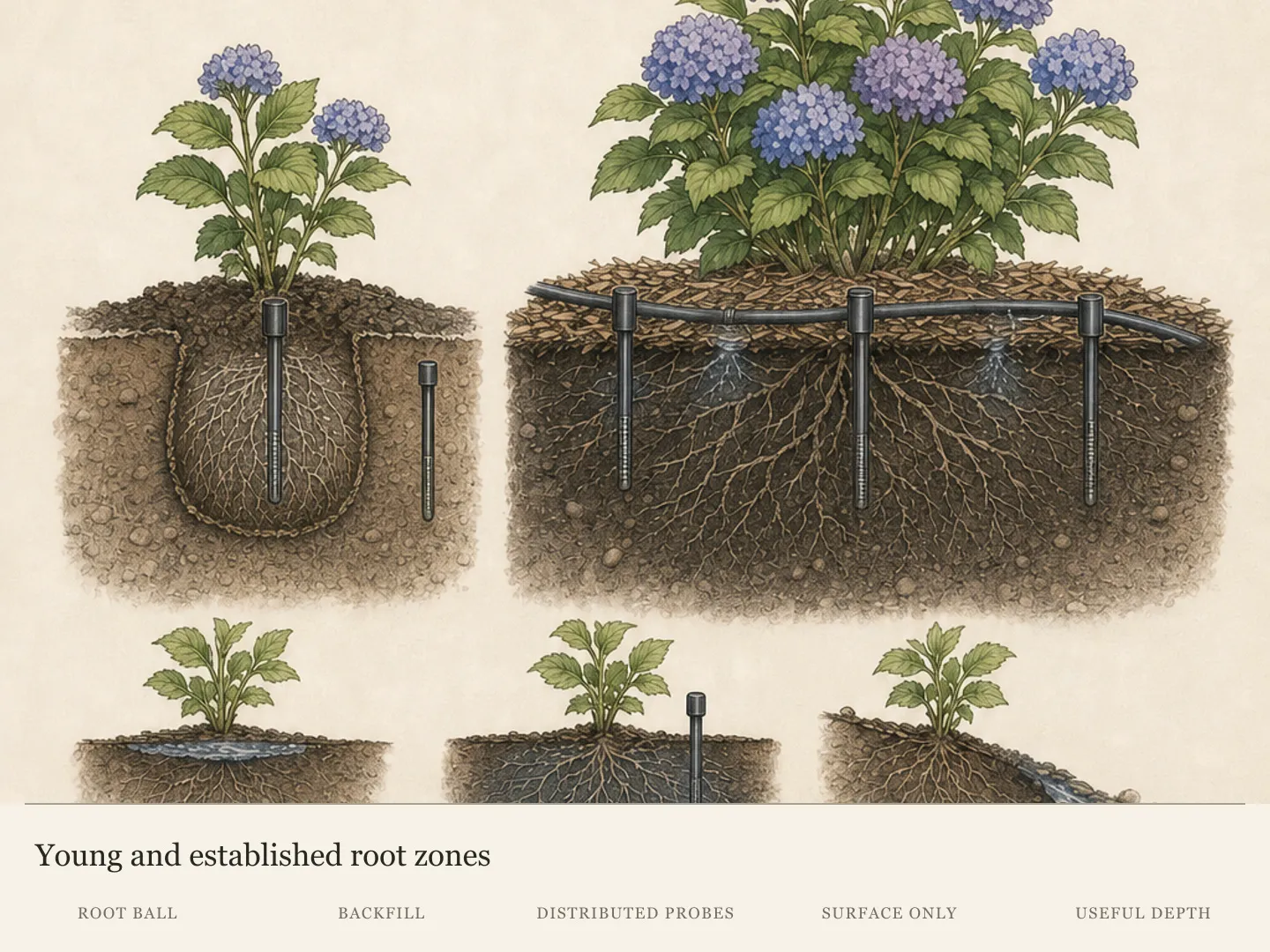
Open a broad hole no deeper than the root ball, loosen circling roots where needed and avoid creating an isolated pocket of rich mix in compacted soil.
- 4Keep the root flare and crown visible
Set the top of the root ball level with the surrounding grade, backfill with the excavated soil and water slowly to settle air pockets.
- 5Mulch the soil, not the stems
Apply an organic mulch over the root zone while leaving a clear collar around the crown and lower stems for inspection and airflow.
- 6Establish by soil checks
Probe the original root ball and surrounding soil separately through the first seasons, watering slowly when the occupied root zone begins to dry.
Pruning bigleaf hydrangea
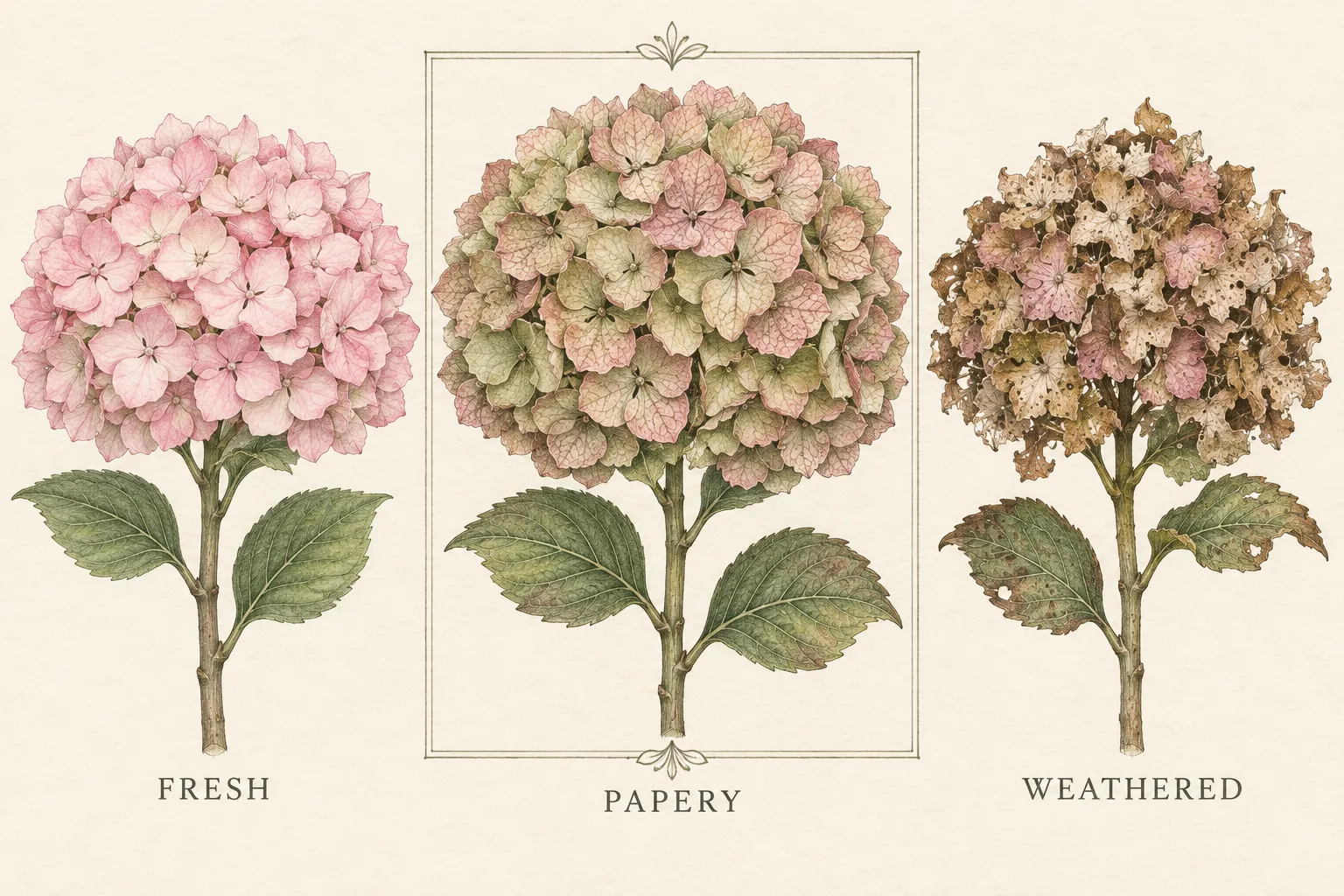
Identify the flowering wood before making size cuts. Traditional bigleaf hydrangeas bloom mainly on old wood, so prune only when needed and make structural cuts soon after flowering; late-season, winter or early-spring heading cuts can remove dormant flower buds. Reblooming cultivars use both old and new wood but still flower earliest from surviving old-wood buds. In spring, wait for growth to reveal winter damage, then remove confirmed dead stems to living tissue. Deadheading removes only the faded flower and short stalk above the first healthy leaf pair; it is not a substitute for branch pruning. If the shrub repeatedly outgrows the site, move it or select a smaller cultivar instead of cutting the whole framework to the ground each year.
Seasonal care
Spring
Wait for buds and leaves to reveal live wood, remove only confirmed winter-killed stems, renew a crown-safe mulch layer and begin root-zone moisture checks before warm weather.
Summer
Maintain even moisture by checking below mulch, protect the shrub from exceptional afternoon heat, deadhead conservatively if desired and make any type-appropriate structural cuts soon after bloom.
Autumn
Allow current shoots and old-wood flower buds to mature, stop unneeded fertilizer, water during prolonged dry weather and avoid hard pruning that removes the next display.
Winter
Protect bud-bearing stems from browsing, drying wind and severe exposure where the cultivar is marginally hardy; keep drainage open and do not mound wet mulch against the crown.
Safety and garden spread
Common problems
No flowers
- Look for
- Healthy leaves with missing terminal buds, prior hard pruning, winter-killed upper stems, browsing or deep shade.
- Action
- Identify the flowering wood, preserve living stems and use the full no-bloom diagnosis before changing fertilizer or pruning again.
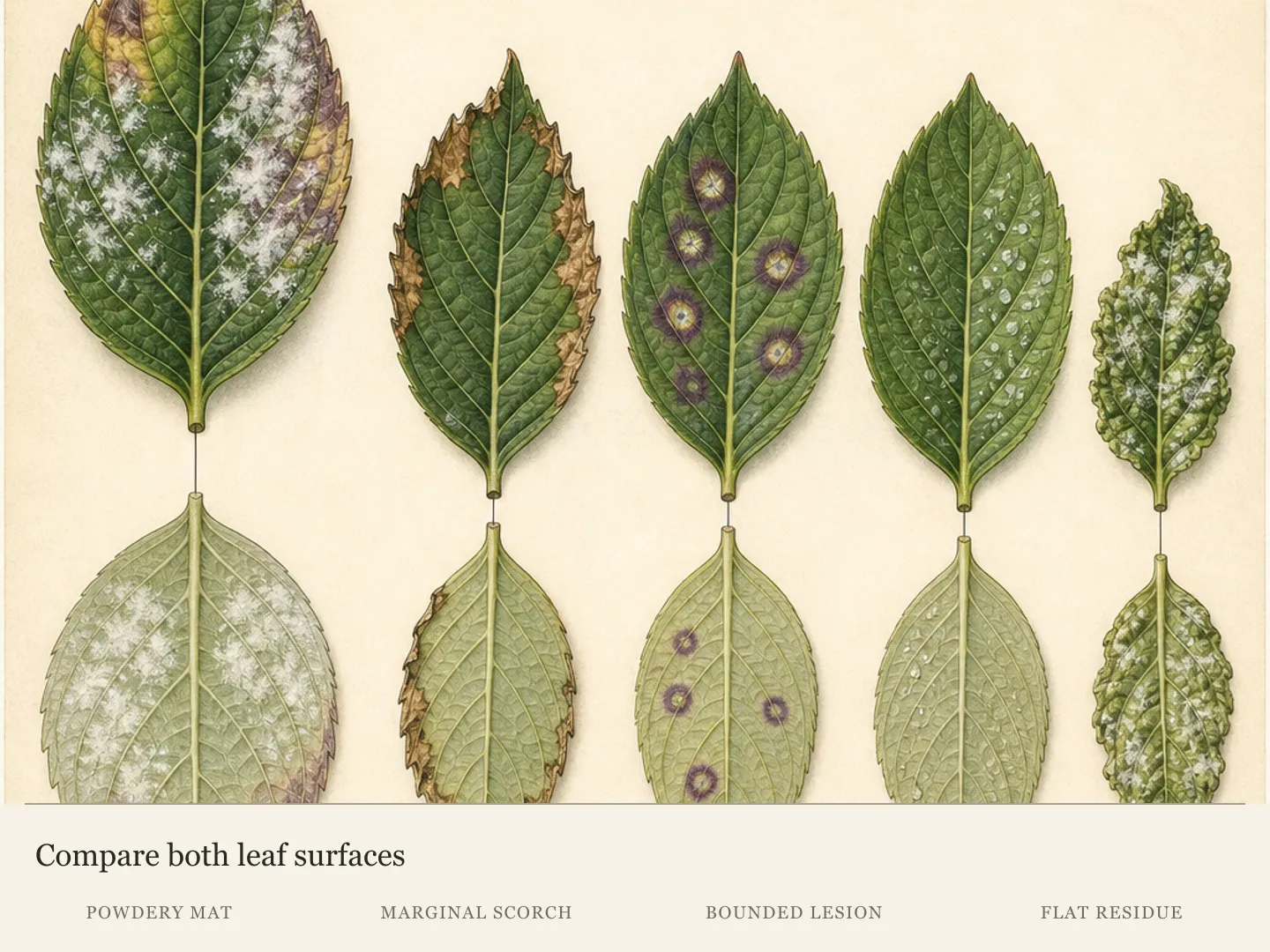
Leaf-edge scorch
- Look for
- Crisp brown margins on exposed leaves, often paired with heat, dry root zones, wind or reflected sun.
- Action
- Check moisture below mulch and exposure at two times of day, then correct watering distribution or heat load without saturating roots.
Powdery mildew
- Look for
- Expanding white powdery growth on one or both leaf surfaces, sometimes with puckered young leaves.
- Action
- Confirm the pattern against residue and scorch, improve spacing and leaf drying, and scale management to spread and recurrence.
Leaf spots
- Look for
- Discrete bounded lesions rather than continuous dry margins or removable surface residue.
- Action
- Remove fallen affected leaves, avoid unnecessary foliage wetting and seek local diagnosis when lesions advance or cause early defoliation.
Persistent wilt
- Look for
- Shoots remain limp the next morning despite a root zone that is either dry at depth or persistently wet.
- Action
- Inspect root-ball moisture, drainage and crown condition before adding water; investigate roots when wilt persists in moist soil.
Related reading
Sources
- Hydrangea macrophylla. North Carolina Extension Gardener Plant Toolbox. Source record · Accessed 2026-08-16.
- Hydrangea macrophylla (Thunb.) Ser.. Royal Botanic Gardens, Kew. Source record · Accessed 2026-08-30.
- Hydrangea macrophylla Group. Missouri Botanical Garden. Source record · Accessed 2026-08-16.
- Pruning Hydrangeas. University of Maryland Extension. Source record · Accessed 2026-08-16.
- Hydrangea: Identify and Manage Problems. University of Maryland Extension. Source record · Accessed 2026-08-16.
- Toxic and Non-toxic Plants: Hydrangea. ASPCA Animal Poison Control Center. Source record · Accessed 2026-08-16.