Gardens · four season flowering hedge design
Design a Four-Season Flowering Hedge with a Maintainable Rhythm
Combine repeated structural shrubs with a restrained sequence of flowers, fruit, foliage, and winter form while preserving gates, windows, drainage, and pruning access.
Published Last updated
In this guide
Define what the hedge must do
List screening, boundary, flower, fruit and winter-structure priorities in order. One hedge cannot maximize every trait. Schedule the work when the full boundary can be measured before spring planting and existing vegetation leafs out. Confirm the choice by inspecting mature width, bloom time, fruit, winter stem structure, drainage, sightlines and the route for selective pruning. The safe finish is reached when repeated structural shrubs hold a coherent hedge through gaps between seasonal features.
Set maximum height from utilities, views and neighbor agreements. Pruning cannot permanently shrink unsuitable genetics.
Choose informal selective pruning or formal clipping before species selection. Flowering shrubs often lose bloom under repeated shearing. In this case, success means repeated structural shrubs hold a coherent hedge through gaps between seasonal features. Let the next inspection test whether repeated structural shrubs hold a coherent hedge through gaps between seasonal features; the workday shows only the starting condition.
Use the define what the hedge must do stage to compare mature width, bloom time, fruit, winter stem structure, drainage, sightlines and the route for selective pruning across the whole planting, including one unaffected reference point. Continue only where that evidence agrees with repeated structural shrubs hold a coherent hedge through gaps between seasonal features.
Begin with boundary functions that remain useful after flowers fade: screening height, view filtering, habitat, wind moderation, or simple enclosure. Decide where the hedge must stay low for a window and where an opening or gate must remain clear. A mixed flowering hedge needs enough depth for natural shrub outlines; a strip too narrow for mature widths will require constant heading cuts. Penn State design principles favor unity and repetition, so repeat a framework shrub and use seasonal features as measured interruptions, not planting every available species once.
Draw access and infrastructure before plants
Map gate swing, meters, drains, windows and underground services. Keep permanent clear zones.
Reserve a working strip on at least one side where possible. Mature shrubs still need inspection and renewal cuts. Check mature width, bloom, fruit, winter structure, drainage, sightlines, and the selective-pruning route along the full boundary. Keep utility clearance, gate swing, windows, drainage, and local invasive guidance fixed on the plan.
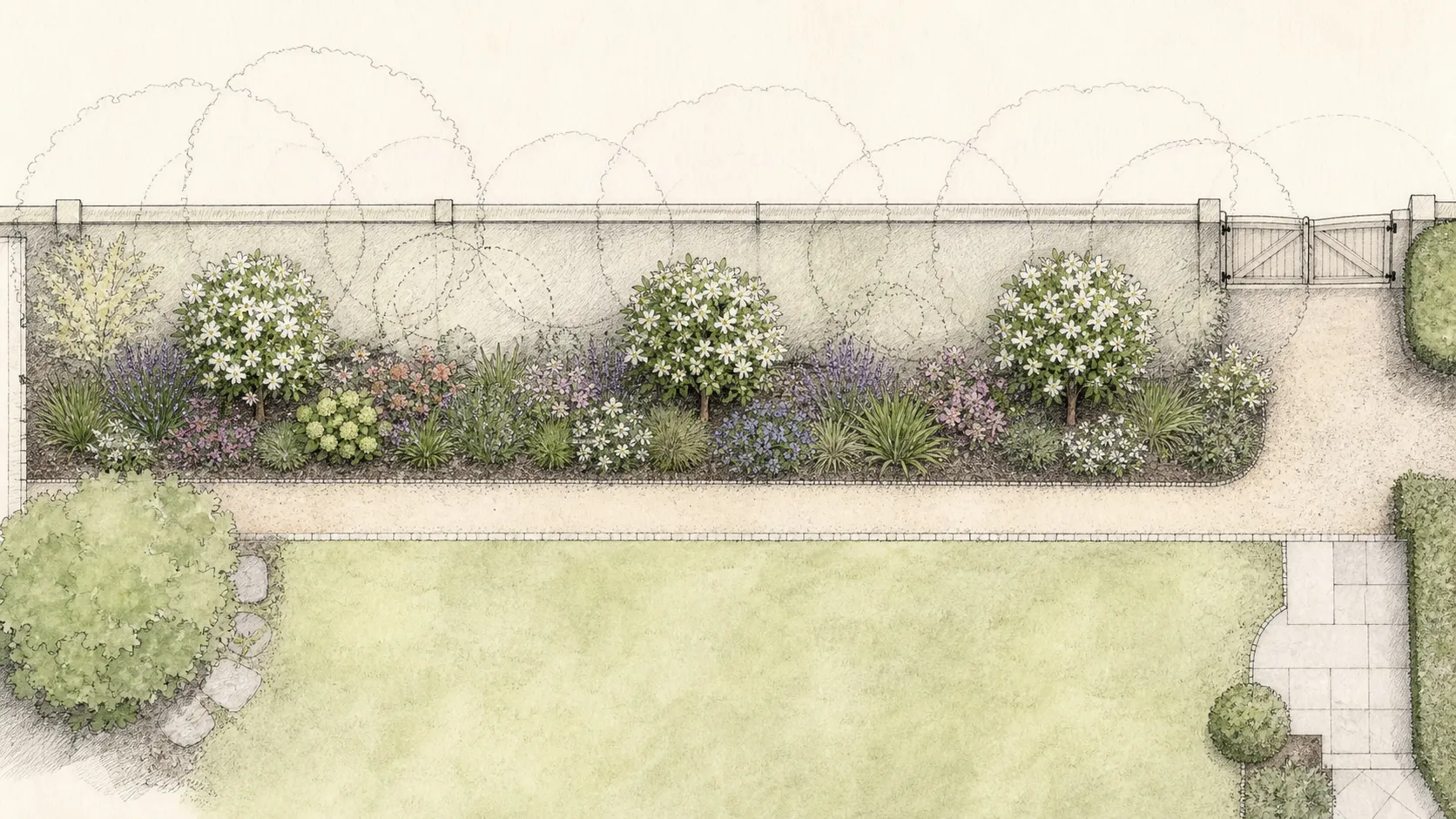
Follow the natural grade and preserve surface drainage. A hedge should not create a dam. The finished work must allow repeated structural shrubs hold a coherent hedge through gaps between seasonal features. Weather and new growth can clarify mature width, bloom time, fruit, winter stem structure, drainage, sightlines and the route for selective pruning during a measured pause.
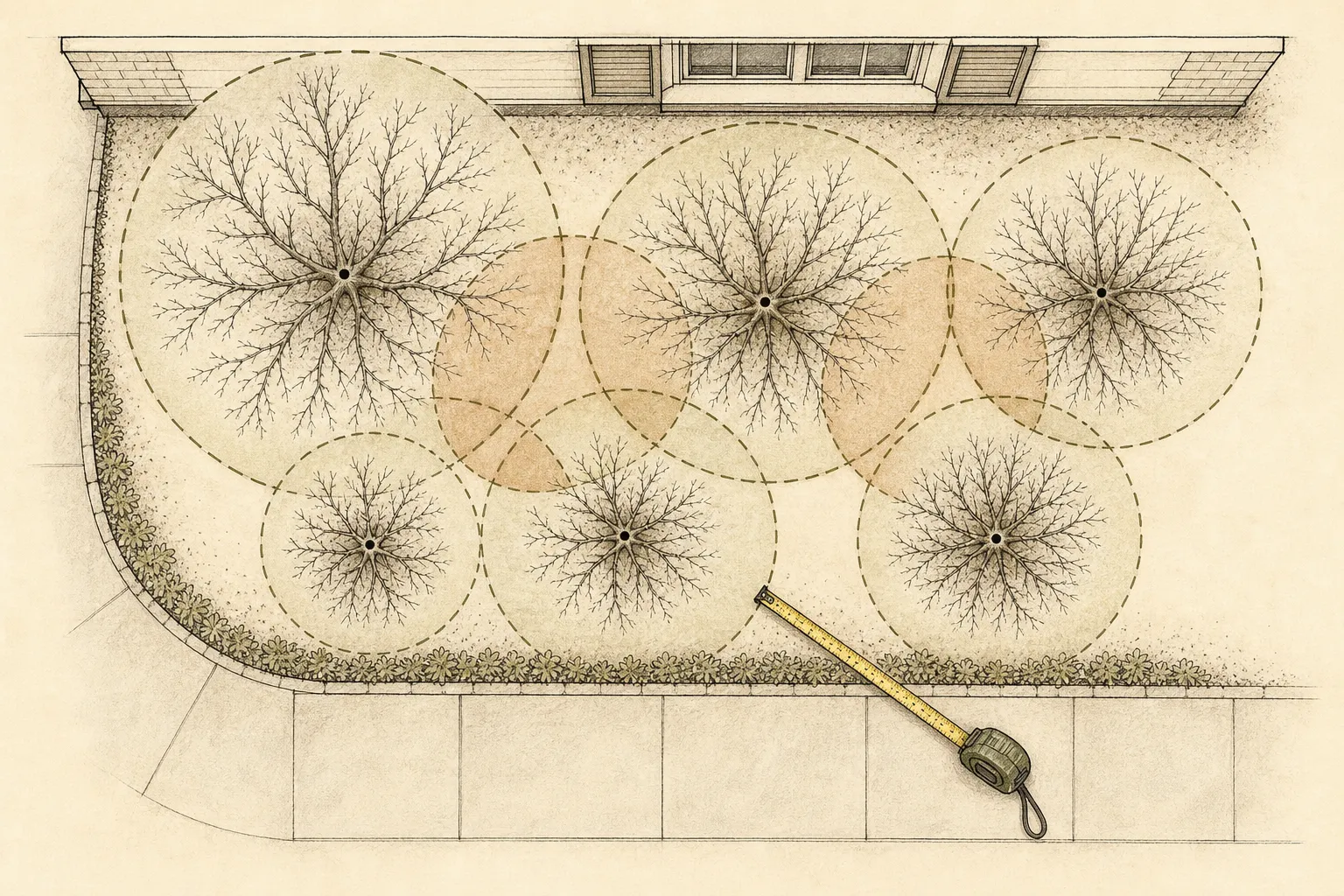
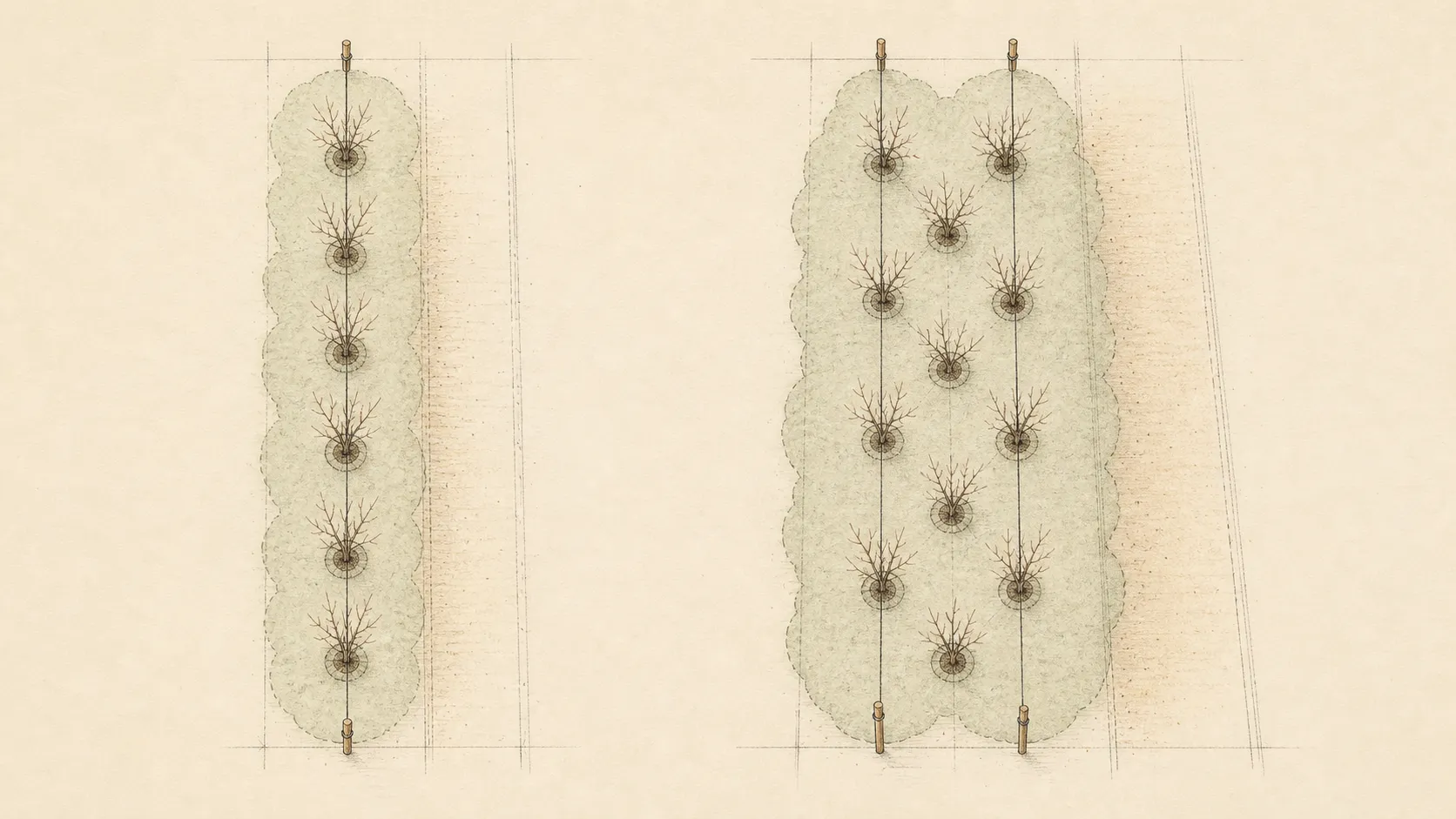
Measure utilities, eaves, pavement, drainage, property lines, and the route a gardener will use behind or within the hedge. Draw mature circles or ovals at scale, not nursery-pot dots. Utah State emphasizes mature height and width because a shrub forced under an awning or into a walk becomes a permanent pruning conflict. Leave clearance for meters, gates, and utility work without assuming branches can be held at a sharp wall indefinitely. A maintenance strip also protects wet soil from repeated foot traffic near the crown.
Keep municipal sight-triangle and utility rules with the drawing. A shrub that fits horticulturally may still be prohibited beside a drive, corner, easement, or service panel. Confirm those limits before setting centers, because later clearance pruning can destroy both flowering and the intended repeated rhythm.
Recheck nursery substitutions against the scaled plan before accepting delivery. A different cultivar name can change mature width, fruiting, and pruning response enough to break the sequence.
Build one elevation from mature outlines
Draw every shrub at credible mature height and width. Nursery size is irrelevant to final overlap. Separate seasonal timing from cosmetic urgency. The useful window is when the full boundary can be measured before spring planting and existing vegetation leafs out.
Repeat a structural species or closely related form at intervals. Repetition unifies the mixed sequence. Compare that setting with mature width, bloom time, fruit, winter stem structure, drainage, sightlines and the route for selective pruning.
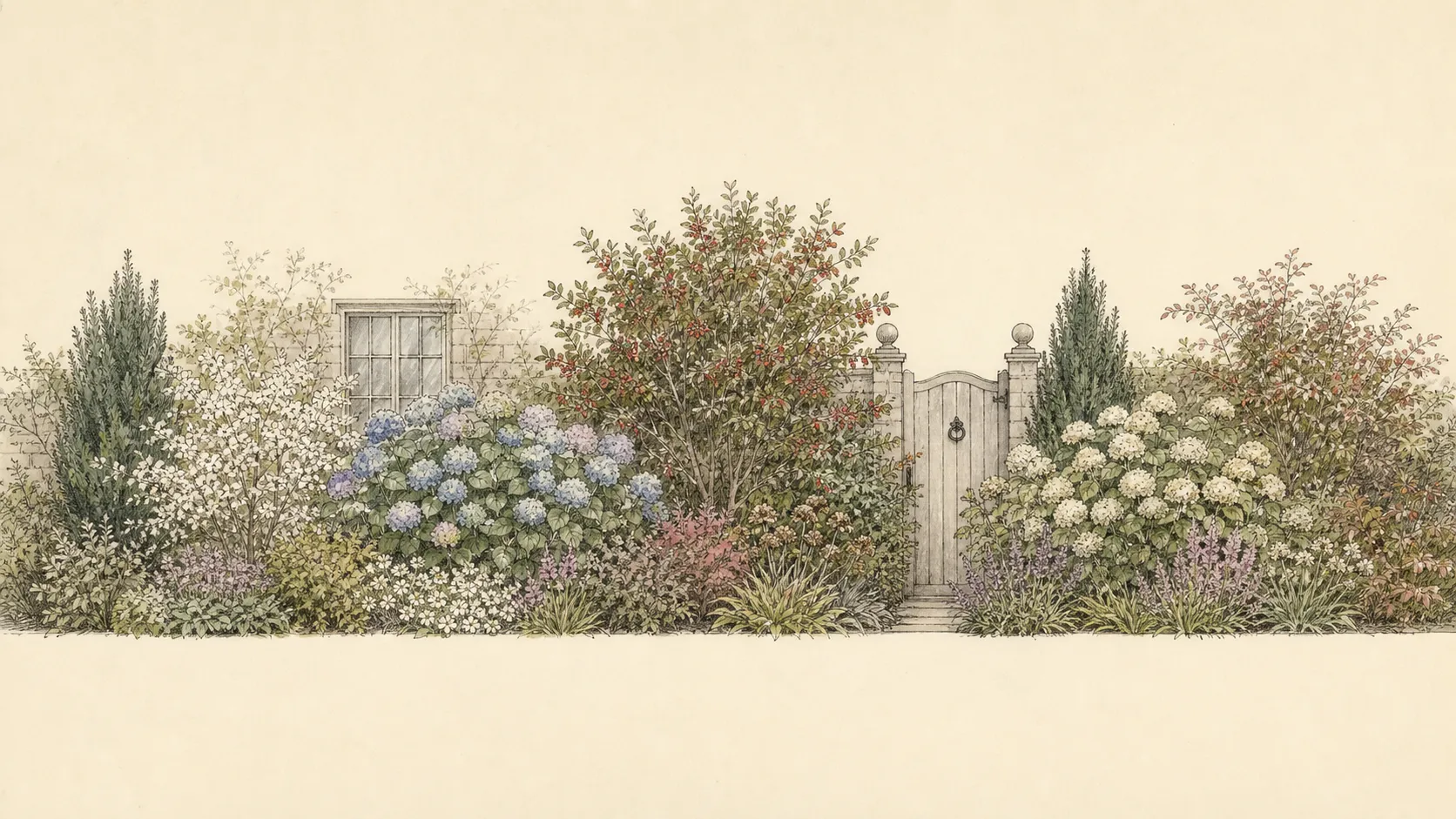
Keep windows and gates framed by lower forms, not annual heading. Let genetics protect clearance. Stop once repeated structural shrubs hold a coherent hedge through gaps between seasonal features.
A side elevation reveals gaps that a plan view misses. Plot the expected mature height of each repeated anchor and seasonal shrub, then check whether the line still screens at seated and standing eye levels. Use foliage density, branch habit, and winter outline as well as height. Staggering centers can create depth on a broad boundary, while a narrow property line may need a single row of naturally upright cultivars. Reject any selection whose unpruned width reaches the house, road sightline, or neighbor's access.
Test the elevation in winter as well as summer. Deciduous shrubs lose visual mass after leaf fall, and an evergreen anchor may cast shade onto its neighbors as it widens. Draw the lowest branches and expected snow or fruit load, then look from both sides of the boundary. A hedge that must be equally opaque at ground level and six feet high may need more depth or a second staggered row. Where only view filtering is required, deliberate gaps reduce plant count and improve access.
Mark the mature centerline with stakes before planting and view it from both properties. This confirms that the planned canopy remains inside the agreed boundary.
Sequence seasons without chasing continuous bloom
Assign spring flower, summer flower, autumn fruit or foliage and winter structure to different shrubs. Overlap is useful but not mandatory. A four-season hedge does not require every shrub to bloom continuously. Repeat a dependable structural species, then place seasonal shrubs where their mature width, bloom window, fruit, and maintenance access fit the measured boundary.
Use foliage texture and branching to carry weeks without flower. A hedge is not a perennial border. Record mature width, bloom time, fruit, winter stem structure, drainage, sightlines and the route for selective pruning before the work begins.
Confirm fruiting requirements and whether berries fit the site. Some plants need compatible pollination partners. Account for boundary length, exposure, root space, regional shrub performance and maintenance access define the composition.
Build a seasonal sequence with distinct peaks, not an impossible promise of uninterrupted bloom. A fothergilla-like spring shrub can combine flowers with autumn color; a smooth-hydrangea-like group carries summer; a verified viburnum may add fruit and fall foliage. Repeated evergreen or twiggy deciduous anchors keep the line coherent between those events. Check fruiting and pollination needs before relying on berries. Winter interest can also come from bark and branch structure, reducing the pressure to fill the boundary with dense evergreens.
Make root-zone requirements agree
Group shrubs with compatible drainage and establishment water. Irrigation cannot satisfy wet- and dry-site plants in one line. One irrigation line cannot reconcile a waterlogged pocket with a dry slope. Map drainage and root competition along the run, then group shrubs that can share establishment watering and long-term soil conditions.
Account for neighboring tree roots and roof shadows. Long boundaries contain several microclimates. Use mature width, bloom time, fruit, winter stem structure, drainage, sightlines and the route for selective pruning to decide whether the task is corrective, preventive, or unnecessary. That distinction controls timing and scale.
Use a soil test for pH or nutrient decisions. Use a continuous root-zone treatment across shrubs with compatible soil needs. Keep gates, sightlines, utility clearances, and a rear maintenance strip fixed on the plan. Match each shrub to those limits at mature size so selective renewal pruning remains occasional, not a permanent size-control campaign.
Finish make root-zone requirements agree by testing access as well as appearance. The planting should remain reachable for watering and inspection while repeated structural shrubs hold a coherent hedge through gaps between seasonal features.
Survey moisture after rain along the entire run. Downspouts, compacted corners, tree roots, and slopes can create several root environments within one apparent bed. Group shrubs with compatible drainage and establishment water, and route runoff before planting. Use a soil test for pH or nutrients when a chosen shrub has a narrow requirement. Avoid enriching each hole into an isolated pocket; roots eventually leave it. Mulch the continuous bed lightly while keeping every stem base visible and irrigation adjustable by zone.
Use a bounded worked composition
For a sunny Mid-Atlantic example, repeat compact inkberry-like evergreen anchors at thirds of the run. Verify local cultivars and sex where relevant.
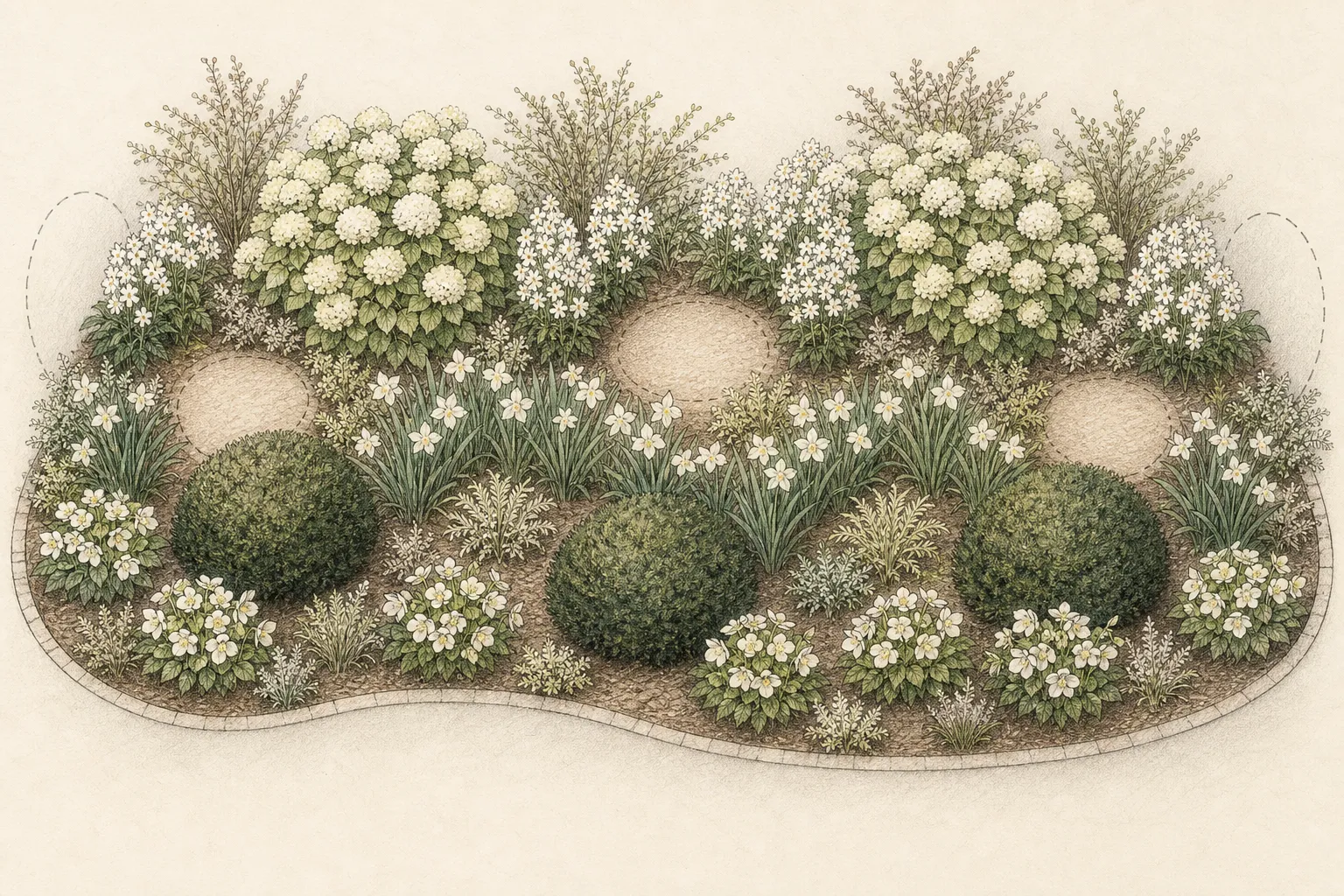
Place a fothergilla-like spring shrub and smooth-hydrangea-like summer group between anchors. Preserve each mature outline.
Use a viburnum-like autumn fruit and foliage shrub only with regional noninvasive guidance and pollination needs resolved. Substitute locally. Include mature width, bloom time, fruit, winter stem structure, drainage, sightlines and the route for selective pruning.
For a sunny Mid-Atlantic example, repeat compact inkberry-type anchors at thirds of a measured run, subject to cultivar sex and local disease guidance. Place a fothergilla-type shrub for spring and fall, a smooth-hydrangea-type group for summer, and a locally noninvasive viburnum-type shrub for autumn fruit. This is a functional diagram, not a universal shopping list. Resolve exact mature widths, pollination, deer pressure, and soil before selecting cultivars, and preserve a clear route for selective pruning behind the composition.
On a 36-foot run with clear access at both ends, three repeated anchors can establish a nine-to-twelve-foot rhythm, but exact centers come from cultivar widths. Place seasonal shrubs between those centers only if their mature canopies can touch lightly without engulfing the anchors. Keep the hydrangea-type group in the moister sector and the fothergilla-type shrub where its autumn color receives light. This calculation is illustrative; scale the run and calculate quantities again after local cultivars are selected.
Fruiting shrubs add another dependency. Some viburnums require genetically compatible plants with overlapping bloom, and several widely sold species are invasive in parts of North America. Confirm both pollination and current regional status before assigning fruit as the autumn feature. If a suitable fruiting shrub is unavailable, use a noninvasive shrub with persistent foliage, seedheads, or strong fall color for the same seasonal role. Add a compatible pollinator plant only when its mature width fits the measured boundary.
Plant and maintain the rhythm
Set centers from mature spread and stagger only where depth permits. Dense instant screening creates future congestion. Track mature width, bloom time, fruit, winter stem structure, drainage, sightlines and the route for selective pruning.
Use selective post-flowering or dormant cuts according to each species. One hedge-wide shearing date will sacrifice some flowers.
Review gaps, access and winter structure annually. Replace failed site matches before forcing neighbors to fill unnaturally.
Plant at the correct depth and water the full root balls through establishment, then let each shrub develop its natural outline. Maintenance follows species biology. Spring-flowering shrubs are generally renewed after bloom; smooth hydrangea responds to a different schedule because it flowers on new growth. Illinois Extension warns that hedge shears create a dense outer shell and reduce interior flowering. Record each shrub's bloom window and renewal method, remove selected old stems where appropriate, and keep the repeated framework visible, not clipping every species on one day.
Establishment should be staged along the run so watering and inspection remain practical. Water each original root ball deeply, compare moisture with surrounding soil, and expand intervals as roots grow outward. Replace ties and guards before they abrade stems, and remove temporary supports when their job ends. During the first three years, record survival, actual width, bloom, fruit, and winter structure by shrub. Use that evidence to adjust selective renewal, not to impose a tighter hedge line. If one species repeatedly needs more water or pruning than its neighbors, replace that role with a better-matched shrub before the conflict spreads through the boundary.
Before ordering, total the quantities from the scaled plan and compare them with the maintenance budget. Fewer correctly sized shrubs usually establish a clearer rhythm than extra plants destined for removal. Keep a copy of the final cultivar list with mature dimensions and pruning notes.
Review the hedge at leaf-out, peak flowering, autumn fruit or color, and midwinter. Measure gaps and overlaps from the same points, then compare them with the scaled mature plan. A temporary young-plant gap needs time; a branch entering a gate or utility clearance needs selective correction. Record which shrubs flowered before making the next pruning schedule, and note whether fruiting pairs overlapped in bloom. If one seasonal feature disappears, change only that role after confirming the framework remains coherent. This four-visit record prevents one dramatic bloom or one bare week from driving a full hedge redesign.
Design ideas
- Style
- informal mixed ornamental hedge
- Space
- residential boundary or long foundation edge
- Climate
- The worked example is for a temperate Mid-Atlantic residential boundary with sun to light part shade, draining soil and an eight-foot maximum where no utility conflict exists. Every shrub must be reselected for local hardiness, invasive status, heat, deer pressure and mature dimensions. The named examples are functional placeholders, not a national palette. Confirm regional hardiness, current invasive status, fruiting requirements, deer pressure, mature size, and whether each shrub flowers on growth formed this year or earlier.
- 1Map the boundary
Measure the full run, mark permanent no-plant zones and reserve a continuous maintenance strip plus an unobstructed drainage route. Draw the hedge to scale and include trunk centers, mature canopies, gates, meters, windows, drainage paths, and an access strip. A measured drawing reveals where the boundary is too narrow for shrubs before purchase.
- 2Structural repeat
Use one locally suitable compact evergreen or durable deciduous framework shrub at repeated intervals, sized below utilities and windows. Repeat the framework shrub often enough to connect the composition after flowering shrubs go quiet. Its natural mature height must sit below wires and windows because annual shearing is not a substitute for suitable scale.
- 3Spring feature
Insert a fothergilla-like spring-flowering shrub with compatible mature width, fall color and site needs, or a locally documented equivalent. Place the spring shrub where its flower buds will not be removed by winter clipping. Fothergilla also contributes autumn color, so a locally suitable substitute should carry at least two seasonal jobs.
- 4Summer feature
Use a smooth-hydrangea-like group only where drainage, light and new-wood pruning practice fit the boundary. Smooth hydrangea flowers on current-season stems, while other hydrangeas respond differently. Keep this group in compatible moisture and record its own pruning window, and keep treatments species-specific.
- 5Autumn feature
Choose a viburnum-like fruit and foliage shrub after checking pollination, invasive status, mature scale and fruit use near paths. Check whether the selected viburnum needs a compatible pollinator and whether it is restricted locally. Set fruiting branches back from narrow walks where dropped fruit or wildlife activity would conflict with passage.
- 6Winter structure
Let repeated framework, branching and selected stem color hold the hedge after leaf fall, while evergreen density remains secondary. Winter interest can come from repeated branching, persistent fruit, bark, or selected young stems. Use those features at deliberate intervals so the leafless hedge still reads as one boundary.
- 7Species-specific pruning map
Record whether each shrub sets flower buds on previous-season shoots or on new growth, then assign its own renewal method, not one hedge-wide clipping schedule. Give every shrub a row on the maintenance map with its bloom period and renewal method. Spring-flowering shrubs are generally renewed just after bloom; indiscriminate hedge shearing suppresses flowers and shades interior growth.
- 8Regional substitution rule
Preserve seasonal jobs, repetition and mature geometry while replacing every example with locally proven noninvasive shrubs where necessary. Substitutions must preserve mature geometry and seasonal function, not merely flower color. Compare the replacement's width, soil, light, pollination, regional status, and pruning response before changing the plan.
Related reading
Sources
- Choosing Shrubs for Your Garden. Penn State Extension. Source record · Accessed 2026-08-30.
- Shrub Selection for Utah Landscapes. Utah State University Extension. Source record · Accessed 2026-08-30.
- Pruning Spring Flowering Shrubs. University of Illinois Extension. Source record · Accessed 2026-08-30.