Grow · bare branch shrub spacing audit
Audit Shrub Spacing While Branches Are Bare
Use leafless structure to compare mature shrub spread with paths, walls, windows, and neighboring crowns before another growing season hides the conflicts.
Published Last updated
In this guide
- Inspect branch structure and spacing after leaf fall
- Map mature spread against walls, walks, and windows
- Read branch traffic and interior crowding, not just footprint
- Compare shrub-to-shrub overlap and the lost maintenance strip
- Decide whether pruning, moving, or removal is the right fix
- Work one bounded example before rewriting the whole border
- Record the decision before leaves return and rewrite the evidence
- Mark which shrubs to retain, move or prune
- Steps
Inspect branch structure and spacing after leaf fall
A leafed-out shrub can look lush enough to hide its own spacing mistake. Winter removes that disguise. Once the foliage has dropped, you can see the actual scaffold, the branch angles that will load with leaves again, and the distance between the woody frame and the wall, path, or neighboring crown it will soon press against. That is why the audit belongs now. The shrub is showing structure instead of giving you a summer illusion of fullness.
This is also the easiest season to separate branch architecture from ornamental effect. A shrub may have beautiful flowers in May yet still be blocking a window head, scraping a walk in rain, or crushing the maintenance strip behind it. When the branch framework is visible, you can evaluate those problems directly. The task is not to decide whether the shrub is attractive. It is to decide whether its mature width and position still agree with the garden's use.
Winter truth is especially helpful because it is quieter. The gardener is not distracted by bloom, pollinators, or the temporary abundance of new growth. You can compare the current woody outline with the documented mature spread from the plant tag or reference source and ask a blunt question: can this shrub ever reach a normal adult size here without permanent conflict? That question is much harder to answer honestly when the shrub is covered in leaves.
Map mature spread against walls, walks, and windows
Mississippi State and UGA make the same foundational point in different ways: mature size means both height and spread, and spacing decisions made at planting time save future labor and replacement cost. Use that logic in reverse for an audit. Start with the mature spread you should have planned for, then compare it with the distance from the shrub's center to the nearest path edge, wall, window line, or neighboring plant center. A winter map makes those geometry problems visible before another season of growth compounds them.
The most useful map is brutally simple. Draw the hard edges first. Add the shrub centers as they currently stand. Then draw each mature footprint as a circle, oval, or species-appropriate canopy shape using the larger plausible spread, not the smaller one you hope the plant might accept under pruning. If a shrub is expected to mature 5 feet wide, its center must sit at least 2.5 feet from a hard edge before you add any extra clearance for arching stems, pedestrian width, or service access.
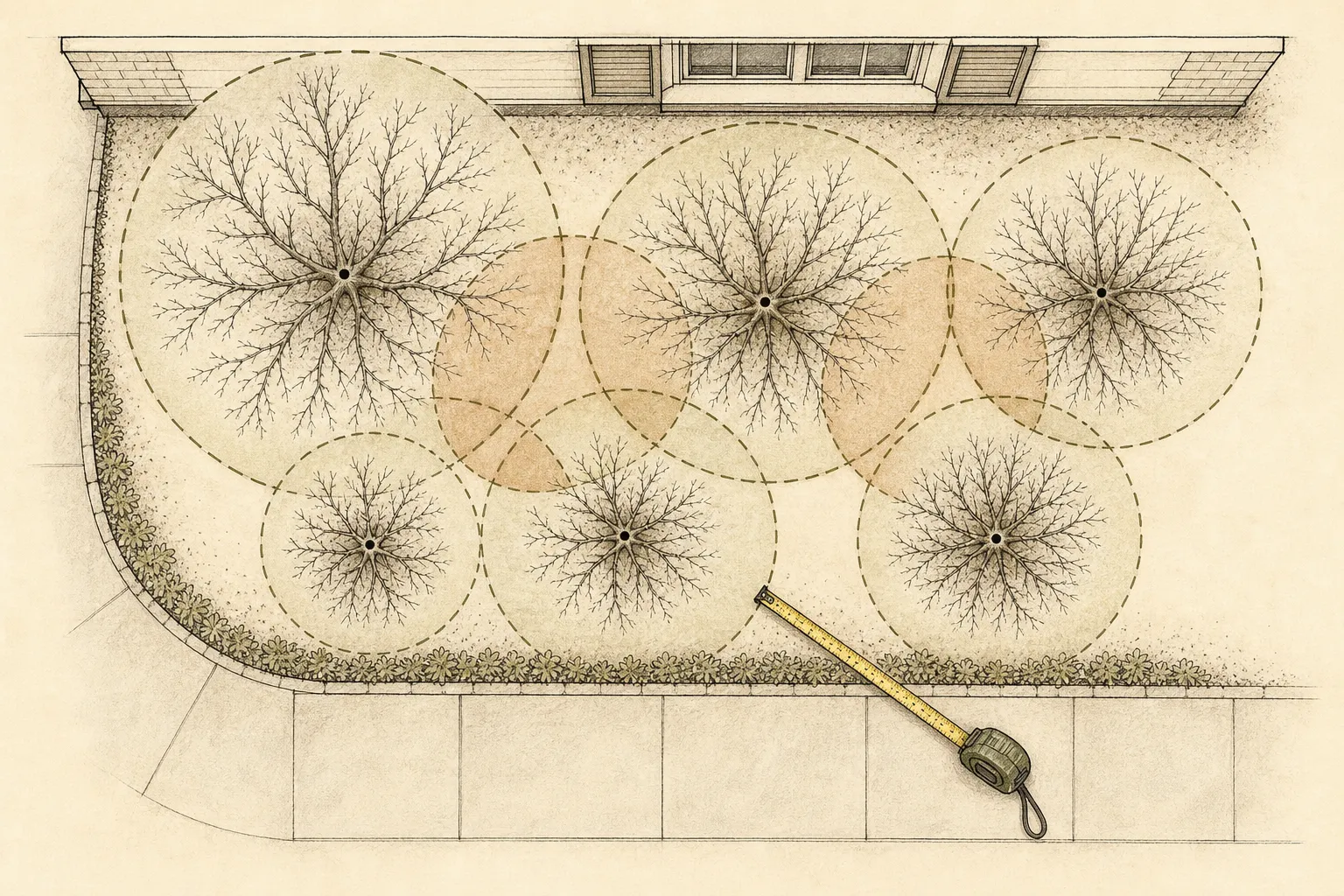
Window lines deserve the same discipline. The fact that a bare shrub sits below a sill in January does not mean it will respect that sightline in June. Draw the mature height and lean of the branch structure, not just the height of the current stems. A spacing audit that ignores the vertical window zone often produces one more year of reactive summer shearing rather than one clean structural decision.
Read branch traffic and interior crowding, not just footprint
Spacing problems do not appear only at the outer edge. They show inside the shrub too. Bare branches make it easy to see rubbing stems, inward-facing congestion, and dark interior wood that receives little light because the plant has been forced into too small a space. A shrub can technically fit between two lines on a plan and still be functionally overcrowded because every season's growth is pushed back into itself. That is not a beauty issue. It is a maintenance and health issue.
Walk the routes the shrub meets. Brush past it with a coat on. Open the gate it flanks. Stand at the window it shades. Reach behind it as if you needed to clear leaves from a drain or adjust irrigation. These physical checks often reveal a conflict the plan alone misses. Branches that barely clear a path in dry winter weather may lean well into that space when laden with spring leaves or summer rain. The audit needs to anticipate the plant's occupied space, not just its dormant outline.
Look for asymmetry caused by the site rather than the cultivar. Reaching toward light, flattening against a wall, and one-sided dieback each suggest that the shrub's position is already wrong for its mature habit. If the plant is expressing that conflict in bare wood, no amount of seasonal clipping will make it truly at home. The winter audit is the moment to recognize when form distortion is evidence, not personality.
Compare shrub-to-shrub overlap and the lost maintenance strip
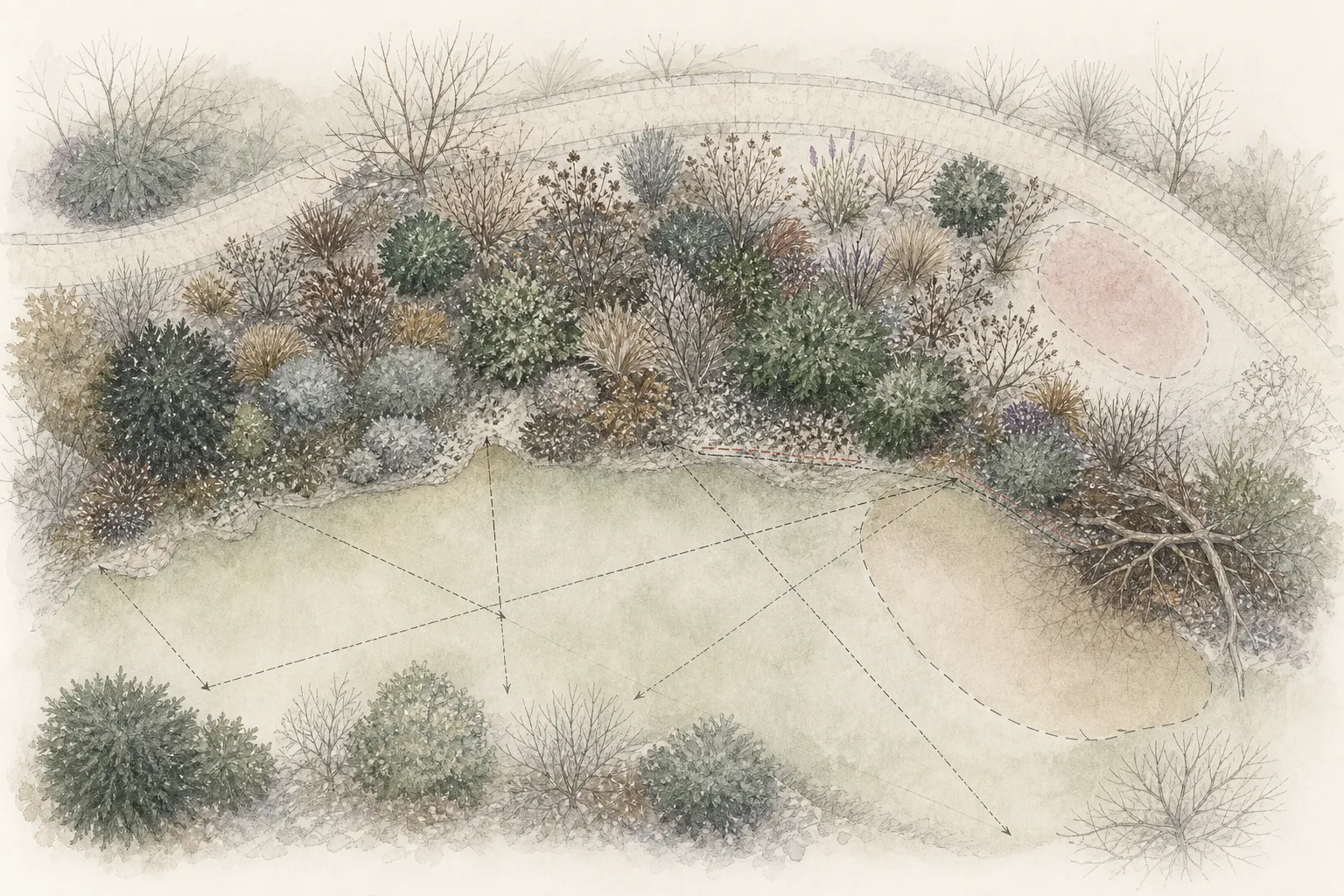
Two shrubs can each be correctly sized for a site and still be badly spaced relative to one another. The leafless season makes their future collision easier to project because you can see which plant already occupies the shared airspace and which one is being forced upward or sideways. Draw both mature outlines and then mark where a human hand, pruners, or a hose line should still fit between them. If that service strip has disappeared on paper, it will certainly disappear in leaf.
This matters most at foundations and front walks, where the original planting often looked tidy because nursery shrubs were small and evenly spaced. Years later the gap that once held mulch, airflow, and access has become a thicket of competing branch tips. The audit should identify whether one shrub is truly misplaced, whether both are too close, or whether the intended effect was a hedge that should be managed as one continuous mass instead of several unrelated specimens still treated individually.
Do not let sentiment protect an impossible pairing. A beloved shrub may still be the wrong neighbor for another beloved shrub if their mature habits cancel each other. Winter gives you the cleanest chance to see the overlap without foliage theatrics. One plant may deserve the position more than the other because it anchors the view, suits the soil better, or offers year-round structure the other does not. Spacing decisions are easier when the woody evidence is stripped down.
Decide whether pruning, moving, or removal is the right fix
Not every spacing problem is solved the same way. Selective structural pruning is appropriate when the shrub fundamentally fits the site but contains a few competing stems, a blocked sightline, or one branch line that has developed poorly. Moving is appropriate when the plant is still young enough to transplant well and the problem is mostly positional. Removal is appropriate when the mature width simply has no honest home in the current spot and repeated size control would turn the shrub into permanent maintenance debt.
Winter helps separate these categories because you can see how much of the plant is conflict and how much is sound framework. If removing three stems restores light, access, and a balanced scaffold, pruning may be enough. If the entire crown sits too close to a wall or every branch heads straight through a walkway, the site is wrong, not the branch selection. The audit should preserve the difference between a branch problem and a placement problem.
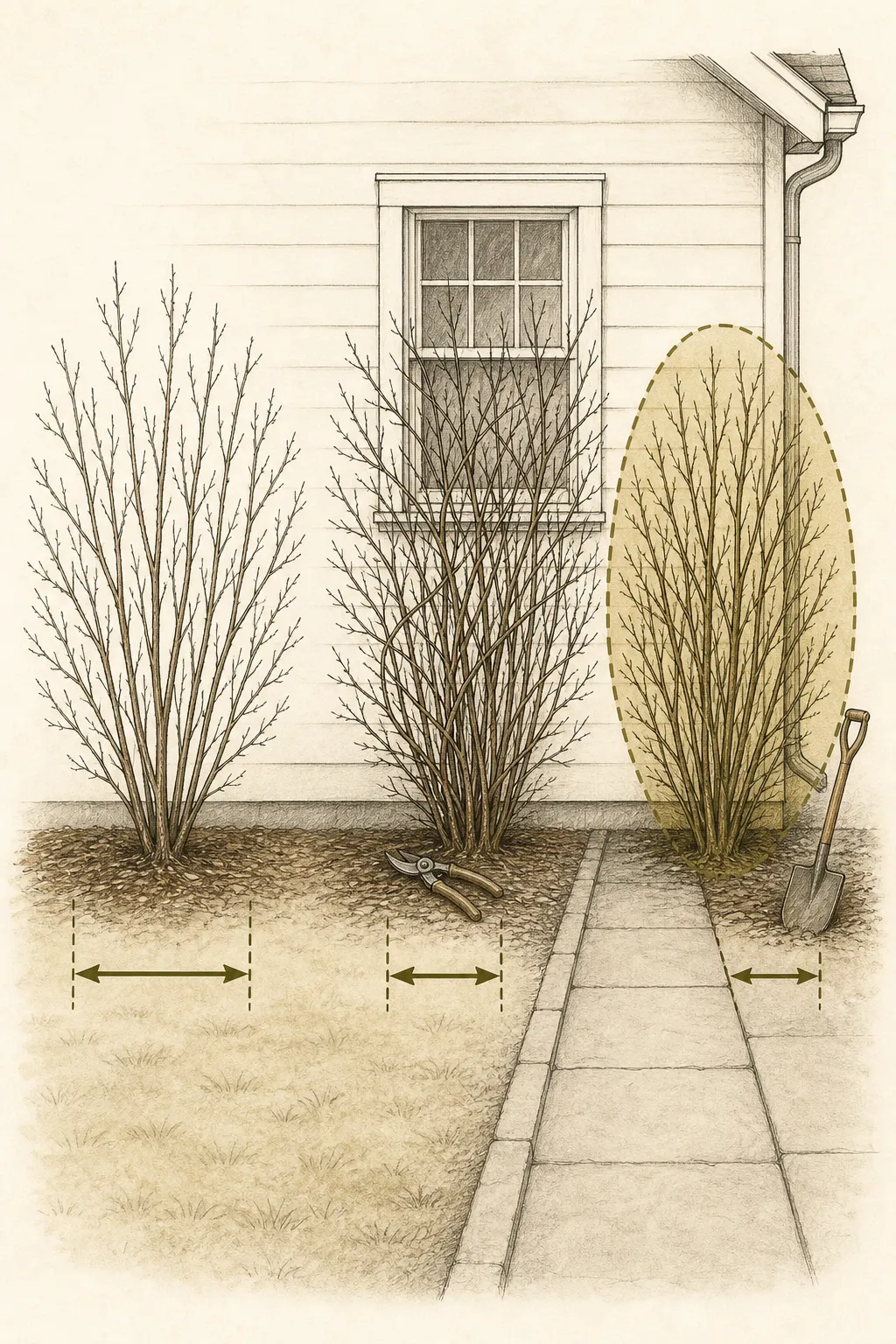
This is where plant age and replacement cost come in. A young shrub that is already colliding with a path often deserves relocation before it becomes harder to move. A large aging shrub crammed under a window may be better replaced with a plant whose mature spread matches the space. The audit is not anti-pruning. It is anti-fantasy. It should tell you whether pruning maintains a sound design or merely disguises a mistake for one more year.
Work one bounded example before rewriting the whole border
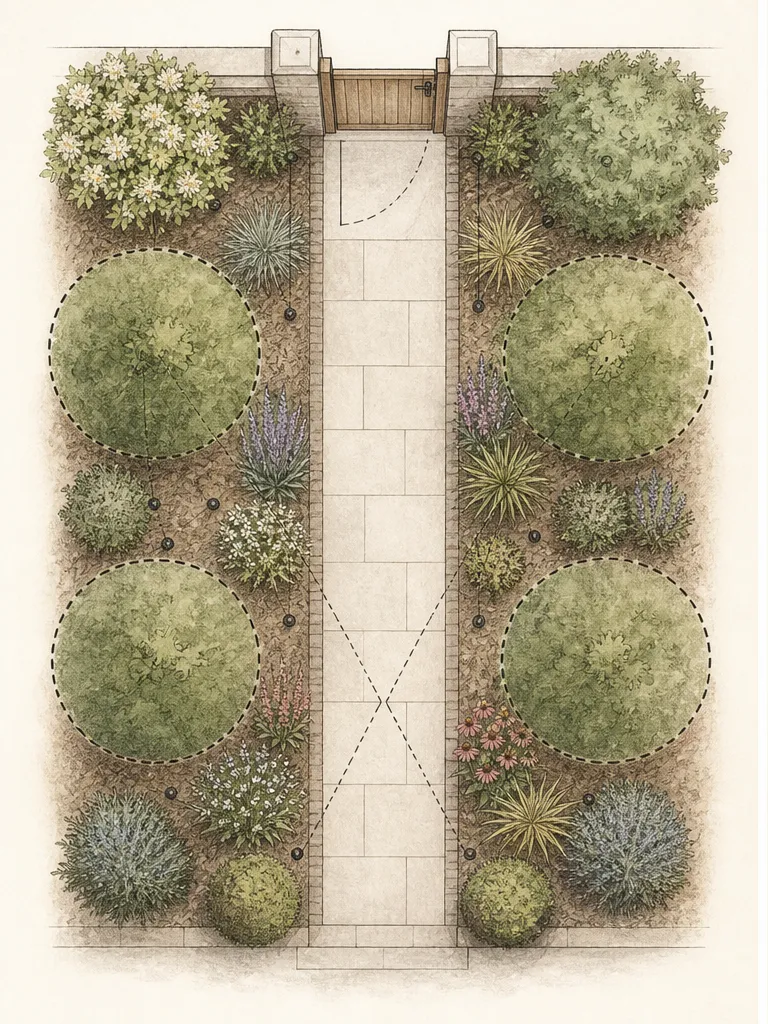
Imagine a 5-foot-wide deciduous shrub centered only 2 feet from a front walk and 3 feet from a paired shrub of similar vigor. On paper alone the problem is already visible: the walk steals half a foot of the mature footprint before rain-loaded stems and pedestrian clearance are even considered, and the two shrub outlines are destined to overlap. In leaf, that planting will never look spacious. In winter, the branch lines show the collision beginning.
The bounded fix might be to keep the shrub that anchors the composition, move the younger paired shrub outward while dormant if the species tolerates it, and selectively thin the retained shrub to remove the few branches already crossing into the walk. That is a three-part correction with one clear purpose: restore one honest footprint to each shrub and give the path back its dry edge. It is not a broad vow to prune everything harder next summer.
A worked example matters because it converts a vague design anxiety into a measurable decision. Once one shrub pair has been corrected on paper, the rest of the property can be audited the same way: center, mature spread, path or wall offset, overlap, and service strip. Winter is the only season when you can run that logic cleanly across many woody plants without constantly mistaking temporary foliage for permanent capacity.
Record the decision before leaves return and rewrite the evidence
Finish the audit with a marked plan and fixed-view photographs. Label which shrubs are being thinned, which are being moved, and which are scheduled for replacement. Add the mature dimensions that justified the choice. Without that record, spring enthusiasm can erase the whole audit and restore the old cycle of reacting to crowded foliage instead of acting on winter evidence. The point is not merely to notice the problem. It is to preserve a decision clear enough to survive the next burst of growth.
When leaf-out begins, compare the same views again. If the winter judgment was correct, the shrub should occupy the predicted space and the route or window should remain clearer with much less improvisation. If it does not, revise the map, not just the shears. A spacing audit is successful when it reduces recurring corrective work and helps the shrub grow closer to its natural habit, not when it produces one briefly tidy dormant picture.
Keep the audit modest and repeatable. One honest spacing correction can improve the whole border more than a flurry of unrecorded cuts. Winter gives the evidence; the record keeps that evidence from disappearing. Once the branches leaf out again, you should be looking at a shrub system whose future shape is easier to trust because its spacing was judged when nothing could hide it.
Mark which shrubs to retain, move or prune
Draw one line for the space the shrub may occupy and a second for the clearance the path, window, or neighboring crown must retain. A shrub that can stay within its line through selective pruning is a maintenance candidate; one whose mature framework already crosses required clearance is a moving or replacement candidate.
Photograph the bare framework with a measuring rod in view and record the decision before leaf-out. Repeat the photograph in summer. The pair shows whether the winter judgment protected circulation and plant form or whether foliage simply concealed the same conflict.
Check vertical clearance as well as footprint. Branches below a window, eave, light, or gate can create a conflict even when the crown fits neatly on the plan. Mark the height at which the obstruction begins and compare it with the shrub's natural mature habit. Repeated heading cuts made to hold a tall cultivar below a fixed feature usually signal a plant-selection problem, not a pruning challenge.
Separate temporary contact from structural overlap. Flexible outer twigs that brush after a season of growth may need selective thinning, while main stems crossing a path edge or neighboring trunk indicate that the permanent framework has run out of room. Record which kind of conflict you observed so the eventual work matches the evidence.
Schedule moves for the suitable dormant or planting season in your region and prepare the destination before lifting anything. The audit decides what should change; it does not make frozen, saturated, or otherwise unsuitable soil safe for transplanting. Confirm underground utilities before digging and protect neighboring roots that are meant to remain.
Steps
- Level
- easy
- Time
- One measured winter walk-through plus a follow-up check at leaf-out
- Tools
- Measuring tape, Printed mature-size references or plant tags, Notebook or site plan, Pruners only after the audit is complete
- Materials
- Temporary marking paint, stakes, or hose for mature spread outlines, Weatherproof labels for shrubs under review, Replacement shortlist if one or more shrubs clearly cannot fit
- 1Choose the leafless inspection window
Walk the shrub border after leaves have dropped but before spring growth hides the framework again. Photograph the route, windows, walls, and the shrub group from the same fixed points you will use later.
- 2Map each shrub by mature spread
Record the plant centers and draw the full adult width of each shrub against paths, walls, windows, and neighboring plants. Use the mature spread from a reliable source, not the current nursery-sized footprint.
- 3Inspect internal branch crowding
Look for rubbing stems, flattened sides, and dark congested interiors that show the plant is being forced back into itself. Check the path and service strip physically, not just visually.
- 4Mark overlap and lost access
Identify where two shrubs are converging and where maintenance access has disappeared. Distinguish a true hedge intention from an accidental collision of individual shrubs.
- 5Choose the correct fix class
Use selective pruning only when the plant fundamentally fits the site. Choose relocation when the shrub is still movable and the problem is mainly positional. Choose replacement when the mature width will never fit honestly.
- 6Test one bounded correction
Work one shrub pair or one path conflict through the full logic of center, mature spread, overlap, and service clearance before you generalize the solution across the whole property.
- 7Carry the measured audit into leaf-out
Keep the plan and photos, then compare the same views when leaves return. Measure the remaining path width, check whether windows and lights still clear the crown, and photograph from the original marked position. If foliage exceeds the projected line, determine whether the mature-size reference was wrong, the center was measured incorrectly, or vigorous new growth changed the maintenance expectation. Revise the record before cutting, and date every correction so later growth can be compared against it. A successful winter audit should reduce recurring emergency trimming and make the woody structure demonstrably easier to trust.
Plants in this guide
Related reading
Sources
- 19. Landscape Design. NC State Extension. Source record · Accessed 2026-08-19.
- Proper landscape plant spacing saves time, money. University of Georgia Extension. Source record · Accessed 2026-08-19.
- Home Landscape Design. Mississippi State University Extension. Source record · Accessed 2026-08-19.
- Selecting Landscape Shrubs with Special Comments on Invasive and Native Plants. Mississippi State University Extension. Source record · Accessed 2026-08-19.