Gardens · perennial border winter skeleton audit
Audit a Summer Perennial Border by Its Winter Skeleton
Read paths, woody anchors, stems, seed heads, empty ground, supports, views, and maintenance access in winter to improve a flower-rich border without redesigning it blindly.
Published Last updated
In this guide
- Choose fixed winter viewpoints
- Map what remains when flowers disappear
- Distinguish structure from leftover clutter
- Compare the same view across seasons
- Inspect soil, drainage, and hardscape
- Edit roles before buying plants
- Write a small reversible revision plan
- Translate the audit into one bounded revision
- Design ideas
Choose fixed winter viewpoints
Winter reveals the framework that summer flowers conceal. Begin the audit before cutting stems or moving supports: choose the doorway, main window, path approach, seat, and street view that actually govern how the border is experienced. Mark each standing position on a sketch and take a wide photograph that includes the bed edge, backdrop, and circulation. The aim is not to make January resemble June. It is to see whether the permanent lines, dormant gaps, and retained stems still compose a readable garden.
Record the date, recent rain or snow, sun direction, wind, and how much cleanup has already occurred. A border photographed after half its stems were removed cannot be compared honestly with an untouched summer image. Use the same camera height and frame at spring emergence, peak summer volume, and autumn decline. Fixed views expose changes in scale and access that memory softens, including a shrub that has widened across a path or a support grid that became visible only after leaf fall.
Walk every service route before deciding what winter material deserves to stay. Locate dormant crowns from labels or summer photographs, then mark where feet, wheelbarrows, hoses, and pruning tools can pass without compacting the root zone. Broken stems that whip into circulation, stakes with sharp exposed ends, and cages leaning onto paths are maintenance failures, not winter texture. The first audit sheet should therefore contain three columns: keep for structure, remove for health or safety, and investigate before acting.
Map what remains when flowers disappear
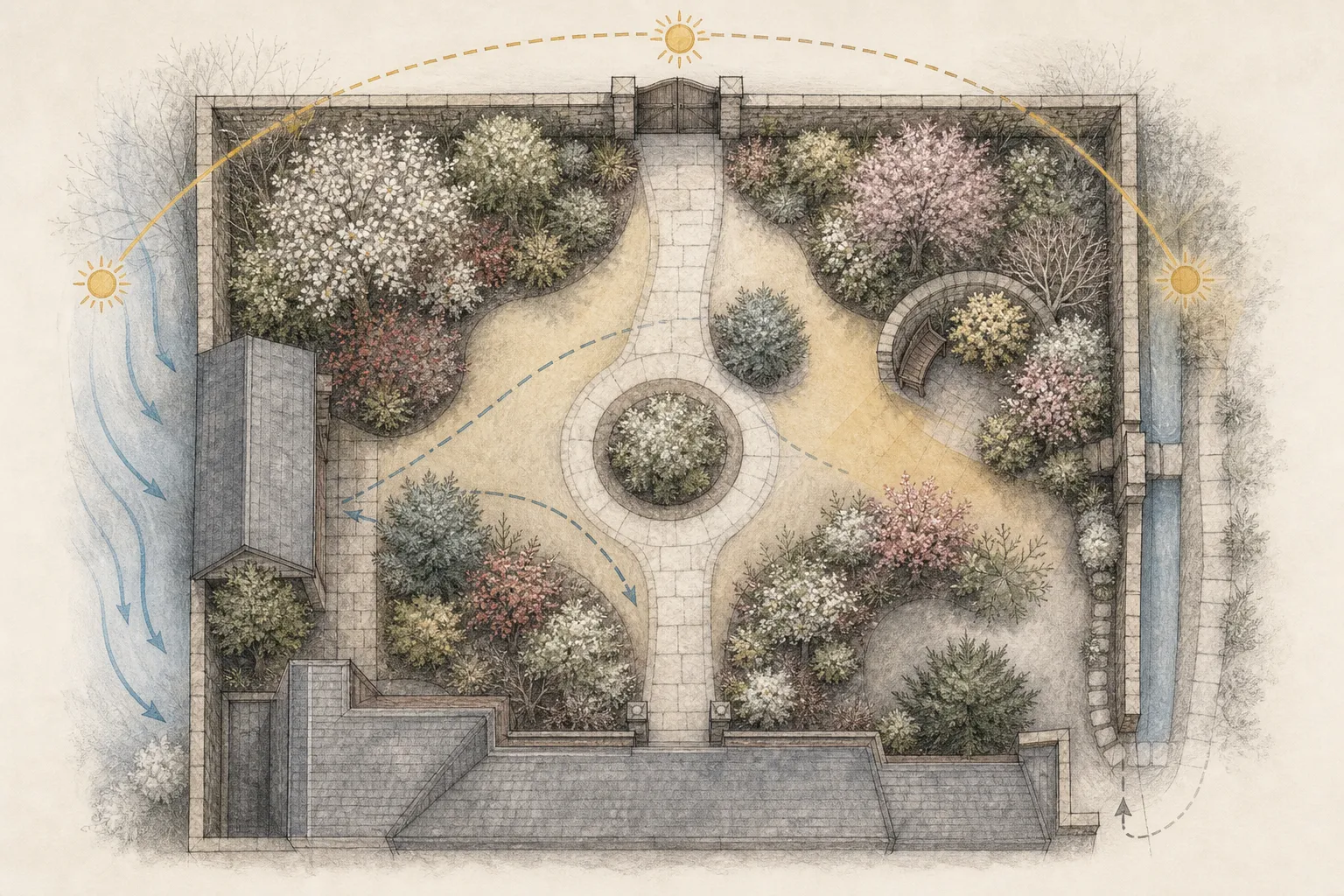
Draw a measured winter base plan showing the path, edging, walls, grade changes, drains, trees, shrubs, evergreen masses, standing grasses, seed heads, supports, and bare soil. Add dormant peonies, bulbs, hostas, and other absent crowns from records rather than treating their positions as empty. NC State's design guidance emphasizes scale, rhythm, balance, and the changing three-dimensional space; the winter map translates those ideas into the parts that are still physically present.
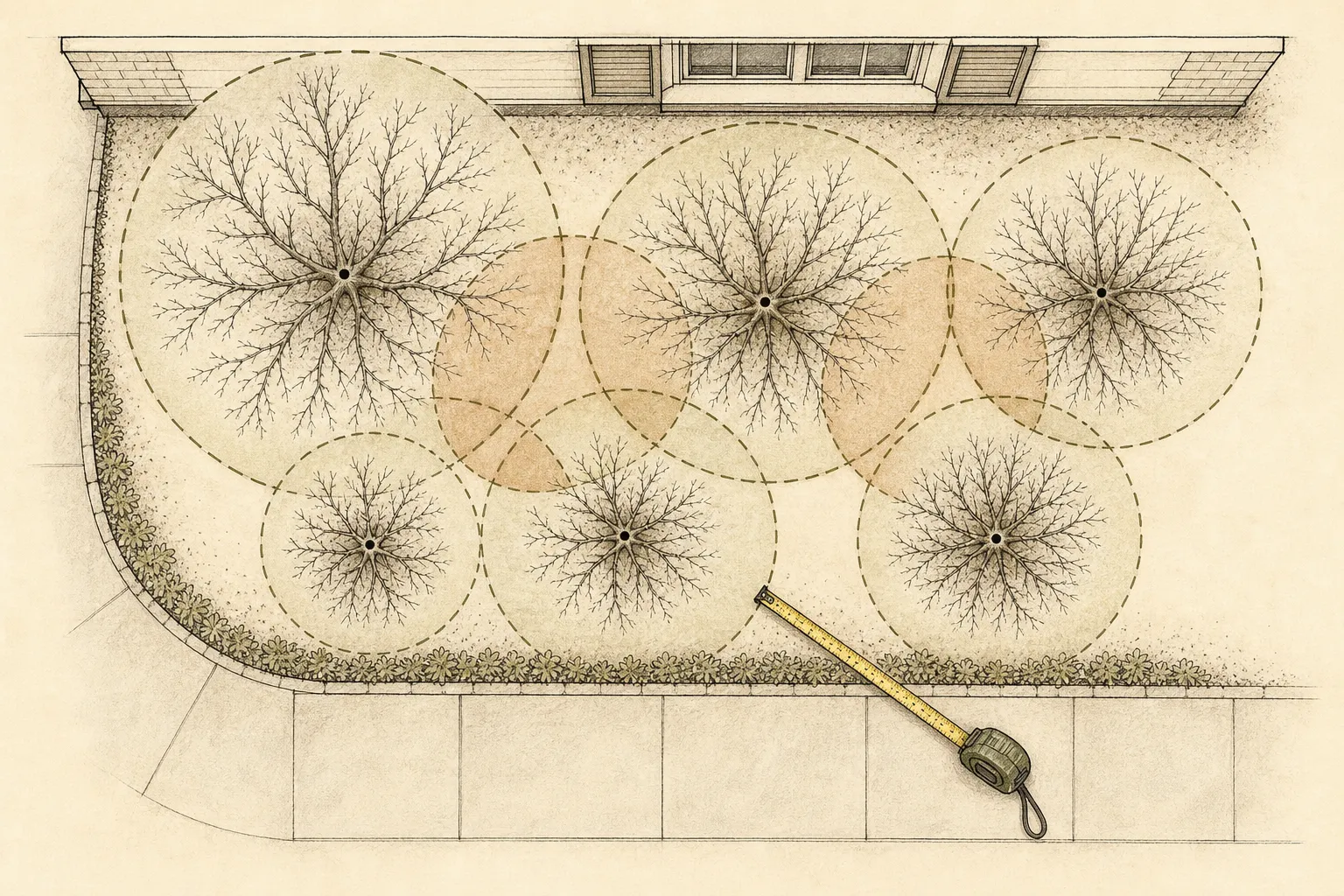
Overlay credible mature widths for every woody plant and persistent grass. Include sucker spread, branches that arch under snow, and the clear space needed to reach a drain or wall. A compact nursery outline is irrelevant once a shrub occupies four feet of path-side depth. The map should distinguish the horizontal plane of path and open soil, the vertical plane of shrubs and stems, and any overhead canopy that changes light between winter and summer.
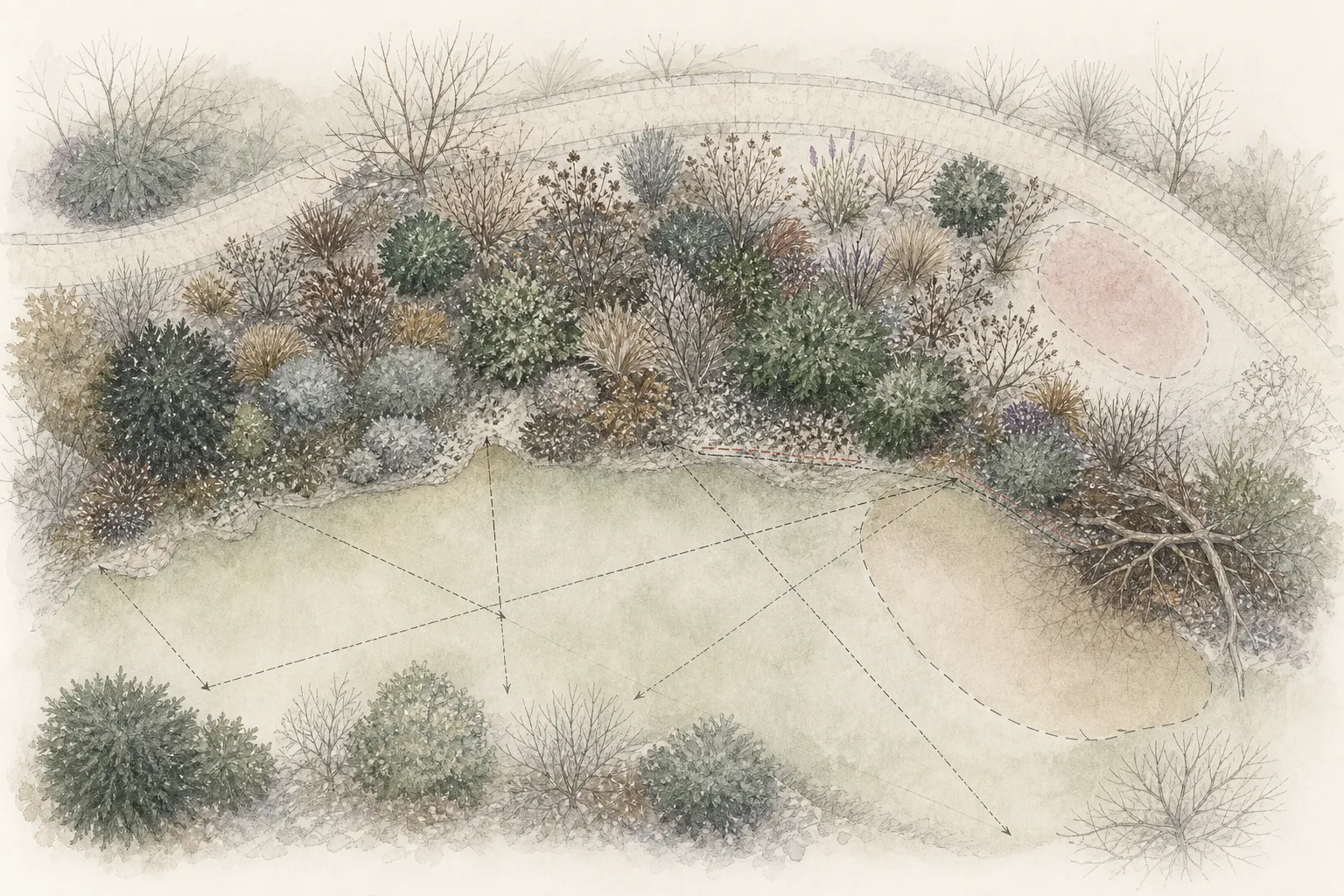
Classify each apparent gap. A planned gap may hold a dormant peony, leave air around a crown, expose a path edge, or provide room for a grass to expand. A failure gap may contain a dead plant, a repeatedly waterlogged low point, or an opening created because adjacent crowns leaned away from shade. A structural gap remains visually weak in both winter and summer; a seasonal gap disappears when herbaceous foliage returns. Those categories prevent an impulsive winter purchase from creating July crowding.
Keep the first map descriptive. Do not draw proposed plants until drains, existing root zones, labels, and summer outlines are located. Note one dominant winter anchor, the repeated secondary forms, and any competing focal points. If the border has no hierarchy, circle the strongest existing relationship before adding another specimen. A coherent revision usually begins by revealing or repeating something that already works, not by introducing a new collection of unrelated winter-interest plants.
Distinguish structure from leftover clutter
Useful winter residue has a clear form from normal viewing distance. Upright grass clumps, firm branching seed heads, colored woody stems, and sound evergreen foliage can hold height, line, or mass. Material that has collapsed into a wet mat, broken across neighboring crowns, or scattered as weak isolated stalks does not perform the same job. Judge whole groups rather than saving every stem because one seed head looks attractive at arm's length.
Plant health overrides appearance. University of Illinois Extension supports leaving many perennials standing for seed, cover, and crown marking, while also recommending removal of foliage affected by disease. Identify the plant and the previous problem before deciding. Powdery-mildewed phlox, blighted peony foliage, and clean switchgrass do not need one cleanup rule. Bag or dispose of diseased material according to local guidance; do not leave it over the crown simply to preserve a brown silhouette.
Remove or store equipment whose summer job has ended. Peony rings, loose ties, temporary stakes, irrigation flags, and netting should not become accidental winter sculpture or wildlife entanglement. Keep only supports that remain stable, visible, and necessary for a defined plant. Photograph their positions before removal so they can return before spring stems elongate. Clean soil and plant debris from reusable hardware, discard damaged pieces, and label specialized supports by plant rather than rebuilding the system from memory each year.
Wildlife value is strongest when it is intentional and safe. Retain several sound stem groups in a quiet part of the border, preserve compatible leaf litter, and leave seed heads that remain accessible to birds. Clear the main route, drains, diseased plants, and material pressed onto crowns. This selective approach avoids the false choice between stripping the entire bed and abandoning it untouched. The border can present a deliberate winter foreground while its less visible rear layer carries more habitat.
Compare the same view across seasons
Place each winter photograph beside its peak-summer counterpart and trace permanent anchors first: woody crowns, evergreens, path edges, walls, and the bases of ornamental grasses. Then outline the summer masses that temporarily join those anchors. The matched elevation should reveal whether flowers enrich a stable framework or merely hide weak spacing. An evergreen that looks appropriately strong in January may become a dark, airless block behind midsummer foliage; a sparse winter gap may be the exact emergence room a peony needs.
Measure access at maximum spread. Mark stems that fall across the path after rain, foliage that covers labels, and crowns that cannot be reached for division without stepping through neighbors. RHS border guidance asks gardeners to plan from ultimate height and spread and to account for staking, pruning, deadheading, and division. Add those maintenance footprints to the summer overlay. A border that can only be serviced by crushing its front layer is overfilled even when its flower photograph looks abundant.
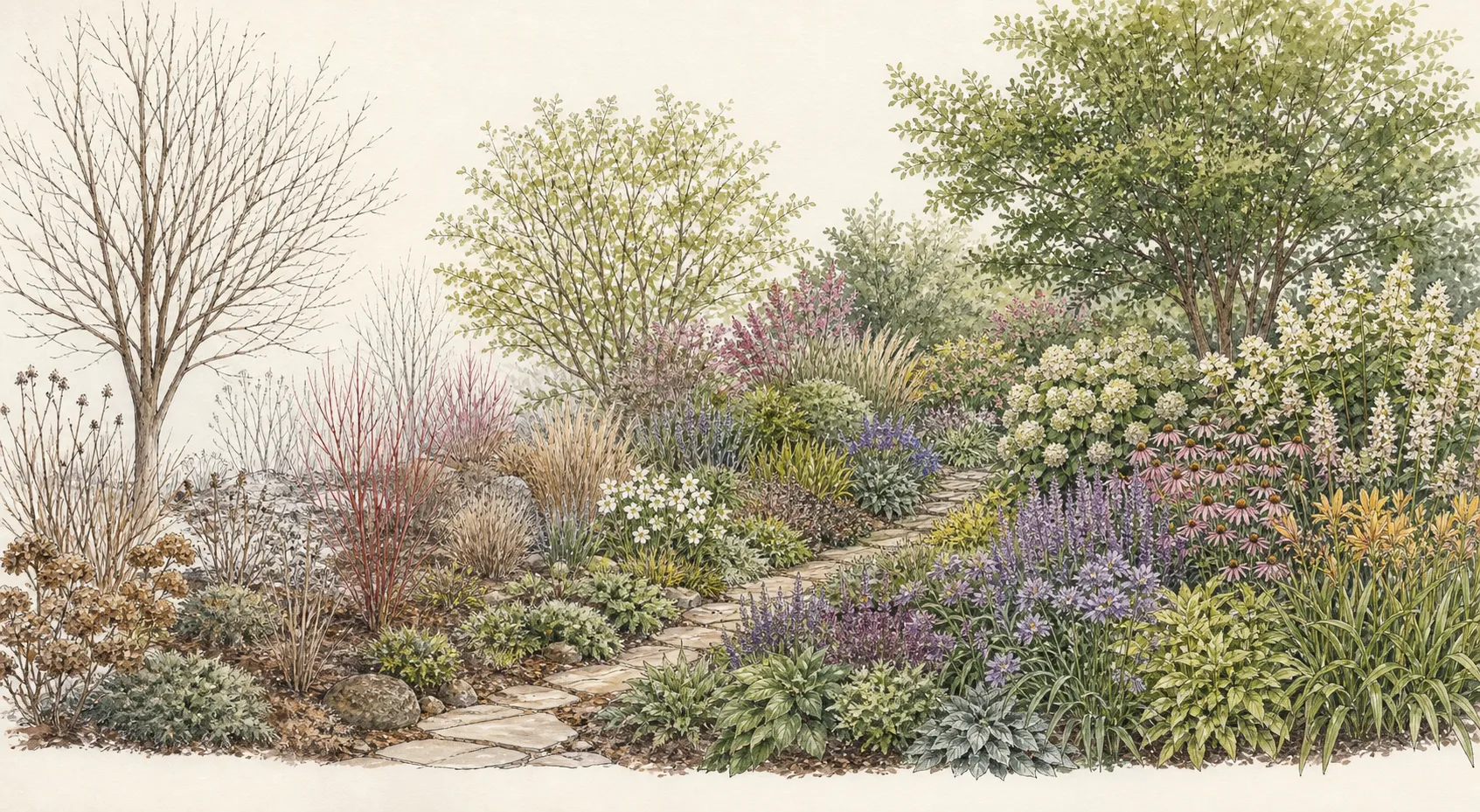
Trace seasonal handoffs instead of treating summer as one event. Note which plant supplies spring foliage, which carries early flowers, which becomes a midsummer screen, which keeps autumn seed heads, and which disappears completely. A plant can earn its place through one strong season if another layer covers its absence. The audit fails when several neighboring plants peak and vanish together, leaving the same unsupported gap from late autumn until spring.
Inspect soil, drainage, and hardscape
Winter and thaw expose conditions hidden by foliage. Mark standing water, runoff paths, soil pushed against edging, salt splash, compacted shortcuts, and places where freeze-thaw has lifted a crown. Compare the pattern after more than one weather event. One puddle during frozen conditions does not prove year-round drainage failure, but repeated saturation around the same perennial base is a reason to correct water movement before adding a replacement plant.
Inspect the soil line around every woody anchor and persistent crown. Pull accumulated mulch away from shrub stems and root flares, and uncover herbaceous crowns that were buried by leaf piles or annual top-dressing. Do not rake aggressively through marked dormant plants. Use hands around hosta eyes, shallow peony buds, bulbs, and late-emerging perennials. Record where roots are exposed by heaving and wait for workable soil before gently resetting them; pressing through saturated soil can create the compaction the audit is meant to reveal.
Use the leafless season to inspect edging, steps, lighting, irrigation outlets, wall clearances, and support anchors. Repair loose path edges and exposed fasteners before summer foliage hides them. Keep downspout work, buried utilities, and structural drainage within appropriate professional or local-code limits. Keep defects that need excavation or access visible until the repair is complete; a new shrub belongs only after the work zone is clear.
Schedule soil work for conditions that protect structure. RHS guidance advises against preparing a border while ground is frozen or waterlogged. Flag the problem now, photograph it, and return when the soil crumbles instead of smearing under pressure. If a low point needs regrading, protect established roots and confirm where redirected water will go. The finished correction should improve drainage and maintenance without raising soil over crowns or sending runoff across the path.
Edit roles before buying plants
Give every proposed change one role: evergreen mass, upright winter line, persistent seed-head group, spring emergence marker, path repair, or summer gap filler. Reject a purchase that cannot be named more precisely. When a border already contains the required role, reveal it by thinning, relocating, or removing competing material. Editing an oversized foreground can restore the winter composition more effectively than adding another shrub behind it.
Filter plants by measured conditions and future work. Record mature height and spread, soil moisture, pH, light, hardiness, growth habit, self-seeding or suckering, summer volume, winter form, and the pruning or division route. RHS recommends starting a border with evergreen and structural plants, then repeating groups of herbaceous material. That sequence works only when each structural plant fits its soil and can reach maturity without routine size-control shearing.
Use repetition to strengthen what the audit already found. Two or three upright grasses can form a rhythm; several matching stonecrops can carry one foreground seed-head layer; one compact evergreen can hold a dark mass. Avoid assigning equal emphasis to each addition. A border with ten winter novelties has no clearer skeleton than a summer border with ten isolated flowers. Keep one focal relationship and let repeated supporting forms move the eye toward it.
Write a small reversible revision plan
Rank work in this order: unsafe access, active drainage or grade problems, diseased material, damaged supports, plant-health conflicts, and finally visual additions. Give each task a plant-specific window. Peony division, grass cutback, shrub pruning, and path repair cannot be collapsed into one convenient weekend. List the prerequisite for each action, the crown or root area that must remain protected, and the next seasonal observation that will show whether the change helped.
Limit the first revision to a few legible moves. For example, remove one failed plant, widen one service opening, relocate one young crowded perennial, and add one structural plant only after its mature circle fits the plan. Label every move and photograph the cleared space before replanting. A smaller revision keeps the border intact and makes it possible to recognize whether winter structure improved without confusing the result with a complete redesign.
Review after a full cycle, not after the first flush of new growth. Compare winter frame, spring emergence, peak summer access, autumn persistence, and maintenance time. Keep a change only if the plant remains healthy, the route stays usable, and the intended role is visible from the fixed viewpoint. If a new evergreen overwhelms the summer view or a grass repeatedly collapses, move it while young rather than adding supports and pruning rules to defend a poor placement.
Translate the audit into one bounded revision
Here is a worked composition for a temperate USDA Zone 5–7 border with cold winters, humid summers, and full sun to light afternoon shade. The 24-by-8-foot bed has moist but well-drained acid-to-neutral soil in its rear and middle bands, plus a separately managed free-draining, lower-fertility strip along the front. It is viewed from a house window and a path at the front edge. This is not a prescription for dry alkaline ground, waterlogged clay, the Deep South, or a fire-prone site. Check local invasive lists, cultivar availability, and municipal clearance requirements before using any taxon.
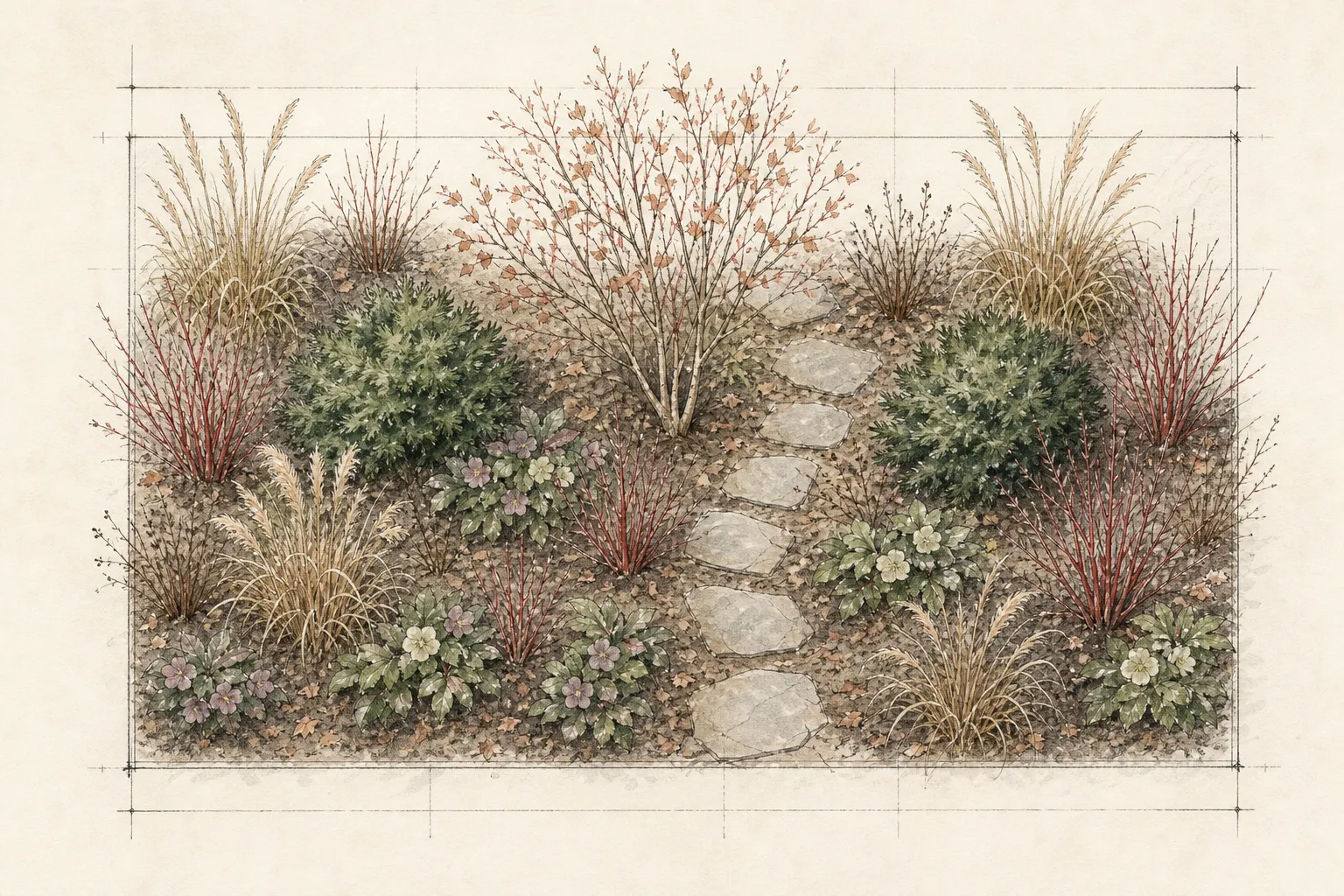
Measure coordinates from the left end and the path edge. In the rear row at 6 feet depth, place Panicum virgatum 'Northwind' at 3, 10, and 22 feet; Missouri Botanical Garden gives it a 4–5-foot foliage height, 2–2.5-foot spread, and persistent winter form, with panicles potentially reaching 6 feet. Place one Ilex glabra 'Shamrock' at 16.5 feet in the same rear band, reserving its documented 3–4-foot height and spread. Keep it out of alkaline soil and allow inspection for suckers rather than clipping it into a smaller ball.
In the middle row at 3.8 feet depth, place three Paeonia lactiflora cultivars at 5.5, 13, and 20.5 feet, using cultivar labels for final dimensions and allowing at least the 3–4-foot center spacing in Purdue's Indiana guidance. Their crowns supply spring and early-summer mass but disappear after dormancy, so mark each one permanently and keep its shallow eyes free of added soil. In the distinct free-draining front strip at 1.5 feet depth, repeat five Hylotelephium spectabile 'Autumn Joy' at 2, 7, 12, 17, and 22 feet; NC State describes clumps about 1–2 feet high and wide with browned winter flower heads. Keep that strip outside the regular medium-moist irrigation line because the cultivar suffers in overly moist or fertile soil.
The seasonal sequence is deliberate. Peony shoots establish spring volume and flowers, the switchgrasses rise behind them through summer, 'Autumn Joy' carries late color and seed-head form, and 'Shamrock' remains the single dark winter mass. After peony foliage is removed in dormancy, its three open circles remain readable between the grass uprights and low stonecrop heads. That bare ground is reserved crown space, not an invitation to insert another perennial. Keep the path edge open enough to reach every peony and cut the grasses before new shoots rise.
Substitute by role and condition, using color only after the site requirements agree. Replace 'Shamrock' with a locally reliable evergreen near 3–4 feet only if it accepts the measured soil, moisture, hardiness, winter exposure, and available pruning access; do not move a moisture-loving inkberry into a dry alkaline bed. Replace 'Northwind' with a clump-forming upright grass of comparable spread only when it remains standing locally and is not invasive. If a separate dry front strip cannot be maintained, omit 'Autumn Joy' and choose a contained 1–2-foot local perennial whose persistent heads and root moisture needs match the main bed.
Design ideas
- Style
- Layered ornamental planting with legible seasonal structure
- Space
- Home ornamental garden bed, border, courtyard, or seasonal container
- Climate
- Adapt taxa, timing, shelter, and moisture to local hardiness, summer heat, rainfall, wind, soil, and drainage.
- 1Build a fixed-view contact sheet
Print one winter, spring-emergence, peak-summer, and autumn image from each marked viewpoint at the same scale. Trace paths, permanent woody crowns, grass bases, and summer plant outlines on transparent overlays. Keep the sheet with the border plan so future divisions and purchases are checked against actual seasonal volume rather than a single flattering photograph.
- 2Keep one evergreen mass
Use one naturally scaled evergreen as the winter dark value, leaving visible air between it and deciduous stems. Draw its full summer outline before planting and retain access to the back and root zone. If local soil or climate cannot support the selected evergreen without repeated correction, leave the role open until a locally dependable substitute is documented.
- 3Repeat three upright winter lines
Preserve or add three clump-forming grasses at unequal intervals where their mature width remains outside the path and neighboring crowns. Choose a cultivar with documented local posture, then remove any clump that repeatedly lodges under ordinary rain or snow. The repeated verticals should guide the winter view without forming a continuous screen in summer.
- 4Make one seed-head foreground
Group a durable seed-head perennial near the front where its browned structure reads as one low layer. Remove stems that collapse, carry disease, or hide crown drainage, while retaining sound heads through the useful season. Mark the planned spring cutback route so later bulbs and emerging crowns are not damaged when the winter layer is cleared.
- 5Protect a deliberate dormant gap
Outline the mature crown of one summer-dominant perennial on the winter plan and keep that circle visibly unfilled. Use a permanent label and a light surface treatment that does not bury the crown. The opening should provide emergence room, air, and maintenance access; fill it only if a full seasonal comparison proves that the space is unused.
- 6Turn support storage into part of the plan
Photograph every support in position, assign it to a labeled plant, and create one dry storage location for rings, grids, ties, and stakes. Return each support before stems need it, using the photograph rather than guesswork. Retire bent or sharp hardware instead of leaving it in the winter bed as an accidental line or future snag.
- 7Reserve one service opening
Keep a narrow mulch or stepping interval aligned with a drain, wall, valve, and plants that need periodic division. Repeat its edge treatment elsewhere so it reads as negative space rather than a missing plant. Do not let volunteer seedlings, decorative pots, or spreading groundcovers close the route after the border matures.
- 8Approve changes after one winter return
Set three acceptance tests for every revision: the intended winter role remains clear, peak-summer circulation stays open, and plant health no longer depends on compensating inputs. Photograph the result after the next leaf fall. Relocate a young failure, reduce an over-repeated layer, or retain the unchanged gap according to those tests rather than adding another plant immediately.
Plants in this guide
Related reading
Sources
- Landscape Design. NC State Extension Publications. Source record · Accessed 2026-08-30.
- How to Plan a Border. Royal Horticultural Society. Source record · Accessed 2026-08-30.
- How to Have a Beautiful Winter Garden. Royal Horticultural Society. Source record · Accessed 2026-08-30.
- Planting and Care. University of Illinois Extension. Source record · Accessed 2026-08-30.
- Panicum virgatum 'Northwind'. Missouri Botanical Garden. Source record · Accessed 2026-08-30.
- Ilex glabra 'Shamrock'. Missouri Botanical Garden. Source record · Accessed 2026-08-30.
- Hylotelephium spectabile 'Autumn Joy'. NC State Extension. Source record · Accessed 2026-08-30.
- Growing Peonies in the Indiana Landscape. Purdue University Extension. Source record · Accessed 2026-08-30.