Gardens · sheltered courtyard winter flowering shrubs
Design a Sheltered Courtyard for Winter-Flowering Shrubs
Use walls, winter sun, air drainage, scent routes, mature shrub scale, and open paving to make a small courtyard support a restrained winter-flowering composition.
Published Last updated
In this guide
- Draw the courtyard as a set of microclimates
- Preserve the courtyard's outlet and summer crown space
- Choose the flowering event by site fit
- Compose two events and a quiet framework
- Allocate roots and water in confined beds
- Shape the sensory route without clutter
- Coordinate pruning and seasonal transitions
- Plant one Zone 7b courtyard composition
- Design ideas
Draw the courtyard as a set of microclimates
A courtyard is not uniformly sheltered. Measure the walls, doors, windows, paving, beds, drains, steps, utilities, and the full route used by people carrying bins, tools, or deliveries. Track winter sun at morning, midday, and late afternoon because a wall can create a warm reflected pocket beside a strip kept out of direct light. Draw both the planted ground and the air volume a mature shrub will occupy; winter flowers are a poor bargain if summer branches darken a room or narrow the exit.
Map cold air and water before choosing plants. Cold air may settle in the lowest enclosed corner even when the wall above feels warm. Downspouts can alternate a root zone between a dry eave shadow and a concentrated storm discharge. Observe at least one rain and one thaw, then mark ponding, splash, snow storage, salt exposure, wind funnels, and places where paving sends water toward a stem base. Resolve unsafe drainage and building access before using a shrub to hide them.
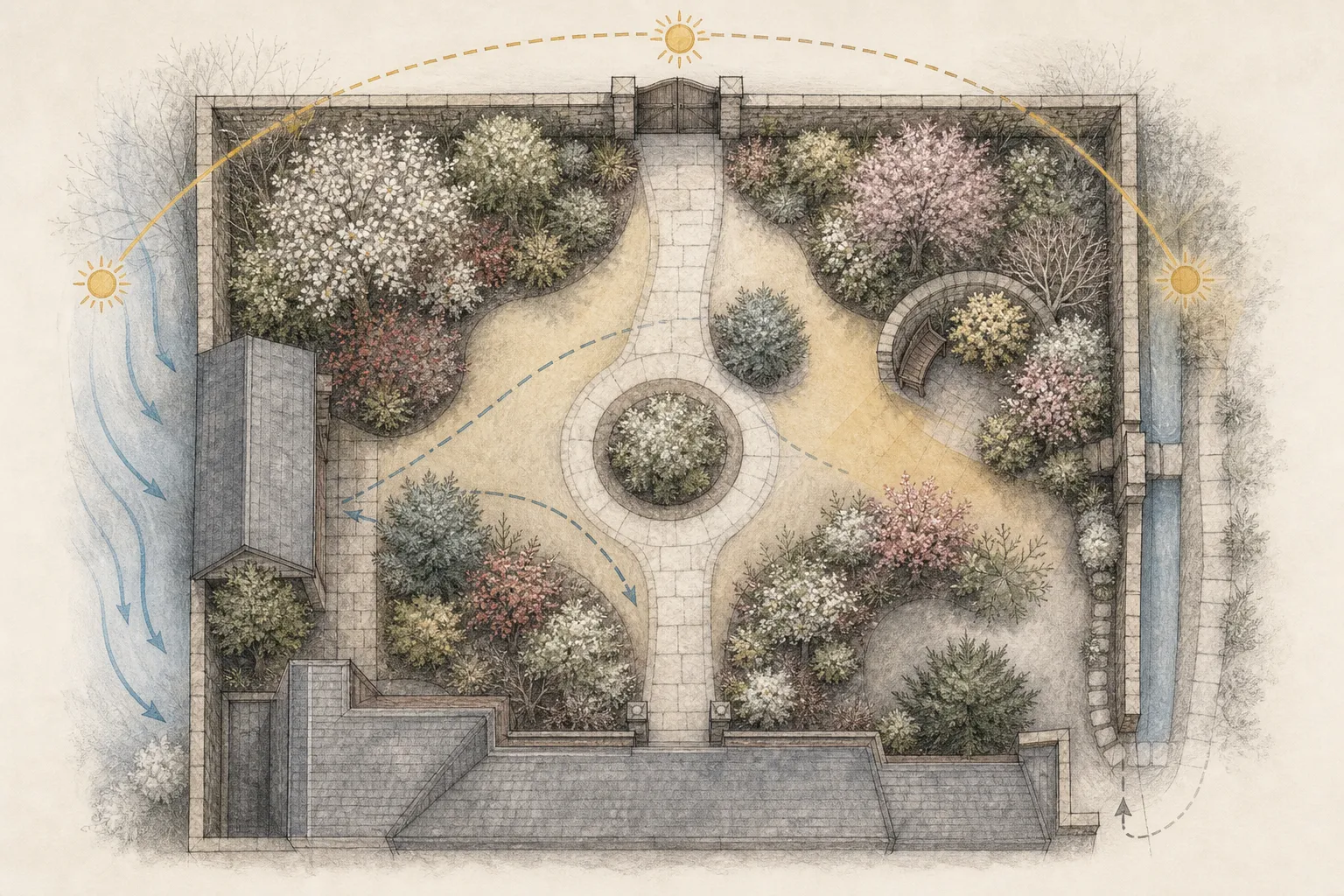
Choose one indoor view and one walking pause as the principal winter experience. Photograph both with the courtyard empty of temporary furniture, then draw every candidate at mature summer spread. Keep doors, window cleaning, wall inspection, vents, fire access, and neighboring-property clearances outside those circles. The remaining space is the actual planting envelope. A small court often supports one principal flowering shrub and one low secondary event; filling every corner usually creates a collection that cannot mature naturally.
Preserve the courtyard's outlet and summer crown space
Accept the worked courtyard only if morning light, shelter, drainage and the cold-air outlet are real site conditions. Draw the shrubs at their summer widths while retaining the path and wall-service space. A winter-flowering substitute must meet the same spatial and cultural limits. Its seasonal appeal does not justify closing the outlet or narrowing access after leaf-out.
Choose the flowering event by site fit
Compare candidates by exact identity, hardiness, mature width, soil moisture, pH, winter light, wind exposure, flower timing, summer foliage, and pruning response. Shelter cannot make a Zone 8 shrub dependable in a colder courtyard, and a south-facing wall may move buds early enough that a later freeze still damages them. Use local performance records and the named cultivar; treat catalog promises as unverified until site evidence agrees. Reject any crown that fits only if it is sheared below its documented size every year.
Place fragrance where it will be encountered without forcing contact. A shrub near the door can scent still winter air, but its wet branches must remain outside the clear route at full leaf. Check fruit, thorn, contact, ingestion, and pollen concerns for the people and animals using the enclosed space, where exposure is concentrated. If the best-scented candidate conflicts with access, drainage, or hardiness, choose a locally suitable shrub serving the same height and seasonal role instead of moving it into a marginal corner.
Compose two events and a quiet framework
Let one deciduous flowering shrub carry the principal late-winter event and one low evergreen group carry an earlier or overlapping fragrance. Separate them by height and distance so the eye reads two distinct crowns. A dark wall, shadowed fence, or evergreen foliage can act as the backdrop; it does not need another hedge in front of it. Keep bare branch structure visible around the principal flowers and allow the secondary group to remain a quiet ground-level mass.
Use paving and protected soil as active negative space. Open ground can reveal a reflected pool of winter light, make small flowers legible, and keep drains or service points reachable. Leave measured intervals open for light, drainage, and access. A few repeated lower plants are stronger than a different novelty at each corner, and the open plane gives mature roots and branches room that is invisible when young nursery plants are first installed.
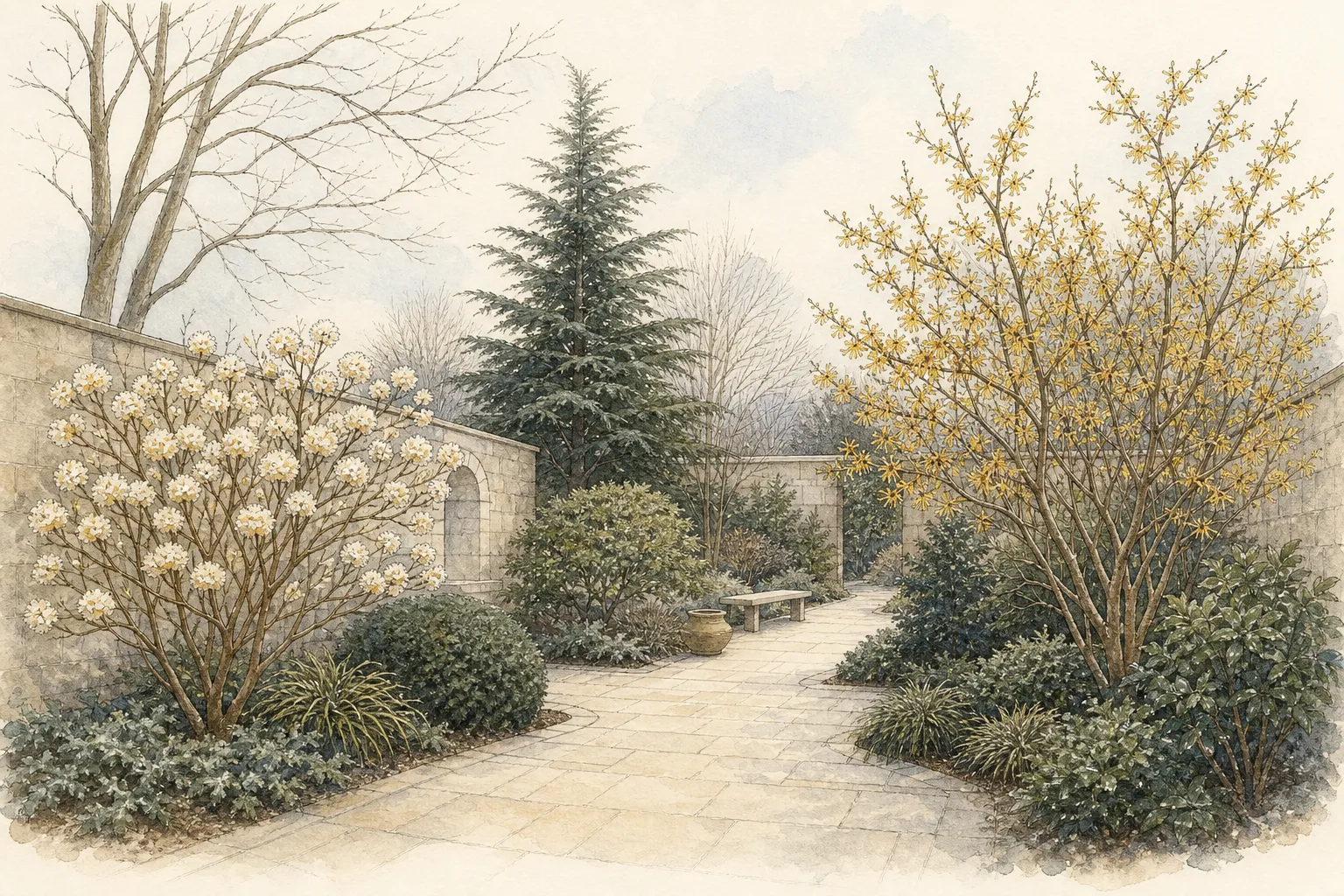
Test the design in grayscale and in summer outline. Winter yellow or white flowers need enough contrast against the chosen wall; dark foliage needs relief from permanent shadow. Draw the deciduous shrub fully leafed and the evergreen at its widest suckering extent. If those masses join across the path or block the window, increase separation now. The court must remain comfortable after flowers finish, when foliage, shade, and circulation become the dominant experience.
Keep furniture and lighting subordinate. One movable seat may occupy a dry pause outside root zones, while low outdoor-rated lighting may define a step or branch opening if installed to local electrical and dark-sky requirements. Aim fixtures at steps or path edges and route cables outside cultivatable soil. The composition should remain understandable in daylight from the window and entry; equipment only supports safe use of that structure.
Allocate roots and water in confined beds
Measure the soil volume between paving, foundations, retaining walls, and existing roots. A bed can be wide at the surface yet shallow above rubble or compacted subsoil. Keep shrub root flares and stem bases at finished grade, with mulch and migrating gravel held back for inspection. Maintain finished soil below wall details and keep the shrub's lower framework exposed. If excavation could affect a foundation, utility, or established structural root, obtain appropriate local advice before planting.
Route roof water separately from routine irrigation. A downspout should discharge through a safe designed path, not onto the crown of the feature shrub. Check the open side and wall side of each root ball because the wall may exclude rain while paving sends runoff toward the opposite edge. Water new plants through establishment by actual root-zone moisture, then reduce frequency according to weather and growth; a sheltered court can remain dry in rain and saturated after one concentrated storm.
Group plants whose moisture and drainage needs genuinely overlap. Edgeworthia and dwarf sweet box both accept humus-rich, moist but well-drained soil in shelter, but neither should sit in a sealed basin. Keep a low inspection opening between their crowns and make surface treatment thin enough to lift. If a container is considered, calculate mature root volume, saturated weight, drainage, frost exposure, watering access, and a safe moving plan together. A pot is not a shortcut around an unsuitable in-ground microclimate.
Reserve a service strip along the wall and direct access to every drain, irrigation fitting, window, and pruning side. Mark it on the plan before roots spread. Use paving, a stable stepping surface, or genuinely low planting according to the site, giving workers a route outside dormant bulbs and shrub canopies. The service route is part of the composition because it protects crown soil from repeated compaction and prevents maintenance from becoming destructive.
Shape the sensory route without clutter
Put scent beside a route that is actually used in winter: the latch side of the entry, the sheltered turn toward the door, or the indoor window opened briefly on mild days. Keep the fragrant plant far enough away that its mature branches and wet leaves stay clear of coats and faces. Air movement matters. A wind funnel can strip scent away, while a fully stagnant recess may also hold frost. Observe where light wind pauses and use that pocket as the sensory center.
Let material restraint amplify fragrance. Use one paving field, one quiet wall value, and a limited evergreen texture instead of competing ornaments, signs, and pots. Permanent plant labels belong low and reachable, not as focal plaques. If seasonal containers are added, give them a defined summer destination and winter storage plan before they enter the court. A winter composition loses clarity when every temporary object remains after its flowering job ends.
Test the route under ordinary burdens. Open every door, roll bins, carry a wide parcel, trail a hose, and walk in bulky winter clothing. Confirm that the viewing pause stays dry and that no chair leg rests over a root zone or drain. Keep the seat movable so snow, ice, pruning, or wall work can reclaim the space. Comfort depends on circulation and shelter working together; fragrance does not compensate for a courtyard that is awkward or unsafe to use.
Coordinate pruning and seasonal transitions
Write a separate pruning note for every woody plant. Edgeworthia forms flower buds on older growth, so routine size reduction risks removing the late-winter display; reserve cuts for dead, damaged, crossing, or clearly misplaced branches and keep the natural open outline. Dwarf sweet box can be shaped after flowering if it encroaches on the route, while suckers are removed selectively at the edge of its assigned patch. One courtyard-wide spring shearing date would damage the design as well as the plants.
Manage summer for the next winter. Keep paperbush evenly established without waterlogging, prevent broad leaves from pressing against a hot wall, and watch whether its mature shade changes the sweet box below. Mark new flower-bud clusters before autumn work. A branch that blocks access may signal a fundamentally misplaced shrub. Move a young plant during a locally suitable season while the root system is still manageable.
Record first flower, peak scent, frost injury, scorch, drainage trouble, path clearance, and maximum summer spread from the same viewpoints. Clean diseased material and blocked drains promptly while retaining healthy protected soil. After several winters, keep the two-event sequence only if both plants remain healthy and distinct. A substitute must repeat the role and compatible conditions; it does not inherit the original plant's timing, size, or pruning merely because its flowers share a color.
Plant one Zone 7b courtyard composition
This worked plan is for an east-facing 16-by-14-foot enclosed courtyard in USDA Zone 7b in the Mid-Atlantic. The site receives morning sun and bright afternoon shade, with humus-rich moist but well-drained soil and an open south-side passage that lets cold air and storm water leave. It does not apply unchanged to Zone 6, alkaline dry fill, a sealed low basin, the Gulf Coast, or an exposed roof terrace. Confirm local hardiness, invasive status, building clearances, and nursery identity before purchase.
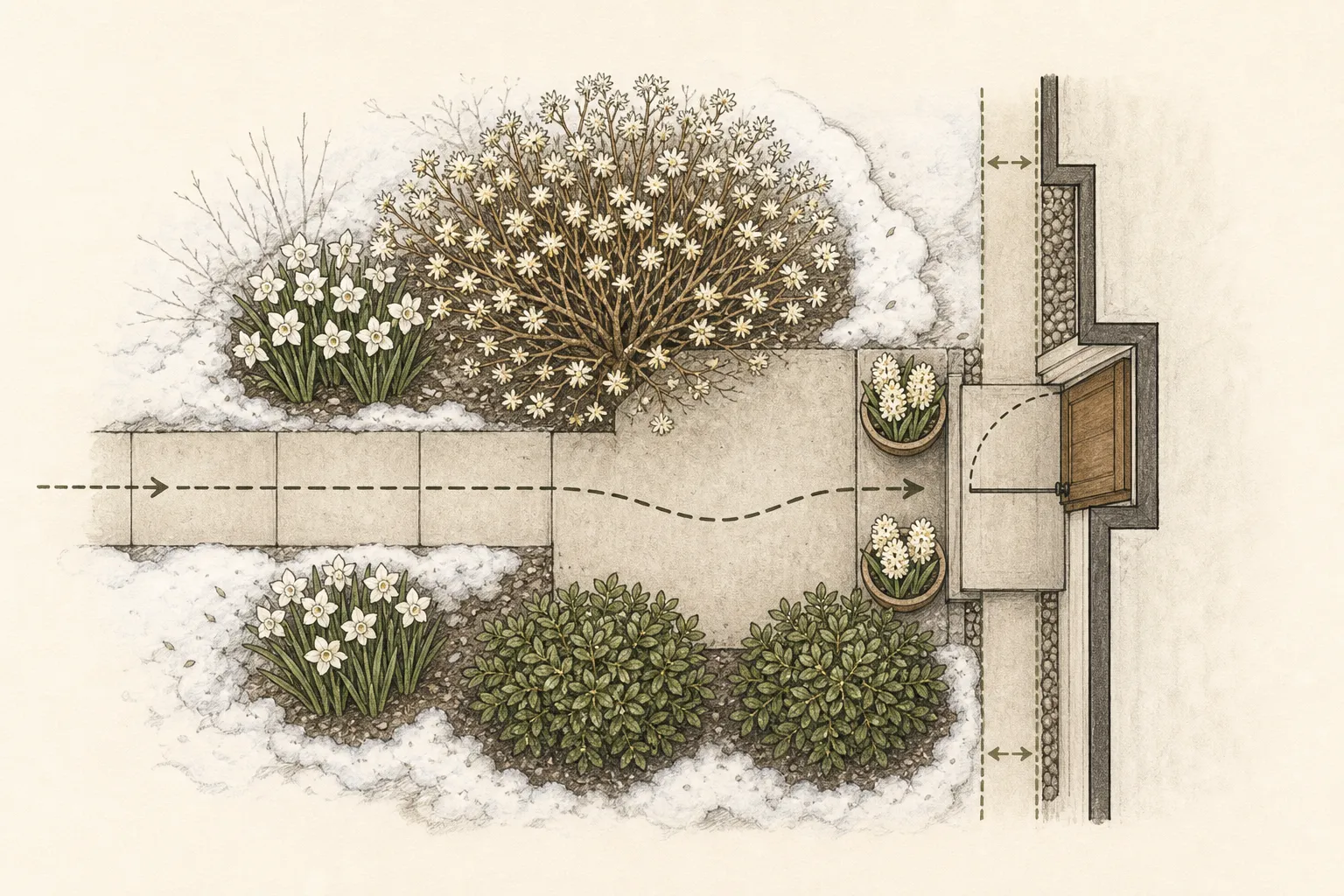
Keep a 4-foot-wide clear path from the south opening to the east-side door. In the northwest planting bed, center one Edgeworthia chrysantha 4 feet from each adjoining wall and reserve at least a 6-foot-diameter crown, following NC State's 4–6-foot dimensions and roughly 7-foot spacing guidance. Its leafless three-pronged branches and fragrant yellow clusters provide the principal late-winter event; its broad deciduous summer foliage becomes the court's largest seasonal mass. Reserve the full crown below clear sky, outside window clearance, and free from annual size-control pruning.
Along the shaded north wall near the entry pause, place three Sarcococca hookeriana var. humilis 'Sarsid2' FRAGRANT MOUNTAIN plants at 4-foot centers on a line 4 feet from the wall, beginning 3 feet from the path corner. Missouri Botanical Garden gives this cultivar a 2–3-foot height and 3–4-foot spread in Zones 6–8, with fragrant late-winter to early-spring flowers and slow suckering. The group makes the low evergreen framework and carries scent near the door without forming a tall hedge. Preserve a 2-foot wall-service strip behind the assigned patch and remove suckers that enter it.
Leave the central pale paving open. From the principal window, the evergreen sweet box forms a low dark line, paperbush flowers float against the northwest wall, and the route remains visually quiet. In summer, Edgeworthia supplies the overhead foliage mass while the sweet box keeps the north base green. The two plants share sheltered, moisture-retentive but draining soil, yet the irrigation must still reach both original root balls without discharging against their stems or the building.
Set the nursery pots on their measured centers before digging and test the path, window, drain, and wall-service strip with the mature circles marked on the paving. Plant only when local conditions allow roots to establish without saturated or frozen soil, keeping both root flares at the nursery grade. Water each original root ball and surrounding soil separately through establishment because the wall shadow can exclude rainfall from the sweet box while open paving sheds water toward paperbush. During the first full year, record leaf scorch, wilt, standing water, sucker spread, flower-bud survival, and branch clearance. Correct delivery or drainage before adding fertilizer, mulch, or another plant. Move a failed young placement while roots remain manageable; permanent pruning and irrigation exceptions reveal a poor fit.
Substitute within strict limits. North of Zone 7, use a locally proven winter-flowering shrub only if its documented mature crown fits the same 6-foot space. Its roots must accept the measured soil and drainage, and its pruning must not obstruct the route; a large witch hazel will not fit by role alone. Replace FRAGRANT MOUNTAIN only with a shade-tolerant evergreen winter-scented shrub that remains below about 3 feet, spreads predictably, and is legal and dependable locally. If either role lacks a credible plant, preserve the open wall or paving and omit the marginal specimen.
Design ideas
- Style
- Restrained sheltered winter courtyard
- Space
- Enclosed entry court, townhouse patio, or small walled garden
- Climate
- The worked plan is bounded to a sheltered, east-facing USDA Zone 7b Mid-Atlantic courtyard with morning sun, afternoon shade, an open cold-air outlet, and humus-rich moist but well-drained soil. Elsewhere, recheck hardiness, heat, soil, drainage, legal status, and mature crown size before substituting either shrub.
- 1One dark-backed flowering shrub
Set the principal deciduous flowering shrub against one quiet wall, centering it far enough away that the mature crown can be viewed on all sides and reached without a ladder over neighboring plants. Keep windows and vents outside its summer outline. Use the wall for contrast, not as permission to flatten the rear branches with repeated pruning.
- 2A secondary scented pause
Group three low evergreen scented shrubs beside the latch-side pause, outside the door swing and coat-width route. Space them at documented mature width and let the repeated foliage read as one mass. Keep the flower source near nose level only if fruit, contact, pet access, shade, and local hardiness have been checked for the exact taxon.
- 3Open pale ground
Retain a single pale paving field between the two shrub events so winter light, fallen petals, and branch shadow remain visible. Align joints and edging with the door, letting bed curves remain secondary. Keep drainage inlets exposed and use removable pots only for a scheduled seasonal purpose, storing them once that display ends.
- 4A single evergreen mass
Use the repeated sweet-box group as the sole evergreen planting mass; a clipped hedge around the whole court would close the open plane. Let its top remain below the window and its outer suckers stop at the service strip. If the leaves yellow or lose gloss, investigate sun, moisture, and pH before feeding or adding another evergreen layer.
- 5Three bulb pockets
If bulbs are added later, place only three marked pockets beyond the paperbush root ball and outside the wall-service strip. Choose exact taxa after checking local performance and ingestion risk, then let foliage mature without blocking the path. Map every pocket before summer planting so dormant bulbs are not mistaken for unused ground.
- 6A wall-service strip
Keep a continuous 2-foot strip beside the wall and widen it at drains, utilities, and window-cleaning positions. Finish it with the same stable surface used elsewhere so it reads as intentional access. Keep the strip free of groundcover, irrigation loops, furniture, and suckers; its uninterrupted line protects both building maintenance and shrub roots.
- 7A framed indoor view
Place the paperbush so one natural branch opening frames flower clusters from the principal window without centering the whole shrub like a specimen in a pot. Photograph the same frame when leaves are fully expanded. If summer foliage darkens the room or presses the glass, relocate the young shrub while it remains movable; pruning away its characteristic crown would erase the intended form.
- 8A removable seasonal seat
Set one light movable chair at the dry pause between the door and principal view, outside root balls and the drain line. Confirm that a seated person does not block circulation or lean into foliage. Store the chair during snow, ice, pruning, deliveries, or wall work so the small court can change function without compressing soil.
Plants in this guide
Related reading
Sources
- Landscape Design. NC State Extension Publications. Source record · Accessed 2026-08-30.
- How to Have a Beautiful Winter Garden. Royal Horticultural Society. Source record · Accessed 2026-08-30.
- How to Plan a Border. Royal Horticultural Society. Source record · Accessed 2026-08-30.
- Edgeworthia chrysantha. NC State Extension. Source record · Accessed 2026-08-30.
- Edgeworthia. Royal Horticultural Society. Source record · Accessed 2026-08-30.
- Sarcococca hookeriana var. humilis 'Sarsid2'. Missouri Botanical Garden. Source record · Accessed 2026-08-30.