Gardens · early spring entry threshold garden design
Design an Early-Spring Threshold Garden for the Daily Entrance
Compose a small entry garden from winter structure, close flower detail, emerging foliage, safe access, and a summer handoff rather than filling the doorway with seasonal containers.
Published Last updated
In this guide
- Design for the entrance that is actually used
- Draw the threshold as infrastructure
- Read light before and after leaf-out
- Compose a permanent winter framework
- Place close flowers in repeated pockets
- Build one source-bounded Zone 7 composition
- Plan the summer handoff before planting
- Maintain flowers without obstructing the route
- Edit the threshold after one full year
- Design ideas
Design for the entrance that is actually used
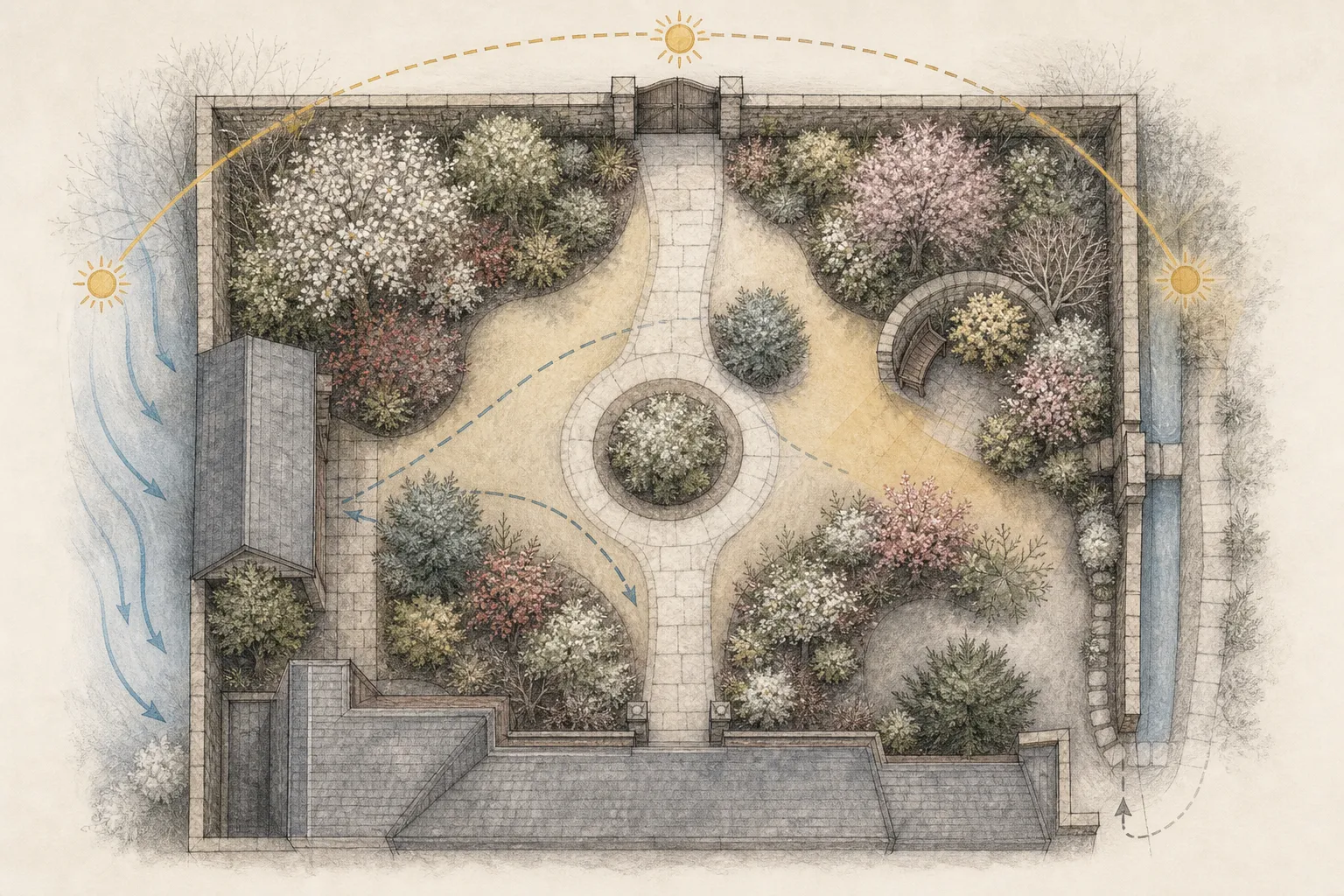
Begin at the door used for groceries, mail, school bags, deliveries, and winter boots. Observe the approach in both directions and at the hours it is busiest. The ceremonial front walk may not be the daily threshold. An early-spring garden earns its detail through repeated close encounters, so place it where people naturally slow to use a key, turn, set down a bag, or wait for the door.
Photograph from inside with the door closed, from the landing, and from the approach. Include sill, frame, handrail, house number, light, camera, downspout, meter, gate, and neighboring windows. Small flowers can be visible from a low interior view while disappearing from standing height outdoors. The composition should serve both views without blocking daylight, privacy, egress, or service access.
Record how wet shoes, snow, deicing material, rain splash, and carried objects move through the space. Preserve a generous route at mature wet foliage width. Thorny, toxic, brittle, or strongly scented plants need placement that does not force contact. An intimate garden is not one that narrows the path until every coat brushes a shrub.
Choose one mood: quiet woodland emergence, pale formal order, fragrant shrub threshold, or bright bulb procession. This decision governs repetition and omission. A small entrance cannot carry every desirable early flower plus evergreen topiary, colored stems, decorative pots, and ornaments without becoming a seasonal display rack. One clear character lets individual botanical detail be noticed.
Draw the threshold as infrastructure
Measure door and gate swings, landing depth, path width, steps, railings, slopes, drains, roof drip, downspout discharge, utilities, lighting spread, and the service strip beside the wall. Draw them first at fixed scale. Add the cleared winter route and the wider turning space needed with a bag, mobility aid, stroller, or delivery. Plantable soil begins only outside these functions.
Map puddles, ice, splash, compacted edges, foundation dryness, and salt exposure after real weather. A bed beside the landing can be saturated by a downspout at one end and dry under the eave at the other. Divide it into moisture zones or correct drainage before assigning plants. Do not use a moisture-loving woodland plant as decoration in a dry wall shadow or leave bulbs in a meltwater basin.
Draw existing roots and mature outlines of every woody plant. Reserve wall inspection and window-cleaning access. A paperbush or witch hazel may look airy when young but requires several feet of width; a dwarf evergreen can still block a low window. Reject positions that depend on annual shearing around a light, number, gate, or path. The threshold should become easier, not harder, to use as plants mature.
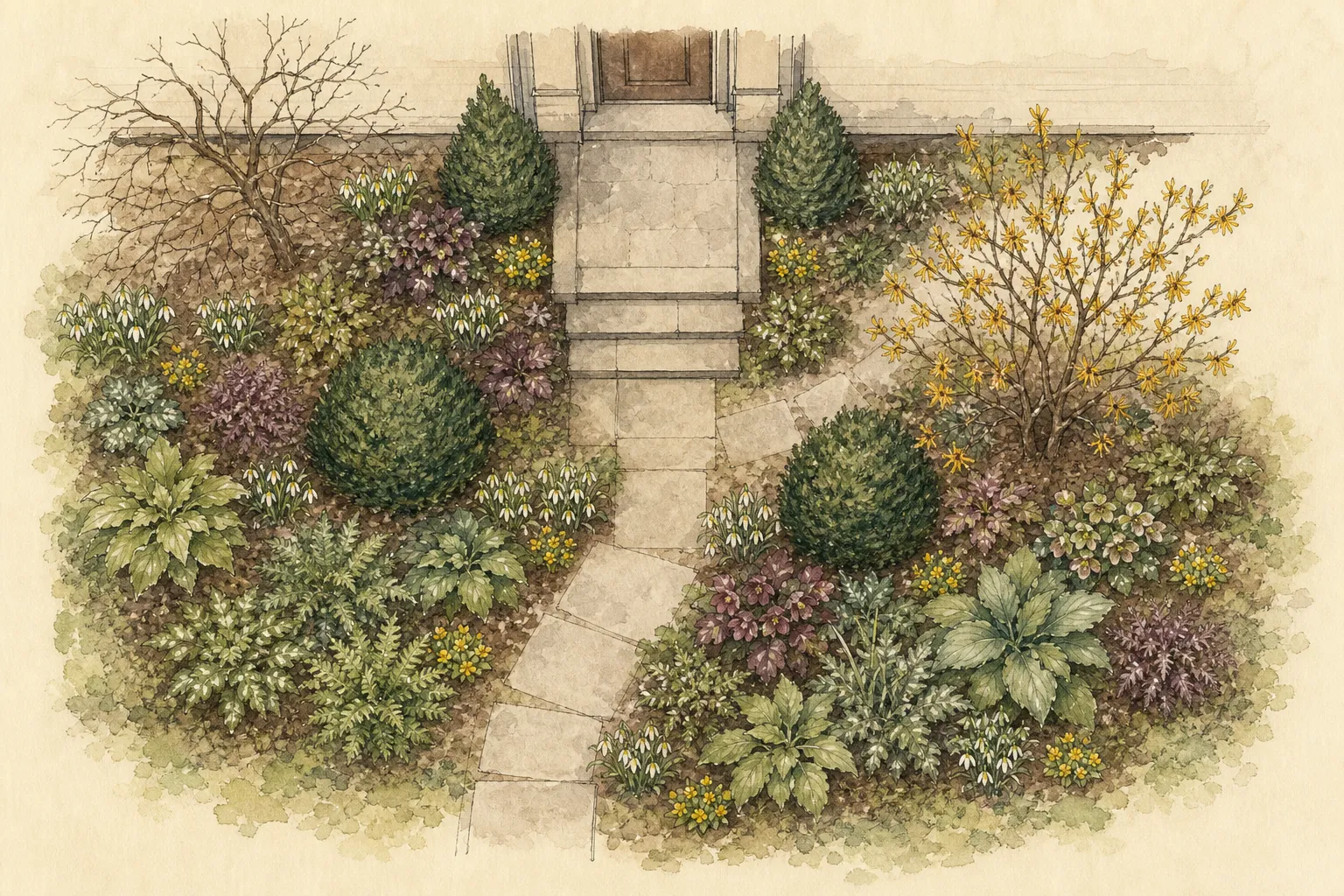
Mark underground and overhead utilities before stakes, edging, or shrubs. Keep plants clear of vents and heat pumps. If the entry is shared or regulated, confirm property, accessibility, and sight-line requirements. The garden can frame the route through open space, low repeated groups, and an off-center focal shrub without occupying the functional surface.
Read light before and after leaf-out
Early-spring plants often use bright light before deciduous canopies close. Observe winter sun, building shade, reflected heat, and the date nearby trees leaf out. A bed labeled partial shade in July may receive intense low sun in February; a north entry may remain cold and dim. Use the seasonal light rhythm rather than one annual label.
Map exposure at flower and foliage height. Ground-level bulbs can sit in a shadow cast by the path edge while a shrub above receives sun. A south masonry wall can accelerate buds, then expose them to late frost. A sheltered east-facing entry can offer morning light and reduced afternoon heat. Select regionally suitable plants after the microclimate is measured.
Consider indoor light. A dense evergreen near the glass affects the room all year, while a deciduous flowering shrub can preserve winter daylight and add summer screening. Draw the upper opening to sky and keep mature crowns outside it. Use a dark evergreen farther from the window as a background only when its roots, shade, and size fit.
Record wind at the landing. Buildings funnel air around corners, and door movement creates bursts. Small fragrant flowers are more perceptible in shelter, but a stagnant wet recess can support disease. Seek moderated exposure with drainage and air, not a sealed pocket. The same corner that holds scent may collect leaves and snow against crowns.
Compose a permanent winter framework
The garden must remain coherent before bulbs emerge and after their foliage fades. Use one woody focal form, one stable evergreen or architectural counterweight, a clear path edge, and a protected ground plane. Existing masonry, railing, or a borrowed tree can supply structure without another plant. The framework should be legible from the approach and simple enough that small flowers are not lost.
Place the focal shrub outside the door swing and primary sight line, near a pause where flowers and fragrance can be examined. Draw its complete mature spread and service gap. A dark background can clarify pale or yellow flowers, but keep enough distance for both crowns to dry and be maintained. Do not sandwich flexible branches between a wall and the walking route.
Use evergreen mass asymmetrically rather than as a low hedge around every edge. One compact form can balance the focal shrub and carry the scene through summer. Confirm that it tolerates the soil and does not shade the bulb layer too early. Select a naturally fitting size; repeated clipping near the door creates dense outer growth and a permanent maintenance obligation. Keep the ground plane visible. Shallow mulch, compatible leaf litter, or restrained low cover protects soil while showing bulb shoots, root flares, and drainage. Avoid deep coarse mulch that buries tiny plants or rolls onto paving. Negative space at the crown and between clumps makes the entry feel intentional and lets a dropped key or patch of ice be seen.
Place close flowers in repeated pockets
Early bulbs and low perennials should be placed where a person can see them without stepping into soil or bending a shrub aside. Use several small irregular groups beside the outside of a curve, below a window, or near the landing pause. Leave visible soil between groups. A continuous carpet is difficult to edit, can spread beyond the design, and makes individual flower structure disappear.
Choose nursery-propagated stock and check local invasive status, toxicity, and sourcing. Snowdrops and winter aconite are toxic if eaten; detached bulbs can resemble edible alliums to an uninformed person. Keep them away from kitchen-herb edges and children who dig. Wear gloves for planting and preserve botanical labels through dormancy.
Repeat one flower color or leaf form along the route. Three snowdrop pockets can lead toward a pale flowering shrub; winter aconite can create a warmer low counterpoint. Do not alternate every available species like samples. Repetition makes a tiny planting read from standing height, while close inspection reveals differences within each clump. Add one early perennial layer, such as locally suited hellebores, only where soil, toxicity, mature foliage, and regional disease considerations fit. Place it behind bulbs so its expanding leaves do not cover them before their foliage replenishes storage. Cut old leaves only according to plant health and local guidance, preserving emerging flowers and avoiding sap contact.
Build one source-bounded Zone 7 composition
Consider a sheltered east-facing Zone 7 entrance with a twelve-foot path edge, six-foot planting depth at its widest point, morning sun, bright deciduous shade later, and humus-rich soil that drains after rain. This is a worked composition, not a universal list. Confirm local hardiness, exact cultivar dimensions, toxicity, invasive status, and nursery availability. Replace the plant role when the site differs.
Place one Edgeworthia chrysantha toward the back outside the door view, reserving roughly a four- to seven-foot crown and a working gap from wall and path. Its terminal silky buds, late-winter yellow flowers, fragrance, and three-forked branch architecture provide the focal event. This choice assumes reliable shelter near its cold limit; colder or exposed gardens need a regionally hardy shrub with comparable scale and seasonal role.
Set one naturally compact dark evergreen at the opposite back corner, far enough from paperbush to preserve air and flower visibility. Choose a taxon proven for the local soil and light rather than a generic box ball. Its role is stable mass and backdrop. Keep its mature outline below the window opening and outside the wall service strip without relying on hard annual shearing.
Place three irregular Galanthus nivalis groups of five to nine nursery bulbs along the middle and near path, with visible leaf litter between them. Use Eranthis hyemalis in two separate small warm-yellow pockets only if locally suitable and contained. The counts create readable clumps but are not a spacing prescription; supplier depth, regional conditions, and mature naturalizing behavior govern installation.
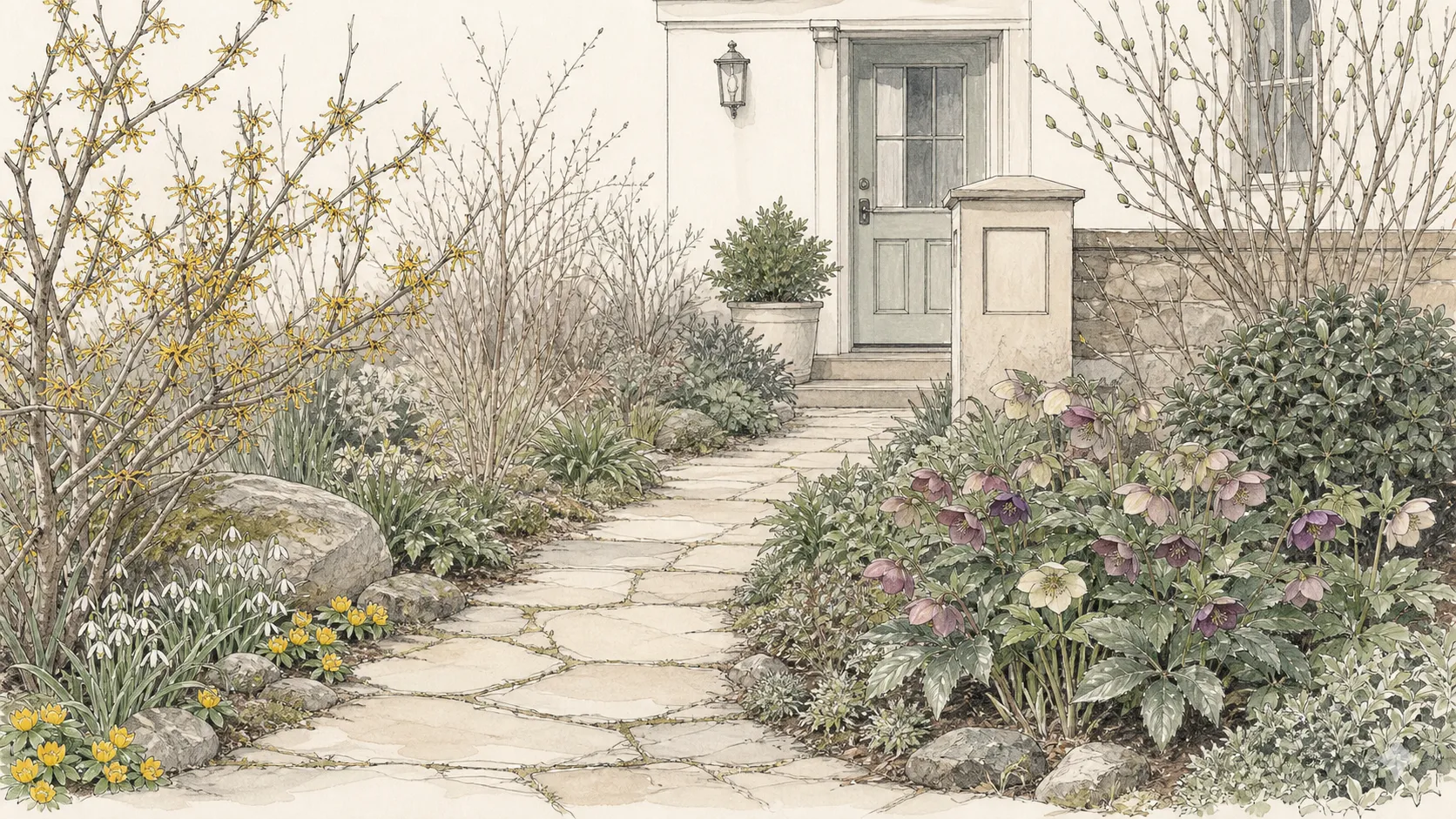
Add three Helleborus × hybridus plants as a later low middle layer where local guidance supports them, leaving room for mature foliage and keeping toxic tissue out of the walking line. Their flowers and leaves hand the scene toward spring after the smallest bulbs. Use one repeated pale or muted flower range rather than a mixed seed strain if color control is important.
Keep the foreground edge largely open with shallow mulch and one low evergreen foliage repetition that shares the moisture and shade, or omit it during establishment. A small frost-safe container may occupy the landing seasonally but is not required. The permanent composition already contains line, mass, flowers at two heights, fragrance, and a summer foliage handoff.
Plan the summer handoff before planting
Snowdrop and winter-aconite foliage must remain until it yellows naturally, then their locations become quiet. Mark clumps on a garden plan and with discreet permanent labels outside the bulbs. Later perennials should expand around, not through, the dormant area. Avoid annual digging, dense groundcover roots, and irrigation emitters placed where summer maintenance will disturb bulbs.
Paperbush becomes a broad leafy shrub, hellebores retain substantial foliage, and the evergreen remains visually heavy. Draw this July version. If it blocks the path or window, the winter drawing is invalid. Add no tall summer filler merely because the spring plan contains open ground. Use one low compatible texture or let protected mulch preserve breathing space.
Provide summer moisture according to each root zone. A wall edge can dry while the outer bed stays moist. Group compatible plants and inspect beneath foliage. Do not water dormant bulbs indiscriminately into saturated soil or let the focal shrub wilt repeatedly. The design needs drainage and a practical irrigation route, not a single decorative planting mix.
Use autumn to reset rather than replace the scene. Clear drains, remove diseased material, restore shallow mulch, inspect developing buds, and plant additional bulbs only where the measured record shows a gap. Resist filling every dormant mark with seasonal containers. The entry should remain recognizable across seasons, with changing detail held by the same framework.
Maintain flowers without obstructing the route
Inspect the landing and path before plant work. Remove ice, displaced mulch, fallen branches, and matted debris that blocks emerging shoots. Keep handrails, numbers, lighting, and door hardware visible. Cut no shrub simply because a branch appears near the path while frozen; assess mature placement and make plant-specific cuts at the correct time.
Prune the flowering shrub minimally according to its flowering wood. Paperbush carries flowers on older stems and is generally corrected after bloom; a substitute may differ. Remove dead or damaged tissue when the live boundary is clear and preserve natural branch architecture. If repeated size control is needed at the entrance, replace the plant rather than converting it into a clipped obstruction.
Let bulb foliage complete its cycle. Do not braid, fold, or tie leaves to improve the doorway view. Keep dogs, feet, rakes, and delivery bins away. Deadhead only where seed spread is unwanted and the species guidance supports it. Division or relocation should occur at the appropriate stage, with toxic bulbs handled and replanted promptly.
Clean tools between plants when disease is suspected and follow current label-directed sanitation. Remove moldy or diseased material separately. Do not spray a mixed entry planting with one preventive product for convenience. The close human setting makes accurate diagnosis, legal use, drift, pets, and contact especially important.
Edit the threshold after one full year
Photograph from the interior, landing, and approach at late winter, peak spring, midsummer, and autumn. Compare mature route width, window light, flower visibility, bulb foliage, ground plane, and shrub overlap. Record where fragrance was perceived and where people actually stepped. The daily route often reveals a desire line that the original plan missed.
Move young plants during the locally appropriate season when a conflict is clear, rather than pruning every year around it. Preserve established bulbs by mapping and lifting only as guidance supports. If one group disappears from view, determine whether it failed biologically, was hidden below the sill, or was trampled. Replacement without diagnosis repeats the loss.
Remove decorative clutter accumulated around quiet weeks. Extra pots, signs, lanterns, and ornaments can obstruct access and compete with small flowers. Retain one movable accent only if it has safe drainage, wind stability, and a defined seasonal role. The garden itself should not need a sign announcing that it is an early-spring composition.
Close the annual record with bloom dates, spread, cold damage, summer volume, water, pruning, bulb increase, and incidents at the path. Add or remove one element at a time. A successful threshold becomes calmer as evidence accumulates: safer access, stronger repetition, plants that fit their root conditions, and flowers close enough to reward the ordinary act of coming home.
Design ideas
- Style
- Quiet layered early-spring entry garden
- Space
- Daily entrance, landing edge, or short front path
- Climate
- The worked composition assumes a sheltered east-facing Zone 7 site with morning sun, later deciduous shade, and humus-rich freely drained soil. Verify local cold, heat, invasive status, toxicity, cultivar size, and moisture; preserve the roles and replace taxa when conditions differ.
- 1One fragrant shrub at the pause
Reserve the complete mature crown of a locally suitable late-winter flowering shrub outside door, window, gate, utility, and path conflicts. Align flowers with the landing pause and a quiet dark background, preserve a service gap, and maintain the correct old or new flowering wood rather than shearing for access.
- 2Three bulb pockets along the route
Place nursery-propagated early bulbs in separated irregular groups visible from the landing and interior sill. Leave protected ground between them, retain green foliage, mark dormancy, and keep toxic bulbs away from edible-plant edges and child digging. Use repetition to guide the eye rather than alternating many species.
- 3A dark evergreen counterweight
Use one naturally fitting evergreen mass opposite the flowering shrub to carry summer and winter structure. Keep it below useful window light and far enough away for both crowns to dry and be inspected. Choose by local soil and climate, not by the ability to clip it into a small retail shape.
- 4A later low perennial handoff
Place a restrained group of site-suited early perennials behind the smallest bulbs so expanding foliage does not bury them. Confirm mature leaf volume, toxicity, disease, and summer moisture. Repeat one controlled flower range to connect the transition without turning the entry into a mixed collection.
- 5An open root-flare ground plane
Use shallow mulch, compatible leaves, or sparse cover to protect soil while keeping shrub bases, bulb shoots, drains, dropped objects, and ice visible. Prevent coarse mulch from spilling onto paving. The quiet plane is an active visual layer and an inspection surface, not an unfinished gap.
- 6A service strip outside the view
Preserve access to wall, window, meter, downspout, lighting, labels, and the back of crowns. Position it outside the strongest sight line when possible, but keep it stable in rain and frost. Never fill it with later purchases; working access prevents trampling through bulbs and improvised pruning from the path.
- 7One safe seasonal container
If a movable accent is useful, choose one frost-safe stable container whose foliage or flower tone repeats the garden. Keep drainage off walking surfaces, preserve door and handrail clearance, and remove it when its role ends. It supplements the planted composition rather than becoming a rotating substitute for permanent design.
- 8A measured opening to indoor light
Draw the window and seated sight line, then preserve an upper opening between mature crowns. Use the opening to frame bare branches, low sun, or sky while protecting room daylight and egress. The threshold garden should add seasonal detail without becoming a permanent screen against the house.
- 9A rain-safe place to pause
Widen one point outside the door swing where a person can stop with a bag and view the focal flowers without entering soil. Grade water away, preserve handrail and lighting reach, and keep mature wet foliage beyond the stance. The pause turns close botanical detail into part of the daily route instead of an obstacle beside it.
Plants in this guide
Related reading
Sources
- How to Create a Winter Garden. Royal Horticultural Society. Source record · Accessed 2026-08-19.
- Landscape Design. NC State Extension Publications. Source record · Accessed 2026-08-19.
- Fragrant Winter Shrubs. Penn State Extension. Source record · Accessed 2026-08-19.