Winter Aconite
Eranthis hyemalis
A species profile of Eranthis hyemalis, a tiny yellow late-winter tuber for humus-rich soil beneath deciduous trees and shrubs.
Published Last updated
At a glance
- Light
- Full sun before canopy leaf-out, then partial shade
- Water
- Medium; keep the spring root zone moist and avoid permanent saturation
- Soil
- Humus-rich, fertile, well-drained soil; neutral to alkaline conditions are often favored
- Hardiness
- Zones 3–7
- Bloom
- Late winter to early spring
- Height
- 3–6 in · 8–15 cm
In this guide
Overview
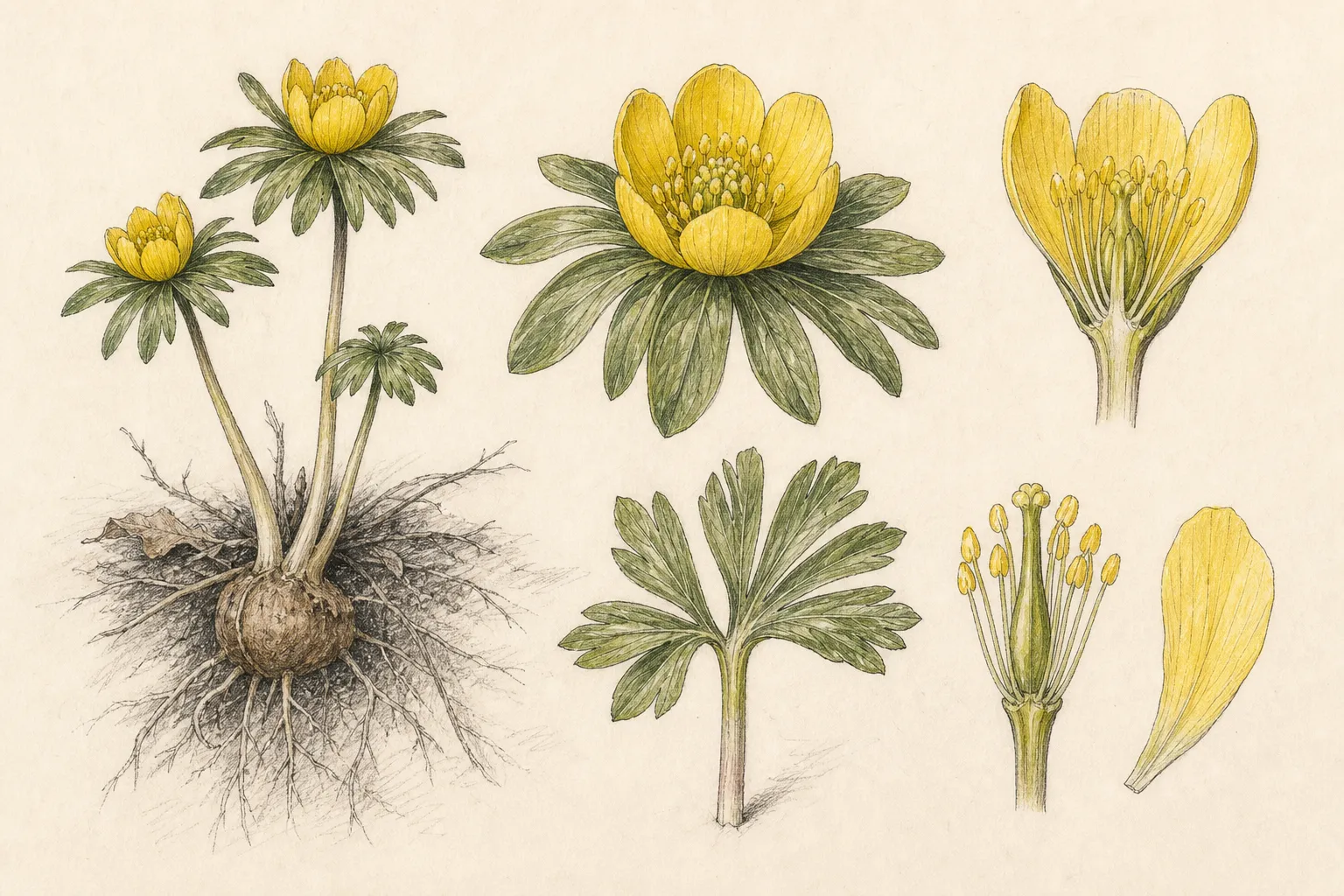
Eranthis hyemalis is a ground-level winter event rather than a permanent edging plant. A short stalk carries one glossy yellow cup above a collar of divided green bracts, often before the basal leaves are fully apparent. The whole plant is only a few inches tall. It is most convincing where the viewer can approach closely: beside a winter path, at the front of a woodland border, or under open deciduous branches.
The plant uses a seasonal light window. It can receive direct sun while the overhead canopy is bare, then retreat as spring shade increases. Missouri Botanical Garden recommends organically rich, medium-moisture, well-drained soil and notes the usefulness of a site sunny at bloom but increasingly shaded after leaf-out. A dense evergreen canopy does not provide the same rhythm.
The “bulb” sold in packets is a small tuber and can lose viability if it dries severely. Plant promptly in late summer or early autumn at the depth and spacing supplied for that stock; the institutional references commonly give roughly 2 to 3 inches deep and 3 inches apart. Soaking advice varies in commerce, so follow the nursery’s handling instruction rather than improvising a long soak that deprives tissue of oxygen.
Winter aconite disappears by late spring. Its absence is normal dormancy, not evidence that the bed is vacant. Mark the colony, pair it with later plants whose roots and crowns will not be repeatedly disturbed, and avoid summer digging in the same soil. A low, spreading companion can conceal the fading foliage while leaving the early shoots enough light.
Naturalization comes from offsets and seed. A successful group often becomes more persuasive over years, but speed depends on pollination, seed maturity, soil conditions, and disturbance. Do not expect a fresh packet of tubers to become a broad yellow sheet in one season. Begin with several irregular pockets and let the spaces between them remain visible.
The plant contains toxic compounds and is unsuitable for edible beds or places where children and pets routinely investigate bulbs. Its small flowers can support early foraging insects, yet wildlife value does not cancel poisoning risk. Site it deliberately, wear gloves for division, and keep detached tubers out of compost piles accessible to animals.
- Family
- Ranunculaceae
- Range
- Southern and central Europe from France toward Bulgaria and adjacent western Asia
- Soil pH
- 6–8
- Spread
- 3–6 in per plant, expanding by seed and offsets · 8–15 cm per plant, expanding by seed and offsets
Planting & careHow to grow winter aconite
The species performs differently across regions. Verify local invasive status and suitability before naturalizing it, especially near woods or natural areas.
- 1Choose deciduous overhead cover
Find a place bright in late winter and gently shaded after trees or shrubs leaf out. Avoid dense evergreen shade and soil that becomes dust-dry every summer.
- 2Prepare a stable woodland surface
Loosen compacted soil only as needed, retain drainage, and add finished organic matter across the bed rather than making rich isolated pockets.
- 3Plant fresh tubers promptly
Plant the small tubers promptly in late summer or early autumn, about 2–3 in (5–8 cm) deep and roughly 3 in (8 cm) apart. Use several irregular groups rather than a single straight row.
- 4Mark the dormant colony
Place a discreet permanent marker outside the planting so later bulb work, edging, or summer renovation does not cut through sleeping tubers.
- 5Let leaves finish
After flowering, retain the green foliage until it yellows and collapses naturally. It is replenishing the underground storage organ for the next cycle.
- 6Divide after flowering when needed
Lift and separate only where a well-established group is overcrowded or moving beyond its boundary. Replant immediately and handle all parts with gloves.
Pruning winter aconite
No pruning is required. Remove foliage only after it has yellowed and detached easily. Avoid cutting the colony with a string trimmer or hoe, and do not tidy away emerging shoots while clearing winter leaf litter.
Seasonal care
Spring
Observe bloom and seed set, keep the root zone evenly moist, divide established clumps after flowering if needed, and allow foliage to decline on its own.
Summer
Respect dormancy, preserve the marker, and avoid excavation or heavy irrigation that leaves the tubers in stagnant soil.
Autumn
Plant fresh tubers promptly, reset displaced markers, and add only a light leaf-mold surface layer that will not bury emerging shoots.
Winter
Watch for the first flowers and clear only matted debris that physically blocks them, using gloves and hand tools rather than a rake across the colony.
Safety and garden spread
Common problems
No emergence
- Look for
- An empty marked area through the expected local season.
- Action
- Check planting date, tuber freshness, depth, drainage, and disturbance history. Wait through the full regional window before digging into a dormant planting.
Sparse return
- Look for
- Fewer flowering shoots after an initially good year.
- Action
- Review summer drying, standing winter water, premature foliage removal, and competition from dense companions. Correct the site condition rather than feeding blindly.
Crowded declining patch
- Look for
- Many small leaves and fewer well-formed flowers in an old colony.
- Action
- After flowering, lift a limited section, discard unsound tissue, and replant sound tubers with room. Leave the rest undisturbed as a control.
Unwanted spread
- Look for
- Seedlings appearing beyond the intended ornamental pocket.
- Action
- Remove young seedlings with gloves before seed set and maintain a visible boundary. Check local guidance before allowing the species near natural areas.
Plant details
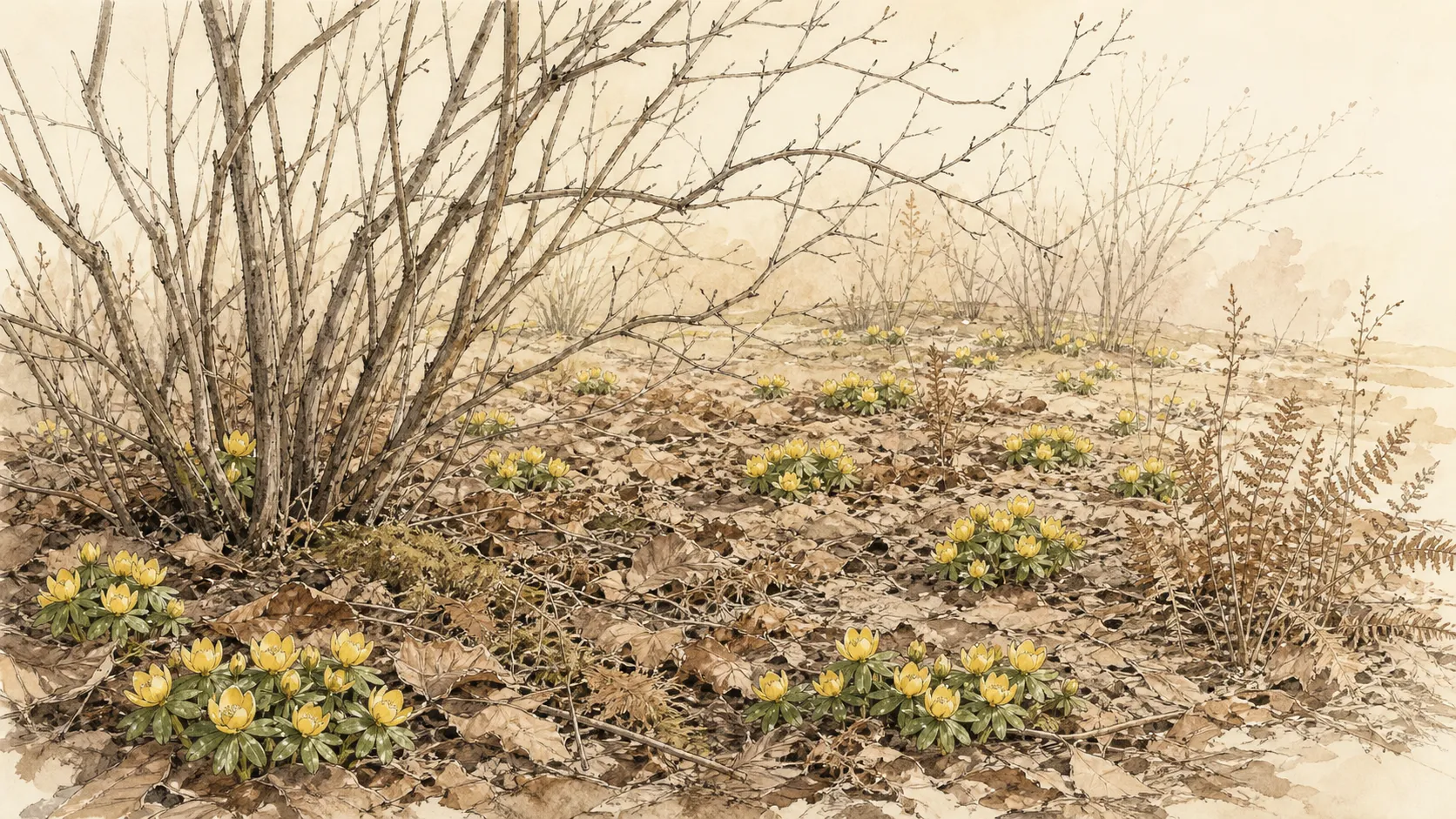
Small irregular groups of winter aconite flowering through leaf litter beneath deciduous shrubs
Related reading
Sources
- Eranthis hyemalis. North Carolina Extension Gardener Plant Toolbox. Source record · Accessed 2026-08-30.
- Eranthis hyemalis. Missouri Botanical Garden. Source record · Accessed 2026-08-30.
- Eranthis hyemalis. Royal Horticultural Society. Source record · Accessed 2026-08-30.