Gardens · late winter fragrance path wind shelter
Design a Late-Winter Fragrance Path That Works in Cold Air
Place fragrant winter shrubs around a real walking route, using shelter, mature scale, flower height, and seasonal access to make scent perceptible.
Published Last updated
In this guide
Begin with the winter journey
A fragrance garden fails when its scented plants are placed as remote specimens. Winter flowers are often small, the air is cold, and visitors move quickly unless the route offers a reason to slow down. Walk the property on several calm and breezy days. Mark the door used in winter, the path that is actually cleared, the gate that sticks, the patch where ice lingers, and the places where a person naturally pauses to latch, turn, or look.
Record the journey in both directions. A shrub noticed while leaving the house may be hidden by a door swing on the return, and a plant beside the summer route may sit beyond a snow bank in February. Observe from standing and seated height. Winter honeysuckle flowers carried above eye level, low sweet box beneath a window, and ground-level bulbs beside steps create different encounters even if their catalog descriptions all say fragrant.
Separate a destination from a passage. A bench in full winter shade may be too cold to invite a long stay, while a sheltered widening of the path can support a thirty-second pause. Place the strongest close-range detail there. Reserve the longer view for branch silhouettes and pale flower clusters that can be read before the scent becomes apparent. The visitor should discover the planting rather than search a border for an odor promised on a label. Map obstacles as permanent design shapes. Keep landing depth, handrails, lighting, house numbers, gate swings, utilities, drainage channels, and the cleared walking width open at mature plant size. A flexible branch still obstructs a route when it is wet or snow-loaded. Scent does not justify planting a thorny, toxic, or oversized shrub where people must brush past it, and local access requirements remain more important than the ornamental sequence.
Read cold air and winter wind
Fragrance molecules move differently with temperature, humidity, and air movement, but the garden decision is observational rather than theoretical. Stand at each proposed pause while a light breeze is moving. Note where air accelerates between buildings, curls around a hedge, or settles behind a wall. Repeat the observation from more than one winter direction because a single prevailing-wind arrow cannot describe every cold front or sheltered courtyard.
A completely exposed shrub may release fragrance that is carried away before a visitor reaches it. A plant pressed into a stagnant, wet recess may flower poorly or develop root and foliar problems. Seek a middle condition: moving air moderated by a permeable hedge, fence, evergreen mass, or building corner, with enough openness for the crown to dry and enough winter light for the selected species.
Low winter sun can warm flowers and improve the experience during part of the day. Plot sun at the hours when the route is used, not as a daily total copied from summer. Deciduous overhead branches, rooflines, and neighboring buildings produce long seasonal shadows. A south-facing masonry pocket may become valuable in a cold region but damaging in a climate where winter warmth prompts early growth before a hard freeze.
Treat scent as a short-range layer rather than a property-wide cloud. The Penn State and RHS sources describe several shrubs with notable winter fragrance, yet intensity varies among taxa, cultivars, weather, flower stage, and individual perception. Place each plant where its flowers can also be seen and its habit earns space. A visually coherent path remains successful on a cold day when little fragrance travels.
Draw the route before choosing fragrant plants
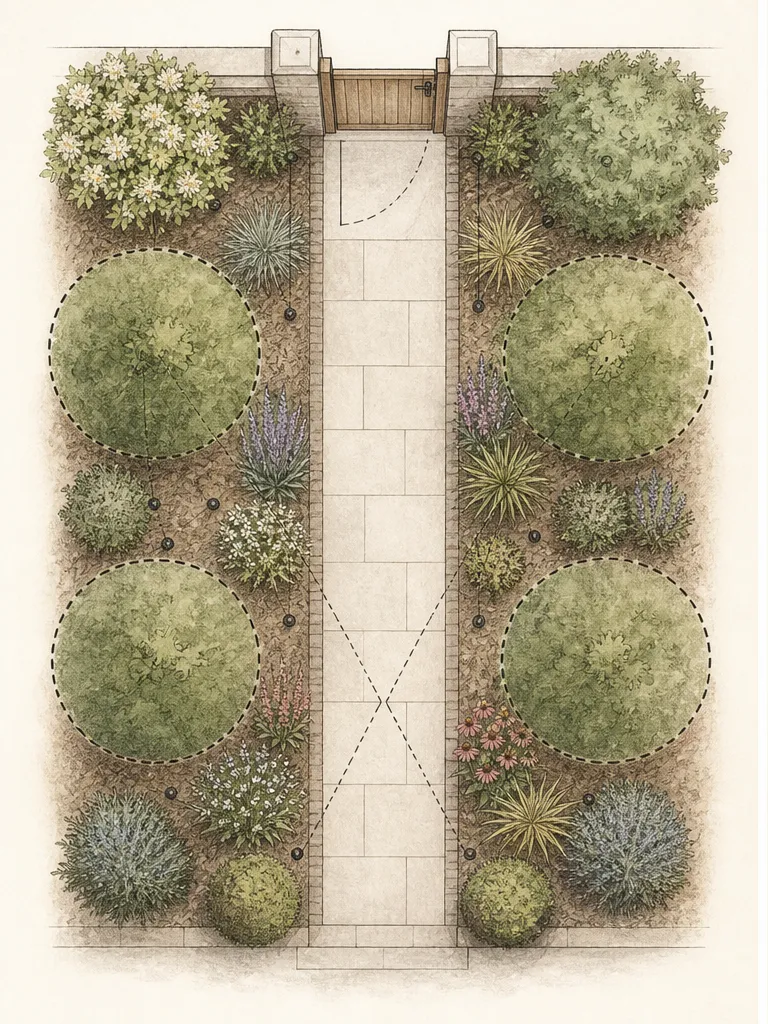
Create a measured base plan with the path, landings, doors, gates, windows, slopes, downspouts, utility zones, and existing woody roots. Add the minimum maintained route plus extra width at pauses. Then draw each candidate as a mature outline from a reliable plant profile. Do not use the nursery pot as a scale symbol. A four-foot plant in a two-foot gap creates a pruning problem, not an intimate sensory moment.
Assign fragrance to three positions: threshold, pause, and distance. A low evergreen such as sweet box can serve a sheltered threshold where regional conditions suit it. A witch hazel or paperbush can occupy a wider pause where the branchwork has room. A larger winter honeysuckle or wintersweet can mark the distant turn. This hierarchy prevents every plant from crowding the path edge and gives the route a legible rhythm.
Keep fragrant flowers at reachable viewing distance while protecting the plant. A visitor should not need to pull a branch down or step into a crown. Place a broad shrub beside the outside of a curve, set low plants near but beyond the paving edge, and preserve a stable inspection point. Use the path surface and a quiet background to make small flowers visible instead of surrounding every fragrant plant with competing winter color.
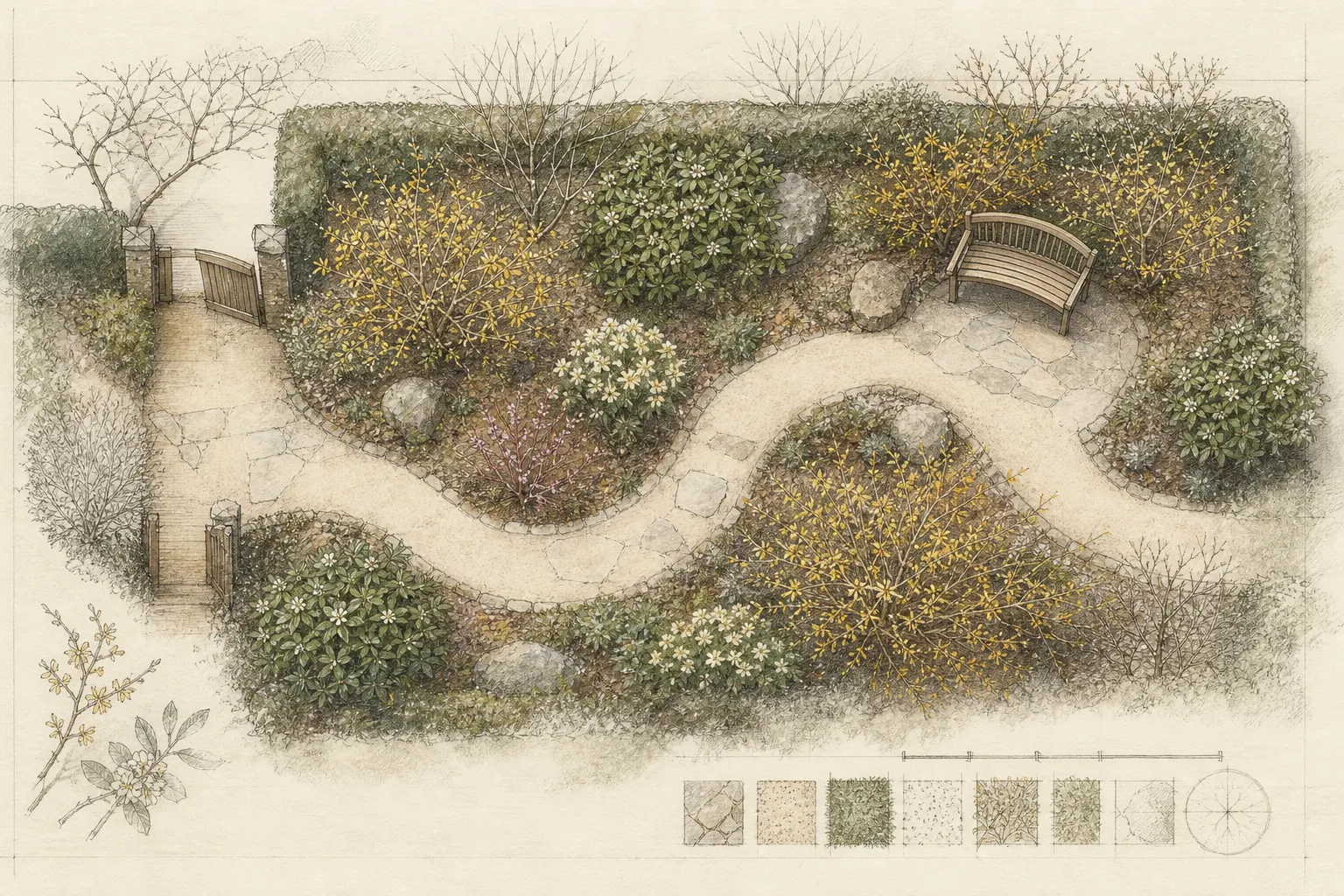
Plan the least attractive season as carefully as bloom. Deciduous shrubs may become plain green masses in summer; spring bulbs disappear; evergreen fragrance plants remain visually heavy. Draw the same route in June and October. Add summer foliage and groundcover only where roots, moisture, light, and maintenance are compatible. Avoid filling every winter gap, because negative space lets a visitor see branch form and keeps paths serviceable.
Use shelter to retain scent, not to trap damp
A windbreak should alter exposure at human and flower height without sealing the planting into a damp box. Existing hedges, slatted fences, walls with open ends, and evergreen groups can slow air. Measure the leeward pocket during rain and thaw. If water sits around the proposed shrub or the route remains icy, correct drainage and circulation before adding a plant that prefers humus-rich but freely drained soil.
Place shelter far enough away to preserve mature spread and maintenance access. An evergreen planted directly behind a witch hazel may eventually consume its light and branch space. A fence too close to a paperbush can rub flexible shoots and prevent inspection. Draw both mature outlines and a working strip between them. The composition should still allow selective pruning, leaf cleanup, wall care, and replacement of a failed plant.
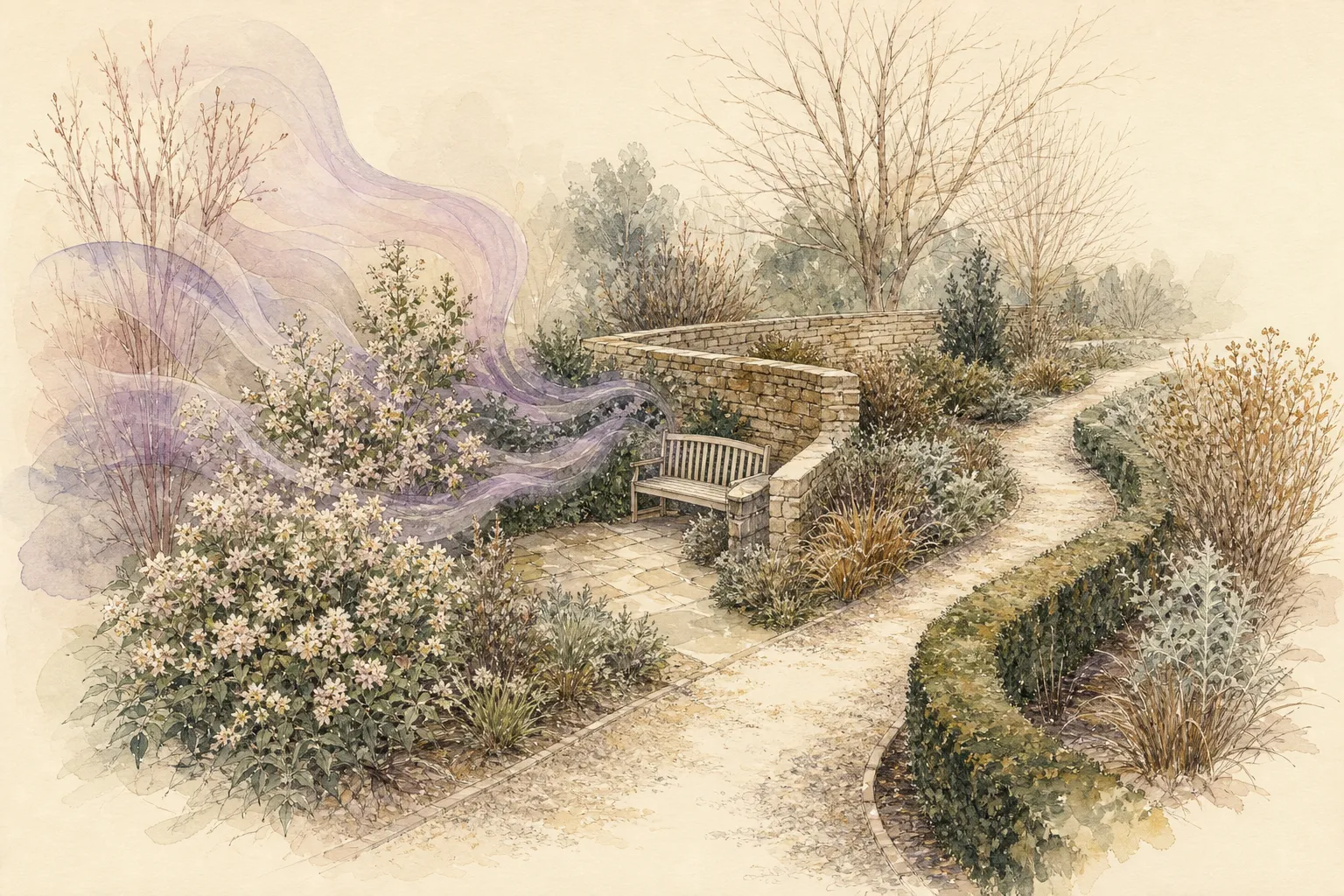
Use topography cautiously. A lower pocket may hold still air and display scent on a mild afternoon, yet it can also collect frost and meltwater. A raised border may drain well but expose flowers to stronger wind. Compare the plant’s cold tolerance, bloom timing, and moisture preference with the actual microclimate. Do not build a mound against tree roots or a foundation merely to create a warmer-looking scene.
Test the route with temporary markers before planting. Place stakes or empty pots at the proposed centers and tie string at expected mature width. Walk the cleared winter route carrying bags, opening gates, and using handrails. View the markers from indoors. This simple rehearsal reveals conflicts that a flat drawing misses and often shows that fewer, better-positioned shrubs will provide a stronger sensory sequence.
Build one source-bounded planting sequence
Consider a sheltered Zone 7 courtyard with moist but well-drained loam, morning sun, light afternoon shade, and a twelve-foot route between a house door and garden gate. This is a worked composition, not a national plant list. Confirm current local hardiness, invasive status, toxicity, cultivar dimensions, and nursery identity before purchase. Substitute only with a plant that matches the same root conditions, mature role, and maintenance space.
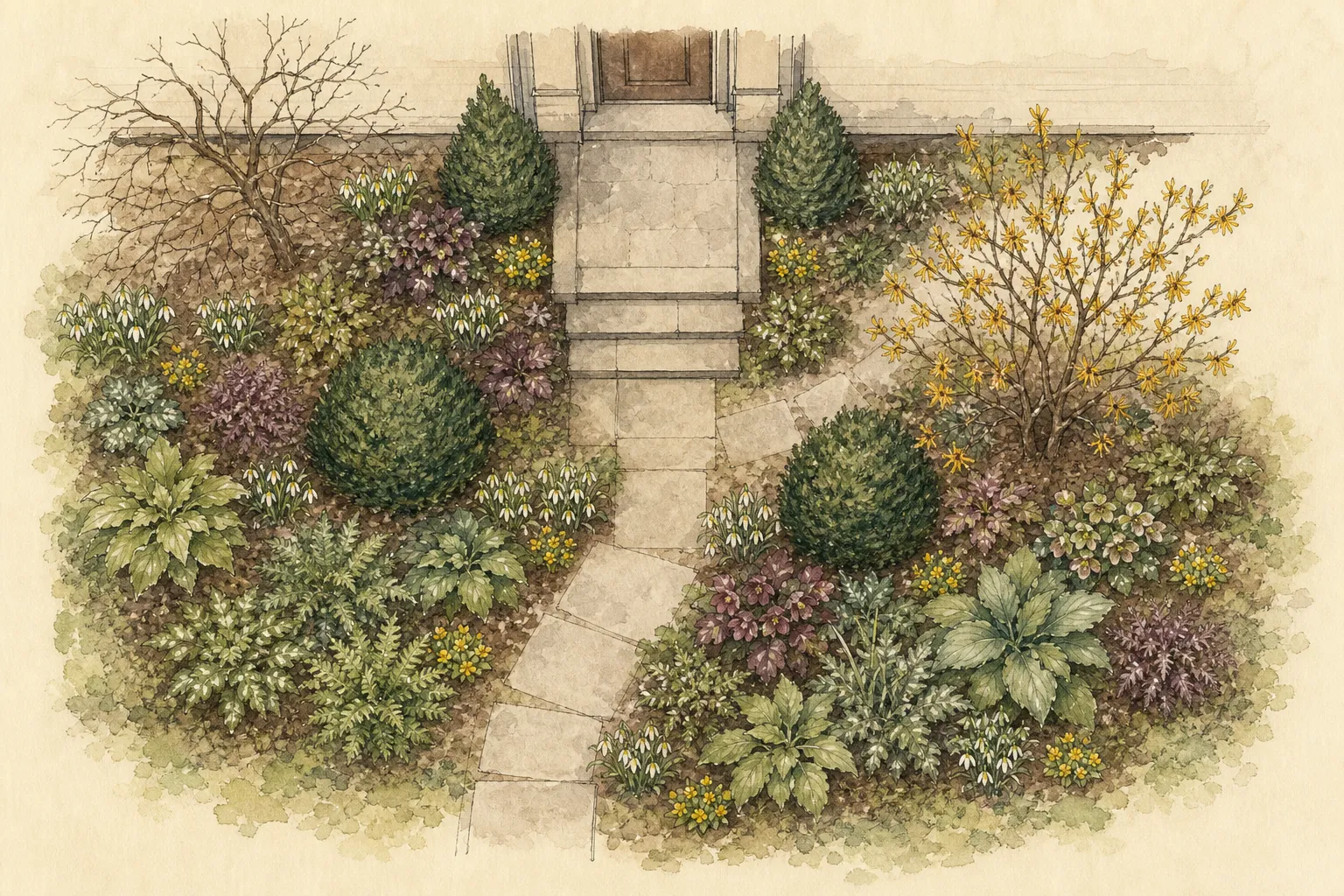
At the threshold, use three Sarcococca hookeriana var. digyna selections only where local evidence supports the taxon and the measured bed can hold their eventual spread. Set them beyond the landing and door swing, with flowers near knee height and evergreen foliage framing the first turn. Their role is low winter scent and year-round edge structure. In colder or exposed regions, replace the role rather than pretending a wall guarantees survival.
At the widened pause, place one Hamamelis vernalis where a full eight- to fifteen-foot spread can develop. Its Ozark origin, suckering habit, and moisture needs must fit the site. Put the center outside paving and utility zones, use a dark evergreen mass at a respectful distance behind it, and keep the near side open for viewing. Remove boundary suckers while young if the design calls for a specimen rather than a colony.
Near the final turn, use one Lonicera fragrantissima only after checking local status and mature dimensions. Give its arching crown room away from the gate and pair it with a summer-facing foliage group that tolerates the same soil. The winter honeysuckle provides a broader distant mass and a second fragrance moment. If it is invasive or unsuitable locally, choose a regionally appropriate winter-flowering shrub with comparable size, exposure, and pruning needs.
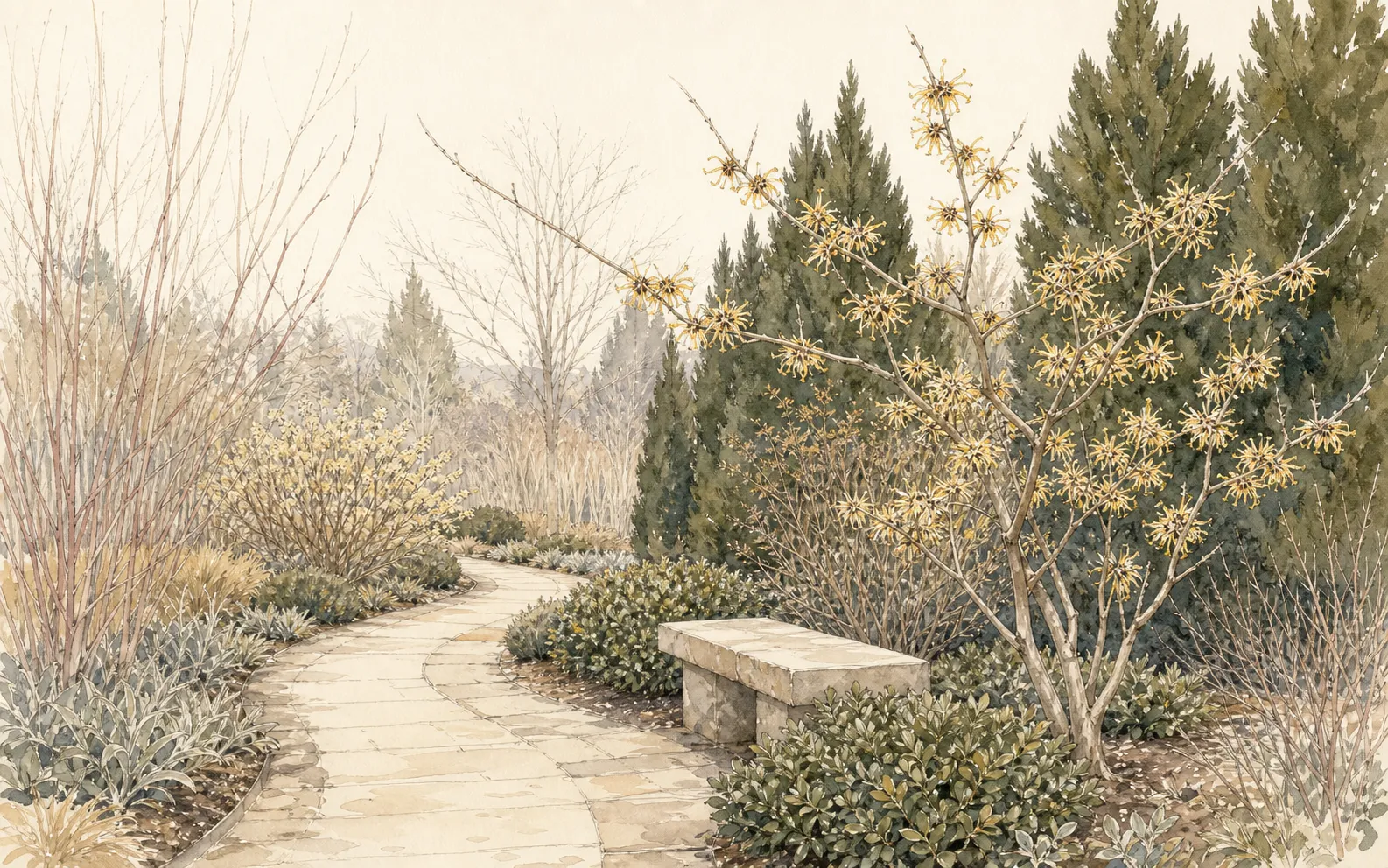
Add a small Galanthus nivalis drift only where nursery-propagated stock is locally acceptable. Place several irregular clumps beyond the path edge beneath deciduous cover, leaving visible soil between them. The snowdrops create a low visual cue that draws the eye toward the pause, then go dormant. Mark their location and use later foliage that will not require summer digging through the bulbs.
The sequence is intentionally spare. Each fragrance source occupies a different height and distance, while evergreen backing, path geometry, and dormant stems carry the scene between flowers. Additional taxa should enter only when they solve a measured gap in season, scale, or habitat. A collection of six scented shrubs in one small court produces competition and maintenance debt, even if every plant is individually desirable.
Stagger bloom by observation, not catalog months
Catalog bloom months are regional summaries. Build the initial sequence from authoritative profiles, then keep a simple record of first open flower, peak scent, flower finish, and damaging weather for each plant. Include the time of day and the point on the route where fragrance was perceived. Three years of local notes are more useful for refinement than a single unusually warm February.
Overlap events instead of demanding a continuous unbroken perfume. A mild spell may compress several shrubs into one week, while a hard winter may hold buds closed. Give each plant an independent visual role so the path does not feel empty when its flowers pause. Witch hazel branchwork, sweet box foliage, snowdrop clumps, bark, and retained seedheads can carry separate moments.
Flowering dates can shift as a shrub matures and nearby canopy changes. A young plant may bloom sparsely; an evergreen screen can thicken; a tree can cast more shade. Recheck useful light and wind every few years. If one plant consistently misses the route’s use period, move or replace it only during the locally suitable season and only if its roots can be handled safely.
Avoid pruning the bloom calendar away. Many winter-flowering shrubs carry flowers on growth made before winter, so late-autumn or winter clipping removes buds. Record each taxon’s flowering wood and correct pruning window. Make selective cuts after bloom where guidance supports them, preserve the natural outline, and reject a design that depends on repeated size reduction beside the path.
Audit the route after rain, frost, and leaf-out
A winter fragrance path is still infrastructure. Inspect paving after rain and freeze, confirm that runoff does not cross the walking line, and keep lighting and handrails unobstructed. Look for branches weighted into the route by wet snow. Correct the underlying placement or support problem rather than tying mature shrubs back every winter. Safety and ordinary passage are part of the garden’s beauty.
Stand inside the house and look toward the route. Windows can frame flower clusters and colored stems, but shrubs should not block useful daylight, egress, or maintenance. A plant placed primarily for scent may be visually untidy from the room during summer. Adjust companion foliage and background mass while keeping the fragrant crown open and the wall-side service route accessible.
After deciduous leaf-out, check whether the early bulbs and low evergreens have enough light and whether summer companions bury dormant crowns. Trace irrigation coverage across the entire root zone. Winter-fragrant shrubs with different moisture needs should not share one undifferentiated watering schedule. Group compatible roots, then let repetition of form or color connect substitutions across changing conditions.
Remove a plant when it repeatedly fails the site, not when one storm spoils a display. Document cold injury, drought stress, waterlogging, or excessive pruning before acting. Replacement is an opportunity to correct scale or exposure. The route should grow clearer as evidence accumulates: fewer obstacles, better-timed encounters, and plants whose fragrance, form, and root needs belong to the same place.
Design ideas
- Style
- Sheltered sensory winter garden
- Space
- Path, courtyard, or entry route
- Climate
- The worked sequence assumes a sheltered Zone 7 courtyard with morning sun and moist but well-drained loam. Every taxon requires local hardiness, invasive-status, toxicity, and mature-size confirmation.
- 1Threshold scent below the handrail
Use one low evergreen fragrance group outside the landing and door swing. It should frame arrival, remain below sight lines, and tolerate the measured light and soil. Preserve a clean paving edge and access to walls, lights, drainage, and handrails; replace the plant role when local winter exposure is unsuitable.
- 2A broad shrub at a real pause
Widen the path before placing a large winter-flowering shrub. Reserve its complete mature outline, stand where flowers can be viewed without pulling branches, and keep a dark background at enough distance to avoid future crowding. The pause should remain comfortable while carrying a bag or opening a gate.
- 3Ground-level flowers as a directional cue
Set several small bulb clumps on the side of the route that leads toward the main fragrant shrub. Leave soil and leaf litter visible between groups, mark summer dormancy, and choose later companions that will not require excavation. Use nursery-propagated material and check local naturalization guidance.
- 4One distant fragrance mass
Place a larger arching shrub near the far turn where its crown can be seen before it is smelled. Keep it clear of the gate and provide a summer foliage partner for the same root conditions. If the named taxon is invasive or climatically unsuitable, replace its mature role rather than its flower color alone.
- 5Permeable shelter with working space
Use an existing hedge, slatted fence, or evergreen group to slow wind around a pause. Retain open ends and enough separation for both crowns to dry and be maintained. Inspect meltwater and ice before planting; a still pocket that remains saturated is not a successful fragrance trap.
- 6A local bloom ledger
Record first flower, strongest scent, finish, damaging weather, and the point on the route where each plant is experienced. Compare several seasons before changing the planting. The notes reveal real overlap, changing shade, and pruning errors while protecting the garden from impulsive additions after an unusual winter.
- 7A sheltered indoor viewpoint
Frame one flower-bearing crown from the window used most often in winter, then verify the same plant from the outdoor route. Keep its mature outline below useful daylight and away from egress, meters, and wall maintenance. Use pale flowers against a dark, distant background, but preserve air between the two crowns. The composition should remain readable when cold weather keeps visitors indoors, without turning a fragrance plant into an overgrown foundation shrub.
- 8A restrained summer handoff
Pair the winter sequence with a limited summer layer that shares its light, drainage, and moisture rather than filling every dormant interval. Map bulb foliage and shrub roots before adding perennials. Choose one repeating leaf form or quiet flower color, preserve bare inspection space around woody stems, and keep later growth outside the walking line. The summer planting should support the route after winter bloom without concealing drainage problems or requiring excavation through dormant bulbs.
- 9A thaw-day maintenance route
Reserve a place to stand while checking mulch, drainage, storm damage, and labels during a winter thaw. The working position must not compress bulb ground or require reaching through flowering stems. A discreet stepping surface or widened path keeps the sensory route serviceable and lets small defects be corrected without turning maintenance into an unsightly shortcut through the planting.
Plants in this guide
Related reading
Sources
- Fragrant Winter Shrubs. Penn State Extension. Source record · Accessed 2026-08-19.
- Scented Winter Shrubs. Royal Horticultural Society. Source record · Accessed 2026-08-19.
- Landscape Design. NC State Extension Publications. Source record · Accessed 2026-08-19.