Ozark Witch Hazel
Hamamelis vernalis
A practical species profile of Hamamelis vernalis, the broad, fragrant winter-flowering shrub native to gravelly Ozark stream corridors.
Published Last updated
At a glance
- Light
- Full sun to partial shade; flowering is strongest with ample sun
- Water
- Medium and consistent during establishment; avoid prolonged summer drought
- Soil
- Humus-rich, moist but well-drained acid to neutral soil; clay is tolerated where drainage remains open
- Hardiness
- Zones 4–8
- Bloom
- Midwinter to early spring, commonly January through March in the lower Midwest
- Height
- 6–10 ft, occasionally taller · 1.8–3 m, occasionally taller
In this guide
Overview
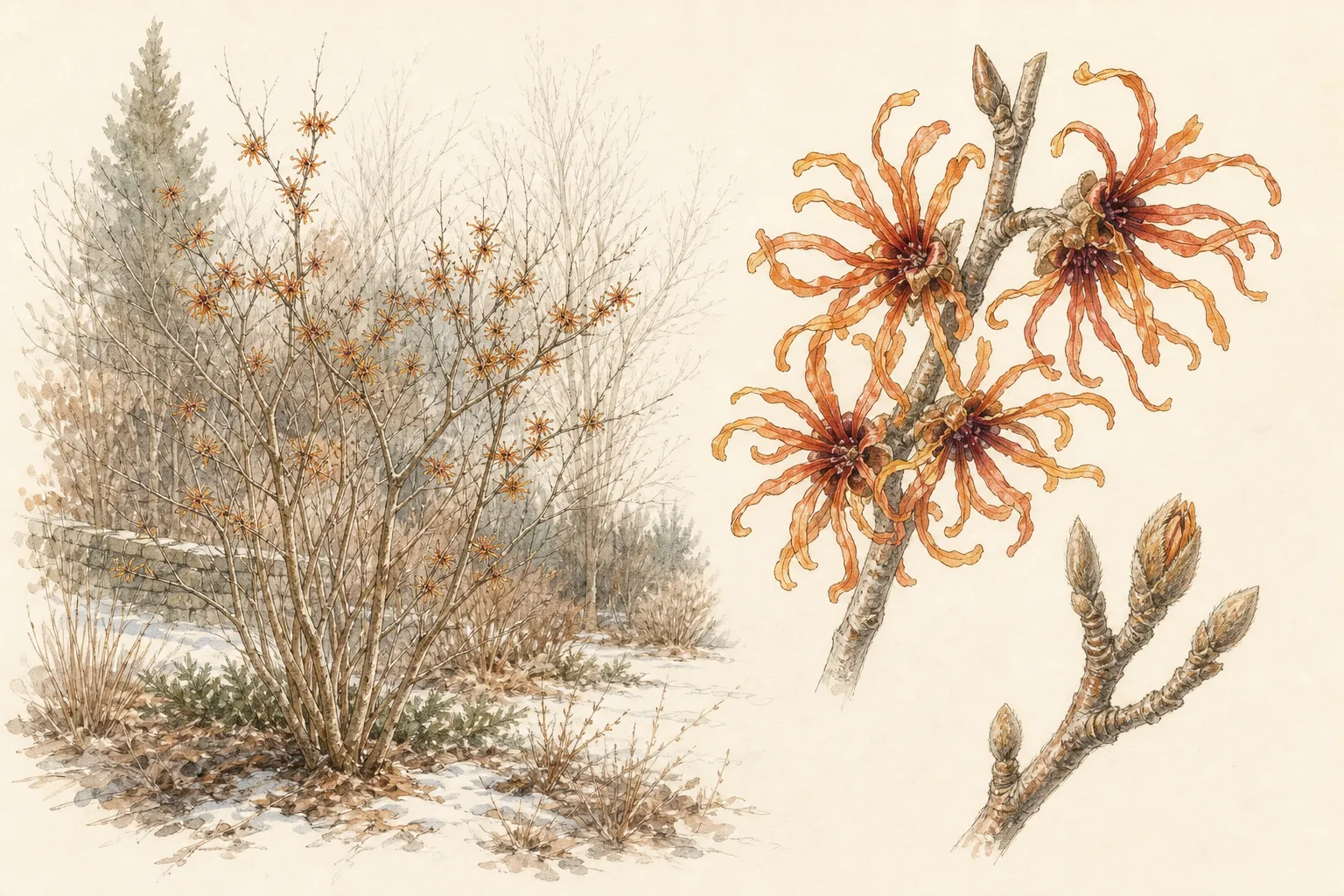
Hamamelis vernalis is one of the few woody ornamentals whose main flower display belongs to winter. Clusters sit close to bare twigs, each flower carrying four narrow petals that can curl inward during severe cold and extend again as conditions moderate. The flowers range from yellow through copper and reddish orange, and their fragrance is easiest to notice in still air at close range. A specimen belongs near a route or view, not at the remote back of a property where its small flowers disappear.
The species is native to gravelly stream beds, wooded slopes, and related sites in the Ozark region. That origin should not be simplified into either “wetland shrub” or “drought shrub.” Established plants tolerate clay where excess water can leave the root zone, yet they perform best with reliable moisture and can scorch during hot, dry summers. A rain-garden edge may suit it when inundation is brief and the crown does not remain waterlogged.
Mature scale is the decisive design fact. Missouri Botanical Garden describes a plant commonly 6 to 10 feet high and 8 to 15 feet wide; North Carolina Extension notes that some plants become larger. Root suckers can create a broad colony. Reserve the full spread, keep it clear of narrow foundations and gates, and decide at planting whether the design welcomes a thicket or requires regular sucker removal.
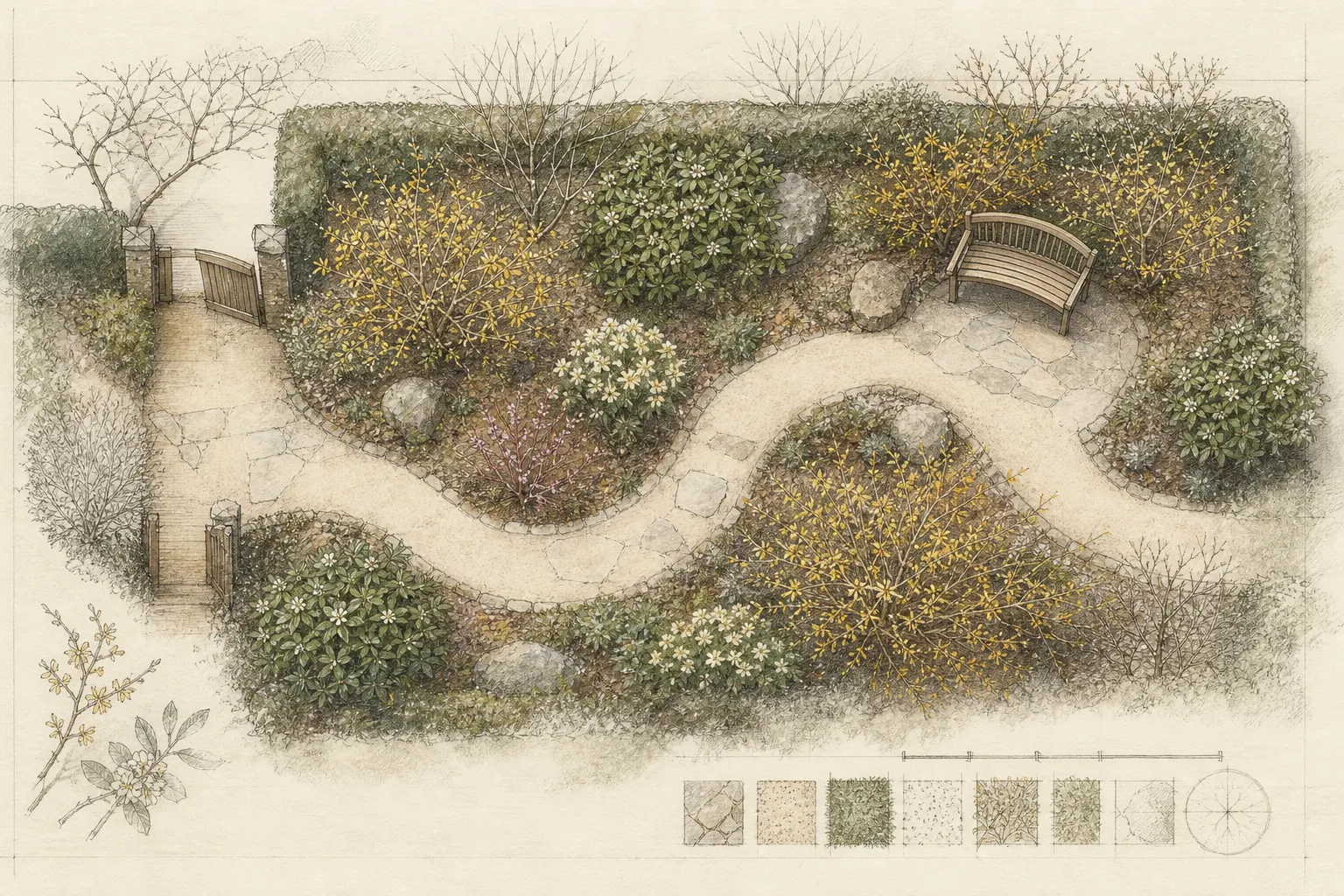
Leaves are broadly oval and can turn yellow in autumn, but the winter branchwork and flowers are the stronger reasons to grow the species. The dense multi-stem outline works at a woodland edge, above a moist swale, or as a screening mass set back from a path. Use an evergreen or shaded wall as a visual background, while keeping enough open air around the crown for the natural layered branching to remain legible.
Named selections differ in flower color, fragrance, height, and habit. Grafted plants may send up rootstock suckers that do not match the named top. Keep the nursery label, identify the graft union if present, and remove shoots arising below it. Straight species grown from seed can also vary, which is valuable in a naturalistic planting but relevant when a precise color is promised.
Winter flowering is locally timed. A January date in St. Louis does not guarantee a January display in a colder or warmer garden, and a thaw may open flowers before a later freeze. Treat the documented bloom window as a range, then record the actual plant over several years. Flowering wood is formed before bloom, so indiscriminate winter clipping removes the feature the shrub was chosen to provide.
- Family
- Hamamelidaceae
- Range
- Ozark Plateau of southern Missouri, northern Arkansas, and eastern Oklahoma
- Soil pH
- 5–7
- Spread
- 8–15 ft · 2.4–4.6 m
Planting & careHow to grow ozark witch hazel
USDA Zones are a broad temperature screen. Missouri Botanical Garden gives 6–10 ft as a common species height, while NC State records plants to 16.5 ft; the displayed height therefore flags that older or favorably sited shrubs may become taller. Summer heat, drought, soil moisture, wind exposure, provenance, and cultivar identity still determine local performance.
- 1Reserve the mature footprint
Draw an 8- to 15-foot-wide outline before purchase. Keep that outline outside paths, windows, utilities, neighboring property, and structures that would force regular shearing.
- 2Read moisture after rain
Check several points around the proposed root zone after meaningful rain. Favor soil that remains evenly moist but drains; reject a basin that holds stagnant water around the crown.
- 3Place fragrance within reach
Site the shrub near a path, gate, or frequently viewed winter route while preserving its spread. A sheltered position allows fragrance to linger and protects flowers from drying wind.
- 4Set the root flare at grade
Plant the upper structural roots at finished soil level, spread circling roots where feasible, and backfill with the excavated soil unless a site-specific prescription calls for broader work.
- 5Water the original root ball
During establishment, inspect moisture within the nursery root ball as well as in the surrounding soil. Apply water slowly across the occupied root zone and let excess water drain.
- 6Define the sucker policy
For a specimen, remove unwanted suckers when young and trace graft-origin shoots carefully. For a colony, mark the permitted boundary and keep paths and companion crowns open.
Pruning ozark witch hazel
Prune minimally after flowering. Remove dead, damaged, rubbing, or badly placed stems at their origin, and take unwanted suckers while small. Avoid shearing: it obscures the layered habit and repeatedly removes flowering wood. A neglected colony can be thinned over several years rather than cut into a tight geometric shell.
Seasonal care
Spring
Observe flowering finish before pruning, remove rootstock or boundary suckers, refresh a shallow mulch ring away from stems, and water new plants through dry intervals.
Summer
Check deep moisture during heat, especially on exposed sites. Leaf scorch concentrated on the hot side is a reason to assess water and wind before adding fertilizer.
Autumn
Record leaf color and mature spread, clear leaves only where they bury the crown, and complete suitable planting early enough for roots to settle before hard freezes.
Winter
Enjoy flowers from the path, note fragrance and color in different weather, and postpone size-control pruning until the display has finished.
Safety and garden spread
Not grown as an edible plant. Keep all garden plant material away from children and pets that chew unfamiliar plants.
Common problems
Summer leaf scorch
- Look for
- Brown leaf margins or patches concentrated on the hottest, driest, or windiest exposure.
- Action
- Check soil moisture at root depth, irrigation coverage, reflected heat, and recent root disturbance. Restore steady moisture without leaving the crown saturated.
Unwanted suckering
- Look for
- New stems arising beyond the intended footprint or below a visible graft union.
- Action
- Trace each shoot to its origin and remove it cleanly while young. Repeatedly cutting only the visible top encourages a congested boundary.
Sparse winter flowers
- Look for
- A healthy shrub with few flower clusters compared with previous years or nearby plants.
- Action
- Review useful sun, pruning date, drought during bud formation, cultivar identity, and winter weather. Avoid routine feeding until a specific deficiency is established.
Root-zone decline
- Look for
- Weak extension growth, thinning crown, small leaves, or dieback associated with standing water or buried stems.
- Action
- Expose the root flare, inspect drainage and grade, remove excess mulch from stem bases, and seek a local diagnosis when decline continues.
Plant details
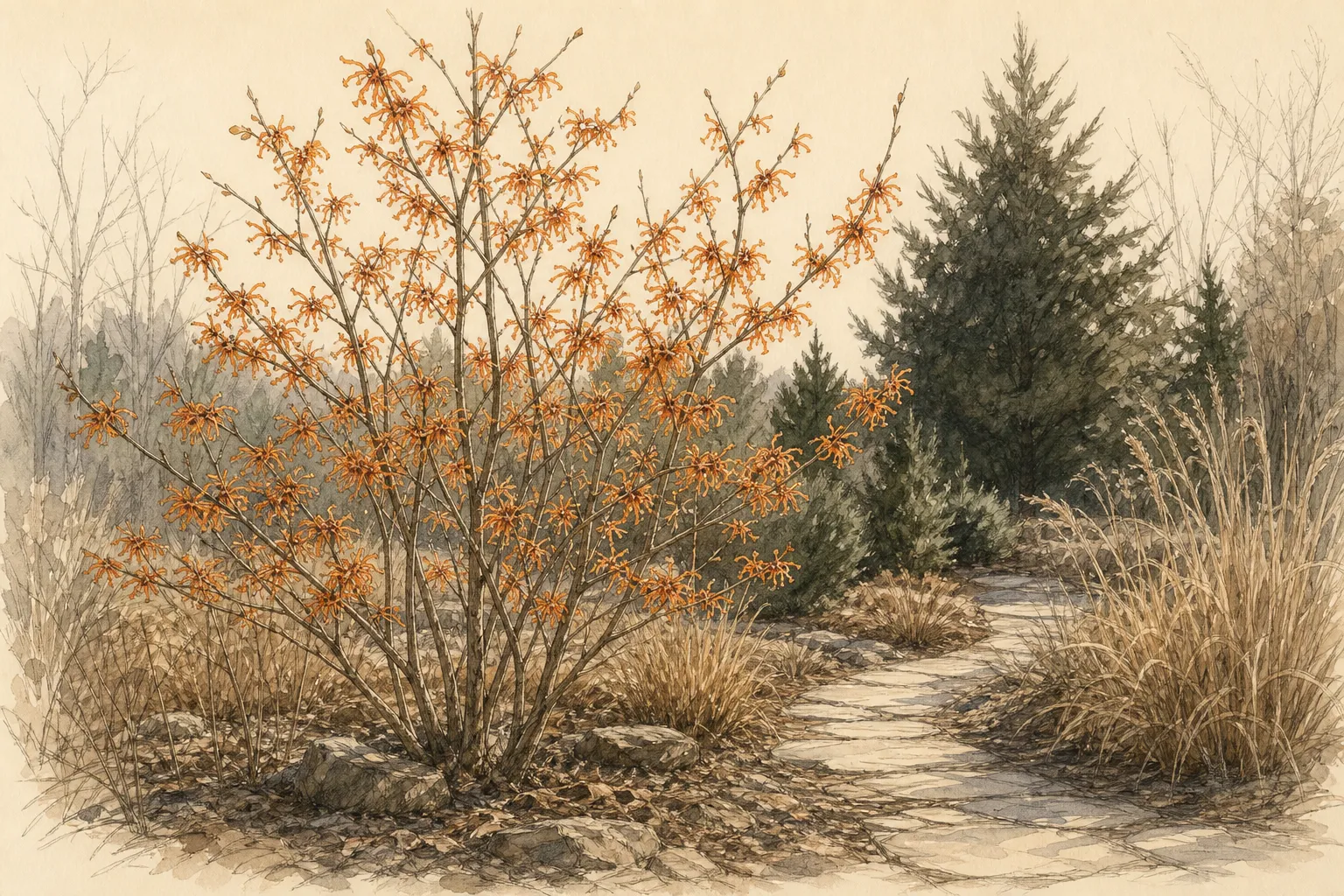
Mature Ozark witch hazel flowering beside a late-winter garden path with dark evergreen backing
Related reading
Sources
- Hamamelis vernalis. Missouri Botanical Garden. Source record · Accessed 2026-08-30.
- Ozark Witch Hazel. North Carolina Extension Gardener Plant Toolbox. Source record · Accessed 2026-08-30.
- Hamamelis vernalis. Royal Horticultural Society. Source record · Accessed 2026-08-30.
- Hamamelis vernalis Sarg.. Royal Botanic Gardens, Kew. Source record · Accessed 2026-08-30.