Gardens · winter garden indoor view composition
Frame a Winter Garden View from the Room You Actually Use
Design one layered winter composition from an occupied indoor viewpoint while preserving daylight, access, drainage, and four-season garden structure.
Published Last updated
In this guide
- Choose one occupied viewpoint
- Measure the occupied viewpoint
- Inventory winter features honestly
- Compose depth inside the window frame
- Build a source-bounded plant framework
- Design the ground plane and seasonal handoff
- Test winter light, reflection, and weather
- Edit the view once each year
- Test one paperbush against the actual window view
- Design ideas
Choose one occupied viewpoint
A winter view is not designed from the middle of the lawn. Begin in the room where someone regularly sits, works, cooks, or passes during the cold season. Choose one primary position and one secondary standing position. The chair at breakfast height, the sink, and the doorway can see different strips of the same border. Trying to satisfy every point equally usually produces a vague arrangement rather than a deliberate composition.
Photograph the view on a bright overcast day, in low sun, after rain, and after snow if the climate provides it. Include the complete window frame, sill, curtains, screens, and reflections. The frame is part of the design: it crops branches, hides low ground, and can turn a small feature into a focal point. A plant visible outdoors at waist height may disappear completely below a high interior sill.
Record how the room is used. Preserve daylight at a desk, privacy at a neighboring window, a child-safe outlook, and clear egress where required. Plants cannot block vents, meters, heat pumps, window cleaning, or foundation inspection. A winter composition that darkens an already dim room or demands annual shearing against glass is not successful, even if the nursery labels promise colorful stems.
Decide the emotional register before listing plants. A quiet pale scene may use a few repeated verticals and soft seedheads. A graphic scene may contrast white bark, a clipped dark evergreen mass, and open snow. A naturalistic view can show layered twigs and retained stems without becoming visually congested. The intended character gives a reason to omit attractive plants that belong to another composition.
Measure the occupied viewpoint
Measure eye height at the primary seat, sill height, window width, distance to the glass, and distances from glass to the near bed, middle border, and background. On a simple section drawing, project the sight line over the sill. Mark the band that must remain open for useful sky and daylight. Then draw existing fences, buildings, trunks, utilities, and grade changes at their actual positions.
Create a matching elevation from inside. Outline every existing woody plant at current and credible mature size. Do not draw only the portion visible in winter; summer foliage will occupy more visual mass and may shade the room. Include snow accumulation, roof shedding, downspout discharge, and the route used for window or wall maintenance. These constraints determine where a permanent focal shrub can safely stand.
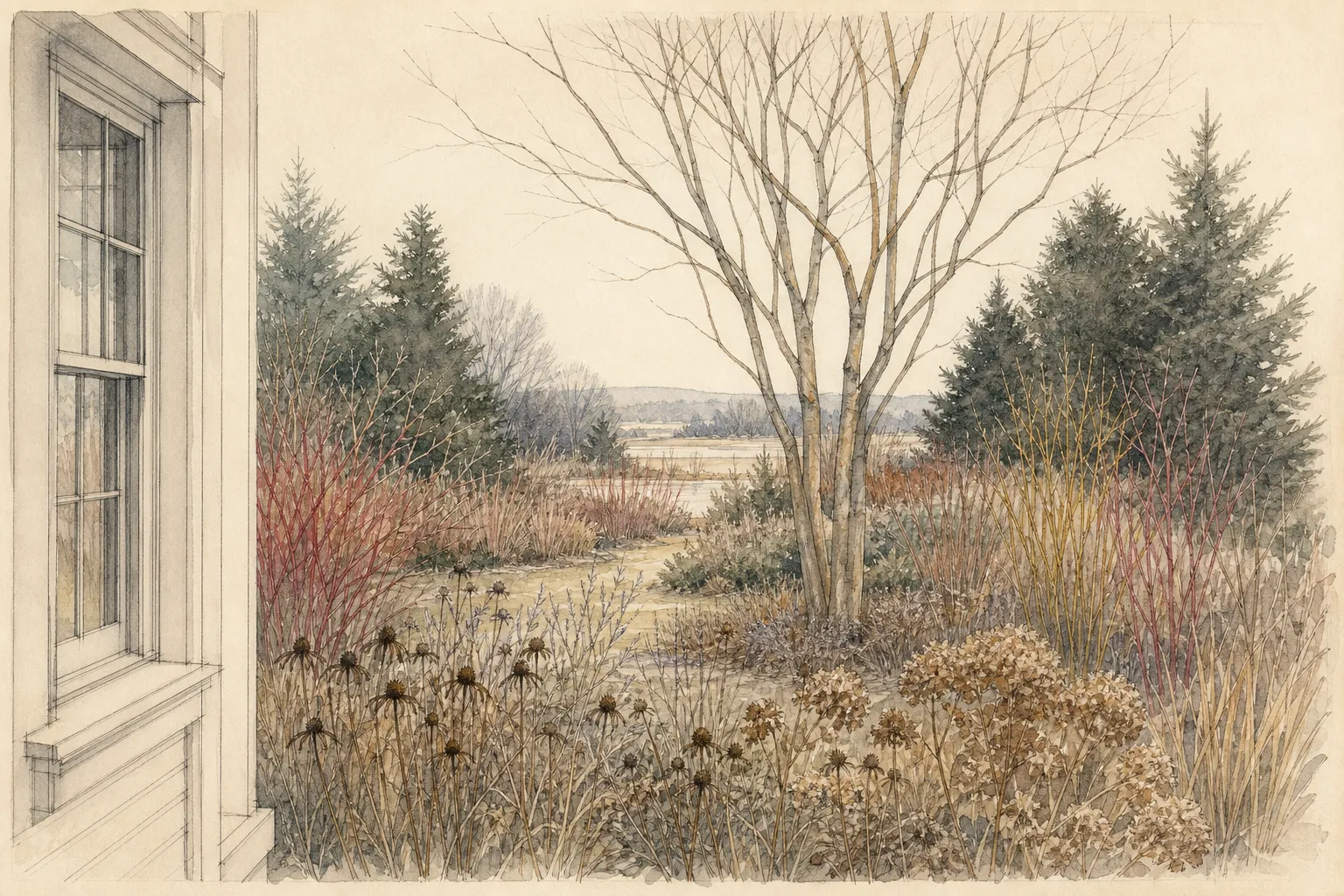
Use stakes outside to test the drawing. One person sits at the viewpoint while another moves a tall pole or bright card through proposed positions. Mark where the focal point is fully visible, partly cropped, or aligned awkwardly with a post or neighbor’s roof. Repeat from the secondary position. A shift of two feet can separate a branch silhouette from background clutter without changing the plant list. Observe parallax. A near stem moves across the background as the viewer changes position, while a distant feature remains stable. Use that movement intentionally: a sparse foreground branch can reveal and conceal a farther pale trunk, giving depth. Avoid a dense near evergreen directly against the glass, where it becomes a dark wall from every angle and narrows both light and perceived garden size.
Inventory winter features honestly
Walk the garden after deciduous leaves fall and classify what remains: trunk and twig color, branching pattern, evergreen volume, persistent fruit, seedheads, grasses, stone, walls, water, and borrowed scenery. Record each feature’s viewing distance. Fine bark markings disappear across a large yard; a broad white trunk reads farther away. Tiny winter flowers need a close route even when the plant contributes a visible overall shape from indoors.
Check the duration of every promise. Colored young stems are strongest when managed by species-appropriate renewal pruning; old neglected stems may turn dull. Persistent fruit can be removed by birds quickly, and wet snow can flatten grasses. Evergreen foliage can bronze or scorch. Choose several independent structural layers so one weather event or wildlife visit does not erase the entire composition.
Evaluate backs as well as fronts. A deciduous shrub may reveal a utility box after leaf fall, while a conifer intended as screening can grow wide enough to consume a path. If screening is essential, draw it as infrastructure with mature width and access, then compose in front of it. Do not use a temporary ornamental haze to conceal a permanent service conflict. Retained stems and seedheads need editing. Keep plants whose winter structures remain upright, legible, and healthy; cut material that collapses over paths, harbors an unresolved disease problem, or turns into an indistinct mat. Naturalistic does not mean untouched. The visible ground plane, selective open spaces, and a few intact silhouettes allow the retained material to be read as intentional.
Compose depth inside the window frame
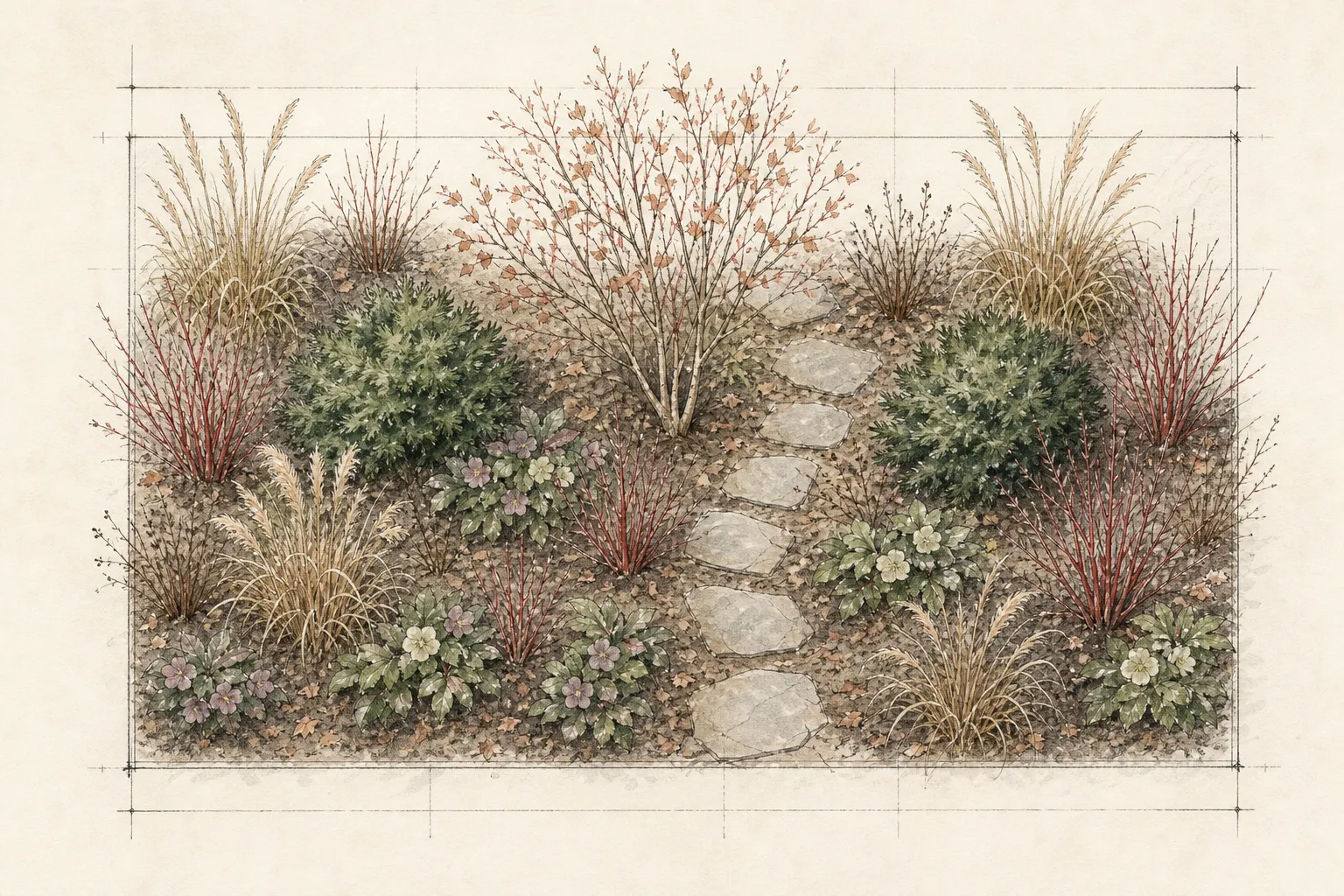
Divide the framed view into foreground, middle ground, and distance. The foreground should be sparse because near objects appear large and can obscure everything beyond. Use one branch rhythm, low evergreen edge, or simple paving line near the window. Keep foundations and drainage visible. The middle ground holds the main seasonal composition; the distance provides a stable tree, hedge, wall, or open sky against which smaller forms can be understood.
Place one focal event off center where a natural sight line meets it. This may be a winter-flowering shrub, pale multi-stem tree, sculptural evergreen, or a gate framed by bare branches. Give it breathing room. A focal plant surrounded by equal-strength colored stems, ornaments, and clipped forms becomes merely another object. Negative space can be mulch, snow, a simple low groundcover, or the quiet face of a wall.
Repeat one secondary characteristic across depth. The warm tone of a distant wall can reappear in a twig, the silver of grass in pale bark, or a rounded evergreen form in two different scales. Repetition connects the scene without requiring identical plants. Match soil, light, moisture, and mature size first; visual similarity cannot make incompatible root conditions function together.
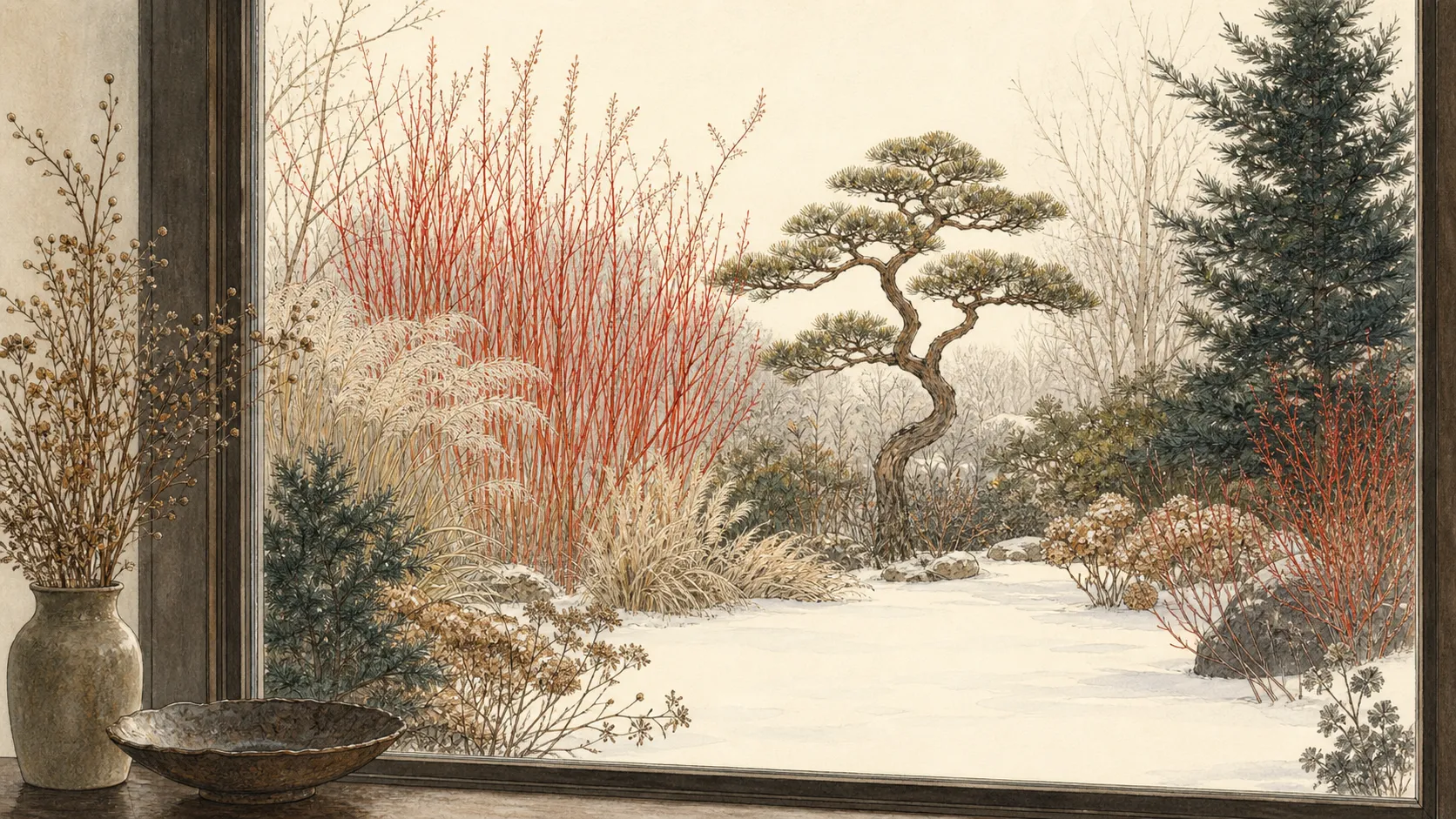
Test the composition in grayscale. A photograph with color removed reveals whether the view relies entirely on red stems or yellow foliage. Strong winter scenes also differ in value, mass, line, and texture. A dark evergreen backing can clarify pale twigs, while a tracery of branches can soften a blank fence. Preserve enough contrast that the view remains coherent during fog, rain, or weak indoor reflections.
Build a source-bounded plant framework
For a temperate garden with moist but well-drained soil and a view across a modest border, begin with structure rather than a shopping list. A small deciduous tree or large shrub may anchor the distance, one winter-flowering shrub can occupy the middle ground, and an evergreen group can form a dark counterweight. Confirm local hardiness, invasive status, mature dimensions, toxicity, and cultivar traits before assigning a name to any role.
A birch or other pale-barked tree is effective only where its mature roots, height, and canopy belong. Bark color varies among species and selections, and some are poorly suited to heat, drought, or local pests. Do not select a white trunk from a photograph and ignore site ecology. Place the trunk where it is visible against a darker background, while keeping eventual branches clear of the roof and utility lines.
A witch hazel or paperbush can provide close winter flower detail where regional conditions fit, but both require credible mature space and plant-specific moisture. Position the flowering crown in the middle ground, not squeezed below the sill. A nearby outdoor route should reach the flowers safely, because an indoor view cannot deliver fragrance or allow diagnosis. Protect the shrub from utility access and repeated snow dumping.
Use broadleaf or coniferous evergreens sparingly as visual weight and background. Their dense summer and winter shade affects every companion. Choose forms that remain within the measured outline without shearing, and preserve air around deciduous stems. A clipped shape can suit a formal composition only when the plant tolerates that maintenance and the long-term labor is deliberately accepted.
Design the ground plane and seasonal handoff
The lowest part of the view is often hidden by the sill, yet it controls plant health and outdoor experience. Map downspouts, slopes, standing water, tree roots, irrigation, and snow storage. Keep mulch shallow and away from woody stems. A clean ground plane can include leaf litter beneath compatible shrubs, restrained evergreen cover, or visible soil around early bulbs. It need not be filled edge to edge.
Early bulbs can create small points of light below a winter shrub, but position them where the interior sight line actually reaches. Use nursery-propagated stock, check local naturalization concerns, and mark dormant locations. Later companions must not require digging through bulbs or shade their foliage before it replenishes the storage organ. The bulbs are a seasonal layer, not disposable confetti.
Plan spring and summer from the same indoor seat. The focal winter shrub may become a plain green mass; pale grasses may be cut; deciduous shade may conceal the background. Add one summer flowering or foliage layer that shares the site and keeps the window’s useful opening. Avoid compensating for every seasonal quiet period. A view needs rest as well as events.
Use autumn to reinforce structure rather than add another unrelated collection. Seedheads, grass color, fruit, and leaf change can echo winter forms. Keep a maintenance route outside the composition so leaves can be cleared from drains and diseased material removed without trampling bulbs. The four-season handoff works when the same framework supports changing details, not when four separate gardens compete for one frame.
Test winter light, reflection, and weather
Low sun can illuminate bark beautifully for a short period and then produce glare on the glass. Record the useful hour and view from the actual seat. A plant that depends on backlighting may vanish on overcast days, so pair light effects with stable form. Interior lamps can reflect after dusk and obscure the garden; curtains, viewing angle, and discreet outdoor lighting affect whether the scene remains visible.
If lighting is used, illuminate a path or structural surface for safety first. Avoid uplighting crowns indiscriminately, shining into neighboring windows, or disrupting wildlife with all-night brightness. Use the lowest effective level, shield the source, and comply with local requirements. A pale trunk can often be read by borrowed ambient light without turning the garden into a display stage.
Observe rain and thaw. Water may stripe a wall, darken bark, flatten seedheads, and reveal a low point in the bed. Snow changes apparent height and can bury low evergreen forms. Draw the composition at the local typical snow depth if relevant, and keep vulnerable branches away from roof slides and shoveled piles. Features should survive weather as living plants, not only as a dry-day photograph.
Wind creates movement in grasses and fine twigs, but it also scours evergreens and abrades branches against structures. Do not place a delicate focal plant in a wind funnel solely because the sight line is perfect. Modify exposure with a permeable distant screen where appropriate, or choose a tougher plant for the role. The site condition has priority over the interior composition.
Edit the view once each year
Take a photograph from the marked viewpoint at the same time each winter. Compare plant outlines with the original measured elevation. Identify what now blocks sky, merges into another crown, falls below the sill, or reveals an unwanted background. Make the fewest plant-specific pruning cuts needed for health and separation. Avoid shearing every element back into the old drawing; living architecture should mature.
Review the focal hierarchy. If a colored-stem group has expanded into the visual center, renew or reduce it according to species guidance. If an evergreen background has swallowed the flowering shrub, selective removal or replacement may be safer than repeated hard pruning. Protect the best-established, site-suited plant rather than automatically preserving the most expensive purchase.
Check the outdoor route to every feature. Branches, ice, irrigation lines, and dormant bulbs should not prevent close inspection. Confirm that windows, walls, drains, meters, and fences remain serviceable. An indoor composition can hide practical deterioration because the frame excludes the edges. Walk the entire site before declaring the view complete.
Remove decorative explanations that the scene no longer needs. Extra signs, ornaments, and winter containers often accumulate when the planting feels quiet. First restore spacing, ground-plane clarity, and contrast. Add a movable object only when it has a defined role and safe weather resistance. The strongest view usually contains fewer independent statements and more deliberate relationships among plants already rooted there.
Test one paperbush against the actual window view
A sheltered Zone 7 Maryland garden can test a single Edgeworthia chrysantha as a middle-ground winter feature where moisture, drainage and light fit the retained profile. Assume a 12-by-12-foot bed begins 10 feet beyond the window. Put the proposed shrub center 6 feet inside that bed and reserve a 7-foot mature-width circle. One shrub fits the square with 2.5 feet between its circle and each edge; the circle says nothing yet about whether its height blocks the seated view.
From the actual chair, mark the shrub's documented mature height as well as its width using a safe temporary outline. Compare it with the sill, desired sky and existing background before purchase. Move or reject the position if the outline closes the view; do not plan to keep an unsuitable shrub small through repeated cutting. The count of one and these distances are illustrative assumptions, and colder or exposed sites need a different locally supported winter feature.
Design ideas
- Style
- Layered four-season winter composition
- Space
- Border viewed through a frequently used window
- Climate
- Use locally suited plants and verify snow, wind, drainage, hardiness, mature size, toxicity, and invasive status. The composition method is adaptable; the sample plant roles are not a universal palette.
- 1A pale trunk against a quiet distance
Place one regionally suitable pale-barked small tree where the trunk is visible above the sill and against a darker hedge, wall, or borrowed canopy. Draw mature roots, crown, roof clearance, and utilities first. Keep the foreground sparse so the trunk reads as structure rather than one more vertical among stakes and stems.
- 2One flowering shrub in the middle ground
Reserve the full mature outline of a locally suitable winter-flowering shrub beside a safe outdoor approach. Align its flower-bearing branches with the occupied sight line, preserve dark background at a distance, and avoid routine winter clipping. The plant should contribute branch architecture from indoors and close flower detail outside.
- 3Evergreen weight on one side
Use a restrained evergreen group to balance the frame and clarify pale deciduous twigs. Select a form that fits without perpetual shearing, protect window daylight, and account for year-round root competition and shade. Leave air and a maintenance strip between the evergreen and the focal shrub.
- 4A low bulb constellation
Place several irregular groups of locally appropriate nursery-propagated early bulbs where the sill does not hide them. Leave visible ground between groups, protect green foliage after bloom, and mark summer dormancy. Later companions must share the site without requiring excavation or heavy cover.
- 5A retained-stem foreground
Keep only a few perennials or grasses whose winter stems remain upright and healthy. Repeat their line across the lower frame without blocking foundation access or paths. Cut collapsed or diseased material and reveal enough ground plane that retention appears deliberate rather than neglected.
- 6A measured opening to the sky
Treat useful daylight as an element of the design. Mark an upper opening in the elevation and keep mature crowns outside it. The opening can frame changing cloud, snow, or a distant tree while preventing the winter garden from becoming a permanent screen against the room.
- 7A maintenance edge outside the picture
Provide a discreet route from the path to drains, walls, labels, and the back of crowns. Locate it just beyond the primary frame when possible, but keep it functional in wet or frozen weather. Good access prevents shortcut trampling and allows the visible composition to remain calm.
- 8A rain-readable surface
Let one wall, stone edge, or simple path reveal changing rain and low winter light without becoming a drainage hazard. Grade water away from structures and routes, keep splash off vulnerable bark, and position the surface where the window frame includes it. Its value is atmospheric and structural, so it should remain useful when no flower or snow is present.
- 9A movable seasonal accent
Where the planting needs a temporary point rather than another permanent root system, use one frost-safe container or object placed outside egress and maintenance routes. Size it from the interior elevation, anchor it for local wind, and remove it when the seasonal role ends. It should reinforce the composition’s line or tone, not become a label explaining that the garden is meant to be viewed.
Plants in this guide
Related reading
Sources
- How to Create a Winter Garden. Royal Horticultural Society. Source record · Accessed 2026-08-19.
- Landscape Design. NC State Extension Publications. Source record · Accessed 2026-08-19.
- Winter Interest in the Garden. University of Minnesota Extension. Source record · Accessed 2026-08-19.
- Edgeworthia chrysantha. North Carolina Extension Gardener Plant Toolbox. Source record · Accessed 2026-09-09.