Paperbush
Edgeworthia chrysantha
A garden profile of Edgeworthia chrysantha, the sheltered deciduous shrub with three-forked stems, silky buds, and fragrant late-winter flowers.
Published Last updated
At a glance
- Light
- Bright partial shade or sheltered sun; protect from harsh afternoon exposure in hot climates
- Water
- Medium; consistent moisture in freely drained soil
- Soil
- Humus-rich, moisture-retentive but well-drained loam
- Hardiness
- Zones 7–10
- Bloom
- Late winter to early spring, on stems formed the previous season
- Height
- 4–6 ft, larger in some selections · 1.2–1.8 m, larger in some selections
In this guide
Overview
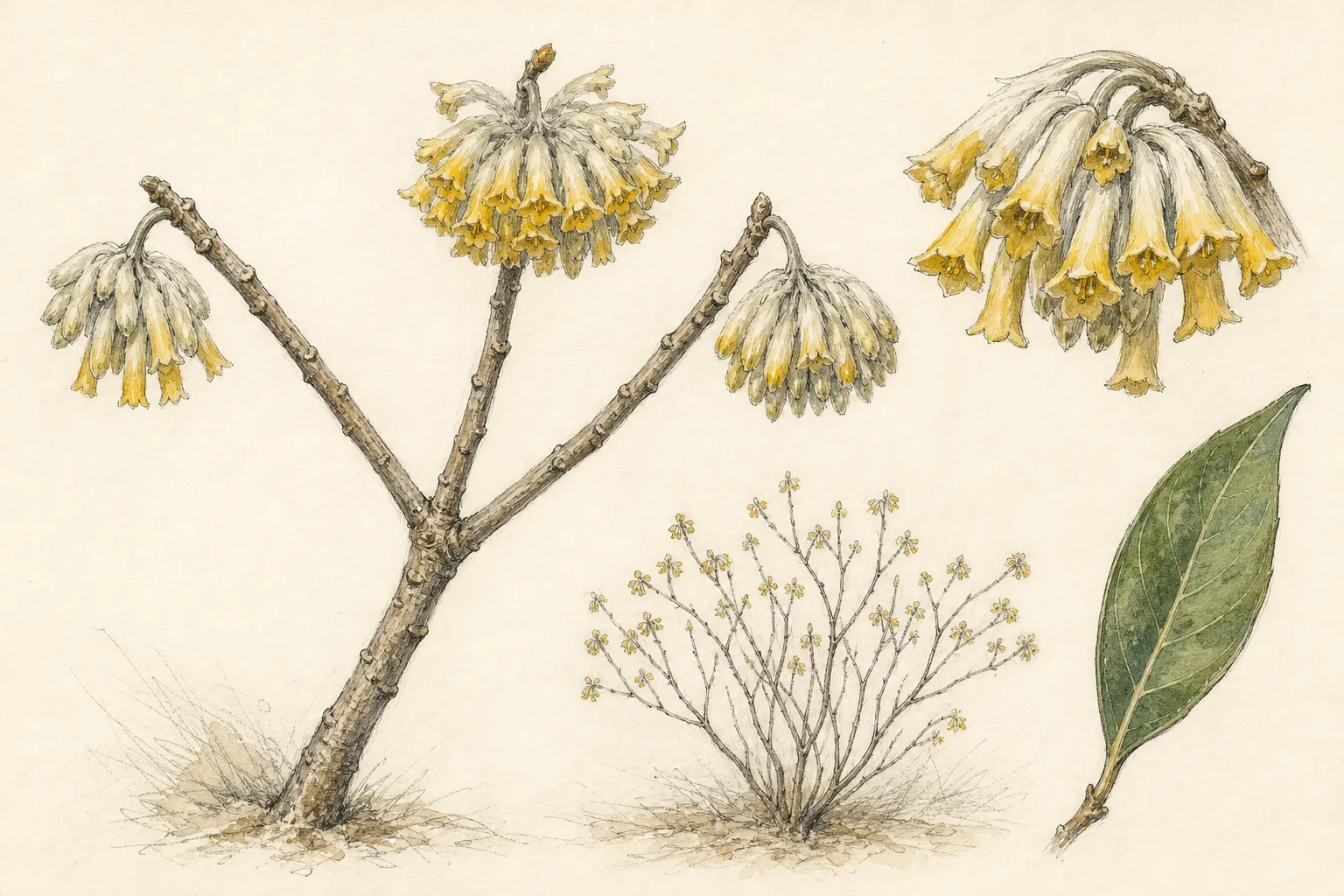
Paperbush builds its winter display months before it opens. Rounded, silky bud clusters form at the tips of bare flexible branches, then reveal many small tubular yellow flowers. The scent and fine flower detail reward close viewing. Place the shrub beside a path or sheltered sitting point, but leave enough width that visitors do not brush continually against the naturally rounded crown.
Branching often divides in threes, giving Edgeworthia a distinctive architecture even without leaves. The summer foliage is broad near the shoot tips and can create a soft, almost tropical mass. That seasonal transformation makes the shrub useful as a specimen or at the back of a border, though the winter framework becomes muddled if neighboring evergreens press into it.
Shelter is the central site requirement. RHS and NC State sources favor humus-rich, moist but well-drained soil and protection from harsh wind; hot afternoon sun can stress foliage in warm climates. A bright east-facing courtyard, open woodland edge, or wall-side border can work when roof runoff, reflected heat, and foundation dryness have been measured rather than assumed.
Published size varies among sources and named selections. The straight species is commonly described around 4 to 6 feet high and broad, while cultivars can grow larger. Draw a credible cultivar-specific footprint and reject any position that requires annual reduction around a window, gate, heat pump, or narrow path. Flexible branches are not permission to bend the shrub out of service routes.
Flowers are carried on older growth. Routine winter pruning removes buds, and hard size control sacrifices the natural branching. Prune only damaged or badly placed wood, generally after flowering, and make selective cuts at branch origins. If a mature paperbush has outgrown its space, relocation while young or replacement with a smaller plant is safer than perpetual shearing.
Cold damage may kill buds or shoot tips while the root system survives. Wait until growth resumes before deciding how much wood is dead, then prune to sound tissue. Repeated injury indicates a site or regional mismatch. A shrub that needs elaborate wrapping every winter may be better treated as a collector’s experiment than a dependable structural plant.
- Family
- Thymelaeaceae
- Range
- Southern China to northern Myanmar
- Soil pH
- 5.5–7.5
- Spread
- 4–7 ft · 1.2–2.1 m
Planting & careHow to grow paperbush
Cold tolerance varies with provenance, cultivar, establishment, wind, and drainage. Gardeners near the lower temperature limit should use a sheltered microclimate and local experience.
- 1Find a protected exposure
Map winter wind, afternoon heat, roof runoff, and reflected light. Favor a bright sheltered pocket whose soil drains after rain and remains evenly moist in summer.
- 2Draw the named plant at maturity
Use current dimensions for the exact selection and reserve access around the crown. Keep flower clusters close enough to a path for scent without narrowing the route.
- 3Plant at the structural roots
Set the root flare or upper structural roots at finished grade. Tease or correct circling container roots where feasible and keep mulch away from stem bases.
- 4Establish uniform moisture
Water the original root ball and surrounding soil slowly, then check both zones. Do not compensate for a dry wall-side bed by leaving the crown in saturated soil.
- 5Protect the framework, not every twig
Use site shelter and root-zone mulch first. Temporary wind screening may help a new plant, but keep materials from rubbing buds and remove them on schedule.
- 6Build a low companion layer
Choose shallow, manageable companions for similar light and moisture. Preserve the paperbush stem bases, inspection route, and the winter outline.
Pruning paperbush
Prune sparingly after flowering because buds are carried on old wood. Remove dead, broken, crossing, or badly placed stems at their origin and preserve the three-forked architecture. Delay judgment on suspected winter-killed tips until healthy growth clearly separates live from dead tissue.
Seasonal care
Spring
Enjoy the end of bloom, make limited corrective cuts afterward, inspect winter-killed tips as leaves expand, and maintain even moisture during establishment.
Summer
Watch afternoon scorch and drought stress, water the occupied root zone deeply as needed, and avoid late soft growth caused by unnecessary fertilizer.
Autumn
Protect the root zone with a shallow mulch ring, keep it off stems, and inspect the developing silky flower buds before any cleanup or nearby work.
Winter
Keep abrasive covers away from buds, observe cold and wind exposure, enjoy scent from the path, and postpone pruning until bloom and viability are clear.
Safety and garden spread
Kew lists no known hazards, and the retained sources identify no specific contact or ingestion risk. That absence does not make an ornamental plant a food; do not consume unidentified material.
Common problems
Bud or tip injury
- Look for
- Brown flower clusters, shriveled shoot ends, or delayed leaf-out after a cold or windy period.
- Action
- Wait for the live boundary to declare itself, then prune only dead tissue. Review exposure and regional suitability before adding permanent shelter.
Leaf scorch
- Look for
- Pale or brown margins on the side exposed to hot afternoon sun or drying wind.
- Action
- Check root-zone moisture and reflected heat, preserve drainage, and consider filtered afternoon shade if the plant can be moved while young.
Poor flowering
- Look for
- Healthy foliage but few terminal winter flower clusters.
- Action
- Review winter pruning, previous-season shoot damage, light, and cultivar identity. Do not add fertilizer unless a soil or tissue diagnosis supports it.
Root decline
- Look for
- Weak growth, small leaves, dieback, or soft tissue at buried stem bases.
- Action
- Expose the flare, remove mulch from stems, inspect drainage, and seek local diagnostic help when decay or progressive dieback is present.
Plant details
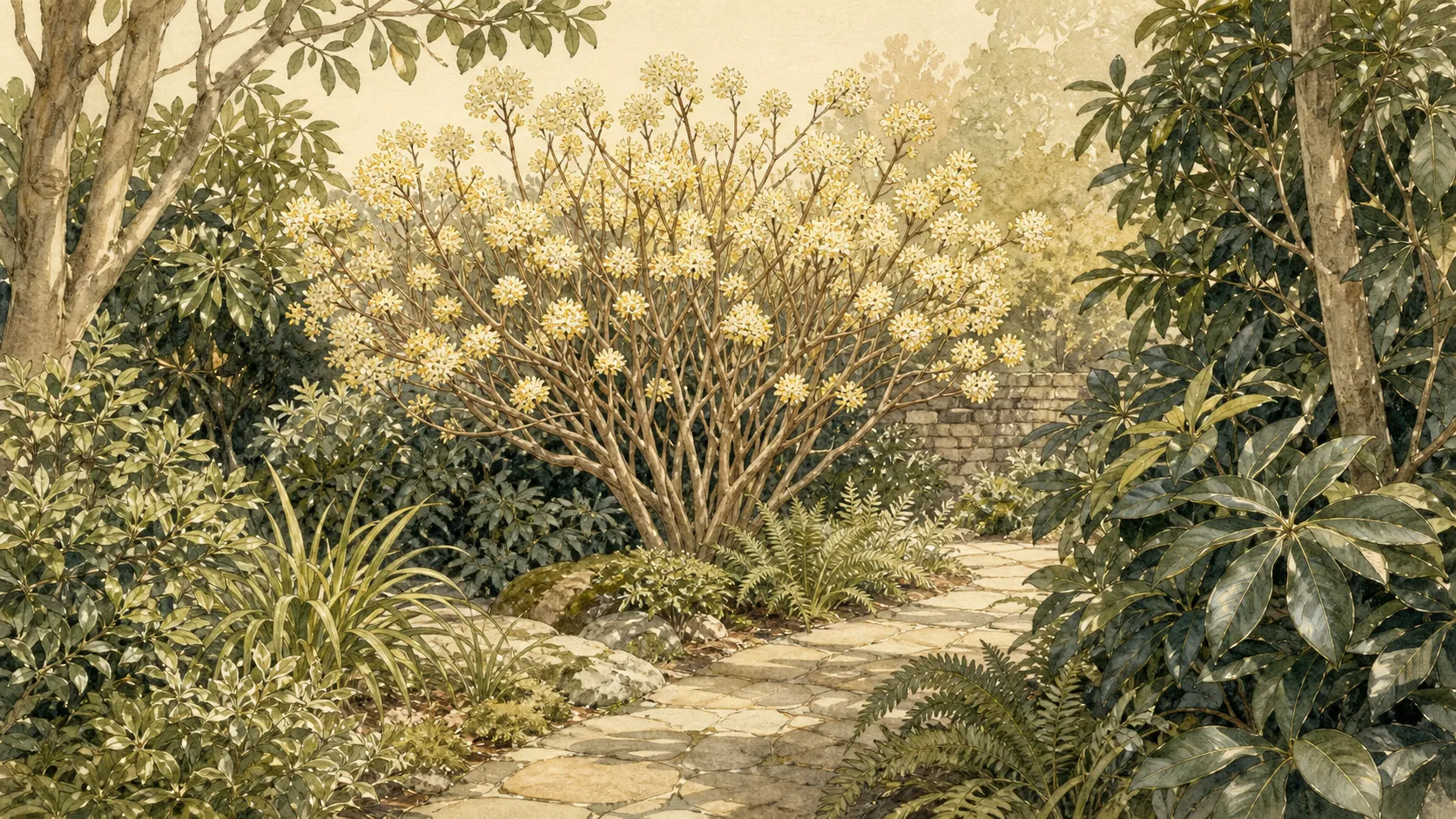
Mature paperbush flowering in a sheltered part-shade border beside a close viewing path
Related reading
Sources
- Edgeworthia chrysantha. North Carolina Extension Gardener Plant Toolbox. Source record · Accessed 2026-08-30.
- Edgeworthia chrysantha. Royal Botanic Gardens, Kew. Source record · Accessed 2026-08-30.
- Edgeworthia chrysantha. Royal Horticultural Society. Source record · Accessed 2026-08-30.