Gardens · winter entry scented shrubs bulbs
Design a Winter Entry with Scented Shrubs and Bulbs
Make a winter entry feel inhabited by placing scented shrubs where cold air can hold them briefly and bulbs where fragrance and detail meet the door.
Published Last updated
In this guide
- Start with the entry you actually use in winter
- Reserve the route before placing the scented layers
- Choose the sheltered scent layer before flowers
- Use bulbs as near-door punctuation, not as a carpet
- Build one climate-bounded composition for a mild-winter entry
- Keep the route serviceable through thaw, rain, and maintenance
- Hand the entry from winter fragrance to spring and summer without clutter
- Record the scent timing from the step outward
- Test fragrance, access, and scale before planting
- Design ideas
Start with the entry you actually use in winter
A winter entry is not an abstract front border. It is the route used with boots, bags, gloves, cold hands, and a door that may swing into wind. That means the design begins with the shoveled line, the place where meltwater sits, the handrail or latch that slows a person down, and the slice of air that stays calm enough for scent to register at all. A beautiful shrub planted beyond the snow pile may be technically in bloom and practically absent.
Walk the route both leaving and returning. Note where a person naturally pauses to unlock the door, set down a parcel, or brush snow from shoes. Those short pauses are where fragrance is most likely to be noticed in cold weather, especially if the air is partially sheltered by a wall, porch return, evergreen mass, or the building itself. A scented plant at the far property line may be admirable from the street, but it is not doing the job named in this article.
The winter entry also has to keep working after the flowers are gone. NC State's landscape-design guidance is useful here: paths, mature plant size, service access, and the relationship to doors and structures should be drawn before decorative planting is assigned. A design built only around the few weeks of strongest scent often crowds the very spaces that later need sweeping, pruning, and summer growth clearance.
Use the interior view as part of the same entry, not as a separate design problem. Many winter approaches are first experienced from inside, especially on dark mornings and wet evenings. A low bulb grouping that vanishes from the window, or a shrub that blocks the side light from the door, changes how welcoming the planting feels before anyone steps outside. The best entry compositions therefore serve both the moving body outdoors and the stationary eye indoors.
Reserve the route before placing the scented layers
Test the sheltered regional assumptions and full shrub footprints before setting the winter entry sequence. Keep in-ground bulbs outside the shoveled route and distinguish movable scent pots from permanent planting. Where winter hardiness fails, change the plant or its seasonal role; reducing spacing or relying on fragrance does not make an unsuitable permanent shrub fit the entry.
Choose the sheltered scent layer before flowers
Cold air carries fragrance differently from warm still air, so winter-scented shrubs work best where exposure is moderated rather than sealed off. Penn State and RHS both stress the importance of placing fragrant winter shrubs close enough to be encountered, not just admired. Think in layers: a lower evergreen scent source near the threshold, a broader flowering shrub at the pause, and a clear route between them. The air has to move enough to stay healthy, but not so fast that every bloom is stripped of presence.
This is why an entry design often needs one fragrant plant lower than knee to waist height and another at shoulder to head height farther out. The lower layer meets the step and the door. The broader shrub creates a second moment just beyond the threshold. When both are planted at the same depth and size, they compete for the same slice of air and the entry feels crowded instead of composed. Mature size belongs in the first sketch, not the final correction.
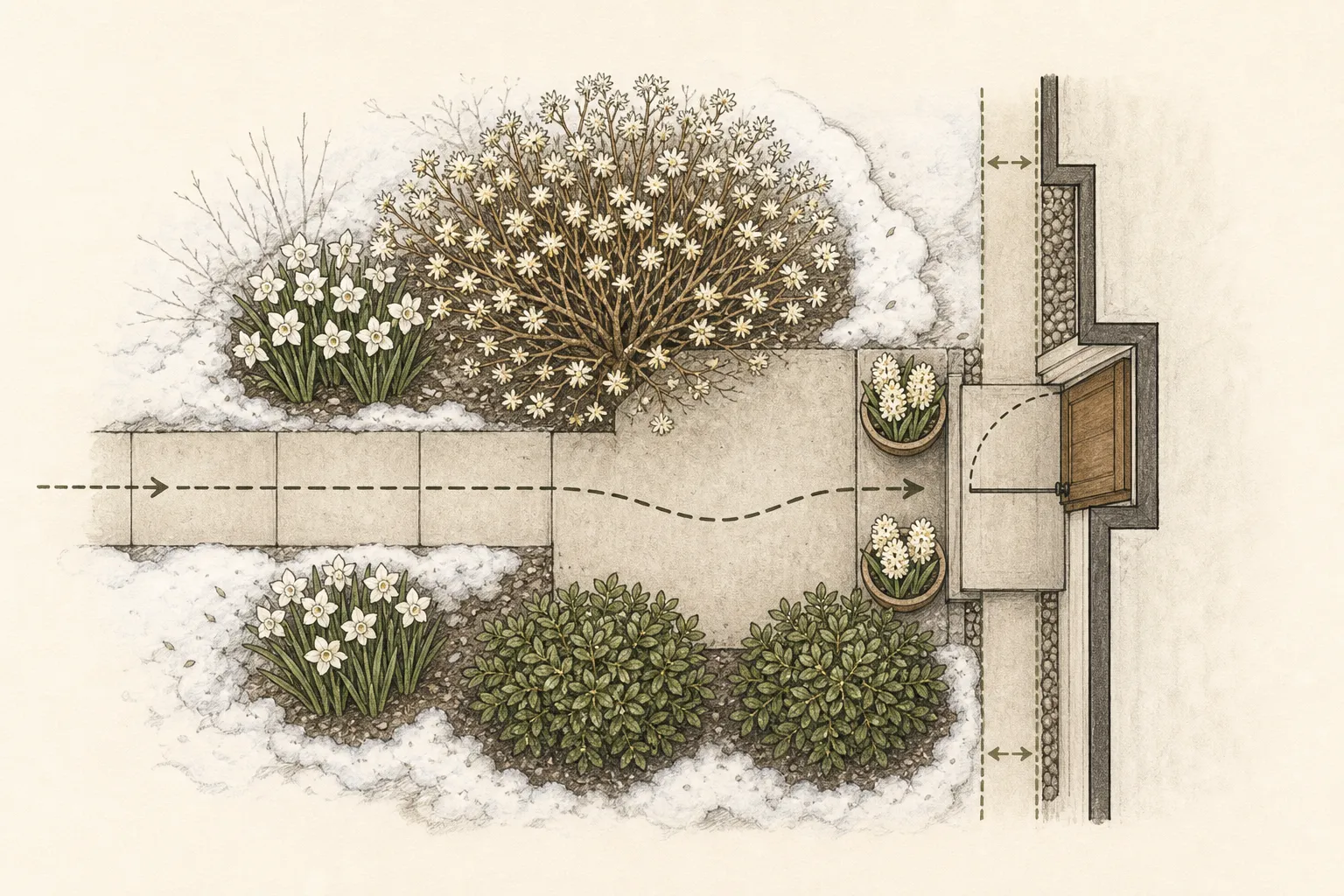
An overhead plan is the clearest way to preserve that balance. Draw the cleared walk, the opened door, the service strip beside the wall, and the mature footprint of every candidate. The plant arrangement should still make sense on a rainy February day when flowers are not the main event. If the drawing already shows branches in the path or bulb pots where a shovel must pass, the winter scent plan is wrong before any plant is bought.
Use bulbs as near-door punctuation, not as a carpet
Bulbs at an entry should operate at close range. Their job is not to replace the shrubs or fill every empty inch of soil. They punctuate the route where people stop long enough to see and smell them. In cold weather that usually means a few concentrated groups near the step, beside the pause, or in containers that can be placed exactly where they matter. Fragrance is stronger when a bulb is brought into the human zone than when it is broadcast across a bed and left to fend for itself in moving air.
Choose bulb types by the experience they create and the space they need. Narcissus 'Thalia' reaches about 1 to 1.5 feet tall with a spread around 0.5 to 0.75 feet, which makes it useful for modest drifts or repeated clumps in the in-ground layer. Hyacinths are intensely fragrant and about 25 cm or 10 inches tall in bloom, so they excel in containers near a door or low step where their scent is not lost. Each belongs to a different tier of the same composition.
This is also where restraint matters most. A winter entry gains power from repetition and emptiness. Three pots of different bulbs, two more tucked under a shrub, and a scatter of miscellaneous corms often produces confusion instead of welcome. Use bulbs as a few deliberate notes set against evergreen foliage, bare twig structure, or the dark plane of the house. Their scale and season become clearer when the design allows them air.
Build one climate-bounded composition for a mild-winter entry
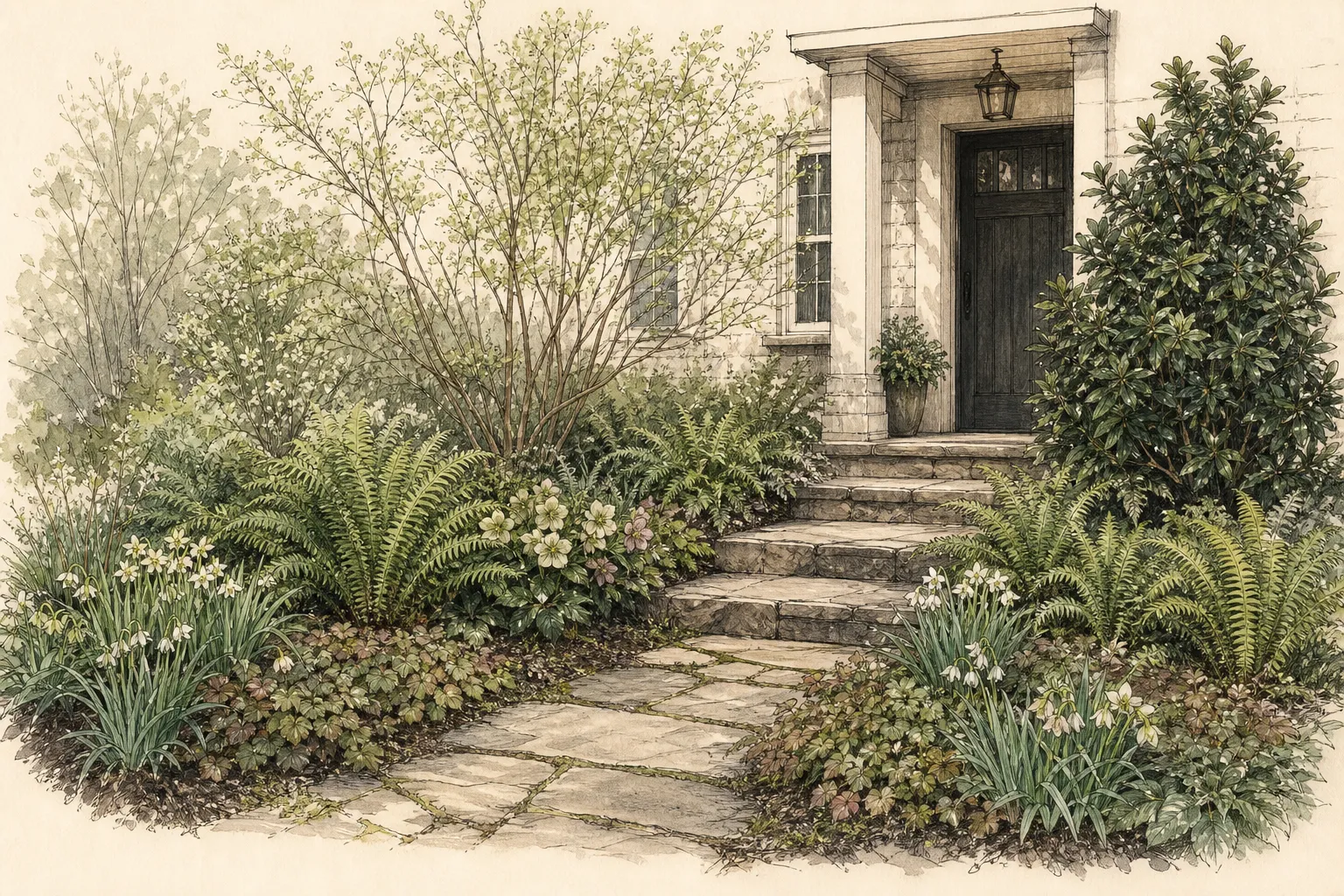
Consider a sheltered USDA Zone 7a entry on the east side of a house, with morning sun, reflected warmth from masonry, and medium-moisture soil that drains cleanly. The route is eight feet wide from gate to door, with a two-foot maintenance strip along the wall and one wider pause near the step. This is not a universal recipe. It is a worked composition for a mild-winter entry where paperbush and fragrant sweet box are hardy enough to be realistic structural choices.
At the wider pause, place one Edgeworthia chrysantha where its full mature footprint of roughly 4 to 6 feet tall and 4 to 6 feet wide can develop without clipping into the route. Give it a dark, quiet background and keep the near side open so both flower form and fragrance can be read. Closer to the threshold, use two Sarcococca ruscifolia plants, each maturing around 3 to 4 feet tall and wide, tucked just beyond the door swing where fragrance can sit low in sheltered air without becoming a branch obstacle.
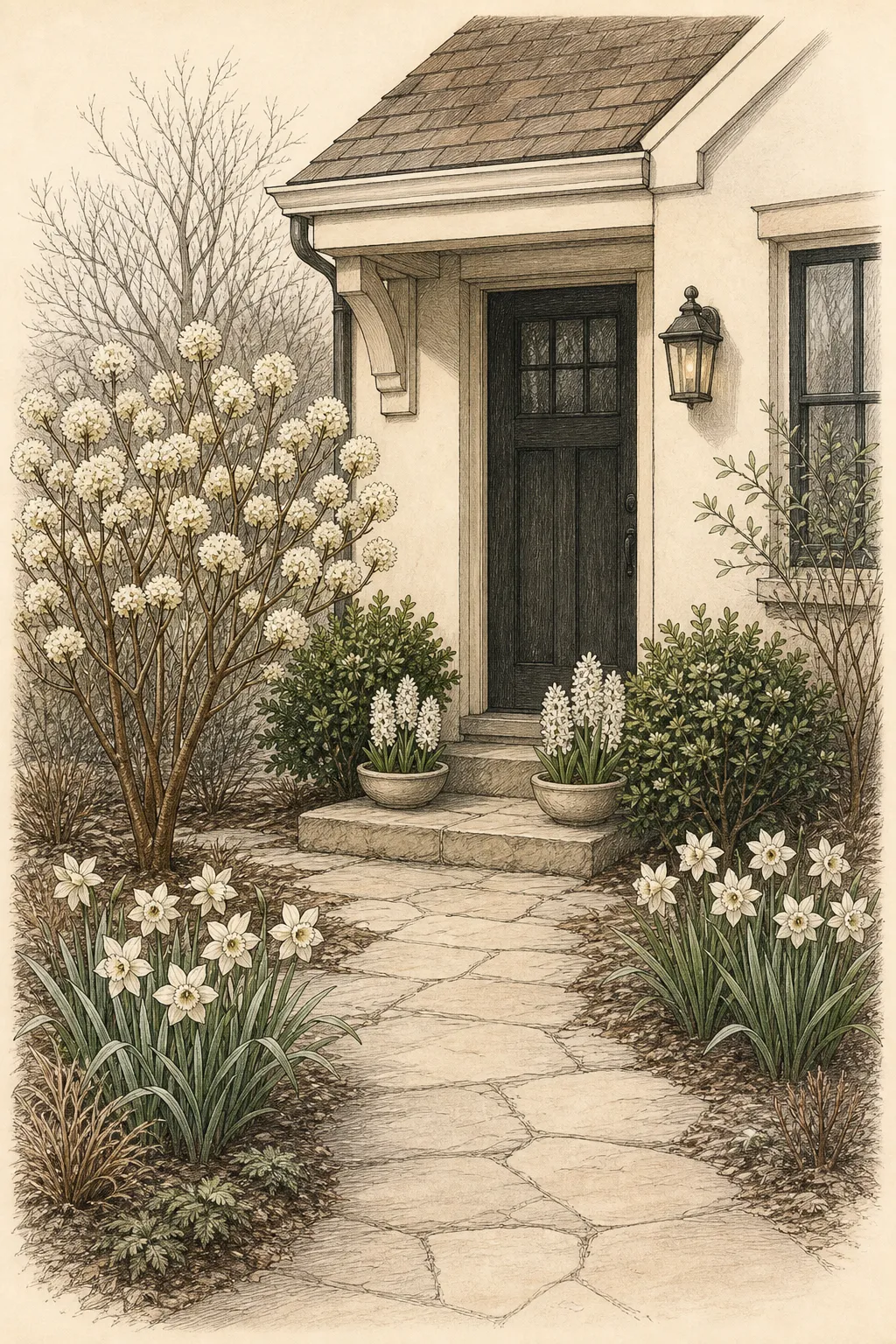
Under the shrub layer, place two repeated groups of Narcissus 'Thalia' where their white flowers can rise between 12 and 18 inches beside the pause, not directly in the shoveled line. Add two shallow pots of white hyacinths at the step for the strongest close-range scent. The in-ground shrubs create the winter framework, the narcissus lengthen the sequence into late winter and early spring, and the portable hyacinths carry fragrance right to the door. Colder zones should treat the hyacinths as movable seasonal material and substitute hardier shrub roles where paperbush or fragrant sweet box are unreliable.
The composition stays disciplined because each plant has one main job. Paperbush makes the broader middle-distance event. Fragrant sweet box brings scent down to threshold height and keeps leaves through the year. Narcissus gives the route a cleaner vertical white echo after the first shrub flowers. Hyacinths supply the most immediate perfume exactly where the door is opened. If another plant cannot be assigned a similarly narrow task, it does not need to join this entry.
Keep the route serviceable through thaw, rain, and maintenance
A winter entry that smells lovely but traps runoff, leaf litter, or a shovel is not well designed. Preserve a true service strip beside the wall and outside every mature crown. Do not let bulb pots occupy the only place where ice melt can be managed. This is where the design earns its keep in bad weather. The more ordinary the maintenance path remains, the more likely the scented planting is to stay attractive rather than becoming a seasonal inconvenience resented by the household.
The shrub layer needs room to be inspected without crushing bulbs or stepping into wet soil. A paperbush set too close to the wall cannot be cleaned beneath, and a sweet box pushed into the cleared walk becomes a pruning problem every year. Keep the mature footprints honest. The composition should still be readable when branches are wet, when bulbs are dormant, and when a person approaches carrying something bulky. Winter usability is part of the aesthetic, not a separate engineering step.
This is also why the number of plants should stay low. A restrained entry with one large flowering shrub, one lower evergreen fragrance layer, and a few repeated bulb notes gives the gardener clear decisions about pruning, lifting pots, and cleaning the route. A more crowded planting usually produces more maintenance edits and less sensory effect. The smallest winter space benefits most from a disciplined hierarchy.
Hand the entry from winter fragrance to spring and summer without clutter
The transition out of winter is easiest when the entry is designed to look intentional after bloom rather than dependent on constant replacement. Cut hyacinth flower stalks when finished, then let the foliage feed the bulbs if you plan to keep them. Remove or shift the pots only after their job is done, not the first day the heads fade. The in-ground narcissus can bridge the gap between winter shrubs and later perennial foliage if there is enough open soil and light around them.
The shrubs must also hold their own once scent fades. Paperbush contributes branch architecture and broad leaves later in the season; fragrant sweet box becomes a low evergreen mass. If those shapes do not suit the entry in June, the winter design was incomplete. This is another argument against using too many taxa. A small palette is easier to carry across seasons because each plant has a legible non-flowering role as well as a brief fragrant one.
Do not force a summer border into the same inches simply because spring leaves expose empty ground. The entry needs space for drainage, door clearance, and bulb ripening. A few later companions can be added if their root and moisture needs align with the shrub layer, but the winter structure should remain visible. The best spring handoff keeps the entry calm rather than turning it into a second unrelated garden moment.
This handoff is also when restraint with containers matters. Once the hyacinths finish, the temptation is to fill their places with another run of showy annual pots. Sometimes that is useful, but only if the new containers preserve the same circulation and do not hide the in-ground structure you designed so carefully. A winter entry feels sophisticated when the seasonal container layer changes without making the permanent composition disappear.
Record the scent timing from the step outward
A winter entry is small enough that one season of notes becomes genuinely useful. Record the first fragrant day, not just the first open flower. Note whether scent was strongest at the door, the pause, or only in still weather. These observations tell you whether the low layer needs to move closer, whether the larger shrub is too exposed, or whether the pots should be rotated for better shelter next year. Scent belongs to the route, so the route is where it must be measured.
Keep the record visual as well as aromatic. Photograph the entry from the gate, from the step, and from indoors. Include the service strip, the opened door, and the bulb pots in the frame. What felt balanced in planting weather may look crowded with a coat rack, umbrella stand, and winter light. A fixed view lets you judge structure and circulation at the same time. That is especially important in small entries, where one branch can undo the whole composition.
After one full cycle, refine only the element that missed its job. The bulb pots may need to shift closer to the wall, or the lower evergreen fragrance layer may need more space from the path. Resist the temptation to answer every weak moment with another plant. A winter entry becomes more persuasive when each season removes an uncertainty and strengthens the hierarchy already there. The result should feel quieter, more deliberate, and easier to inhabit each year.
Test fragrance, access, and scale before planting
Mark mature shrub widths on the ground, set temporary pots at intended centers, and walk the route carrying bags or opening the door. Preserve the landing, handrail, meter access, drainage edge, and visitor turning space. A fragrant plant that narrows the route will be cut repeatedly and never develop the form the design requires.
Place the strongest scent source where still winter air can hold it near the approach, but keep thorny growth and bee-attracting flowers away from the narrowest passage. In colder climates, preserve the same framework with locally hardy shrubs and use movable bulb containers for the near-door seasonal note.
Review the entry from the street, five steps away, and the doorstep. The distant view needs evergreen mass and a legible route; the middle view needs bark or flower detail; the threshold needs fragrance without clutter. If every plant is chosen for close-up novelty, the entry will look scattered from the first approach.
Keep a maintenance route to every shrub and bulb pocket. Deadheading, leaf removal, and selective pruning should be possible without stepping across emerging bulbs or dragging tools through the doorway.
Design ideas
- Style
- Sheltered entry composition built from winter fragrance, clear circulation, and repeated white spring accents
- Space
- Front step, side door, porch return, or compact courtyard entry
- Climate
- Worked composition for a sheltered USDA Zone 7a entry with morning sun, reflected warmth, medium-moisture soil that drains well, and enough wall or porch protection that winter scent is not stripped away immediately by wind. Colder or more exposed sites need hardier substitutions for paperbush and fragrant sweet box, and may use hyacinths only as movable seasonal containers placed after severe weather has passed.
- 1One broad shrub at the pause
Use a single winter-flowering shrub with room for its full mature crown where the route naturally widens. The pause should be large enough for scent to gather briefly without pushing branches into circulation, and open enough that the shrub still reads as a clear silhouette from indoors. Mark the crown diameter before planting and leave the working side accessible for selective pruning, leaf removal, and inspection of the wall or utility edge behind it. Keep the door swing and sightline unobstructed in every season.
- 2Lower fragrance at the threshold
Place the low evergreen scent layer just beyond the door swing or step edge, where it can perfume the threshold without forcing every coat and bag to brush past it. Keep the mature width clear of handrails, package drop points, and the line a snow shovel needs to follow.
- 3Bulb pots where scent is lost least
Use hyacinths or another strongly scented bulb in repeated shallow pots close to the wall or step, where the flowers sit within arm's length and are less exposed to moving winter air. The pots should feel like part of the route rather than like freestanding decorations dropped into any spare corner.
- 4A white bulb drift beside, not across, the route
Keep in-ground narcissus or snowdrops in repeated side groups that point toward the door. Preserve the shoveled line and service strip instead of planting fragrance directly into the maintenance path, and leave enough open soil for bulb foliage to ripen without being buried under later companion planting.
- 5A summer shape for every winter plant
Choose shrubs whose non-flowering habit still belongs at the entry after winter ends. The composition should read as intentional in leaf, not just during the scented weeks, so every winter star must also earn its footprint in the ordinary months.
- 6A fixed-view scent ledger
Photograph the entry from the gate, the step, and indoors while noting where fragrance was actually perceived. Use those paired records to move only the layer that missed its job, instead of answering every weak moment by crowding in another scented plant.
- 7One dark background plane
Reserve at least one quiet dark backdrop behind the main flowering shrub so pale blooms and branch silhouette read in low winter light. Fragrance may draw a person closer, but visual contrast convinces them to stop.
- 8A shovel-proof threshold
Test the final composition with winter maintenance in mind. If the route cannot be shoveled, swept, and approached with wet boots without knocking into the scented layer, the entry will not stay beautiful long enough to justify the planting.
Plants in this guide
Related reading
Sources
- Fragrant Winter Shrubs. Penn State Extension. Source record · Accessed 2026-08-19.
- Scented Winter Shrubs. Royal Horticultural Society. Source record · Accessed 2026-08-19.
- 19. Landscape Design. NC State Extension. Source record · Accessed 2026-08-19.
- Edgeworthia chrysantha - Plant Finder. Missouri Botanical Garden. Source record · Accessed 2026-08-19.
- Sarcococca ruscifolia - Plant Finder. Missouri Botanical Garden. Source record · Accessed 2026-08-19.
- Narcissus 'Thalia' - Plant Finder. Missouri Botanical Garden. Source record · Accessed 2026-08-19.
- How to grow hyacinths / RHS Growing Guide. Royal Horticultural Society. Source record · Accessed 2026-08-19.