Grow · balcony broadleaf evergreen container winter shelter
Shelter Broadleaf Evergreen Containers on a Balcony
Decide whether a potted broadleaf evergreen can remain outside, then buffer the exposed root ball, reduce winter wind and sun, preserve drainage, and keep the shelter safe on a balcony.
Published Last updated
In this guide
- Decide whether the plant can stay above ground
- Check the balcony limits before adding protection
- Read roots, leaves, and container as three winter systems
- Move the collection before constructing shelter
- Buffer the root ball without sealing the pot
- Screen foliage from the dominant winter stress
- Manage winter moisture from the root ball
- Inspect after wind, snow, thaw, and deicing
- Dismantle shelter in stages and read spring growth
- Steps
Decide whether the plant can stay above ground
A balcony is one of the hardest places to overwinter a woody plant in a container. Iowa State advises that above-ground container plants need protection because roots are less cold hardy than shoots and a small soil volume can fall to damaging temperatures. Illinois Extension sets the same problem in practical terms: winter success depends on preventing the soil mass from freezing and maintaining appropriate moisture, with a large soil mass, insulation, and a protected location doing the work. A balcony shelter can moderate exposure; it cannot reproduce the thermal stability of earth around a root system.
Start with the exact plant, cultivar, and pot. Confirm the plant's hardiness in the intended region, then ask a local nursery or Extension professional whether its roots can reasonably survive in an above-ground container through the expected minimum temperatures. Inspect whether the pot material itself is rated to remain planted through freeze-thaw. Illinois notes that many containers are damaged by freezing and thawing with soil left inside, while large concrete and wooden planters may be more durable in its northern Illinois context. Plant hardiness and container durability are two separate gates.
Choose a different winter location when either gate fails. An unheated but protected structure, a ground-level heeling-in site, or another locally recommended dormant-storage arrangement may be safer than elaborate balcony wrapping. Iowa State calls burying a container in soil one of the most reliable home-garden methods because soil insulates the roots; that option is unavailable on a balcony. The absence of ground insulation must appear honestly in the decision. A handsome screen does not turn a marginal shrub or fragile ceramic pot into a reliable outdoor system.
Check the balcony limits before adding protection
Pass the plant, pot, exposure and building-constraint checks before grouping or wrapping containers. Keep insulation, wind screening and drainage as separate parts of the setup. Inspect moisture only when the mix can be assessed meaningfully. If weather exceeds the planned shelter's limits, use the prearranged safe relocation route instead of adding an improvised exposed structure.
Read roots, leaves, and container as three winter systems
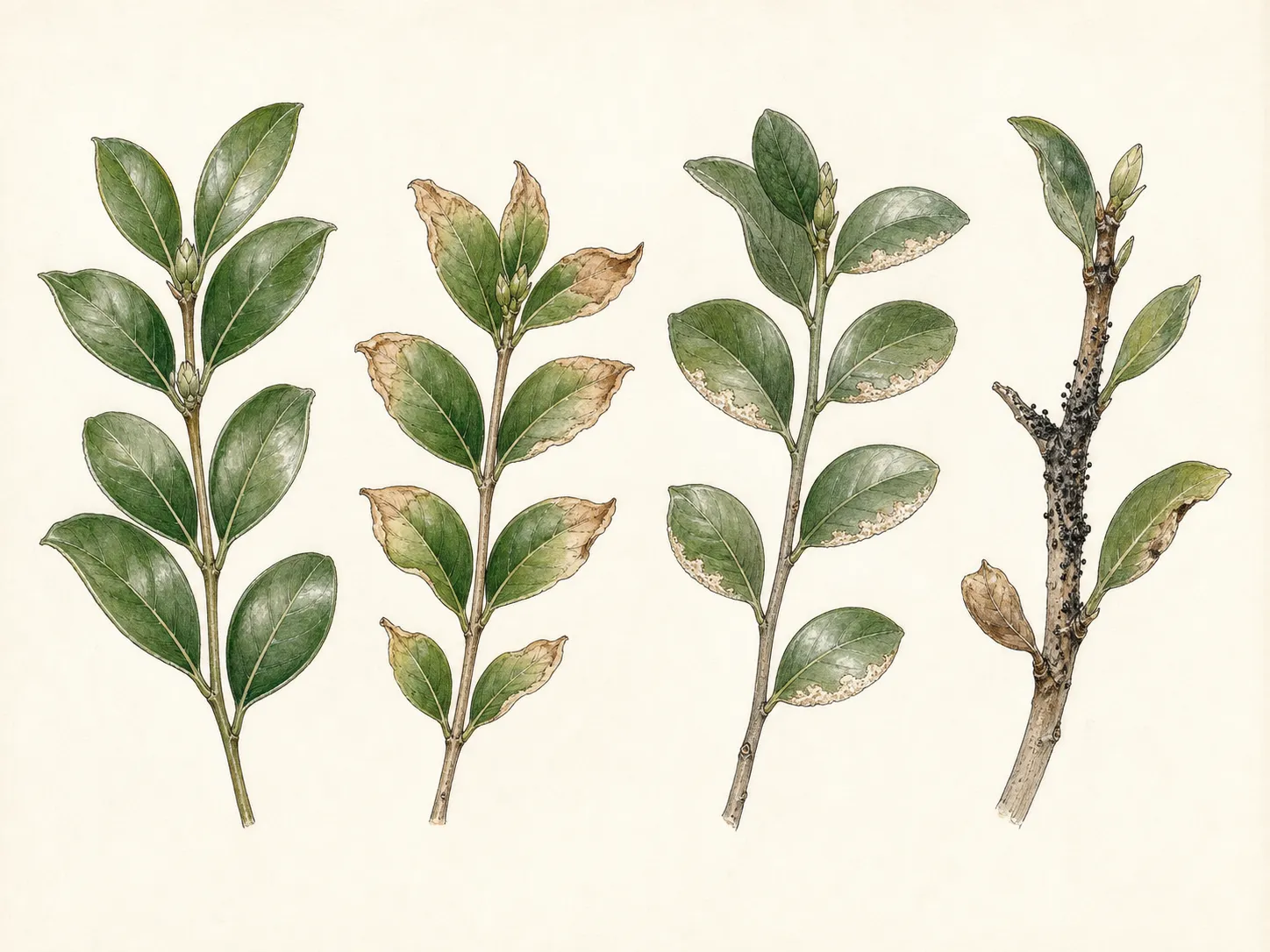
Broadleaf evergreens keep a large living leaf surface through winter. NC State identifies desiccation and limited root hardiness as the two major winter problems for container plants and calls desiccation the most common winter injury of container-grown evergreens. Leaves can lose water during bright, cold, or windy weather while a frozen root ball supplies little or none. Root injury can remain hidden until spring, when a plant begins growth and then wilts because the damaged roots cannot support the canopy.
The container adds its own failure modes. A pot can freeze through from the sides, stand in meltwater, split under expanding wet mix, or lose drainage when ice and debris block the hole. The plant can therefore fail with foliage that was carefully screened, and the pot can fail even when the shrub is cold hardy. Inspect drainage, feet or supports, saucers, cracks, root crowding, and the amount of exposed sidewall. Remove a water-holding saucer for winter unless the container maker explicitly requires another arrangement.
Shelter must preserve access to all three systems. You need to see the foliage, feel the mix when thawed, inspect the drain, and observe the pot wall. A sealed bundle makes those checks difficult and can trap heat or moisture. NC State's nursery guidance warns that winter coverings can bring abrasion, stem breakage, rodents, and heat or moisture buildup. A balcony adaptation should be smaller and more inspectable than a nursery block, with no assumption that farm-scale fabrics or straw systems are permitted around a residence.
Move the collection before constructing shelter
Map the balcony during winter weather. Mark the prevailing wind corridor, the railing edge exposed on several sides, the low afternoon sun, reflected light from glass or pale walls, roof drip lines, snow shedding, the door swing, the floor drain, and the route needed for inspection. NC State notes that shade can reduce evergreen water loss on bright, cold days and that wind barriers work only when placed correctly. On a balcony, turbulence around corners and railings can defeat a screen copied from an open nursery, so observe the actual path of wind.
Move eligible pots toward the calmest usable zone, often inward from the railing and away from a corner that accelerates wind. Group containers with similar winter moisture and temperature needs so the cluster buffers some exposed sidewall and can be inspected as one unit. Keep foliage separated enough that leaves do not stay pressed together wet, and keep every pot stable. Do not assume a building wall supplies safe warmth; use it as an exposure boundary only after confirming runoff, exhaust, reflected sun, and local building rules.
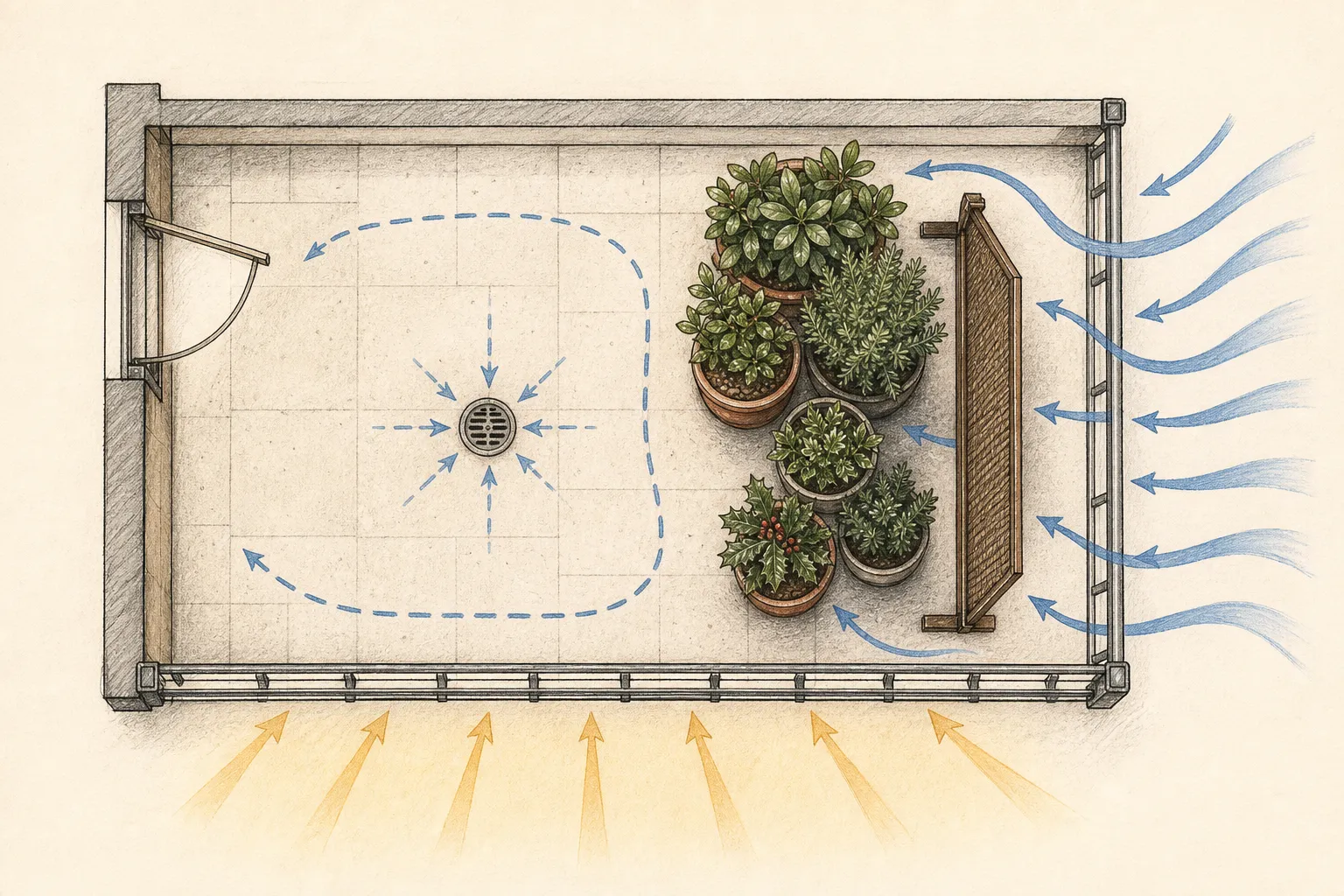
Preserve the balcony's primary jobs. The door must open, the walking route must remain passable, and the drain must remain clear of pots, insulation, leaves, and ice. Wet containers, soil, water, screens, and snow add load, and a site-specific structural calculation is required from the responsible property professional. If the collection cannot be clustered within the building's load, attachment, fire, appearance, egress, and drainage limits, move it to another winter location.
Buffer the root ball without sealing the pot
Insulate the container sides as an enclosure around the pot, not as material packed through the evergreen canopy. NC State describes clustered pots in a sheltered shaded location with mulch over containers or insulating material around the perimeter in its regional nursery systems. Illinois emphasizes a large soil mass in a well-insulated planter. For a residential balcony, translate the principles rather than copying the materials: protect exposed sidewalls, reduce rapid temperature swings, and use only clean, building-approved materials that can be secured and kept dry enough for the setting.
A larger ventilated outer box can create a protected zone around one or several stable pots. Keep the inner pot upright, fill side gaps with an approved insulating material that will not blow away, and leave a service opening for moisture checks. The top dressing should not bury stems or the root flare. Do not place wet insulation directly against foliage or wrap branches into the enclosure. If the plant is grafted or trained as a standard, the exposed stem and graft may need species-specific guidance beyond root-ball buffering.
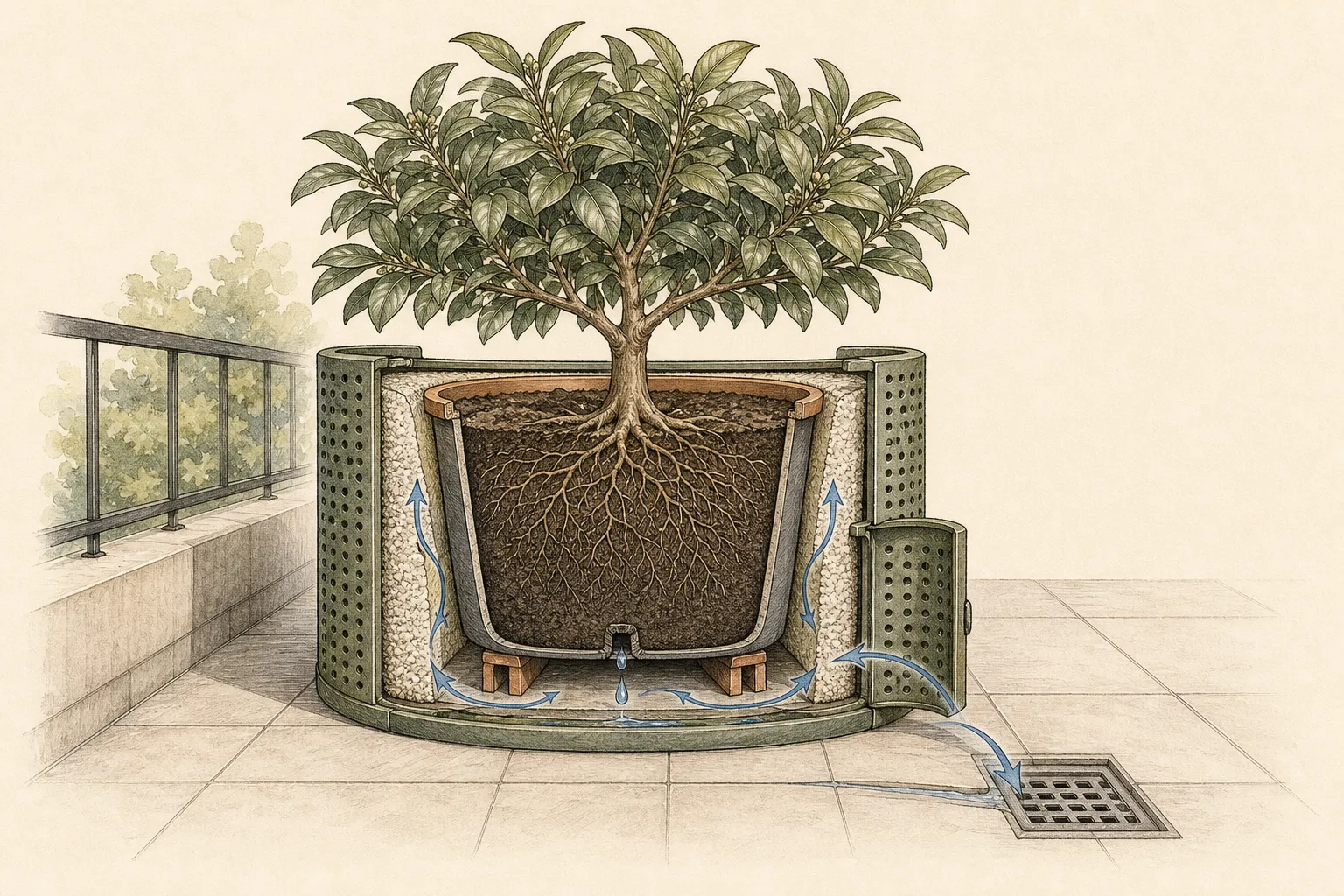
Keep drainage visible from inlet to outlet. Elevate only with supports approved for the pot and surface, making sure the arrangement cannot tip. Water must pass through the mix, leave the drainage hole, and reach the balcony drain without soaking insulation or refreezing across a path. A waterproof sleeve with no bottom exit is a reservoir, not winter protection. Check the container manufacturer's freeze-thaw instructions before boxing it in, because hidden cracks or saturated porous walls can worsen out of sight.
Screen foliage from the dominant winter stress
Use a freestanding screen only after moving and grouping have reduced exposure. Place it between the evergreen foliage and the dominant wind or bright winter sun, with air space so leaves never rub against fabric. NC State describes shade cloth and row-cover fabrics as ways to reduce sunlight and wind movement around evergreen container crops; the same source warns that badly placed windbreaks can create damaging swirls. A balcony screen therefore needs observation and adjustment. More enclosure is not automatically more protection.
Keep the top and inspection side open unless local professional guidance specifies a tested enclosure. The screen should reduce the force crossing the leaves without trapping the entire plant in a damp chamber. Support it on a stable frame independent of branches and pots that could topple together. Do not attach fabric to a railing or facade without explicit permission and a wind-safe design. A loose panel becomes a sail or falling object. If it cannot be secured for the building's wind exposure, omit it and relocate the plant.
Read the completed geometry from inside and outside. Leaves should remain clear of the screen at rest and during expected movement; the pot enclosure should not block lower airflow or drainage; the frame should not narrow the path. Check which parts of the canopy still receive the brightest afternoon sun and whether the screen redirects wind onto another plant. The goal is moderated exposure, not darkness. Because broadleaf evergreens still need a suitable site, a screen that remains essential every winter may be evidence that the balcony and plant are a poor long-term match.
Manage winter moisture from the root ball
Enter winter with appropriately moist, freely drained mix. NC State advises adequate irrigation before extended freezes and during prolonged cold, sunny, or windy conditions in its container-nursery context; Illinois says watering needled and broadleaf evergreen containers is essential in winter. Neither instruction means keeping a balcony pot saturated.
Waterlogging removes air from the root zone and increases the amount of water that must drain safely. Use the plant, pot, weather, and actual mix condition rather than a weekly calendar.
Check moisture only when the mix is thawed enough to assess and accept water. Probe below the surface at more than one point without tearing major roots. If water is needed, apply it early enough in a mild interval that excess can drain before a hard refreeze. Iowa State advises watering containerized plants before soil freezes and after it thaws, and says supplemental irrigation is unnecessary while soil is frozen in its heeled-in system. On an above-ground balcony, do not pour water onto a frozen root ball expecting it to correct inaccessible moisture.
Track what the shelter changes. An overhang can exclude rain; a wind screen can slow drying; a sunny wall can thaw one side first; insulation can keep the center frozen after the surface softens. Lift only a small service panel to inspect, then restore it. Do not judge moisture from leaf curl alone, because cold response, root freezing, desiccation, and salt exposure can resemble one another. Record thaw dates and watering amounts so repeated spring damage can be interpreted rather than answered with more water by reflex.
Inspect after wind, snow, thaw, and deicing
The first weather event tests the design. After strong wind, check screen anchors, pot movement, abrasion, and any material lifted toward the railing. After snow or freezing rain, remove loads only when it can be done without striking frozen branches. Look under the pot for blocked drainage and along the path for ice. Correct a screen that channels drifting snow into the canopy or an enclosure that collects meltwater. The system must remain stable when wet and cold, not only during a calm installation afternoon.
Keep deicing salts and salty runoff out of the container. Move the pot farther from a treated doorway or change the runoff route rather than relying on the screen. Do not shovel contaminated snow into the enclosure. If leaves become bronzed or brown, record the side, height, and timing before pruning. NC State notes that inadequately watered broadleaf evergreens may bronze and later show shoot dieback, but similar symptoms can follow root cold, salt, or physical injury. Diagnosis waits for the complete pattern.
Create an emergency threshold before severe weather arrives. A forecast beyond the plant-and-container plan, a failed screen, a frozen blocked drain, or an unsafe load should trigger relocation to the preselected protected place if movement can be done safely. Do not carry an icy heavy pot through a narrow door during the storm. Use a stable dolly and help where appropriate, or move earlier. If no safe relocation exists, the original decision to overwinter on the balcony needs to be more conservative.
Dismantle shelter in stages and read spring growth
As severe cold recedes, remove the foliage screen in stages so leaves reacclimate to brighter light and stronger air movement. Keep root insulation longer if the root ball still faces hard freezes, but open service areas and watch drainage. A warm sunny spell inside a winter enclosure can advance growth before the balcony climate is ready. NC State warns that heat buildup under coverings can promote early shoot development in nursery systems. Ventilation and gradual removal keep a successful shelter from becoming a spring stress.
When the root ball is thawed, water according to need and inspect the canopy without immediate pruning. Root injury can reveal itself after shoots begin to grow, and winter-burned leaves may remain attached while buds and inner stems are still viable. Wait for normal growth to define dead tissue. Compare the windward and sheltered sides, the outer and clustered pots, and the root-zone records. Those controls reveal whether exposure, root temperature, drainage, or plant selection most likely limited the result.
Use the evidence to simplify next winter. A plant that survives only inside an elaborate enclosure may belong in a more protected site or a different container system. A durable pot and well-matched evergreen may need only inward relocation, root buffering, and measured moisture checks. Replace damaged insulation and retire unstable screens rather than storing them as a default kit. The best balcony winter plan becomes lighter as its plant choices, positions, and containers become better matched to the actual exposure.
Steps
- Level
- moderate
- Time
- About 60 to 120 minutes for setup, plus weather and moisture checks
- Tools
- weatherproof thermometer near plant level, soil probe or wooden skewer, stable pot dolly rated for the filled container, hand broom for keeping drains clear, measuring tape
- Materials
- building-approved insulating enclosure or panels, secure freestanding wind or shade screen if permitted, stable pot supports that preserve drainage, weatherproof labels and care record
- 1Pass the plant and pot decision gates
Identify the species and cultivar, confirm local root hardiness for above-ground container culture, and verify the pot's freeze-thaw rating. Choose a protected structure or ground-level overwintering method when the shrub is marginal, the soil volume is small, the pot is fragile, or the balcony cannot provide safe moderation.
- 2Map exposure and building constraints
Make two timed observations on a cold windy day, one before noon and one later in the light cycle. On a scaled sketch add airflow arrows, sun patches, drips, stored-snow zones, and the mandatory clear rectangles supplied by the property professional. The plan passes only when a loaded dolly can reach each pot while staying outside the door arc and drain-service box.
- 3Move and group before wrapping anything
Shift eligible pots inward from the exposed railing corridor to the calmest usable zone and group plants with compatible needs. Keep foliage separated, every container stable, and the drain and path open. Observe the new position during wind before adding a screen; relocation may solve enough exposure by itself.
- 4Buffer the container sides
Place the pot within a stable, ventilated, building-approved insulating enclosure, protecting sidewalls while leaving the plant canopy free. Keep the root flare or stem base exposed, provide a service opening for moisture checks, and preserve a continuous drainage route from mix through the pot and across the balcony surface.
- 5Add a secure freestanding screen if needed
Set the screen between foliage and the dominant wind or bright winter sun with enough clearance to prevent rubbing. Keep the top and inspection side open, secure the frame independently, and follow building rules. Remove or relocate the system if the panel flaps, redirects turbulence, narrows the path, or could become airborne.
- 6Check moisture only when the mix is receptive
Before the first hard freeze, water a dry root ball thoroughly and confirm that the entire applied volume can leave the pot and reach the balcony drain. During later mild intervals, probe below the surface and water only when the thawed mix needs it, early enough for excess to clear before refreezing. Log the check, amount, drainage time, and shelter condition.
- 7Inspect weather performance and reopen gradually
After wind, snow, thaw, and deicing, correct movement, abrasion, blocked drainage, ice, and contaminated runoff. Use a preplanned safe relocation threshold for weather beyond the system's design. In spring, remove foliage screening in stages, retain root buffering only as needed, and wait for growth to reveal true dieback before pruning.
Plants in this guide
Related reading
Sources
- Preparing Nursery Plants for Winter. NC State Extension. Source record · Accessed 2026-08-30.
- Overwintering Plants in Containers. Illinois Extension. Source record · Accessed 2026-08-30.
- Overwintering Unplanted Trees, Shrubs and Perennials. Iowa State University Extension and Outreach. Source record · Accessed 2026-08-30.
- Product Care & Information. Campania International. Source record · Accessed 2026-08-30.