Catawba Rhododendron
Rhododendron catawbiense
A species-led profile of Rhododendron catawbiense, the broadleaf evergreen of southern Appalachian woodland edges, with explicit cultivar, climate, soil, and toxicity limits.
Published Last updated
At a glance
- Light
- Bright partial shade or filtered woodland-edge light, with protection from harsh afternoon sun and drying wind; local climates may permit more or require less direct light
- Water
- Consistently moist during establishment and active growth, but never persistently saturated; shallow roots must not be allowed to dry completely
- Soil
- Acidic, high-organic-matter soil with a loose, aerated structure and reliable drainage
- Hardiness
- Zones 4–8
- Bloom
- Mid- to late spring, sometimes extending into early summer with region and elevation
- Height
- Usually 6–10 ft in gardens; older plants may exceed this in favorable conditions · Usually 1.8–3 m in gardens; older plants may exceed this in favorable conditions
In this guide
Overview
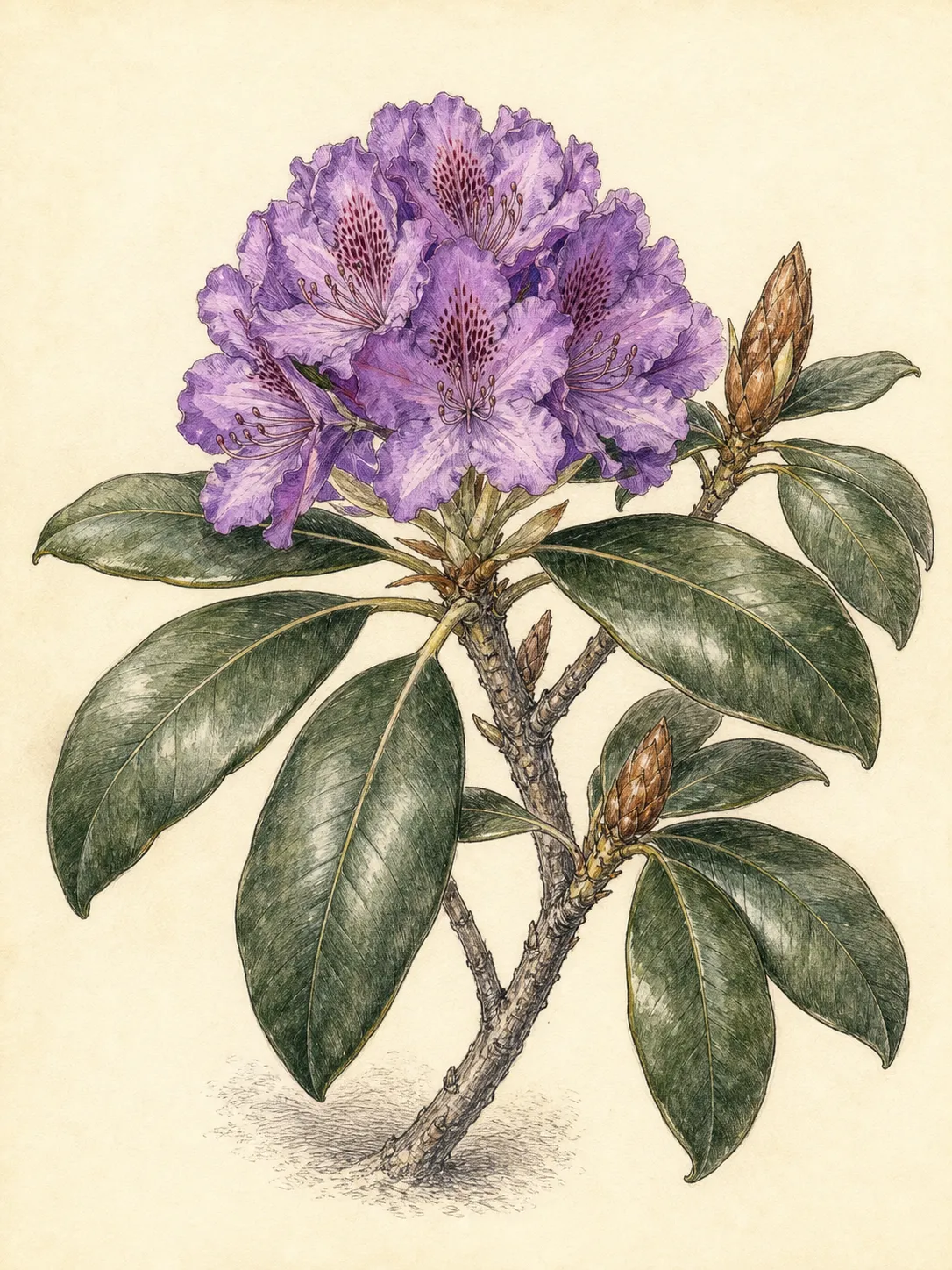
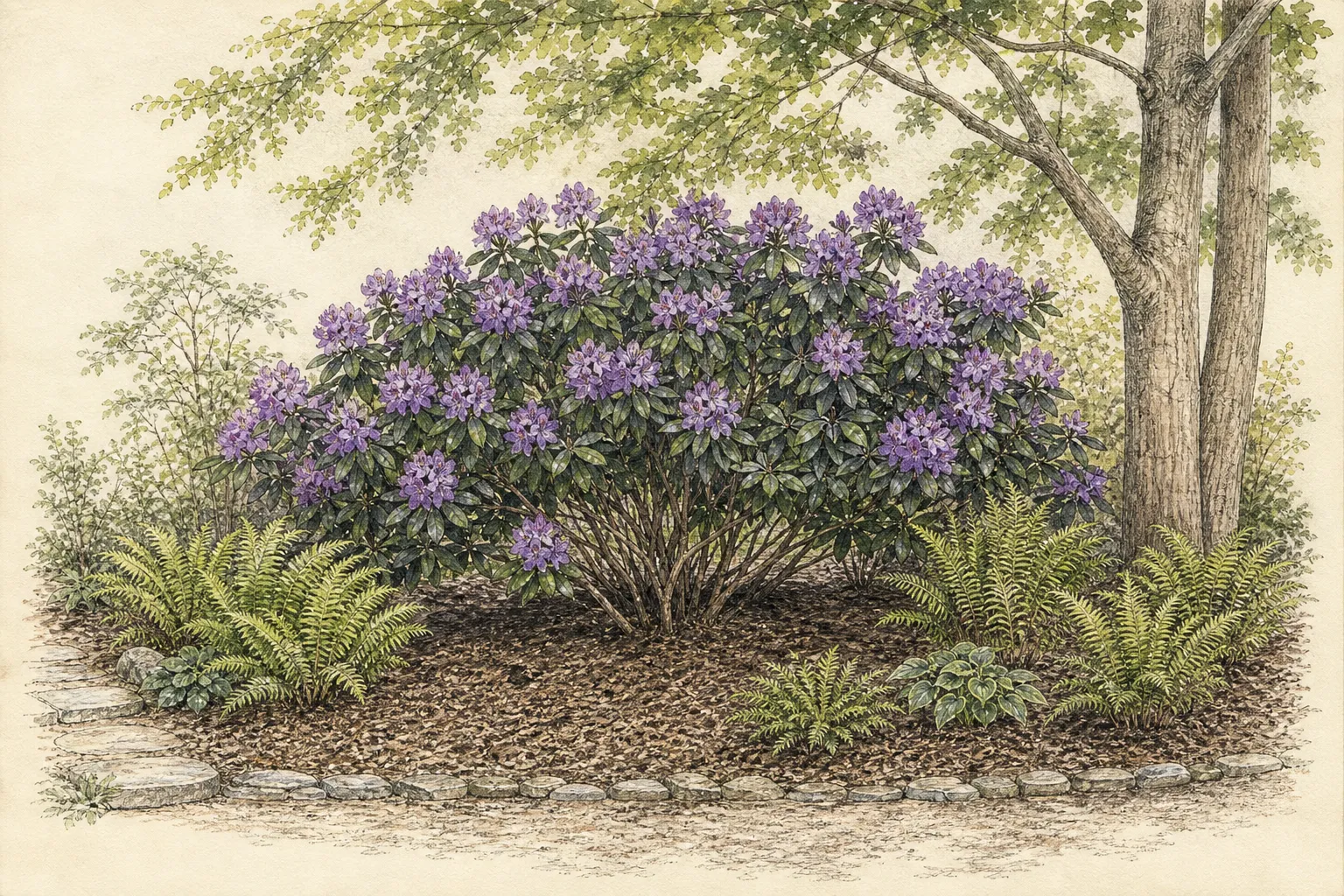
Catawba rhododendron is a substantial evergreen framework shrub, not a temporary bank of spring color. The species develops a dense to spreading, rounded, multi-stemmed outline that can become wider than many residential foundation beds. Its dark foliage remains present through winter, so the mature mass affects views, paths, windows, air movement, and neighboring plants in every season. Site it where that permanence is useful: at a woodland edge, in a broad acid border, as a distant specimen, or in a small group with room between finished crowns.
Identification begins with the whole plant. Rhododendron catawbiense carries simple evergreen leaves in tiers or clusters toward branch tips, giving each shoot a strong layered rhythm. Mature leaves are leathery, broadly elliptical to oblong, and generally glossy dark green above with paler undersides. Young twigs can appear yellowish green before aging brown, and older bark becomes gray-brown and finely scaly. No single leaf proves the name; read habit, twig, bud, flower, label, and provenance together.
Flower buds are conspicuous, acute, and covered with yellow-green scales. In spring they open into compact terminal trusses of broad funnel- to bell-shaped flowers. The species is usually described in lavender-pink to purple tones with greenish or yellow-brown markings near the throat. Garden material can vary, and white or differently colored selections associated with the species exist. Do not reject or confirm identity from color alone, and do not apply the species dimensions automatically to a hybrid sold under a shortened rhododendron label.
Its native geography explains the preferred garden atmosphere but does not provide a universal recipe. Southern Appalachian slopes and ridges can combine bright woodland light, cool root zones, organic surface layers, moving air, regular moisture, and drainage. A flat irrigated foundation bed may be wetter and hotter even if it is shaded. Reproduce the functional conditions—acid reaction, oxygen in the root zone, moisture without saturation, and relief from harsh exposure—rather than importing a decorative woodland look onto incompatible soil.
Light should be evaluated with temperature and moisture. Bright filtered light or morning sun can support dense growth and flowering, while harsh afternoon sun and drying wind can injure leaves or increase root-zone demand. Deep shade may preserve foliage but reduce flower density or loosen the habit. The correct balance shifts with latitude, elevation, cloud cover, humidity, and cultivar. Observe the intended position through the growing season and use nearby regional gardens as evidence.
The root system is shallow, fibrous, and sensitive to both drying and oxygen-poor soil. The desired soil holds moisture through organic matter while allowing excess water to leave. Rhododendron guidance commonly places the preferred pH in an acidic range; this record uses 4.5–6.0, supported by Oregon State guidance for rhododendrons and azaleas. Test before amending. Where naturally alkaline soil, concrete leaching, or alkaline irrigation water continually raises pH, choosing another shrub may be more durable than repeated correction.
Design companions around the final evergreen envelope. Fine ferns, sedges, spring bulbs, and lower woodland perennials can contrast with the broad leaves, but their crowns must remain outside the shrub's shallow roots and drip line as it matures. Keep an access pocket for checking soil, refreshing mulch, and removing spent flower trusses if desired. Do not cultivate deeply beneath the plant or install dense thirsty companions that turn every dry interval into competition.
The species usually needs little formal pruning. Its natural rounded-spreading habit and tiered shoots are more valuable than a clipped shell. Flowers for the following year develop on older growth, so severe or late pruning can remove the next display. Use selective cuts after flowering when size correction is truly necessary, remove dead or damaged wood when identified, and plan renewal gradually. A shrub repeatedly sheared away from a window or path was placed in too small a volume.
Human exposure needs its own scope. The National Capital Poison Center's genus-level guidance says a small accidental taste of rhododendron or azalea may cause mouth irritation, nausea, or vomiting, while serious effects are more associated with larger intentional ingestion. NC State separately classifies Rhododendron catawbiense as a low-severity poisonous plant. Do not turn either source into a claim that every exposure is harmless or that a species profile can determine treatment; use Poison Control for a case-specific human assessment.
Animal exposure is not inferred from the human pattern. The ASPCA lists Rhododendron species as toxic to dogs, cats, and horses, and the Merck Veterinary Manual identifies grayanotoxins throughout Rhododendron species and describes gastrointestinal, neurologic, and cardiovascular effects in animals. Exclude Catawba rhododendron from grazing areas and from routine pet access. These animal sources do not establish a safe amount for a particular pet, so suspected consumption belongs with a veterinarian or animal poison-control service.
- Family
- Ericaceae
- Range
- Southern and central Appalachian region of the eastern United States, from West Virginia into the southeastern states
- Soil pH
- 4.5–6
- Spread
- About 8–10 ft for the species · About 2.4–3 m for the species
Planting & careHow to grow catawba rhododendron
Kew accepts Rhododendron catawbiense as a species native from West Virginia to the southeastern United States, while NC State describes its southern Appalachian woodland-slope and ridge context. The Zone 4–8 envelope, 6–10 ft garden height, and 8–10 ft spread come from the NC State species profile and should not be treated as performance guarantees outside comparable climates. It is adapted to cool, moist, acidic, draining conditions and can struggle in hot lowland sites, alkaline or compacted soils, exposed winter wind, or waterlogged ground. Nursery plants sold as Catawba hybrids, catawbiense hybrids, or named cultivars may carry the species in their ancestry while differing in flower color, mature size, cold hardiness, heat response, and disease susceptibility. Keep the complete label and use cultivar-specific regional guidance for final spacing and exposure. NC State rates the species as highly flammable and says it should not be planted within a home's defensible space. Exclude it from that fire-safety zone and follow the locally adopted defensible-space plan, whose dimensions and vegetation rules vary by jurisdiction and site.
- 1Confirm that the label names the species
Look for Rhododendron catawbiense written in full and retain any cultivar name. A label that says Catawba hybrid or only rhododendron may describe different dimensions, hardiness, flower color, or heat response. Compare leaf, bud, twig, and mature-habit information, and use the purchased plant's documented cultivar limits for final placement.
- 2Map light, wind, and mature clearance
Choose bright filtered light or a position with gentle direct sun and protection from the harshest afternoon exposure and drying wind. Draw the species' broad final spread, keeping it clear of windows, paths, vents, and smaller permanent crowns. NC State rates the species as highly flammable and advises against planting it within a home's defensible space, so place it outside the locally defined fire-safety zone. In hotter, colder, or fire-prone regions, verify exposure and clearance with local authorities before planting.
- 3Test acidity and drainage
Sample the actual root zone rather than nearby lawn soil. Confirm an acidic reaction and observe the site after substantial rain. Do not plant into a basin that stays saturated or into highly alkaline ground that would need continual aggressive correction. Use laboratory or Extension recommendations for any pH adjustment and account for alkaline concrete or irrigation water.
- 4Prepare a broad shallow root zone
Remove weeds without deep tilling and loosen a broad area while protecting existing tree roots and utilities. Improve organic structure across the planting zone only as local soil guidance supports; do not create a small pocket of radically different material. Keep the base firm enough that the shallow root ball will not settle below grade.
- 5Expose the upper roots
Remove the container or open B&B wrapping according to stock-specific guidance, then find the root flare or uppermost woody roots. Correct circling or defective roots using current nursery-stock recommendations. Do not use the top of loose potting mix or burlap as the depth reference, and reject a root system whose serious internal defects cannot be corrected.
- 6Set the root ball at grade
Place the upper structural roots at finished grade to slightly above it where local drainage guidance calls for a raised setting. Keep the stem base visible, spread or orient roots outward where possible, and backfill with compatible site soil. Do not mound soil over the root ball or compact wet soil around the shallow roots.
- 7Water the ball and surrounding soil
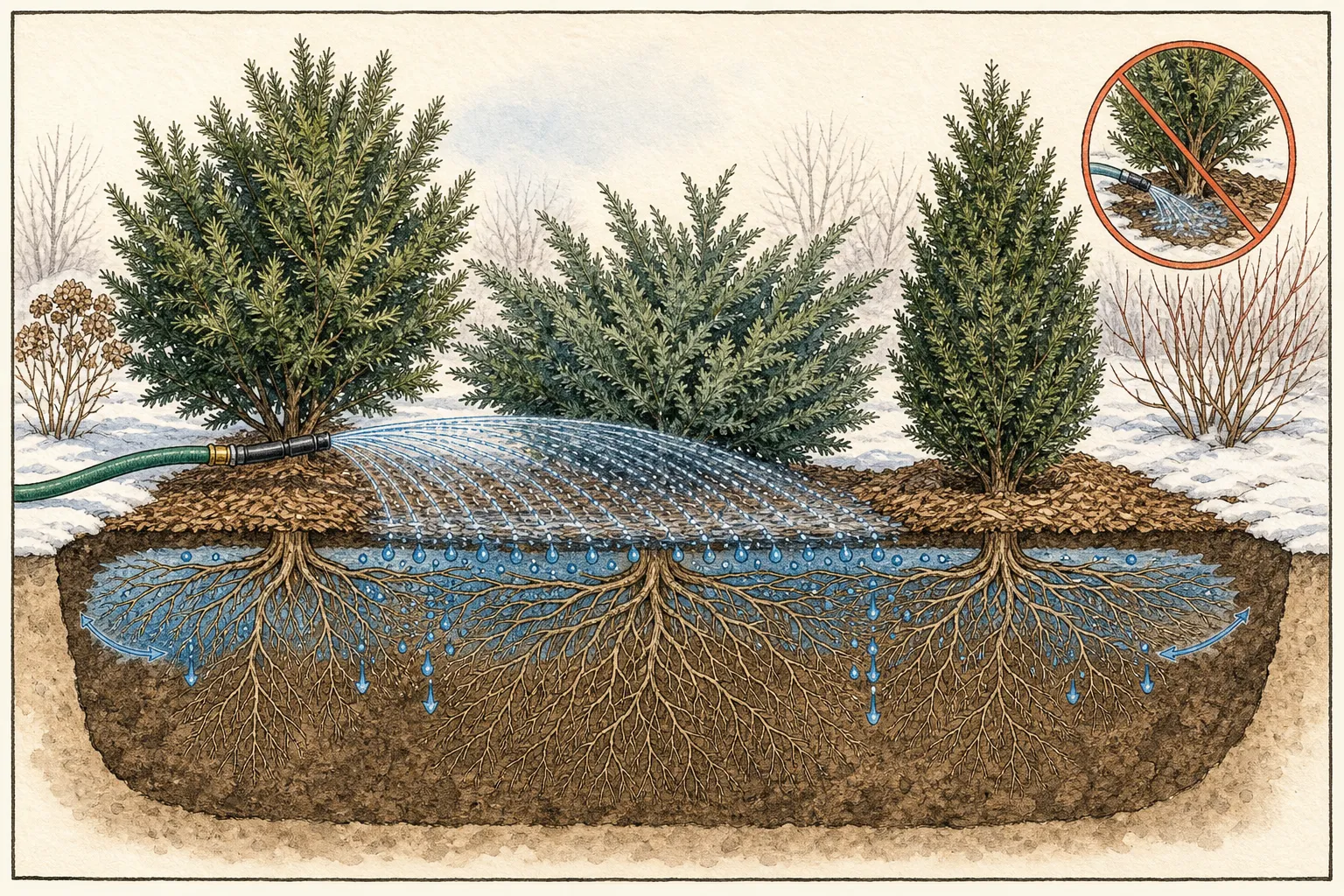
Apply water slowly after planting so the original root ball and adjacent soil are both moistened and obvious voids settle. Check the two zones separately through establishment because their textures can dry differently. Maintain consistent moisture without leaving the crown or root ball saturated, and adjust to rain, heat, wind, soil, and plant response.
- 8Mulch without burying stems
Apply a conservative organic surface layer over the root zone to buffer moisture and temperature, tapering it completely away from trunks and branch bases. Keep the shallow roots protected from hoeing and foot traffic. Mark the plant, store the exact name and source, and leave access for moisture checks and future selective pruning.
Pruning catawba rhododendron
Prune Catawba rhododendron selectively and only for a defined reason. After flowering is the least disruptive window for removing a misplaced branch, modestly reducing an overextended shoot, or shaping a young framework because it preserves more time for growth and avoids blindly removing the next season's flower buds later in the year. Trace each branch to a sound side branch or its origin rather than shearing the evergreen surface. Remove confirmed dead, broken, or diseased wood when found, cleaning tools between suspect cuts and seeking regional diagnosis for unexplained dieback. Spent trusses may be snapped or cut carefully after bloom if a tidy appearance is desired, but protect the tender new shoots beside them; leaving some trusses is not a health failure. For an old leggy shrub, stage renewal over multiple seasons and confirm the cultivar's response before making large cuts. Do not repeatedly clip the plant into a narrow hedge, cut shallow roots during edge maintenance, or prune healthy foliage simply to compensate for alkaline soil, drought, saturation, or poor light. A specimen that chronically blocks a path or window should be moved when feasible or replaced with a smaller documented cultivar rather than held indefinitely below its natural species envelope.
Seasonal care
Spring
Before bloom, inspect winter leaf condition, branch tips, mulch movement, drainage, and the visibility of the stem base. Do not interpret every curled or discolored leaf from a cold interval as a permanent diagnosis; compare new growth and regional conditions. During flowering, verify the terminal trusses and record color and timing as identification evidence. After bloom, remove spent trusses only if desired and make any necessary selective pruning before new flower buds develop. Test soil rather than automatically applying an acid fertilizer, and keep cultivation shallow around the fibrous roots.
Summer
Check moisture below the mulch during heat and wind, sampling the original root zone and surrounding soil. Keep conditions consistently moist but not saturated, especially in compacted ground. Watch for scorch concentrated on the exposed side, yellow new leaves with greener veins, wilt associated with wet soil, or branch dieback that continues despite appropriate moisture. These patterns require separate investigation of light, pH, drainage, roots, or disease. Keep mowers, string trimmers, pets, and deep-rooted companions away from the shallow root zone.
Autumn
Continue moisture checks as temperatures moderate; evergreen leaves still lose water even after deciduous companions are dormant. Clear only dense material that mats over stems or blocks drainage and restore a conservative mulch layer without piling it against bark. Avoid late heavy feeding or pruning that stimulates tender growth or removes formed flower buds. Mark the mature drip line before adding bulbs or perennials, and keep cut material out of pet and livestock access while following local yard-waste guidance.
Winter
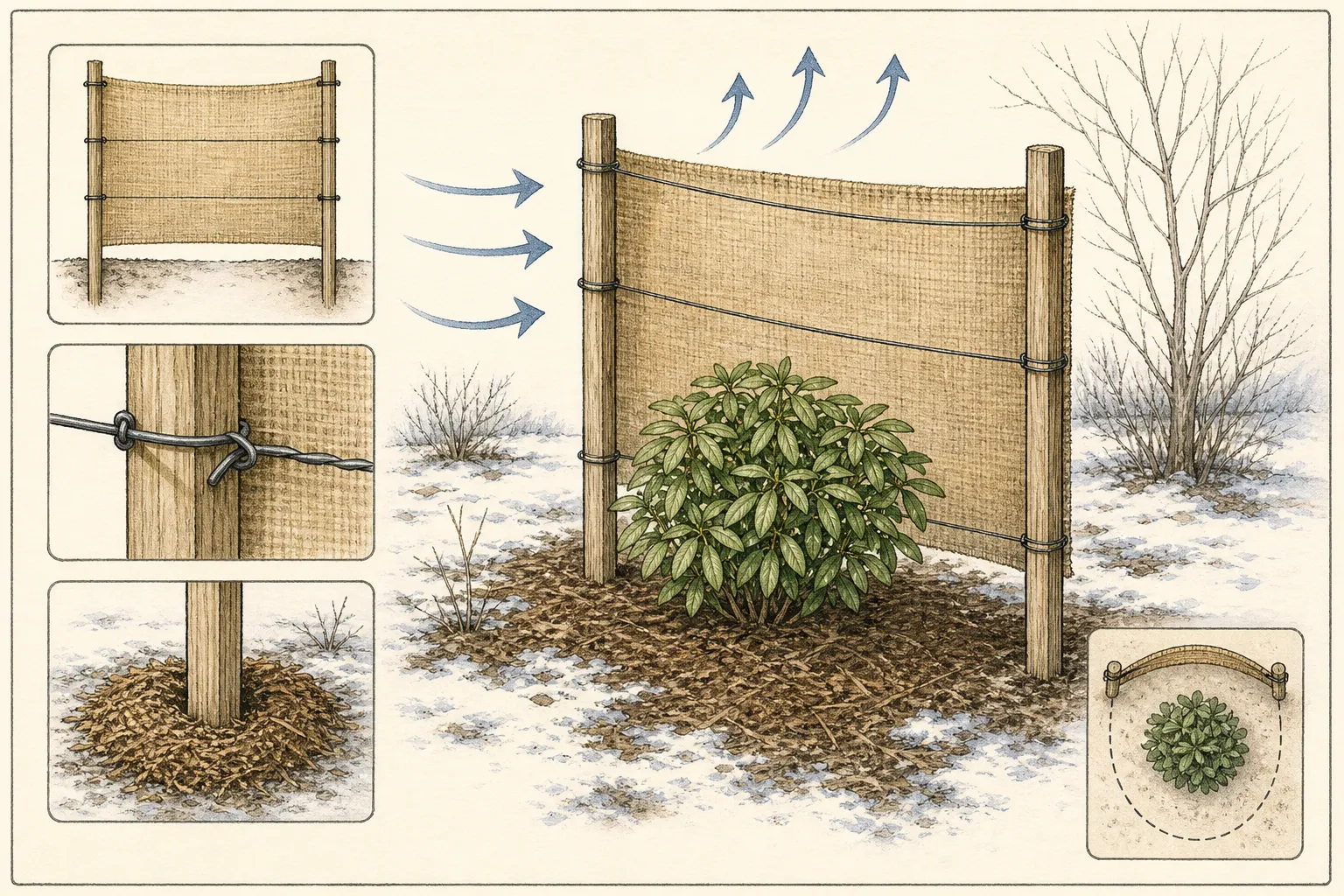
Inspect after wind, heavy precipitation, freeze-thaw cycles, or abrupt sun exposure. Keep road salt, roof discharge, and standing water away from the root zone. Evergreen leaves may change posture during cold weather, so wait for moderate conditions before declaring damage, while broken branches and split unions need prompt assessment. Check that burlap screens or temporary wind protection do not rub foliage or trap the shrub, and plan spring pruning from the visible branch framework without cutting flower buds in the dormant season.
Safety and garden spread
Common problems
Root decline in wet soil
- Look for
- Persistent wilt, dull foliage, yellowing, reduced growth, or branch dieback while the root zone remains saturated or drains slowly.
- Action
- Stop automatic watering and assess drainage, planting depth, and root condition. Do not add fertilizer to a failing wet plant. Seek a regional diagnostic service for progressive decline and correct the site rather than repeatedly replacing rhododendrons in the same waterlogged pocket.
High-pH chlorosis
- Look for
- New leaves becoming yellow or yellow-white while veins remain greener, especially near concrete, alkaline fill, or a site with a rising soil-test pH.
- Action
- Test soil and irrigation water before acidifying. Rule out saturated or damaged roots and severe drought, which can also discolor foliage. Follow laboratory recommendations for gradual correction, or replace the shrub when the site's buffering and alkaline inputs make a stable acidic root zone unrealistic.
Sun or drying-wind scorch
- Look for
- Bleached or crisp brown tissue concentrated on the side receiving hot afternoon sun, reflected light, or prevailing dry wind.
- Action
- Check root-zone moisture and the daily exposure pattern together. Restore appropriate moisture if dry, add safe temporary shelter during an exceptional event, and relocate the shrub in a suitable season if the normal site repeatedly exceeds the species or cultivar's regional tolerance.
Sparse bloom
- Look for
- Few terminal trusses despite otherwise stable growth, often after late pruning, in very deep shade, or following weather injury to buds.
- Action
- Confirm plant identity and cultivar, review when branches were cut, and compare summer light with regional guidance. Preserve sound older growth through the next bud cycle before diagnosing. Do not force bloom with fertilizer when shade, pruning, or winter exposure is the limiting condition.
Oversized or leggy framework
- Look for
- Branches repeatedly obstructing paths or windows, bare shaded interiors, or a broad species habit compressed into a narrow bed.
- Action
- Make selective post-flowering cuts only where adequate side growth remains, and stage any renewal. Restore light and access without shearing the shell. If the mature envelope cannot fit, move the shrub when feasible or replace it with a documented smaller cultivar.
Unexplained branch dieback
- Look for
- One or more shoots losing leaves, developing discolored bark, or continuing to decline while neighboring branches remain green.
- Action
- Check for physical injury, root-zone saturation, drought, and planting depth, then submit representative material to a local diagnostic service. Remove only confirmed dead or diseased wood with clean tools and avoid broad treatment without a diagnosis.
Possible human ingestion
- Look for
- A witnessed or suspected human taste or ingestion, with or without mouth irritation, nausea, or vomiting. A small accidental taste and a larger intentional ingestion require different case-specific assessment.
- Action
- Keep the exact plant name and any known amount and timing available, then use the National Capital Poison Center's webPOISONCONTROL tool or telephone service for case-specific directions. Follow that assessment rather than applying animal guidance or a generic garden remedy, and seek emergency help when Poison Control directs it.
Possible animal ingestion
- Look for
- Missing leaves or flowers, known access by a dog, cat, horse, or grazing animal, or gastrointestinal, weakness, coordination, heart-rate, or blood-pressure changes described in veterinary guidance.
- Action
- Prevent further access, retain the exact plant name or a photograph, and contact a veterinarian or animal poison-control service. The ASPCA and Merck Veterinary Manual establish animal risk but do not provide a safe household dose; follow veterinary directions rather than transferring human guidance to the animal.
Related reading
Sources
- Rhododendron catawbiense Michx.. Royal Botanic Gardens, Kew. Source record · Accessed 2026-08-30.
- Rhododendron catawbiense. NC State Extension Gardener Plant Toolbox. Source record · Accessed 2026-08-30.
- Toxic and Non-toxic Plants: Rhododendron. ASPCA. Source record · Accessed 2026-08-30.
- Spring Care Tips Keep Rhododendrons and Azaleas Thriving. Oregon State University Extension Service. Source record · Accessed 2026-08-30.
- Azaleas and Rhododendrons: Common and Potentially Dangerous. National Capital Poison Center. Source record · Accessed 2026-08-30.
- Houseplants and Ornamentals Toxic to Animals. Merck Veterinary Manual. Source record · Accessed 2026-08-30.