American Holly
Ilex opaca
A field guide to Ilex opaca: identify its native evergreen form, plan for male and female plants, and give the slow-growing tree acidic drainage and winter shelter.
Published Last updated
At a glance
- Light
- Full sun to part shade; useful afternoon shade in hot summer climates
- Water
- Moderate, with consistent moisture and drainage during establishment
- Soil
- Acidic to neutral, moisture-retentive but well-drained soil; intolerant of prolonged saturation and limestone conditions
- Hardiness
- Zones 5–9
- Bloom
- Late spring into early summer; fruit colors in autumn and can persist into winter
- Height
- 15–30 ft in cultivation · 4.5–9 m in cultivation
In this guide
Overview
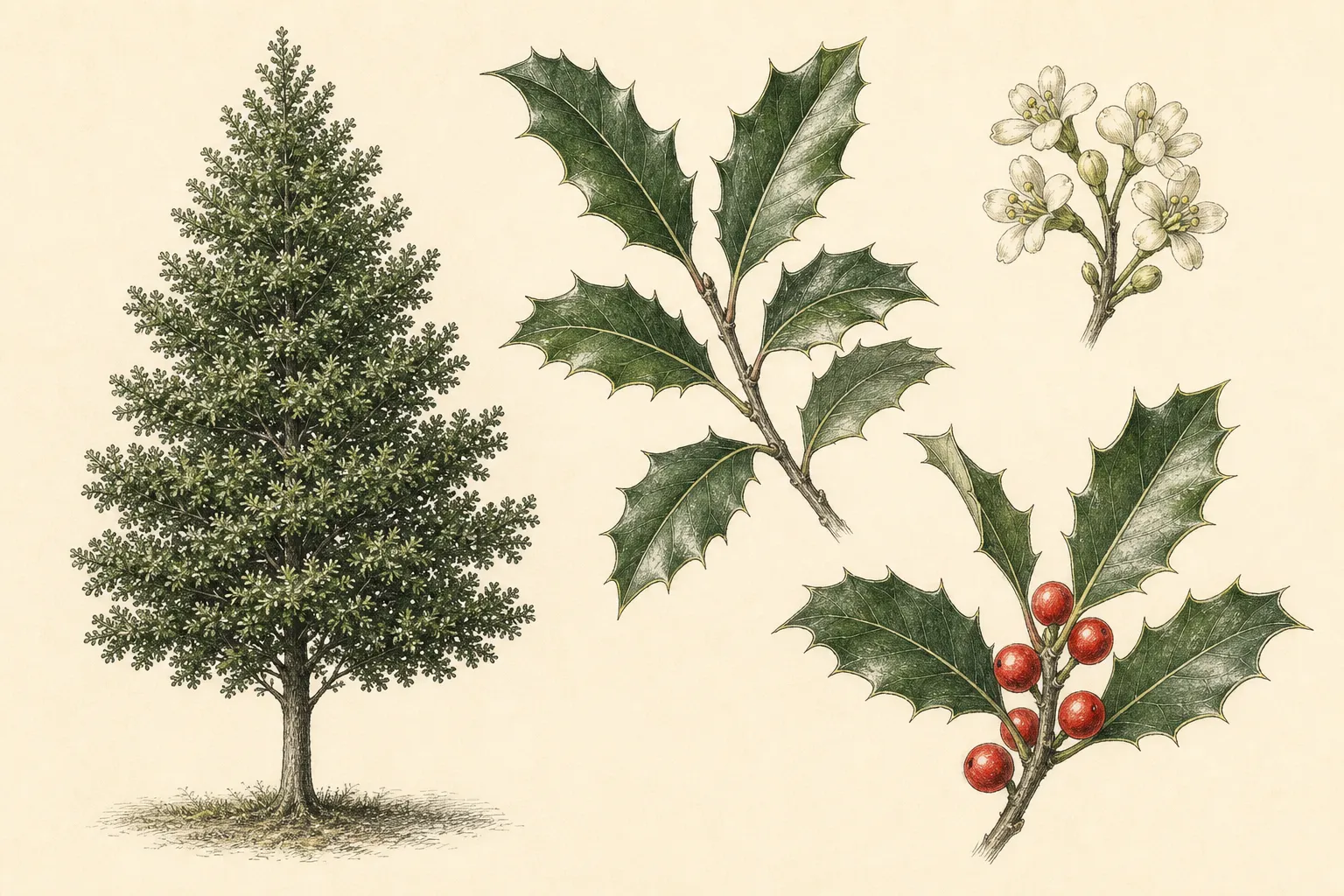
American holly is the eastern North American broadleaf evergreen behind the classic winter combination of deep green leaves and red fruit. In gardens it develops slowly into an upright pyramidal tree, generally smaller than old woodland specimens. Its dense outline gives a border year-round weight, while the foliage catches low winter light without the coarse scale of many conifers.
Identify it by the complete set of traits. Leaves are alternate, thick and leathery, usually duller than English holly, with wavy margins carrying stiff spine-tipped teeth that can vary on one tree. Small creamy white flowers open in late spring. Female flowers can mature into round drupes, usually red, while male plants supply pollen and remain fruitless. A red-berried plant is therefore not a self-contained production unit.
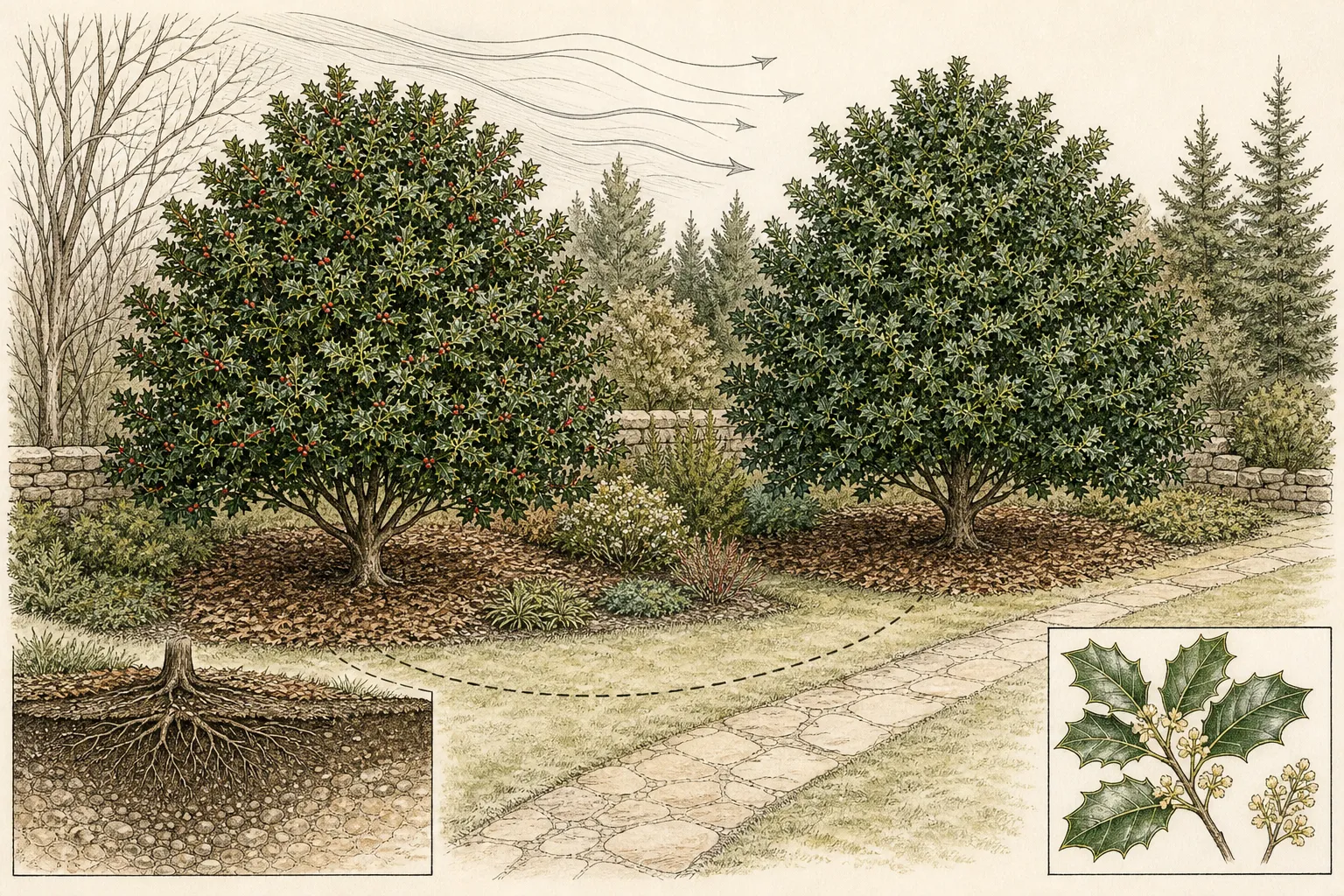
The species is dioecious, with male and female flowers on separate plants. Choose a named female for fruit quality and mature habit, then obtain a compatible male whose flowering period overlaps. One male may serve more than one nearby female, but distance, intervening barriers, weather and pollinator activity all affect fruit set. Nursery compatibility advice is more reliable than a universal ratio.
Full sun produces the densest framework and strongest fruiting where soil moisture is adequate. Part shade is workable, and afternoon protection can help in hot climates, but deep shade opens the crown and reduces density. The site should also soften cold winter wind and intense winter sun, particularly near the colder edge of the range where evergreen leaves can lose water while roots sit in frozen soil.
American holly favors acidic, well-drained ground that remains reasonably moist. Missouri Botanical Garden notes yellowing in alkaline soil and intolerance of flooding or saturation. Correct a poorly drained planting area through site choice and wider grading before planting; a deep amended pocket cannot make a chronically wet position safe for a long-lived evergreen tree.
Its eventual footprint deserves architectural planning. A species-sized tree can reach 15–30 feet tall and 10–20 feet wide in cultivation. Keep it clear of eaves, narrow gates, overhead conflicts and paths where thorny leaves would brush people. Smaller named selections exist, but the cultivar's documented dimensions must replace the species range in a tight garden.
Fruit supports visual winter interest and is used by birds, yet it is not garden food for people or pets. Retain fruit outdoors where it contributes habitat, and prevent access where children or animals may ingest fallen drupes. Cut decorative branches sparingly across an established tree so one side is not stripped and the slow-growing canopy remains intact.
- Family
- Aquifoliaceae
- Range
- Eastern and central United States, from southern New England through the Southeast and west toward Texas and Missouri
- Soil pH
- 5–6.5
- Spread
- 10–20 ft · 3–6 m
Planting & careHow to grow american holly
Zones 5–9 and the 15–30 ft cultivated size are Missouri Botanical Garden planning ranges, not guarantees for every cultivar. Northern and exposed gardens should use locally proven selections and shelter foliage from desiccating winter wind and sun. American holly is dioecious: a named female needs a compatible male flowering at the same time for dependable fruit. Ask the nursery for a pollinizer match rather than assuming any holly will work. NC State rates the species as highly flammable and says it should not be planted within a home's defensible space; keep it outside the locally defined fire-safety zone and follow the applicable local plan.
- 1Choose a documented selection
Record the cultivar, sex, mature dimensions and regional hardiness. When winter fruit matters, select a female and a compatible male with overlapping bloom rather than buying two unnamed hollies.
- 2Reserve the mature envelope
Mark the expected crown width and height, checking paths, buildings, views and overhead space. Give the thorn-edged foliage a position where the permanent tree will not require routine size control.
- 3Confirm light and winter shelter
Use full sun to part shade with locally appropriate afternoon protection. Read prevailing winter wind and reflected sun, placing the evergreen where a building or planting can soften exposure without creating deep shade.
- 4Verify soil reaction and drainage
Test soil when alkalinity is suspected and observe the site after rain. Choose acidic to neutral, draining ground; correct broad grading problems before planting and reject a position that remains saturated.
- 5Plant at the root flare
Set the first structural roots at finished grade, spread or correct circling container roots as current tree-planting guidance directs, backfill principally with site soil and keep mulch away from the trunk.
- 6Establish the whole root zone
Water deeply according to soil moisture during establishment, expanding the watered area as roots spread. Retain a broad mulch ring while keeping bark and trunk flare exposed.
- 7Protect form while growth is young
Remove only broken, crossing or clearly defective branches with clean cuts. Preserve the central pyramidal framework and delay decorative harvesting until the plant is established enough to absorb it.
Pruning american holly
American holly needs less pruning when its mature size fits the site. Preserve the natural pyramidal outline and inspect young trees for a coherent leader, broken branches and tight competing stems. Make corrective cuts while branches are small, using current tree-pruning standards and never topping the crown. Established plants tolerate selective pruning, but repeated shearing turns a tree into a dense outer shell and conceals its branch structure. Harvest decorative boughs lightly across the canopy rather than cutting one visible side bare. Perform major structural work during a locally appropriate dormant window and remove storm-damaged branches when safety requires it. Fruit is borne on female plants after flowering and pollination, so indiscriminate clipping can reduce both flowers and the winter display. Keep thorny cuttings contained and away from children and pets.
Seasonal care
Spring
Inspect winter injury, preserve sound evergreen foliage, renew a trunk-clear mulch ring and watch male and female bloom overlap. Water new trees when the root zone begins to dry and correct drainage before summer storms.
Summer
Maintain establishment moisture without saturation, check for chlorosis where soil reaction is unsuitable and protect roots from mower or string-trimmer injury. Let the leader and side branches extend naturally.
Autumn
Confirm fruit set on female plants, water before freeze when autumn is dry, clear blocked drainage and protect the root zone without piling mulch over the trunk flare.
Winter
Read windward foliage for desiccation, keep deicing salt and piled snow away, remove hazardous breakage and take only restrained decorative cuts from established plants.
Safety and garden spread
Common problems
No fruit on a healthy tree
- Look for
- A male plant, a female without a compatible nearby male, poor bloom overlap, deep shade or flowers lost to weather.
- Action
- Confirm the plant's sex and cultivar, document spring flowering and add a nursery-recommended compatible male when pollination is missing.
Yellow leaves in alkaline soil
- Look for
- Interveinal yellowing or weak growth where soil tests high in pH or limestone influences the root zone.
- Action
- Test soil and obtain local guidance before amending. Choose an adapted plant for persistently alkaline ground rather than repeatedly treating a fundamentally unsuitable site.
Winter scorch
- Look for
- Brown leaf margins or whole patches strongest on the windward or sun-exposed side while soil is frozen.
- Action
- Document exposure, preserve live wood, improve root-zone moisture before freeze and use site-scale wind protection for young plants; wait for spring growth before judging final dieback.
Root decline in wet ground
- Look for
- Sparse growth, dull foliage, dieback and persistently saturated soil or standing water around the root zone.
- Action
- Stop routine watering, identify the drainage failure and seek diagnosis before replanting. Correct the site broadly; replacing the tree in the same wet pocket repeats the cause.
Crowded or misshapen crown
- Look for
- Branches pressed against a building, path or neighboring tree, or repeated hard cuts holding a species-sized tree in a shrub-sized space.
- Action
- Use selective professional pruning where feasible and plan eventual replacement with a documented smaller selection if the permanent site cannot contain the mature tree.
Related reading
Sources
- Ilex opaca. North Carolina Extension Gardener Plant Toolbox. Source record · Accessed 2026-08-30.
- Ilex opaca. Missouri Botanical Garden Plant Finder. Source record · Accessed 2026-08-30.
- Ilex opaca, American holly. USDA Forest Service Fire Effects Information System. Source record · Accessed 2026-08-30.
- Toxic and Non-toxic Plants: Holly. ASPCA Animal Poison Control Center. Source record · Accessed 2026-08-30.
- Holly berries: A beautiful decoration but a poisonous snack. National Capital Poison Center. Source record · Accessed 2026-08-30.