Gardens · overgrown perennial border edit
Edit an Overgrown Perennial Border Before You Dig
Map every ornamental plant as keep, move, divide or remove before renovation, then phase the work around identity, mature space, species timing and establishment care.
Published Last updated
In this guide
- Pause the renovation long enough to see the garden
- Document a full season when identity is uncertain
- Map conditions and fixed structure first
- Draw the decision map before lifting anything
- Work a measured Zone 4b border from before to after
- Keep plants that earn their exact position
- Move healthy plants whose role is in the wrong place
- Divide only when division solves a named problem
- Remove plants that undermine the new framework
- Phase the renovation around plant timing
- Prepare and replant the border as a maintained system
- Judge the edit after establishment, not at planting
- Design ideas
Pause the renovation long enough to see the garden
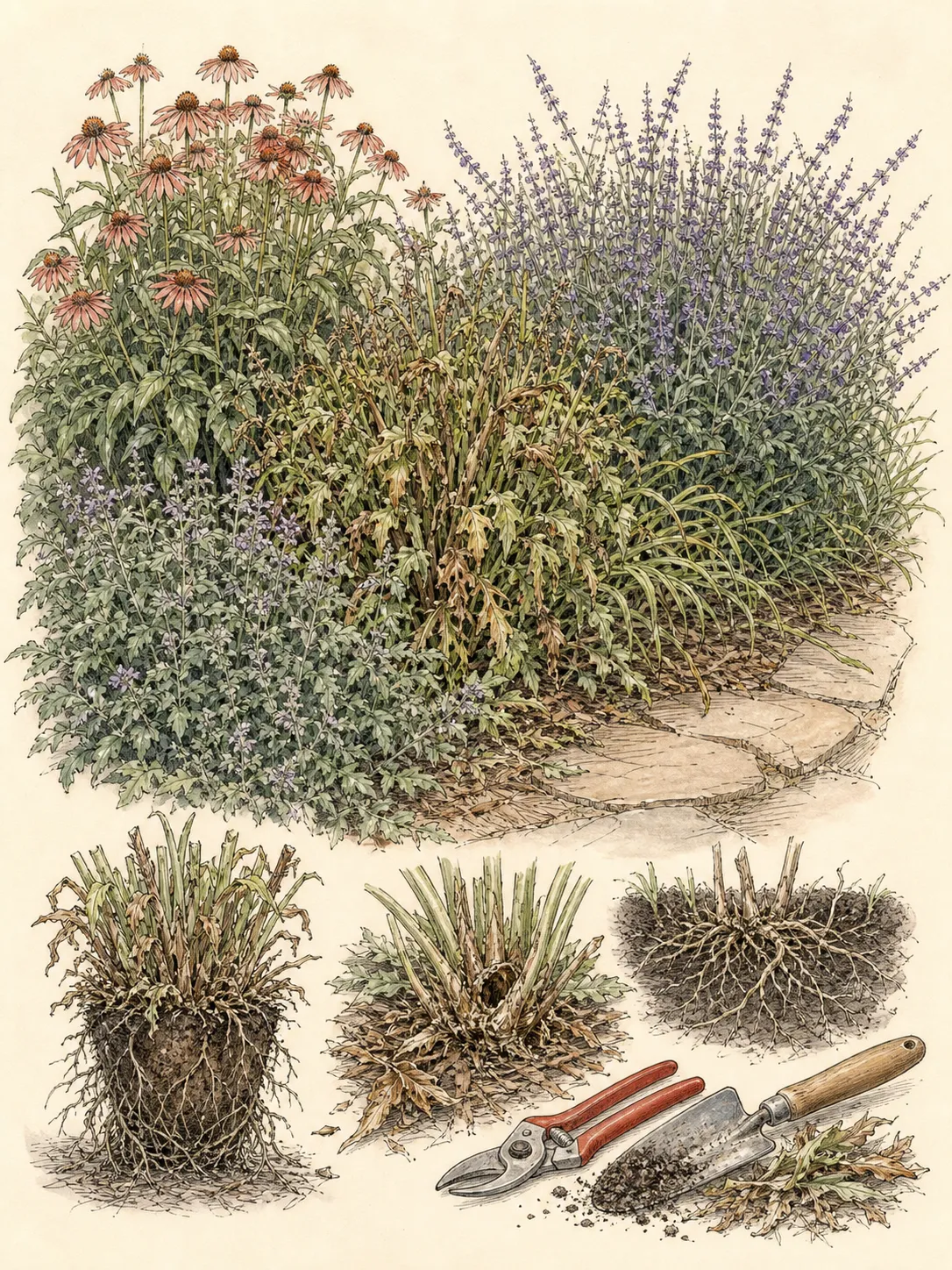
An overgrown border is not one problem. It contains successful plants that became too large, sound plants in poor positions, clumps that genuinely need division, unwanted spreaders, hidden bulbs, valuable mature anchors and gaps masked by foliage. Digging everything at once destroys those distinctions. Begin with an edit: identify what exists, decide what the border must do and give every plant a provisional action before a spade changes the evidence.
Write a short design brief from the main viewpoints. The border may need to clear a path, reveal a window, frame a seat, improve a spring-to-autumn sequence or reduce annual staking and division. Rank those jobs. A plant can be healthy and beautiful yet work against the brief through scale, timing or maintenance. Conversely, a quiet foliage clump may be worth retaining because it connects seasons and protects the composition from becoming a collection of isolated flowers.
Choose the renovation scope you can establish, not merely clear. Lifting is only the middle of the work; roots need protection, destinations need preparation and replanted divisions need aftercare. A phased edit can preserve shade, soil cover and visual continuity while one zone changes. Mark the boundary of the first coherent area and leave the rest observed but undisturbed until that area is replanted and its irrigation is working.
Document a full season when identity is uncertain
Photograph the border from fixed points before cutback and mark each crown once as confirmed, probable or unknown. Use seasonal images, labels and prior records to connect spring shoots with later foliage and flowers; keep an unknown plant under observation until identity is sufficient for timing and care. The purpose is one usable action map, not a second archive: record the name, measured footprint, condition and provisional keep, move, divide or remove code, then stop documenting unless a later season changes the decision.
Map conditions and fixed structure first
Measure the border, paths, walls, trees, shrubs, utilities, taps, drains and stepping points. Draw them to a workable scale. RHS renovation guidance begins with a plan and site conditions because plants can be judged only in relation to light, soil and aspect. Add summer and winter shade, roof runoff, dry root zones, low wet areas and places where access equipment must pass. These fixed facts define what can remain.
Draw the mature canopy and protected root area of woody plants before assigning herbaceous space. An overgrown perennial can often move; a mature shrub or tree may be expensive or risky to relocate. Preserve visible root flares and avoid making a new digging trench through established roots. If a woody anchor is itself unsuitable, obtain plant-specific pruning or arboricultural advice rather than treating it as a large perennial that can be divided.
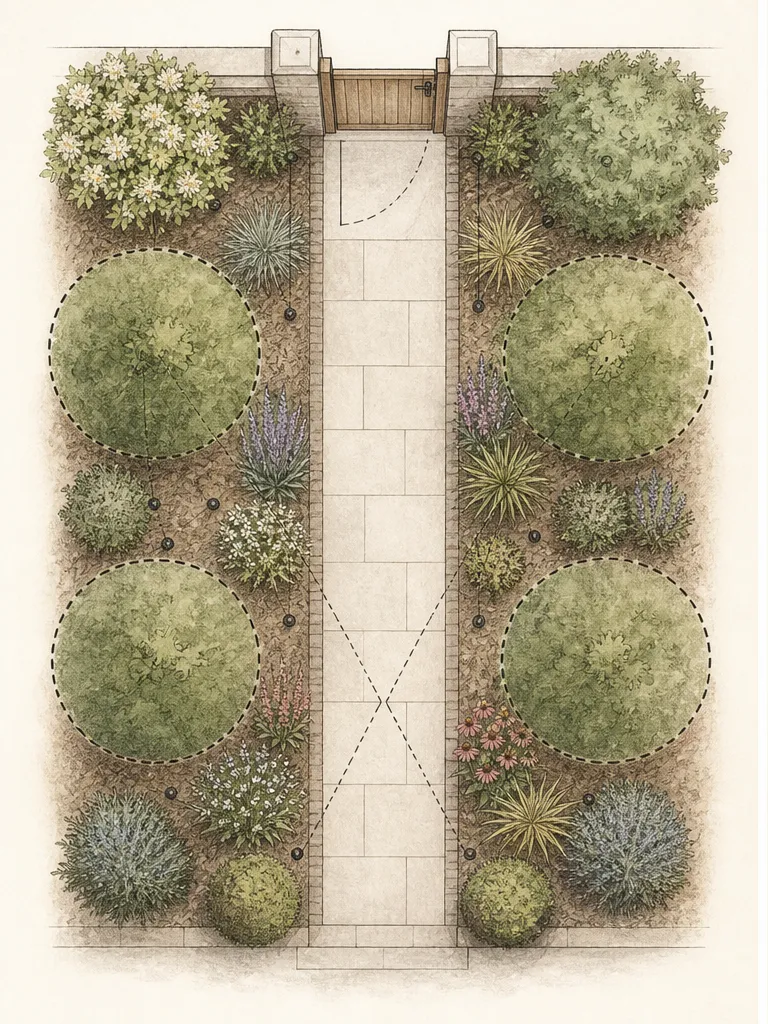
Mark circulation as a planting component. Paths need their full usable width, and every retained group needs an approach for watering, support, division or cleanup. Show views from windows and seats as cones across the plan. A tall plant can remain near the front if its canopy is transparent and the view needs it, while a dense lower mass may block more. Position follows form and purpose, not a rigid tall-at-back rule.
Draw the decision map before lifting anything
Use four action codes: keep in place, move intact, divide, and remove. Add a fifth temporary code for observe when identity, season or condition is unresolved. Apply one code to every numbered plant. A cloud of maybes hides conflict, so write the reason beside each decision: anchor, wrong light, crowded crown, excessive spread, duplicated role, unsafe access, declining center or incompatible maintenance. Reasons make the edit coherent and reviewable.
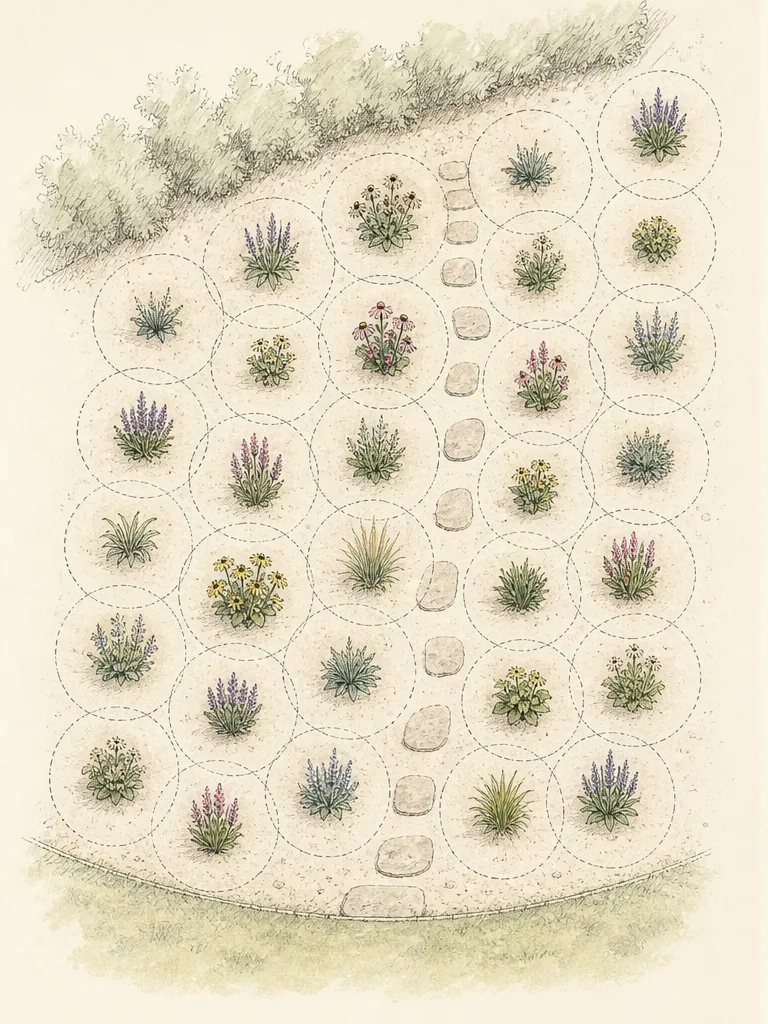
Draw each retained or relocated plant at mature spread, not current cutback size. Overcrowding often returns because small spring divisions are spaced by the gaps between their leaves. Include the expected canopy, crown and service side. Where several plants occupy one future footprint, decide which role is strongest. Do not solve the collision by drawing them smaller. Keep one, move one, divide one or remove one before the ground is opened.
Separate visual abundance from plant count. Three expanding clumps can create more useful mass than twelve isolated remnants. Identify repeated shapes or colors worth carrying through the border and quiet areas that should remain open. RHS planning emphasizes omission as well as inclusion. Every division does not need to return to the same bed; surplus can be held, shared or discarded responsibly according to identity and local guidance.
Work a measured Zone 4b border from before to after
A completed central-Minnesota case shows what the four codes change. The border is 18 feet long and 6 feet deep beside a south-facing fence in USDA Zone 4b, viewed from a 3-foot path along its south edge. It receives seven hours of summer sun; the loam drains by the day after ordinary rain but dries first along the path. Measure x eastward from the west end and y northward from the path. The brief is exact: preserve two old anchors, reopen the full path, replace one congested front band with repeated 2-foot mounds and retain a reachable route to every crown.
Before work, five named groups occupy nearly every footprint. A Paeonia lactiflora 'Sarah Bernhardt' at x = 3.2, y = 4.1 feet measures 36 inches high by 42 inches wide; KEEP it because it is sound, correctly placed and Iowa State notes that peonies can remain undisturbed for many years. A Baptisia australis at x = 15.4, y = 4 feet measures 54 by 54 inches; KEEP it and mark its full footprint as no-dig because Iowa State and Minnesota describe Baptisia as difficult to divide, and Minnesota advises against moving it where possible. These are measured case dimensions, not universal cultivar specifications.
Three Echinacea purpurea 'Magnus' clumps, each 38–42 inches high by 18–22 inches wide, lean from the path edge at x = 2, 3.8 and 5.6 feet and y = 1.4 feet; MOVE them intact because the crowns are sound but the daylily band crowds their light and the stems obstruct the path. Five Hemerocallis 'Stella de Oro' crowns have merged into a 10-by-3-foot band from x = 4 to 14 feet; their foliage is about 20 inches high and flower stems about 26 inches, so DIVIDE the band to recover distinct repeatable mounds. A 4-foot-high Physostegia virginiana colony fills an 8-by-4-foot patch from x = 7 to 15 feet; REMOVE it from this border because its spread defeats the lower-maintenance brief. Iowa State identifies obedient plant as a vigorous spreader that can crowd neighbors, making removal a design decision rather than a diagnosis.
The after-plan keeps the peony and Baptisia at their measured centers. Move the three Echinacea to x = 7, 9.5 and 12 feet at y = 3.8 feet, 30 inches center to center, preserving each root ball and a 24-inch mature footprint. Split the daylily mass into five robust divisions with healthy shoots and roots; set them at x = 2, 5, 8, 11 and 14 feet at y = 1.4 feet, 36 inches center to center, each within a 24-inch envelope. Remove all Physostegia material from the bed and monitor its former footprint before filling any missed patch. The final plan leaves the path edge clear, repeats one low rhythm across the front and gives the moved coneflowers light between the two undisturbed anchors.
Schedule the Echinacea move and daylily division in early spring while growth is low and neither is flowering. Minnesota calls spring a good time to move many perennials; Iowa State permits daylily division in spring or late summer to fall. Water dry soil the day before, choose a cool overcast work period, prepare all destinations first and shade roots during the short transfer. Replant the Echinacea at its previous crown level. For each daylily division retain healthy shoots and roots, replant at the same level and water the root volume immediately. Iowa State advises prompt replanting and continued watering through the first growing season; flowering may be reduced while divisions establish.
This is a Zone 4b renovation case, not a portable recipe. Its measurements describe the actual before condition and the intended mature envelopes after editing. In regions where these cultivars differ in size, where spring is too short or wet for safe lifting, or where the same taxa are not locally durable, keep the decision logic but replace the schedule and footprints with regional guidance and measured local plants. Do not move the Baptisia or divide the peony merely to reproduce the diagram; their keep decisions depend on the retained sources and on their success in these exact positions.
Keep plants that earn their exact position
A keep-in-place plant should fit the light, drainage and mature space, support the design brief and remain serviceable from the path. It may be a healthy structural clump, a slow-establishing specimen, a valued cultivar or a plant whose roots resent disturbance. Mark a protected no-dig zone around it. Renovation activity can damage a keeper through trampling, exposed roots or piled soil even when no one intends to lift it.
Test the plant through more than peak flower. Does its foliage remain useful, does it reveal or block a view, and can neighboring plants receive light? Does its maintenance fit the garden, or does annual staking and repeated spread control overwhelm the available time? A sentimental plant can remain when that value is explicit, but give it adequate space rather than using sentiment to justify a crowded compromise that injures everything around it.
Flag keepers physically before work starts. Use bright temporary markers beyond the crown and add them to the plan. Define where barrows, tarps and tools may not rest. If a retained plant has dormant bulbs around it, mark those as a separate underground layer. A stable anchor lets the renovated border retain age and scale; it should not become the accidental casualty of clearing neighboring material.
Move healthy plants whose role is in the wrong place
Move a plant intact when its crown is sound but its position conflicts with light, moisture, mature scale, color sequence or access. Identify the destination before lifting and verify that it corrects the actual mismatch. Moving a shade-stretched plant to another shaded corner or placing a path-flopper beside a second narrow path only relocates the symptom. Draw the receiving footprint and prepare its irrigation route first.
Use species-specific timing. Some perennials move readily during early growth; others are better handled after flowering or in a dormant window. Climate changes those windows. Iowa State and Minnesota publish regional division guidance but both emphasize that timing varies among species. Consult the exact plant and local authority rather than labeling all spring-flowering plants for autumn and all autumn-flowering plants for spring without exceptions.
Preserve root mass and orientation where division is not intended. Dig outside the estimated crown, lift with support beneath the roots and protect the root ball from sun and wind. Replant at the species' correct depth in prepared soil, not automatically deeper for stability. Water the entire root volume and label the move. A transplanted keeper may flower less while re-establishing; record that expected cost before judging the new position.
Divide only when division solves a named problem
Division is useful for rejuvenating certain clumps, reducing vigorous spread or creating enough plants to repeat a successful role. Signs can include a declining center, smaller flowers, crowding or an outline that has outgrown its allotted space. Minnesota and Iowa State both connect division with rejuvenation and size control, but not every perennial benefits. Deep-rooted or disturbance-sensitive plants may be difficult, and long-lived peonies can remain undisturbed for decades.
Confirm the division method and season for the species before lifting. Prepare destinations or a protected holding area, clean and sharpen tools, and water dry soil in advance where local guidance supports it. Each retained section needs viable shoots or buds and a healthy root portion appropriate to that plant. Discard dead centers and compromised tissue rather than multiplying every fragment merely to maximize numbers.
Replant the strongest divisions at the correct grade and mature spacing. Iowa State notes that smaller divisions can take longer to recover and that newly divided perennials may not flower strongly in the next cycle. Use that establishment reality in the design: retain enough larger sections for visible structure and avoid promising an instant full border. Label cultivar identity because unnamed surplus quickly recreates confusion.
Remove plants that undermine the new framework
Remove a plant when it is unwanted, repeatedly unsuitable, beyond practical recovery, duplicating a stronger role or consuming maintenance the garden cannot support. A healthy plant is not automatically entitled to remain. Use the design brief and site map rather than guilt. If it can be responsibly relocated or shared, do so only after confident identification and checking local restrictions; do not distribute an unknown or problematic spreader.
Separate the plant from entangled perennial weed roots before moving it. RHS warns that persistent weeds intertwined with keepers can require staged removal and observation before replanting. Do not transfer contaminated root balls into a clean holding bed. Where identity is uncertain, keep material on site and contained until it can be assessed. Renovation should reduce hidden spread routes, not export them with generous divisions.
Record what was removed and why. The empty footprint may reveal a drainage problem, buried edging, compacted layer or root competition that explains prior failure. Correct the site before filling it. Leave the space open through a rainfall or growth cycle if necessary. A planned pause provides better evidence than immediate replacement with another plant chosen only because the hole is available.
Phase the renovation around plant timing
Group actions by safe plant window and by physical zone. One phase might clear an accessible edge and move early-emerging perennials; another might wait until a particular clump finishes flowering; a third might address dormant bulbs. Do not keep roots exposed while debating the layout. Each work session should end with plants replanted, heeled in or potted in protected conditions appropriate to the species.
Set up a holding area before the first lift. Use durable labels that connect to the map, containers large enough for protected roots and shade or shelter suitable for temporary recovery. Keep stock moist but drained. A holding area is not long-term storage; set deadlines tied to prepared destinations. Plants left in anonymous buckets through heat lose both condition and identity, undermining the careful decisions that justified saving them.
Preserve at least one visual anchor and one clear route in every phase. Renovating alternating zones can keep the border legible and reduce soil compaction from repeated crossing. Photograph each completed phase from the original viewpoints before moving on. If establishment is poor or site conditions differ from the map, pause and correct the method rather than extending the same mistake through the remaining border.
Prepare and replant the border as a maintained system
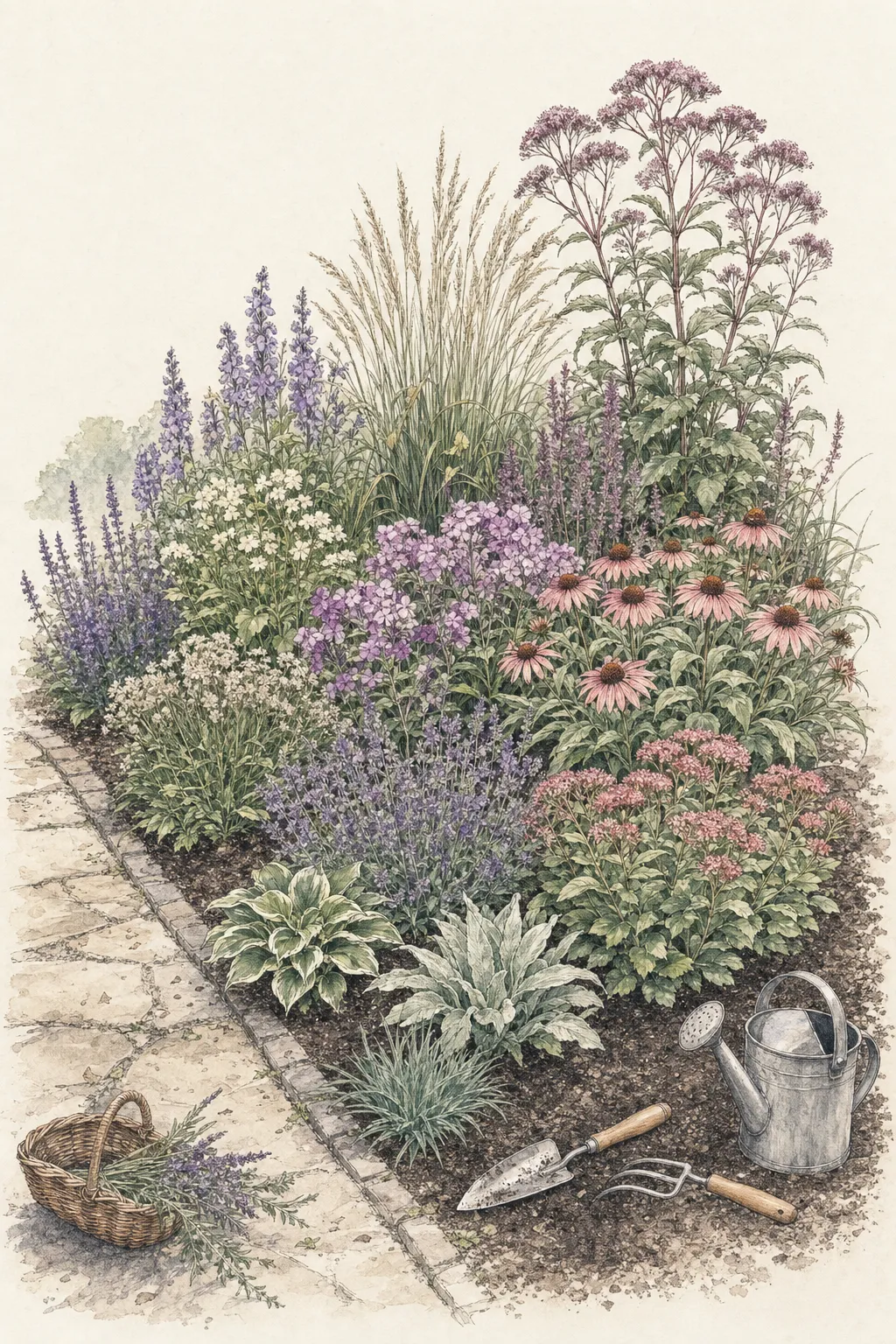
Once a zone is clear, reassess soil structure, drainage and perennial weed roots. Use a soil test for nutrient or pH decisions instead of adding fertilizer by habit. Incorporate appropriate organic matter across the prepared area where local soil guidance recommends it, but do not alter isolated pockets so sharply that water movement changes around roots. Protect the root zones of retained woody plants from cultivation.
Set retained groups on the surface in their containers or wrapped root balls before planting. View them from the house, path and seat at mature spacing. Confirm repeated forms, quiet intervals and access. Keep crowns at their species-appropriate depth and do not let mulch erase visible crown or root-flare relationships. Water each root volume and adjacent soil, then check settling before assuming the original grade held.
Make maintenance visible on the final plan. Mark future division candidates, support positions, dormant bulb groups, irrigation checks and routes to interior plants. A renovated border fails quickly when its appearance depends on access that no longer exists. Store the keep, move, divide and remove map with a clean final plan so the reasoning survives after foliage expands and labels disappear beneath it.
Judge the edit after establishment, not at planting
Expect the first season to show soil and imperfect scale. Monitor moisture in moved root balls and divisions, keep labels readable and compare the actual path clearance and crown footprints with the after-plan before filling intervals. In the measured case, the three moved Echinacea and five daylily divisions are reviewed as separate establishment units; Physostegia regrowth is removed from its mapped former footprint rather than confused with a failed new group.
The edit is complete when every retained plant has a reason, every moved or divided group has enough room and the gardener can reach the work the design requires. Keep, move, divide and remove are not rankings of plant worth; they align living material with place, season and care. Revise one failed relationship without reopening the entire border.
Design ideas
- Style
- Edited perennial border retaining mature anchors, repeated groups, calm intervals and explicit maintenance access
- Space
- Established ornamental border that has become crowded, unbalanced, difficult to maintain or partially unidentified
- Climate
- Schedule moving and division by identified species, cultivar, local season, soil workability and establishment window; confirm regional invasive, disposal and plant-health guidance before sharing or replanting material
- 1Create a four-color action survey
Photograph and measure the border, number every confirmed plant and assign one color each to keep, move, divide and remove. Use a fifth neutral mark for observation rather than guessing. Draw mature footprints, not current shoots, and write one reason beside every action. Review collisions on paper before lifting. The map becomes a working inventory, a protection plan for retained anchors and a checklist that prevents attractive but surplus divisions from drifting back into every new opening.
- 2Keep one old anchor in every work zone
Choose a sound shrub, slow perennial, strong foliage mass or valued cultivar that already fits its exact position. Mark a no-dig root zone and preserve a route around it. Recompose moved and divided plants in relation to that established scale instead of clearing the whole zone to bare soil. The anchor gives immediate age and continuity, while its stable position helps reveal whether new groups have enough room. Do not select an anchor solely for sentiment if it blocks the border's main function.
- 3Read the measured action ledger
In the 18-by-6-foot Zone 4b case, keep Paeonia 'Sarah Bernhardt' at x = 3.2, y = 4.1 feet and Baptisia australis at x = 15.4, y = 4 feet; move three Echinacea 'Magnus' from the path edge to x = 7, 9.5 and 12 feet at y = 3.8 feet; divide the merged Hemerocallis 'Stella de Oro' band into five groups at x = 2, 5, 8, 11 and 14 feet at y = 1.4 feet; and remove the Physostegia colony. Every action answers a measured conflict, and no keeper is disturbed merely to make the plan symmetrical.
- 4Divide for repetition, not multiplication
Select one proven clump whose species benefits from division and use a limited number of strong divisions to repeat its form through compatible pockets. Draw those pockets at mature spread and discard dead centers or surplus responsibly. Do not return every fragment to the border. Larger healthy sections can provide structure sooner, while smaller pieces may need a nursery area and more recovery time. Keep cultivar identity attached and use species-specific timing, depth and aftercare for the complete operation.
- 5Pair every flower mass with a service gap
Place a visible interval beside each major group where a foot, watering wand or support can reach without crushing crowns. Align some gaps with views so they also create rhythm and reveal plant form. Mark them on the plan as deliberately unplanted space. Protect them from surplus divisions and spontaneous purchases. A service gap makes future editing possible, reduces hidden hardware and keeps path edges clear; it is one of the most valuable outcomes of renovation even though no plant label describes it.
- 6Execute the case in two timed operations
First mark no-dig circles around the peony and Baptisia and clear the mapped Physostegia footprint without parking soil or tools on either anchor. In the early-spring operation, prepare all eight receiving holes, move the three Echinacea root balls intact and divide the daylily band into five strong groups at the measured centers. Replant immediately at the prior crown levels, water each root zone and maintain moisture through the first growing season. Leave any uncertain former Physostegia patch open for observation rather than shifting the coordinates to hide it. This sequence converts phasing from a generic tactic into the completed case.
- 7Reserve an observation nursery
Create a contained, labeled holding bed or group of draining containers for healthy plants whose identity, final role or timing is not yet resolved. Keep each number tied to photographs and prevent roots from drying. Do not let the nursery become permanent overflow: assign a review date and require every plant to move into the plan, remain for further observation or leave responsibly. The nursery preserves reversibility without forcing uncertain plants back into the renovated border simply because work has reached the end of the day.
Plants in this guide
Related reading
Sources
- Borders: Revitalising an Over-Mature Bed. Royal Horticultural Society. Source record · Accessed 2026-08-19.
- How to Divide and Transplant Perennials. Iowa State University Extension and Outreach. Source record · Accessed 2026-08-19.
- How and When to Divide Perennials. University of Minnesota Extension. Source record · Accessed 2026-08-19.