Gardens · spring summer border handoff
Design a Spring-to-Summer Border Handoff
Map bulbs, early perennials and summer structure as overlapping states so the border changes season without cutting green bulb foliage, crowding crowns or losing its visual framework.
Published Last updated
In this guide
- Define the handoff as a visible middle season
- Protect the bulb leaves during the summer transition
- Map the border as overlapping states
- Protect spring foliage as part of the composition
- Choose summer structure before choosing summer flowers
- Give early perennials a specific bridge job
- Build repeatable handoff groups
- Plant a measured Zone 4b border near St. Cloud
- Use color as a thread, not the whole bridge
- Edit the border during the awkward weeks
- Adapt the plan to region, cultivar and exposure
- Revise from a full seasonal record
- Design ideas
Define the handoff as a visible middle season
A spring-to-summer handoff is not a relay in which one flower disappears exactly as another opens. It is the longer interval when bulb flowers fade, their green leaves remain active, early perennials relax and summer plants are still building height. Design that interval as a garden state of its own. If the border looks coherent then, its peaks will feel connected rather than like two unrelated displays sharing soil.
Begin with the principal view and the job of the border. It may frame a path, soften a fence, hold a view from the kitchen or lead toward a seat. That structure must remain legible when few plants flower. Choose one enduring line, repeated mound, vertical rhythm or foliage contrast to carry the scene. Color can pass between seasons, but form and spacing provide the bridge when weather shortens or shifts bloom.
Set a realistic ambition. A border does not need a continuous wall of flowers from the first bulb to late summer. Missouri Botanical Garden recommends a bloom chart and notes that exact flowering time shifts among years even when relative sequence is more dependable. Aim for one or more clear points of interest, supported by readable foliage and structure. The handoff should tolerate overlap, delay and an occasional missed bloom without collapsing.
Protect the bulb leaves during the summer transition
Check the measured Minnesota example using both mature perennial circles and active bulb-foliage pockets. A later canopy must not close over still-green bulb leaves merely to tidy the view. Keep the stated climate, soil and access limits when substituting, and record relative bloom and leaf decline. The handoff succeeds when both stages can finish their work in the allocated space.
Map the border as overlapping states
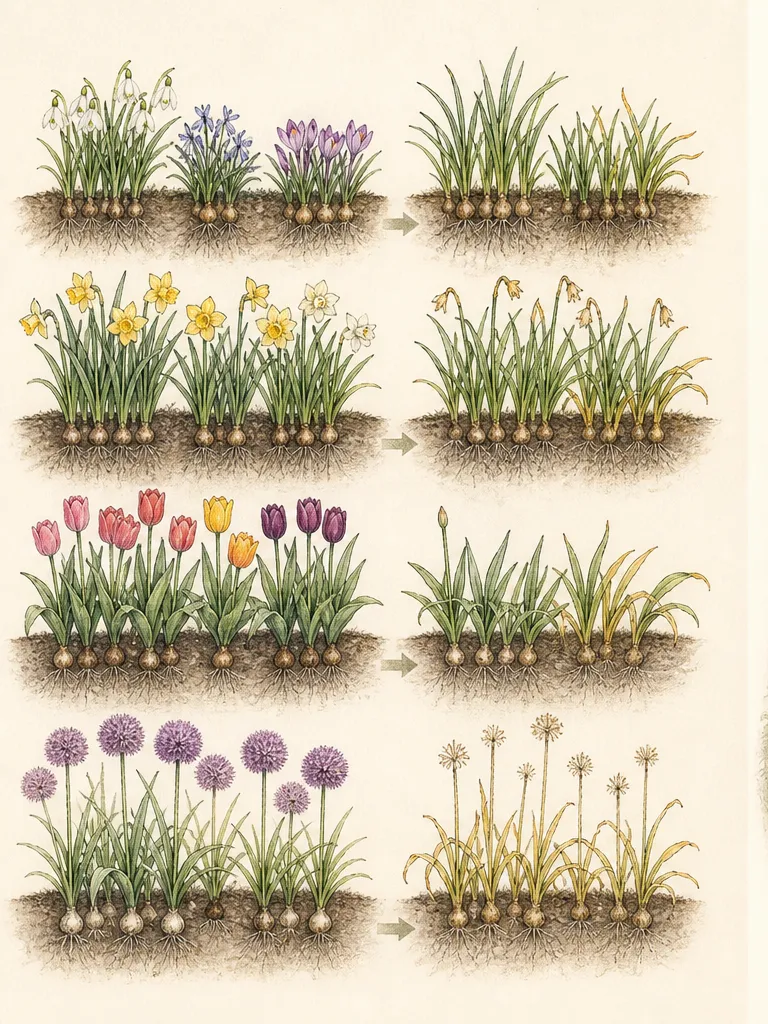
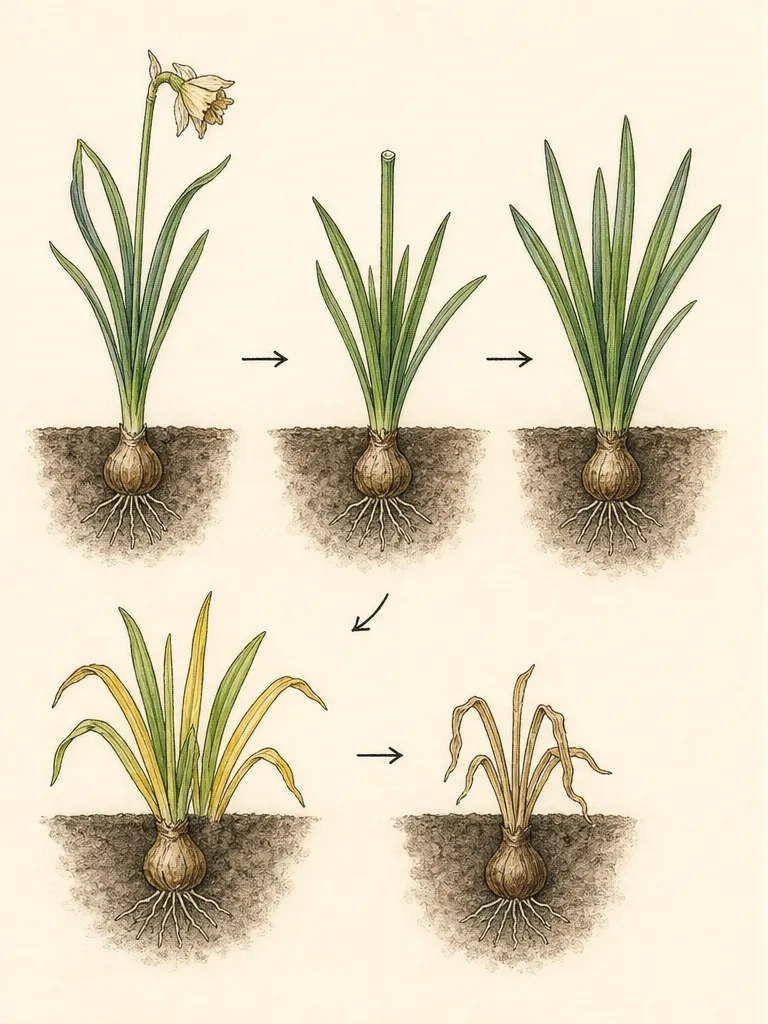
Photograph the border from the same viewpoint at bulb emergence, peak spring flower, full green bulb foliage, summer-perennial expansion and established summer structure. Give each important plant separate bars for flower and foliage or canopy, recording unusual heat, shade or rain rather than turning one year's dates into a permanent calendar. University of Minnesota explains that bulb leaves continue photosynthesis after flowering, so the green-leaf bar is active care rather than debris available for early removal.
Add only the maintenance facts that change placement: when a crown needs support or division, where bulbs may later be lifted and which path edge must remain open.
A combination that works only when stepped on or tied aside is not durable. The map should expose both the visible handoff and the working route while plants occupy their full seasonal volume.
Protect spring foliage as part of the composition
Leave green bulb leaves upright and exposed to useful light until they yellow through their normal cycle. Do not braid, knot, fold or hide them under a heavy neighboring canopy. The design problem is spatial: foliage may be too close to a path, too broadly scattered or paired with a companion that expands too early. Solve those relationships in the plan instead of asking early removal to make a poor arrangement look tidy.
Give foliage a calm background. A defined edge, low persistent mound, dark evergreen plane or repeated leaf texture can make relaxed bulb leaves look intentional. The companion does not need to cover them. It can redirect attention while preserving light and air. Keep the companion crown beside the bulb pocket rather than directly over it, and draw both at mature spread so a young open planting does not become a root and leaf collision.
Treat bulb persistence as regional and cultivar-specific. Some tulips are planned as a renewed display, while other bulbs can remain and increase where soil and seasonal moisture suit them. Do not promise perennial return from the broad word bulb. Keep botanical and cultivar labels, note whether each group is intended to naturalize, persist modestly or be lifted, and design access accordingly. A handoff cannot be maintained if its underground layer has become anonymous.
Choose summer structure before choosing summer flowers
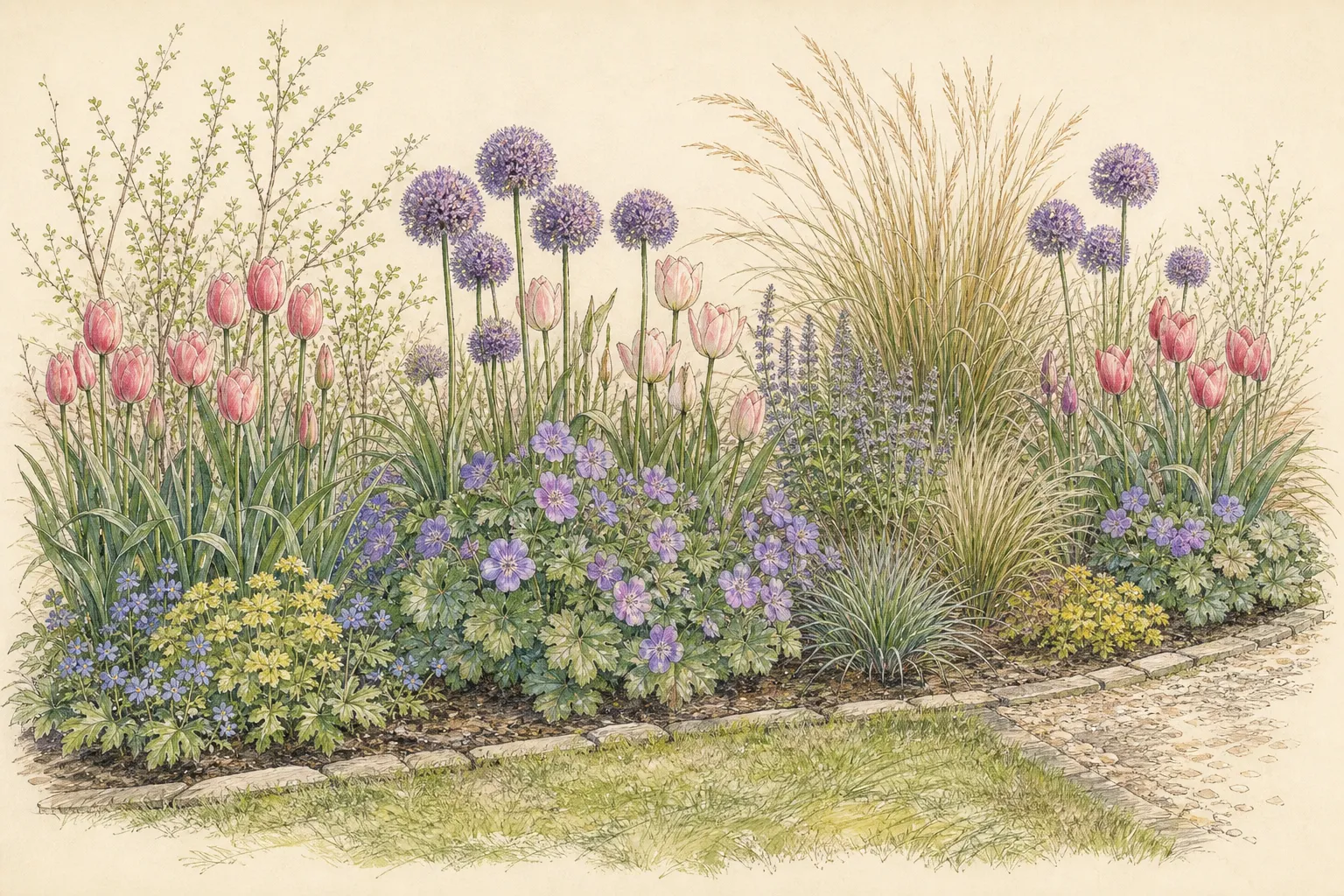
Select the summer layer first by mature outline: a broad mound, upright column, airy screen, arching grass or strong leaf mass. RHS border guidance begins with structural plants and then groups perennials, a useful order because flowers are temporary while bulk and texture organize the bed for months. Ask what will occupy the view as bulb leaves yellow and early flower stems are cut back, not only what will bloom at midsummer peak.
Match emergence speed to the intended handoff. A late-rising plant can be excellent summer structure yet leave a gap if every neighbor also rests after spring. An early, broad plant may take attention quickly but smother bulb foliage if placed over it. Use local observation or regional records to compare growth curves. The right partner is not universally early or late; it reaches useful visual weight after the bulb has had enough unobstructed green time.
Keep care compatible within each group. Similar appearance does not make plants compatible if one needs dry summer dormancy and another receives frequent irrigation. Compare light through the season, drainage, mature water demand, fertility and division access. Where conditions shift along a long border, repeat the structural role with a different locally suitable plant rather than forcing one species through sun, shade, wet and dry pockets.
Give early perennials a specific bridge job
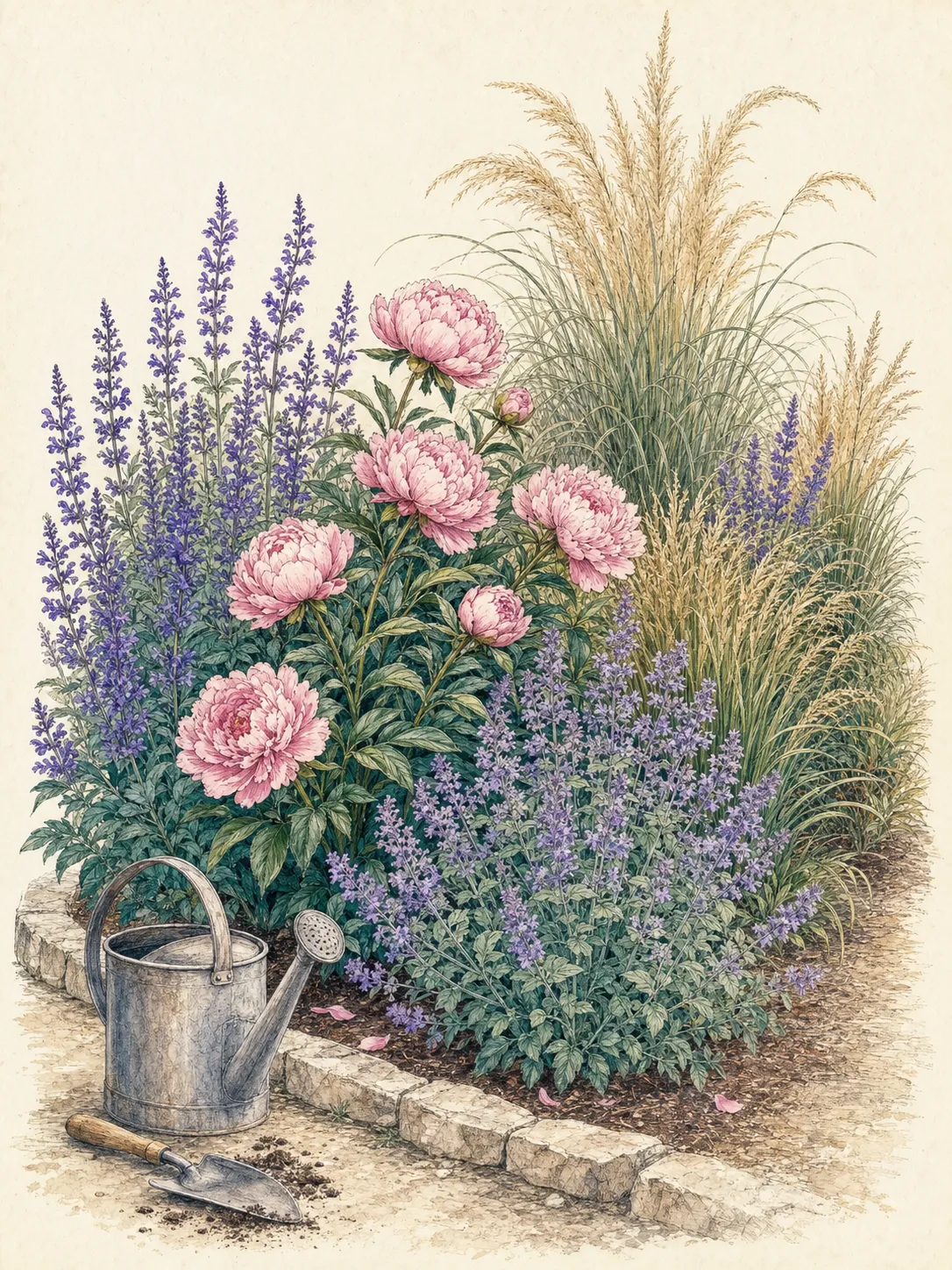
An early perennial can extend spring color, supply foliage around bulb leaves or create the first structural mound. Assign one job rather than expecting every plant to flower, conceal, edge and persist equally. A compact clump may frame bulb foliage without covering it. An airy flowering stem can carry a color note upward while summer leaves expand below. A persistent basal rosette can hold the foreground after its own flowers finish.
Decide what happens after that perennial flowers. Some plants remain handsome, some benefit from selective deadheading, some can be cut back after a flush and some must retain foliage. Use species-specific guidance. Do not make a generic shearing date part of the composition. Draw the post-bloom shape honestly and pair it with a summer neighbor that can take emphasis without depending on premature removal of healthy leaves.
Limit the number of bridge roles. A small border with many single spring perennials can become a collection of brief incidents. Choose one or two repeating forms and allow quiet intervals between them. Repetition gives the eye a path through changing detail, while differences in flower time can occur inside the repeated framework. The goal is a coherent transition, not a sample of every plant that blooms before summer.
Build repeatable handoff groups
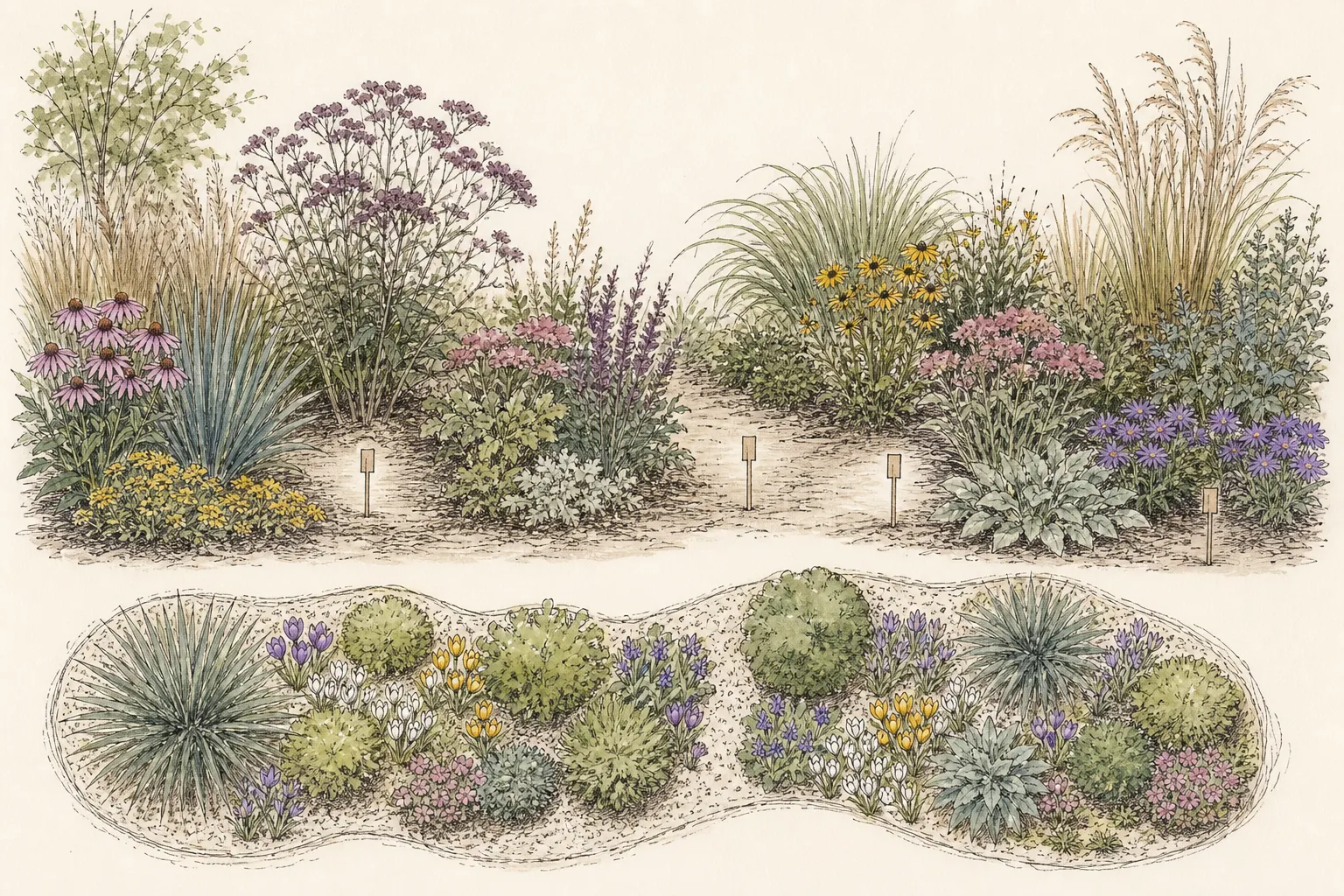
Compose one complete unit before distributing plants across the whole bed. Include a spring bulb pocket, an early perennial with a defined bridge job, a summer structural crown and a visible access edge. Draw each component at peak footprint and draw the bulb's green-foliage zone separately. The parts can visually overlap above ground, but permanent crowns and necessary working routes should remain distinguishable on the plan.
Repeat the unit where site conditions genuinely match. A larger version can anchor the main view and smaller echoes can carry rhythm, but preserve the relationship: bulb punctuation, bridge mound, later structure and open edge. If one repeat falls under later tree shade or receives roof runoff, keep the visual roles and choose different plants suited to that pocket. Repetition belongs to the design logic, not necessarily to an identical shopping list.
Leave a deliberate interval after each group. Open soil under mulch, a low ground plane or a visible edge allows changing plants to be read as a sequence. Without intervals, expanding summer crowns merge into one mass and declining spring foliage becomes trapped inside it. Protect these spaces from impulse planting. A gap that reveals form and gives maintenance access is working space, not evidence that the border was underfilled.
Plant a measured Zone 4b border near St. Cloud
Here is one complete Upper Midwest composition rather than a universal shopping list. It occupies a 15-foot-long by 6-foot-deep, south-facing border near St. Cloud, Minnesota, in USDA Zone 4b. The main view is from a 3-foot path along the south edge; the bed receives at least seven hours of sun, has loam that drains after rain and can be watered during establishment. Measure x from the west end and y northward from the path. Missouri Botanical Garden's retained guide treats more than six hours as full sun, asks designers to scale mature height and spread, and limits a wall border to about 6 feet deep where access would otherwise suffer.
Use four named plants and these working mature envelopes for this specific plan: 45 Muscari armeniacum at 6–8 inches high by 3–4 inches wide; 21 Narcissus 'Thalia' at 14–16 inches high by about 6 inches wide; seven Geranium sanguineum 'Max Frei' at 9–12 inches high by 18 inches wide; and five Echinacea purpurea 'Magnus' at 36–42 inches high by 24 inches wide. The quantities and envelopes are design inputs checked against the stock labels used for this example, not promises for every nursery strain. University of Minnesota lists M. armeniacum and Narcissus hybrids among hardy bulbs for Zones 3 and 4, while the Missouri source includes hardy geranium and purple coneflower among perennial-border choices and requires plant size to govern placement.
Place the five Echinacea centers at x = 1.5, 4.5, 7.5, 10.5 and 13.5 feet, all at y = 4.5 feet, giving them 36-inch centers across the back. Make three 24-by-18-inch Narcissus pockets centered at x = 3, 7.5 and 12 feet and y = 2.9 feet, with seven bulbs at 6-inch centers in each pocket. Make three 18-inch-wide Muscari drifts centered at x = 1.5, 7.5 and 13.5 feet and y = 2 feet, using 15 bulbs at roughly 3- to 4-inch centers in each. Set the seven geraniums across the front at x = 1, 3.2, 5.4, 7.6, 9.8, 12 and 14.2 feet and y = 0.8 foot, about 26 inches center to center. Permanent crowns remain separate even where leaves meet visually.
In an ordinary central-Minnesota sequence, Muscari and Narcissus emerge in April; Muscari supplies the first low flower in late April into May, Narcissus carries the taller May display, and both retain green leaves afterward. The geraniums expand from April into low foreground mounds and flower through the June bridge. Echinacea emerges behind the bulb pockets in May, gains structural weight during June and carries the back line into its July and August flowering period. Weather can move those windows, but the spatial job remains: the geranium receives the eye in front of yellowing leaves and the Echinacea rises behind them; neither crown sits over a bulb pocket, so active bulb foliage remains exposed until it yellows naturally.
This plan assumes all four labeled stocks are hardy to the declared Zone 4b site, full-sun tolerant and suited to drained loam. Keep spring soil evenly moist when rain is short, avoid waterlogged bulb pockets, and water all new perennial root zones through establishment without forcing a permanently wet summer bed. Treat bulb return, perennial longevity and the stated dimensions as locally observed variables rather than guarantees. Outside the cold Upper Midwest, recheck every name: where winters do not support these Narcissus or Muscari cycles, substitute regionally perennial spring bulbs; where summer heat, winter wet or different hardiness limits either geranium or Echinacea, replace that plant with a locally durable mound or upright structure of the same measured envelope and growth timing.
Use color as a thread, not the whole bridge
Carry one color relationship through buds, flowers, stems and leaves rather than matching two peak photographs. A cool spring flower might hand to blue-green foliage, then to a deeper summer bloom. A warm bulb can echo a red leaf edge or seed head before a later flower repeats the hue. Include the color of yellowing foliage and spent stems in the study; they occupy the handoff even when catalog images omit them.
Test color from the main viewing distance. Small pale flowers can disappear against a bright wall, while a dark summer mass may make faded spring foliage more conspicuous. Use a quiet repeated green to unify changes and reserve high contrast for a few moments. RHS guidance treats green and foliage texture as central border materials, which keeps the scheme coherent when no chosen flower is at peak.
Avoid a one-for-one color substitution. If every yellow bulb must be replaced visually by a yellow perennial, the border becomes a schedule of matching spots. Let shape, line or leaf texture carry some transitions. A repeated upright can link different colors, and a shared rounded mound can make separate flower seasons feel related. Multiple design threads make the handoff more resilient to weather and cultivar variation.
Edit the border during the awkward weeks
Observe at least once after petals fall and before summer flowers dominate. Remove spent flowers where appropriate, but leave required foliage. Straighten labels, recover the path edge and support rising plants before they lean across bulb leaves. These small actions reveal whether the design works. Do not fill every opening with annuals while the summer layer is still expanding; mark temporary gaps and reassess when crowns approach their expected spread.
Distinguish a care problem from a design problem. Yellowing bulb foliage can be normal; foliage flattened into a path is a siting problem. A summer perennial that is late to rise may be healthy; an unplanned bare view is a sequencing problem. A bridge plant that flops from shade may need relocation rather than a tighter cage. Name the cause on the plan before moving or adding plants, and change one relationship at a time.
Keep cuts selective. Preserve enough early-perennial foliage for the species, remove broken stems cleanly and avoid shearing mixed crowns together. If a summer plant needs support, install it while stems are manageable and outside neighboring crowns. The handoff period is not a general cleanup event. It is a set of separate plant-care decisions coordinated so the composition can change without damaging next year's spring display.
Adapt the plan to region, cultivar and exposure
Use relative sequence such as opening, middle, bridge and summer structure instead of fixed national dates. Missouri Botanical Garden notes that bloom can shift substantially among years. Elevation, coastal influence, spring heat, aspect and cultivar can compress or stretch the interval. The order may remain useful while exact weeks move. Build overlap so the border still reads if one season advances and another pauses.
Confirm every plant's hardiness, chilling or heat limits, drainage and summer moisture locally. Spring bulbs beneath deciduous trees may receive good active-season light before the canopy closes, as University of Minnesota notes, but evergreen shade or dense surface roots create a different site. Warm-region bulb behavior can differ from cold-winter persistence. A design example is a method, not a guaranteed plant list for every garden.
Record named cultivars because mature height, leaf timing, flower period and persistence can differ within a species. Avoid promising that a compact label remains compact without checking its measured regional performance. Where local invasive guidance restricts a plant or where toxicity matters for the household, substitute the role rather than preserving the name. The handoff is successful when locally suitable plants perform the intended sequence.
Revise from a full seasonal record
Compare the five photographs already specified: emergence, peak spring, green-foliage phase, summer expansion and established summer structure. Note only what changes the plan—which leaf mass blocked another, whether the path stayed usable and whether the intended bridge acquired visual weight before bulb leaves yellowed. Use the complete sequence for autumn changes rather than repeating another documentation system.
Move a bulb pocket that repeatedly blocks a path, reduce a bridge plant that covers active foliage or divide a summer crown whose mature spread erased the interval, always at the species-appropriate time. Preserve successful spacing, repeated form and foliage relationships even when a cultivar fails, then substitute for the actual site rather than copying the plant list into incompatible conditions.
Design ideas
- Style
- Layered naturalistic border with repeated seasonal handoff groups and visible maintenance structure
- Space
- Temperate ornamental border viewed from a path, room or seating area from spring emergence through summer
- Climate
- Choose bulbs and perennials by local hardiness, chilling, heat, light, drainage, summer moisture, mature habit and invasive or toxicity guidance; use relative sequence rather than fixed dates
- 1Scale the Zone 4b handoff on one sheet
Draw the 15-by-6-foot St. Cloud example at one square per foot, with the path on the south. Plot five Echinacea purpurea 'Magnus' at 36-inch centers in the back, three seven-bulb Narcissus 'Thalia' pockets and three 15-bulb Muscari armeniacum drifts through the middle, and seven Geranium sanguineum 'Max Frei' at 26-inch centers along the front. Add April emergence, May bulb flower, June geranium bridge and July–August Echinacea structure as four bands beside the plan. The drawing makes mature crown separation, bulb-foliage light and the region-specific substitutions visible in one place.
- 2Pair a bulb pocket with a rising frame
Place a concentrated bulb pocket beside, not beneath, a summer perennial whose foliage rises into a clear mound or upright frame. Keep their crowns and future digging zones separate while allowing leaves to meet visually. The bulb supplies spring emphasis; the perennial becomes recognizable during the green-foliage phase and carries summer structure. Repeat the relationship in similar light and drainage. Where conditions change, substitute another locally suitable structural plant while keeping the same spatial rhythm and an accessible edge.
- 3Use an early perennial as punctuation
Repeat a limited early perennial at the end or bend of several bulb groups. Its role is to mark the transition with a recognizable mound, leaf or airy stem rather than to conceal every fading leaf. Choose it for the actual site's light, moisture and post-bloom behavior. Leave enough room for its mature crown and decide in advance whether it is deadheaded, selectively cut or simply retained. The repeated punctuation keeps the border legible while different bulbs and summer plants change at different rates.
- 4Build a calm foreground for active foliage
Use a crisp path edge, low persistent foliage or quiet mulched plane in front of bulb groups. The calm foreground makes green and yellowing leaves read as a seasonal layer instead of neglect. Keep bulb foliage out of circulation without tying or cutting it, and retain a hand-width route where the gardener must reach labels and supports. If leaves still occupy the path, move the bulbs during their correct dormant handling window; do not demand that maintenance compensate for a spatial error.
- 5Repeat form across changing plant lists
Choose one form—rounded mound, airy vertical or broad arch—and repeat it from spring bridge plants into summer structure. The actual species can change where the border moves from sun to partial shade or from dry to moisture-retentive soil. Match mature scale and visual weight rather than forcing one plant through incompatible pockets. This makes the handoff continuous to the eye while respecting regional and site limits. Keep full labels so later division, support and replacement decisions remain plant-specific.
- 6Carry one color through non-flower parts
Select a hue from a spring bract, bulb flower or stem and find it again in early-perennial foliage, a summer leaf edge or a later bud before relying on another open flower. Test the relationship from the main view and include ordinary green and yellowing foliage in the sample. A color thread carried by several plant parts survives shifted bloom better than a precise flower-to-flower match. Limit high contrast to a few repeated points and let green unify the longer interval.
Plants in this guide
Related reading
Sources
- Landscaping with Perennials. Missouri Botanical Garden. Source record · Accessed 2026-08-19.
- Planting Bulbs, Tubers and Rhizomes. University of Minnesota Extension. Source record · Accessed 2026-08-19.
- Planning a Beautiful Garden Border. Royal Horticultural Society. Source record · Accessed 2026-08-19.