Hardy Hibiscus
Muenchhusia moscheutos
A moisture-loving North American perennial with immense late-summer flowers, a bold leafy habit and roots that return after winter dormancy.
Published Last updated
At a glance
- Light
- Full sun
- Water
- Medium to wet
- Soil
- Moist, organic, acid to neutral
- Hardiness
- Zones 5–9
- Bloom
- Midsummer to early autumn
- Height
- 3–7 ft · 0.9–2.1 m
In this guide
Overview
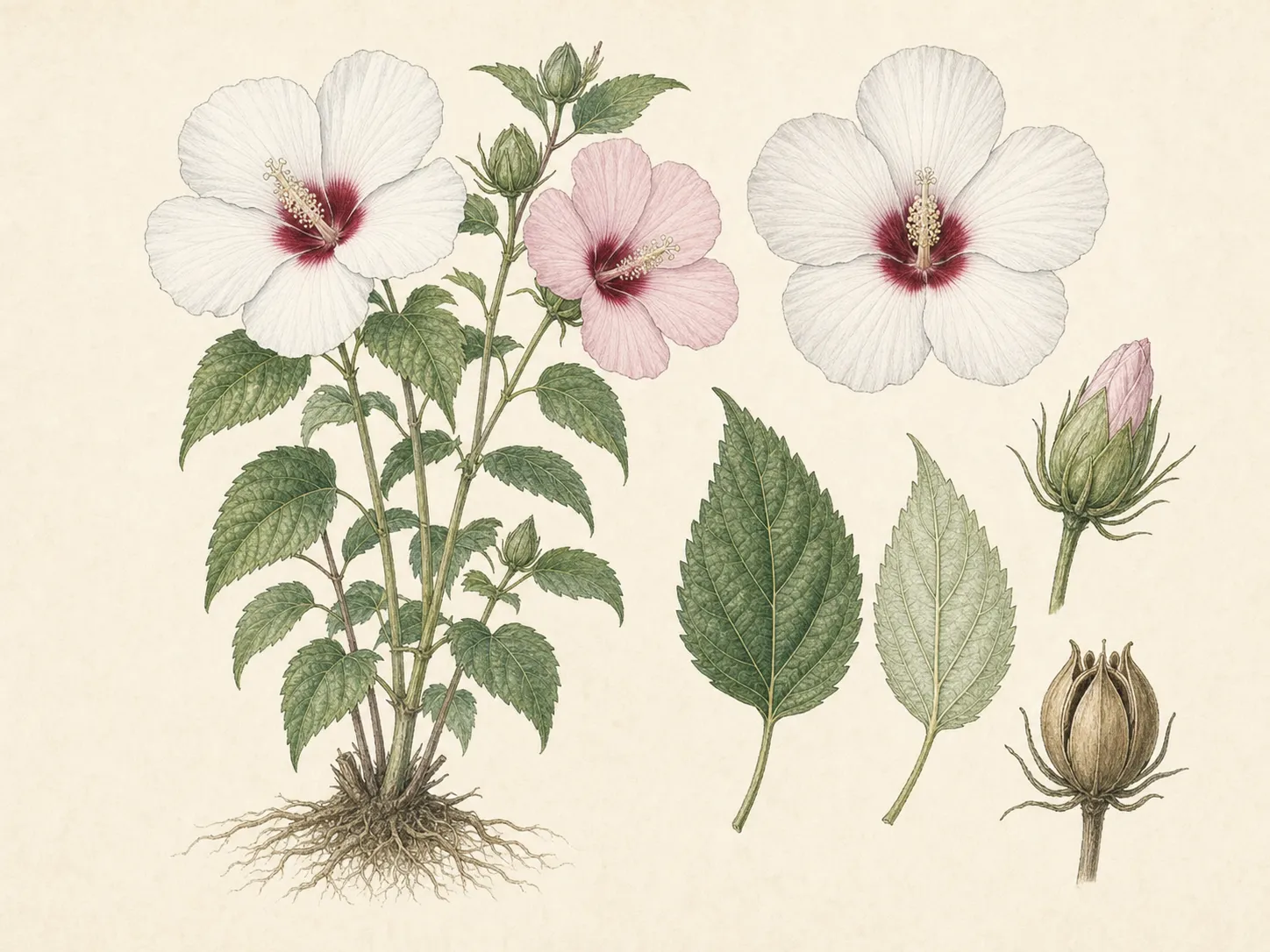
Hardy hibiscus brings an almost implausible scale to a temperate perennial border. A settled crown sends up a fresh cluster of sturdy green stems each year, building a broad leafy plant before opening saucer-shaped flowers from midsummer into early autumn. The species usually carries white to pink flowers with a dark crimson eye; the projecting staminal column, five broad petals and coarse, toothed leaves give the plant the unmistakable structure of the mallow family. Each flower is brief, often lasting only a day or two, but an established clump can continue opening new buds in succession for weeks.
Despite its shrub-like summer outline, this is an herbaceous perennial. Frost ends the stems, while the living crown and roots remain below ground and produce an entirely new framework the following season. That distinction matters in spring: hardy hibiscus is commonly one of the last perennials in a mixed border to show new shoots. A bare-looking crown while neighboring plants are already growing is not, by itself, evidence of winter loss. Mark the position and allow warm soil to wake the plant before deciding that it has failed.
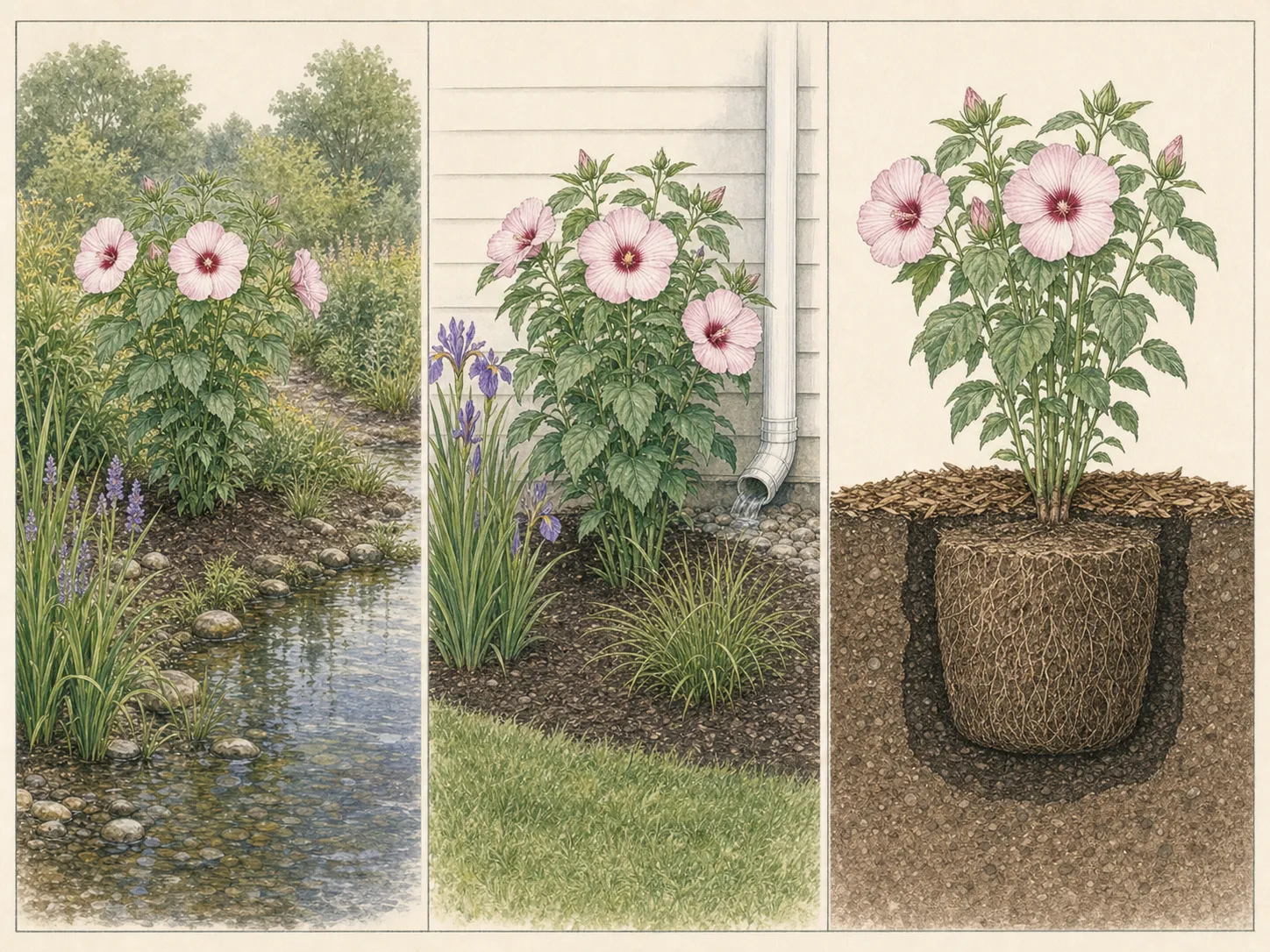
The species comes from wet places—marshes, floodplains, riverbanks, moist meadows and pond margins—across southeastern Canada, much of the central and eastern United States and northeastern Mexico. In a garden, that ancestry translates into a preference for sun and dependable root-zone moisture. It is particularly useful where a conventional border dries too slowly for Mediterranean plants: a rain-garden shoulder, a low bed that remains moist after storms, a pond edge or a generously watered perennial planting. It tolerates heat and humidity well when its roots do not run dry.
The scientific name needs a note. Royal Botanic Gardens, Kew now accepts Muenchhusia moscheutos, following a 2025 segregation of this North American group from Hibiscus. Most gardening references, nurseries and cultivar labels still use Hibiscus moscheutos, and that name remains the one readers are most likely to encounter. Both names on a label can refer to this plant; neither should be confused with woody Rose of Sharon, Hibiscus syriacus, or the frost-tender tropical hibiscus, Hibiscus rosa-sinensis.
Garden-center plants also blur the boundary between the wild species and hardy-hibiscus hybrids. Modern selections may combine several North American rose-mallow species and can differ greatly in height, foliage color and flower size. Compact cultivars may fit a front garden, while vigorous forms need the scale of a pond edge or the back of a border. Treat the species dimensions on this page as a planning envelope, then check the named selection rather than assuming that every dinner-plate flower belongs to an identical plant.
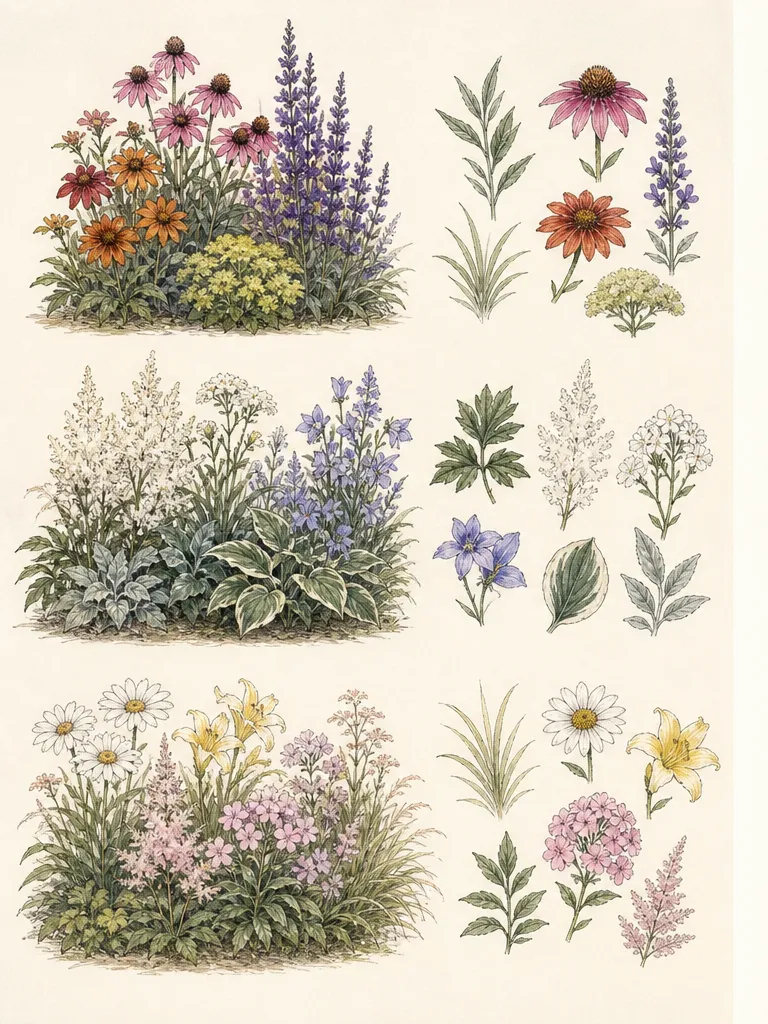
Use the plant as a late-season anchor rather than scattering single stems through a dry mixed bed. Its large leaves read as a solid mass long before bloom, and the flower scale is strongest against simpler companions: upright rushes, blue flag iris, switchgrass or fine-textured sedges in a moist design. Leave enough open air around the clump for the foliage to dry and enough visual space for the flowers to be seen whole. The dormant winter gap is real, so nearby grasses, seed heads or an evergreen backdrop can hold the composition until the new stems return.
- Family
- Malvaceae
- Range
- Southeastern Canada through the central and eastern United States to northeastern Mexico
- Soil pH
- 5–7
- Spread
- 2–4 ft · 0.6–1.2 m
Planting & careHow to grow hardy hibiscus
This profile describes the species and species-like garden selections in USDA zones 5–9. Plants sold as “hardy hibiscus” may instead be complex hybrids with different mature sizes, colors and lower-zone ratings, so use the nursery label for cultivar-specific spacing and winter limits.
- 1Confirm which hibiscus you are buying
Look beyond the flower photograph. A hardy hibiscus should be sold as Muenchhusia moscheutos, Hibiscus moscheutos or a clearly identified hardy rose-mallow hybrid. Rose of Sharon is a woody shrub that keeps a permanent branch framework; tropical hibiscus has glossy evergreen foliage and is hardy outdoors only in warm climates. If the tag gives a cultivar, use its stated height and hardiness rather than the species averages.
- 2Choose sun with dependable moisture
Give the plant full sun for the strongest stems and heaviest flowering. Light shade can be tolerated, but deep shade tends to reduce bloom and encourage a looser habit. The better site is not merely one that can be watered occasionally: it is a position where the soil remains evenly moist through summer, such as a rain-garden edge, a low border or a bed reached by regular irrigation.
- 3Reserve the mature footprint
Plan for a substantial clump before digging. Species plants commonly reach 3–7 feet tall and 2–4 feet wide, while hybrids can fall outside that range. Keep the crown away from paths where broad leaves will narrow circulation, and avoid squeezing it against a wall or dense shrub. A sheltered but open position reduces wind damage without sacrificing air movement around the foliage.
- 4Prepare a broad root zone
Loosen a broad area rather than creating a small pocket of radically different soil. Moist loam or silt with organic matter suits the plant; acid to neutral conditions are preferable. In an ordinary border, incorporate finished compost across the bed surface if the soil is low in organic matter. Do not use a rich amendment-filled hole that leaves the root ball isolated from the surrounding ground.
- 5Set the crown at the existing grade
Plant at the depth held in the nursery container, with the top of the root ball level with the finished soil. Backfill, water slowly to settle the soil and add a modest organic mulch, keeping it clear of the emerging stems. The goal is a continuous moist root zone, not a buried crown or a cone of mulch pressed against the plant.
- 6Establish moisture before expecting scale
Water deeply after planting and prevent the root ball from drying during its first growing season. Once established, hardy hibiscus can be vigorous, but drought still reduces flower production and can scorch leaf margins. Let new stems build their full framework before judging the plant’s final shape; a young clump may need more than one season to achieve the mass shown on a mature label.
Pruning hardy hibiscus
Hardy hibiscus flowers on the current season’s stems, so its old framework does not need to be preserved for next year’s bloom. After frost, either cut the dead stems back to roughly 3–4 inches for a tidy border or retain part of the standing structure through winter. The hollow stems can provide nesting material for stem-nesting bees; in a wildlife-oriented planting, NC State Extension recommends leaving 12–24 inches and allowing those stems to persist. Whichever approach you choose, keep a visible marker at the crown. Remove the remaining dry stems when new shoots make their position clear, cutting without damaging the soft emerging growth. Pinching young stems can make some vigorous selections bushier, but it also delays their natural development and is unnecessary when the cultivar already has a compact habit. Deadheading is cosmetic: individual flowers close quickly and are replaced by new buds, while retained capsules add autumn and winter structure.
Seasonal care
Spring
Wait for genuinely warm soil before judging the crown. Keep its marker in place, remove heavy mats of wet debris and watch for new shoots at ground level rather than buds on last year’s stems. Finish cutting back retained stems only when you can see where the live growth begins. Divide or move an established clump while it is dormant or just beginning growth, and restore even moisture immediately afterward.
Summer
Maintain consistent moisture as the stems gain height and buds form. A plant that repeatedly wilts or develops crisp leaf margins is signaling a dry root zone, even if the surface was recently sprinkled. Check the undersides of leaves for groups of hibiscus sawfly larvae if tissue is being skeletonized, and inspect buds and tender growth for aphids. Full sun, open spacing and steady water usually produce the strongest, freestanding clump.
Autumn
Allow the final flowers to give way to ovoid capsules if winter structure or seed is wanted. After frost blackens the foliage, decide whether the setting calls for a short, tidy cut or retained stems for wildlife. Clear diseased leaf debris rather than composting it beside the crown. Where the species is near its cold limit, apply winter mulch after the ground has cooled instead of piling material over a still-active crown.
Winter
The visible plant is dormant, but the perennial crown remains alive below ground. Keep the site marker intact so spring cultivation does not disturb it. Standing stems and capsules can remain as structure unless they are diseased or unsafe in wind. Check that displaced mulch has not formed a dense wet cap directly over the crown, and avoid interpreting the absence of evergreen growth as a need to replace the plant.
Safety and garden spread
No special contact hazard is documented in the horticultural references consulted. This ornamental profile does not establish food, medicinal or pet safety; keep unidentified plant material out of mouths.
Common problems
No shoots in early spring
- Look for
- A firm, undisturbed crown while neighboring perennials are already in leaf.
- Action
- Wait for warmer soil and keep the location marked. Hardy hibiscus commonly emerges late; investigate crown damage only after its normal local emergence window has passed.
Scorched or wilting leaves
- Look for
- Crisp brown margins, drooping foliage or reduced flowering during hot, dry weather.
- Action
- Check moisture below the surface, then water the full root zone deeply and consistently. Correct the dry site rather than relying on repeated light sprinkling.
Skeletonized foliage
- Look for
- Leaf tissue eaten between veins, often with small sawfly larvae feeding on the undersides.
- Action
- Inspect leaf undersides early. Remove low numbers by hand or dislodge them with a firm water spray; reassess before considering any product and follow its label if one is used.
Few flowers or leaning stems
- Look for
- A loose, reaching habit with sparse buds in a shaded or crowded position.
- Action
- Increase light and open space around the clump where possible. Move the plant during dormancy if the site cannot provide adequate sun and dependable moisture.
Chewed flowers and leaves
- Look for
- Irregular holes with adult Japanese beetles visible on blooms or upper foliage.
- Action
- Inspect in the cool part of the day and remove beetles into soapy water when practical. Healthy, well-watered plants often tolerate limited feeding; avoid treating open flowers in ways that expose visiting pollinators.
Plant details
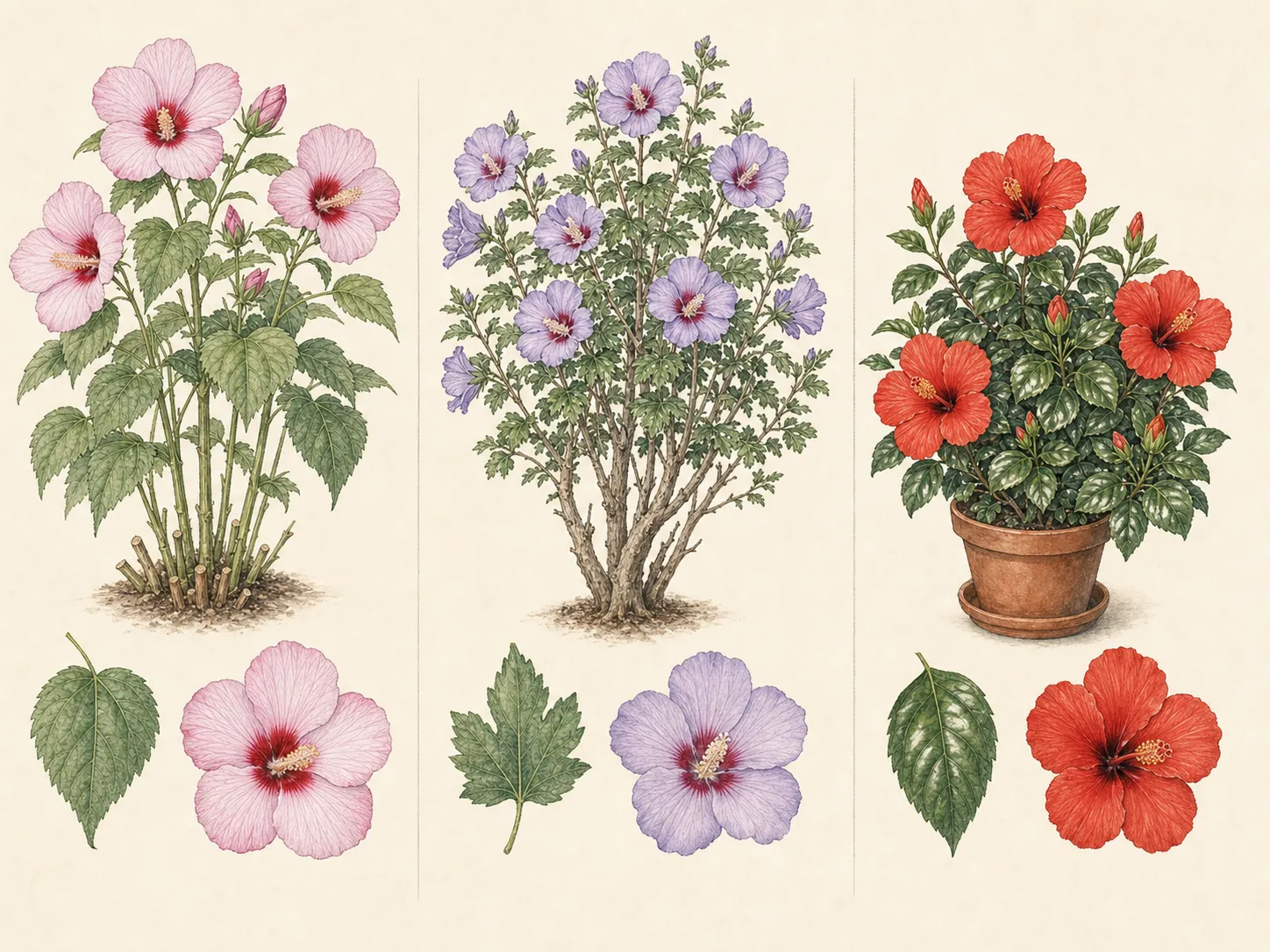
Hardy hibiscus at left as an herbaceous clump, Rose of Sharon at center as a woody shrub, and tropical hibiscus at right as a glossy potted evergreen
Related reading
Sources
- Muenchhusia moscheutos. Royal Botanic Gardens, Kew. Source record · Accessed 2026-08-18.
- Muenchhusia moscheutos. NC State Extension. Source record · Accessed 2026-08-18.
- Hibiscus moscheutos. Missouri Botanical Garden. Source record · Accessed 2026-08-18.
- Perennial Hibiscus. University of Illinois Extension. Source record · Accessed 2026-08-18.
- Rosemallow. University of Maryland Extension. Source record · Accessed 2026-08-18.
- Muenchhusia hybrid. NC State Extension. Source record · Accessed 2026-08-18.
- Hibiscus moscheutos. South Carolina Native Plant Society. Source record · Accessed 2026-08-18.