Grow · spring bloom review autumn edit
Review Spring Bloom Now and Plan Better Autumn Changes
Photograph and map spring bulbs and perennials while the evidence is visible, then convert bloom, foliage, crowding, and access notes into a restrained autumn edit plan.
Published Last updated
In this guide
- Record the garden while the evidence is visible
- Give each autumn task a spring observation and a timing check
- Build one record that still works in autumn
- Read flower sequence and viewing value separately
- Follow bulb foliage beyond the flowers
- Assess perennial partners by behavior
- Separate symptoms from causes
- Translate observations into bounded decisions
- Write the autumn plan before foliage vanishes
- Protect the current season while planning the next
- Execute the edit and preserve the feedback loop
- Steps
Record the garden while the evidence is visible
Spring memory compresses quickly into a few favorite flowers and disappointments. By autumn, exact bulb positions have vanished, tree shade has changed, neighboring perennials have expanded, and a bare-looking gap can be mistaken for unused soil. Review now because flower order, foliage condition, mature spring spread, and circulation conflicts are still visible together.
Choose the scope before opening a notebook. Work on one border, courtyard bed, or repeated set of bulb pockets rather than making a vague survey of the whole property. State what the autumn plan must improve: a missing middle bloom, daffodil foliage over a path, two perennial clumps merging, or spring color visible from the street but absent from the main window.
Treat the review as evidence, not a score. A late group may be following its normal local sequence; a sparse tulip group may have been intended as a one-season display; a perennial may be slow because it was moved. Record identity, history, and conditions before labeling a plant a failure. Weather in one year should not become a universal bloom calendar.
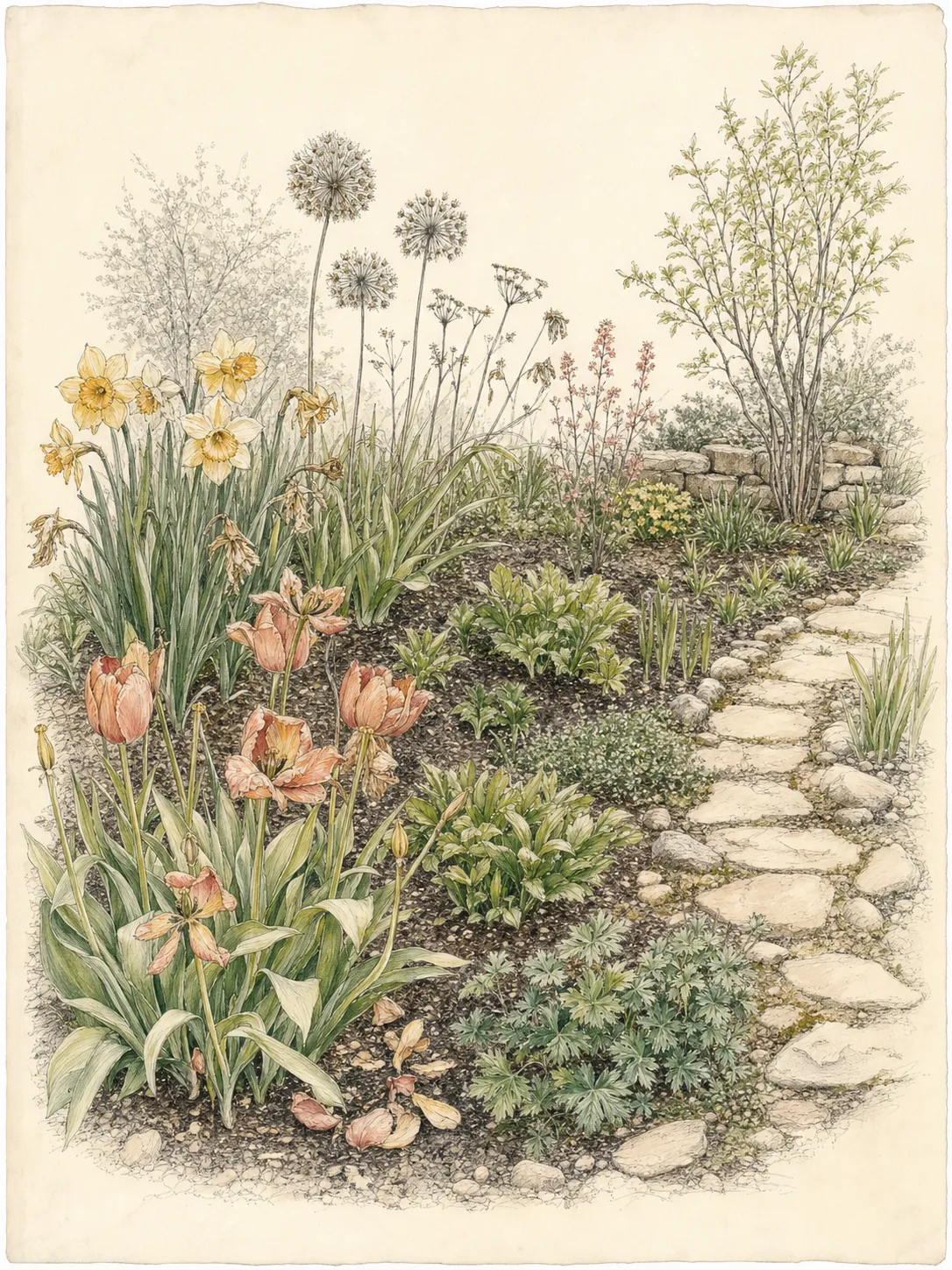
Set a stopping rule for autumn work. Favor the few changes supported by repeated views or clear plant behavior, preserve successful negative space, and leave uncertain groups under observation. The purpose of the review is to reduce impulsive digging and duplicate buying, not to create a task for every note.
Give each autumn task a spring observation and a timing check
Assign a single bounded action to each mapped group, supported by an actual spring observation. Then verify the named plant's suitable season and site conditions before executing it in autumn. Keep uncertain diagnoses under observation. A remembered gap is not sufficient evidence to divide, move or replace plants whose dormant positions and mature footprints remain unconfirmed.
Build one record that still works in autumn
Start with a simple scaled or measured sketch showing permanent edges, paths, walls, trees, shrubs, utilities, irrigation, and known perennial crowns. Number each bulb group and spring-flowering perennial. Use the same number on photographs and notes. A durable group ID is more useful than a folder of close-up flowers whose location cannot later be recovered.
Choose fixed photograph points: the entry, principal window, path approach, and one overall maintenance view. Mark where the camera stood and repeat the framing at first bloom, peak effect, after petals fall, and during foliage decline. Exact intervals are less important than a consistent sequence tied to dates and visible conditions.
For each group, record botanical name and cultivar where known, source, planting year, approximate count, first visible flower, strongest display, finish, foliage condition, nearby companions, light, moisture, and any intervention. Distinguish a true bulb from other underground structures only where it affects care; the garden label and source record should control the action.
Add a confidence field. Mark identity, location, and diagnosis as confirmed, probable, or unknown. An unlabeled clump with yellowing foliage is not ready for an autumn purchase order. The confidence mark tells the later gardener whether to act, verify the name, or wait for another cycle without losing the observation.
Read flower sequence and viewing value separately
Build a local sequence strip using first flower, peak effect, and finish for each mapped group. Avoid converting one season into promised dates for future years. Relative order—group A before B, with useful overlap—is more durable than a catalog month, especially across different exposures within the same garden.
Judge display from the views that matter. A flower can perform perfectly but face away from the principal window, disappear against a pale path, or sit behind a perennial that leafs out early. Record the visual mismatch separately from plant health. The autumn response may be repetition elsewhere, a contrasting companion, or no change if the group serves another view.
Note scale and rhythm. One isolated bulb may be lost from the street but delightful beside a seat; a large drift can dominate a small bed; identical clusters at regular intervals can appear dotted. Photograph enough context to see group size, spacing, and surrounding foliage rather than collecting only portraits of individual blooms.
Mark genuine gaps only after comparing the sequence with foliage and structure. A quiet week may be useful if fresh leaves, bark, or emerging perennials hold the design. Add flowers where the view truly collapses, not wherever the timeline lacks a colored bar. Long spring interest is a composed progression, not continuous maximum bloom.
Follow bulb foliage beyond the flowers
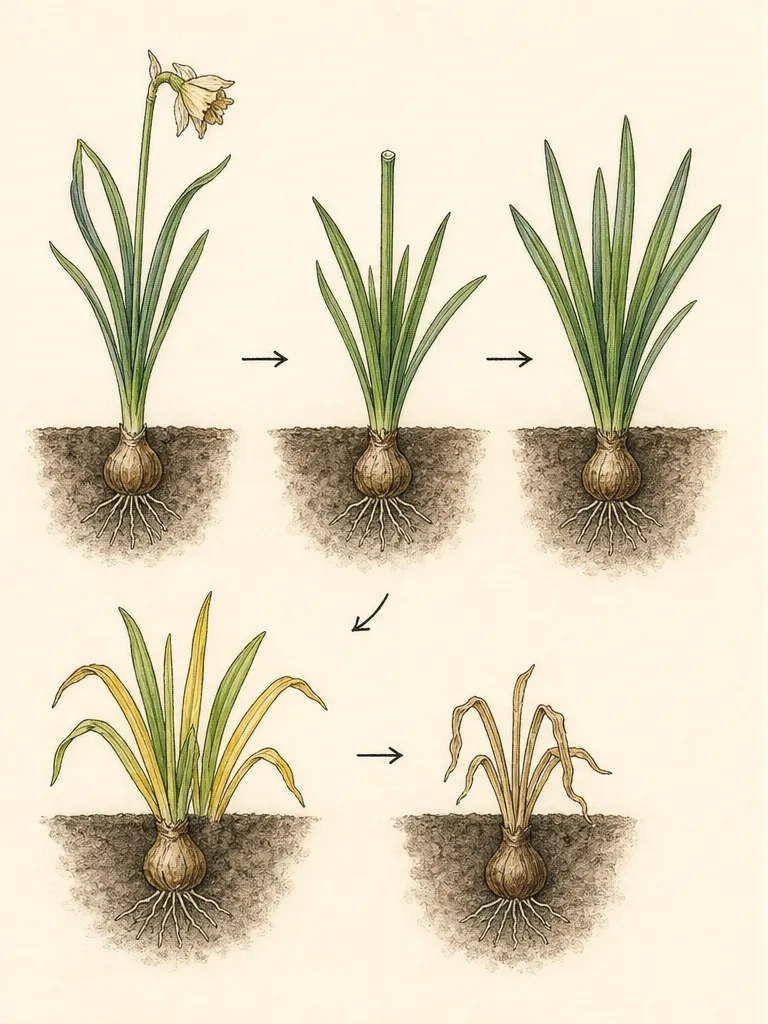
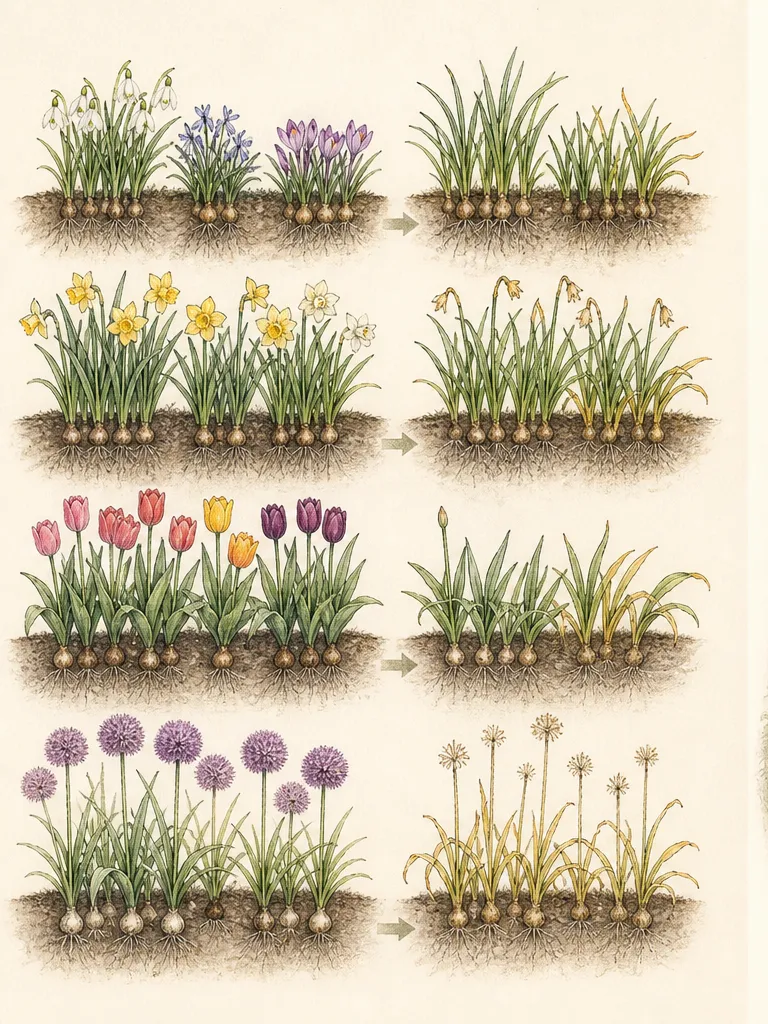
The bulb review continues after petals fall. Iowa State Extension advises leaving spring-bulb foliage until it dies and turns brown because premature removal interrupts bulb growth and can reduce the following display. RHS likewise advises waiting until leaves are yellow and no longer productive. Record the actual foliage phase rather than assuming it ends with bloom.
Photograph whether leaves remain upright, fall across a path, become hidden too early, or sit comfortably among emerging companions. Do not tie, braid, or bundle leaves for neatness; RHS cautions that this interferes with their work. If foliage blocks access, mark the location problem for later relocation instead of cutting it early.
Record deadheading separately from leaf removal. Iowa State recommends removing faded tulip and daffodil flower heads where seed is not wanted while retaining foliage. Do not turn that species-specific example into a rule for every ornamental bulb; seed value, naturalizing behavior, and plant identity can change the decision.
Map bulbs before leaves disappear. Add distance from two permanent points or photograph a labeled marker beside the group. This prevents autumn digging into established crowns and keeps new bulbs from being stacked blindly on older ones. Remove temporary markers only after the location is recoverable from the durable plan.
Assess perennial partners by behavior
For each spring perennial, record mature spring width, flowering height, lean, neighboring overlap, crown visibility, and the date when foliage begins to dominate. Distinguish a healthy designed overlap from a plant covering another crown or path. A companion that gracefully hides declining bulb leaves may still be too competitive at root level.
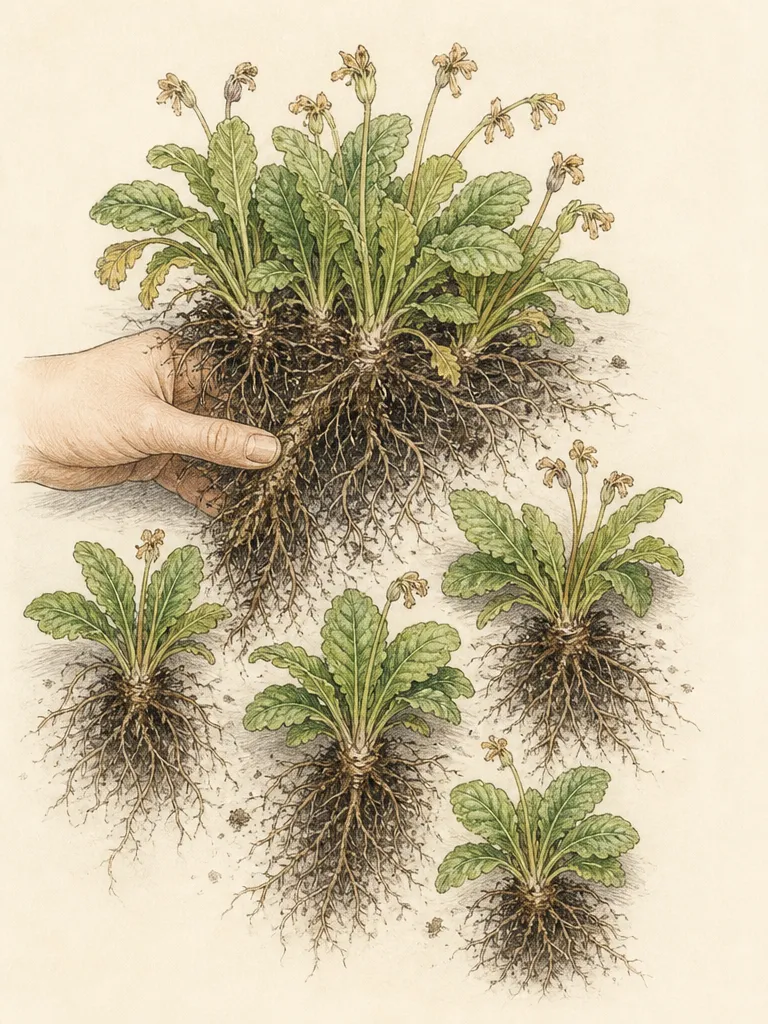
Look for division cues rather than following a fixed calendar. University of Minnesota Extension links division to plant performance and advises doing it while plants are not flowering. Reduced vigor, a failing center, crowding, or loss of planned space can support division; a large healthy clump that still fits may not need disturbance.
Identify plants that resist division or have species-specific windows before putting them on an autumn list. University of Minnesota notes that spring- and summer-flowering perennials are often divided in fall, but also identifies exceptions and difficult deep-rooted plants. Local climate, winter wet, hardiness, root type, and the named taxon determine whether autumn is appropriate.
Record design role before deciding to move a perennial. A clump may be the only foliage mass bridging two bulb groups or the structural edge that keeps declining leaves away from a path. Preserve the role even if the plant changes. Replace by habit, mature dimensions, and conditions rather than by flower color alone.
Separate symptoms from causes
Write what is visible before naming a cause: no flowers, fewer stems, pale leaves, a soft crown, scorched margins, lodged growth, or a group missing from its marker. Add soil moisture, recent weather, shade, planting history, and photographs. A diagnosis made from memory in autumn is weaker than a spring record of the whole pattern.
Do not assume fertilizer solves weak bloom. Bulb persistence varies by species and cultivar, and flowering can be affected by foliage removal, drainage, shade, maturity, planting depth, climate, disturbance, or a display intended for replacement. Use soil tests and authoritative plant-specific guidance before adding nutrients or changing pH.
Distinguish one-year weather effects from repeated site mismatch. Late freezes, unusual heat, or heavy rain can shorten or damage a display. Mark the event and compare unaffected groups. Reserve major relocation for evidence that the site, drainage, light, or mature spacing remains wrong beyond one exceptional season.
Escalate uncertain health problems to a local diagnostic service before moving material around the garden. Record the sample location and advice. Avoid spreading a suspected problem through division or bulb redistribution, and do not retain a treatment recommendation without its diagnosis, current label, and regional context.
Translate observations into bounded decisions
Give every mapped group one status: keep, observe, add, move, divide, reduce, or remove. Attach a single evidence statement, such as 'strong flowers, leaves block path for three weeks' or 'healthy clump closes access to neighboring crown.' If the reason cannot be stated from the record, leave the group under observation rather than assigning work.
Choose the smallest action that solves the problem. A bloom gap may need a repeat of an existing successful group, not a new species. A path conflict may require moving one bulb cluster behind a foliage edge, not cutting all leaves early. A crowded perennial may need one division removed while the main clump stays in place.
Rank changes by prerequisite. Drainage, construction, tree work, irrigation repair, and path clearance precede planting. Plant identity and suitable timing precede division. Bulb quantity follows the scaled area and intended group pattern. This order prevents an autumn delivery from dictating the design before the site can support it.
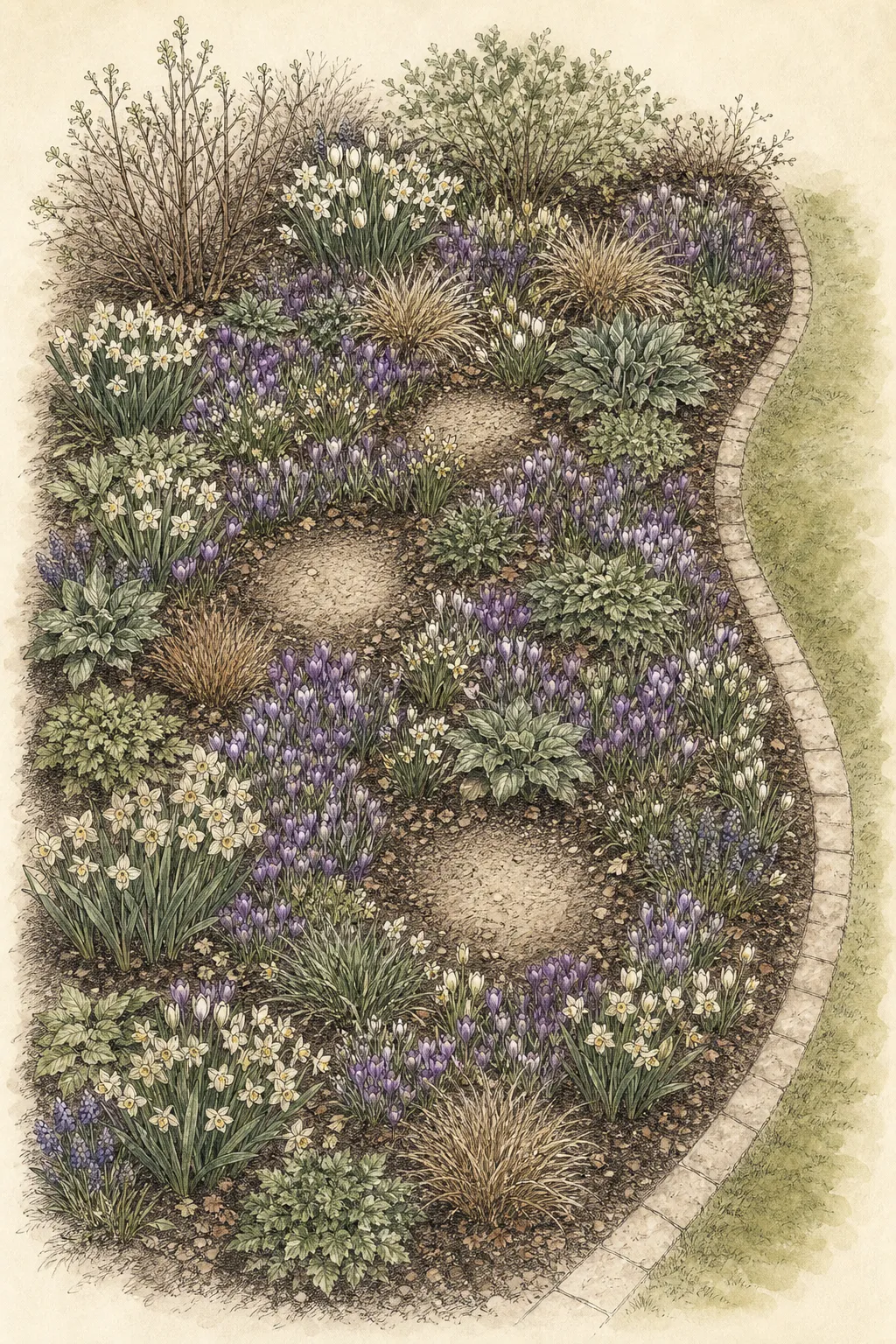
Limit the plan to a coherent edit zone. Protect successful groups and dormant crowns outside it. A visible boundary, plant list, and as-built update make the work reversible and reviewable. When several causes remain possible, schedule another observation date instead of converting uncertainty into excavation.
Write the autumn plan before foliage vanishes
Transfer approved actions to a clean autumn plan while spring positions are still known. Show existing crowns, bulb groups, plants to retain, moves, divisions, new groups, access routes, and no-dig areas. Draw mature spreads for all additions. Keep a separate removal list so an old label cannot be mistaken for a planting target.
Attach a plant-specific timing window and regional prerequisite to every action. Spring-flowering bulbs are commonly planted in autumn, but exact timing, depth, chilling need, and storage tolerance vary. Perennial division timing varies by taxon and climate. In cold regions, University of Minnesota advises allowing fall divisions time to establish before soil freezes; local guidance should set the actual window.
Build a bulb order from named groups, not a total shopping count. Specify botanical name, cultivar, intended pocket, group shape, locally appropriate planting depth, and whether the selection is expected to perennialize or be replaced. Check regional invasive status and toxicity exposure. Preserve the supplier record when substitutions occur.
Create a task sequence: verify labels, prepare destination, mark dormant crowns, lift only approved material, replant promptly, water according to conditions, restore labels, and update the as-built plan. Include a cancellation rule for saturated, frozen, excessively hot, or otherwise unsuitable soil. The calendar serves the plants; it does not override site conditions.
Protect the current season while planning the next
Do not begin autumn corrections in late spring merely because the problem is obvious. Keep bulb foliage until it finishes naturally, preserve healthy perennial leaves, and avoid moving plants in flower unless a safety issue demands it. Planning and immediate intervention are different jobs.
Use discreet temporary markers and photographs rather than digging exploratory holes among active roots. If a bulb group must be lifted, Iowa State places that work after foliage has died back and supplies storage guidance for bulbs held until fall. Follow species-specific and local advice; some bulbs are better replanted promptly and some do not store well.
Maintain ordinary water and care according to plant needs, not as a reward for plants marked to move. A division or transplant begins with a sound parent plant and a prepared destination. Avoid pushing soft growth with unsourced fertilizer in anticipation of autumn work.
Share the map with anyone mowing, weeding, or renovating nearby. Mark no-cut foliage and no-dig crowns. Spring records lose value when routine cleanup removes leaves too early, moves labels, or installs summer annuals directly over the planned bulb pocket.
Execute the edit and preserve the feedback loop
Before autumn work, reopen the spring photographs and verify that the proposed action still fits the garden after summer growth. Confirm plant identity, destination conditions, weather, and access. Remove any purchase or move whose reason no longer holds. A plan is evidence preserved for decision, not a command that must be completed.
Work one mapped zone at a time. Protect retained crowns, lift the approved plant with appropriate tools, keep divisions shaded and moist until replanted as University of Minnesota advises, and restore planting depth according to the species. Place bulbs and perennials in their drawn groups rather than scattering leftovers into unrecorded gaps.
Update quantities, cultivar substitutions, final centers, planting dates, and any canceled work on the as-built plan. Photograph the finished soil surface from the fixed views before labels disappear under mulch or winter weather. Keep purchase labels and diagnostic notes with the group record.
Return to the same views next spring. Compare relative sequence, group scale, foliage behavior, access, and plant vigor with the original evidence. Do not judge every moved perennial by immediate flower count; establishment and species response differ. The review becomes useful over time when it records what changed, why, and whether the bounded autumn action solved the observed spring problem.
Steps
- Level
- easy
- Time
- Two to three short spring reviews plus one planning session; autumn work varies by the approved edits
- Tools
- Camera or phone, Notebook or garden record, Measured base plan, Pencil and weather-resistant labels, Tape measure, Trowel or spade for approved autumn work, Garden fork or clean division tool where species guidance calls for it
- Materials
- Existing plant and bulb labels, Archival group-number markers, Locally suitable bulbs or perennials only after the plan is complete, Species-appropriate mulch, Plant-specific regional care references
- 1Choose one edit zone and fixed views
Limit the review to a border or connected set of bulb pockets. Mark permanent edges, paths, structures, trees, utilities, and camera positions on a base plan. State the few outcomes autumn changes should improve. Photograph enough context to show group scale, surrounding foliage, access, and background rather than collecting only flower close-ups.
- 2Number every spring group
Give bulbs and spring perennials stable group IDs and connect those IDs to labels, photographs, and the plan. Record botanical name and cultivar where known, source, planting year, approximate count, conditions, and confidence in identification. Mark uncertain plants for verification and keep them out of the action list until identity is sound.
- 3Record bloom as a local sequence
Note first flower, strongest display, and finish for each group, together with weather and exposure. Compare relative order and useful overlap rather than promising catalog dates. Evaluate each mapped view for group size, rhythm, contrast, and genuine gaps, recognizing that foliage or structure may carry a quiet interval without more flowers.
- 4Follow leaves and crowns after bloom
Photograph bulb foliage until it yellows naturally and record any path conflict, early concealment, or successful companion. Keep leaves untied and uncut while productive. Measure perennial spring spread, crown crowding, lean, and access. Map bulb positions from permanent points before foliage disappears and preserve healthy growth while planning later work.
- 5Write observations before diagnoses
Describe visible symptoms and context without guessing: missing flowers, weak stems, pale leaves, soft crown, poor drainage, shade, or recent disturbance. Compare similar groups and repeated years. Seek local diagnosis for unexplained decline before dividing, relocating, fertilizing, or treating, and preserve any advice with the exact plant and site record.
- 6Assign one bounded action per group
Choose keep, observe, add, move, divide, reduce, or remove and attach one evidence statement. Use the smallest change that answers the record. Rank drainage, construction, access, and identity prerequisites first. Leave uncertain groups under observation and protect all successful planting outside the clearly drawn edit zone.
- 7Attach species and regional timing
For every approved move, division, or bulb addition, verify the named plant's suitable season, soil condition, planting depth, establishment needs, and local climate window. Do not assign all spring plants to one autumn weekend. Add cancellation rules for saturated, frozen, hot, or otherwise unsuitable soil and identify plants that should wait for another season.
- 8Execute, map, and compare
Recheck the spring evidence before autumn work, prepare destinations first, protect retained crowns, and complete one mapped zone at a time. Record final plant centers, quantities, substitutions, and canceled tasks. Photograph the finished surface from fixed points, then repeat the same spring review next year to test whether each limited change solved its stated problem.
Plants in this guide
Related reading
Sources
- Care of Spring-Flowering Bulbs After Bloom. Iowa State University Extension and Outreach. Source record · Accessed 2026-08-19.
- How and When to Divide Perennials. University of Minnesota Extension. Source record · Accessed 2026-08-19.
- How to Grow Bulbs. Royal Horticultural Society. Source record · Accessed 2026-08-19.