Grow · divide primroses after flowering
Divide and Replant Crowded Primroses After Flowering
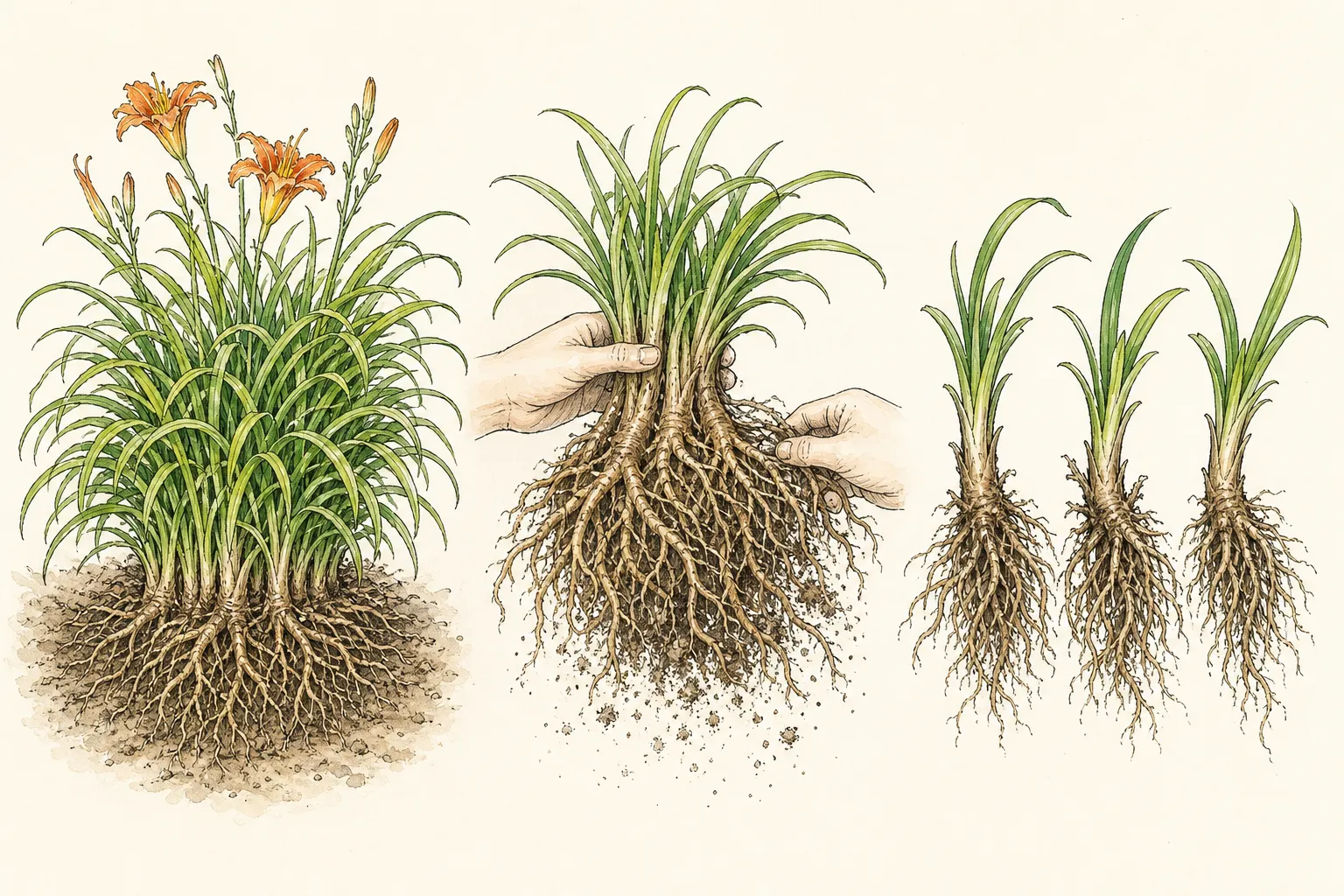
Confirm a division-suitable primrose, wait until flowering is over, prepare cool moist positions, lift the crowded clump, keep vigorous rooted rosettes, and replant each crown at soil level.
Published Last updated
In this guide
- Confirm that this primrose should be divided
- Limit division to the identified primroses and suitable conditions
- Let crowding, not the calendar, justify the job
- Choose the after-flowering window by condition
- Prepare cool moist destinations before lifting
- Lift the clump and read its crown
- Separate substantial rooted rosettes
- Reset every crown at the soil surface
- Use aftercare to distinguish stress from failure
- Steps
Confirm that this primrose should be divided
The name primrose covers a diverse genus, and division is not equally suitable for all of it. This guide is for confirmed common primrose, Primula vulgaris, and garden Polyanthus primroses that form separable rosette clumps. The University of Washington Miller Library specifically limits its general division recommendation to those plants and warns that division can weaken other Primula species.
Identify the plant from a retained label, a reliable garden record, or features checked against an institutional plant reference. Common primrose makes low basal rosettes of wrinkled leaves with flowers held from the center. Polyanthus types usually hold clusters on clearer stems above rosettes. Do not assume that a tall candelabra primula, cowslip, drumstick primula, or an unlabeled gift plant belongs in the same procedure.
If the identity is uncertain, stop at observation. Photograph flowers, leaves, and the whole habit; keep the plant intact through another flowering cycle; and seek regional horticultural identification. A crowded appearance is not urgent enough to justify weakening a plant that prefers another propagation method.
Also distinguish a hardy garden primrose from a short-lived decorative pot sold for indoor display. Its label and local hardiness determine whether it belongs in the bed at all. Division cannot convert a tender or unsuitable plant into a durable regional perennial.
Limit division to the identified primroses and suitable conditions
Use this after-bloom method only for the common and Polyanthus primroses described here. Prepare cool, suitable receiving positions before lifting, then retain vigorous rooted pieces at crown level. Compare moisture and physical stability during recovery. A different Primula group or an unsuitable weather window requires its own guidance, even if the plant has just finished flowering.
Let crowding, not the calendar, justify the job
A large clump does not automatically need division. Look for several rosettes pressed together, a weakening or dead center, fewer flowers, reduced vigor, or growth that has exceeded the intended space. Oregon State Extension treats those symptoms—not an anniversary—as the reason to divide. A compact, floriferous clump with healthy leaves can remain undisturbed.
Separate renovation from propagation. Renovation removes failed central tissue and keeps a smaller number of strong outer sections. Propagation seeks more plants, but every additional split reduces the roots and stored resources carried by each section. For a crowded primrose after bloom, favor substantial rooted rosettes that can re-establish rather than the maximum possible count.
Check for abnormal mottling, distorted leaves, widespread rot, or unexplained decline before sharing divisions. Missouri Botanical Garden notes that Primula vulgaris can be affected by several diseases, including viruses. Division carries living tissue and attached soil into new positions; it should not be used to distribute a suspect problem around the garden or to other gardens.
Map the destinations before lifting. If the original clump occupied one suitable cool, moist, partly shaded pocket, six divisions do not create six equivalent sites. Keep only the number that can be replanted promptly into conditions that match the plant. Surplus healthy material should be handled under current local guidance for moving plants and soil.
Choose the after-flowering window by condition
Missouri Botanical Garden recommends division of Primula vulgaris in spring after bloom, and Oregon State gives the broader rule of dividing spring bloomers after flowering or in fall. The useful boundary is that flowering has finished and the plant is not being divided while in bloom. Choose the cooler available period that leaves enough time for roots to settle before severe heat, drought, or frozen soil in the region.
Work on a cool, overcast, still day when possible. Leaves lose water faster in heat and wind while divided roots have limited uptake. If the after-flowering period has already turned hot and dry, keep the clump intact and use the locally appropriate later window. A date in June is not itself evidence that conditions are safe in every climate.
Water dry soil before the work so roots and surrounding ground are moist but not saturated. Wet clay smears and compacts; powder-dry soil falls from fine roots and is difficult to rewet evenly. The receiving bed should be workable, free of standing water, and ready to hold crowns at the same surface relationship as the parent.
Remove spent flower stems if they obstruct the crown, but keep healthy leaves. Those leaves support new root growth after replanting. Trim only torn or failed tissue. General advice to cut back another perennial to a fixed height should not be imported into a low rosette whose living leaves remain compact and useful.
Prepare cool moist destinations before lifting
Common primrose is suited to organically rich, consistently moist, well-drained soil in part shade, with more protection from afternoon heat in warm climates. Translate that description through local conditions. A stream edge, open woodland, border front, or pathside position may work only if drainage, summer heat, and water access are suitable.
Mark enough space for each division to rebuild a rosette without immediately recreating the crowding. Use the named plant’s regional mature spread rather than a universal interval. Open every hole to the depth of the expected roots and keep the crown position at soil level. Reserve backfill and stage water before the parent leaves the ground.
Improve the bed broadly if a soil assessment shows low organic matter, but do not create isolated rich pockets in poorly drained ground. Primroses need moisture and oxygen together. A hole that stays full of water is not made suitable by adding compost, and a dry tree-root zone may demand more irrigation than a small division can reliably receive.
Place labels in the receiving positions now, especially when several flower colors or cultivars are involved. Once flowers are gone and roots are divided, identity is easy to lose. A correct label preserves future bloom expectations and prevents an unnamed division from being treated as a different primula later.
Lift the clump and read its crown
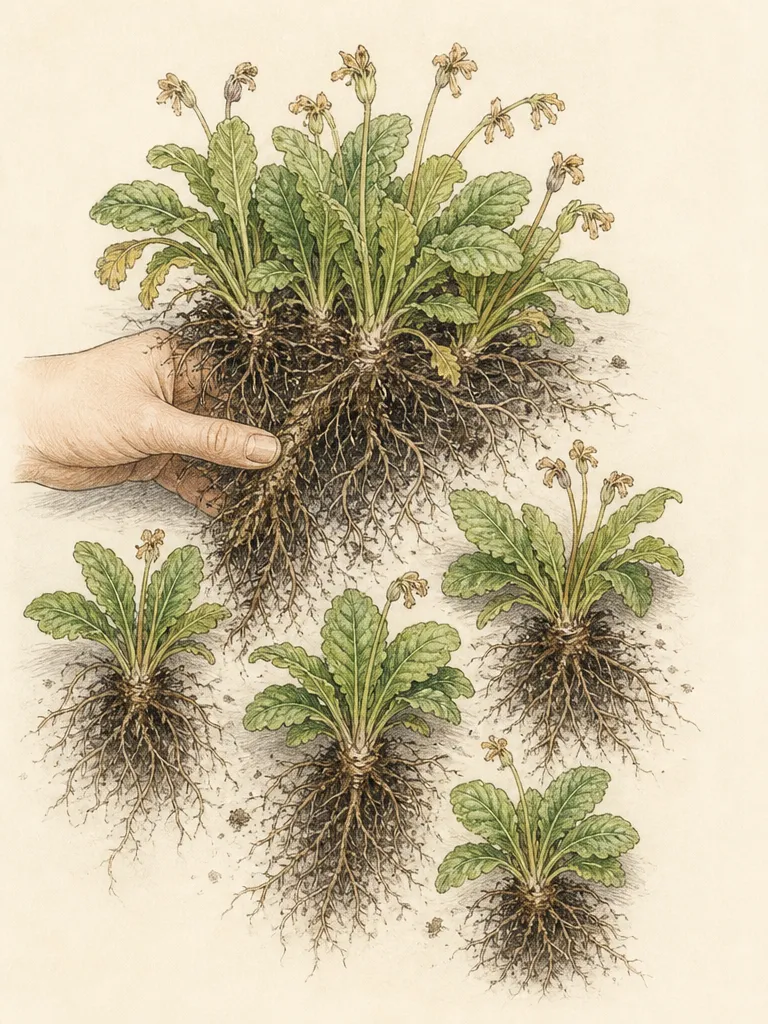
Insert a hand fork or spade beyond the outer leaves and work around the clump. Lift from several sides instead of levering through the center. Support the root mass as it rises and move it to shade immediately. The goal is to reveal the crown connections while retaining as many fine roots as practical.
Ease away only enough loose soil to see natural seams, living rosettes, and failed central tissue. Do not wash every root clean as a routine. Soil can help keep fine roots moist and coherent while the sections are assessed. If the crown is too dense to read, use a gentle stream only where necessary and keep all exposed parts shaded.
Identify vigorous outer rosettes with firm crown tissue and attached roots. The dead or hollow center of an old clump is not useful merely because it occupies space. Remove clearly decayed portions with a clean sharp knife, cutting back to sound tissue. Discard suspect diseased material rather than composting or sharing it where local guidance advises otherwise.
If the entire crown is soft, discolored, or poorly rooted, stop dividing. Preserve any unquestionably healthy outer portion only if it can be separated cleanly, and diagnose the site problem before returning a plant to it. More pieces do not rescue a clump whose decline comes from unsuitable drainage, heat, or disease.
Separate substantial rooted rosettes
Begin at a natural seam between rosettes and ease the crowns apart by hand. Use a clean knife for a resistant connection rather than twisting until roots strip away. Every retained section needs a firm growing crown, healthy leaves or buds, and enough attached roots to support establishment. A loose leaf fan without a crown or a crown fragment without roots is not a viable division.
Keep sections generous. General perennial guidance may give minimum growing-point counts, but primrose crown structure and vigor vary. The safer field rule is to stop splitting while each section still reads as a small complete plant. A few strong divisions usually recover more reliably than many slivers and provide a clearer renovation of the parent.
Maintain orientation as you work. Keep leaf bases above roots and do not let sections dry in sun or wind. Lay them on damp material in shade only for the brief period needed to finish separation. If planting will be delayed, stop making more divisions; prepared holes should receive each section as soon as it is accepted.
Do not automatically replant the old center. A failed core is removed so vigorous outer growth can occupy renewed space. Likewise, do not put every healthy section back into the original footprint. Repeating the former density recreates competition before the plants have recovered.
Reset every crown at the soil surface
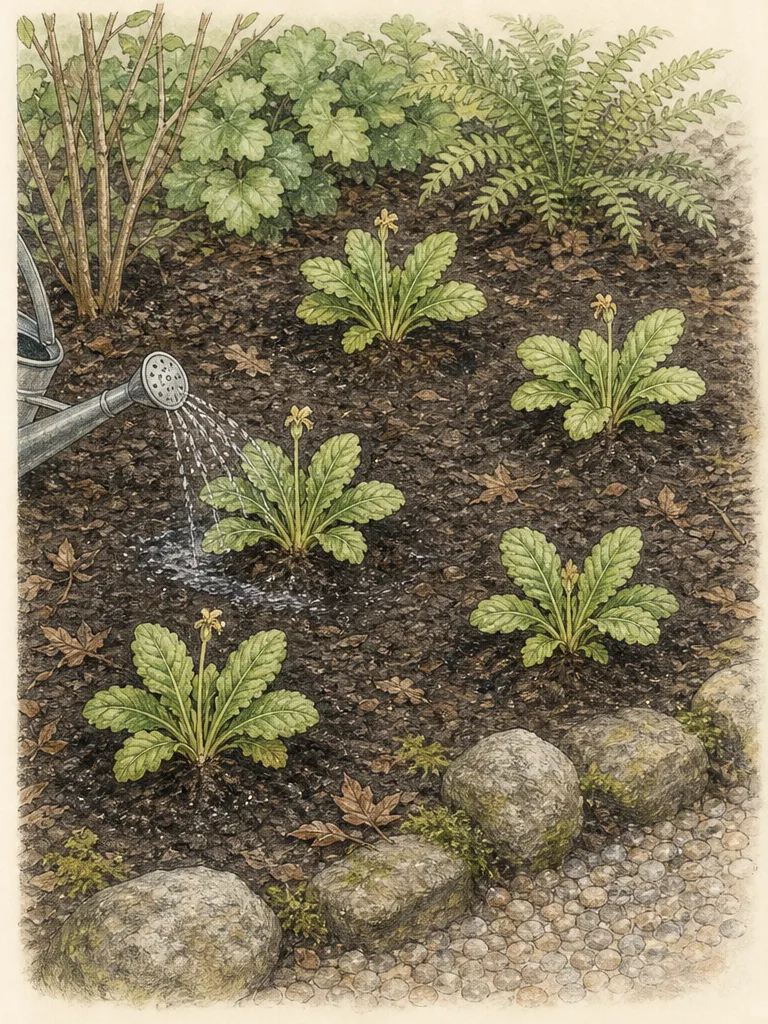
Place each division in its prepared hole with roots spread naturally downward and outward. Hold the crown at the same level it occupied before lifting—neither buried under backfill nor perched with roots exposed. Oregon State guidance for divisions keeps crowns level with the soil, a relationship that protects both root contact and crown aeration.
Backfill gently around the roots, closing broad voids with fingers and soil rather than forcing the crown downward. Firm just enough to hold the section upright. A primrose rosette may lean after handling; correct the root position instead of burying leaf bases to make the foliage appear symmetrical.
Water each section immediately and watch the soil settle. Add soil around exposed roots, but uncover any crown pulled below grade. The first watering should connect roots and soil throughout the hole without leaving a permanent basin of standing water. If water ponds, pause and correct the drainage issue rather than assuming a moisture-loving plant wants saturation.
Apply a light mulch around, not over, the rosettes to moderate drying and soil splash. Keep labels visible and leave room to inspect the crown. In a warm region, temporary afternoon shade may protect a newly divided plant, but a permanent need for rescue shade indicates that the site itself should be reconsidered.
Use aftercare to distinguish stress from failure
Check the divisions frequently enough to prevent the small root systems from drying, but test the soil before watering. Consistently moist means that usable moisture remains while air can return to pore spaces; it does not mean continuous ponding. Compare several sections. Shared wilting points toward weather or irrigation, while one failing plant suggests depth, root damage, or a local pocket.
Expect the clumps to look smaller after responsible division. Do not fertilize heavily to force immediate leaf size or replace the removed density with more divisions. Stable crown level, firm leaves during cool parts of the day, and fresh growth are more useful signs than instant fullness. Flower display may be reduced while roots re-establish.
Watch for crowns sinking, roots becoming exposed, mulch covering leaf bases, or foliage collapsing in wet soil. Correct the physical problem early. If symptoms include spreading discoloration, distorted new growth, or rot moving through multiple plants, stop sharing material and seek regional diagnostic help rather than continuing ordinary aftercare.
Keep a record of identity, division date, site, and response through the following bloom. The next decision should come from vigor and crowding, not a preset cycle. A healthy rebuilt clump can remain intact until it again shows a horticultural reason to divide.
Steps
- Level
- moderate
- Time
- One cool-session division with ongoing moisture checks
- Tools
- Hand fork or small spade, Clean sharp knife, Watering can or hose with a gentle outlet, Plant labels
- Materials
- Confirmed Primula vulgaris or Polyanthus primrose, Prepared site soil, Light organic mulch, Damp cloth or tray for brief shaded holding
- 1Confirm identity and need
Proceed only with a confirmed common primrose or Polyanthus primrose that forms a separable rosette clump. Look for real crowding, a failing center, reduced vigor, or an exceeded boundary. Leave a healthy compact clump intact, and postpone any unlabeled primula until its identity and suitable propagation method are known.
- 2Choose a cool after-bloom period
Wait until flowering has ended and choose a cool, overcast, still period with enough regional growing time for roots to settle before severe heat or frozen soil. Moisten dry soil in advance without saturating it. If the available after-flowering weather is hot and dry, use the locally appropriate later division window instead.
- 3Prepare every destination
Select partly shaded, consistently moist but well-drained positions matched to the plant and climate. Open all holes before lifting, reserve backfill, stage water, and place cultivar labels. Space the future rosettes by reliable regional mature spread so the divisions do not immediately recreate the original crowding.
- 4Lift outside the crown
Work a fork or spade around the clump beyond its outer leaves and ease the root mass upward from several sides. Support it and move it into shade. Remove only enough loose soil to see rosettes, natural crown seams, attached roots, and any failed central tissue; do not routinely wash all fine roots bare.
- 5Separate vigorous rooted sections
Ease natural seams apart by hand or cut a resistant connection cleanly. Keep each division as a substantial small plant with a firm crown, healthy leaves or buds, and useful attached roots. Remove dead or decayed center tissue. Stop splitting before either side becomes a weak fragment and keep accepted sections shaded and moist.
- 6Replant at crown level
Set each section immediately with roots spread into the prepared hole and the crown level with the surrounding soil. Backfill gently, firm only enough for support, and water. Correct settling that exposes roots or buries the crown, then apply a light mulch around the rosette while leaving leaf bases and labels open.
- 7Monitor moisture and recovery
Check soil near the roots and water before divisions dry, while allowing drainage and air to return. Compare sections for patterns, correct sinking or exposed roots promptly, and watch for abnormal distortion or spreading rot. Use the labels to compare divisions from the same parent: several wilting together suggests weather or irrigation, while one loose or sunken crown points to a planting fault. Note whether the soil is dry, evenly moist, or saturated before adding water, and inspect again after the next hot or windy period. Judge recovery by stable crowns and fresh growth, not by immediate fullness or a fixed date for the next division.
Related reading
Sources
- Primula vulgaris - Plant Finder. Missouri Botanical Garden. Source record · Accessed 2026-08-19.
- How and When to Divide Perennials. Oregon State University Extension Service. Source record · Accessed 2026-08-19.
- Propagating Primulas. University of Washington Elisabeth C. Miller Library. Source record · Accessed 2026-08-19.
- Perennials: Selection, Planting, and Care. University of Maryland Extension. Source record · Accessed 2026-08-19.