Grow · plant supports
Repair and Inventory Plant Supports Before Spring Growth
Sort supports by plant job, reject damaged frames and abrasive ties, repair reusable pieces while access is open, and assign each support before fresh growth hides the route.
Published Last updated
In this guide
- Inventory supports by plant job rather than by pile
- Match support type to mature habit and spring timing
- Reject bent metal, split canes, and abrasive ties before growth hides access
- Repair frames and anchors while the bed is open
- Place supports early and tie for movement rather than rigid restraint
- Turn the support audit into a spring installation list
- Steps
Inventory supports by plant job rather than by pile
The usual storage pattern for plant supports is a false economy. Rings, canes, old ties, trellis panels, netting, anchors, and odd scraps get leaned into one corner until the first tall shoot demands an answer. By then the work becomes reactive and the border is already narrowing. University of Vermont Extension puts repair and replacement of trellises and other plant supports on the spring checklist before the season crowds in, and that ordering is more useful than it first appears.
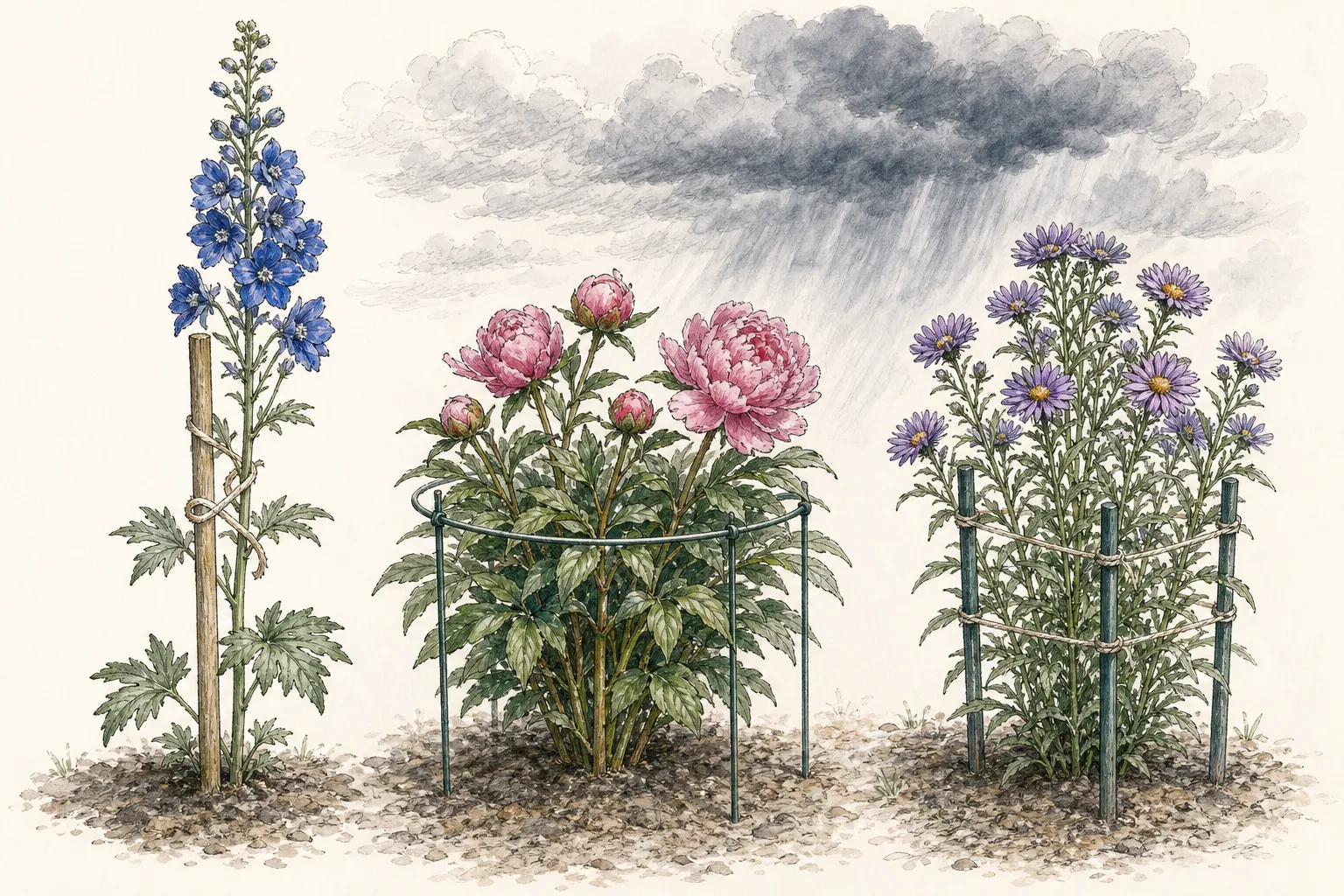
Start by turning the support corner into categories of plant job. One group belongs to heavy-flowered clumps such as peonies that may arch toward the ground in rain. Missouri Botanical Garden notes exactly that risk for common garden peony, where large semi-double blooms may need staking or other support. Another group belongs to tall brittle stems such as delphiniums and similar perennials. A third belongs to climbers that need a durable vertical route. A fourth belongs to newly planted or top-heavy small trees or standards that need temporary anchoring, not decorative restraint.
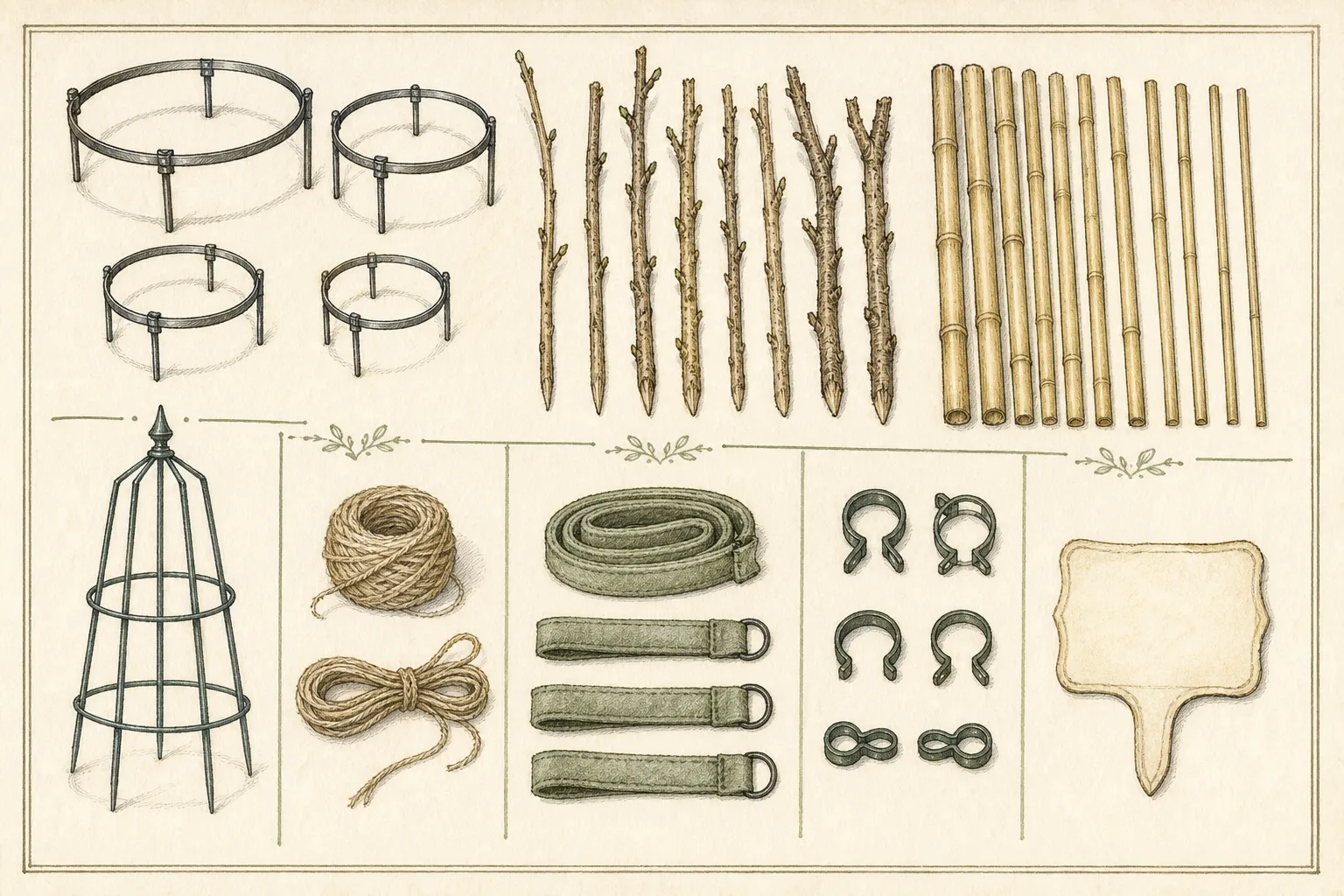
This job-based sorting changes what you notice. A peony ring that is slightly out of round may still be useful once reshaped. A split bamboo cane with a sharp edge is not a harmless spare merely because it still looks straight from one angle. A flexible tree tie does not belong in the same bucket as abrasive wire or weathered string. When the categories are plant jobs rather than leftover objects, you stop asking whether a support still exists and start asking whether it is still fit for a named living load.
Record each category against actual beds or plants while you sort. Which border holds peonies that always need a ring before buds swell? Which clematis or sweet pea route needs a trellis checked before shoots climb? Which young standard or freshly planted woody specimen still requires temporary support and which should be freed from it? The inventory becomes useful only when it reconnects stored hardware to next season's living structure.
Match support type to mature habit and spring timing
A plant support succeeds when it matches both the mature habit and the season of installation. Royal Horticultural Society guidance says perennial supports should ideally be inserted in spring before plants have made too much growth so that stems can grow through them and hide them. Later staking is harder and can damage more advanced growth. That timing principle is the backbone of this article. Repair and assignment belong before emergence outruns access.
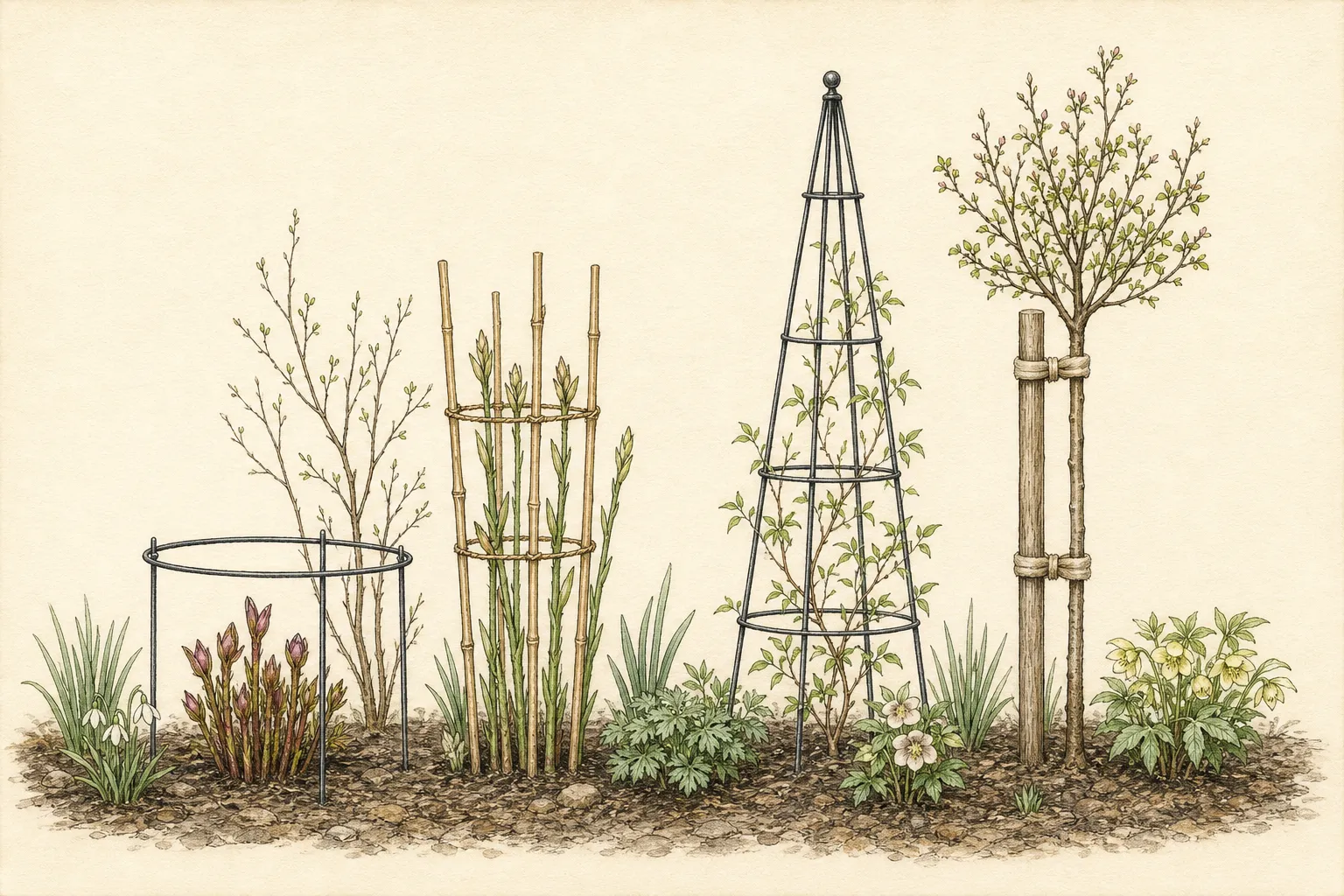
The support must also match how the plant fails. RHS notes that some perennials split and flop under their own flowers, some tall brittle stems are damaged by wind, and even shorter perennials may droop into paths or turf. That means different physical forms do different jobs. Rings or grids support a clumping crown from below. Twiggy stakes or discreet cane webs diffuse support through stems. Obelisks, wires, or trellis panels provide route rather than uplift. Temporary ties on a young standard tree or shrub stabilize a trunk while allowing it to move.
Use mature habit instead of seedling appearance to set size. A support chosen from today's tiny clump will usually be too low, too narrow, or too late. Missouri Botanical Garden's peony warning about rain-driven arching blooms is a reminder that the support must anticipate the load at flowering, not react to it after stems begin to lean. Likewise, a climber's frame should be checked for the height, spread, and wind exposure it will carry when fully leafed, not merely for the bare stems visible in winter.
Support timing can also determine what remains attractive. Early placement lets foliage and stems mask rings or twiggy frameworks so the border reads as planting, not scaffolding. Late emergency staking may still rescue a plant, but RHS is clear that emergency work is often a damage-control exercise. The more you can decide on the support type and placement while growth is still dormant or low, the less likely you are to bruise roots, snap shoots, or end up tying every stem individually in a panic.
Reject bent metal, split canes, and abrasive ties before growth hides access
A support audit is valuable because it lets you discard bad pieces without sentiment. Reject metal rings that are deeply bent, rusted through at welds, or missing legs that once carried the load evenly. Reject canes that are split, punky, or sharpened into ragged points. Reject netting with broken structure where stems will fall through unsupported gaps. Keep only pieces that can still carry the kind of force the plant will apply months from now in wind, rain, and full bloom.
The tie material deserves even closer scrutiny because it is the component most likely to injure living tissue quietly. RHS advises not tying plants in too rigidly and recommends soft twine with a figure-of-eight technique so the tie passes between stem and cane and reduces rubbing. University of Maryland Extension makes the same structural point for staked trees and shrubs from another angle: ties should not be so rigid that they prevent all movement, and padding should protect bark where a support meets the stem. Those ideas translate cleanly to ornamental support work.
That means wire, narrow abrasive cord, brittle zip ties, or sun-hardened plastic loops should not return to spring use simply because they are still physically present. A tie is part of the support system, not an afterthought. If it cuts, hardens, twists, or grips too narrowly, it changes a support from helpful restraint into living damage. Supports hold because they permit controlled movement, not because they lock every stem in place.
Inspect fasteners and anchors with the same standard. A trellis panel attached with failing screws, a frame with missing clips, or a young-tree stake using cracked tubing is already in partial failure. Growth will not improve it. The audit becomes worthwhile when you reduce the pile to pieces you would trust without apology if a storm followed the first warm week of growth.
Repair frames and anchors while the bed is open
Repair work belongs before planting routes narrow and before soil fills with new stems. Straighten reusable rings, replace missing fasteners, cut new soft ties, clean stakes, and stage anchors while the bed is still legible. UVM's spring checklist pairs inventory with replacement planning for exactly this reason: once the season starts, even simple repairs turn into delays because you have to work around emerging foliage and urgent garden jobs.
Rebuild only what is structurally worth keeping. A ring that can be returned to true, a trellis panel that only needs fresh fixings, or a stake bundle that needs re-sorting is a repair candidate. A panel that is rusting through at its stress points or a cane that will splinter under insertion is not. Winter and very early spring maintenance should create confidence, not merely postpone failure until the first heavy bloom or wind event.
Use the open-bed moment to solve access questions as well as hardware questions. Where will the legs of a peony ring actually go without spearing a crown? Which side of a climber support remains reachable for guiding stems later? Where can a temporary tree stake stand without striking root-ball fabric or rubbing a low branch union? These are route decisions, and they are much easier to make before stems occupy the same space.
Temporary support for woody ornamentals needs the same early clarity. University of Maryland Extension says the goal of staking is to prevent substantial leaning or falling while a plant establishes, not to immobilize it. That guidance is useful because it prevents decorative over-staking. If a young standard or recently planted shrub no longer needs support, winter inventory is the moment to retire the stake. If it does still need support, repair or replace the tie system now so it enters spring correctly adjusted.
Place supports early and tie for movement rather than rigid restraint
Support placement is the point where inventory becomes horticulture. RHS advises that supports should go in early enough for stems to grow through them, and also warns against tying too rigidly. Those two pieces of advice belong together. The best support is not simply strong. It is strong enough, early enough, and open enough that the plant can use it without being cinched into a fixed unnatural shape.
For ring or grid supports, center the frame over the crown while shoots are still low enough to thread through naturally as they elongate. For cane networks and twiggy staking, distribute the support around the clump rather than tying every stem to one upright point. For climbers, confirm that the support route is already firm before new growth begins to search for attachment. The support should describe the plant's eventual path, not chase it after it has sprawled.
When individual ties are necessary, use the figure-of-eight principle RHS recommends so the tie crosses between plant and support and reduces rubbing. University of Maryland's tree-staking guidance reinforces the larger principle by insisting that ties allow slight sway. That matters in flower borders too. A stem that can move a little remains less likely to scar, snap, or be cut by its own restraint than one held motionless against a rigid support.
Keep emergency staking separate in your mind from planned support. If a plant flops after a storm, rescue it as cleanly as possible. But do not let the emergency method become the standard method. Planned spring placement should prevent the need for improvised ties, visible cages jammed through active growth, or heavy-handed corrections that smother neighboring plants while trying to save one.
Turn the support audit into a spring installation list
A finished support audit ends with assignment, not with a neater shed wall. Write down which supports are ready, which must be bought, which will serve which plants or beds, and which pieces are retired. UVM suggests putting needed replacements on the shopping list early, and that timing matters because supports are easiest to buy accurately when you can still measure the old piece and name the plant it failed to carry.
Use the list to capture timing as well as quantity. Note which rings or frames need to be in place before peonies or other heavy-flowered perennials stretch upward. Note which climber supports must be checked before the first new stems appear. Note whether any young tree or standard needs a review date for support removal, following Maryland's warning that supports left on too long can do harm rather than good. A support left in place forever is not the same thing as a support thoughtfully assigned.
This written list also prevents overbuying. When all supports are stored in one vague heap, gardeners often replace everything because nothing feels trustworthy. A real audit tells you that only certain ties, fasteners, or one trellis panel are missing, while several repaired pieces remain entirely serviceable. The savings are not only financial. You preserve storage space and reduce the temptation to force a new support into a bed that needed a different form altogether.
By the time spring growth begins in earnest, the correct result is calm. The supports are already matched to named plants, safe ties are cut and ready, damaged pieces are gone, and installation order is understood. That calm is the purpose of repairing and inventorying before growth begins. It protects the plant, the gardener's access, and the look of the border at the same time.
Steps
- Level
- moderate
- Time
- About 60 to 90 minutes for a mixed home-garden support collection
- Tools
- gloves, pruning snips or wire cutters for old ties, work surface for sorting supports, marker and labels, basic repair tools for bolts or clips
- Materials
- soft twine or other non-abrasive plant ties, replacement fasteners or clips for reusable frames, new rings, canes, or trellis sections only where the audit shows a true shortage
- 1Empty the support corner and sort by plant job
Pull out rings, grids, canes, trellis panels, obelisks, flexible ties, and temporary staking systems, then sort them by the kind of plant load they are meant to carry. Separate heavy-flowered clumps, tall brittle perennials, climbers, and temporary woody-plant supports. A mixed pile hides whether you actually have the right support for each plant or only a pile of vaguely upright objects.
- 2Assign each support to a named bed or plant
Match reusable pieces to actual plants before growth starts. Identify which peonies, delphiniums, clematis, standard shrubs, or young trees will receive each support. If a support cannot be assigned to a real plant and season, it is excess or unsuitable stock rather than preparedness. The inventory becomes useful only after it reconnects hardware to living growth.
- 3Discard unsafe or structurally weak pieces
Remove bent frames that cannot be trued, rusted welds, split canes, brittle netting, cracked clips, and abrasive old ties. Keep only parts you would trust under wet weather, flower weight, and wind. A support that already cuts, twists, or collapses on the bench will not improve once stems are leaning into it outdoors.
- 4Repair reusable frames while access is open
Straighten sound rings, replace missing fasteners, clean stakes, and group soft ties with the support they belong to. Work while crowns, roots, and access paths are still easy to see. Early repair lets you solve placement and stability questions before shoots occupy the space where each leg, cane, or anchor will need to go.
- 5Place supports before growth outruns the route
Install ring, grid, cane, and trellis supports in spring while stems are still low enough to grow through or around them naturally. Check that climbers have a clear route and that the support form matches the plant's mature habit. Late emergency staking may rescue damage, but it should not replace deliberate early placement.
- 6Tie only where needed and allow movement
Use soft ties and a figure-of-eight method when stems or trunks need an individual attachment. Keep enough slack for slight movement and to prevent rubbing. The tie should guide and steady the plant, not immobilize it. If many stems need rigid separate ties, the support form itself is probably wrong for the plant.
- 7Record replacements and review dates
Write down missing parts, new purchases required, and any support that should be removed later in the season or after establishment. Include temporary supports for young woody ornamentals so they are not forgotten and left on indefinitely. A support audit is complete only when it carries forward into spring installation and later review.
Plants in this guide
Related reading
Sources
- Perennials: Staking for Support. Royal Horticultural Society. Source record · Accessed 2026-08-19.
- Spring Garden Checklist. University of Vermont Extension. Source record · Accessed 2026-08-19.
- Paeonia lactiflora - Plant Finder. Missouri Botanical Garden. Source record · Accessed 2026-08-19.
- Planting a Tree or Shrub. University of Maryland Extension. Source record · Accessed 2026-08-19.