Jackman’s Clematis
Clematis × jackmanii
A garden-origin deciduous climber represented by Clematis × jackmanii, with velvety violet summer flowers, leaf-stalk climbing, and pruning that must follow its label and actual bloom pattern.
Published Last updated
At a glance
- Light
- Full sun to partial shade
- Water
- Even moisture in moist but well-drained soil
- Soil
- Moisture-retentive, well-drained clay, loam, or sand
- Hardiness
- Zones 4–9
- Bloom
- Summer into early autumn, depending on stock, climate, and pruning
- Height
- 10–15 ft · 3–4.6 m
In this guide
Overview
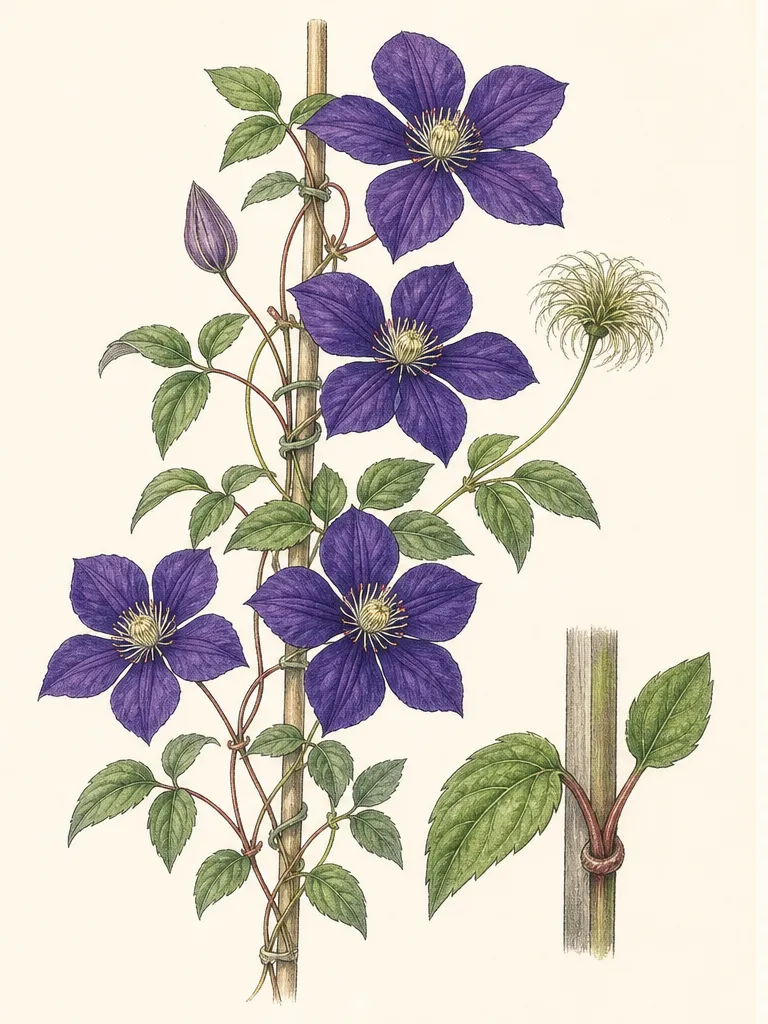
Jackmanii is one of the clearest ways to understand the late large-flowered clematis look: a deciduous climber that threads leaf stalks around a support and covers the new season’s framework with broad, velvety violet-purple flowers. The classic flower has four textured colored sepals surrounding pale greenish-cream anthers, though flowers may vary and nursery stock carrying related names can differ. After bloom, the developing fruits hold long plumed styles that make soft, silvery-brown heads.
The botanical name carries an important multiplication sign. Royal Botanic Gardens, Kew accepts Clematis × jackmanii as an artificial hybrid and records the formula C. lanuginosa × C. viticella. This is not a wild species with a native geographic range. It is a garden-origin hybrid, and the familiar cultivated plant has accumulated names, selections, and related large-flowered stock.
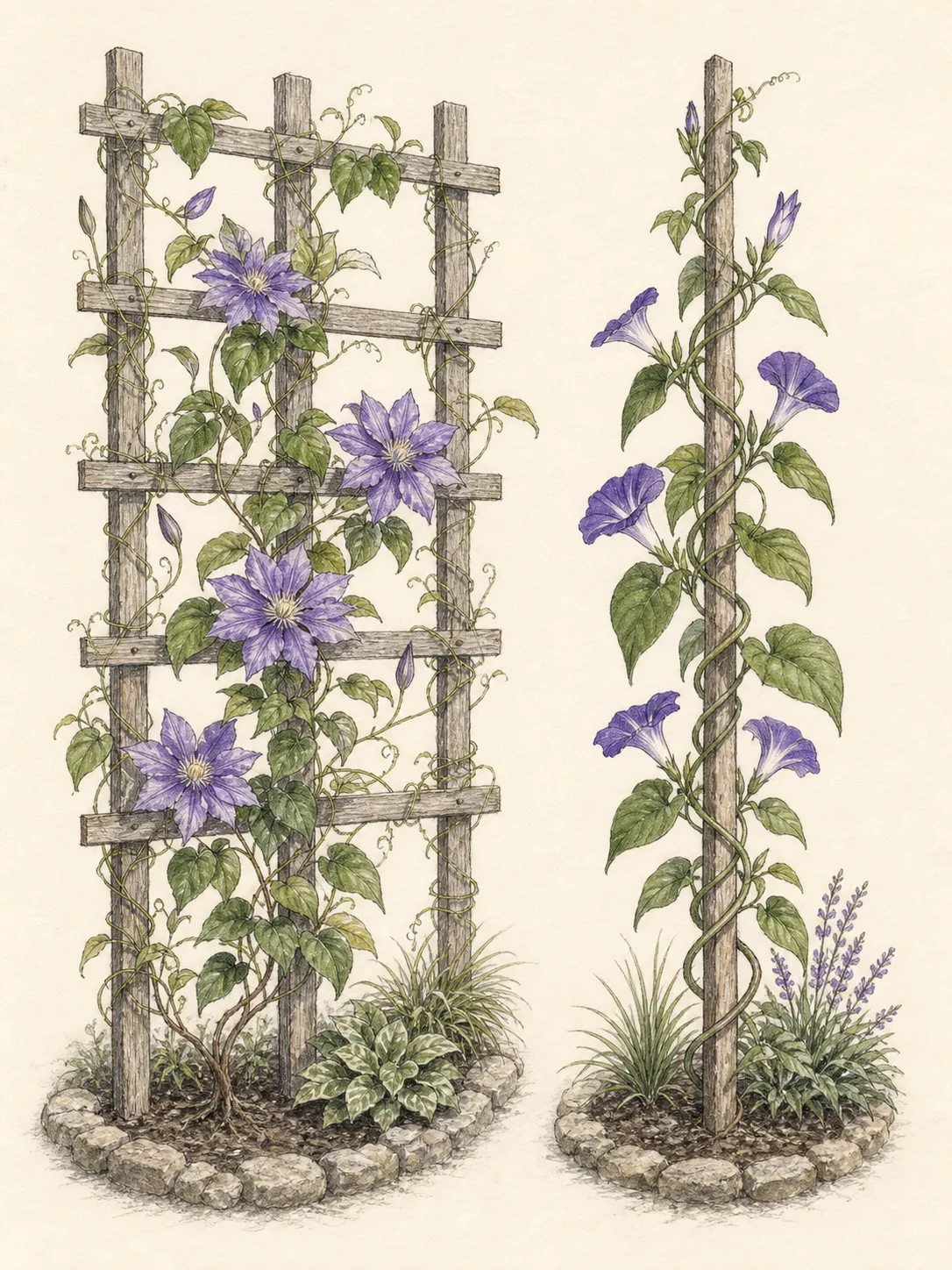
Identification begins with climbing method. Clematis does not cling with adhesive pads or twine its entire stem like a bean. Its leaf stalks wrap around narrow supports. A broad wall by itself offers nothing to grasp, while mesh, wires held away from the surface, or slender trellis members allow the vine to attach. Compound green leaves cover a woody perennial base that loses its foliage in winter and sends vigorous new extensions in spring.
The classic plant belongs to the late large-flowered horticultural group. RHS describes such clematis as deciduous climbers with star-shaped flowers opening on current-year growth in summer and autumn. That new-wood habit explains why Group 3 pruning can produce a fresh flowering framework each year. It does not mean that every plant sold under a broad Jackmanii or large-flowered label should be cut identically without checking its name and flowering record.
Use the vine where a vertical summer flower mass is wanted without the permanent bulk of a large shrub: a cottage-garden trellis, narrow screen, wall wires, or an open obelisk. The support must be installed before planting and strong enough for a leafy, rain-wet mature vine. Position it so stems can be untied and pruned from stable ground. A clematis placed behind an inaccessible thorny shrub may look romantic for one season and become impossible to manage the next.
Full sun to partial shade and even moisture in well-drained soil are the broad requirements shared by the retained horticultural sources. The top growth needs enough light for strong flowering, while the root zone should avoid severe heat and drying. Shade the soil surface with an appropriate low companion or a modest mineral or organic mulch kept clear of the stems; do not let a vigorous companion invade the crown or take all available water.
Treat mature size as a label-specific planning envelope. NC State gives 10–15 ft high and 3–6 ft wide for its entry, while RHS gives 2.5–4 m high and a narrower spread. Climate, pruning, support, and the exact stock all affect the outline. Reserve the larger plausible space, keep stems away from gutters and cables, and choose a smaller named cultivar if the site cannot accept annual extension growth.
All plant parts should be treated as irritating and unsafe to eat. Sap can affect skin, and veterinary guidance lists Clematis species as toxic to dogs, cats, and horses. Gloves, sleeves, prompt washing, and keeping prunings away from animals are sensible routine controls. The plant’s beauty does not require placing it beside a child’s play space or an animal enclosure.
- Family
- Ranunculaceae
- Range
- Garden-origin artificial hybrid; Kew records Clematis lanuginosa × Clematis viticella
- Soil pH
- 6–8
- Spread
- 3–6 ft · 0.9–1.8 m
Planting & careHow to grow jackman’s clematis
This profile uses Clematis × jackmanii as the representative late large-flowered garden hybrid. NC State lists USDA zones 4–9 and dimensions of 10–15 ft by 3–6 ft, while the RHS profile gives a narrower UK spread and H6 hardiness. Nursery plants sold as Jackmanii Group, ‘Jackmanii’, ‘Jackmanii Superba’, or another large-flowered cultivar are not interchangeable. Use the exact label for mature dimensions, regional hardiness, flower timing, and pruning group. The RHS exact profile assigns Group 3, but RHS pruning guidance also allows ‘Jackmanii’ to be handled by Group 2 or 3; NC State labels its entry Type 2. The plant’s verified identity and observed bloom pattern therefore control pruning.
- 1Verify the exact plant and label
Look for Clematis × jackmanii, the cultivar ‘Jackmanii’, or another fully named large-flowered clematis, and keep the label. Record mature height and spread, hardiness, flowering period, and pruning group exactly as supplied. Do not assume that ‘Jackmanii Alba’, ‘Jackmanii Superba’, and every plant in a Jackmanii Group share identical timing or treatment.
- 2Choose a support the leaf stalks can grasp
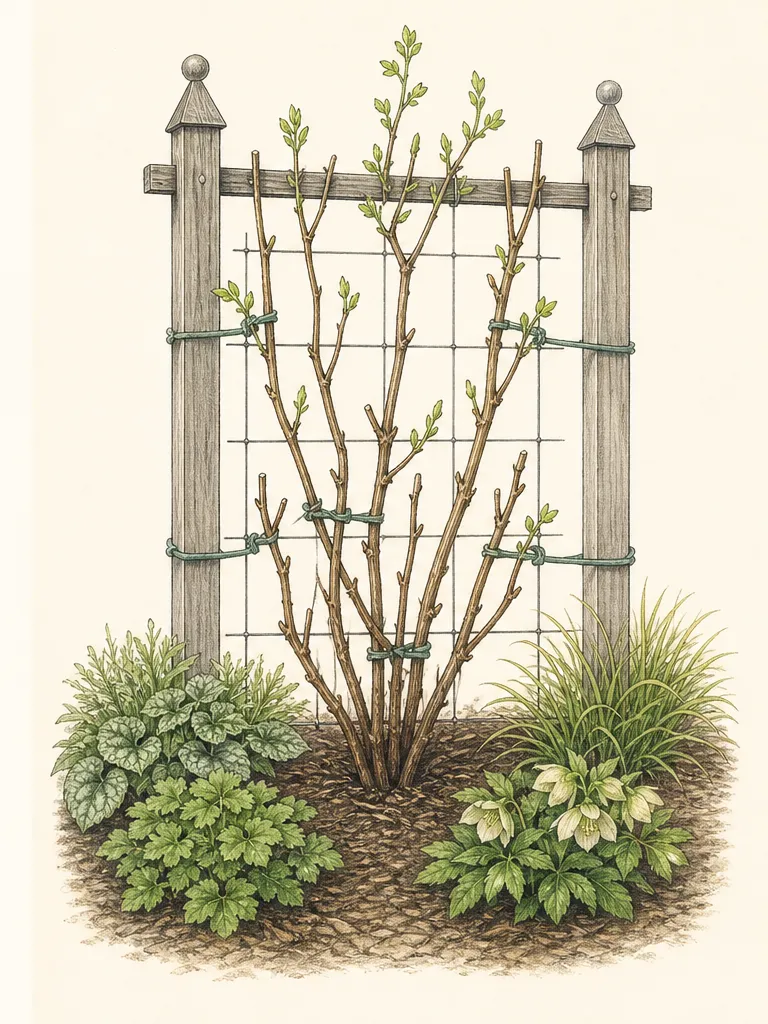
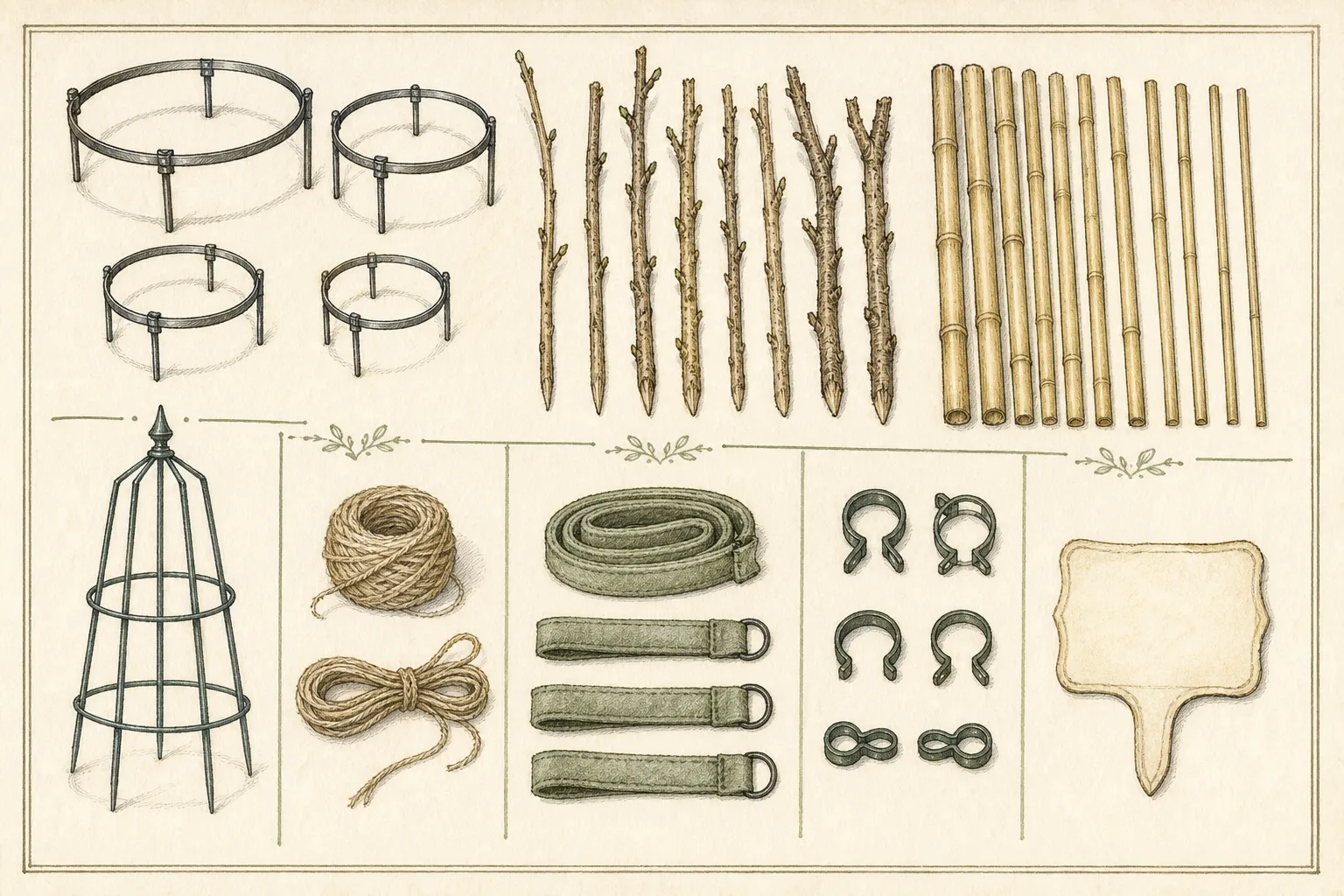
Install mesh, wires, or a trellis with slender members before planting. Hold wall supports away from the surface for air and tying access, and make the structure strong enough for the mature wet vine. Keep the pruning side reachable from stable ground and avoid routes into rooflines, utility cables, or fragile shrubs.
- 3Match light, moisture, and root competition
Select full sun to partial shade with moisture-retentive, well-drained soil. Avoid a dry wall base beneath deep eaves unless irrigation can reliably reach it, and avoid a low saturated pocket. The root zone can be shaded with a restrained companion or mulch, but do not create dense competition directly over the crown.
- 4Prepare a broad planting area
Remove perennial weeds and assess drainage before opening the hole. Prepare enough width for the root ball and outward growth without creating a small amendment-filled container in the ground. Locate underground services through the local process before digging and preserve access to the support for future tying and pruning.
- 5Set the plant to its documented depth
The RHS Jackmanii profile recommends setting the crown 2–3 in (5–8 cm) deep to encourage shoots from below ground. Apply that instruction to correctly identified, healthy nursery stock; do not copy it automatically to an unrelated vine or a compromised crown. Spread correctable outer roots, backfill, and keep the stem base visible enough to monitor.
- 6Water and shade the root zone
Water slowly through the root ball and surrounding soil, then check actual moisture below the surface during establishment. Keep the soil evenly moist without leaving the crown in stagnant water. Add a modest mulch or low companion for surface shade while keeping material and competing stems away from the clematis base.
- 7Train several stems from the beginning
Guide young shoots across the lower support instead of tying one leader straight to the top. Use soft ties where leaf stalks cannot yet reach, leaving room for thickening. Spread the framework so flowers will cover the intended area and inspect ties during the active season before they constrict or stems enter gutters and neighboring plants.
Pruning jackman’s clematis
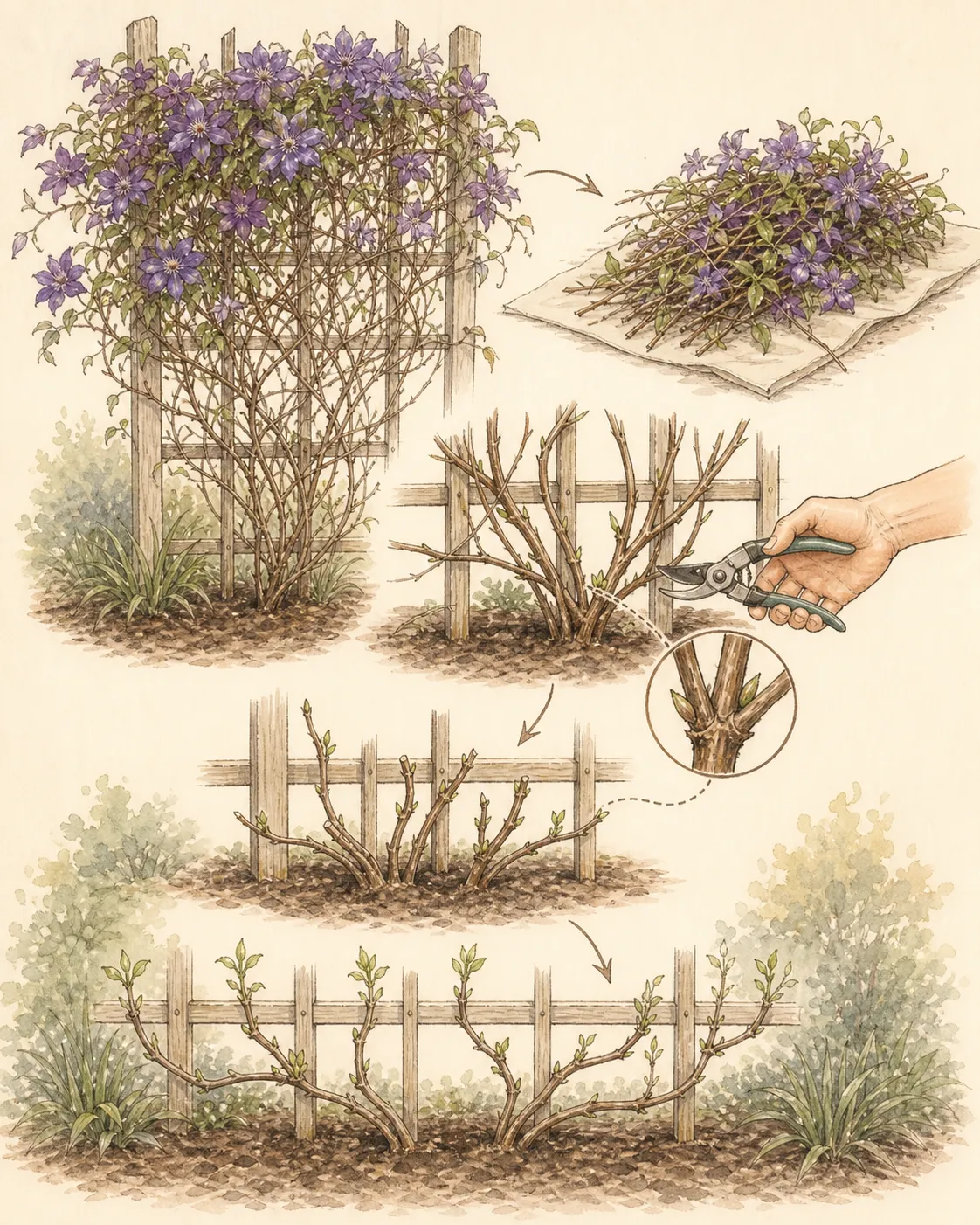
Resolve the plant’s identity before cutting. The RHS profile for Clematis × jackmanii assigns Pruning Group 3, whose late-flowering plants bloom on growth made in the current season. For that verified pattern, prune in late winter or early spring as buds begin to move: remove dead and weak material, then cut old stems to just above the lowest strong pair of healthy buds, commonly within the low framework described by the RHS guide. Tie the resulting shoots across the support as they lengthen. However, RHS also lists ‘Jackmanii’ among mid- to late-summer cultivars that may be treated by Group 2 or Group 3, and NC State labels its Jackmanii entry Type 2. If the retained nursery label specifies Group 2, or the plant reliably flowers early on old stems before blooming again, preserve a framework and use the lighter group-two method rather than erasing that early display. When the label is lost, observe and record flowering time and the age of flowering wood for a full cycle before imposing a hard annual cut. A neglected verified Group 3 plant can usually be reset to low healthy buds, but a differently identified large-flowered cultivar may lose a season’s early flowers under the same treatment. Wear gloves and sleeves, keep sap away from eyes and mouth, clean tools after use, and collect all cut material where children and animals cannot reach it.
Seasonal care
Spring
Confirm the pruning record before growth accelerates. For a verified late-flowering Group 3 Jackmanii, cut old stems to low healthy buds in late winter or early spring, then guide several new shoots across the lower support. If the label specifies Group 2, retain the sound framework and remove only dead or weak ends according to that method. Renew a modest mulch while keeping stems open, begin moisture checks as leaves expand, and protect brittle shoots from rough handling.
Summer
Tie or weave new extensions before they tangle, spacing them across the support and redirecting growth away from gutters, cables, doors, and neighboring crowns. Check root-zone moisture during heat, especially beside walls and under eaves, and water deeply when the soil is drying rather than applying frequent surface splashes. Observe bloom timing and note whether flowers occur on new growth alone or also on retained older stems; this record is essential when the pruning label is uncertain.
Autumn
Allow plumed seed heads to remain where their structure is wanted, or remove them with gloves before they scatter and tangle. Keep fallen leaves from forming a wet mat over the crown, but preserve a moderate protective surface layer. Inspect the support, ties, and wall fixings after the vine loses foliage. Do not hard-prune an uncertain plant merely for tidiness; retain enough labeled or mapped framework to make the correct late-winter decision.
Winter
The deciduous framework is exposed, making identity records and stem condition easier to review. Replace failing support parts before new growth begins and remove loose ties that can abrade stems. Keep the crown from standing in winter water. In colder parts of the stated USDA range, follow local Extension guidance for root-zone protection and cultivar hardiness. Schedule pruning for the locally appropriate late-winter or early-spring window rather than cutting during severe frozen conditions.
Safety and garden spread
Common problems
Flowers only at the top
- Look for
- A tall tangled framework with a bare lower section and most late flowers beyond comfortable viewing height.
- Action
- Verify that the plant is managed as Group 3, then reset it to low healthy buds in the proper late-winter or early-spring window and train several new shoots horizontally across the lower support.
Expected early flowers were removed
- Look for
- A plant labeled or observed as flowering on retained older stems produces only a later flush after hard pruning.
- Action
- Recheck the cultivar and pruning label. Preserve a sound framework under the appropriate Group 2 method in the next cycle and record which stems carry the first flowers.
Sudden stem collapse
- Look for
- One or more shoots wilt or blacken rapidly while other stems may remain normal; damage or constriction may also be visible near the base.
- Action
- Inspect ties, stem bases, and moisture first. Remove collapsed material back to healthy tissue with clean tools and consult local diagnostic guidance if decline continues; do not assume every wilt is the same disease.
Weak flowering and long soft growth
- Look for
- Sparse flowers, stretched stems, or a vine reaching strongly toward better light from a shaded or crowded support.
- Action
- Compare the site with the cultivar’s light requirement and reduce competing growth where appropriate. Move the plant during a suitable dormant period if the support cannot provide adequate light and root-zone moisture.
Dry root zone beside a wall
- Look for
- Wilting, scorched leaf edges, or dry nursery soil beneath eaves even when nearby open ground received rain.
- Action
- Check moisture below the surface and apply water slowly over the full root zone. Redirect roof runoff safely and maintain surface shade without piling material against the stems.
Contact or ingestion exposure
- Look for
- Skin redness or burning after sap contact, or salivation, vomiting, or diarrhea after an animal chews plant material.
- Action
- Stop exposure, wash contacted skin, and seek advice from an appropriate medical professional, veterinarian, or poison service. Do not use the garden profile as treatment guidance.
Related reading
Sources
- Clematis × jackmanii T.Moore. Royal Botanic Gardens, Kew. Source record · Accessed 2026-08-19.
- Clematis × jackmanii | Jackman's Clematis. Royal Horticultural Society. Source record · Accessed 2026-08-19.
- Clematis Pruning: Group Three. Royal Horticultural Society. Source record · Accessed 2026-08-19.
- Jackman's Clematis - Clematis x jackmanii. NC State Extension. Source record · Accessed 2026-08-19.
- Toxic and Non-toxic Plants: Clematis. ASPCA. Source record · Accessed 2026-08-19.