Gardens · vine attachment trellis selection
Choose a Trellis by How the Vine Climbs
Match trellis members and placement to twining stems, twining petioles, tendrils, or scrambling canes, then allow for mature load, ties, pruning, and wall access.
Published Last updated
In this guide
- Start with the exact vine, not the empty wall
- Separate the attachment surface from the supporting structure
- Read the attachment on a live shoot
- Use four named starting specifications, not one generic trellis
- Execute one Central Illinois clematis installation
- Give twining stems a continuous route
- Offer petioles a fine secondary network
- Give tendrils many narrow contact points
- Build scrambling vines a tying framework
- Place the support for roots, walls, and future access
- Match permanence and material to the garden
- Audit attachment and load through a full season
- Design ideas
Start with the exact vine, not the empty wall
A trellis is not a neutral decoration. Its member thickness, spacing, strength, surface, height, and distance from a wall determine whether a vine can attach and whether the gardener can maintain it. Begin with the exact botanical name and cultivar. Record mature height and spread, annual or perennial life cycle, woody or herbaceous framework, pruning needs, and regional status before choosing the structure.
Separate attachment from vigor. Two vines may both twine while one remains a light seasonal screen and the other becomes a heavy woody framework. A delicate grid that a young shoot can grasp may not carry the mature plant, while a massive timber post may be too broad for a small petiole or tendril to wrap. The useful support satisfies both the gripping organ and the long-term load.
Define the garden job: cover a fence, frame a doorway, shade a seat, soften a shed, mark an entry, or provide a temporary summer panel. Add the required view, clear openings, neighboring plants, and the route for pruning. If the intended vine is locally invasive, too vigorous for the space, or incompatible with the structure, choose another vine before trying to solve the mismatch with harder pruning.
Separate the attachment surface from the supporting structure
Match petioles, tendrils, twining stems or tied canes to an accessible contact layer, then assess the permanent frame for the actual mature vine and site. A suitable cable or mesh spacing does not certify anchors or load capacity. Preserve wall clearances and a route for release and pruning before allowing the vine to occupy the full field.
Read the attachment on a live shoot
Look at a young actively growing shoot rather than only the mature tangle. A twining stem wraps its main axis around a support. A petiole climber wraps the stalk connecting a leaf blade to the stem. A tendril climber sends a separate slender organ that coils after contact. A scrambling plant extends long stems that lean, hook, or rest but still need deliberate ties to remain on a vertical framework.
Follow the attachment from its origin. Clematis is the familiar petiole example: the leaf stalk, not the main woody stem, finds a thin support. A climbing rose carries long arching or trailing canes and prickles but does not produce a wrapping organ that secures the framework independently. Illinois Extension distinguishes twining stems, tendrils, petioles, aerial roots, and adhesive disks; this guide focuses on the four types commonly assigned to trellis systems.
Do not identify the method from a common name. Climbing, rambling, vine, and wall shrub describe garden behavior loosely, not one attachment anatomy. Observe several shoots and check an institutional plant profile, because juvenile growth may be tied by the nursery and appear self-clinging. Once the organ is known, sketch the contact point at full scale; that small detail prevents an expensive support from being functionally invisible to the plant.
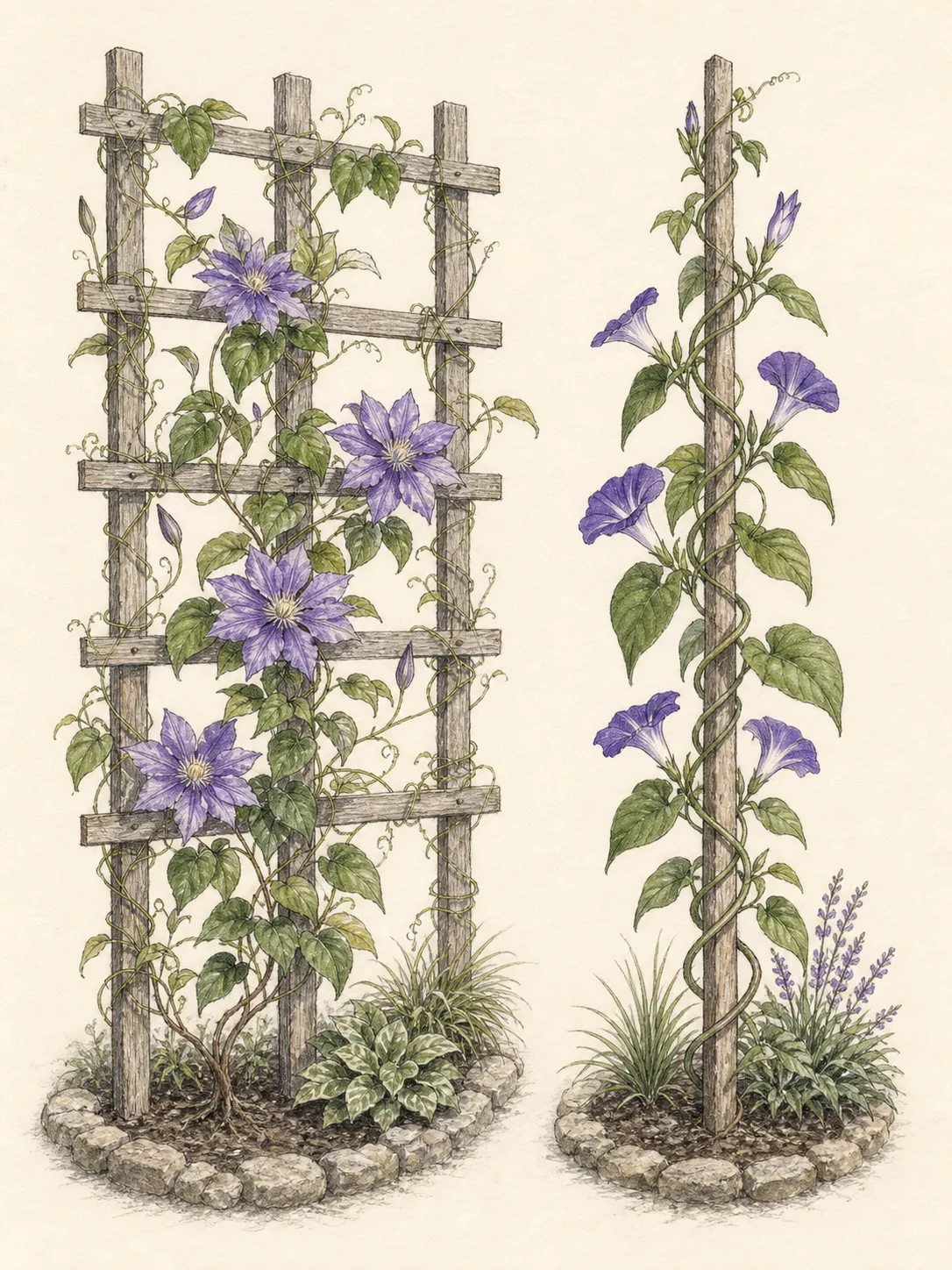
Use four named starting specifications, not one generic trellis
These four specifications are bounded garden starting points assembled from institutional attachment, size, hardiness, and training guidance. They are not interchangeable engineering designs. Verify the named plant's regional status, keep the frame within its documented mature spread, and have anchors and structural members selected for the actual wall or footing, local wind, wet foliage, snow or ice where relevant, and public exposure.
For a twining stem, NC State lists Lonicera × brownii at 8–12 feet high and 6–10 feet wide in Zones 3–8. Give it a permanent frame no smaller than 10 feet wide by 12 feet high, with smooth 1/2-inch vertical rods on 6-inch centers and open sides from which a misplaced coil can be released. The rod diameter and spacing are a declared trial geometry, not an NC State prescription or proof of load capacity; watch the first active shoots and add a closer removable cord only if stems repeatedly miss the rods.
For petioles, NC State lists Clematis × jackmanii at 10–15 feet high and 3–6 feet wide in Zones 4–9. Use a fine 1.8-millimetre stainless-steel cable grid on 12-inch centers inside a separately engineered permanent frame, with loose starter ties that are removed after petioles engage. FassadenGrün identifies its 1.8-millimetre cable for light clematis systems and publishes a 0.9-kilonewton yield load and 1.8-kilonewton ultimate load for the cable; those are cable-component values, not allowable anchor, wall, frame, or complete-system loads.
For tendrils, University of Illinois Extension describes Passiflora incarnata as a 10–15-foot-per-season vine and places its hardiness in Zones 5–11. Give each season's shoots a replaceable 6-inch square grid whose contact members are no broader than 3/4 inch, the upper limit Illinois gives for tendril access, and attach that grid to a permanent frame sized for the full seasonal height. In Zone 5 or 6, treat the upper network as removable seasonal growth support while separately checking local spread and winter behavior.
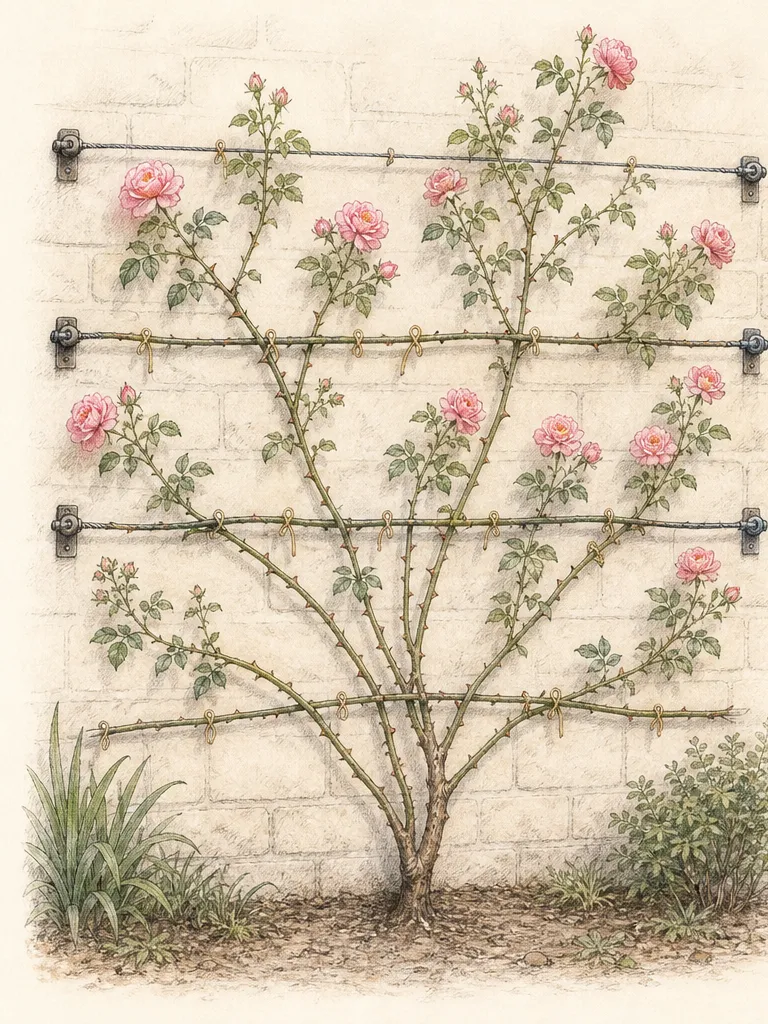
For a scrambler, NC State lists Rosa setigera at 15 feet high by 10 feet wide when supported, in Zones 4–8. Use reachable horizontal wires over the full 10-by-15-foot trained field, with the lowest wire 18 inches above soil and later wires 12 inches apart, following the Royal Horticultural Society's climbing-rose training intervals. Secure canes with soft inspectable ties; prickles are not anchors. This is a permanent tying framework, and its anchors must be selected for the mature rose and site rather than inferred from wire diameter.
Execute one Central Illinois clematis installation
For a declared Central Illinois Zone 6 installation of Clematis × jackmanii on sound masonry, lay out a 6-foot-wide by 10-foot-high cable field. Set 1.8-millimetre vertical and horizontal cables at 12-inch centers, place the lowest horizontal 12 inches above finished soil, and hold the grid 2 inches off the wall. The field fits the lower end of NC State's documented 10–15-foot height and the full 3–6-foot spread; it is deliberately smaller than the most vigorous documented height so the top remains reachable for plant-specific pruning.
Place the root center 18 inches out from the wall and lead shoots back with loose canes or temporary ties. Those offsets follow Royal Horticultural Society guidance to hold wall supports about 2 inches from the surface and plant climbers about 18 inches out, reducing the wall-base rain-shadow problem while preserving working space. Keep a clear approach at the crown and stop the field outside window, vent, gutter, roof, and service clearances.
Specify anchors into verified sound masonry or structural framing through a qualified installer; do not anchor only to veneer, mortar of unknown condition, trim, or cladding. The published 0.9-kilonewton yield and 1.8-kilonewton ultimate figures describe the selected cable alone. They do not establish safe working load, pretension, anchor spacing, wall capacity, or resistance to local wind and wet foliage, so those values must come from the complete support supplier or a competent designer. Inspect cable tension, anchors, wall condition, petiole contact, and escape into service zones after installation and after severe weather.
Give twining stems a continuous route
A twining stem needs something it can encircle as growth rises. Vertical rods, wires, cords, poles, open lattice, chain-link, and the upright members of an arbor can provide a route, provided their dimensions suit the exact vine. Broad closed boards interrupt wrapping. A flat decorative panel with only wide members may support foliage after repeated tying, but then the gardener—not the stem—is providing the attachment system.
Plan for the stem to increase in diameter. Do not force a woody twiner through a tight mesh from which it can never be removed, and do not let it coil around gutters, downspouts, railings, young trees, or cables that require independent service. Strong twining growth can bind neighboring stems and structures. Give each principal shoot a legible path and enough open access to redirect new growth before it knots around the wrong object.
Match structure to mature force and regional behavior. Wisterias, honeysuckles, hops, annual morning glories, and other stem twiners differ enormously in weight, persistence, hardiness, and spread. The attachment category selects the kind of route, not the engineering specification. Use a structure designed for the expected load and site, and obtain professional construction advice when posts, masonry anchors, overhead elements, or public safety are involved.
Offer petioles a fine secondary network
Twining petioles are small and need narrow members they can reach around. Thin wire, cord, narrow lattice, or a fine mesh attached to a stronger frame can provide the working surface. This two-scale solution is often better than making the whole trellis delicate: posts and rails carry the plant, while the replaceable secondary network gives leaf stalks enough contact points to climb.
Keep the fine network accessible. Petioles can remain around wire after leaves age, and a dense mesh can make pruning or untangling difficult. Provide openings large enough for hands and tools while retaining narrow strands for attachment. Lead young clematis stems toward the network with loose temporary ties, then let new leaves make their own contacts. Do not cinch a tie around the tender growing tip or assume one old petiole will carry a heavy mature stem forever.
Preserve the exact clematis or other petiole climber's pruning group, mature size, and site needs. The same fine support can serve a compact cultivar or an extensive vine, but the frame behind it cannot be identical. Keep labels and map principal stems before dormant pruning. A fine grid hidden behind old growth is useful only if it remains strong, reachable, and separable from stems that need to be removed.
Give tendrils many narrow contact points
Tendrils search locally and coil around slender objects, so wire, cord, narrow lattice, mesh, or chain-link usually offers more opportunities than widely spaced broad slats. Position the first contacts where new shoots actually emerge. If the vine must cross a long blank distance before finding the grid, use a temporary cane or tie to guide it without bending the shoot sharply.
Distinguish tendril attachment from final support. A small tendril can hold a shoot to the grid, but the trellis must carry wet foliage, flowers, fruit where applicable, and years of woody growth for perennial vines. Check the exact plant rather than scaling the frame from tendril size. Passionflowers, ornamental grapes, sweet peas, and other tendril climbers do not share one mature load, hardiness range, or pruning system.
Choose a grid that can be cleaned and repaired. Very fine netting may suit one annual season but become difficult to separate from dry stems or inappropriate for a permanent woody vine. Rigid mesh can be durable yet trap canes where cuts are hard to make. Decide whether the vine and secondary support will be removed together each year or whether the plant needs a serviceable long-term framework.
Build scrambling vines a tying framework
Scramblers and wall shrubs do not become secure merely because stems touch a trellis. Climbing roses, for example, extend long canes that can lean or catch with prickles, but their principal framework needs ties to a fence, arbor, or wire system. Choose broad reachable runs that let stems be fanned, trained, and renewed rather than a tight mesh that swallows every branch.
Place ties where they support weight without constricting growth, using material suited to the stem and expected service life. The fastening side should face the gardener, and every tie should be inspectable after growth and wind. Leave space to trace a principal cane from base to tip. Crossing several canes through one opening may cover the trellis quickly, but it hides rubbing, blocks pruning, and makes future renewal destructive.
Use the exact plant's flowering and pruning habit. A once-flowering rose and a repeat-flowering climber may share a support style while requiring different timing for substantial cuts. The trellis selection guide should not override plant-specific pruning advice. Its job is to provide a framework where correct pruning remains possible and a long cane can be removed in controlled sections without dismantling the support.
Place the support for roots, walls, and future access
Install the trellis before the vine needs it and preferably before planting, then keep the planting hole away from foundations, dense structural roots, and the driest wall base. Walls and eaves can exclude rain even when the visible foliage receives weather. Lead the young stem back to the support with a cane or loose tie while the root zone occupies soil where water, drainage, and future growth can be managed.
Hold wall-mounted wires or trellis far enough from the surface for stems, ties, hands, and air to pass without scraping. Keep windows, doors, vents, gutters, meters, roof edges, and property boundaries clear at mature spread. A narrow empty margin around these elements is permanent service space. If annual pruning requires leaning a ladder into the vine or reaching across glass, reduce the support height or change the site.
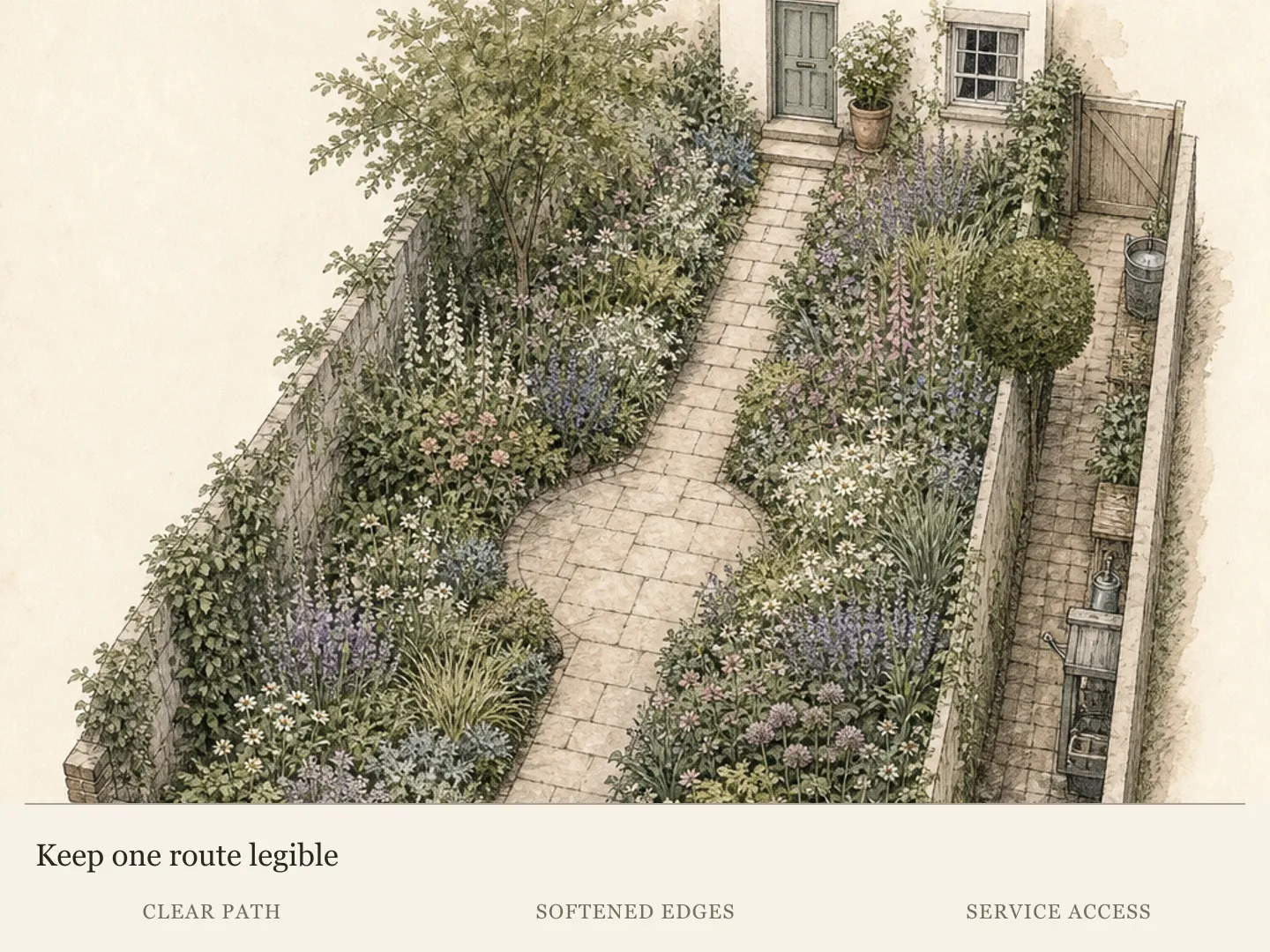
Reserve an approach at the base. Underplanting can shade roots and soften bare stems, but it must not cover the vine crown, block every anchor, or force the gardener to stand on neighboring crowns. Draw the mature footprint of companion plants and the path of removed stems. The support is successful when attachments remain visible from the working side even after the garden looks full from the front.
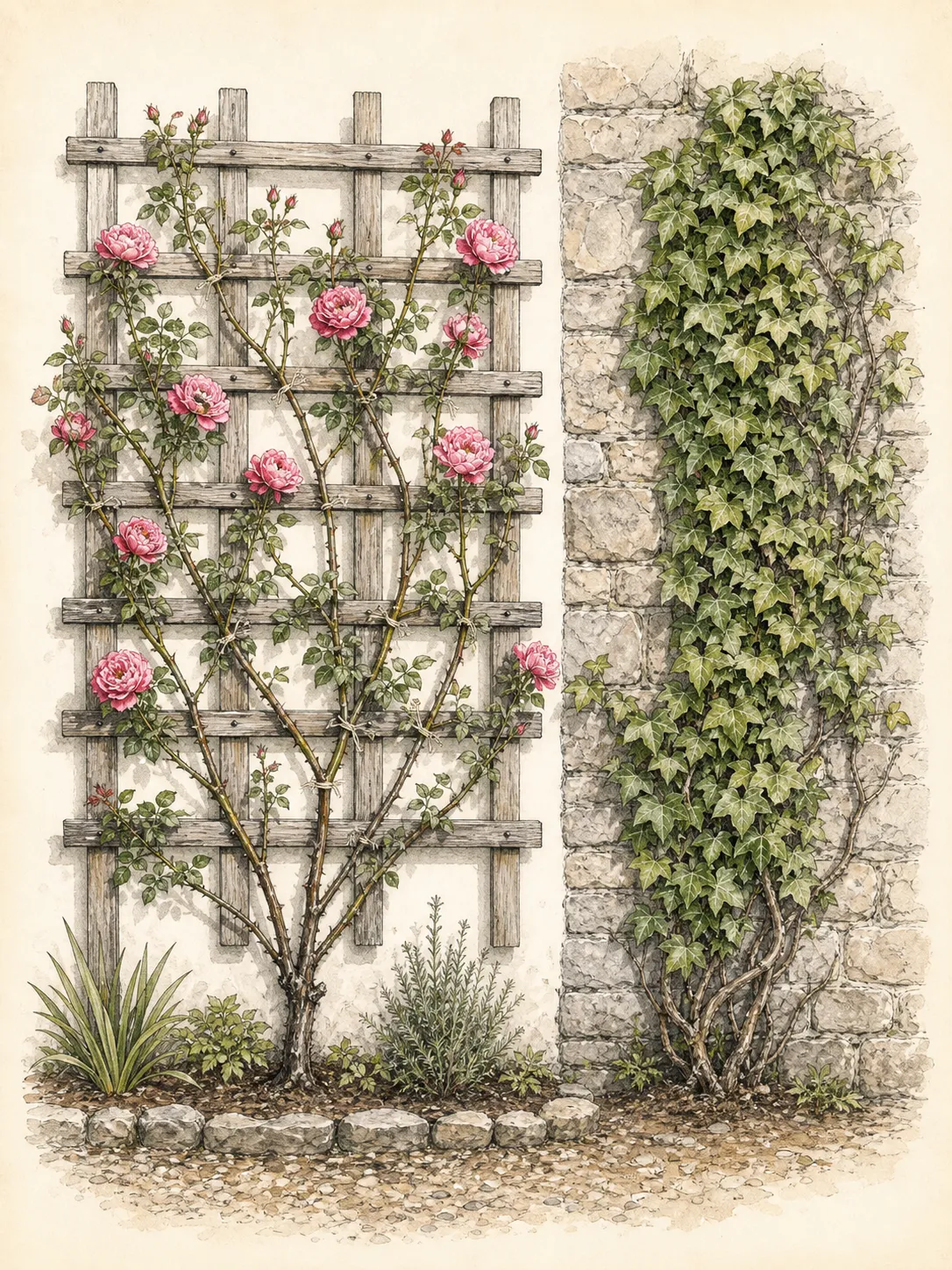
Before approving placement, rehearse a full maintenance cycle with the trellis empty. Stand where each tie, anchor, and future pruning cut would be reached; carry the actual hand tools through the route; and trace how a released stem could be lowered without crossing glass, seating, neighboring crowns, or a public path. Confirm that wall fasteners and the support can be inspected independently of the vine, and that removing a secondary grid would not require detaching the structural frame. At the soil line, reserve enough open surface to see the crown, direct water, and notice a shifted tie or damaged shoot without excavating companion plants. Then draw the mature canopy, not the nursery height, from both front and side. The side view often exposes conflicts hidden by an elevation: foliage pressing against cladding, shoots reaching a gutter, a thick stem trapped behind a rail, or a service path narrowing to nothing. If the only maintenance plan depends on severe annual cutting, unsafe ladder work, or reaching through the vine to structural hardware, reduce the trellis, move it, or select a smaller plant. Placement is complete only when attachment, root care, building access, and removal of old growth can all occur without dismantling the surrounding garden.
Match permanence and material to the garden
Decide whether the support is seasonal, replaceable, or permanent. Annual twiners and tendril climbers can use a light removable secondary grid on a sound frame, allowing vine and cord to be cleared together. A woody perennial needs durable, corrosion-resistant or rot-resistant components compatible with the site, plus fasteners sized for mature load. Decorative aging is acceptable; hidden structural decline is not.
Consider how the trellis looks during dormancy. A fine wire system can nearly disappear behind summer foliage but leaves a quiet wall in winter; an obelisk or arbor remains an architectural feature after annual vines are removed. Match that off-season form to the garden. Do not compensate for an oversized empty structure by choosing a vine that will outgrow the available soil or require unsafe pruning.
Keep the plant separate from building maintenance. A removable panel or wires with accessible ends may allow painting, pointing, or repairs without cutting the whole vine. Do not route growth beneath siding, shingles, cables, or drainage components. Self-clinging roots and adhesive disks require a separate surface-risk assessment and are outside this four-method trellis guide; do not treat a trellis as proof that direct wall attachment is harmless.
Audit attachment and load through a full season
During active growth, check whether new shoots find the intended member. A twining stem repeatedly falling away may need a closer vertical route; petioles or tendrils may be facing members too broad or too distant; a scrambler may simply need another planned tie. Correct the interface while growth is flexible rather than winding stems by force or adding random strings that cross the service side.
After wind and rain, inspect anchors, sag, abrasion, constricted ties, and stems entering forbidden openings. Support the plant before adjusting structural hardware. Replace a failing secondary grid before it transfers the full load to one cane or fastener. If masonry, timber, or an overhead structure moves, unload the area and obtain competent repair; foliage should never be used to hide a support problem.
At dormancy or seasonal removal, photograph the framework and note where attachment succeeded. Clear dry annual growth, release obsolete ties, map permanent stems, and inspect the empty trellis. The right design remains understandable without leaves: its member size matches the attachment organ, its frame matches mature load, roots occupy viable soil, and every important tie, anchor, and pruning route is still reachable.
Design ideas
- Style
- Purposeful vertical garden structure in which trellis geometry follows visible plant attachment and seasonal framework
- Space
- Garden wall, fence, arbor, obelisk, pergola post, freestanding screen, or large container support
- Climate
- Declared worked installation: Central Illinois USDA Zone 6 with Clematis × jackmanii on verified sound masonry; the four comparison specifications retain each named plant's documented hardiness and mature-spread limits, while anchors and structural capacity remain site-specific
- 1Add a fine grid to a strong frame
Use sturdy posts and rails for mature load, then attach a replaceable network of narrow wire or cord for clematis petioles or small tendrils. Keep the network on the service side where it can be renewed without cutting the principal frame or burying it in old stems. Size the permanent frame for the exact mature plant and local exposure; the fine attachment layer does not determine structural capacity.
- 2Give a twiner one clear vertical route
Lead each principal twining stem to a separate pole, wire, or cord it can encircle continuously. Keep gutters, young trees, cables, and railings outside reach. A legible route reduces knots and lets vigorous new growth be redirected before it binds the wrong structure. Inspect the route while shoots remain flexible and release a misplaced coil early rather than forcing a woody stem to reverse direction later.
- 3Fan a scrambler across horizontal runs
Use reachable horizontal wires or broad trellis openings for a climbing rose or wall shrub, then tie long stems in distinct routes. Preserve an open service line below and enough empty margin to remove an old cane without dragging it through windows, companions, or other framework. Place every fastening on the working side and review it as stems thicken; a prickle resting on a rail is not a permanent attachment.
- 4Make an annual removable panel
Stretch a light secondary mesh or cords inside a durable freestanding frame for one-season tendril or twining vines. Design the panel so dry growth and the attachment layer can be removed together, while the frame remains stable and ready for a different annual next year. Confirm that the exact annual is regionally appropriate and that removing the panel will not scatter viable material where local guidance restricts the plant.
- 5Offset the root zone from the wall
Place the vine in viable soil beyond the driest foundation strip, then angle a temporary cane toward the permanent support. Keep the route visible and protect the crown from underplanting. This separates root health from the wall position without asking a young shoot to cross unsupported space.
- 6Frame one opening with permanent margins
Stop trellis members well before a window, door, meter, or vent and treat the empty border as part of the composition. Select a vine whose mature spread can be held inside that frame with ordinary training, not repeated severe cutting at an inaccessible edge.
- 7Pair summer foliage with winter structure
Choose an obelisk, arbor, or panel whose empty form suits the dormant garden, then add an annual or herbaceous vine whose attachment matches it. The structure carries winter design, so the plant can be selected for a manageable season rather than permanent bulk.
- 8Create an attachment sample board
Before building a long screen, offer one candidate vine short samples of narrow wire, cord, lattice, and a broad rail on a safe temporary frame. Observe which organ attaches and where. Use that evidence with mature-load data to specify the final support, not as a substitute for it. Repeat the observation on several active shoots and remove the sample before growth hardens around it, keeping the trial accessible for release without tearing attached organs.
Plants in this guide
Related reading
Sources
- Attachment Methods. University of Illinois Extension. Source record · Accessed 2026-08-19.
- How to Grow Climbers and Wall Shrubs. Royal Horticultural Society. Source record · Accessed 2026-08-19.
- Climbing Rose: Rosa setigera. North Carolina Extension Gardener Plant Toolbox. Source record · Accessed 2026-08-19.
- Brown's Honeysuckle. NC State Extension. Source record · Accessed 2026-08-19.
- Jackman Clematis. NC State Extension. Source record · Accessed 2026-08-19.
- Passion Flower. University of Illinois Extension. Source record · Accessed 2026-08-19.
- Training and Pruning Climbers on Planting. Royal Horticultural Society. Source record · Accessed 2026-08-19.
- Climbing Rose Pruning Guide. Royal Horticultural Society. Source record · Accessed 2026-08-19.
- Stainless Steel Wire Rope for Climbing Plants. FassadenGrün. Source record · Accessed 2026-08-19.