Tools · durable ornamental garden plant label system
Choose Durable Plant Labels for an Ornamental Garden
Match plant-label material, writing method, placement, and record life to seedlings, seasonal displays, dormant bulbs, long-lived perennials, shrubs, and botanical collections.
Published Last updated
In this guide
- Choose the service life before the material
- Match material to record life
- Use wood and bamboo for records that can expire
- Buy plastic labels by formulation, not color
- Reserve metal and slate for stable identities
- Test ultraviolet, water, soil contact, and winter separately
- Make labels readable from the route of approach
- Place labels for retrieval, not display alone
- Build the map and accession record first
- Maintain, correct, and retire the system
- Keep material and mark together in the trial record
- Tool notes
Choose the service life before the material
A durable plant-label system has four parts: a substrate that survives the site, a mark that remains attached to that substrate, a position that can still be found, and a separate record that preserves the identity after the stake disappears. Choose all four from the consequence of failure. A seed tray or annual display may need a label for one season. A dormant bulb, slow-growing shrub, or cultivar divided among several beds can lose years of identity when its marker fails. Permanent collections need a stable code even when the displayed name later changes.
Divide the garden into temporary, seasonal, and long-term records before shopping. Temporary labels cover propagation and plants awaiting a final position. Seasonal labels must pass through irrigation, canopy growth, mulch, and dormancy.
Long-term labels should remain readable through repeated winters and maintenance work while allowing taxonomic corrections. Botanic Gardens Conservation International recommends keeping an accession number and name on collection labels because the number unlocks the fuller record. A home garden can use the same principle with a short unique code tied to a bed map.
Match material to record life
A label fails when either the mark or its support fails, so phrases such as weatherproof marker and permanent label describe incomplete systems. Graphite can grip a matte plastic surface yet wipe from a glossy one. Ink may bond to one polymer and fade on another. Paint can remain visible after the wood beneath it splits. Embossing survives loss of surface color but fixes the information in place. Engraving suits an accession code or stable botanical identity better than a bed note expected to change next spring.
Field-test the exact pair because product names describe only part of its performance. Write the same sample code with each candidate pencil, paint pen, or marker on spare pieces from the purchased batch. Include a control kept indoors. Put the outdoor samples at the bed's real angle and exposure, then photograph them before watering.
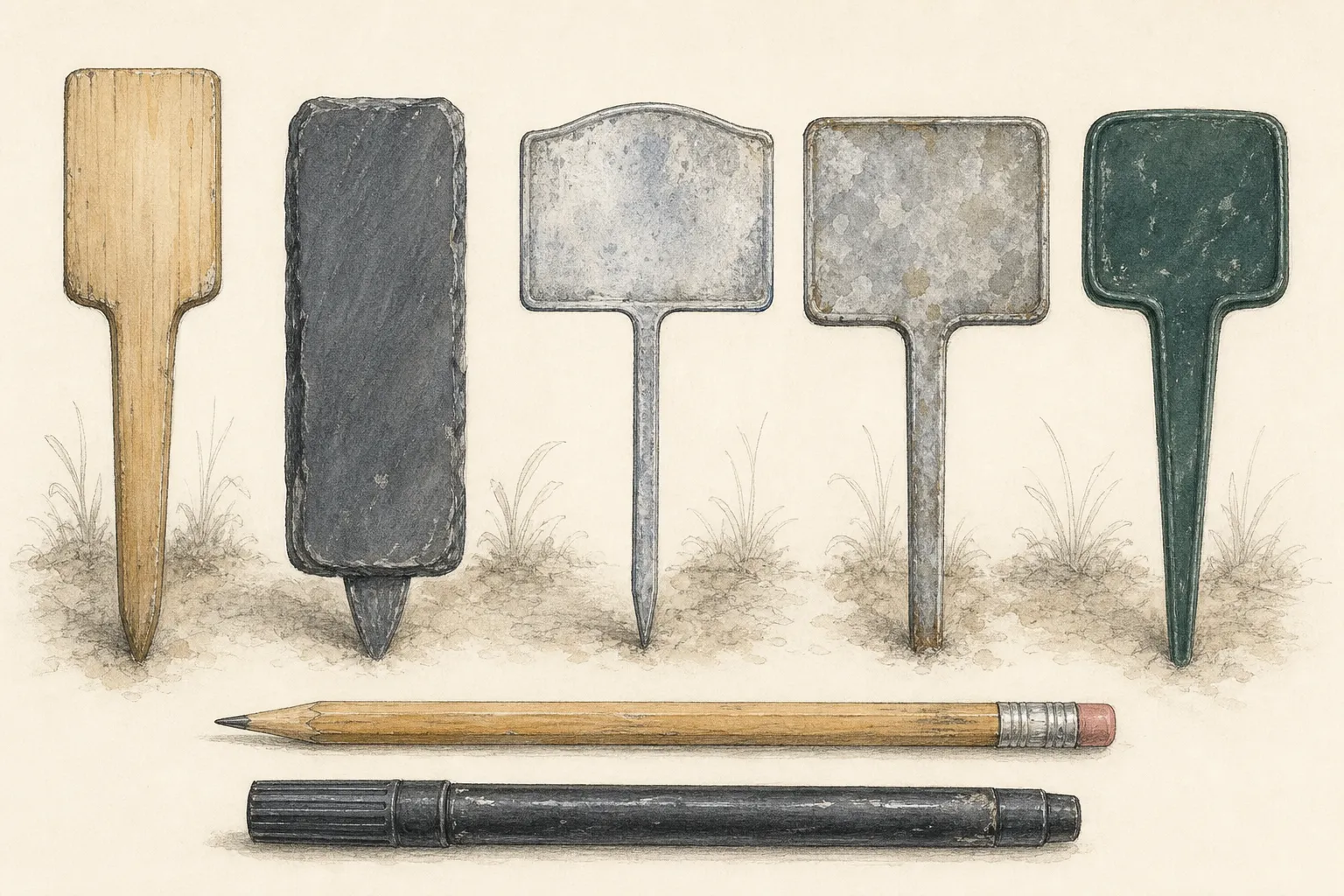
Read the samples at arm's length after irrigation, after a month of sun, and after the most demanding local season. Rub a dry thumb across each mark. Bending, chalking, peeling, or illegibility is a failed pair even if the stake remains upright.
Use wood and bamboo for records that can expire
Untreated wood is inexpensive and easy to cut, but damp compost can draw water into it and blur the writing. The Royal Horticultural Society therefore treats wooden labels as a short-term choice and notes that bamboo absorbs less water and can stay legible for a season. Use either where the identity has already been copied into a permanent record and where a planned handoff exists. Examples include newly divided perennials waiting for placement, bulbs in a nursery pot, and a propagation batch that will receive accession codes after selection.
Keep the written area above the wet soil and mulch line. A broad face gives botanical names enough room without tiny script, while a pointed end can be inserted without burying the final line. Smooth splinters before writing and discard any piece that cracks near a handhold. Coating a disposable wooden stake changes its end-of-life options and creates another surface whose adhesion must be tested. Compost only clean, untreated pieces when the local program accepts them; painted, sealed, glued, or contaminated wood belongs in the disposal route specified locally.
Buy plastic labels by formulation, not color
Plastic labels use many polymer formulations with different durability. The Canadian Conservation Institute documents large differences in sunlight sensitivity among polymers and describes discoloration, chalking, embrittlement, and cracking as forms of light and ultraviolet damage. Those museum findings explain the mechanism; an outdoor garden trial establishes the service life for this use.
Buy labels identified for outdoor exposure, retain the material description from the package, and test a batch in the actual bed. Documented outdoor use carries more useful information than thickness alone when comparing two products.
Writing performance also depends on the surface. University of Georgia Extension reports that pencil on plastic stakes in its school-garden context lasts almost as long as permanent marker, while writing on wood fades quickly. Treat that as a useful test candidate, not a universal guarantee. Compare graphite and the intended marker on clean, dry samples; include irrigation and sun in the trial. Reuse a sound label only after the previous identity is completely removed. A brittle, crazed, sticky, or sharply fractured plastic label has reached retirement even when its words are still readable.
Reserve metal and slate for stable identities
Embossed or engraved metal is appropriate when losing an identifier would be costly and the encoded value is unlikely to change. Chicago Botanic Garden uses photographically engraved anodized aluminum for permanent labels and reserves plastic and waterproof paper for seasonal or temporary displays. That is evidence for a complete institutional system in one climate, not a promise that every aluminum tag will perform alike. Metal alloy, finish, thickness, fastener, mark, salt exposure, and fabrication quality still belong in the purchase decision.
Put the stable accession code in the permanent mark and keep changeable details in the record. A botanical name can be corrected without discarding a sound code tag. Folded or rounded edges are safer around hands than freshly cut sheet; homemade pieces need deburring and a low-consequence trial before garden use. The RHS presents slate as a reusable display surface, but it suits a position where its weight and breakage will not create a path hazard. Chalk, paint, and adhesive lettering on slate require their own exposure test.
Test ultraviolet, water, soil contact, and winter separately
Outdoor survival requires several separate tests. The National Park Service identifies sunshine, especially ultraviolet exposure, as a major source of fading for outdoor exhibit panels; orientation, elevation, and annual sun exposure change the load. Heat and fluctuating temperatures can also warp or delaminate some panel constructions.
A small garden tag has different geometry, yet the exposure logic still applies. Compare samples in the sunniest bed and a shaded bed, and inspect the printed or painted layer separately from the substrate. A sheltered result qualifies only that sheltered position; an open south-facing border needs its own sample.
Water and soil contact reveal adhesion, swelling, and corrosion weaknesses. Keep seams, adhesive joints, and most lettering above the splash and mulch line unless the manufacturer rates the complete assembly for burial.
After a hard freeze, inspect location as well as legibility. University of Minnesota Extension explains that alternating freeze and thaw can heave plants upward; the same soil movement can shift a nearby stake, though the source establishes no label-specific failure rate. Reset a lifted marker after the ground is workable and verify its code against the map before returning it beside a dormant crown.
Make labels readable from the route of approach
Legibility is an access feature, not decoration. Use a matte or low-glare face, strong light-dark contrast, conventional letterforms, open spacing, and enough character height for the actual viewing distance. These choices follow the U.S. Access Board's visual-sign principles.
A private plant marker is generally outside the permanent-room signs covered by ADA Standards. These visual principles offer a useful home-garden benchmark, while public gardens and shared landscapes still need a full assessment of the accessibility and facility rules that apply to them.
Place the reading face where the intended user can approach on a firm route and read without stepping into soil, leaning through thorns, or moving wet foliage. Test it from standing and seated eye levels used in that garden. Use mixed case for botanical names, keep strokes simple, and separate the cultivar clearly from the species. A QR code can lead to photographs or a longer record, but it cannot be the only identifier: glare, damage, network loss, and an obsolete link can make it useless. Retain a short human-readable code on the label.
Place labels for retrieval, not display alone
Choose one repeatable position for each bed, such as the path-side edge of a plant's occupied area, then record the offset on the map. Keep stakes outside crowns, rhizomes, irrigation lines, edging cuts, mower arcs, and normal kneeling space. Leave enough height above the expected mulch to locate the marker, while avoiding a rigid projection at face or shin level. A discreet label that vanishes under midsummer foliage still works when its mapped position and approach are consistent. An ornamental sign intended for visitors needs a more visible, deliberately accessible position than an accession tag used only by the gardener.
Dormant bulbs and ephemeral perennials need a fixed bed reference because no visible plant may remain when the marker moves. Map the center and outline of a group; a single stake cannot describe every offset. Before division, lift the label and plant together, assign suffixes to separated portions, and record their destinations.
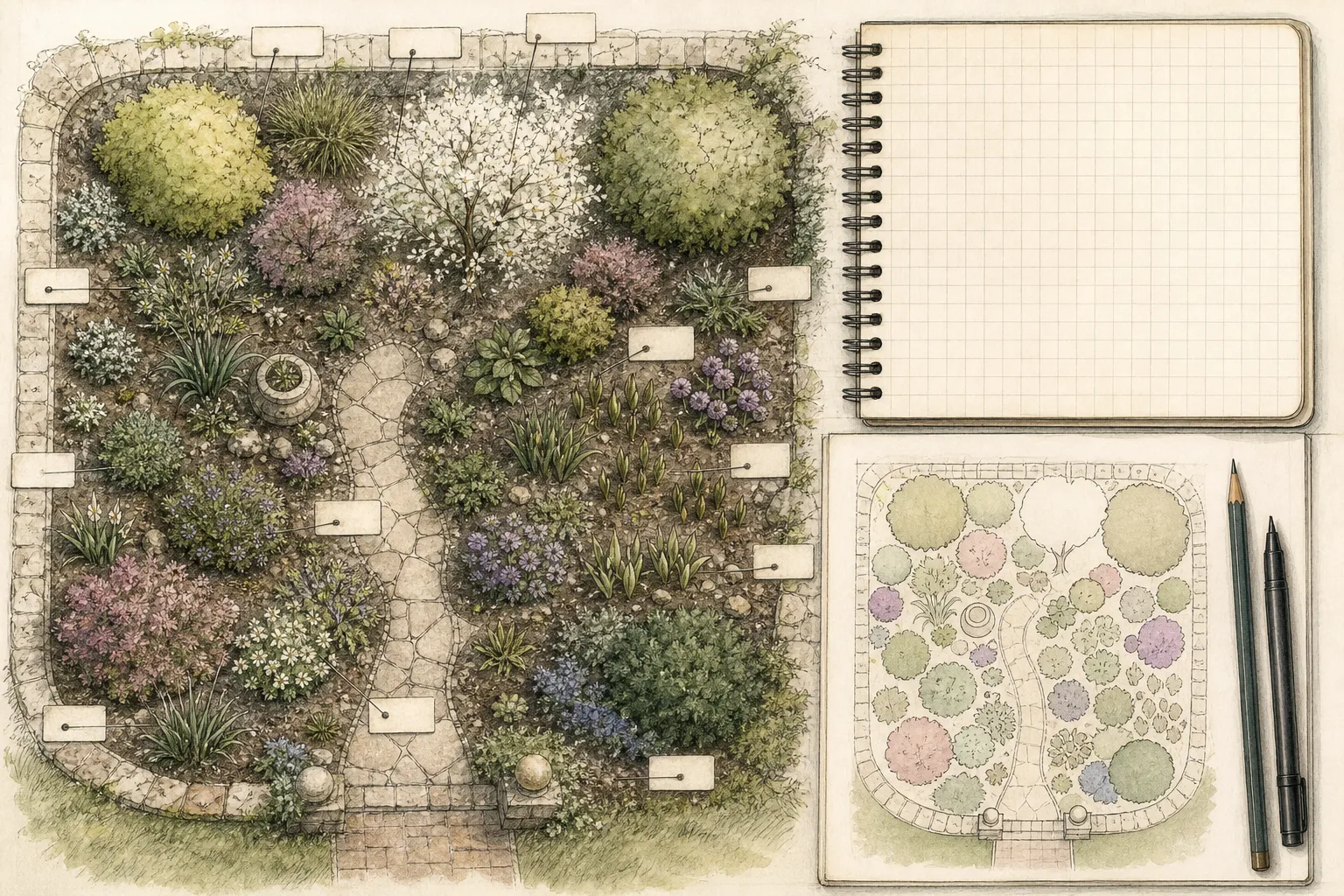
Hanging tags on woody plants must remain adjustable and loose around expanding stems. BGCI specifically calls for labels that can be adjusted or removed without harming the plant. Check attachments where branches rub or where wind can separate label from specimen.
Build the map and accession record first
A physical tag should carry a short code linked to the full record. Give each plant or coherent group a unique code that stays permanently tied to its original record. Record the accepted botanical name, cultivar exactly as purchased, source, acquisition or planting date, quantity, bed, mapped position, label material, and last verification date.
Keep the supplied name when identification is uncertain and flag the uncertainty. BGCI advises indicating identities that still require botanical verification, and Chicago Botanic Garden pairs its labels with mapped locations and continuously updated collection data.
Use fixed reference points such as a wall corner, path junction, or surveyed bed boundary. Movable pots, decorative edging, and individual neighboring plants make poor origins for measurements. Save the table in a widely readable format and export a human-readable copy of the map.
The Library of Congress preservation guide recommends at least two copies of important digital documents on separate media in different locations, followed by regular readability checks. Apply that discipline to the garden record. Keep copies beyond the working device or cloud account, and export from a proprietary app into a format another program can read.
Maintain, correct, and retire the system
Rewrite fading text while both the label and record can still be compared. Photograph the old and replacement labels together, confirm the plant's position, then destroy or quarantine the obsolete marker before it can return to stock. A taxonomic correction should preserve the earlier name in the record with the date and authority used; the accession code remains unchanged.
If a label is found loose and its identity cannot be proved from the map, photographs, and neighboring records, mark the plant as uncertain. A temporary question tag protects the collection from a durable guessed identity.
Clean reusable material with a method compatible with its substrate and finish, then dry and inspect it under good light. Cracks, sharp corrosion, splinters, loosened laminates, incomplete erasure, or a distorted stake are retirement findings. Local programs determine recycling acceptance for each separated material, regardless of the resin symbol or appearance.
Reuse slate and unmarked metal where condition permits; engraved identifiers belong with their record until formally deaccessioned. A small inventory of proven material-mark pairs, dated test samples, and spare labels is easier to maintain than several decorative systems with unknown failure modes.
Keep material and mark together in the trial record
Record each label as a material-and-mark pair: material or product; pen, engraving or other mark; installation date; exact location; map identifier; water and soil exposure; legibility; cracking or movement; replacement time and cost. Test the complete pair in its intended position. Retain a durable label only if its identity can still be retrieved and matched to the map; an intact blank tag has failed the job.
Tool notes
- Type
- Garden plant label, marker, and accession record system
- Purpose
- Keep plant identity retrievable through weather, growth, dormancy, propagation, relocation, and routine maintenance.
- Affiliate
- No commercial links
Maintenance
- Commission a new material-mark pair with one indoor control and outdoor samples in the sunniest and shadiest intended beds. Record product name, material, marking tool, installation date, and photographs. Reject the pair if irrigation removes the mark, the substrate bends permanently, or either outdoor sample becomes hard to read at the planned viewing distance.
- Inspect newly installed labels after the first thorough watering and again after roughly one month of ordinary exposure. Look for ink bleed, graphite loss, adhesive lift, swelling, loosened stakes, and burial by mulch. Correct the material or placement while the plant list and bed plan are still current.
- Run a midsummer legibility round when ultraviolet exposure and foliage cover are near their seasonal peak. Read every code from its normal approach without wiping the face first. Rewrite a fading label only after matching its code, mapped position, and plant; photograph the old and new marks together before destroying the obsolete one.
- After freeze-thaw weather, flooding, strong wind, or major mulch work, compare stake positions with the map. Reset leaning or heaved labels in workable soil, uncover only the reading face, and verify dormant plants primarily by coordinates, using foliage when it is present. Record repeated movement so the next label can use a safer offset or support.
- Before digging, dividing, or relocating a plant, bring the label and record into the work sequence. Photograph the original combination, assign durable suffixes to divided portions, label each destination, then update quantities and mapped positions the same day. Unlabeled divisions stay in a clearly separated holding area until their identity is resolved.
- Reconcile the physical inventory with the record at least once a year. Check accepted name, cultivar spelling, source, quantity, bed, coordinates, label material, and verification date. Preserve former names and the reason for a correction, and keep each accession code permanently tied to its original plant record after removal.
- Export the accession table and bed map to widely readable files after each substantial change. Maintain at least two copies on separate media in different locations, following Library of Congress preservation guidance. Open the copies during the annual inventory so a backup that no longer reads is discovered before the working record is lost.
- Wash soil from reusable labels with the least aggressive method compatible with the material, rinse when appropriate, and dry completely. Inspect under bright light for cracks, splinters, corrosion, delamination, distorted stakes, and ghost writing. Return a piece to stock only when no previous identity can be mistaken for the next one.
- Retire labels by separating wire, fasteners, and mixed components. Compost only clean untreated wood or bamboo where accepted, and confirm local recycling rules for each plastic or metal because appearance alone cannot identify an accepted stream. Keep an engraved accession tag with its deaccession record, or render the identifier unusable before material recovery.
Related reading
Sources
- How to Go Plastic-Free in Your Garden. Royal Horticultural Society. Source record · Accessed 2026-08-30.
- Chapter 5: Collection Record Management Systems. Botanic Gardens Conservation International. Source record · Accessed 2026-08-30.
- Living Plant Documentation. Chicago Botanic Garden. Source record · Accessed 2026-08-30.
- Wayside Exhibit Panel Materials. U.S. National Park Service. Source record · Accessed 2026-08-30.
- Chapter 7: Signs. U.S. Access Board. Source record · Accessed 2026-08-30.
- Mulch Perennials and Bulbs After the Soil Freezes. University of Minnesota Extension. Source record · Accessed 2026-08-30.
- Caring for Plastics and Rubbers. Canadian Conservation Institute. Source record · Accessed 2026-08-30.
- Planning an Edible Garden. University of Georgia Cooperative Extension. Source record · Accessed 2026-08-30.
- Preserving Your Digital Memories. Library of Congress. Source record · Accessed 2026-08-30.