Gardens · small winter border bark stem composition
Design a Winter Bark-and-Stem Border for a Small Garden
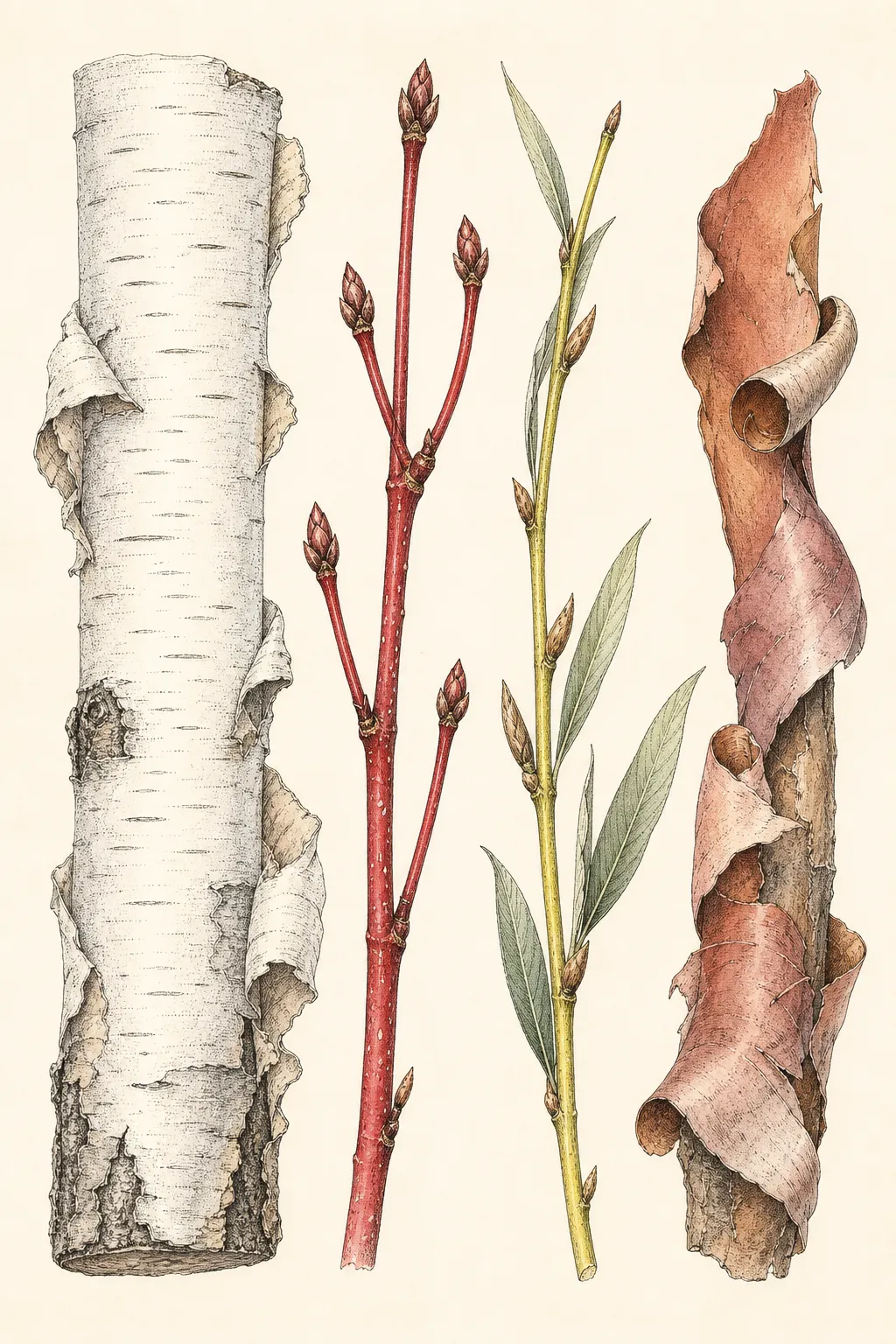
Compose a compact ornamental border with bark color, young stem renewal, evergreen contrast, mature spacing, and a summer framework that earns its winter display.
Published Last updated
In this guide
- Map the winter view and the summer volume
- Compose value and line from the main winter view
- Choose specimens by habit and maintenance
- Allocate roots, crowns, and working access
- Build a ground layer that reveals the stems
- Coordinate separate pruning calendars
- Audit the border across four seasons
- Design ideas
Map the winter view and the summer volume
Photograph the empty border after leaf fall from the window or path where it will be seen most often. Measure bed length and depth, path clearance, gates, drains, utility covers, roof discharge, snow storage and any root flare already in the bed. Mark the direction and duration of low winter sun. Red and yellow stems need light to read clearly, while pale bark can disappear against snow, cream render or a bright fence.
Draw every retained and proposed woody plant at mature summer width as well as dormant winter width. Include arching branches after rain, suckers, and the space needed to walk behind a shrub with secateurs. NC State Extension treats mature scale as a first design constraint because an oversized plant will overwhelm both the composition and its maintenance route. A winter border fails if summer leaves close the path or force annual one-sided cutting.
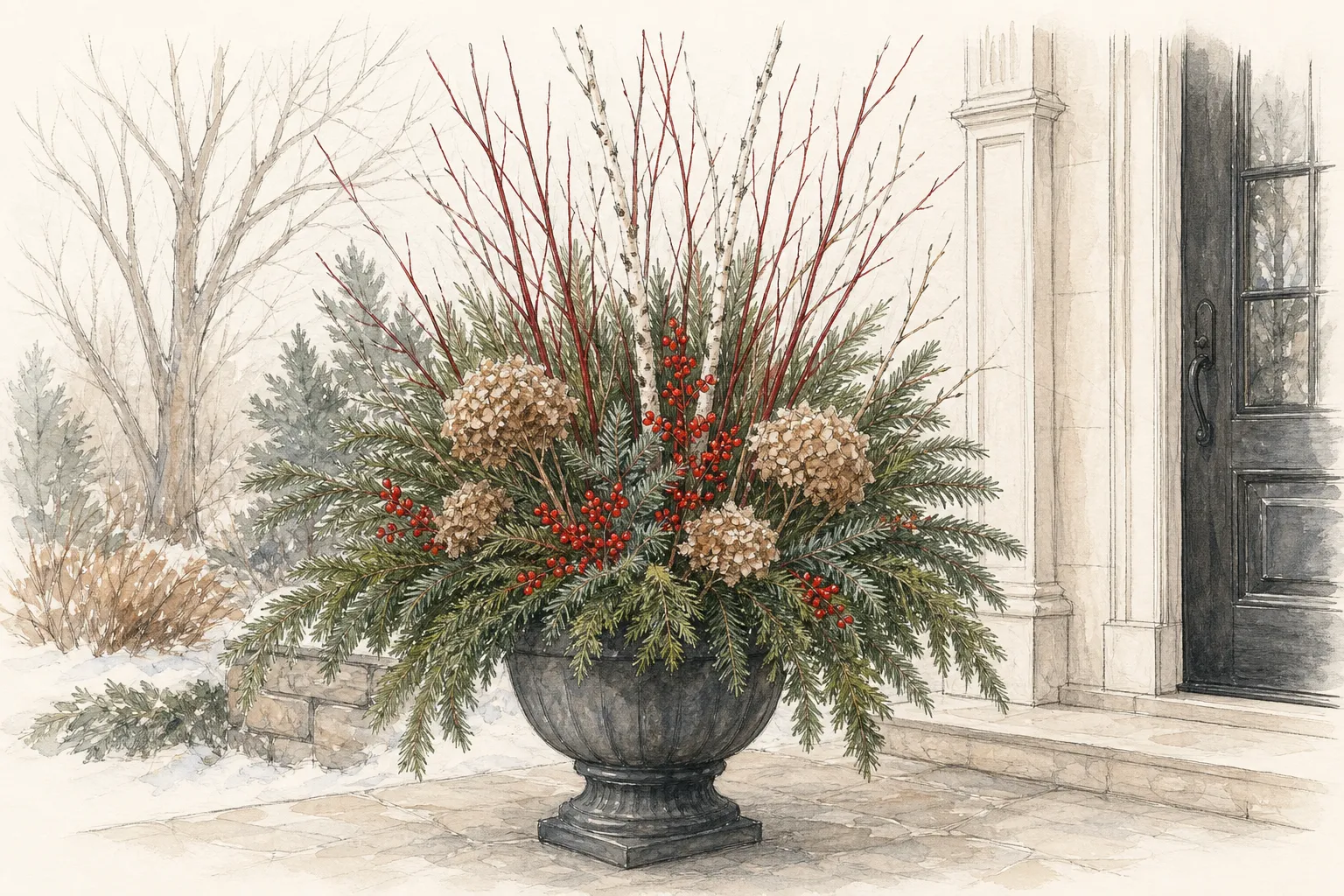
Choose one primary winter event from the main viewpoint: a pale trunk, a concentrated bank of young red stems, or one exfoliating shrub. Give secondary stem colors less area and keep open ground between them. NC State's principles of accent, rhythm and unity support a clear hierarchy; equal amounts of every bark color create a specimen list rather than a composed small border.
Add the maintenance promise to the drawing. A dogwood kept bright by renewal pruning occupies both plant space and annual work time, while an ornamental-bark shrub may need only removal of damaged wood. Record which crowns need access in early spring, which flower on older wood, and which will remain untouched. If those routes and calendars cannot fit, reduce the plant count before installation.
Compose value and line from the main winter view
Build the first sketch in dark, mid-tone and pale values before choosing flower color. A quiet evergreen hedge, dark wall or shaded recess can make young red stems and cinnamon bark legible. Keep the background far enough behind the deciduous shrubs that branches and pruning access do not merge into it. Where the existing background is already pale, use darker bark or dense red stems instead of adding a white-barked tree that will vanish.
Place the tallest line off center and let lower groups step toward the path. A single upright trunk or one tall stem mass can lead the eye across an asymmetric composition, while two lower groups provide balance without mirroring it. Verify the actual mature width and height on the cultivar source. The width printed for an unpruned plant still matters even when renewal pruning is planned, because roots and one season's growth do not stay inside a drawn coppice stool.
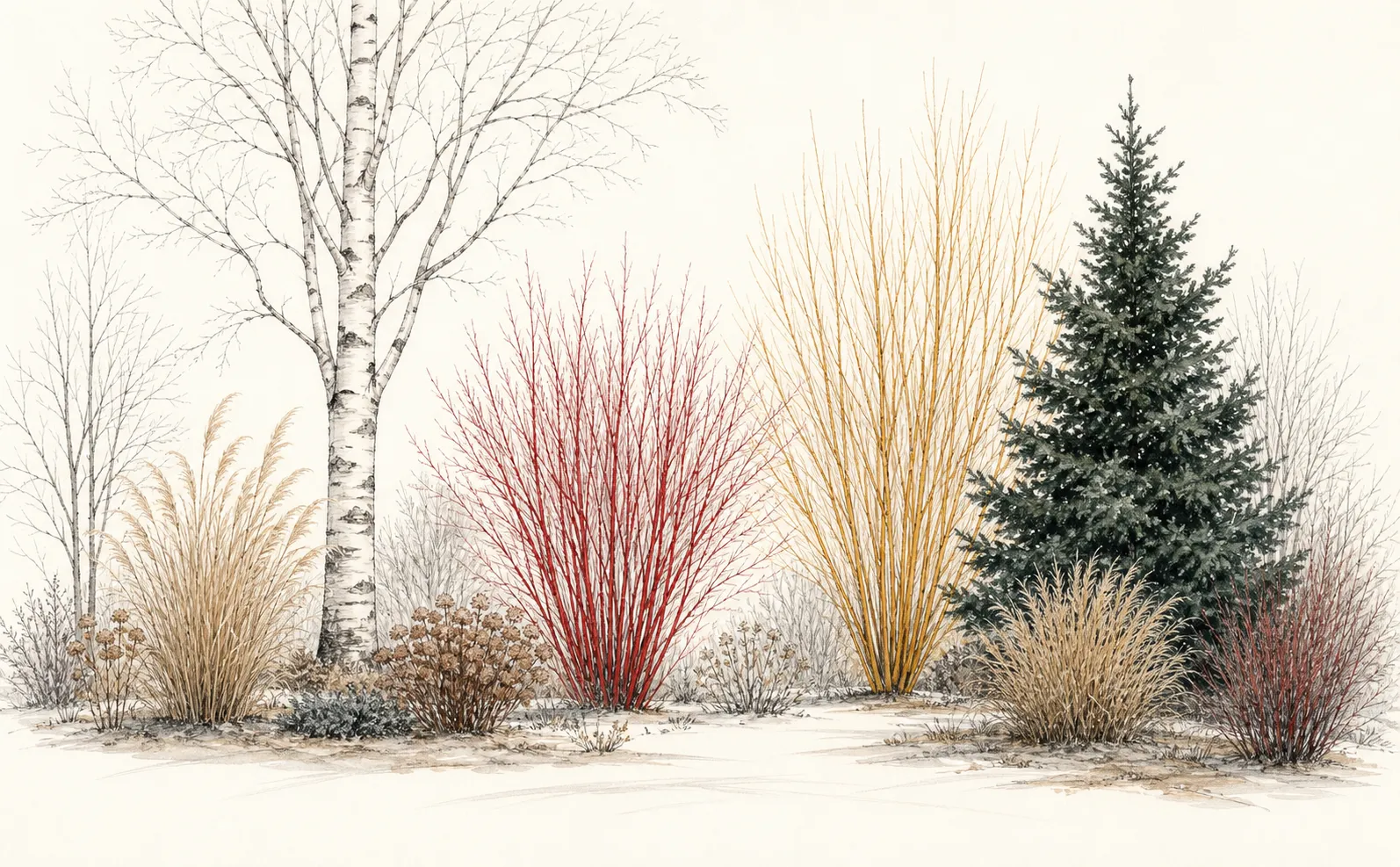
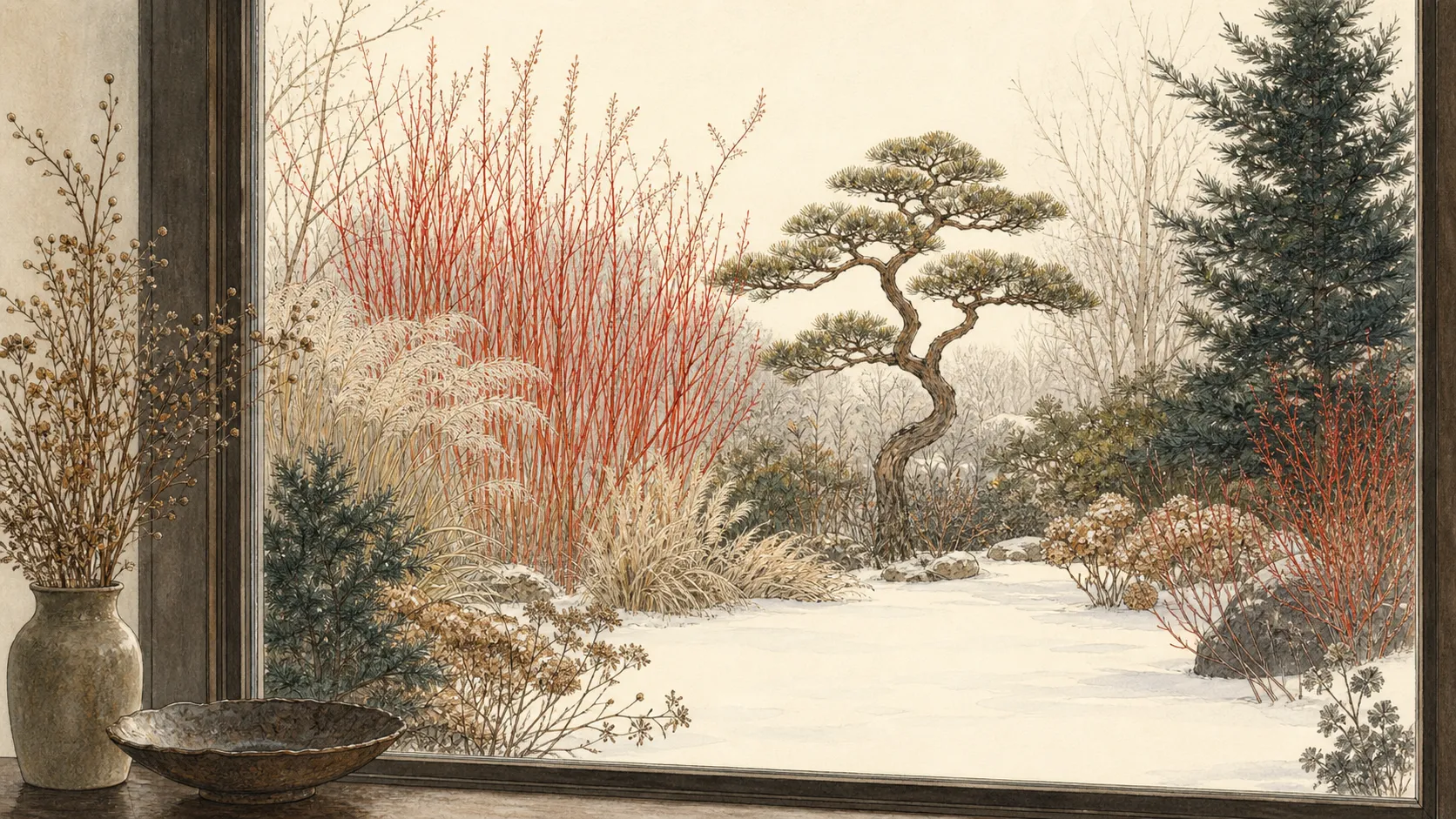
Repeat one stem color in unequal amounts. The strongest red group can hold the focal zone, with a smaller echo several feet away; a yellow-green group should be smaller again unless it is the intended accent. Evaluate the effect under ordinary cloud, low sun and snow. Winter color is produced by bark tissue and reflected light, so a catalog close-up cannot predict how a thin twig group will read from a room ten yards away.
Use protected soil, a low compatible ground layer or restrained leaf litter as negative space. Keep trunk bases, shrub crowns, drains and the edges of sucker-forming plants visible. Another dwarf shrub is not automatically an improvement: an open interval can separate two stem colors, expose exfoliating bark and provide the standing place needed for selective pruning.
Choose specimens by habit and maintenance
Select each plant by mature dimensions, root-zone moisture, hardiness, suckering habit, summer foliage and pruning response. The RHS explains that vivid dogwood color is carried by young stems, but not every colorful shrub needs the same treatment. A tree grown for permanent bark must retain its framework; a compact oakleaf hydrangea flowers on older wood; a red-osier dogwood can renew from basal stems. Those functions cannot share one February cut.
Compare the whole winter structure at garden distance. Many fine dogwood stems make a colored plane, whereas the exfoliating branches of an oakleaf hydrangea make a smaller textured accent. Morton Arboretum places red-osier dogwood in moist to wet soil and notes its thicket-forming habit; a dry foundation shadow is therefore a poor place to demand brilliant stems. Check current local invasive status and fire-safety rules before giving any woody plant a permanent role.
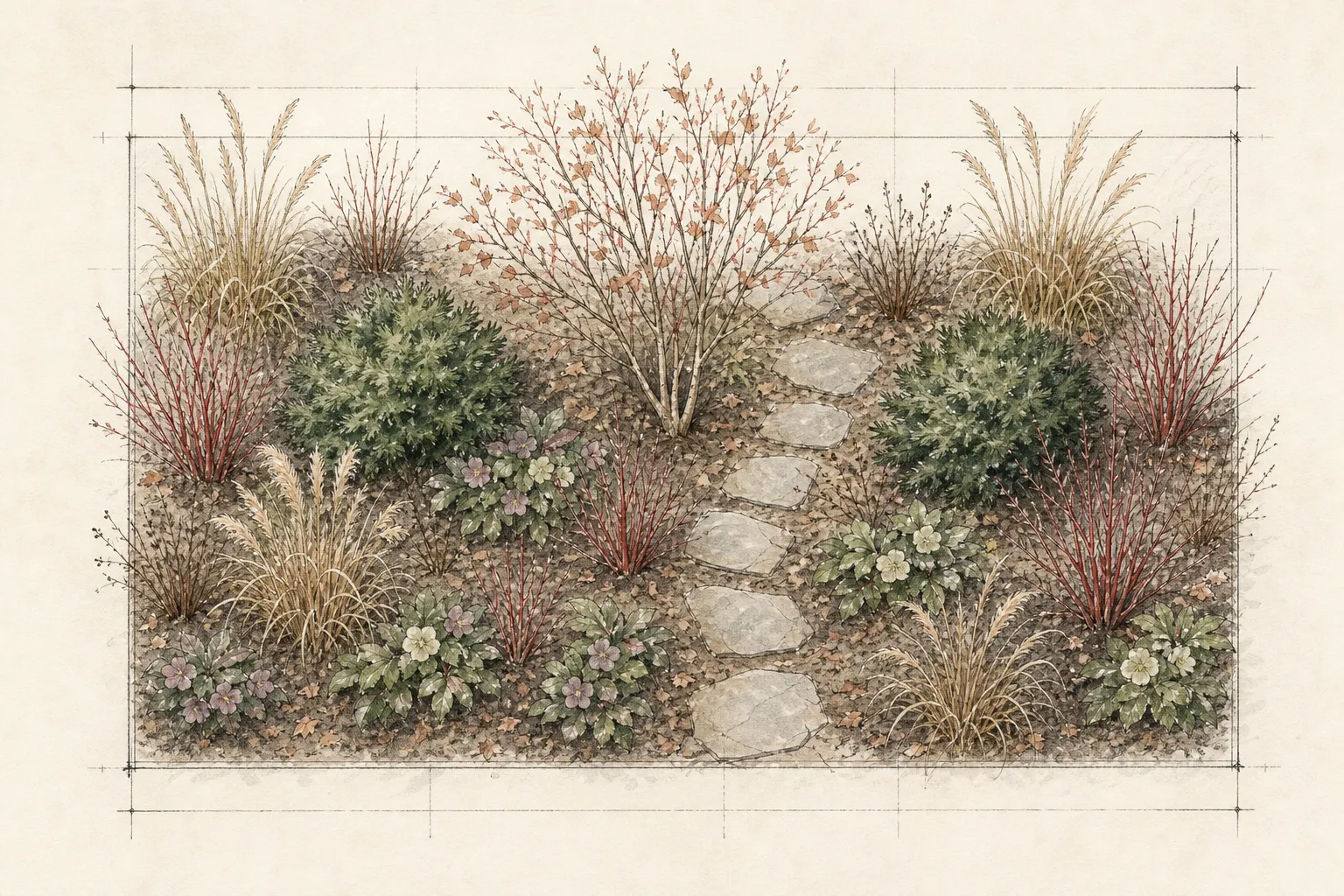
A worked plan for a cold-temperate Zone 5–7 garden uses a 20-by-10-foot border with full sun to light afternoon shade, moist but well-drained soil and an existing dark wall or evergreen background beyond the bed. It is not a plan for arid soil, standing winter water, coastal salt exposure or a jurisdiction where any named plant is restricted. Keep a 3-foot-clear path along the front and at least 18 inches between every mature shrub outline and the background or side boundary.
Place one Cornus sanguinea 'Midwinter Fire' toward the left rear, centered about 3 feet from the left end and 4.5 feet from the back. Oregon State University Extension gives it a mature 5–6-foot height and width, golden autumn foliage and vivid winter stems, with full sun and regular water. Place two Cornus sericea 'Neil Z' Pucker Up! plants through the middle, their centers about 8 and 12 feet from the left edge and 4.5 feet from the back; Morton Arboretum gives each an upright 3–4-foot height and width with red twigs. Set one Hydrangea quercifolia 'Pee Wee' toward the right front, centered about 17 feet from the left and 7 feet from the back. North Carolina Extension gives it a 3–4-foot height, 2.5–3-foot width, autumn color and exfoliating brown bark.
The plants keep distinct seasonal jobs. 'Midwinter Fire' supplies the largest winter color field and autumn gold; Pucker Up! repeats red at a lower scale while retaining summer foliage and wildlife value; 'Pee Wee' brings summer flowers, autumn leaves and mature peeling bark without another bright stem mass. Leave the remaining foreground as a simple crown-clear surface for the first establishment year, then add only a locally suitable low ground layer that shares the measured light and moisture.
Substitutions must preserve dimensions, water demand, stem or bark function and pruning response together. A yellow-twig dogwood such as Morton's 6–8-foot 'Budd's Yellow' needs more room than Pucker Up! and cannot be exchanged one-for-one in this plan. Replace 'Pee Wee' only with a compact shrub documented near 3–4 feet whose permanent bark remains ornamental without coppicing. Reject any substitute that requires a drier hydrozone, blocks the path at mature spread, suckers beyond the available control route or lacks current local legal and hardiness clearance.
Allocate roots, crowns, and working access
Set woody centers from their documented mature spreads, not from pot diameter. Keep branches clear of paving, gates, walls, drains and low lights at full summer volume. Preserve a route to every stool that will be renewed from the base. A worker should be able to identify and remove an old stem without standing on the hydrangea crown or cutting through a bulb group.
Protect existing grades and structural roots. Do not mound new soil over a tree flare or trench an irrigation line through established roots to complete the bark scheme. Oregon State's shrub-planting guidance keeps the top of the root ball level with the soil surface and the hole no deeper than the root ball. Apply the same grade discipline when setting this border and keep mulch away from trunks and crowns.
Group moisture-compatible plants. The worked plan assumes regular water in draining soil because 'Midwinter Fire', red-osier dogwood and 'Pee Wee' all need useful moisture. It must not borrow irrigation from a drought-adapted neighboring bed or send water toward a building. Probe the original root ball and surrounding soil separately during establishment, and correct runoff or saturation before changing the schedule.
Define where suckers may remain. Red-osier dogwood can form a thicket; draw the maximum colony line and keep its outer edge reachable with a spade or pruners. The line should stop before paving, neighboring crowns and dormant bulbs. If the design has no room to inspect or remove outward shoots, choose a less spreading documented cultivar rather than hiding the conflict behind edging.
Build a ground layer that reveals the stems
A useful ground layer connects the border without concealing its woody bases. Use one repeated low plant, marked spring bulbs, a measured organic mulch or compatible leaf litter. Match it to the real summer shade and soil moisture below each shrub. A groundcover that climbs through every stool will make renewal cuts slower and can hide cankers, suckers and a buried crown.
Place spring bulbs where deciduous branches admit light and where later digging will not cross the dogwood renewal zone. Mark the groups before summer foliage covers them. Keep bulbs away from the immediate base of 'Midwinter Fire' and Pucker Up!, where annual stem removal and sucker control occur. The open right foreground near 'Pee Wee' can carry a small bulb drift if its moisture and local hardiness are compatible.
Retain upright perennial and grass stems only where they remain sound and clear of the path. Remove matted, diseased or wind-thrown growth that obscures drainage or presses against colored stems. Winter persistence is a plant-by-plant judgment; one collapsed grass should not dictate cutting every lower layer, just as one decorative seed head should not block access to a damaged shrub.
Keep mulch shallow enough that trunks, root-ball tops and shrub crowns remain visible. Measure what is already present before adding more. A deep annual layer can hold moisture against exfoliating bark, conceal grade changes and make a young-stem display appear tidy while the plant base is declining.
Coordinate separate pruning calendars
Write one pruning line for every woody taxon. For the worked plan, Oregon State gives 'Midwinter Fire' two choices in early spring: hard pruning for maximum young-stem color, or removal of only half the stems to balance flowers with winter color. In a small border, begin with the half-stem approach after establishment; it preserves some older flowering wood and avoids converting the entire shrub into one annual surge.
Morton Arboretum recommends removing a few of the oldest red-osier dogwood stems to the ground each spring to retain bright red growth. Apply that selective renewal to Pucker Up! only after the shrubs are established and old dull stems are identifiable. Do not automatically cut every compact plant to a short stool; the cultivar's 3–4-foot habit and summer form are part of its role.
North Carolina Extension states that 'Pee Wee' blooms on old wood and should be pruned, if needed, immediately after flowering; winter-damaged stems can be removed in early spring. Keep it outside the dogwood renewal pass. Retain its mature exfoliating branches, remove only a defined defect or clearance conflict and accept that severe cold can reduce the next flower display.
Use clean sharp tools and trace dead, cankered, rubbing or badly placed wood before pursuing symmetry. Do not shear all three shrubs into matching mounds. Exterior clipping hides the branching and creates a dense shell, while selective basal or branch-union cuts preserve the distinct stem plane and bark texture. Label the plants so a general cleanup crew cannot apply one date and one cut to the whole border.
Audit the border across four seasons
Take fixed-view photographs after leaf fall, at spring emergence, at maximum summer volume and during autumn color. Compare the same boundaries: path clearance, visible crown bases, separation from the backdrop and the open intervals between stem groups. Record the age and color of retained dogwood stems, hydrangea dieback, sucker spread and any branch loaded into the path by snow.
In spring, check whether renewal produced vigorous replacement stems without erasing all flower and habitat value. In summer, check whether the documented widths still leave air and working access. In autumn, verify that each plant contributes before leaf fall rather than becoming an oversized green filler. In winter, judge the composition from the intended room or path, not only from a close photograph of bark.
Correct site problems before cosmetic symptoms. Weak shoots in saturated ground call for drainage assessment, while scorched foliage and dry root balls call for a moisture and exposure check. Fertilizer cannot correct a buried crown, incompatible hydrozone or missing sunlight. Replace an unsuitable taxon while it is movable rather than holding it indefinitely by severe pruning.
Edit as plants mature. Remove a secondary color group if two red masses have merged, enlarge a service gap before roots and crowns interlock, and leave a successful negative-space interval unfilled. The border is complete when its winter hierarchy, summer clearances and separate maintenance calendars remain understandable without an explanatory label.
Design ideas
- Style
- Layered ornamental bark and young-stem composition
- Space
- Small path-side, courtyard, or window-view border
- Climate
- Select taxa, renewal timing, and moisture strategy for the local climate. The design roles remain useful where individual example plants are not hardy, legal, or suited to the soil.
- 1One pale trunk
Use a single ornamental-bark tree only when its documented mature crown, roots and height fit beyond the shrub layer for the life of the planting. Set it off center against a dark background and keep lower branches visible from the main winter view. If the available bed cannot provide permanent clearance without repeated crown reduction, keep the compact shrub composition and let 'Pee Wee' supply bark texture instead.
- 2A red-stem middle group
Repeat two or three compact red-osier dogwoods at their full documented widths, with enough open ground to reach old stems at the base. Keep the group unequal to the larger focal shrub so it reads as rhythm rather than symmetry. Use selective spring renewal after establishment, and move the group out of dry reflected heat or a site where suckers cannot be inspected.
- 3A yellow-green echo
Introduce yellow stems as a smaller secondary field only where a suitably sized cultivar fits. Morton lists 'Budd's Yellow' at 6–8 feet high and 5–6 feet wide, so it needs substantially more room than Pucker Up! and belongs in a larger revision of the plan. Preserve moisture compatibility and a separate renewal record; color alone does not make it a compact substitute.
- 4Dark evergreen counterweight
Use an existing evergreen hedge, conifer or dark wall as background when it already has enough clearance and compatible moisture. Do not add a clipped evergreen merely to make red twigs photograph well. Its mature roots and shade can weaken the stem shrubs, and dense foliage can close the working strip. A painted fence or shadowed wall may provide the same value contrast without another competing crown.
- 5Fine grass transition
Place one locally suitable, non-running ornamental grass in a repeated foreground group only after checking mature flop, winter persistence, moisture and local invasive status. Keep every crown outside the dogwood pruning route and path edge. Retain winter stems while they remain upright, then cut at the species-appropriate spring stage before new shoots are damaged.
- 6Early bulb pockets
Plant a limited repeated bulb group in open spring light beyond the mapped sucker and renewal zones. Mark it permanently, allow its foliage to finish, and keep the planting depth and soil moisture appropriate to the exact bulb. Avoid scattering bulbs around every shrub base; concentrated pockets leave safer places to stand and make accidental digging during early-spring pruning less likely.
- 7Visible service gap
Preserve an 18–24-inch opening from the path or rear strip to each renewable shrub. Surface it with the same measured mulch as the rest of the bed so it reads as negative space rather than a missing plant. Keep labels, drains and irrigation checks inside reach. Remove volunteer seedlings before they turn the gap into another root and crown conflict.
- 8Quiet terminal edge
Taper the border beside a gate or path with one low repeated ground element and a clear sight line. Keep its mature foliage below the exfoliating branches of 'Pee Wee' and outside the path width. The edge should end the composition without another novelty shrub, and it should remain simple enough that fallen leaves, runoff and stem damage can be seen during winter inspection.
Plants in this guide
Related reading
Sources
- Landscape Design. NC State Extension Publications. Source record · Accessed 2026-08-30.
- Planning a Beautiful Garden Border. Royal Horticultural Society. Source record · Accessed 2026-08-30.
- How to Grow Winter Stem Colour Dogwoods. Royal Horticultural Society. Source record · Accessed 2026-08-30.
- Red-osier Dogwood. The Morton Arboretum. Source record · Accessed 2026-08-30.
- Add Fall Color to the Landscape with Vibrant, Easy-care Shrubs. Oregon State University Extension Service. Source record · Accessed 2026-08-30.
- Hydrangea quercifolia 'Pee Wee'. North Carolina Extension Gardener Plant Toolbox. Source record · Accessed 2026-08-30.