Gardens · pollinator border
Late-Summer Pollinator Border: Bloom Gaps and Repeated Drifts
Map the border's actual August-to-fall bloom gap, then compose regionally appropriate drifts that fit the site, mature scale, and maintenance route.
Published Last updated
In this guide
Find the weeks with too little bloom
Begin with the border's actual late-season record. Walk it at the same time each week and mark every plant carrying open flowers, excluding buds and decorative seed heads from the bloom count. Use one row per week from early August through the expected end of the local growing season. The resulting calendar shows when flowers are available in this particular border, not when a catalog predicts they might appear.
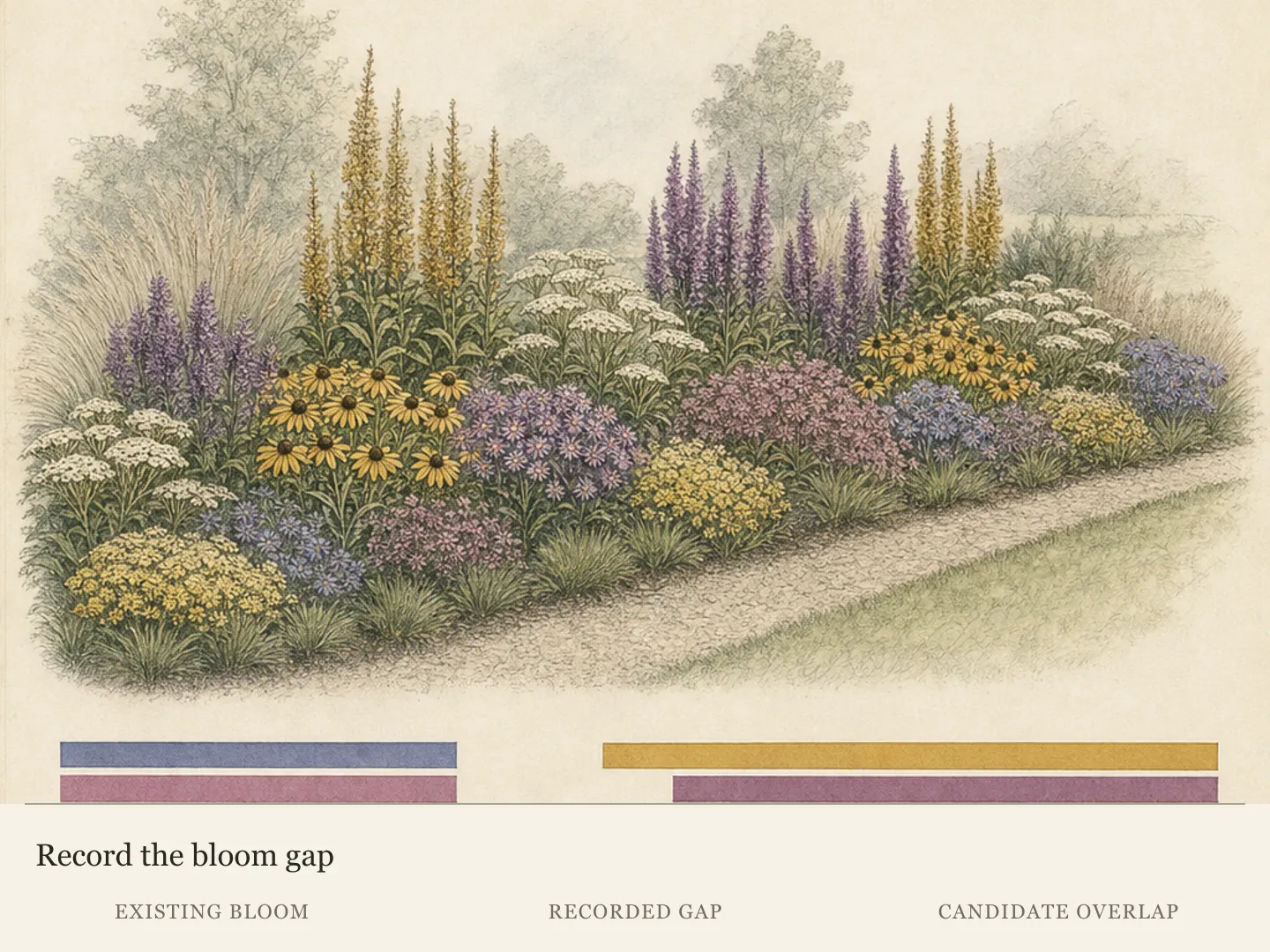
Photograph from the same viewpoint at each visit and identify plants on the calendar by a stable label. Repeated framing helps distinguish a real absence from a flowering plant hidden behind summer foliage. It also reveals whether one large mass dominates the view while smaller open flowers remain present. Keep the written record primary, because a photograph cannot confirm every flower concealed within the border.
Define the gap before naming a replacement. The border may have abundant midsummer bloom, an empty three-week interval, and a strong fall finish, or it may show scattered flowers without a useful overlap. Mark the first weak week, the last weak week, and which existing plants flower immediately before and after. Those boundaries determine what a candidate must contribute.
Record flower form as well as presence during each visit. Two weeks may contain the same number of flowering plant groups yet offer a different range of forms. This second observation helps identify whether the repair needs another period of bloom, another accessible structure among already flowering plants, or both. Keep the columns separate so a diversity question does not inflate the basic continuity record.
Preserve the periods that already work. A quiet August visit is not sufficient reason to rebuild spring, midsummer, and fall groups. The design task is to bridge the observed weak interval with overlap on both sides while retaining successful plants and site relationships. This protects the established structure from a shopping response to one disappointing moment.
Treat the first calendar as provisional. Weather, the site, and young plant development can shift flowering, so continue recording after any addition. Write actual first and last open-flower observations beside forecast dates without replacing the forecast. Over time, the difference shows how the plan behaves locally and whether the apparent gap persists across more than one observation.
Build a regional candidate ledger
Start with a pollinator-friendly plant list for the appropriate US region, then confirm native range and local suitability with a state native-plant resource or Extension office. Regional lists narrow the search and may include bloom time or habitat functions, but they are not exhaustive planting instructions. A plant on the list still has to fit the exact garden and the recorded interval.
Give each candidate one row. Record the source, expected bloom window, flower form, mature height and spread, light, soil, moisture, and any documented habitat function. Put the border's own conditions in the first row for comparison. Empty cells remain visible research gaps; they are not invitations to infer that an unrecorded requirement matches the site.
Add a column that states precisely which weak weeks the candidate is expected to cover. A general label such as late summer is too broad for a calendar showing a specific break. The candidate should begin before the existing earlier display ends or continue until the later display begins. Its place in the ledger depends on overlap, not merely on belonging to the correct season.
Separate regional nativeness from local site fit. A plant can be native to a broad region and still miss the border's sun, soil drainage, available moisture, wind, or space. Confirm both questions and keep the sources attached to the row. The regional list proposes candidates; the site filter decides whether a candidate can enter the composition.
Keep rejected rows in a separate part of the ledger with the reason they failed. A candidate excluded for moisture should not return later because its flower color suits the plan, and a plant too large for the route should not reappear as an impulse purchase. The rejection record preserves the logic of the design while allowing a candidate to be reconsidered if a genuinely different site position is evaluated with its own conditions.
Record functions only when the regional source documents them. A flower color does not establish pollen, nectar, host-plant, or nesting value. Keep this border's scope on late-summer bloom while acknowledging that flowers are only one part of pollinator habitat. Host plants, nesting resources, and broader stewardship remain adjacent decisions that a flower calendar does not complete.
Test the ledger with one regional example
Use a regional example to test the ledger method, not to publish a national recipe. Begin with the observed gap and the site's measured conditions, then ask which regional candidates cover the interval and fit the same root zone. A candidate that supplies a useful date but fails the moisture column is rejected before any visual arrangement begins.
For a sunny Pennsylvania border, one worked sequence might combine stiff goldenrod (Solidago rigida), which flowers from late summer into fall, with smooth or aromatic asters (Symphyotrichum laeve or S. oblongifolium) that continue into fall. Enter each as a separate row with its documented bloom, form, mature footprint, and site requirements. The overlap, not the familiarity of the names, is the point of the example.
Cardinal flower (Lobelia cardinalis) demonstrates the filter's value because it belongs to a different, moist-to-wet site. Its late bloom cannot compensate for a root-zone mismatch in the sunny, drier example. Retain it only for a genuinely suitable wet position that can be managed as another site condition; otherwise it leaves the candidate list.
Compare flower forms after site and timing have passed. A candidate may add a form absent from the border or a late-season function documented by the regional source. Enter that contribution beside the bloom window so it remains a stated reason for selection. Color can refine the composition later, but it does not substitute for documented function, regional fit, or overlap.
Carry the same method to another state by replacing the candidate rows, not by exporting the Pennsylvania names. Confirm native range, soil, light, moisture, mature size, bloom, and local behavior with appropriate resources. The ledger framework remains stable while the species change. This is the intended portability: repeat the questions and evidence fields, not the plant list.
Filter the ledger before composing the border
Remove plants that miss the site's actual sun, soil drainage, available moisture, or wind exposure, even when their bloom dates are ideal. Do this before comparing flower color or arranging drifts. A late flower that remains only through constant rescue watering is not filling the design brief for that place; it is evidence that the row failed the site test.
Draw every surviving candidate at documented mature height and spread over the existing border plan. Remove or relocate candidates that would cover the path, crowd established crowns, or shade lower sun-loving plants. The ledger supplies dimensions; the plan reveals whether those dimensions can coexist. Nursery size and empty spring soil are not reliable measures of late-summer space.
Check whether the candidate's expected bloom actually overlaps both sides of the gap. A plant that opens after the later group is already strong may still be useful, but it does not solve the recorded interval. Keep it out of this repair plan unless another documented job justifies its position without displacing the needed bridge.
Favor documented accessible flower structures and combine unlike forms among the plants that have already passed timing and site fit. Evaluate highly doubled or heavily modified flowers with reliable plant-specific evidence because modification can reduce or conceal pollen and nectar. This is a screening caution, not a universal judgment about every cultivar.
Mark uncertainty in the row that contains it. An approximate bloom window remains a forecast; an unverified mature spread remains a reason to pause placement. Do not average two incomplete candidates into one confident recommendation. Complete the missing local check, choose a better documented row, or leave the position open while the existing border continues to be observed.
Rank the remaining rows by the missing job they perform: opening the bridge, carrying it forward, adding a distinct accessible form, or reinforcing a documented function. A candidate can perform more than one job, but every place in the border should answer a specific gap. When several rows are equivalent, mature fit and maintenance access can decide which one enters the plan.
Compose overlap in repeated drifts
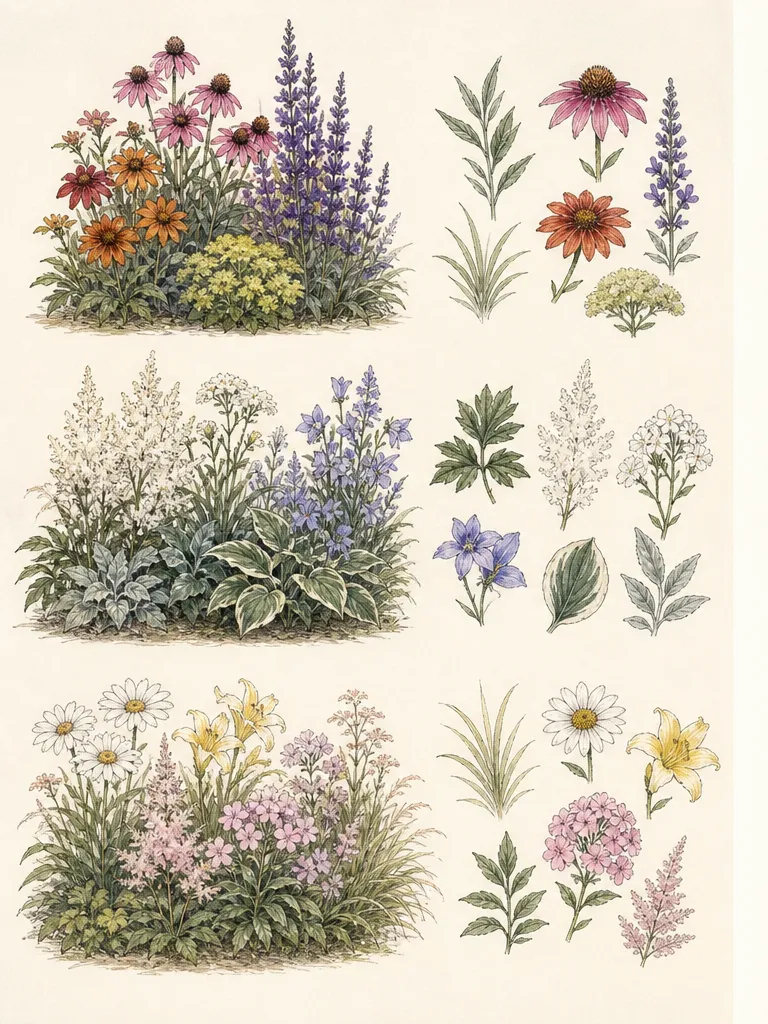
Draw each selected plant at mature spread, then group compatible footprints into repeated patches. Let one drift begin before the existing earlier flowers fade and another carry past it toward fall. The overlap addresses the calendar gap; repetition gives the border visual order and can make floral resources easier for pollinators to locate than isolated single plants.
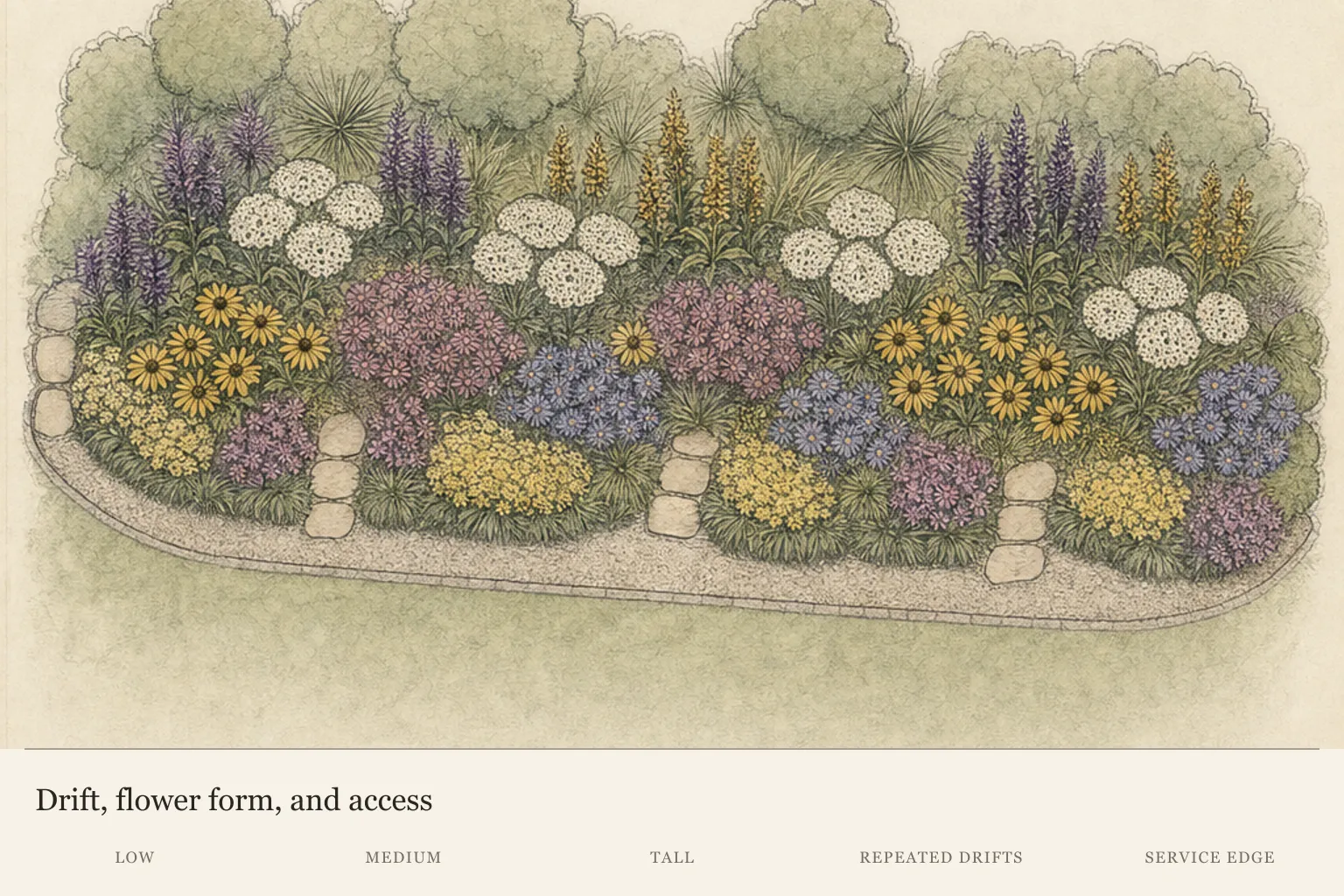
Choose drift size from the mature footprint and available border space, not from a universal plant count. A narrow border may support a repeated compact patch while a wider one can carry a broader mass. Keep each group large enough to read as a group without closing the route or forcing neighboring plants outside their documented space.
Vary flower form across the bridge while repeating at least one form or species in separated positions. The repeated element guides the eye through the border; the contrasting form broadens the floral structure represented. Keep the pattern subordinate to site fit and timing. A beautiful diagram still fails if one repeated plant occupies incompatible moisture pockets.
Use foliage, grasses, or other nonflowering structure to hold the composition between peaks, but record only open flowers in the bloom ledger. This distinction prevents seed heads or persistent leaves from disguising a resource gap. Structural plants can connect the visual sequence while the calendar continues to report the narrower question it was built to answer.
Place taller masses where they will not shade lower sun-loving plants and keep the public edge intentional with repeated lower forms or a clear line. Draw the mature elevation beside the plan. The combination reveals whether late-season height will hide an existing drift, block the viewing point, or narrow the service route when the border is at its fullest.
Test the composition against a shifted season by asking what happens if one forecast window begins later or ends sooner. Overlap on both sides gives the bridge some resilience without promising identical bloom every year. If the whole sequence depends on one precise handoff, add observation to the plan and retain a verified alternate candidate rather than crowding all options into the bed.
Keep a route for observation and care
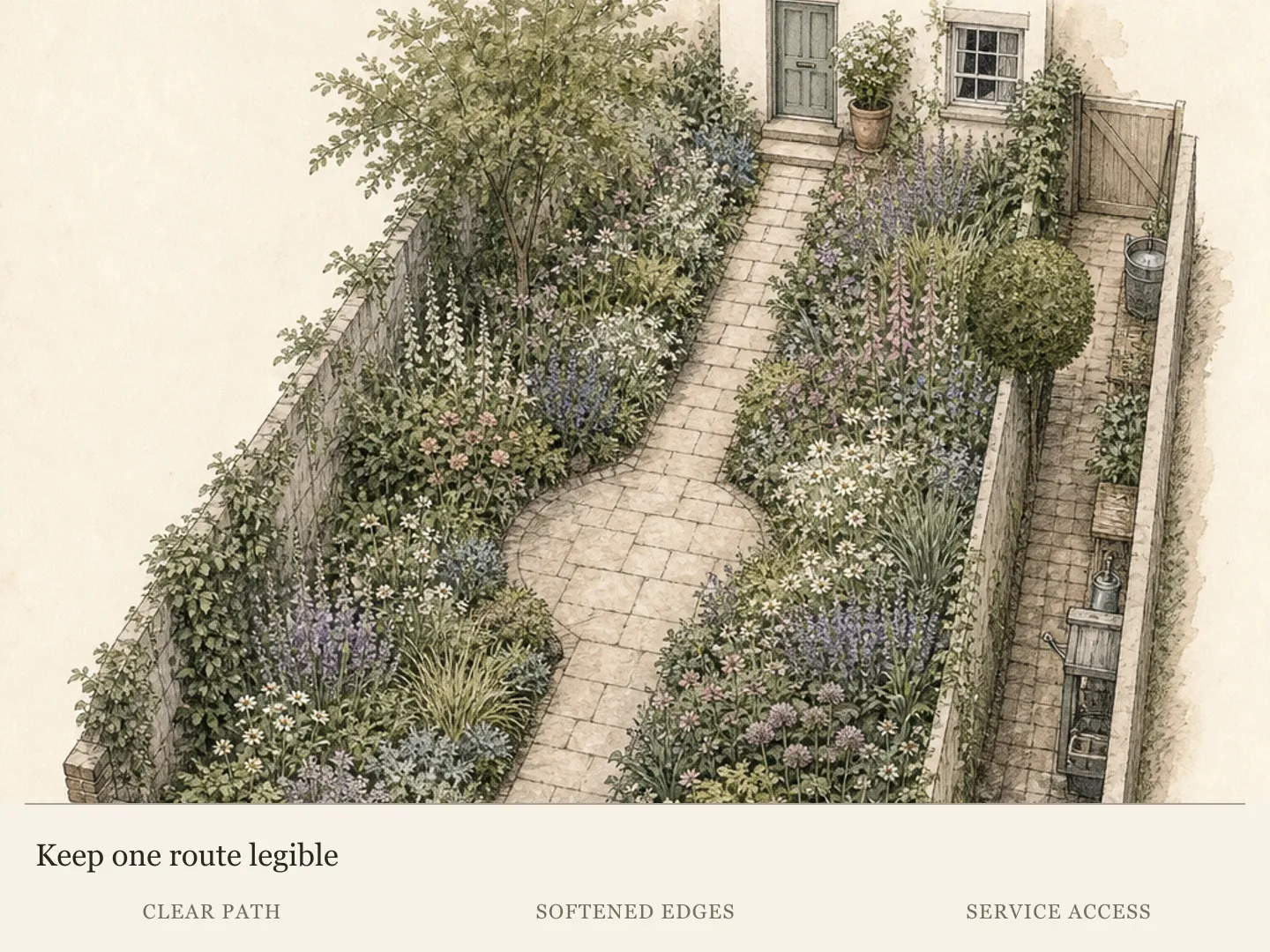
Leave stable stepping points or a narrow service edge where spent stems, weeds, labels, and plant bases can be reached without walking through the drifts. Draw the route with mature footprints in place. If a label can be read only by parting neighboring plants or a center patch requires standing on another crown, the maintenance plan is incomplete.
Keep the public edge intentional with repeated low forms or a clear material line, then place the working route behind or between selected groups. This lets the drifts read as coherent patches from the main view while preserving access for the weekly observations that made the design possible. Managed access also prevents repeated traffic through the planted root zone.
After planting, add actual first and last open-flower dates while retaining forecast dates as forecasts. Record the site position and season with each observation. Weather may shift the sequence, and young perennials may not show mature performance immediately, so one early discrepancy calls for continued attention before a whole drift is moved.
Use photographs to check visual mass and the written ledger to check bloom continuity. A border can look full because foliage and seed heads remain strong while few flowers are open. It can also look quiet from one viewpoint while a partly hidden drift is flowering. Both records together separate the design problem from the observation problem.
Inspect the mature route during the same weekly walk. Record any drift that covers a step, hides a label, or forces observation from inside another group. A plant may meet its bloom assignment and still fail the managed-border plan through scale or placement. Correct access with the smallest useful change, preserving successful timing and repeated groups wherever they remain compatible with the site.
Revise one gap at a time after enough observation. Move or replace the row that fails timing, site fit, mature scale, or access while preserving successful overlap elsewhere. Keep alternates in the candidate ledger rather than planting every possibility at once. The maintained border becomes more precise as local dates accumulate, without being represented as complete pollinator habitat by flowers alone.
Check a six-plant Pennsylvania flowering relay
Consider a sunny 18-by-8-foot Zone 6 Pennsylvania border with moist, well-drained soil. Use three Phlox paniculata and three Solidago rugosa as candidates for a summer-to-autumn relay, checking the exact local flowering interval before purchase. Allocate a 3-foot circle to each phlox and a 4-foot initial cell to each goldenrod; the goldenrod cells are managed colony boundaries, not a claim that rhizomes stop there.
From the front-left corner, put phlox at (3, 2), (9, 2) and (15, 2) feet, and goldenrod at (3, 6), (9, 6) and (15, 6). The two rows have 0.5 foot between the allocated circles, with open intervals along each row. The initial order is six plants. Keep access along both long edges, monitor goldenrod expansion and reduce its cells if they crowd the phlox. This is a regional candidate layout, not evidence of actual pollinator use or a guarantee of continuous bloom.
Design ideas
- Style
- Layered native border with repeated late-season drifts
- Space
- Managed home border with a visible edge and maintenance access
- Climate
- Region-specific US conditions verified for sun, soil, moisture, wind, and growing season
- 1Use an August-to-fall bridge
Pair one regionally appropriate native candidate that opens during the observed August gap with another whose documented window begins before the first finishes and continues toward fall. Draw both at mature spread over the actual border, confirm that each fits the same sun, soil, moisture, and wind conditions, and retain the existing plants that bloom on either side. Record forecast and actual dates separately after planting, along with the viewpoint and season used for each observation.
- 2Repeat one flower form in two drifts
Place one documented accessible flower form in separated groups along the border, then use a contrasting form between them after all candidates pass the site and timing filters. Draw each group at mature scale and leave the maintenance route open. The repeated form creates a visual and floral route without turning every position into one species, while the intervening form adds a distinct structure to the late-season sequence. Keep both forms recorded separately in the bloom ledger.
- 3Build a short-to-tall sequence
Use documented mature dimensions to place lower late bloom near the principal viewing edge, medium drifts through the center, and taller candidates where they will not shade sun-loving plants. Check the elevation from the path and from the weekly photograph position. Repeat one leaf or flower form across the layers so height changes do not fragment the bridge, and keep a service opening to every interior group. Recheck that opening when the tallest layer reaches full seasonal growth.
- 4Give one gap three candidate options
Keep a first choice and two regionally verified alternates in the ledger for the same dated gap. Compare their site fit, mature footprint, flower form, and documented bloom window before considering availability. Purchase only the row that passes the complete filter. If the first choice is unavailable, an alternate still has to cover the recorded interval; a convenient plant that misses the dates does not become a substitute. Leave unresolved fields visible until they are checked.
- 5Preserve a quiet service edge
Repeat a restrained lower form along the reachable side and leave discrete stable stepping points behind it. Align labels and observation positions with that route so interior drifts can be checked without walking through them. Keep the public line continuous where a step enters, using the repeated plant form to bridge the opening. The border retains a composed face while the bloom ledger and routine care remain physically possible. Mark every step on the mature planting plan.
- 6Review the forecast after establishment
Photograph from the same point and record open flowers weekly through the late-season interval. Keep forecast dates visible beside actual first and last bloom, and note the site and season for each record. Avoid moving a major drift because of one unusual week. Use the accumulated observations to decide whether a true gap remains, which candidate failed its assigned job, and whether the border plan or only the calendar needs revision. Retain successful rows unchanged during that edit.
Plants in this guide
Related reading
Sources
- Bring Back The Pollinators: Grow Pollinator-Friendly Flowers. Xerces Society. Source record · Accessed 2026-08-15.
- Pollinator-Friendly Native Plant Lists. Xerces Society. Source record · Accessed 2026-08-15.
- Planting Pollinator-Friendly Gardens. Penn State Extension. Source record · Accessed 2026-08-15.
- Pollinator Garden Tips. University of Illinois Extension. Source record · Accessed 2026-08-15.
- Planting for Pollinators. Penn State Extension. Source record · Accessed 2026-08-16.
- Phlox paniculata. NC State Extension. Source record · Accessed 2026-09-09.
- Wrinkleleaf Goldenrod cultivation profile. North Carolina Extension Gardener Plant Toolbox. Source record · Accessed 2026-09-09.