Grow · seed saving
Seed Saving for Open-Pollinated Flowers
Select a known healthy flower, capture its mature dry seed head in a labeled paper bag, clean one lot, and seal only fully dry seed.
Published Last updated
In this guide
- Decide what the seed can reasonably preserve
- Keep identity, maturity and dryness as separate checks
- Label the parent while the flower is still legible
- Harvest after maturity but before the plant disperses it
- Dry and clean one labeled lot at a time
- Seal only after the dryness check
- Keep storage separate from sowing instructions
- Steps
Decide what the seed can reasonably preserve
Start with a healthy plant whose name and variety are known. Open-pollinated seed is a better candidate than seed from an F1 hybrid when resemblance matters, because hybrid offspring may separate into unexpected colors, sizes, or habits. Even open-pollinated flowers can cross with compatible neighbors. Expect similarity where the record supports it, but never present saved seed as a vegetative clone.
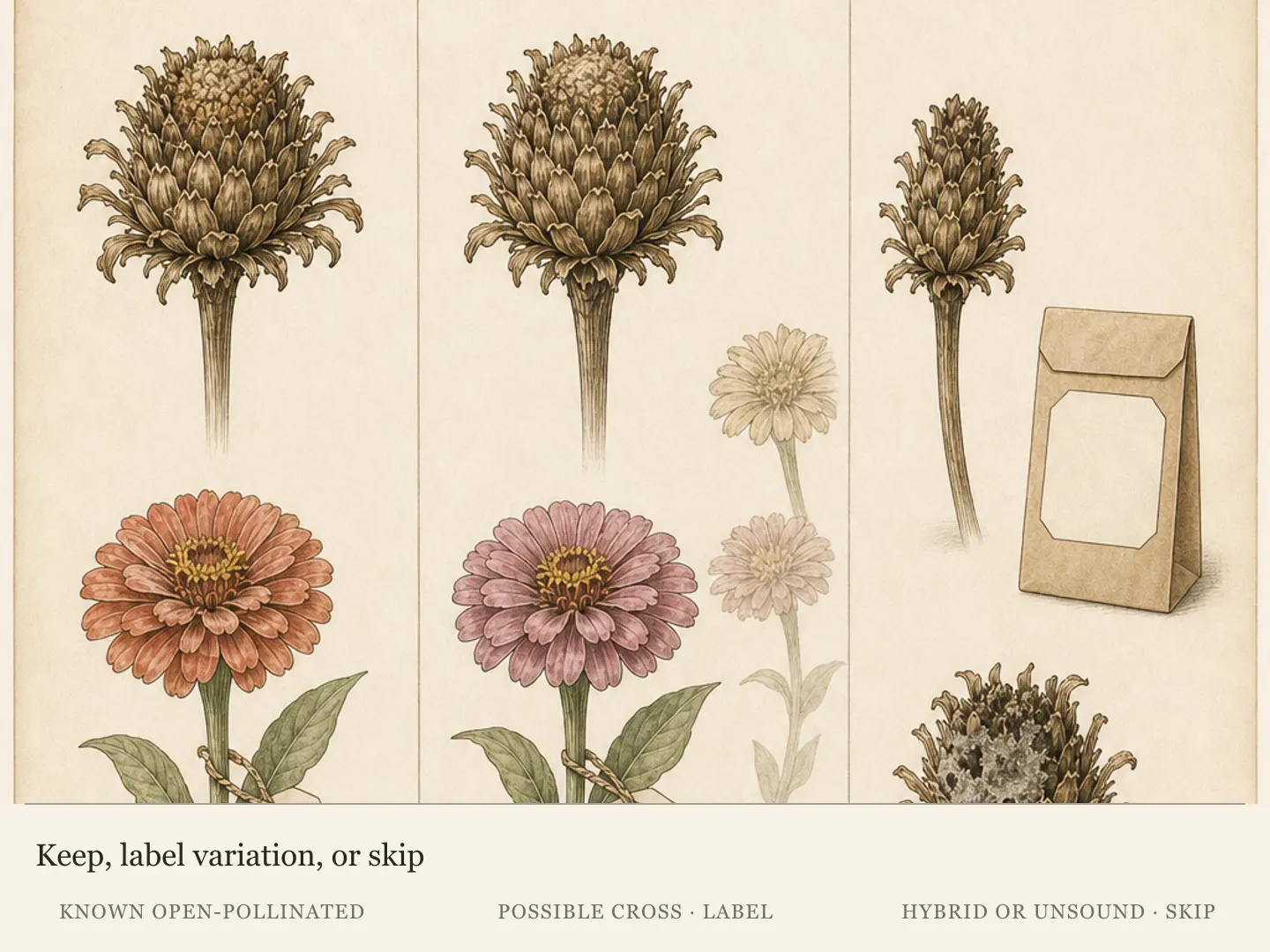
Decide what matters before choosing the parent. The aim may be to retain a flower color, form, habit, or simply a known open-pollinated line for another season. Write that selection reason on the field record. It gives next year's observation a clear comparison and prevents a generally attractive plant from being remembered as evidence for every trait its offspring might show.
Inspect the whole candidate plant, not only the seed head. Skip material from a visibly diseased, badly infested, weak, or off-type parent. A dry head can appear collectible while the parent fails the health and identity gate. Choose another healthy plant or leave the lot unsaved rather than carrying uncertainty into cleaning and storage.
Treat missing identity as a separate outcome. Seed from an unknown flower may be kept as an explicitly labeled experiment, but it cannot inherit a confident species or variety name that the garden record does not establish. The same applies when several tags could belong to the plant. An honest unknown lot remains usable for observation without becoming false provenance.
Keep possible crossing visible in the expectation. Nearby compatible flowers may have contributed pollen even when the selected parent is open-pollinated. That possibility does not make every lot worthless; it changes how the packet is described and how the offspring are judged. Save only when variation is acceptable, and label the uncertainty before the dry material becomes indistinguishable.
Keep identity, maturity and dryness as separate checks
Select a healthy, identified parent before collecting, then use that species' maturity cue for the seed head. Preserve any uncertainty about crossing in the label. Dry and clean each lot separately before the storage dryness check. A known collection date or an open-pollinated label does not prove that immature or damp seed is ready to seal.
Label the parent while the flower is still legible
Seed identity becomes harder to establish as the very traits used to recognize a flower disappear. Petals fall, neighboring heads turn the same brown and cut material loses its position in the bed. A useful record must therefore outlast the display. “Pink flower” is an observation, but it is not an identity when several plants could answer to it later in the season.
Treat the record as a chain linking one living parent to one stored lot. Botanical or reliable common name, any known variety, a distinguishing trait, bed position and date each answer a different future question. Uncertainty belongs in the chain too. Possible crossing or an unverified variety should remain visible rather than being upgraded to certainty when the packet is written.
Species knowledge adds the maturity context that a name alone cannot supply. Composite heads, pods, capsules and wind-dispersed structures advertise ripeness differently and differ in how quickly seed can be lost. Recording the expected structure and dispersal behavior explains why one marked flower may need close watching while another can remain on the plant longer.
Broken identity is a stop condition, not an invitation to infer. Seed color and dried head shape may be shared across multiple garden flowers, and the cleaning table no longer has the living plant as evidence. A missing or contradictory link should be resolved while the parent can still be checked; otherwise the final packet must preserve the uncertainty or the lot should not be represented as known.
Mark the plant before harvest and carry the same identity onto every collection container and storage packet. A useful record does more than describe the flower: it lets a future gardener understand what was selected, where it came from and which parts of the identity remain uncertain.
Harvest after maturity but before the plant disperses it
Seed harvest sits between two irreversible events: physiological maturity and natural dispersal. Drying after collection can remove residual moisture, but it cannot finish development in seed removed too early. Waiting beyond maturity creates the opposite loss as wind, gravity or a bursting pod separates seed from the recorded parent.
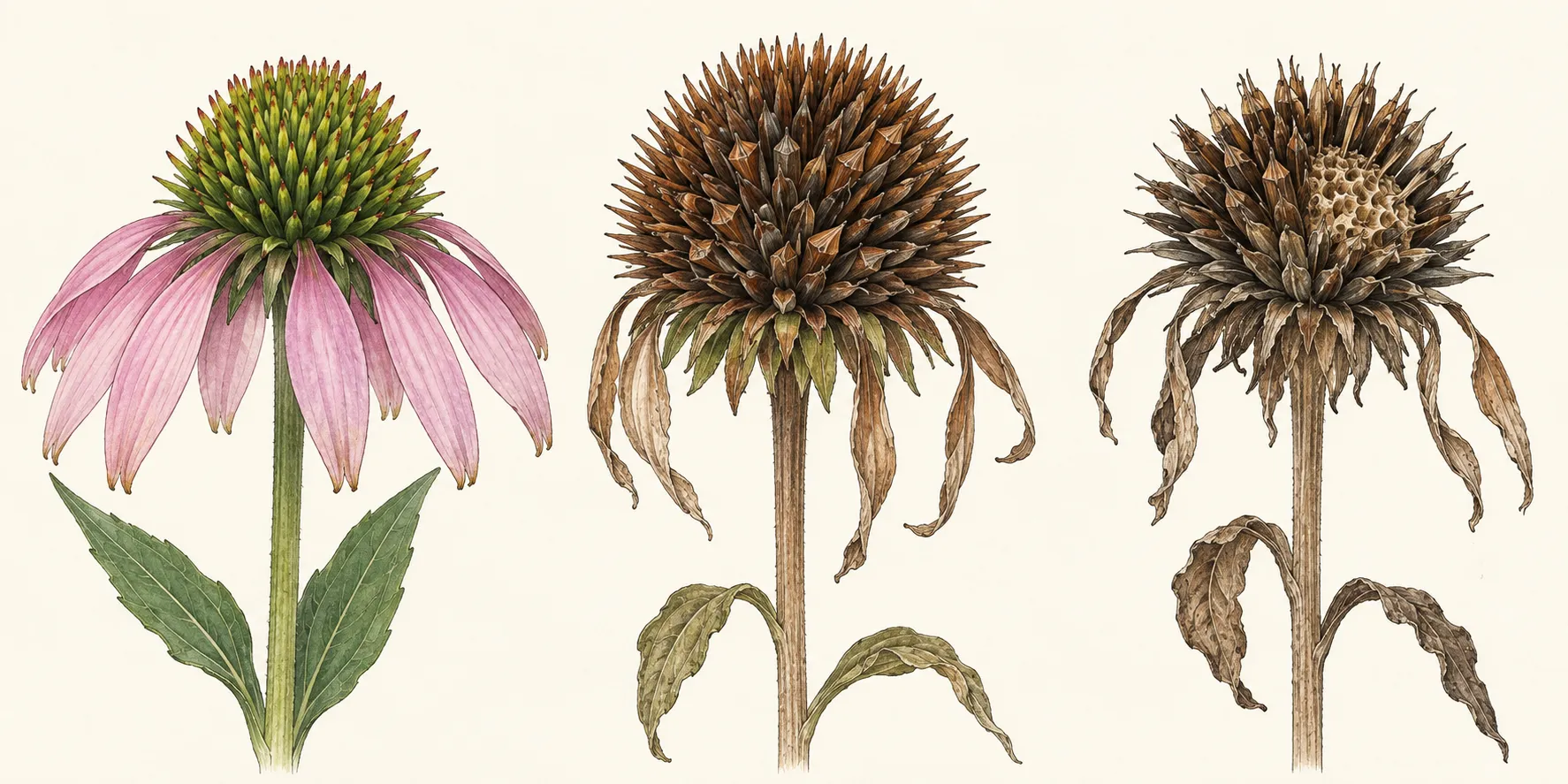
The visible maturity cue belongs to the species. Many dry-seeded flowers develop brown, shriveled heads or pods and a browning stem base, but a generic color rule cannot replace knowledge of the structure. Pale soft seed inside a green fleshy head means something different from hard seed held in a naturally pale capsule. The internal seed and the dispersal mechanism must agree with the external cue.
A plant does not mature every head at once. Exposure, flowering date and position can create several collection windows on one parent. One ripe structure therefore supports a decision about that structure, not a blanket judgment on neighboring heads. Selective harvest preserves immature material on the plant and keeps overripe structures from defining the whole lot.
Weather changes confidence without changing maturity. Rain or dew can make a mature head temporarily unsuitable for collection because surface water travels into the container with it. A dry interval makes both the seed structure and its condition easier to read. Moisture introduced at this point becomes a drying burden later; it is not evidence that the seed itself is unripe.
Dispersal speed determines how narrow the observation window becomes. A retaining pod permits more latitude than a head already releasing seed in ordinary wind. Species-specific bagging may reduce loss, but it does not repair an uncertain identity or make an immature seed ready. Time collection by balancing maturity, weather and the plant's release strategy.
Dry and clean one labeled lot at a time
Drying has two products: seed suitable for storage and plant debris brittle enough to separate from it. Time alone proves neither. A head that bends, feels cool-damp or contains soft tissue still carries moisture that can be hidden when a packet is closed. Crisp structure and freely moving material are more useful evidence than the number of days since collection.
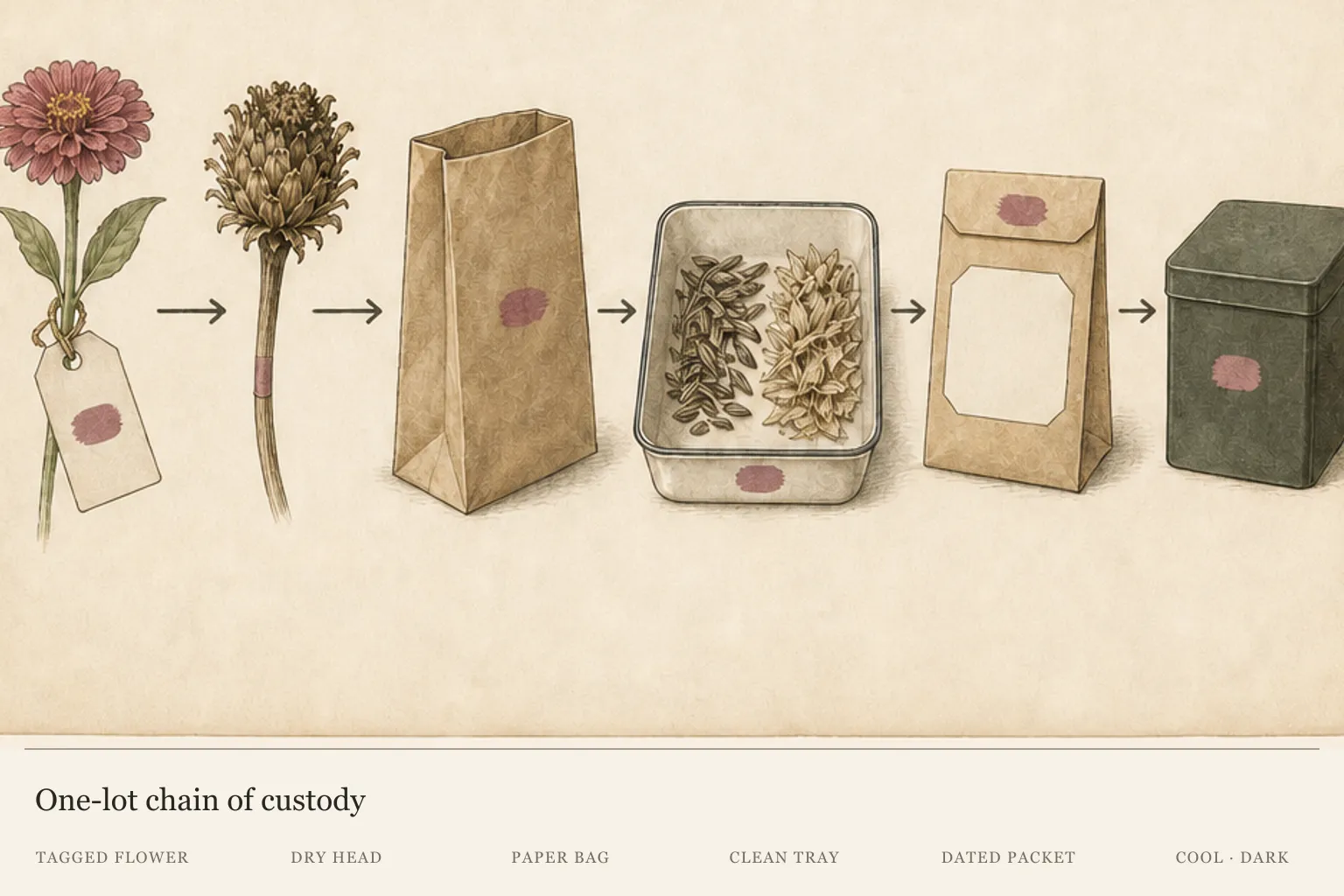
A paper bag suits this interval because it breathes while catching seed released from the head. Its role differs from a sealed storage container, which would retain the moisture the process is meant to lose. Air movement and protection from damp surroundings matter more than direct heat or sun, both of which can create an apparently dry exterior around material that is not ready to packet.
Cleaning is an assessment, not a cure. Removing husks, stems and fluff makes the seed easier to inspect and reduces bulky plant matter in storage, but it cannot make immature seed mature or restore tissue damaged by mold or insects. Soft, discolored or compromised pieces remain evidence that part of the lot is unsuitable.
Different flowers release seed by different mechanics, so the useful tray and screen arrangement follows the structure rather than a universal rubbing technique. The constant requirement is visibility: the working surface should make seed, chaff and damaged pieces distinguishable while keeping the linked identity with the lot.
Cross-lot contamination is both a physical and recordkeeping failure. A few seeds left on a tray can create a packet whose label names only one parent, making the record more confident than the contents justify. Handling one identity at a time and clearing the shared surface protects the provenance established in the garden.
Keep collected material in the breathable stage until both the seed and its surrounding structure are dry enough to evaluate. An unlabeled or mixed lot cannot advance merely because its contents look similar to the expected seed.
Seal only after the dryness check
Airtight storage preserves a dry condition; it does not create one. Residual moisture that might have escaped from paper becomes trapped after sealing and can support mold or rot. The transition to a closed container is therefore a change in risk, not merely a tidier way to organize packets.
Dryness evidence varies with seed size and structure. A larger hard seed can withstand a firmness check, while tiny seed is better judged by its expected appearance and free movement. Clumping, cool-damp feel or condensation during a brief closed trial contradict readiness. No calendar interval can overrule those physical signs.
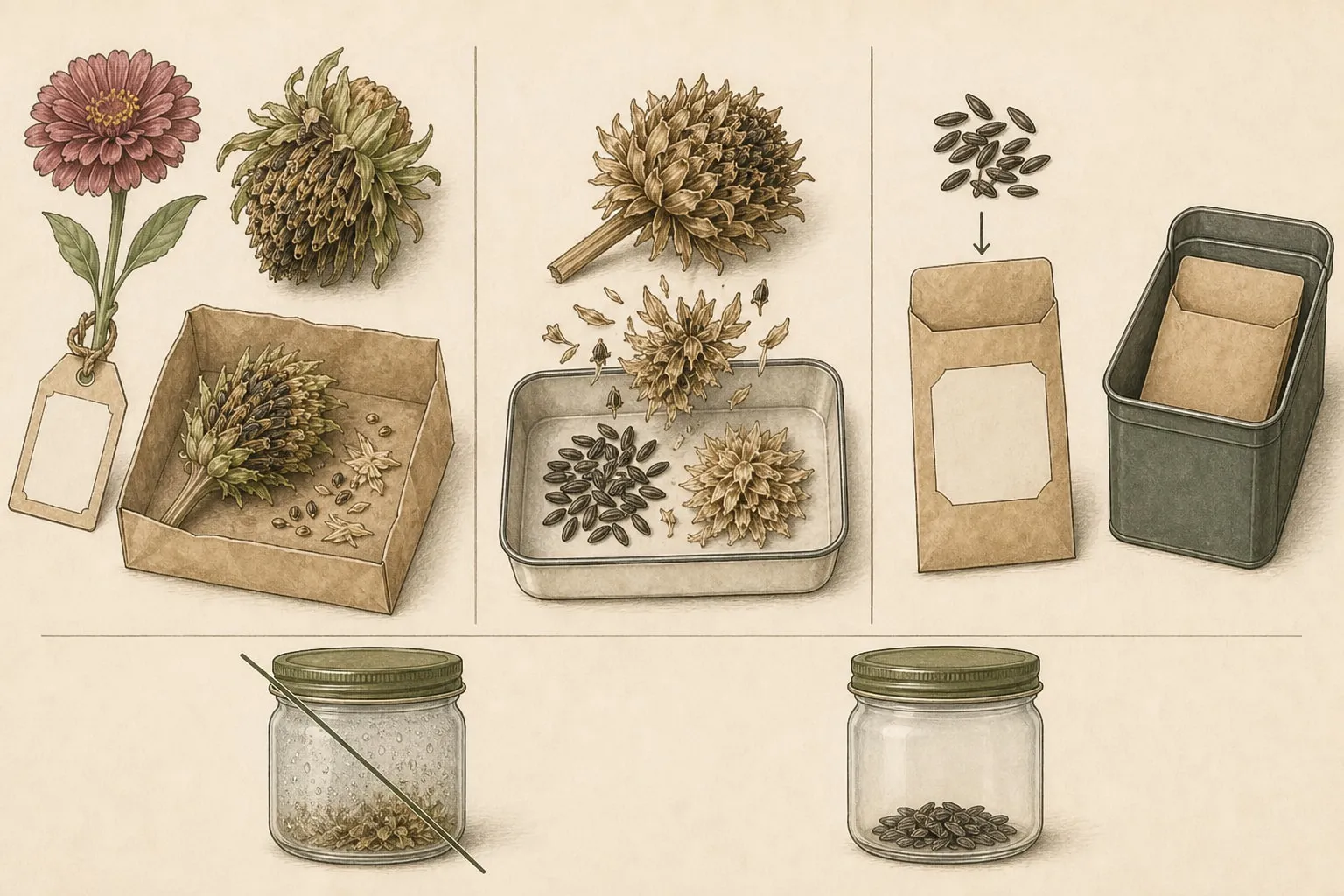
The packet is both a container and a record. It carries the parent identity, collection place and year, selected trait and any crossing uncertainty forward into storage. A clean packet must not silently improve an uncertain field record. Its wording should compress known provenance, not invent confidence after the living plant is gone.
Cool, dry and dark conditions address different causes of decline, but species still differ in longevity. A universal shelf-life promise would be less useful than an honest collection year and sound storage history. Those records let a future sowing decision account for age without pretending that every flower seed remains viable for the same period.
Condensation, unusual odor, mold or insect activity after sealing show that a lot or its environment failed the storage boundary. Isolate the problem from sound packets so one compromised lot does not contaminate the collection. Seal a lot only when it is dry and its identity record remains intact.
Keep storage separate from sowing instructions
The stored packet is not a germination recipe. Some flower seeds need a cold period, moisture treatment, light exposure, or another species-specific condition before they sprout. Research the sowing requirement for each named lot when planting time approaches. Applying one treatment to the whole collection ignores the differences that were carefully preserved during harvest and storage.
Keep treatment notes separate from the collection record. Species-specific sowing guidance may change what happens next, but it does not alter the parent, location, date, or crossing uncertainty already printed on the packet. This separation preserves provenance even when a future gardener tests more than one germination method.
Expect some variation and record it when seedlings flower. Compare color, form, and habit with the selected parent note without assuming that every difference has one cause. A likely cross, hybrid segregation, a mislabeled lot, and ordinary variation do not justify rewriting the original record after the fact.
Use the offspring observation to refine the next selection cycle. A lot that produced useful variation may be saved again under an accurate description; a result that failed the original aim may lead to a different parent or stricter isolation decision. The evidence belongs to the following season, while this packet's identity remains anchored to the plant and year from which it came.
Preserve the one-lot chain through sowing: one parent record, one bag, one cleaning session, one packet, and one planting label. If seed is shared among several sowing tests, copy the source packet identity to each group. The chain makes later flowers interpretable without promising that open-pollinated seed will reproduce a clone.
Steps
- Level
- easy
- Time
- Several short checks, plus indoor drying time
- Tools
- Clean snips, Light-colored tray, Fine screen if useful, Permanent marker
- Materials
- Weather-resistant parent tag, Paper bags, Paper seed packets, Clean airtight storage container
- 1Run the keep-or-skip gate
Choose a healthy, correctly identified open-pollinated parent with a stated trait worth observing again. Skip visibly diseased, badly infested, weak, or off-type plants. Skip hybrid seed when unexpected variation would defeat the purpose. If identity is uncertain but an experiment is still useful, label the future lot as unknown from the start and make no variety claim. Write the selection reason beside the parent identity before moving on.
- 2Mark the selected parent
Attach a loose weather-resistant tag below the chosen flower while it is still recognizable. Record the botanical or reliable common name, variety if known, selected color or form, garden location, and date. Note possible crossing when relevant. Copy the same identity to a paper collection bag and seed packet, resolving any conflict while the living parent can still be checked. Confirm that the field tag remains visible and attached as petals fade.
- 3Confirm the species' maturity cue
Identify whether the seed matures in a head, pod, or capsule and learn how that structure releases it. Record the species-specific sign of maturity and inspect more often as dispersal approaches. Wait for the appropriate dry, brown, brittle, darkened, or freely releasing stage. Leave material that remains green, fleshy, pale, or soft unless reliable species guidance says it is mature. Prepare earlier bagging or closer checks for structures that release seed quickly.
- 4Cut into one labeled paper bag
Harvest on a dry day after surface moisture has gone. Hold the correctly labeled paper bag beneath the selected head before cutting with clean snips, then lower the material directly inside with its parent record. Keep one identified lot per bag and leave unripe neighboring structures on the plant. Keep the bag open in a dry ventilated place after collection. If the head or bag is damp, delay sealing and restore air movement immediately.
- 5Finish drying, then clean the lot
Keep the open paper bag in a dry, ventilated indoor place away from direct sun. Turn the material until the head and released seed are thoroughly dry and crisp. Open one lot over a clean light-colored tray, separate seed from petals, husks, stems, and fluff, and discard soft, moldy, discolored, or insect-damaged pieces. Packet the clean seed and clear the surface before opening another bag. Continue drying if the head bends or the seed still clumps.
- 6Label, seal, and inspect storage
Keep cleaned seed in its named paper packet until the appropriate dryness check passes. Mark species, variety or unknown cross, location, and collection year. Place fully dry packets in a clean airtight container and store it cool, dry, and dark. Inspect early for condensation, odor, mold, or insects; discard a compromised lot separately and recheck the remaining storage condition. Reopen and continue drying any sound lot that still shows moisture. Keep every packet closed and separate while another lot is inspected, and record the date and result of the storage check.
Related reading
Sources
- Cherish favorite flowers and challenge your green thumb with seed-saving. University of Illinois Extension. Source record · Accessed 2026-08-15.
- Seed Saving Basics. Penn State Extension. Source record · Accessed 2026-08-15.
- Saving vegetable seeds. University of Minnesota Extension. Source record · Accessed 2026-08-15.
- Creating Sustainable School and Home Gardens: Creative Ways to Store Seeds. Utah State University Extension. Source record · Accessed 2026-08-15.