Gardens · blue white shade border design
Design a Blue-and-White Shade Border With Foliage as Its Structure
Build a luminous shade border from repeated leaf masses, silver and blue-green tones, white edges and a measured sequence of locally suitable flowers.
Published Last updated
In this guide
- Begin with atmosphere, not a shopping list
- Map shade as changing light
- Test soil moisture beneath the canopy
- Build a three-scale foliage framework
- Use blue as a repeated undertone
- Distribute white without creating glare
- Shape masses before placing individual plants
- Zone plants by water need, not color
- Write a four-season sequence, including absence
- Install the border in readable phases
- Edit for clarity as the border matures
- Adapt the palette without losing the design
- Measure a five-plant blue-and-white shade group
- Design ideas
Begin with atmosphere, not a shopping list
A blue-and-white border in shade works through reflected light and controlled repetition. Blue in this setting is usually blue-green or glaucous foliage, silver leaf surfaces and measured blue flowers rather than a continuous strip of true blue. White appears as leaf margins, pale centers, flower intervals and occasional light-catching objects. The palette can feel cool and spacious, but only when plant masses are legible instead of scattered as one of everything.
Foliage must do the long-season work. A white flower may last days or weeks; a well-sited variegated leaf can hold its value from spring expansion until autumn decline. Broad hosta leaves establish calm weight, silver leaves bridge blue and white, and fine arching blades prevent the composition from becoming a row of rounded mounds. Flowers then mark time within an already coherent structure instead of rescuing an empty plan.
Define the intended mood in one sentence before choosing plants. It might be a moonlit woodland edge, a cool formal ribbon or a soft cottage passage. That phrase controls density, repetition and hardscape. It also prevents the palette from becoming a rule that ignores place. A healthy regionally suitable green substitute belongs in the border more than a fashionable blue plant struggling in the wrong heat or soil.
Map shade as changing light
University of Minnesota guidance treats shade as a site condition to observe, not a single label. Record where direct sun reaches the bed in spring, midsummer and after deciduous leaves fall. Gentle morning light differs from hot afternoon exposure, and the bright edge beneath a high canopy differs from the deep zone behind an evergreen wall. Photograph the border at several hours so memory does not flatten these differences.
Mark reflected light from pale paving, walls and windows. A shaded strip beside masonry may be visually bright while its soil is dry from a roof overhang and warmed by stored heat. Conversely, a dim low corner can remain wet after rain. Light and water must be mapped on separate layers. The blue-white idea is an aesthetic overlay, not evidence that every cool-looking position has cool moist soil.
Keep the map through one full growing cycle before committing rare or expensive plants. Deciduous trees create a bright spring phase followed by summer shade; spring flowers and emerging foliage can use that interval. If immediate planting is necessary, start with a limited framework and leave expansion zones. A measured trial reveals whether blue wax, white margins and silver leaves remain attractive under the site's actual light.
Test soil moisture beneath the canopy
Shade does not guarantee moisture. Tree roots compete throughout the upper soil, foliage intercepts light rain and walls create dry shadows. Probe after a normal rain at the front, center and back of the bed. Mark places that dry quickly, hold even moisture or remain saturated. Repeat during a warm spell. These zones will determine plant placement more reliably than a generalized shade symbol on a nursery tag.
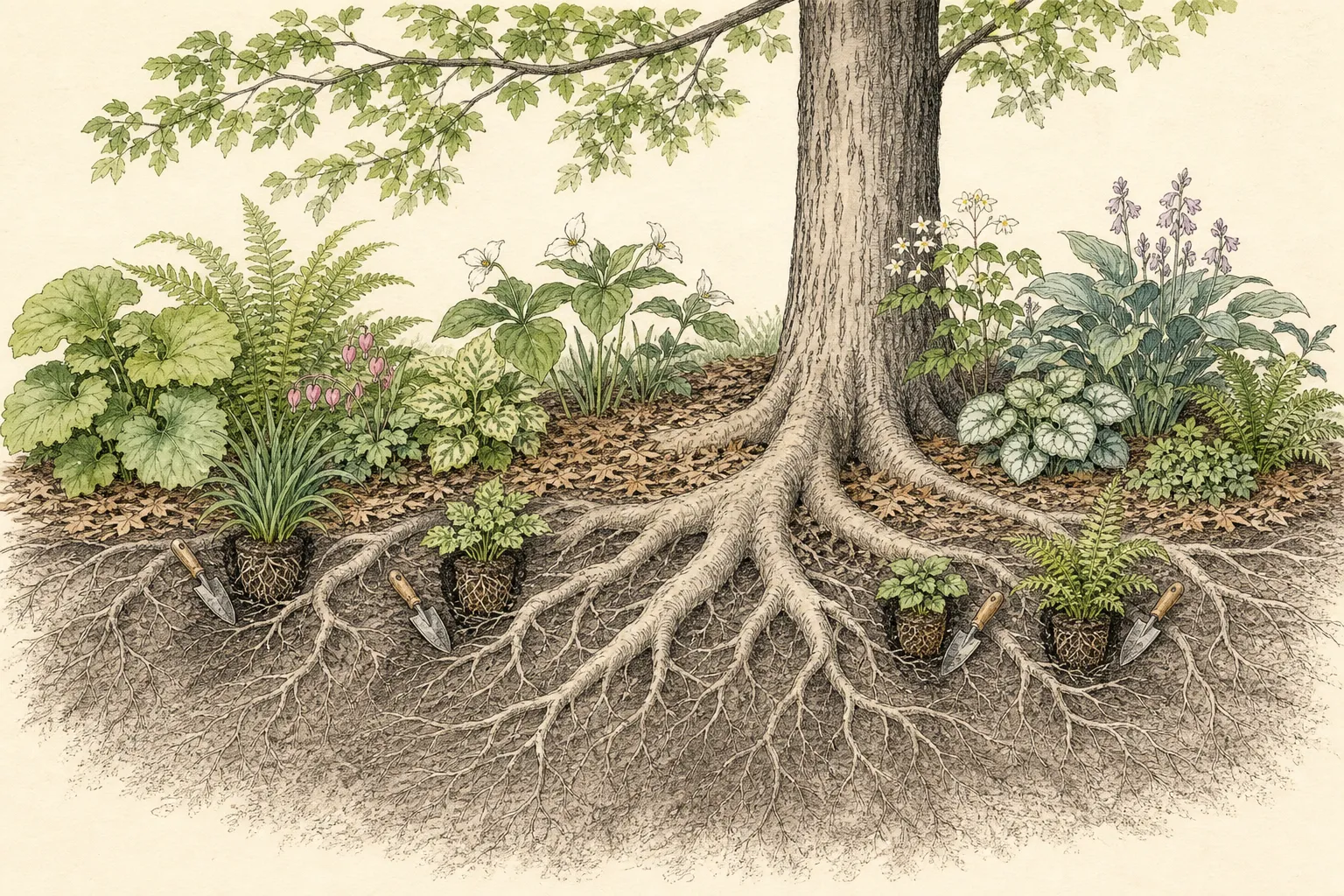
Preserve established tree roots. Do not excavate a continuous deep trench, raise soil over trunks or cut structural roots to install a perennial design. Work in available pockets and use smaller plants where roots are dense. If the entire site is extremely root-filled and dry, adapt the palette to dry-shade plants or use containers placed without burying roots rather than insisting on moisture-loving blue and white selections.
Improve surface conditions gradually with organic matter and a conservative mulch where locally appropriate, keeping crowns and trunks visible. Irrigation can support establishment, but a permanent high-water planting under a thirsty canopy may be an unsound match. The site map should show what the garden can sustain, including water restrictions and drainage limits, before the border's color rhythm is finalized.
Build a three-scale foliage framework
Start with broad anchors. Blue-leaved hosta cultivars can supply substantial rounded masses, while white-edged or cream-centered hostas carry the light note. University of Minnesota explains that the blue color comes from a waxy leaf coating and that hosta cultivars vary widely in size and foliage. Use named selections, protect blue leaves from conditions that compromise their appearance, and space by documented mature spread rather than pot diameter.
Add a medium bridge with leaves that read as silver, pewter or softly variegated. Brunnera macrophylla selections can combine heart-shaped silvered foliage with small blue spring flowers in cool, suitably moist shade. NC State cautions that this species does not perform well in the hot, humid Southeast, so it is a regional option, not a national prescription. In unsuitable climates, choose a locally recommended shade perennial with equivalent leaf scale and color job.
Finish with fine texture. University of Minnesota lists shade-tolerant ornamental grasses and grasslike plants, including Japanese forest grass, that can move among heavier foliage. Choose a regionally hardy selection and match its moisture needs. Fine leaves should weave between anchor masses in repeated drifts, not form a separate unrelated stripe. The contrast of broad, medium and fine foliage keeps a limited palette visually active.
Use blue as a repeated undertone
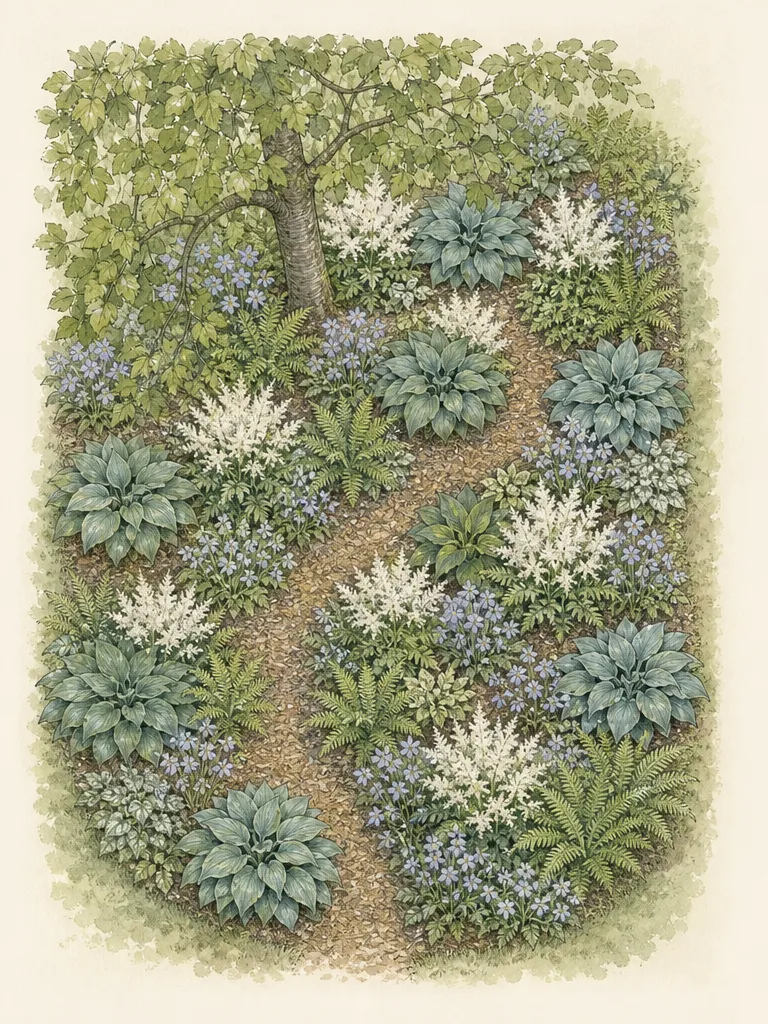
Blue foliage is most convincing when repeated at intervals that the eye can connect. Place an anchor near the entry, echo it around the middle and repeat the note toward the destination. The plants need not be identical, but their blue-green value and scale should relate. A single isolated blue mound reads as a specimen; three or more considered echoes create a border language.
Observe blue leaves at the hour the border is most often used. Some glaucous surfaces appear strongest in open luminous shade and duller in deep green darkness. White adjacency can sharpen the blue, while too many yellow-green leaves may pull the scheme toward another palette. Photograph in overcast and evening light, because those conditions often reveal whether the intended cool continuity is present.
Do not clean or rub waxy blue leaves simply to intensify them. Handle plants carefully during installation and place them away from hose dragging, path traffic and abrasive neighbors. If a named blue selection repeatedly turns greenish or scorches in the assigned position, change the site or use a different plant. The palette should follow healthy tissue, not cosmetic maintenance.
Distribute white without creating glare
White is strongest when it has several forms. Use a broad white-edged leaf near a dark background, a finer cream stripe in the middle layer and a limited group of white flowers at a seasonal focal point. Repeating only identical white blooms can leave long blank intervals. Repeating foliage markings keeps the light rhythm present while flowers come and go.
Keep variegation in masses large enough to read. Many tiny white-flecked plants scattered through the bed can appear restless, especially beside patterned paving. Group two or three compatible plants or allow one mature clump to form the unit, depending on its eventual spread. Separate highly variegated masses with plain blue-green or deep green foliage so the eye has a place to rest.
Pure white is not mandatory. Cream, silver and pale green can mediate between bright white and blue-green. If a chosen white-flowering cultivar requires sun, drainage or moisture the site cannot provide, replace it with a suitable pale foliage effect rather than forcing bloom. The visual job is luminosity; the specific plant remains accountable to climate, soil and available care.
Shape masses before placing individual plants
Draw the border as a set of overlapping mature footprints. Place the largest blue-green anchors first, ensuring they will not cover paths, tree flares or smaller crowns. Add medium silver bridges so no anchor is stranded. Thread fine texture through the gaps, then reserve modest windows for seasonal flowers. This order prevents flower color from consuming the space needed by permanent leaf structure.
Use broad curves and asymmetrical repetition rather than equal dots. One anchor near the front can be answered by a larger mass deeper in the bed. Let some groups disappear behind others and return, which creates depth in a narrow shaded strip. Maintain a clear edge or path so the softness of the planting has a visual boundary. A cool palette becomes more persuasive when its outline is deliberate.
Check every footprint against the label's mature width and local growth. Hostas range from miniature to very large; the generic name cannot set spacing. Brunnera and grasslike companions also differ by cultivar and climate. Leave access for watering and division without creating permanent bare rings. Temporary annual accents or movable pots can occupy first-year gaps without being mistaken for mature spacing.
Zone plants by water need, not color
Place moisture-dependent selections in the naturally even zone or where irrigation can reach them efficiently. Put more drought-tolerant shade plants under the competitive outer canopy and in roof shadows. Do not alternate plants with opposite water needs merely because their leaf colors make a pleasing checkerboard. Such a pattern forces one irrigation setting to overwater one plant while leaving its neighbor short.
Repeat color across zones with different plants performing the same design job. A blue-green broad leaf in the moist middle may be echoed by a tougher matte green-blue form toward the dry edge. A white flower in one zone can be answered by a cream margin in another. This job-based approach keeps the palette continuous while allowing the horticulture to change with the site.
Make the boundaries visible on the planting plan and keep labels after installation. During the first season, probe each zone rather than watering the whole bed by appearance. Adjust emitters to root areas and let the soil surface drain. If one zone remains chronically wet or dry despite correction, revise its plant list before losses turn a design mismatch into a recurring maintenance routine.
Write a four-season sequence, including absence
In spring, take advantage of brighter light beneath deciduous trees. Blue brunnera flowers can accompany expanding silver foliage where the climate suits the plant, while emerging hosta eyes begin the broad-leaf framework. Locally suitable white spring flowers can mark the border's rhythm, but their fading foliage must have space to mature naturally or be covered later by expanding companions without being prematurely removed.
Summer belongs to foliage. Blue-green hosta mounds, white margins, silver bridges and fine arching texture should make a complete composition even between flower events. Add only a few white or blue bloom groups that tolerate the mapped light and water. In autumn, let leaf color and retained seed structures modify the palette rather than chasing an exact blue-white purity after the season naturally shifts.
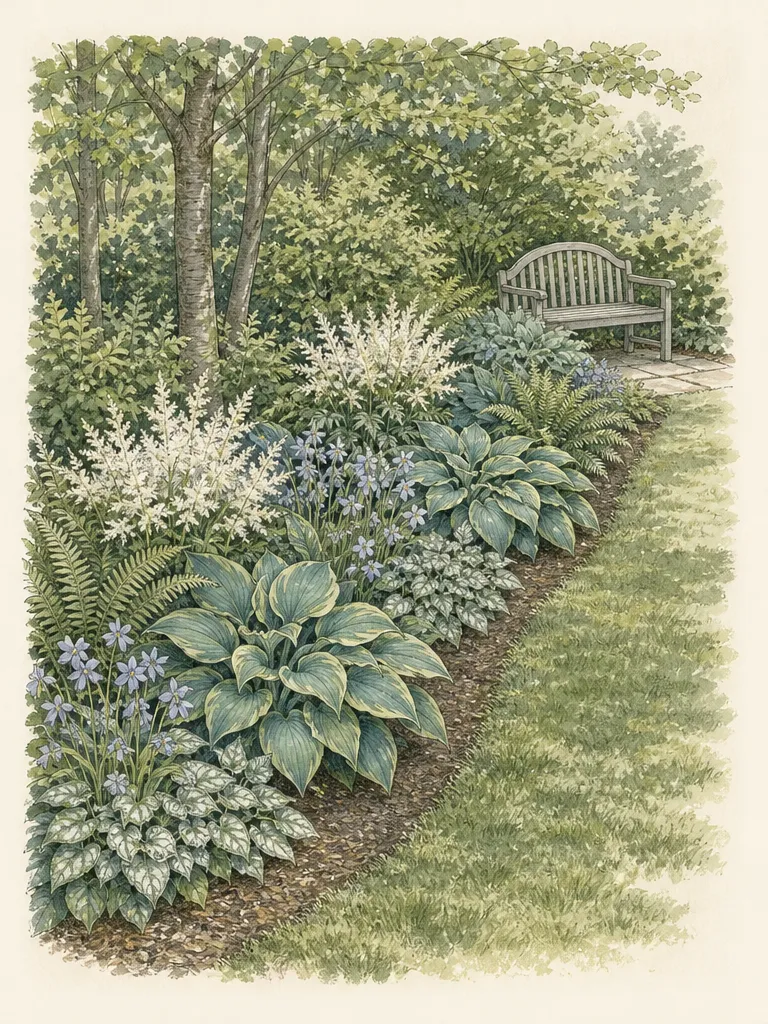
Winter exposes the plan's omissions. Most hostas and brunneras are herbaceous and leave the stage, so record where bare ground will appear. Tree trunks, evergreen plants suitable to the region, stones, a bench or the line of the path can carry structure without burying dormant crowns. A truthful four-season plan designs the empty interval; it does not describe dormant perennials as year-round masses.
Install the border in readable phases
Lay out pots on the surface and view them from the path, window and sitting place. Keep species together in their intended mature groups while checking the repeated blue and white notes. Move whole masses, not individual pots, when the rhythm feels uneven. Confirm that each plant's crown will sit at the correct grade and that digging avoids major roots and underground services.
Plant the framework first: anchors, bridges and fine-textured drifts. Water each root ball and surrounding soil into contact, then label the cultivar and map its position. Add seasonal flowering accents only after the foliage geometry is clear. This phased order makes it possible to stop before the bed becomes overfilled and preserves room for mature spread.
Mulch conservatively, keeping material away from crowns, trunks and fine emerging shoots. During establishment, water according to the separate moisture zones rather than one automatic schedule. Photograph the bed monthly from fixed viewpoints. The images reveal where white disappears, blue masses fail to connect or one leaf scale dominates more objectively than close-up inspection.
Edit for clarity as the border matures
Remove damaged leaves selectively and allow healthy foliage to complete its season. Do not shear hostas into matching domes or cut variegated leaves in half to preserve a boundary. If an anchor exceeds its space, divide or relocate it in an appropriate season, guided by cultivar needs. Repeated mutilation is evidence that the mature footprint was not honored.
Watch for reversions or shoots whose foliage no longer matches a stable variegated cultivar. Obtain plant-specific guidance before removing them at the crown. Also track whether silver and blue effects hold under changing canopy density. Pruning a tree for garden light is specialized work and may affect tree health; adapt understory plants or consult a qualified arborist rather than making large canopy cuts for palette maintenance.
Each year, remove one weak visual idea before adding another. Consolidate scattered white plants into a readable mass, repeat a successful fine texture, or replace a failing cool-climate plant with a regional equivalent. Keep the original site map and annotate changes. The mature border should become simpler and more assured as evidence accumulates, not more crowded with attempted fixes.
Adapt the palette without losing the design
In hot, humid regions, use NC State's warning about Brunnera macrophylla as a clear boundary and seek local extension recommendations for an equivalent silver or pale-leaved shade perennial. In cold regions, confirm hardiness and snow or freeze-thaw exposure for every selection. In mild-winter climates, verify that deciduous plants receive suitable seasonal cues and choose locally proven substitutes when they do not.
Dry shade may require fewer lush broad leaves and more durable fine or matte foliage, while consistently moist shade can support a fuller layered effect. Deep shade may reduce flowering and variegation vigor, making leaf silhouette and hardscape more important. A small courtyard can express the same scheme in three large containers if drainage, watering and winter protection are realistically managed.
Preserve the hierarchy through every substitution: broad anchor, medium bridge, fine thread, repeated blue undertone and controlled white light. When a locally appropriate plant performs the same visual and spatial job, the design remains intact. Botanical fidelity to site is what gives a limited palette longevity; color matching alone cannot turn an unsuitable plant into a sustainable border.
Measure a five-plant blue-and-white shade group
For a cool-night northern Pennsylvania Zone 6 site, test a 12-by-10-foot bed with partial shade and moist, well-drained soil. Use two Hosta plantaginea for broad green leaves and white flowers, and three Brunnera macrophylla for the blue spring flower layer. This is a proposed composition with seasonal blue and white, not a promise that both species flower together or that the hosta has blue foliage. NC State gives the brunnera a spread up to 2.5 feet; allow a 3-foot planning circle around each, and reserve 4 feet for each hosta.
Take the front-left corner as zero and measure feet across and back. Put hostas at (3, 7) and (9, 7), and brunneras at (2, 2), (6, 2), and (10, 2). The hostas have 2 feet between their mature planning circles; the brunneras have 1 foot between theirs. Keep access along the front and rear edges so neither hosta has to be crossed to reach the other. Buy five plants, leaving the intervening space open while the crowns expand.
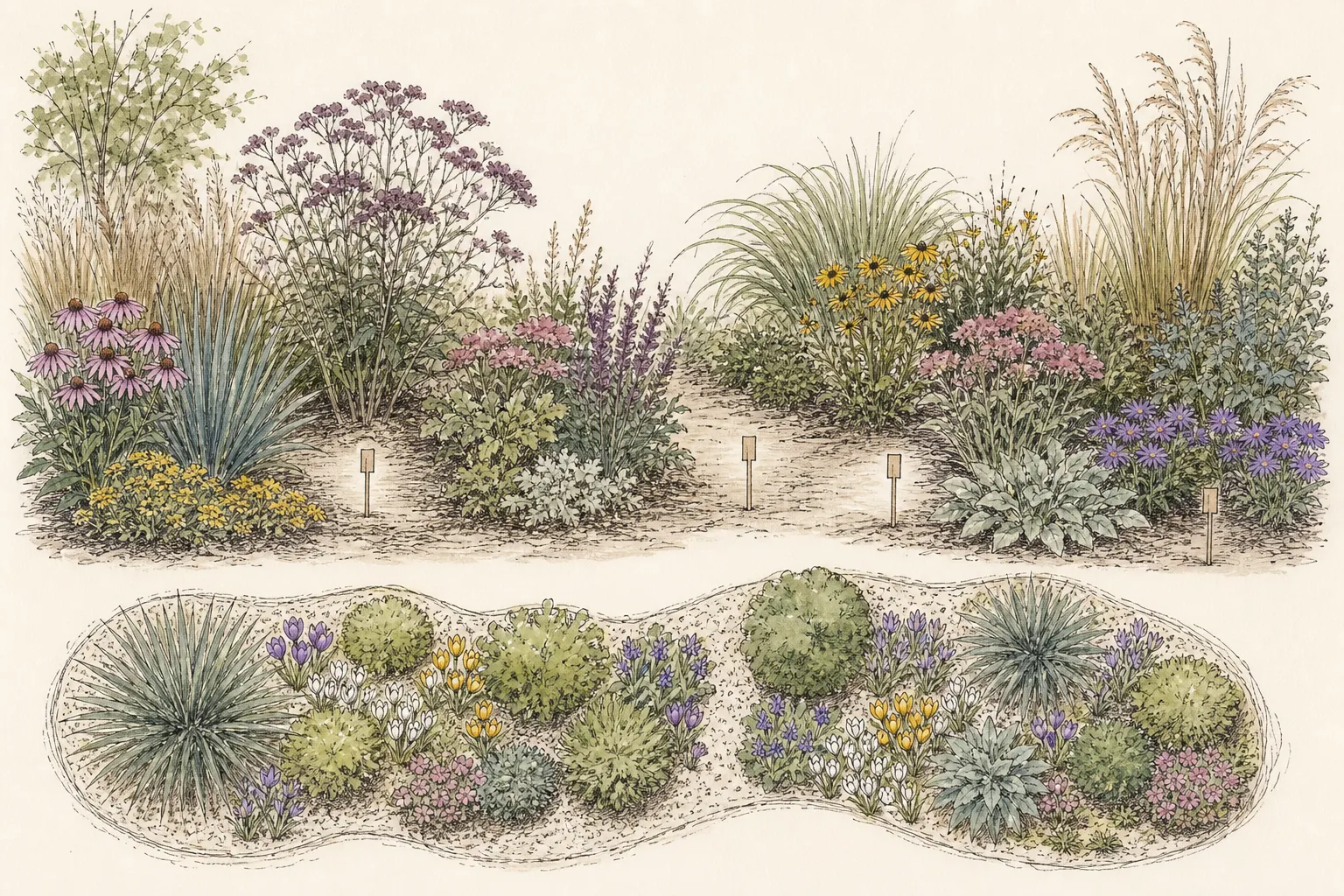
Reject this palette for dry tree-root competition or hot, humid southeastern conditions: NC State specifically excludes brunnera from that climate. Retain the measured broad-leaf and spring-flower roles when selecting a locally supported substitute, then recalculate its circles. Existing illustrations explain the foliage relationships; these coordinates are a separate planting example, not their drawing scale.
Design ideas
- Style
- Luminous blue-and-white woodland border structured by foliage
- Space
- Shaded residential border beside a path, wall or deciduous canopy
- Climate
- Adapt the scheme to local hardiness, summer heat, humidity and the site's measured shade and moisture. Blue-leaved and variegated hostas vary by cultivar and need label-based spacing. Brunnera macrophylla is a cool-shade option and NC State specifically limits its usefulness in the hot, humid Southeast. Japanese forest grass and other fine-textured shade plants also require regional hardiness and moisture checks. Under established trees, protect structural roots and favor planting pockets rather than deep continuous excavation.
- 1Repeat three broad blue-green anchors
Place named blue-leaved hosta cultivars near the entrance, middle and destination so the eye can connect them. Vary group size rather than spacing them as equal dots, and honor each cultivar's mature width. Keep the waxy leaves away from hot exposure, abrasive traffic and hose dragging so the blue undertone remains a living surface, not a color swatch.
- 2Bridge blue and white with silver leaves
Use a medium-scale silver or pewter leaf between broad anchors and finer companions. Brunnera can perform this job in cool, suitably moist shade and adds small blue spring flowers, but it is not a hot-humid-region default. Where it is unsuitable, select a locally recommended shade perennial with comparable scale, restrained color and non-aggressive behavior.
- 3Thread one fine texture through the masses
Repeat a shade-tolerant grass or grasslike plant in loose arcs that pass between hostas and silver foliage. Japanese forest grass is one documented option where climate and moisture fit. Use one principal fine-textured selection rather than many unrelated grasses, and preserve its arching form instead of clipping it into rigid tufts during the growing season.
- 4Make white foliage the dependable light source
Position white-edged or cream-centered leaves where they can be seen against dark green or shadow. Repeat them in two or three substantial masses and separate highly patterned plants with plain foliage. This supplies light after white flowers fade and prevents the scheme from depending on a continuous bloom sequence that the site's shade may not support.
- 5Reserve flowers for seasonal punctuation
Assign a few locally suitable blue and white flower groups to spring, summer and autumn windows only after the foliage plan is complete. Keep each group large enough to read from the main viewpoint. Replace any flower whose sun or water requirements conflict with the site; a pale leaf or container can perform the light job more honestly.
- 6Echo the palette in a simple path edge
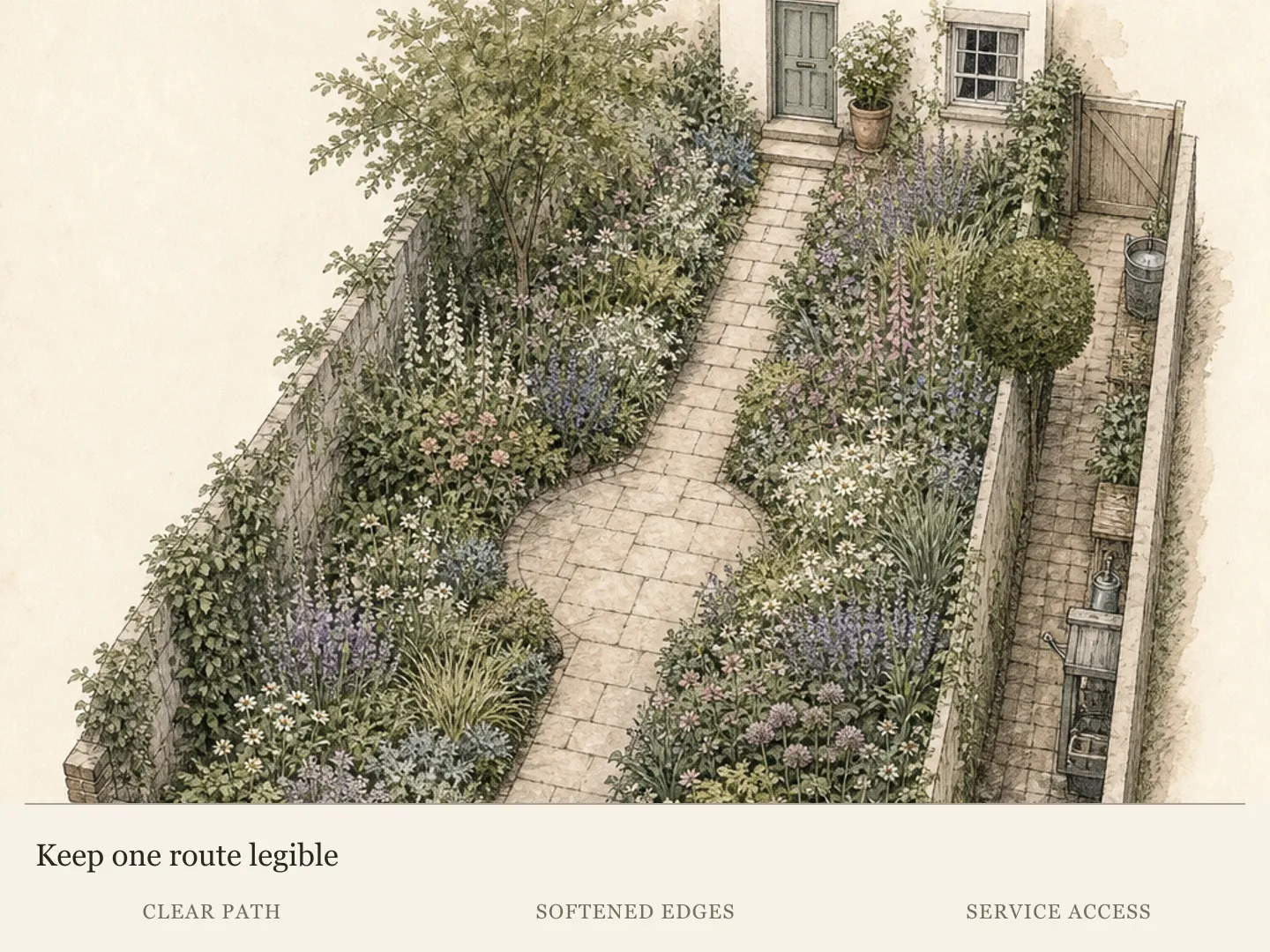
Use a restrained material such as gray stone, weathered timber or a crisp cut lawn line to frame the cool planting. Avoid a busy mosaic that competes with variegation. The path should reveal broad curves, provide maintenance access and remain outside mature leaf spreads, allowing soft foliage to approach the boundary without being repeatedly stepped on or trimmed.
- 7Create a dry-zone version under outer roots
At the canopy's competitive edge, repeat blue-green and pale tones with locally recommended dry-shade plants rather than extending moisture-loving selections. Keep the same broad-medium-fine hierarchy even if the species change. A visible shift in plant material is acceptable when the color rhythm continues and the irrigation plan no longer asks opposite water needs to share one setting.
- 8Hold the winter gap with quiet structure
Place one bench, stone grouping, evergreen mass suited to the region or view of pale bark where dormant hostas will leave space. Keep it subordinate to the living border and avoid covering dormant crowns with decorative fill. The winter element should make absence feel intentional while allowing spring shoots, labels and maintenance access to remain visible.
Plants in this guide
Related reading
Sources
- Gardening in the Shade. University of Minnesota Extension. Source record · Accessed 2026-08-19.
- Growing Hostas in Minnesota. University of Minnesota Extension. Source record · Accessed 2026-08-19.
- Ornamental Grasses for Shady Sites. University of Minnesota Extension. Source record · Accessed 2026-08-19.
- Brunnera macrophylla. NC State Extension. Source record · Accessed 2026-08-19.
- Blue and White Foliage Planting Combination. Royal Horticultural Society. Source record · Accessed 2026-08-19.
- Fragrant Plantain-lily: Hosta plantaginea. NC State Extension. Source record · Accessed 2026-09-09.