Grow · bigleaf hydrangea winter flower bud protection
Preserve Bigleaf Hydrangea Flower Buds Through Winter
Identify the bud-bearing old stems of bigleaf hydrangea, stop late pruning, choose protection by cultivar and climate, and use a leaf-filled mesh cylinder without breaking the buds it is meant to save.
Published Last updated
In this guide
- Confirm that the shrub is bigleaf hydrangea
- Find the flowers before they look like flowers
- Match the protection effort to cultivar and climate
- Stop cutting before winter protection begins
- Build a leaf-filled cylinder around intact stems
- Maintain the protection as weather changes
- Remove the cage when buds begin to expand
- Judge the result across the whole bloom cycle
- Steps
Confirm that the shrub is bigleaf hydrangea
Winter protection begins with identity. Bigleaf hydrangea, Hydrangea macrophylla, includes familiar mophead and lacecap forms, but not every shrub sold as a hydrangea carries next year's flowers on the same wood. Smooth and panicle hydrangeas flower on current-season growth and follow different pruning and protection logic. University of New Hampshire makes species identification the prerequisite to pruning because a gardener can remove flowering potential with an otherwise tidy cut. Preserve the label, photograph leaves and flowers in season, and confirm the botanical name before building a cage around an unknown dormant shrub.
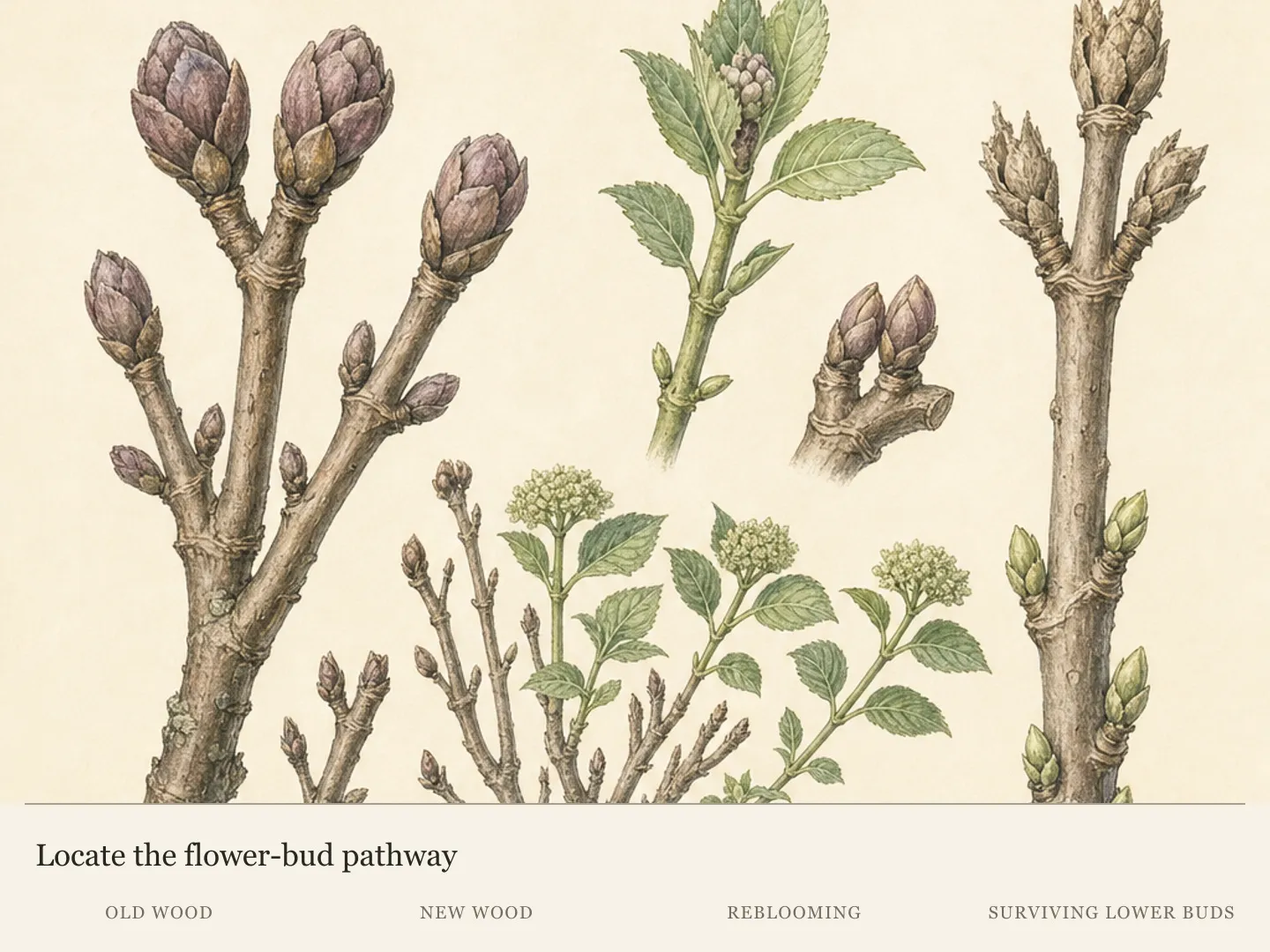
Then identify the cultivar's flowering habit. Virginia Tech explains that traditional bigleaf cultivars set buds in the year before bloom, while remontant or reblooming cultivars can flower on old wood and also make flowers on current-season shoots. Reblooming capacity is insurance, not a reason to sacrifice old stems. Where old buds survive, they can supply an earlier or fuller first display; new-wood bloom may follow later. Record whether the plant has flowered from retained stems, new basal growth, or both, because the cultivar label and the garden's own history refine the winter plan.
Separate bud preservation from every cause of poor bloom. University of Georgia lists winter injury, excessive shade, excess nitrogen, and pruning at the wrong time among reasons a bigleaf hydrangea may fail to flower. A leaf-filled cylinder addresses cold and drying exposure around existing buds. It does not create buds that late pruning already removed, brighten a deeply shaded site, or correct overfertilization. If the plant has been leafy and flowerless for years, inventory all four factors before treating winter protection as the sole diagnosis.
Find the flowers before they look like flowers
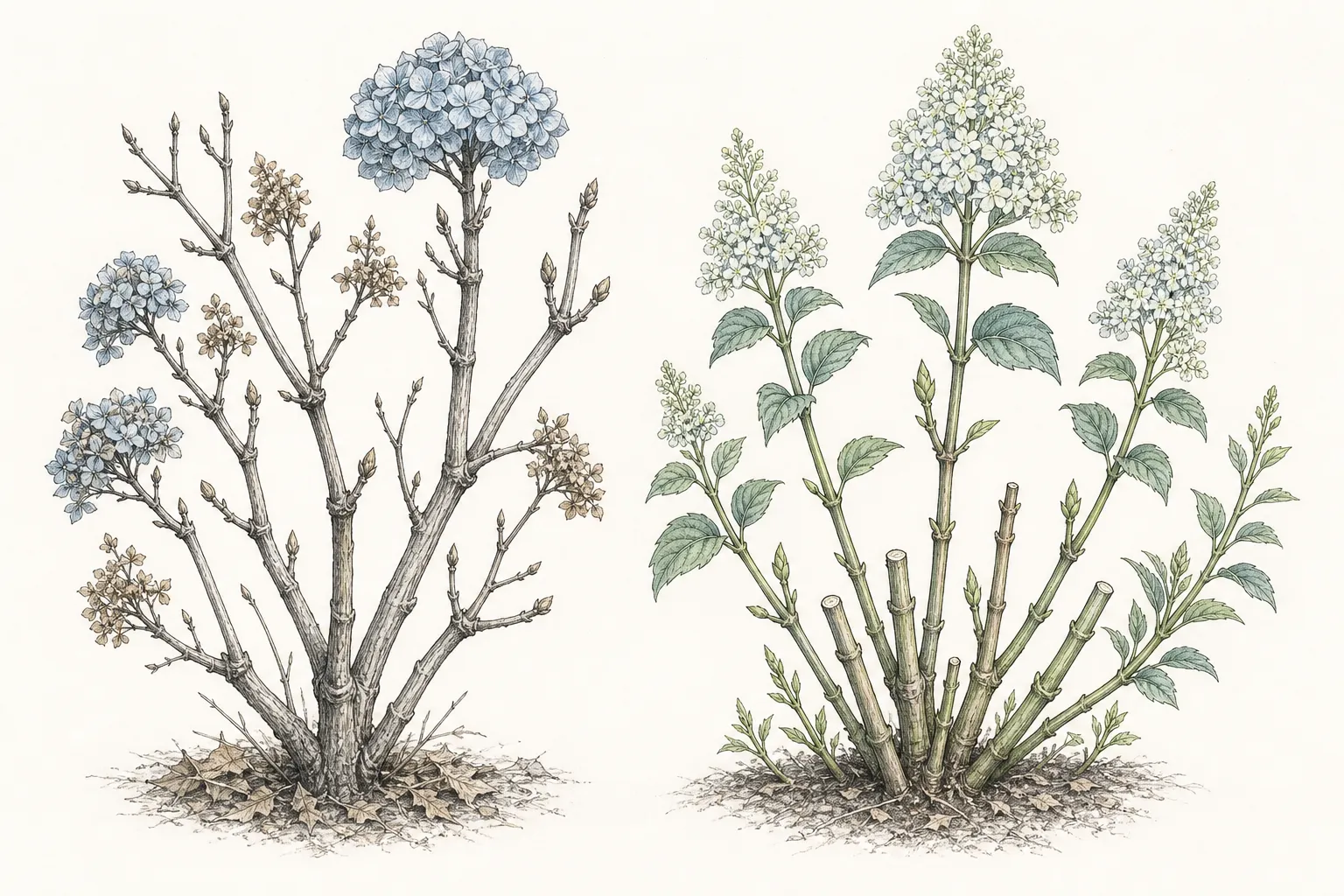
On a traditional bigleaf hydrangea, the important winter structures are the dormant buds on last season's stems. Virginia Tech describes flowers formed in the preceding year, and University of New Hampshire notes flower buds at the tips of old-wood stems, with lower buds sometimes able to develop flowers as well. Walk the shrub before leaf fall is complete if identification is easier then. Trace several stems from the base to their tips, mark previous flower positions, and notice the paired buds along the upper nodes. Those small structures are the reason the whole stem remains standing.
Make a same-angle photograph from one side and a closer record of representative terminal and lateral buds. Plump buds are not proof of a flower, but their distribution gives you a working map. A cane that looks gray and bare in November may carry the next display at its tip. Do not shorten stems to fit a standard cage or make the dormant shrub look neat. The protective structure must be sized around the living architecture; the architecture is not trimmed to suit the materials already in the shed.
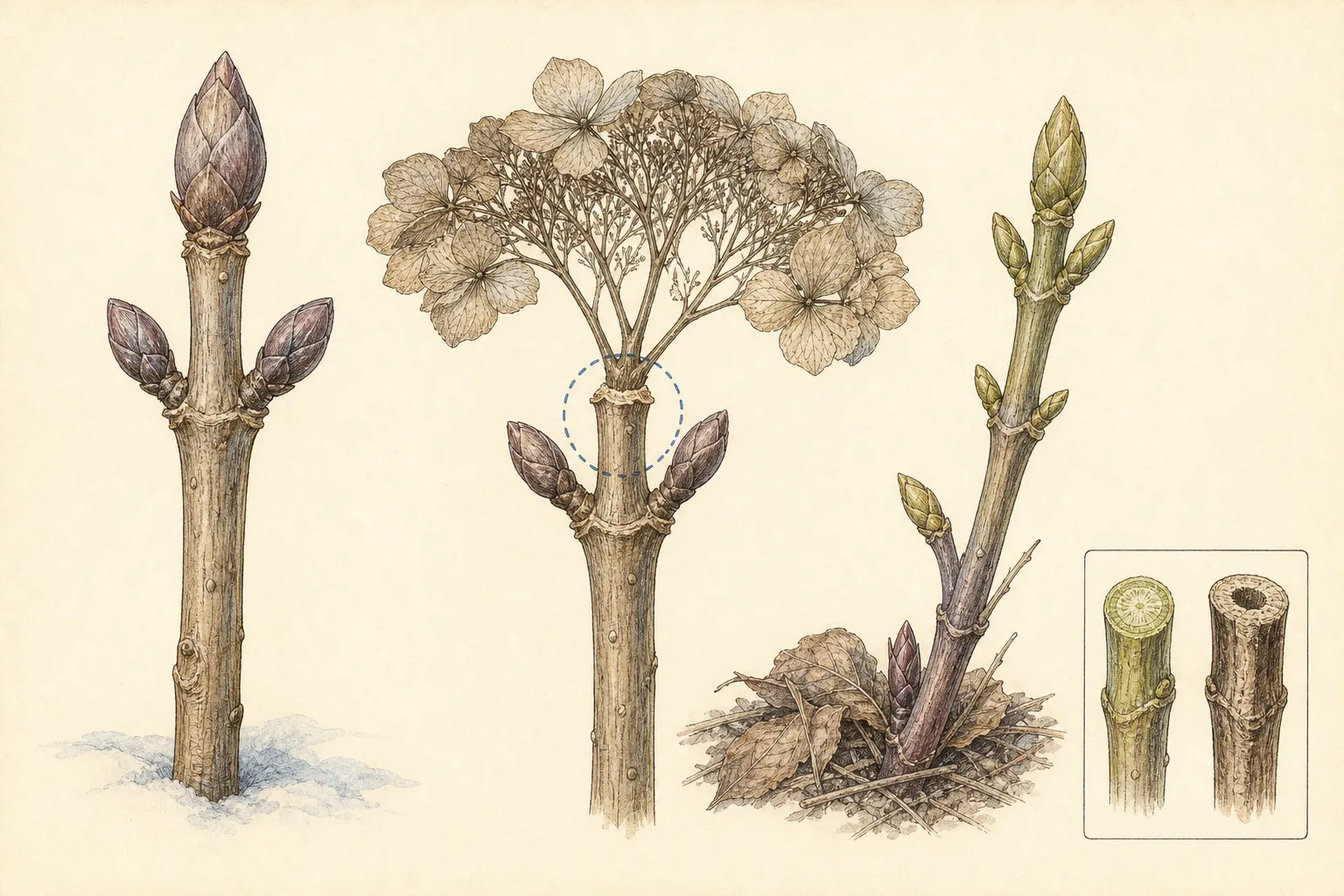
Old wood and dead wood are not synonyms. University of New Hampshire recommends waiting until new growth appears in spring before deciding which bigleaf hydrangea stems are dead. Cutting in autumn based on bark color alone removes evidence and may remove viable buds. Leave uncertain stems through winter. If a branch is already broken, diseased, or hazardous, handle that specific problem with clean cuts and regional guidance, but keep routine shaping, height reduction, and cosmetic cleanup out of the dormant protection sequence.
Match the protection effort to cultivar and climate
Flower-bud hardiness varies among cultivars. Virginia Tech reports that many traditional bigleaf cultivars lose flower buds in USDA zone 6 and may occasionally lose them in zone 7, while remontant cultivars can still make flowers on new shoots after old-wood injury. That is a Virginia Tech scope statement, not a universal guarantee for every zone boundary. Snow cover, wind, late frost, elevation, siting, and provenance can alter the result. Use the named cultivar's breeder information and local Extension experience alongside the zone map.
A shrub in a protected courtyard, on the cooler east side of a building, or under reliable snow may need less intervention than the same cultivar on an exposed ridge. University of Georgia prefers morning sun, afternoon shade, moist well-drained soil, and protection from hot, dry exposure. University of New Hampshire points to cold winter temperatures and drying winds as bud killers in its climate. Read the actual garden: note prevailing wind, low winter sun, snow dumping, thawing roof runoff, and whether protection can stand without crushing the plant.
Choose the lightest method that answers the credible risk. University of Georgia describes temporary sheets, blankets, or cardboard containers for freezing events and also recommends a chicken-wire cylinder filled with leaves for cold protection. University of New Hampshire gives the leaf-filled mesh cylinder as a winter bud-protection method in a colder setting. A forecast cover and a season-long insulated cage are different commitments. Use the event cover for a suitable regional frost episode; use the cage where recurring winter exposure threatens old-wood buds and the structure can be maintained.
Stop cutting before winter protection begins
The highest-value protection may be putting the pruners away. University of Georgia says bigleaf hydrangea forms flower buds in late summer for the following year and warns that late-summer, autumn, and winter pruning removes potential flowers; its Georgia guidance says to avoid pruning after August 1. That date is a regional operational boundary from the source, not a global deadline. The biological rule is wider: once the next flower buds are forming on old stems, shortening those stems spends the bloom before winter weather ever reaches it.
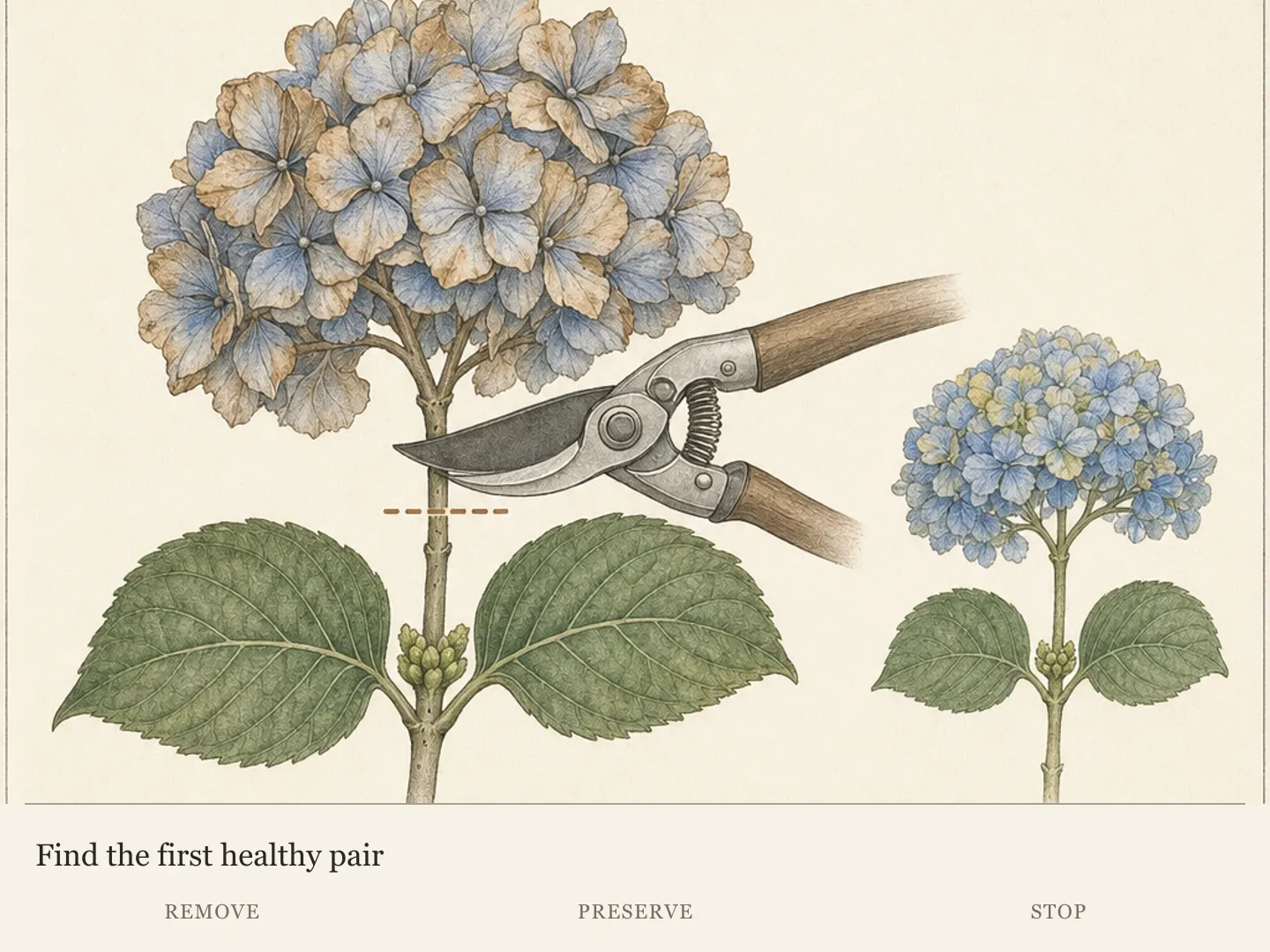
Deadheading also needs bud awareness. A dried flower head can remain through winter without harming the shrub. If a spent bloom must be removed earlier for a specific reason, use the dedicated old-wood deadheading guidance and make the smallest cut above known buds. Do not combine deadheading with height reduction. A gardener who follows the flower head downward seeking a neat outline can pass the first bud pair and remove more of the coming display than intended.
Clear the work zone without cutting the hydrangea. Remove stakes, twine, weeds, and loose debris that will snag the mesh, while keeping the crown visible and undisturbed. Correct a broken cage path or unstable footing before the soil freezes. Water according to current soil moisture and local late-season guidance; the retained sources support moist, well-drained conditions, not waterlogged soil or a ceremonial final soaking. The cage will make access harder, so complete only the necessary root-zone care before it goes up.
Build a leaf-filled cylinder around intact stems
Set a mesh cylinder outside the natural spread of the dormant stems. University of New Hampshire tells gardeners to surround the shrub with mesh while taking care not to damage buds, and University of Georgia describes a chicken-wire cylinder filled with leaves. Those directions make clearance a central design requirement. The wire should not scrape terminal buds when wind moves the plant, and the cylinder should be wide enough for leaves to settle around stems without forcing them inward. Anchor the cylinder so it remains upright without driving stakes through the crown.
Add fallen leaves by hand in shallow lifts. Guide leaves into the space around the outside stems, then toward the center, watching every terminal bud. The goal is an insulating mass around intact flower-bearing wood, not a tightly compacted bale. If a branch must be bent sharply or the mesh must be drawn against buds to contain the leaves, enlarge the cylinder. Stop periodically and look down from above for trapped stem tips. A protection method that breaks the upper buds during installation has failed before the first cold night.
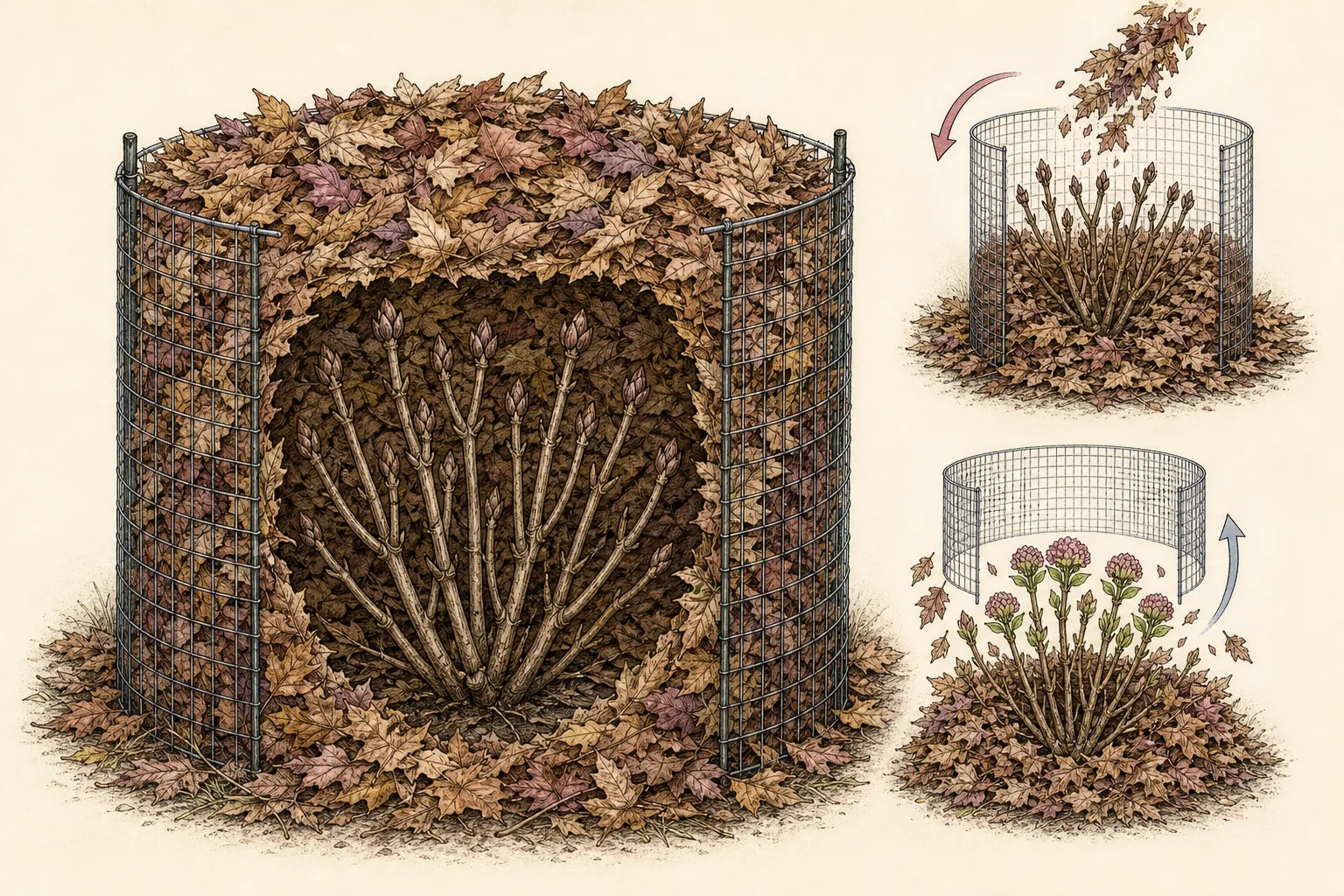
Fill to the height needed to surround the bud-bearing stem tips without building an unstable mound that sheds into paths. The cited sources do not specify a universal leaf species, compression ratio, cap, or enclosure film, so this article does not invent one. Use fallen leaves suitable for the garden and maintain the source method's essentials: a stable mesh boundary, insulating leaves, intact buds, and later spring removal. If local rodents, fire rules, wind, or wet winters make the leaf cage unsuitable, ask local Extension for an alternative instead of sealing the shrub in plastic.
Maintain the protection as weather changes
Inspect after the first wind and settling rain. Refill a void that exposes stem tips only after checking that the branches remain unbroken. Straighten mesh that leans into the shrub and correct an anchor that has loosened. Do not tamp the leaves harder each time they settle. Settlement is a reason to restore coverage gently, not to compress the protective mass against buds. Keep the cage visible at path edges and prevent snow-clearing tools from treating it as a convenient storage pile.
Watch how water moves around the crown. The cage should not redirect roof runoff into the root zone, block a drain, or keep the base in standing water. University of Georgia's site guidance pairs moisture with good drainage; winter protection does not suspend that requirement. If leaves become a heavy collapsed mass and stems are bending, relieve the load carefully during a mild interval while preserving the surrounding insulation. Take photographs rather than reaching into the cage repeatedly, because every inspection that disturbs the buds carries its own cost.
For a temporary sheet or blanket used during a forecast freeze, support it so the material does not crush the stem tips, secure it against wind, and remove it when the event ends. That method is a short-duration cover, not a substitute for a maintained season-long cage in a colder exposed site. Never leave an opaque event cover indefinitely through sunny weather. The plant and protection must remain inspectable, and the chosen method should match the duration of the risk it was selected to answer.
Remove the cage when buds begin to expand
Spring removal is part of bud preservation, not cleanup after the method is complete. University of New Hampshire says to remove the leaf protection once buds begin to expand. Watch the shrub and local forecast together. Pulling the cage away during a warm spell while a damaging cold event remains likely can expose tender expanding tissue; leaving it after growth pushes into the mesh can break the shoots you preserved. Choose a calm day and remove leaves in shallow lifts so stem tips are uncovered rather than dragged.
Lift the mesh vertically with a second person if needed, keeping cut wire ends and anchors away from branches. Count obvious broken or abraded buds and record where the cage failed. Restore any displaced mulch without burying the crown. Keep temporary frost material accessible if the local late-freeze season is not over, but do not rebuild the full leaf mass automatically. Expanded buds have entered a different stage, and local Extension guidance should set the response to a forecast event.
Wait for growth to reveal living stems before pruning. University of New Hampshire advises making cuts one quarter inch above the first set of live buds and removing entirely dead stems at the base. Use that measurement only after viable buds and green interior tissue make the boundary legible. A cane that has live lower buds but a dead tip can be shortened to the living set; a cane that is simply slow should remain. Prune stem by stem, preserving the evidence that the winter outcome provides.
Judge the result across the whole bloom cycle
Record which retained stems flower, when they flower, and whether new basal shoots later produce another flush. That separates old-wood performance from reblooming behavior. A cage that preserved many stems but yielded few flowers may point back to cultivar identity, light, nitrogen, or the timing of earlier pruning. A shrub that flowers well only below the former snow line reveals a useful exposure boundary. Keep the photographs and notes with the cultivar name so next autumn's decision rests on the same plant, not a generic hydrangea calendar.
Protection cannot guarantee bloom in every winter. Virginia Tech's account of cultivar differences and University of New Hampshire's colder-climate experience both show why results vary. Evaluate whether the display gained is worth the structure, leaves, inspection, and spring removal. In a borderline climate, a remontant cultivar may offer more reliable flowering because it can use new shoots as well as old wood. Replacing a persistently incompatible cultivar can be a better garden decision than enlarging an annual cage indefinitely.
Keep the method proportionate. Preserve old stems through the bud cycle, maintain a suitable site, and prune only after the plant reveals living wood. If repeated cold, wind, drainage problems, or late freezes defeat those steps, move the shrub to a more protected microclimate or choose a hydrangea whose flowering wood matches the site. Winter protection is most useful when it carries a fundamentally suitable bigleaf hydrangea through a defined exposure, not when it conceals a permanent mismatch.
Steps
- Level
- moderate
- Time
- About 45 to 90 minutes for installation, plus winter checks and spring removal
- Tools
- work gloves, wire cutters, stakes suitable for the site, camera or phone for bud records, clean hand pruners reserved for spring assessment
- Materials
- garden mesh or chicken wire, fallen leaves, weather-safe ties for the mesh itself, temporary frost cloth, sheet, or blanket if locally appropriate
- 1Confirm species and flowering habit
Verify Hydrangea macrophylla and record the cultivar if possible. Determine whether it flowers mainly on old wood or also reblooms on current-season shoots. Review prior photographs and bloom timing. A smooth or panicle hydrangea follows different wood-age rules, and an unknown dormant shrub should not be pruned into conformity.
- 2Map the bud-bearing stems
Trace representative stems from crown to tip and photograph terminal and upper lateral buds, previous flower positions, and the overall spread. Treat gray dormant old wood as potentially alive. Leave uncertain stems standing until spring growth reveals viability, and size the protection around the intact shrub instead of shortening stems to fit materials.
- 3Choose protection by local risk
Combine named-cultivar hardiness, local Extension experience, winter wind, low sun, snow behavior, and late-freeze history. Use a temporary supported cover for a suitable short frost event or a maintained leaf-filled cage where recurring winter exposure threatens old-wood buds. Protection is not a cure for deep shade, excess nitrogen, or prior pruning.
- 4Stop late pruning and prepare access
Preserve every sound old stem after next year's buds begin forming. Clear only materials that snag the cage, stabilize footing, and correct necessary root-zone care without burying the crown or saturating poorly drained soil. Keep dried flower heads and uncertain stem tips when removing them would also remove or endanger flower buds.
- 5Set the mesh beyond the stems
Build and anchor a cylinder outside the dormant canopy so wire cannot rub the terminal buds. Keep stakes out of the crown. Add fallen leaves in shallow hand-placed lifts, checking from above that stem tips remain intact. Enlarge the cylinder whenever branches must bend sharply or buds touch the boundary.
- 6Inspect without compacting
After wind, rain, and settling, straighten the cage and restore exposed areas gently. Correct runoff, standing water, leaning mesh, and snow-clearing pressure. Do not repeatedly tamp the leaves or reach through the stems. A stable insulating mass around unbroken buds is the goal; a dense load bending the shrub is a new injury.
- 7Remove at bud expansion and prune from evidence
On a calm day as buds begin to expand, lift leaves in shallow layers and remove the mesh without dragging branches. Keep short-term frost protection available if local guidance warrants it. Wait for living growth, then cut only confirmed dead tips about one quarter inch above the first live bud set and dead stems at the base.
Plants in this guide
Related reading
Sources
- Bigleaf Hydrangea, Hydrangea macrophylla. Virginia Tech Cooperative Extension. Source record · Accessed 2026-08-20.
- Pruning Hydrangeas. University of New Hampshire Cooperative Extension. Source record · Accessed 2026-08-20.
- Growing Bigleaf Hydrangea. University of Georgia Cooperative Extension. Source record · Accessed 2026-08-20.