Plant problems · flowering
A Leafy Hydrangea Without Flowers
Use five focused checks for a leafy hydrangea with few flowers: identify its bud-bearing wood, then review winter injury, pruning, browsing, nitrogen and light.
Published Last updated
In this guide
- Identify where this hydrangea makes flower buds
- Reconstruct the bud history before changing fertilizer
- Reconstruct the season that produced the empty canopy
- Read winter injury in buds and living stems
- Separate a pruning cut from a browsed tip
- Interpret vigorous foliage through inputs and light
- Test the strongest cause through one bud cycle
- Reopen the diagnosis when the prediction fails
- Diagnosis
Identify where this hydrangea makes flower buds
A leafy hydrangea with few or no flowers should be identified by species and cultivar before anything is cut or fed. Bigleaf, mountain and oakleaf hydrangeas generally carry flower buds through winter on older stems. Smooth and panicle hydrangeas form flowers on current-season shoots. Reblooming bigleaf cultivars may use both old and new wood.
The distinction establishes where evidence should be visible. On an old-wood bloomer, the useful questions concern stems and buds that survived from the previous season. On a new-wood bloomer, current shoots must develop before they can flower. A reblooming plant keeps both routes, with the old-wood buds opening first and new-wood flowers potentially following later.
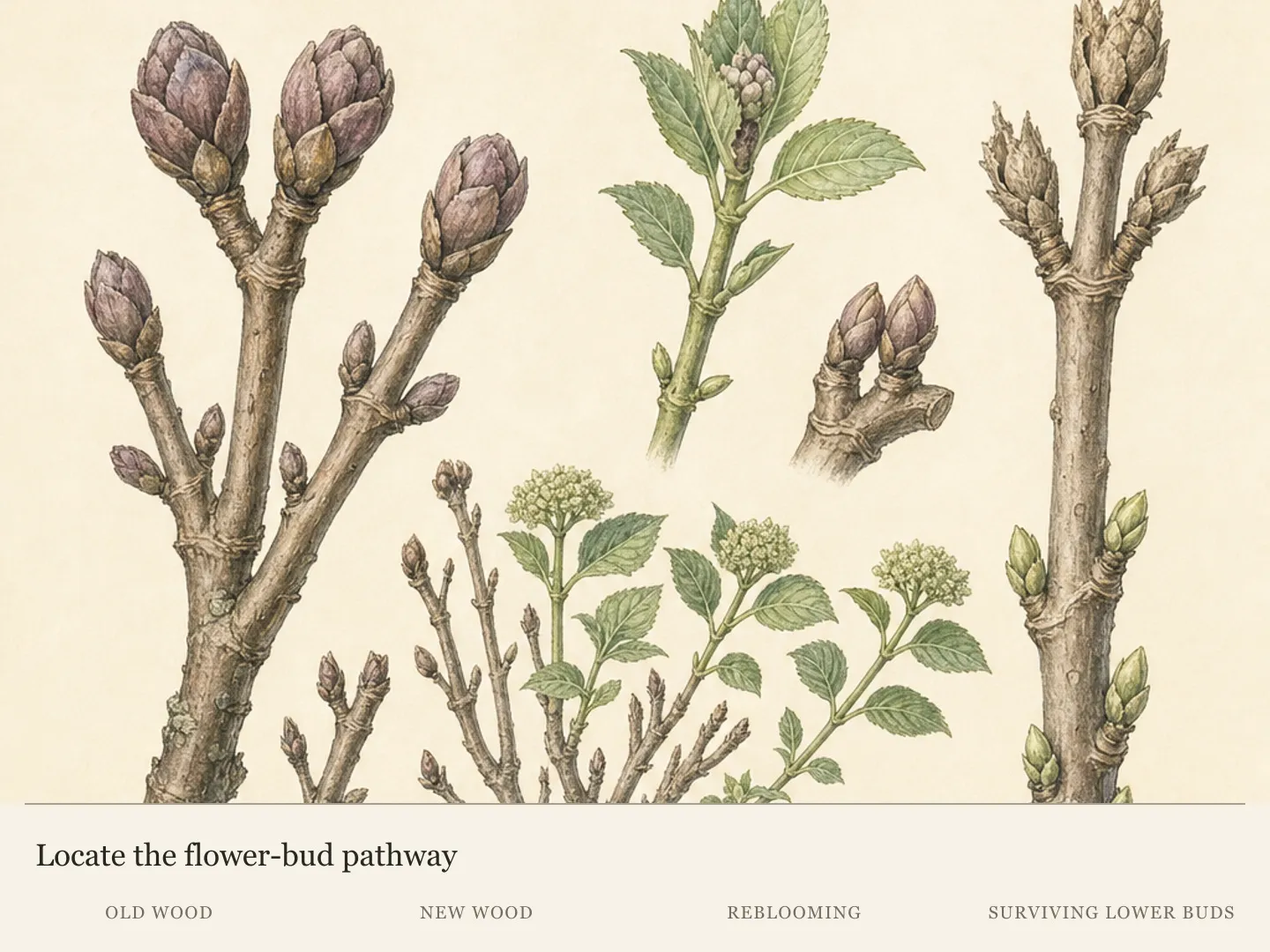
Use the exact plant label, purchase record and an Extension identification guide. Save photographs of leaves and flower-head shape if any flowers remain. Bigleaf and mountain hydrangeas can look similar, and a commercial series can include several named cultivars. The Endless Summer series includes 'Bailmer', BloomStruck, Summer Crush and Twist-n-Shout, yet a series name still does not replace the exact label.
Treat flower form as one clue within the identification. Mophead and lacecap forms occur within bigleaf hydrangea, while other hydrangea groups can also produce rounded or flattened displays. A remembered blue flower can narrow the field, but the durable record is the botanical name and cultivar. Save that identity with the pruning calendar so the same uncertainty does not return each spring.
Leave the framework uncut while identity remains uncertain. A spring heading cut that suits a panicle hydrangea can remove dormant flowers from a traditional bigleaf hydrangea. The foliage that grows afterward may be healthy and abundant, which can hide the connection between the earlier cut and the absent display.
If no reliable identity can be recovered, preserve the stems through a complete observation cycle and document where flowers eventually appear. That takes longer than guessing, but it protects possible old-wood buds and produces evidence for later pruning. Flower absence is low urgency; another speculative cut can wait.
Reconstruct the bud history before changing fertilizer
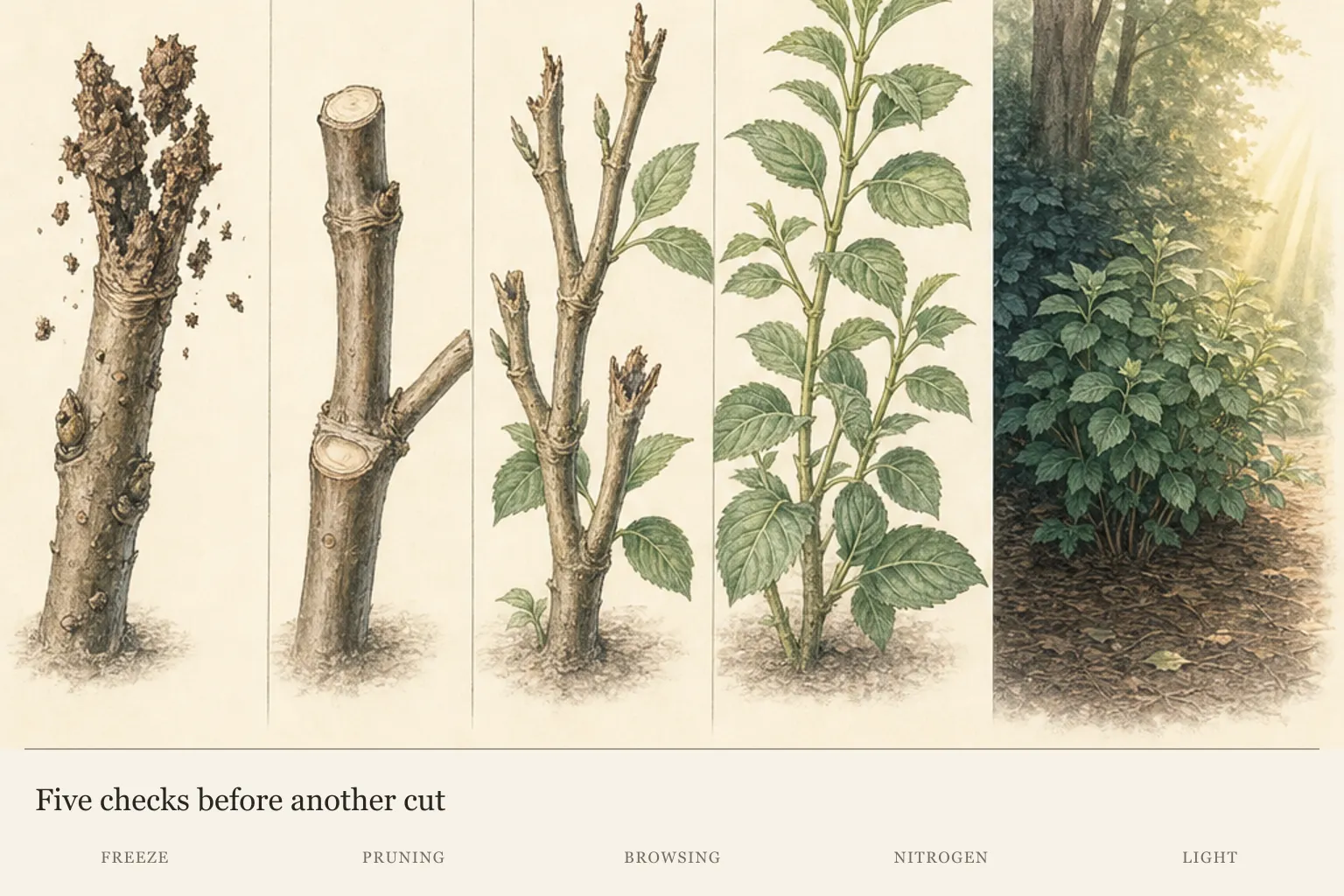
Confirm the hydrangea's flowering wood, then compare winter damage, prior cuts, browsing, feeding history and growing-season light. Keep surviving representative stems labeled through the next bud cycle. Lush leaves alone cannot identify the missing-flower cause, and buds already removed or killed cannot be restored by an immediate fertilizer change. Match the next action to the documented loss.
Reconstruct the season that produced the empty canopy
Old-wood hydrangeas develop their next flower buds during summer and autumn, carry them dormant through winter and open them in the following growing season. That long sequence gives several opportunities for loss. A cut, cold event or browsing episode can remove the flower while leaving enough stem or lower buds for the shrub to leaf out.
New-wood hydrangeas follow another schedule. Their overwintering stems do not hold the next display because the flower buds form on growth produced in the current season. A lack of visible winter buds is therefore expected, and late-winter or early-spring pruning has a different meaning than it does on a traditional bigleaf plant.
Build a simple timeline from the last successful bloom. Include every pruning date and purpose, severe winter or late frost, observed browsing, lawn and shrub fertilizer applications and changes in the tree canopy. Dates matter because the same clue can have opposite significance on old and new wood.
Place each event against bud formation, not just the calendar month. On old wood, pruning or browsing after buds have formed can remove the next display, and winter cold can kill it while dormant. On new wood, those particular flower buds do not yet exist during winter; current-season shoot development becomes the relevant stage. This ordering helps reject a cause that could not have reached the flower-bearing tissue in question.
Photograph the whole shrub before focusing on one stem. Note whether flowers are absent everywhere, concentrated low on protected branches or missing only from the perimeter. Compare the side facing winter exposure with stems near a wall or other shelter. A spatial pattern can separate broad care issues from bud loss concentrated where cold or browsing reached first.
Keep uncertainty in the timeline visible. An unknown pruning date, missing label or unobserved browsing event is a gap, not proof of another cause. Mark those gaps and choose the next observation that could resolve them. Feeding the shrub or cutting it again would add new events without explaining the old ones.
Read winter injury in buds and living stems
On a known old-wood bloomer, examine upper stems for pairs of plump buds and compare them with buds lower on the same branch. Bigleaf hydrangea can carry pointed terminal buds and rounded buds below them. The comparison is more informative than deciding from one tip whether the whole shrub survived intact.
Use a small scratch on a questionable tip only when needed to distinguish living from dead stem. Green tissue beneath the bark indicates living wood. Dry brown tissue paired with buds that crumble supports winter or late-freeze injury. Keep the test small so diagnosis does not become another pruning cut.
Freeze injury can kill flower buds while the stem later produces leaves, or it can damage the upper stem more broadly. Lower buds may survive where snow or a protected position moderated exposure. Flowers appearing only near the base therefore support a vertical injury pattern; they do not show that the shrub changed from old- to new-wood flowering.
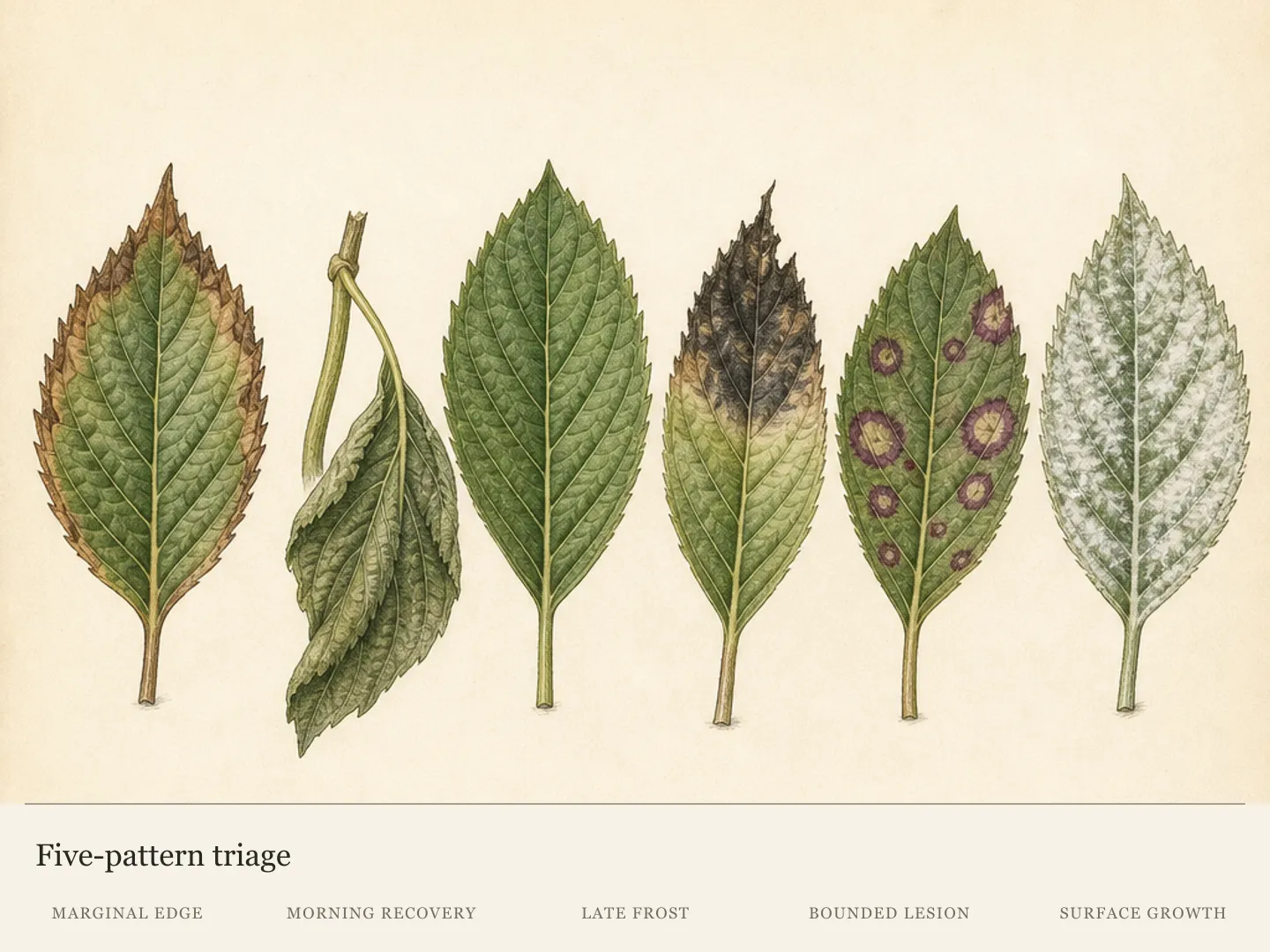
Late spring frost can damage tender buds and newly expanding leaves after dormancy has ended. Match blackened or collapsed tissue to the cold event and compare sheltered growth. A winter narrative that cannot explain the timing of tender new damage should be widened to include the late frost.
Wait for growth to reveal the living boundary before removing dead-looking tips. Premature heading can erase surviving buds below the first damaged portion. Once live growth is clear, remove only wood confirmed dead and preserve sound stems for the next comparison. The current year's display may already be lost even though the framework can support a later cycle.
Separate a pruning cut from a browsed tip
Reconstruct what removed terminal buds. A smooth heading cut repeated across stems points toward pruning. Torn or ragged ends, missing paired buds and damage held at a similar perimeter height support browsing. Inspect several sides of the shrub and the ground nearby; one broken tip is insufficient evidence.
Pruning evidence must be interpreted through flowering habit. Traditional bigleaf, mountain and oakleaf hydrangeas carry the next display on old wood and are pruned, when needed, after flowering. Autumn, winter or early-spring heading cuts can remove those dormant flower buds. Severe overpruning may leave the shrub rebuilding leafy framework before it flowers well again.
Smooth and panicle hydrangeas form flowers on current-season growth and can be pruned in late winter or early spring. If one of these remains flowerless, the mere presence of a spring cut is not enough to diagnose the problem. Review how drastic the cut was, whether current shoots developed normally and whether another evidence row fits better.
Reblooming cultivars retain an exception without becoming cut-proof. They can form flowers on old and new wood, which helps when cold, deer or mistimed pruning removes one set of buds. Preserving as much wood as possible protects the early route and avoids delaying or shortening the later flowering window.
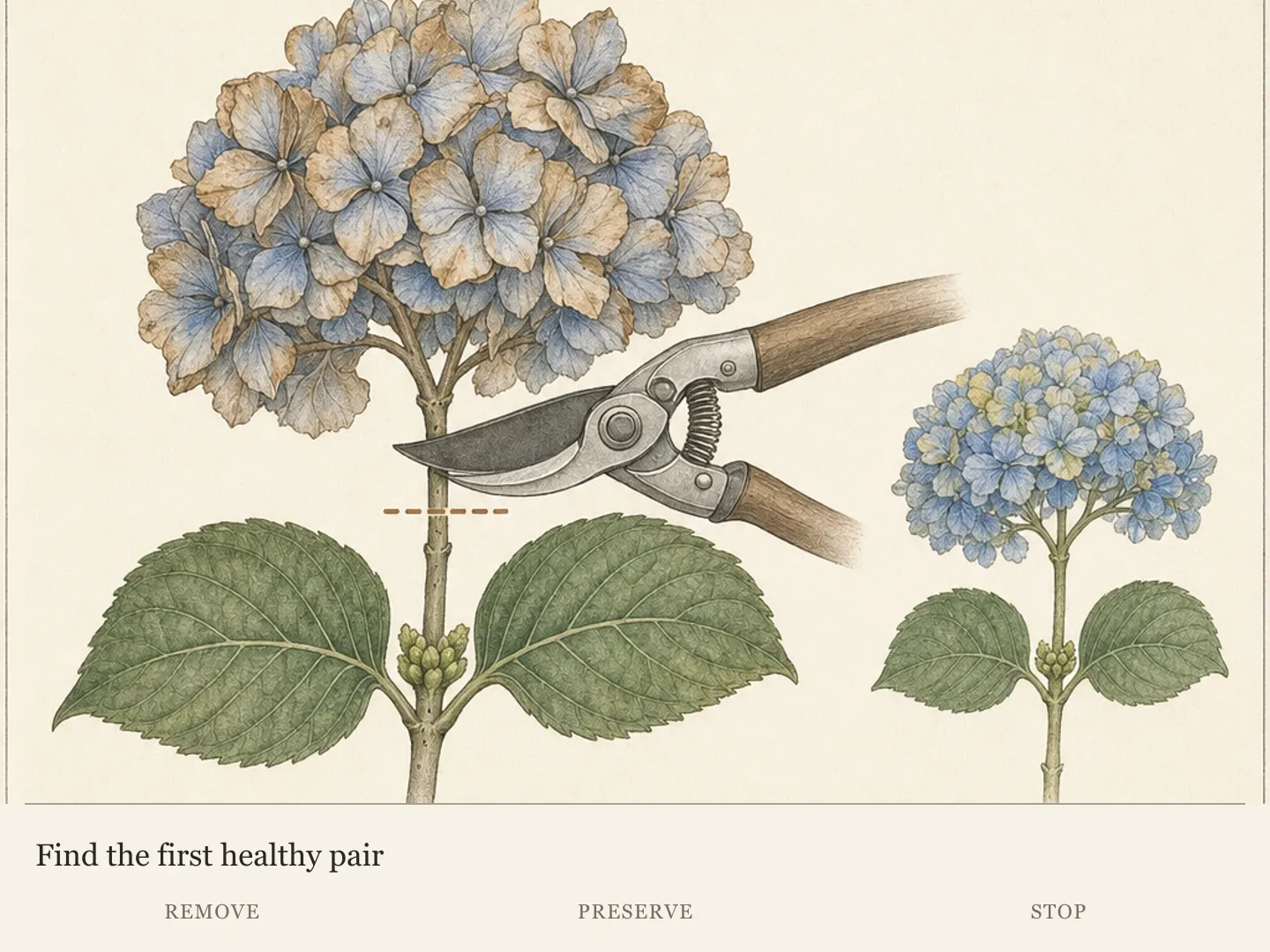
Separate true deadheading from a heading cut in the history. Deadheading removes a spent flower at the branch tip and goes no farther down the branch. A cut that shortened leafy stem or removed several bud pairs was pruning even if its purpose was cosmetic cleanup. That distinction can explain why a gardener recalls removing only old flowers while the shrub records a broader loss.
When browsing evidence is strongest, protect selected bud-bearing stems through the vulnerable period and leave comparable unprotected evidence only where that is practical and appropriate. The next useful observation is whether protected tips retain paired buds and flower. Repeated cutting at the same height would destroy that comparison and resemble the original loss.
Interpret vigorous foliage through inputs and light
A plausible nitrogen explanation requires chronology, contrast and exclusion. Chronology links a known application with subsequent vegetative emphasis; contrast shows that the habit changed from the shrub's own baseline; exclusion asks whether cold, cutting, animals or darkness already account for the missing display. A lush appearance by itself satisfies none of those tests and cannot specify a nutritional cause.
Stop unneeded fertilizer while the record is reviewed. Lack of flowers does not identify a nutrient deficiency, so phosphorus or a bloom product should not be added by guess. A laboratory soil test and plant-specific guidance can support future nutrient decisions without turning flower absence into an automatic fertilizer prescription.
Very deep shade can support foliage while limiting flowering. Record direct and dappled light after nearby trees leaf out, because a winter site assessment can overstate the usable growing-season light. Note which part of the shrub receives morning light and where dense canopy or structures keep it shaded.
Compare light only among hydrangeas with similar cultivar, winter exposure and pruning history. A nearby flowering panicle hydrangea in stronger sun is not a clean control for a bigleaf hydrangea whose buds survived a different winter and whose stems were cut differently. The comparison must hold the other major causes as steady as possible.
Nitrogen and light can create similar first impressions because both routes may leave abundant leaves. The record separates them. Lush soft extension after documented feeding strengthens the nitrogen route; ordinary leafy growth held in very deep growing-season shade strengthens the light route. When both are present, stop unneeded inputs first and preserve the light map for a gradual site decision.
Improve usable light gradually. Bigleaf hydrangea can perform in dappled or partial shade and can suffer under intense afternoon sun, especially when heat raises water demand. Selective canopy work or a move toward morning sun should preserve protection from the harshest exposure. A sudden relocation into hot afternoon sun exchanges the flowering question for heat and moisture stress.
Test the strongest cause through one bud cycle
Choose the cause with the clearest combined evidence and change one condition. Preserve identified bud-bearing stems, protect tips from browsers, stop undocumented fertilizer or improve usable light. Several simultaneous changes may improve the plant, but they erase the ability to learn which condition prevented flowering.
Mark representative stems and photograph them as buds set, pass through winter and enter the next flowering season. On an old-wood type, follow the same upper and lower buds. On a new-wood type, document current shoots. On a rebloomer, separate flowers from surviving old wood from those that arise later on new growth.
Set a realistic checkpoint for each route. Protected tips should remain present. An unpruned old-wood framework should carry its buds forward. Growth after fertilizer restraint should be evaluated for vigor and bud formation, not expected to change overnight. A light adjustment should be judged after the plant experiences the new growing-season pattern.
Use neighboring marked stems where the shrub permits a clean comparison. One protected tip can be followed beside a previously browsed perimeter stem, or one preserved old-wood branch can document what happens when routine heading stops. The comparison does not need to sacrifice buds deliberately. It needs stable labels, photographs and a record of which stems remained outside later cuts.
Recovery may require waiting beyond the season in which buds were already lost. Preserving stems after winter injury cannot recreate flowers that died months earlier, and correcting a pruning schedule cannot restore the display removed by the last cut. The value of the current action is that it allows the next bud cycle to remain intact.
If annual size control keeps removing flower-bearing wood, the site and mature plant size are in conflict. Moving the shrub or replacing it with a naturally smaller cultivar offers a longer-term solution than repeating hard cuts. That decision follows from the pruning pattern, not from one flowerless year.
Reopen the diagnosis when the prediction fails
More than one cause can be present. Deer may browse a shrub already weakened by winter bud loss, or a wrongly timed cut may coincide with excess nitrogen. Rank the evidence and preserve any comparison that remains interpretable. A combined explanation is useful only when each cause has its own visible clue.
Write the prediction before waiting. If pruning caused the loss, preserved correctly timed stems should retain their next buds. If browsing caused it, protected tips should survive better. If nitrogen or deep shade dominates, the recorded growth pattern should change after that input or exposure is corrected. A result that breaks the prediction should reopen the diagnosis.
Bring unresolved cases to local Extension with the exact label, whole-shrub photographs, close views of buds and stem tips and the season timeline. Include pruning, frost, browsing, fertilizer and growing-season light records. That packet is more useful than a detached leaf or a request for a product that will make the plant bloom.
Keep the low urgency in perspective. A healthy leafy shrub without flowers usually allows time to identify its wood habit and protect the next cycle. Escalate sooner when the plant also shows cane dieback, persistent wilt or broad decline, because those symptoms extend beyond the five flowering routes covered here.
Diagnosis
On a known old-wood hydrangea, exposed upper stems leaf out after winter but their flower buds are dry, crumbling or absent, while lower protected buds may survive.
- Check
- Confirm that the plant flowers on old wood, then compare exposed upper buds with lower or sheltered buds on the same shrub. Use a tiny bark scratch only on questionable tips, pairing green living tissue or dry brown tissue with the bud condition and the timing of winter or late-frost injury.
- Cause
- Winter cold or a late freeze killed old-wood flower buds or upper stem tissue while leaving enough living wood for the hydrangea to produce foliage. Lower or sheltered bud survival may preserve a partial display.
- Action
- Retain living old-wood stems and wait for growth to define the dead portion before making a cut. Remove only wood confirmed dead, preserve surviving lower buds and improve winter siting or protection for the next cycle. Judge the response by bud survival and later flowers, since damaged buds from the current cycle cannot be restored.
Healthy leafy growth follows a hard, broad or late cut, yet a traditional old-wood hydrangea carries few intact buds and produces no normal flower display.
- Check
- Find smooth heading cuts across several stems and reconstruct the pruning date and purpose. Match that record to old-, new- or reblooming wood habit. A spring cut strongly implicates pruning on a traditional bigleaf, while the same timing is routine evidence on a panicle hydrangea.
- Cause
- Flower-bearing old wood was removed at the wrong time or too drastically, so later leafy regrowth concealed the earlier loss of dormant buds. Smooth repeated heading cuts preserve the timing evidence.
- Action
- Allow the flower-bearing framework to rebuild and schedule future pruning by the identified hydrangea's old-, new- or reblooming habit. Mark uncut stems as the next comparison. If mature size forces repeated hard pruning, move the shrub or choose a naturally smaller cultivar that fits the space.
Terminal stem tips and paired buds are missing, torn or ragged around the shrub perimeter, often with damage repeated at a similar reachable height.
- Check
- Inspect several perimeter and interior stems for torn ends, missing paired buds and damage repeated at a common height. Compare protected and exposed tips, keep photographs through the next bud-bearing period and look for other browsing evidence before assigning every broken stem to wildlife.
- Cause
- Deer or other browsing removed terminal buds from the accessible perimeter before those buds could open, leaving torn tips and a repeated browsing pattern. Interior or protected stems may retain the comparison.
- Action
- Use a locally appropriate barrier to exclude browsers through the period when terminal buds must remain on the plant. Mark protected stems, photograph their paired buds and compare their survival and flowering with the earlier damage pattern. Keep pruning out of that comparison unless immediate dead or hazardous wood requires attention.
Exceptionally long soft shoots and dense dark-green leaves dominate after repeated shrub feeding, lawn-fertilizer spread or rich inputs, while flower buds remain scarce.
- Check
- List lawn and shrub fertilizer applications, rich amendments and where spread may enter the root zone. Compare those inputs with unusually long soft shoots and dense dark foliage. Stop speculative feeding and obtain a laboratory soil test before adding phosphorus or another nutrient product.
- Cause
- Excess nitrogen favored vegetative extension and dense foliage over flower production, with the input history matching unusually lush soft growth. Lawn spread and direct shrub feeding both belong in the record.
- Action
- Stop unneeded shrub fertilizer and prevent lawn applications from spreading into the hydrangea root zone. Preserve the input record, observe whether later growth is less excessively soft and base future nutrient additions on a laboratory soil test and plant-specific guidance. Flower absence alone does not justify phosphorus or a bloom product.
The hydrangea remains leafy under the growing-season canopy but receives little usable light and forms few buds, without stronger evidence of pruning, cold or browsing loss.
- Check
- Record direct and dappled light after nearby trees have leafed out, mapping morning and afternoon exposure across the shrub. Compare only with hydrangeas that share a similar cultivar, winter pattern and pruning history, and weaken the light diagnosis when another route explains missing buds more directly.
- Cause
- Insufficient usable growing-season light limited flowering even though the site supported leafy growth, and the comparison is not better explained by bud removal. The tree canopy after leaf-out defines the exposure.
- Action
- Improve usable light gradually through selective canopy work or move the shrub toward morning sun while protecting it from intense afternoon exposure. Record the new growing-season light pattern and retain comparable stems through the next bud cycle. Avoid judging the change against a different cultivar with another pruning or winter history.
Plants in this guide
Related reading
Sources
- Hydrangea: Identify and Manage Problems. University of Maryland Extension. Source record · Accessed 2026-08-16.
- Pruning Hydrangeas. University of Maryland Extension. Source record · Accessed 2026-08-16.
- Pruning Hydrangeas for Best Bloom. University of Minnesota Extension. Source record · Accessed 2026-08-16.
- Hydrangea macrophylla. North Carolina Extension Gardener Plant Toolbox. Source record · Accessed 2026-08-16.