Grow · deadheading
Deadheading Bigleaf Hydrangeas Without Cutting Old Wood
Remove faded bigleaf hydrangea heads with one tip-only cut, preserving the first healthy leaf or bud pair and the old-wood flowering framework below.
Published Last updated
In this guide
- Keep the job smaller than pruning
- Stop at the first healthy leaf or bud pair
- Confirm the flower is actually spent
- Read the old-wood framework before choosing a cut
- Locate the boundary on one stalk
- Make one cut and preserve its evidence
- Recognize the moment deadheading has ended
- Judge success by what remains
- Steps
Keep the job smaller than pruning
To deadhead a bigleaf hydrangea, follow one faded flower's short stalk to the first healthy pair of opposite leaves or buds and cut just above that pair. The leafy stem below stays intact. That narrow boundary matters because traditional bigleaf hydrangeas carry future flowers on old wood, and a cosmetic cut becomes pruning as soon as it shortens the branch.
Deadheading is an appearance choice, not a health requirement. A flower head may remain while it pales, greens, blushes, dries to brown, or contributes winter structure. Leaving it attached does not create a horticultural debt that must be corrected later. The question is therefore whether removing this particular head improves the display without sacrificing sound stem below it.
Define the finish before making the first cut. A deadheaded shrub can still carry flowers at several aging stages, and its branch tips can remain at different heights. The intended result is a selected group of faded heads removed at safe landmarks. If the imagined result is a lower, rounder, or uniformly level shrub, the goal already includes branch pruning and falls outside this tip-only job.
Uncertainty favors leaving the bloom. An uncut head can be reconsidered after the plant is identified, heat wilt passes, or the stalk is viewed from a clearer angle. A cut through an old-wood framework cannot be reversed. This makes restraint a practical diagnostic tool, not a failure to finish the shrub.
Stop at the first healthy leaf or bud pair
Follow one genuinely faded flower's short stalk to its first healthy opposite leaves or buds and keep the leafy stem below that point. If the proposed cut enters older framework, it has become a separate pruning decision. Retain decorative aging heads where desired, and mark damaged stems for assessment instead of shortening every stem to make the shrub uniform.
Confirm the flower is actually spent
Begin with the plant label or a reliable purchase record when one is available. Hydrangea macrophylla includes the familiar mophead and lacecap forms, yet flower shape alone should not invite broader branch work. The identification serves one immediate purpose here: it warns that apparently bare-looking older stems may be carrying the framework for another flowering season.
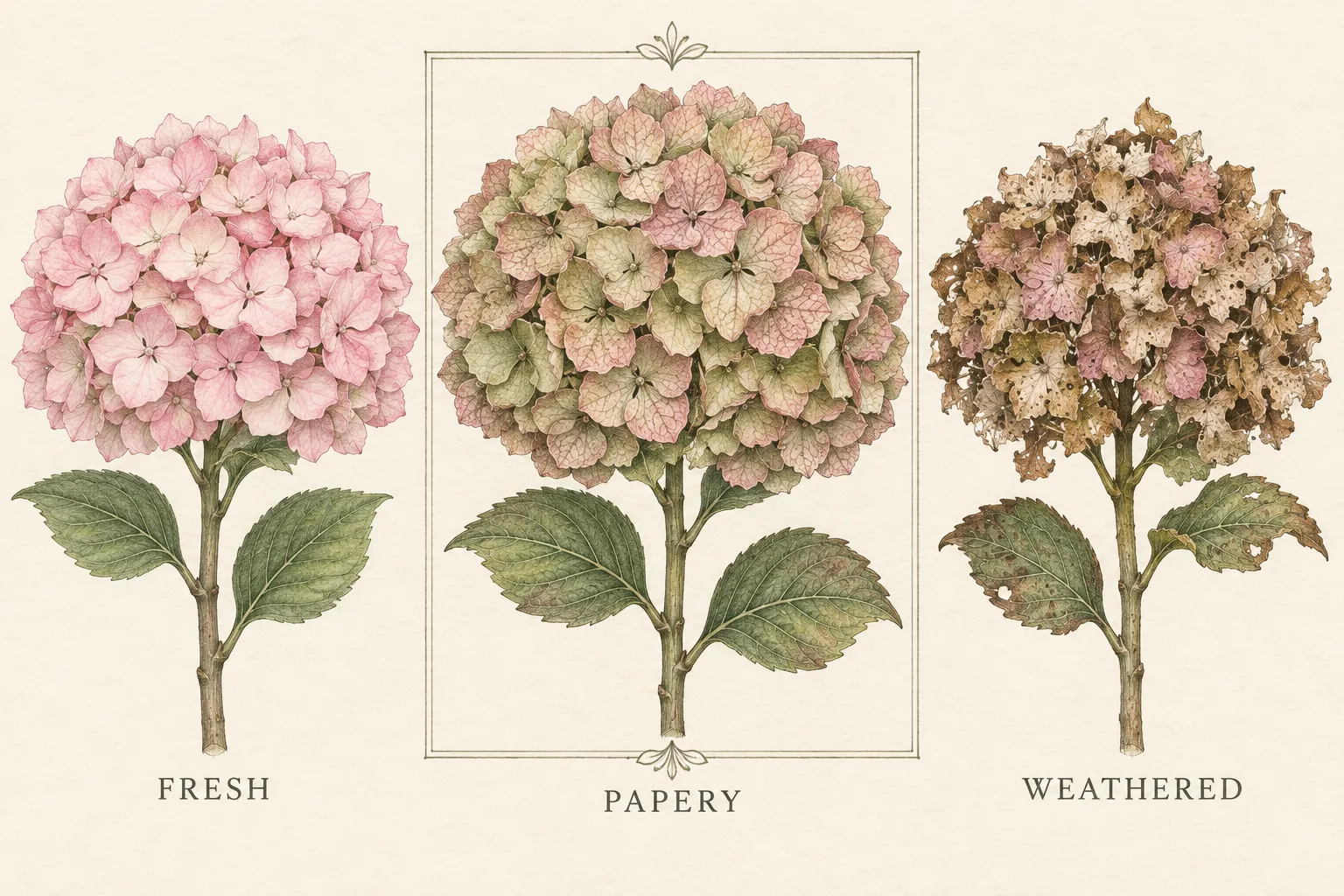
Judge flower age by the stage you want to keep, not by one prescribed color. Bigleaf heads can move through pale, green, ruby, papery, and dry brown phases while remaining decorative. Selective deadheading may remove the most weathered heads while retaining others with useful color. That approach also prevents a mass cut made simply because the heads no longer match one another.
Compare the candidate head with its own stalk and nearby foliage. A flower that is dry and papery while the supporting leaves remain firm presents a clearer cosmetic decision than a richly colored head on a temporarily wilted shoot. The comparison keeps flower aging, whole-shoot stress, and personal display preference from collapsing into one vague category called spent.
Flower heads on the same shrub rarely age in lockstep. Exposure and their individual stage can leave one fully dry while another remains green or ruby. That variation calls for separate decisions, not a deadline for the whole plant. Tagging or mentally noting the uncertain heads keeps them out of the first pass and lets the clearest targets establish a careful working rhythm.
Separate true fading from a temporary heat response. A colorful head and its nearby leaves may droop during a hot, dry afternoon even though the tissue is not spent. Mark that head and look again the next morning after conditions moderate. Recovery closes the deadheading decision for the moment; continued aging can be assessed later on its own terms.
Read the old-wood framework before choosing a cut
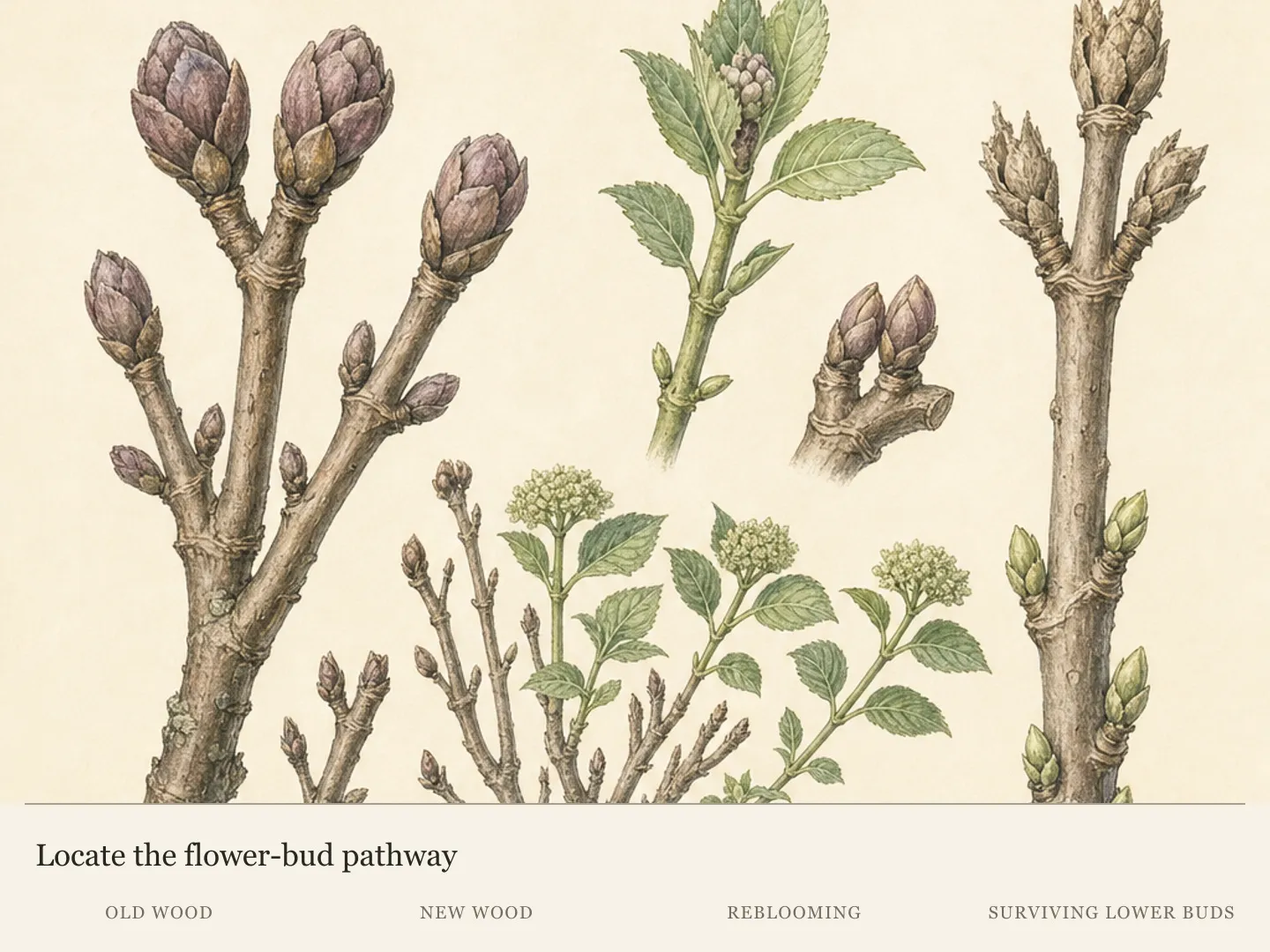
Traditional bigleaf hydrangeas flower on stems that survived from an earlier season. Their next flower buds develop later in summer and into fall, which is why broad pruning advice often places structural work immediately after flowering. Deadheading can occur as individual heads fade because its endpoint is anatomical: the cut stays at the flower tip and preserves the leafy branch.
This distinction explains why two pieces of hydrangea advice can sound contradictory while addressing different cuts. A date attached to branch shortening protects buds that form later on old wood. Flower-tip removal is governed by how far the blades travel. Calendar alone cannot make a deep cut into deadheading, and a conservative tip cut does not become structural pruning merely because the flower faded later.
Repeat-flowering cultivars complicate the calendar but not the stop rule. Some can flower on both old and new wood, so a later flush may be possible. Their new-wood capacity does not make the older framework disposable. Keeping it preserves one of the plant's flowering routes while still allowing the faded head to be removed.
Previous pruning may have left a shrub with an uneven or shortened framework. Deadheading is not the session in which to repair that history. Follow the current flower stalk to its first pair and preserve what is sound below. Trying to compensate for an old heading cut by lowering neighboring stems only repeats the loss across more of the plant.
Treat a change in purpose as a change in task. Removing a brown head is deadheading. Lowering the shrub, making all stems level, thinning crowded branches, or taking stems to the base is pruning. Once size, shape, damage, or renewal becomes the objective, end this session and plan that work according to the identified hydrangea and its flowering wood.
Locate the boundary on one stalk
Hold the chosen head lightly and trace only its own stalk downward. Bigleaf leaves occur in opposite pairs, so the first healthy pair directly beneath the flower provides a visible stopping point. Preserve the leaves themselves and any buds associated with that node. The removable part is the short stalk above it, not the leafy extension below.
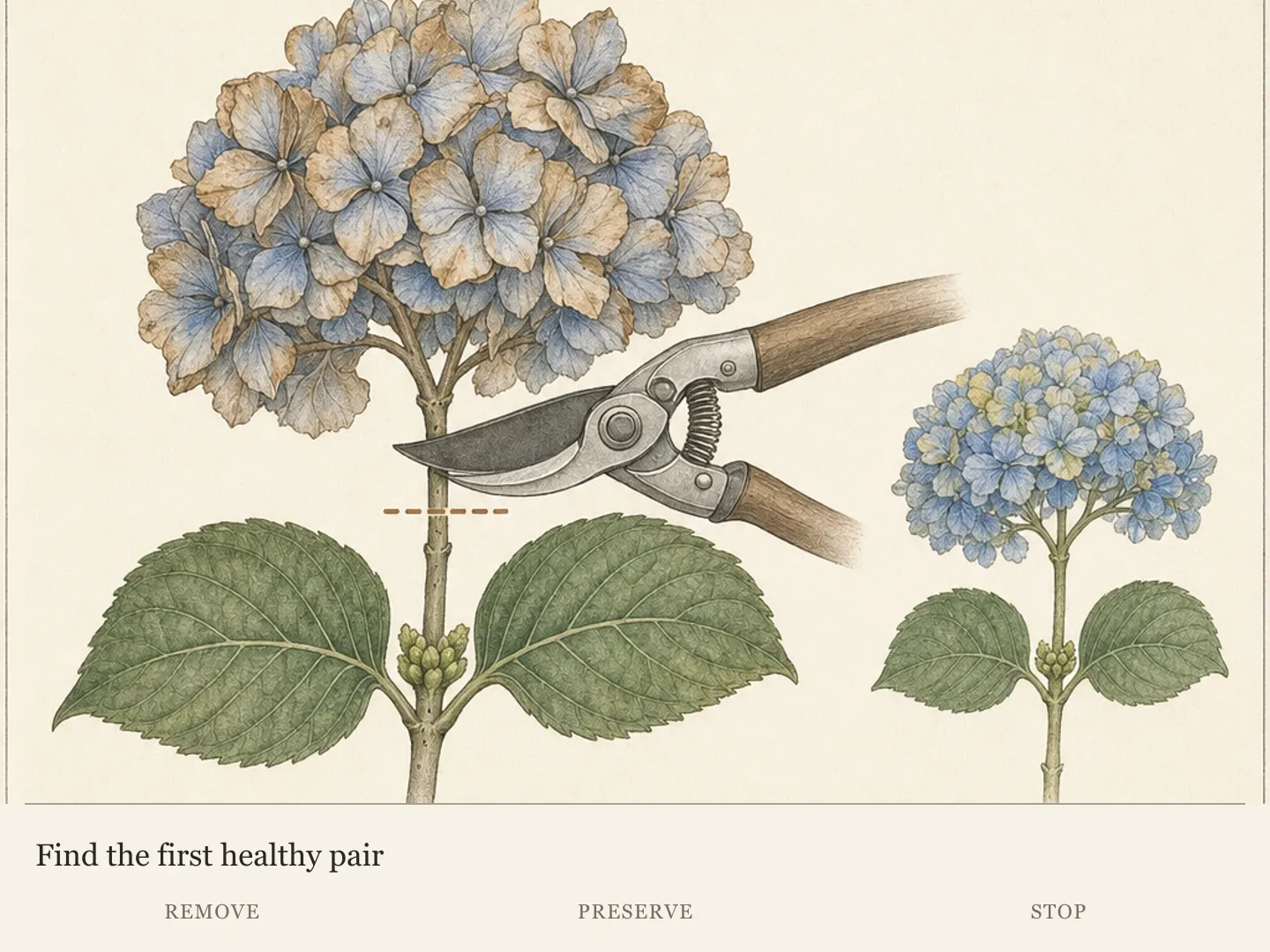
The nearest pair may be hidden by the flower head or turned away from the viewer. Find both sides of the pair before placing the tool. If one leaf is folded behind another stem, clearing the view can reveal that the apparent flower stalk is actually a leafy shoot. A landmark is useful only when its full relationship to the selected head is visible.
Occasionally the nearest pair is damaged, obscured, or too ambiguous to protect confidently. Continuing downward until a more attractive pair appears would remove extra stem and change the work. Leave that head in place, photograph the junction if identification help is needed, and return only when the branch structure and purpose of the proposed cut are clear.
Dense foliage can make two stems appear to be one. Clear neighboring leaves with the free hand, then look behind the target before bringing in the blades. A second shoot caught in the same cut changes the operation from precise flower removal to accidental branch pruning. If the stalk disappears into the canopy, view it from another side; cutting by feel is too uncertain.
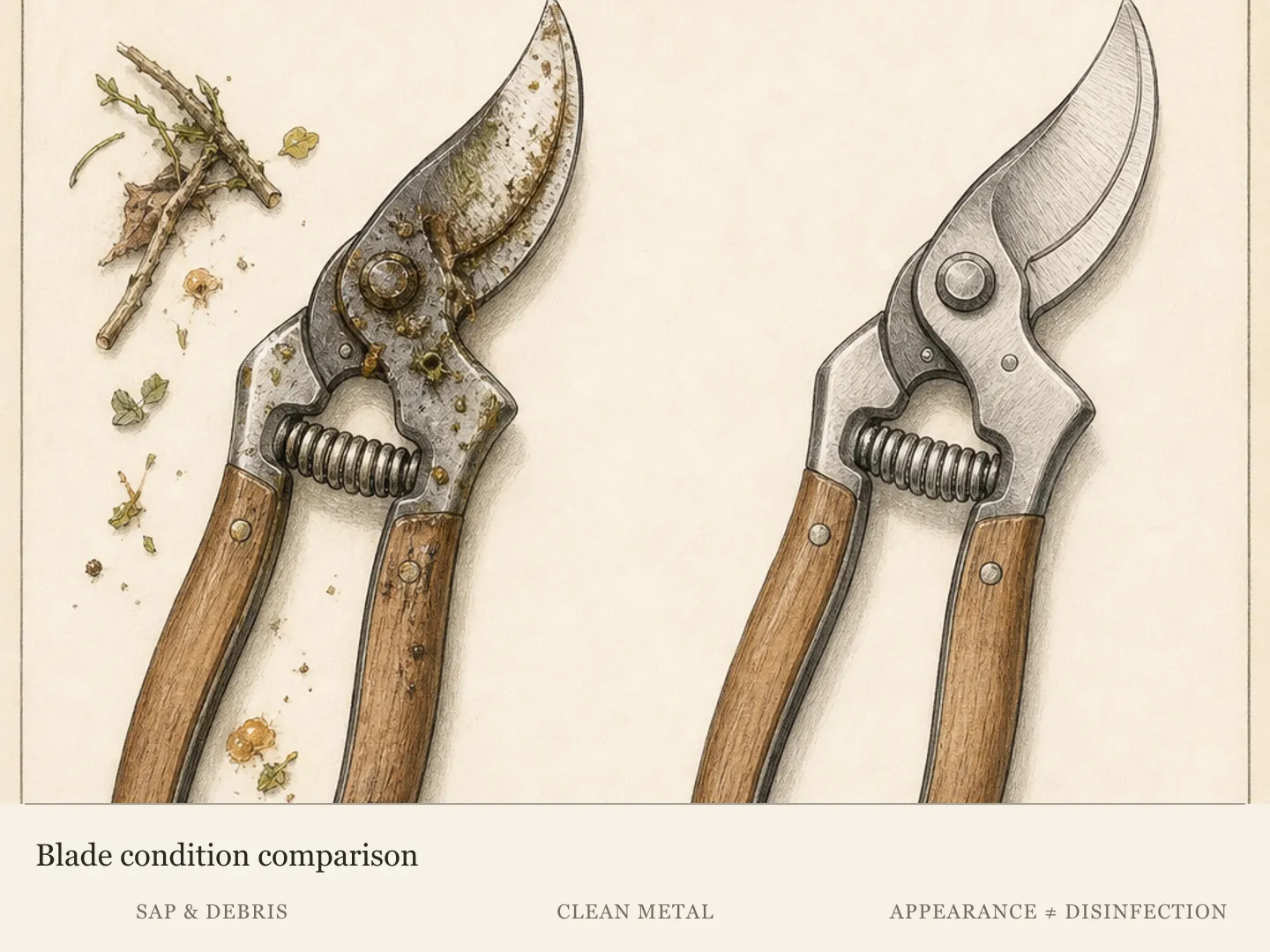
Use clean, sharp bypass hand pruners for a stalk that fits comfortably between the blades. Their scissor action supports a close, smooth cut on a small stem. Position the blades just above the preserved pair, leaving a short section of stalk without creating a long bare stub. A stalk too substantial for comfortable hand-pruner action belongs to a separate pruning assessment.
Make one cut and preserve its evidence
Support the flower head so its weight cannot pull against the final fibers, then close the pruners in one controlled stroke. Place the detached head directly in a container. Drawing a large flower cluster through the canopy can snag leaves, break a neighboring tip, or turn a clean cut into a tear whose lower endpoint is hard to see.
Keep the evidence for each cut together: one selected head, one traced stalk, one preserved pair, and one inspected cut face. Cutting several heads after tracing only the first invites the blades to drift lower or catch a neighboring shoot. The brief inspection after each stroke is faster than diagnosing a torn branch once the detached flowers have obscured where it broke.
Inspect the result before moving on. The first healthy opposite pair should remain undamaged, the leafy branch should be the same length as before, and the cut face should be clean. A trapped leaf, torn strip, or clipped neighboring shoot is a signal to slow down and improve visibility for the next target. Unequal stub lengths are less important than sound tissue and a preserved node.
Sharp, clean blades make the checkpoint legible. A crushed or ragged stalk can conceal whether the cut ended where intended, while debris on the tool complicates work if suspicious tissue appears elsewhere in the shrub. Pause when the cut quality changes. Cleaning, drying, or sharpening the appropriate tool preserves control better than squeezing harder through the remaining heads.
Work around the perimeter one head at a time, pausing after a small group of cuts to view the whole shrub. This reveals when the display already looks balanced and protects aging heads that still contribute color. Shearing every tip to one line erases the evidence that guided each cut and risks removing several pairs of leaves merely to impose a uniform height.
Recognize the moment deadheading has ended
The physical stop is the preserved first pair. Descending below it removes branch length. Repeating that deeper cut across the shrub becomes shaping; choosing older stems for removal becomes thinning or renewal. Those may be legitimate garden tasks, but they require a new objective, an identified plant, and pruning timing that protects the relevant flowering wood.
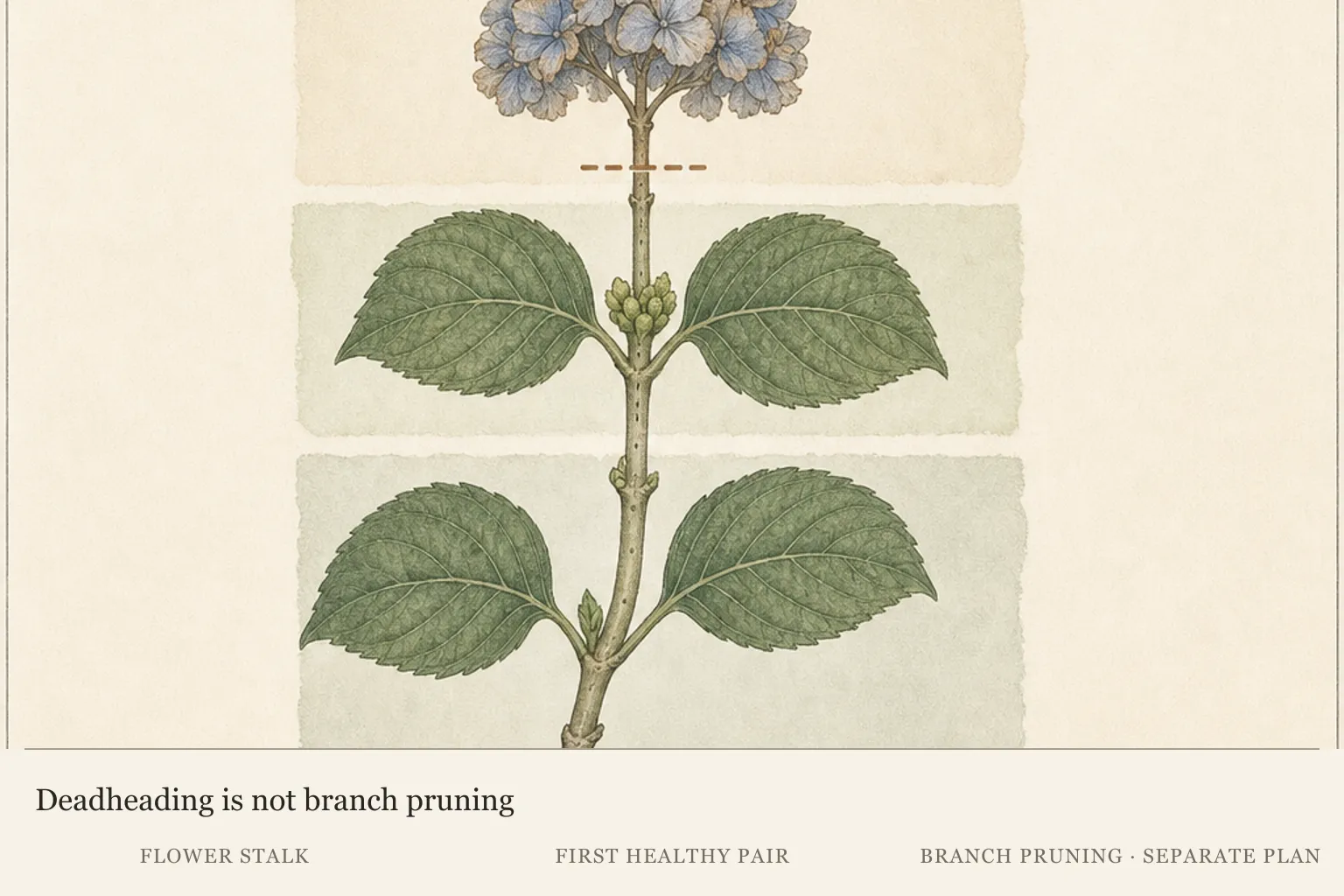
Use the stop rule even when the first pair looks inconvenient. A lower junction may appear tidier, and an adjacent branch may offer a tempting common cut for two flowers. Both choices remove more framework than the individual heads require. The correct deadheading cuts can therefore look irregular when viewed as a row, because each flower stalk meets its own first pair at a different height.
A common failure path begins with a head that cannot be removed neatly at the first pair. The temptation is to search lower for a cleaner-looking junction. Leave that flower for another inspection. Cosmetic symmetry is a weak reason to cross into old wood, especially when the shrub's cultivar, bud condition, or previous pruning history is unknown.
Dead, broken, or suspiciously diseased tissue also changes the assignment. A diseased-looking head or stem calls for diagnosis and an appropriate sanitation procedure; a broken branch calls for a deliberate pruning cut. Keeping those decisions separate prevents the simple deadheading rule from being stretched into unsupported treatment or structural repair.
Judge success by what remains
Finish by collecting the heads, checking the cut sites, and cleaning and drying the pruners. Sound cuts can remain at their natural heights. The shrub need not look machine-leveled; its useful evidence is visible in intact leaf pairs, unshortened branches, and the mix of retained and removed flower heads chosen deliberately.
Revisit the shrub after the foliage settles back into place. A hidden clipped shoot, snagged leaf, or torn cut is easier to see once the removed heads are out of the canopy. This final pass is for observing the work, not making compensating cuts to equalize the outline. Record any damaged or questionable stem for a later, correctly timed pruning decision.
Keep expectations tied to the cultivar and the preserved structure. If another flower develops, note where it arose without treating that response as proof that every bigleaf hydrangea should be deadheaded more deeply or more often. If no later flowers appear, the tip-only work has still met its purpose. It removed selected spent heads while retaining the plant's existing routes to future bloom.
Some repeat-flowering bigleaf hydrangeas may produce later flowers sooner after deadheading, but cultivar and conditions control that response. Treat another flush as a possibility, not the measure of whether the work succeeded. The immediate checkpoint is already available: selected faded heads are gone, the old-wood framework remains, and no extra pruning was smuggled into an optional grooming task.
Steps
- Level
- easy
- Time
- 10 to 20 minutes for a small shrub
- Tools
- Clean, sharp bypass hand pruners, Container for removed flower heads
- Materials
- Plant label or reliable cultivar record, if available
- 1Confirm a bigleaf hydrangea
Read the botanical label, purchase record, or another reliable identification before entering the canopy with pruners. Note whether the plant is a traditional old-wood bigleaf or a named repeat-flowering cultivar, but apply the same conservative boundary to both. When identity remains uncertain, leave questionable heads attached and postpone every cut that would remove leafy stem.
- 2Choose a genuinely faded head
Select one flower that has passed the color or dry-texture stage you want to display. Compare it with nearby heads; a date alone is not a reason to clear the shrub. If a still-colorful head droops during afternoon heat, mark it and recheck the next morning. Recovery means it was a poor target for this session.
- 3Trace and clear the flower stalk
Follow the selected head's individual stalk downward until the first healthy opposite pair of full leaves or visible buds appears. Keep that pair as the fixed landmark. Move neighboring leaves and stems aside, inspect behind the target, and position clean bypass pruners just above the preserved pair where the short flower stalk can be removed cleanly.
- 4Remove only the tip
Hold the flower with the supporting hand clear of the blades, then close the pruners once in a controlled stroke. The cut should end above the first healthy pair without shortening the leafy branch. Lower the detached head directly into a container; pulling it through the canopy can snag foliage or break an unselected shoot.
- 5Check the cut against the stop rule
Inspect the cut before selecting another flower. Confirm that both leaves or buds at the first pair remain, the cut is smooth, and no neighboring stem was clipped. If a clean result would require moving below that pair, stop on that shoot. Size control, leveling, thinning, and dead-wood removal belong to a separately timed pruning decision.
- 6Review and clean up
Step back after several cuts and decide whether any additional faded head truly needs removal. Retain aging flowers that still contribute color or structure, collect all detached heads, and inspect for torn tissue. Mark any damaged stem for a separate pruning decision; another cut would only disguise it. Clean and dry the pruners after the session, using a disease-appropriate sanitation process if suspicious tissue was encountered. Judge completion by intact leaf pairs and unchanged branch length.
Plants in this guide
Related reading
Sources
- Pruning Hydrangeas. University of Maryland Extension. Source record · Accessed 2026-08-15.
- Identify Hydrangeas to Know When to Prune. University of Georgia Extension. Source record · Accessed 2026-08-15.
- Pruning Hydrangeas for Best Bloom. University of Minnesota Extension. Source record · Accessed 2026-08-15.
- Pruning Ornamental Plants in the Landscape. University of Georgia Cooperative Extension. Source record · Accessed 2026-08-15.
- Hydrangea: Identify and Manage Problems. University of Maryland Extension. Source record · Accessed 2026-08-15.