Grow · hydrangea flowering wood pruning
Prune Hydrangeas in Spring by the Wood That Carries Flowers
Identify old-wood, new-wood, and reblooming hydrangeas before cutting, then remove confirmed winter damage without sacrificing the season’s flower buds.
Published Last updated
In this guide
- Sort the shrub into a flowering-wood group
- Identify the flowering group before shortening living stems
- Read buds before deciding a height
- Remove winter damage after life becomes visible
- Thin for structure, not a smaller cultivar
- Treat old-wood types conservatively in spring
- Shape new-wood types with a flower tradeoff in mind
- Record the response and next bloom
- Steps
Sort the shrub into a flowering-wood group
Identify the hydrangea before choosing a spring cut. Bigleaf, mountain, oakleaf, and climbing hydrangeas generally carry flower buds on stems formed in an earlier season. Smooth and panicle hydrangeas form buds on the current season's shoots. A reblooming bigleaf or mountain cultivar can flower from both old and new wood, but its first flush still depends on buds that survived winter.
Use more than flower-head shape when the plant is not in bloom. Oakleaf hydrangea has lobed leaves and peeling stems; panicle hydrangea carries cone-shaped flower clusters; smooth hydrangea commonly has broad rounded clusters; bigleaf and mountain types include mophead and lacecap forms. Keep the nursery label because cultivar breeding can add reblooming without changing the shrub's basic appearance.
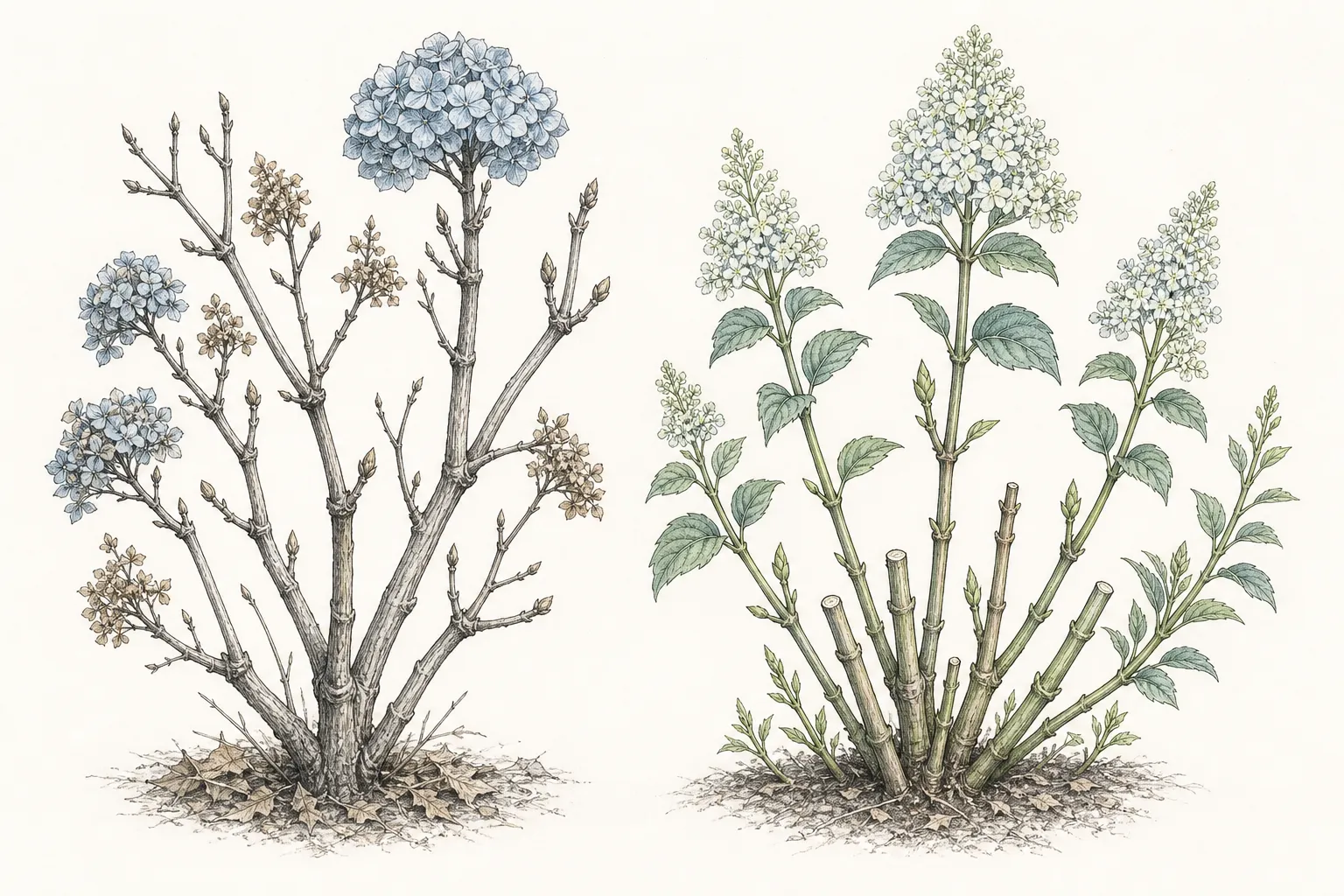
If identification remains uncertain, make only deadwood cuts in spring and watch where flowers appear. Mark stems that bloom from overwintered buds and note new shoots that flower later. One season of observation costs less than removing an old-wood crop of buds. University of Maryland Extension emphasizes that many hydrangeas cannot replace flower buds accidentally removed before bloom.
Pruning is optional for many healthy hydrangeas. It can remove confirmed dead growth, thin a crowded framework, manage an established form, or renew a damaged shrub, but it cannot permanently hold a large cultivar in a narrow space. When annual severe reduction is required to clear a path or window, transplanting or choosing a naturally smaller cultivar is the more durable correction.
Write the group on a weatherproof label near the shrub. Use `old wood—after flowering` for H. macrophylla, H. serrata, H. quercifolia, and climbing hydrangea; use `new wood—late winter` for H. arborescens and H. paniculata. Add `reblooming` only when the named cultivar is documented to flower from both ages. This small record prevents the common error of remembering flower color but forgetting the wood that carries its buds.
Identify the flowering group before shortening living stems
Use species, cultivar and retained stem evidence to choose the hydrangea pruning rule. Confirmed dead tips can be assessed separately from healthy flower-bearing framework. If the group remains uncertain, preserve living stems and record where flowers develop. A single spring height or a hedge-like outline cannot serve all of the flowering groups described below.
Read buds before deciding a height
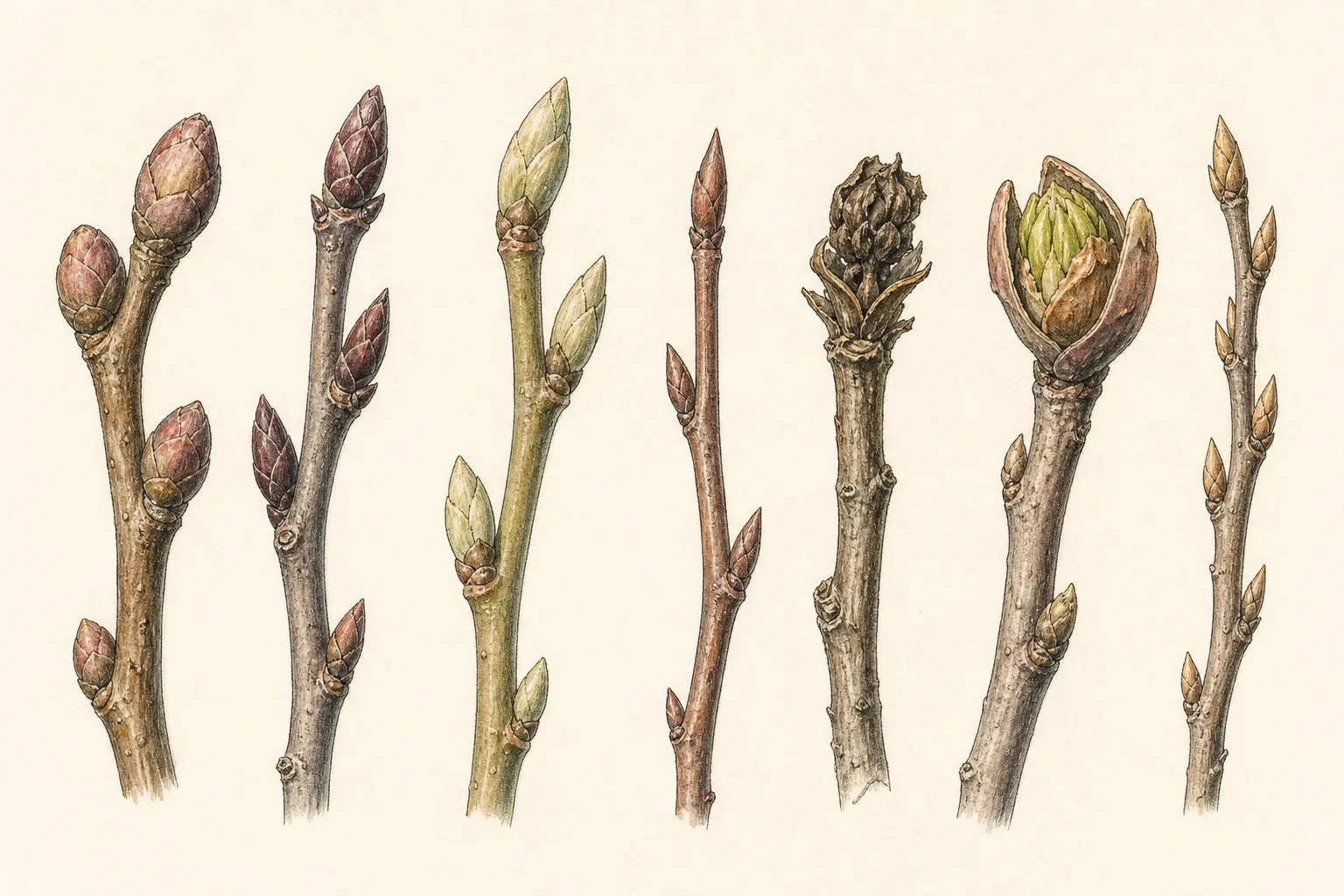
Inspect representative stems from the center, edge, sunny side, and sheltered side before deciding that the entire shrub is dead or overgrown. On bigleaf hydrangea, rounded flower buds can sit below pointed stem tips; on other types, live buds may remain tight until temperatures settle. Compare bud swelling and stem color across the plant, then set each cut from living buds.
Wait until spring growth makes the boundary between live and dead tissue readable. A dead tip may be dry and budless while lower paired buds are swelling. Cut just above the first healthy pair, leaving a short clean stub clear of the buds. Preserve the living length below a dead tip because surviving buds may hold the season's flowers.
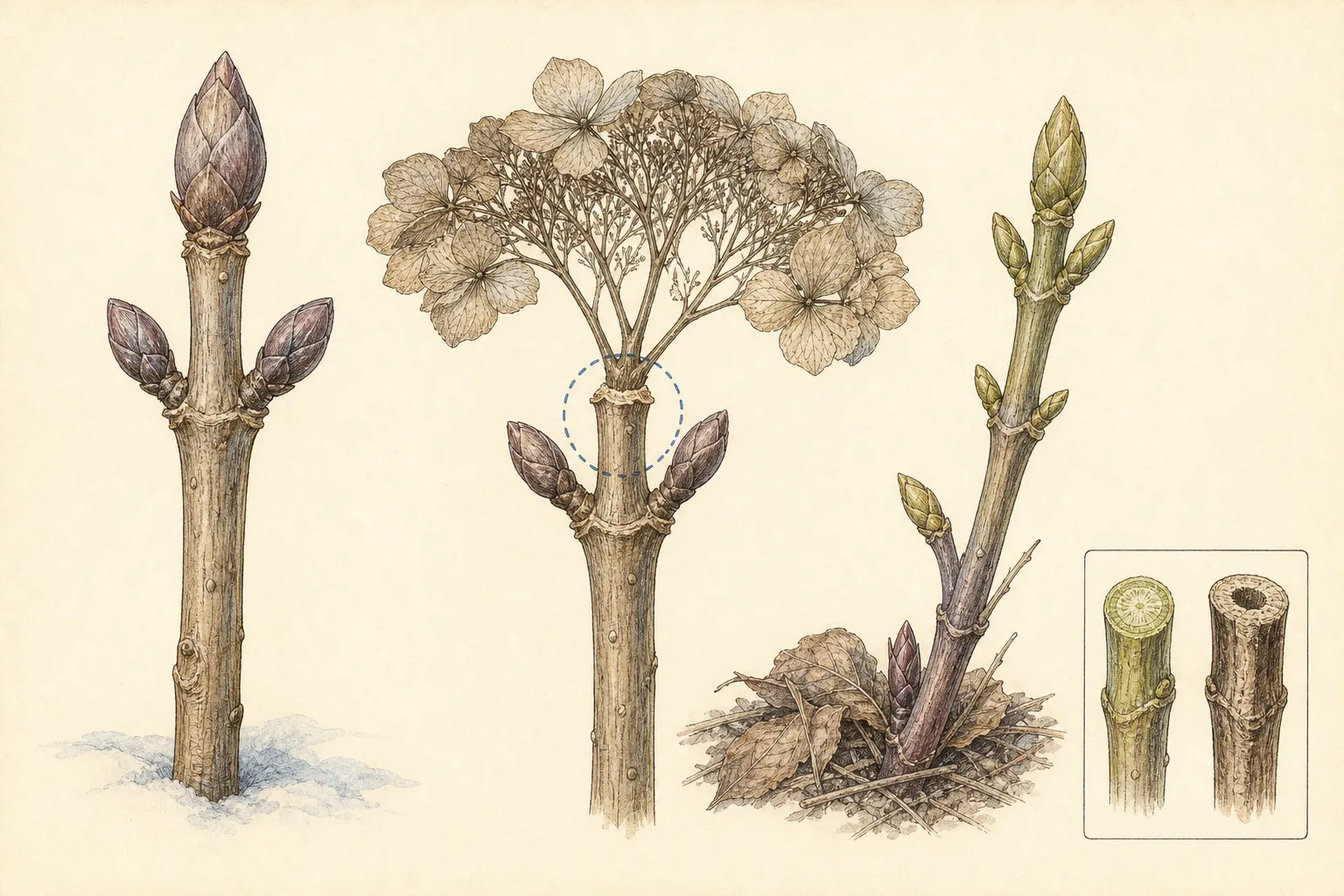
Separate deadheading from structural pruning. Removing a spent flower head at the branch tip does not require taking a long section of stem with it. RHS guidance for mopheads removes the old head in early spring to the first strong pair of buds below; lacecaps can be deadheaded after bloom. If the dried heads are attractive or protect tender buds, leaving them through winter is acceptable.
Bud position also explains why indiscriminate shortening is costly. On an old-wood stem, the large terminal or upper lateral buds may already contain flowers, while lower buds may produce leaves. A cut made several nodes below a faded head can therefore remove more than dead display. Hold the stem gently, trace the first healthy bud pair beneath the head, and make the smallest cut that accomplishes deadheading.
Remove winter damage after life becomes visible
Cold injury can kill only flower buds, the end of a stem, or an entire cane. A shrub that leafs out from lower buds may still be structurally sound even if the first bloom is lost. Delay judgment until multiple stems show their response, especially after a warm spell followed by a sharp freeze. Weather injury is uneven, so a uniform shearing cut removes living evidence along with dead tips.
Start with stems that are unquestionably dead to the base: brittle canes without swelling buds or live tissue where comparable stems are active. Remove them at their origin without nicking adjacent shoots. Then return to partially damaged stems and shorten each to sound buds. Clean cuts at the correct boundary are preferable to cutting all stems low and waiting to see what survives.
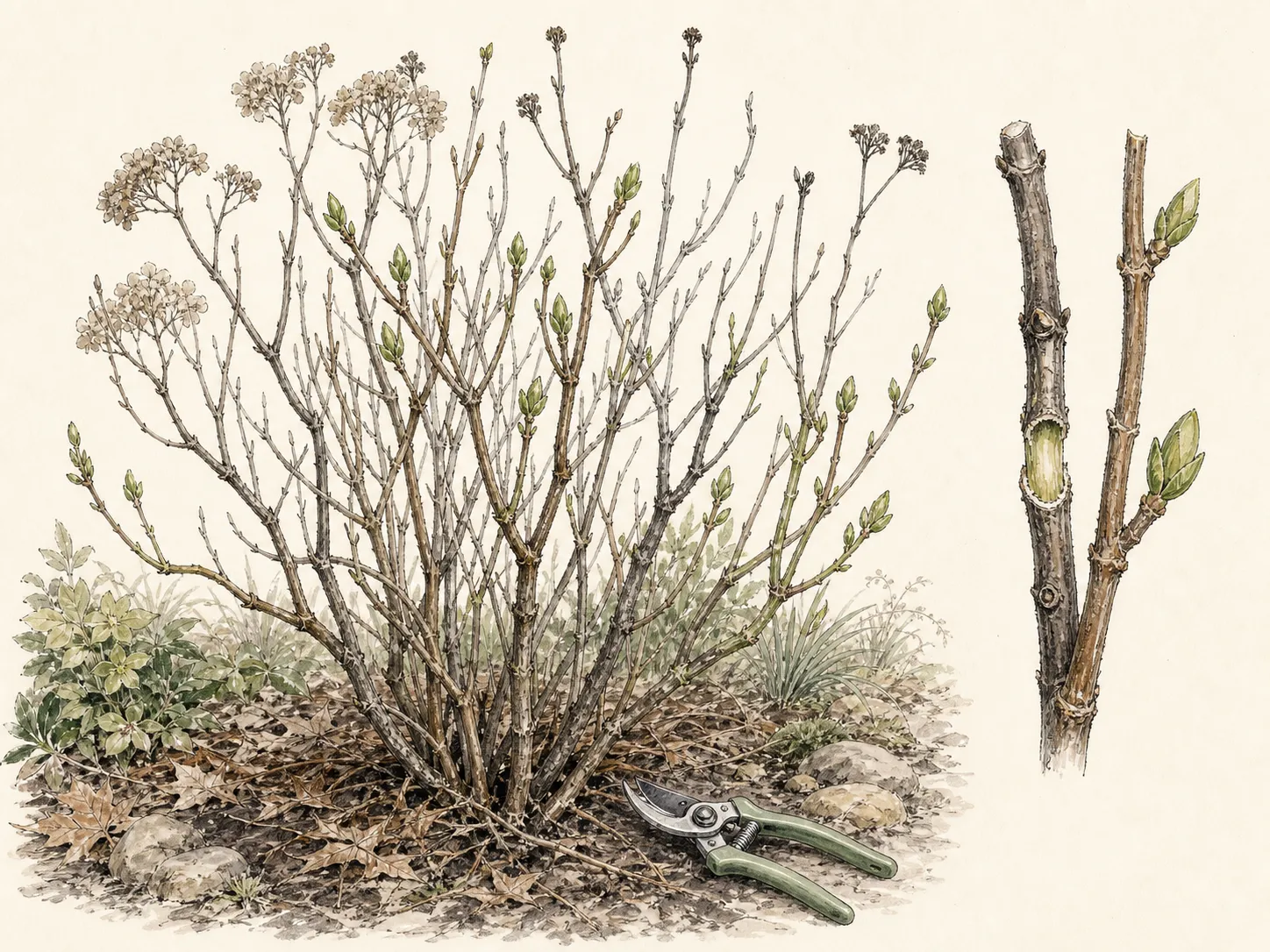
Frost-damaged new shoots may blacken while the older framework remains alive. Give soft tissue time to declare the injury, then trim to healthy growth. RHS guidance cuts affected shoots just above the first undamaged pair of buds. Fertilizer does not revive killed tissue and may promote soft replacement growth before the plant has restored roots and leaf area.
Allow each species and cultivar its normal dormancy-break timing. Panicle and smooth hydrangeas, old-wood species, and individual cultivars can start at different times in the same garden. Check the base for emerging shoots and compare stems of the same plant type. If disease, girdling, or root decline is suspected, obtain a diagnosis before using pruning as the only treatment.
Where only the tip is dead, preserve the living length below it. Where one cane is dead but adjacent canes are active, remove that cane alone. Where every stem is damaged but basal shoots emerge, accept that recovery and flowering may take more than one season. These three patterns require different cuts, even though the shrub looked uniformly brown before budbreak.
Thin for structure, not a smaller cultivar
Thin a dense shrub by removing selected stems at the base, not by clipping every outside tip. Whole-stem removal opens interior space and preserves the natural outline. University of Maryland Extension notes that improved air circulation can reduce leaf wetness and disease pressure, particularly where bigleaf or mountain hydrangeas are crowded against plants, walls, or solid fences.
Choose the weakest, dead, crossing, badly placed, or oldest declining stems first, and distribute removals through the clump. Stop while enough vigorous canes remain to carry leaves and flowers. On an old-wood hydrangea, every live cane removed in spring may contain buds; thinning can still be worthwhile, but make the bloom tradeoff explicit before a size-control cut.
Heading back a tall stem changes height only for the current season and stimulates growth below the cut. It does not change the cultivar's mature genetics. Avoid turning a broad hydrangea into a dense shell of short shoots through repeated shearing. If clear access requires removing a large portion every year, relocate the shrub or replace it with a compact selection.
Renewal pruning is a separate decision from routine thinning. Cutting most old stems to the base can rebuild a badly damaged or sparse shrub, but old-wood types may not flower for a year or longer while replacement canes mature. Stage renovation when bloom continuity matters: remove a portion of the oldest framework, evaluate regrowth, and continue in a later year while retaining flowering-age stems.
Treat old-wood types conservatively in spring
Treat bigleaf, mountain, and oakleaf hydrangeas conservatively in spring because their main flower buds were formed the previous summer and autumn. Limit work to deadheading, confirmed winter damage, and necessary thinning. If substantial reshaping is needed, prune soon after flowering so replacement shoots have the remaining growing season to mature and form buds for the next display.
Reblooming cultivars reduce the penalty for mistimed cuts while preserving the value of old-wood buds. Their old-wood buds produce the earliest flowers; new shoots can add later flowers. Early spring pruning may delay the display, and midseason pruning can interrupt rebloom. Remove as little living wood as the objective requires, and keep the cultivar label because not every bigleaf or mountain hydrangea is remontant.
Climbing hydrangea also flowers on older growth and is not routinely cut like a shrub. RHS guidance shortens overlong shoots after summer flowering while preserving the productive upper framework. Extensive renovation can suppress bloom for several seasons, so spread major reductions across years and confirm that the wall, tree, or support can be serviced safely before beginning.
Oakleaf hydrangea likewise deserves more than a generic mophead rule. It can mature into a large architectural shrub with exfoliating stems and winter structure, and Maryland groups it with old-wood bloomers. Remove only dead, crossing, or truly obstructive wood in spring. If its eventual spread is incompatible with the site, repeated low cuts sacrifice both flowers and form; a larger position or smaller cultivar is the cleaner solution.
Shape new-wood types with a flower tradeoff in mind
Smooth and panicle hydrangeas flower on current-season growth, so late-winter or early-spring pruning does not remove dormant flower buds. Remove dead and weak stems first, then choose how much height to retain. A low framework can produce fewer, larger clusters on vigorous shoots; a taller framework preserves shrub scale and may yield more, smaller flower heads.
Set a framework height for each panicle hydrangea form and cultivar. Large cultivars can become shrubs or small trees, and tree-form plants depend on a retained trunk and branch framework. Cutting a standard to the ground converts or ruins that form. Shorten last year's shoots to healthy buds only within the established structure, and leave enough well-spaced wood to carry summer flower weight.
Smooth hydrangeas can be cut lower when renovation or large flower clusters are the goal, but the strongest new stems can still flop under oversized heads. Match pruning severity to support, exposure, and cultivar. New-wood flowering permits timing flexibility; it does not make hard annual pruning mandatory or turn poor light, crowding, and weak roots into pruning problems.
Flower size and flower number move in opposite directions under some severe new-wood pruning. Maryland's trial example shows a hard-cut smooth hydrangea with fewer but larger clusters than neighboring unpruned shrubs. Choose that tradeoff only when the stems can support the result and the design calls for it. A mass planting may look better with more moderate heads, while a cutting garden may favor fewer large blooms.
Record the response and next bloom
Map the result at flowering time. Note which marked old stems carried the first blooms, whether new shoots flowered later, and which cuts produced weak or crowded regrowth. A simple photograph from the same angle makes next spring's identification easier and reveals whether thinning improved the framework without erasing the natural habit.
Record winter injury separately from pruning response. A bigleaf hydrangea that leafs out but does not flower after severe cold may have lost buds before the pruners arrived. Conversely, bloom concentrated on uncut stems points toward a timing error. Keep local minimum temperatures, cultivar name, and cut date together so weather and maintenance are not confused.
Plan the next cycle from the evidence. Old-wood types may need no cut beyond deadheading; new-wood types may need only a few weak stems removed; a crowded shrub may benefit from selective basal thinning. Stop using an annual calendar entry as permission to cut every hydrangea. The correct date follows species, cultivar, living buds, and the specific job.
Keep a simple stem map when winter damage repeats. Mark a few canes with loose labels noting `uncut`, `tip removed`, or `basal thinning`, then compare flower timing and regrowth. This avoids changing the entire shrub at once and clarifies whether cold, shade, deer browsing, or pruning removed the first flush. Remove the loose markers after the lesson is recorded before they constrict expanding stems.
Use bloom position as the final group check. Flowers opening only on overwintered marked canes confirm the importance of old wood; clusters on fresh shoots confirm a new-wood response; a second flush from new shoots supports a reblooming cultivar. Keep the observation tied to the label and weather record. One season's cold injury can hide normal group behavior, so repeat the map after a milder winter before changing the long-term rule.
Steps
- Level
- moderate
- Time
- 30–90 minutes per shrub
- Tools
- bypass pruners, loppers, labels
- Materials
- disinfectant only when disease is diagnosed
- 1Identify species and cultivar
Recover the species and cultivar from the label, flower form, leaves, and growth habit. Classify it as old-wood, new-wood, or reblooming before removing live stems; if identification remains uncertain, restrict spring work to confirmed deadwood and observe where flowers form.
- 2Inspect representative stems
Inspect buds on several stems around the shrub. Compare sheltered and exposed sides, look for swelling paired buds and basal shoots, and distinguish a dead tip from a dead cane. Wait for readable growth, then choose cuts stem by stem.
- 3Remove confirmed dead tips
Cut fully dead canes at their origin and shorten partially injured stems to just above the first healthy bud pair. Let frozen soft shoots declare their damage before trimming, and preserve additional live wood even when stem heights differ.
- 4Thin selectively
Thin only where density, crossing stems, poor airflow, or an aging cane creates a specific problem. Remove selected stems at the base, distribute the cuts, preserve the natural outline, and stop before the shrub loses the live framework needed for leaves and flowers.
- 5Apply the flowering-group rule
For bigleaf, mountain, oakleaf, and climbing hydrangeas, preserve live old wood in spring. Make substantial shaping cuts after flowering if needed. For rebloomers, remember that old wood supplies the first flush even though new shoots can add later flowers.
- 6Clean up without shearing
For smooth and panicle hydrangeas, prune in late winter or early spring after choosing a framework height and flower-size tradeoff. Retain trunks and structural branches on tree-form panicle hydrangeas; new-wood flowering does not require cutting the shrub to the ground.
- 7Map the flowers
Label representative stems and photograph the shrub during bloom. Record cultivar, winter low, cut date, flower location, and regrowth. Use that evidence to reduce next year's pruning and replace the generic seasonal cut.
Related reading
Sources
- Hydrangea Pruning. University of Maryland Extension. Source record · Accessed 2026-08-30.
- Pruning Hydrangeas. Royal Horticultural Society. Source record · Accessed 2026-08-30.
- Caring for spring blooming plants. University of Minnesota Extension. Source record · Accessed 2026-08-30.