Grow · naturalized daffodil lawn mowing cycle
Naturalize Daffodils in Grass and Preserve Next Year's Flowers
Choose a low-mow lawn zone, plant daffodils in irregular drifts after the soil cools, and delay spring mowing until the leaves finish feeding the bulbs.
Published Last updated
In this guide
- Make the mowing agreement first
- Choose the mowing zone before the cultivar
- Match flower timing to the grass calendar
- Draw a drift that can be maintained
- Wait for a regional planting window
- Plant through turf and leave the surface level
- Protect the first autumn and limit lawn feed
- Let leaf condition restart the mower
- Steps
Make the mowing agreement first
A daffodil lawn works only where spring mowing can wait. Choose a part of the grass that may remain uncut for at least six weeks after flowering and, more decisively, until the daffodil leaves have yellowed and become straw-like. Plant there after the soil cools in autumn, return every turf plug level with the lawn, and mow around the patch in spring while the foliage is still green. If the household needs a neat weekly cut across the entire lawn, place bulbs along a border or low-mow edge outside the traffic lane.
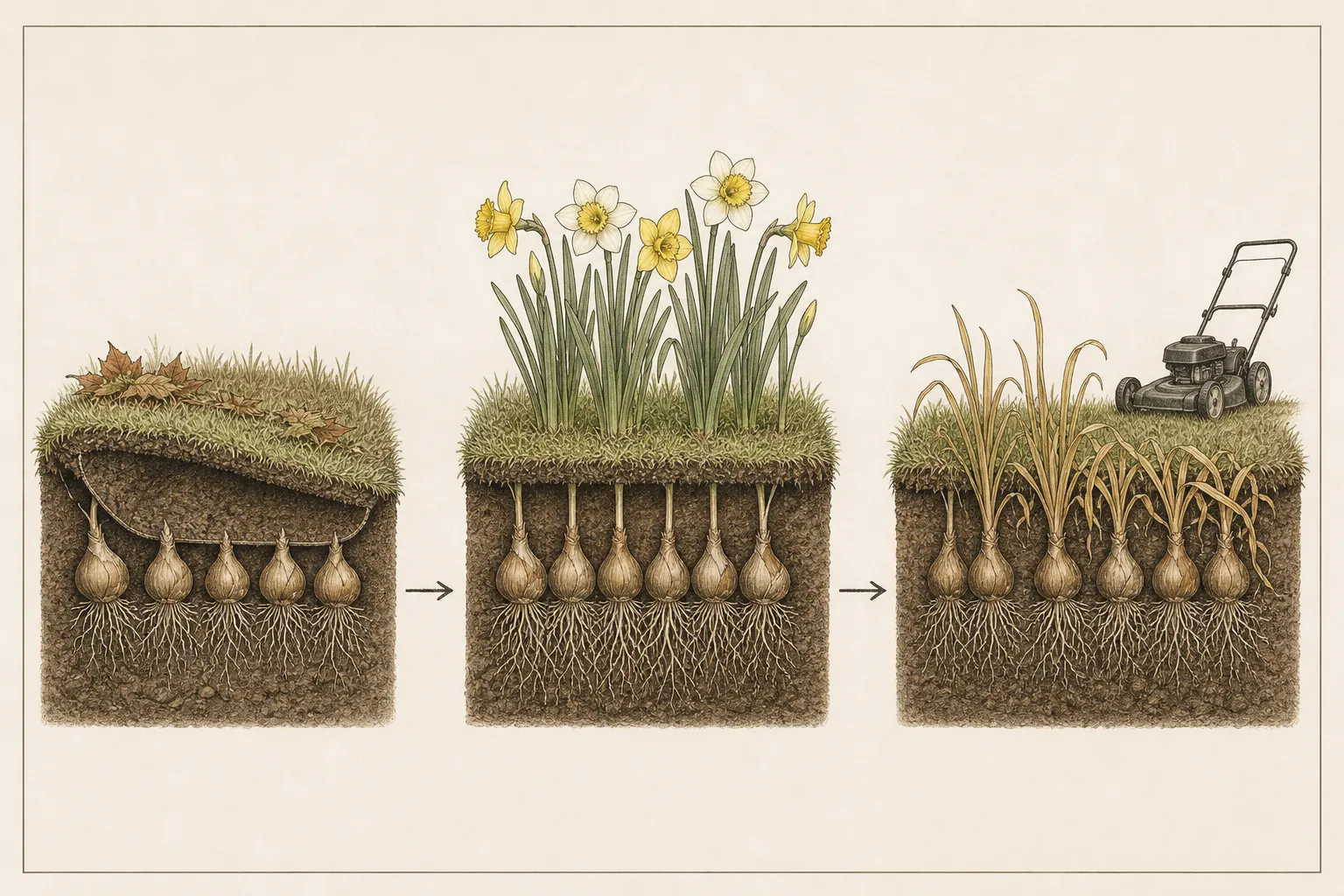
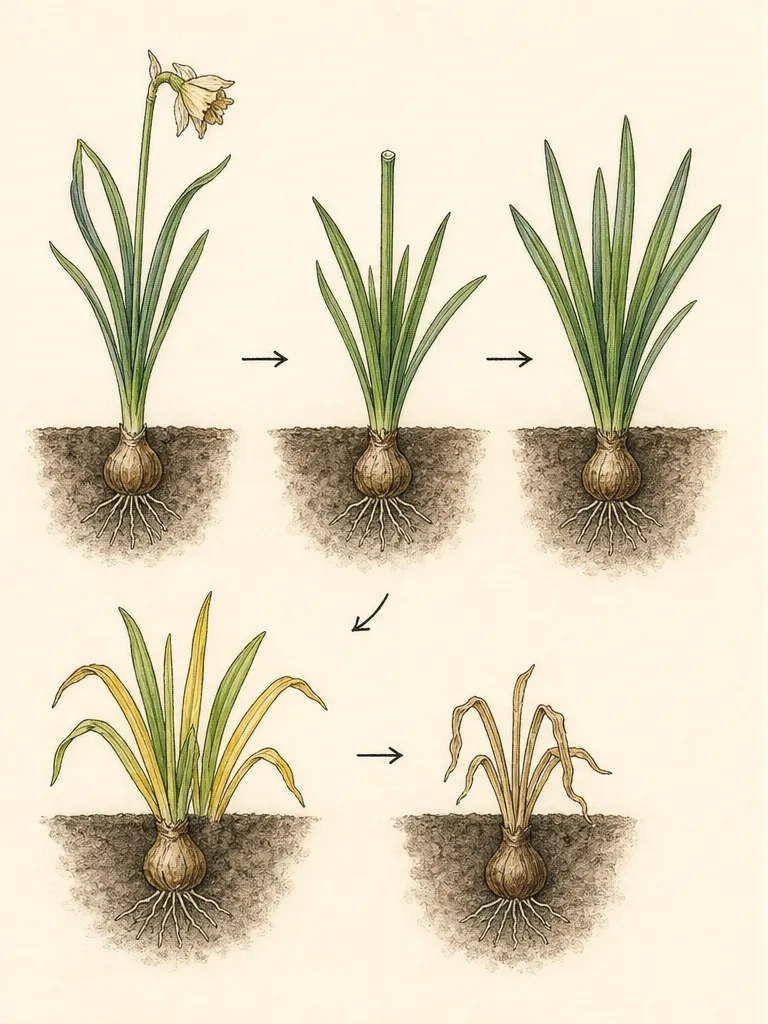
That mowing delay is not optional tidiness advice. Iowa State University Extension explains that daffodil leaves commonly persist for four to six weeks after bloom while manufacturing food that is moved into the bulbs. Cutting them before natural dieback can reduce the stored energy available for the next flowering cycle. The Royal Horticultural Society gives the practical field rule: leave at least six weeks after flowering and ideally wait until the leaves are yellow and straw-like. Time is a minimum check; leaf condition is the release signal.
Naturalizing means building a planting that can remain, multiply, and read as an informal colony, not a bedding display reinstalled each year. That promise changes the design sequence. The gardener must reserve light, drainage, unmown foliage time, and access for several seasons before choosing flower color. A beautiful first spring in the wrong lawn zone is a failed naturalized planting if the only practical response in May is to mow it flat.
Choose the mowing zone before the cultivar
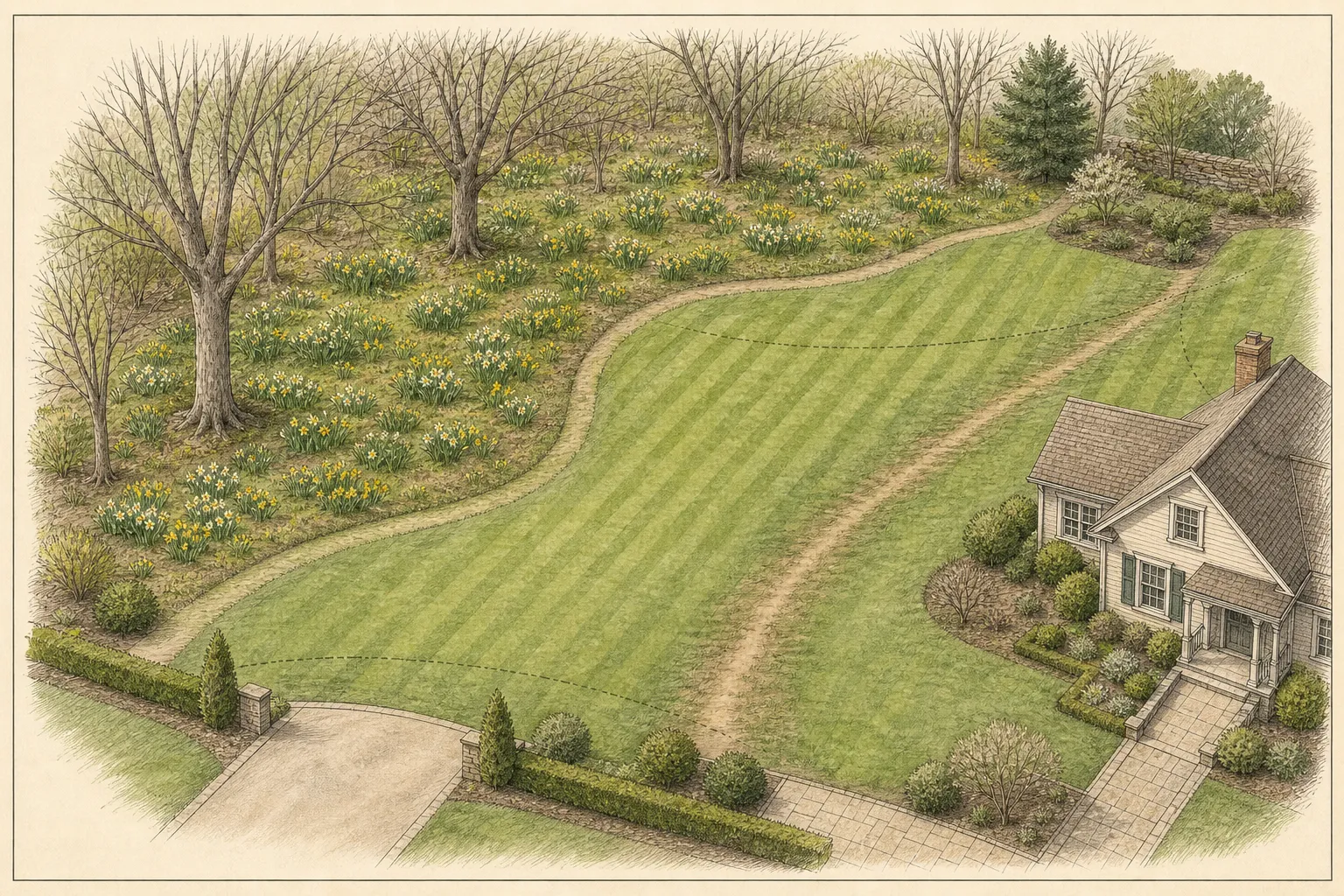
Walk the lawn by use, not by appearance. Keep bulbs out of the main route from door to gate, children's play area, dog run, ball-retrieval line, narrow strip beside parked cars, and any slope where tall spring grass would hide footing. Look instead at an outer arc, the open edge beneath deciduous trees, a broad verge, or the back of an island where a mown perimeter or path can preserve access. Illinois Extension is blunt about the tradeoff: daffodils in grass belong in an out-of-the-way location where delayed mowing can be tolerated.
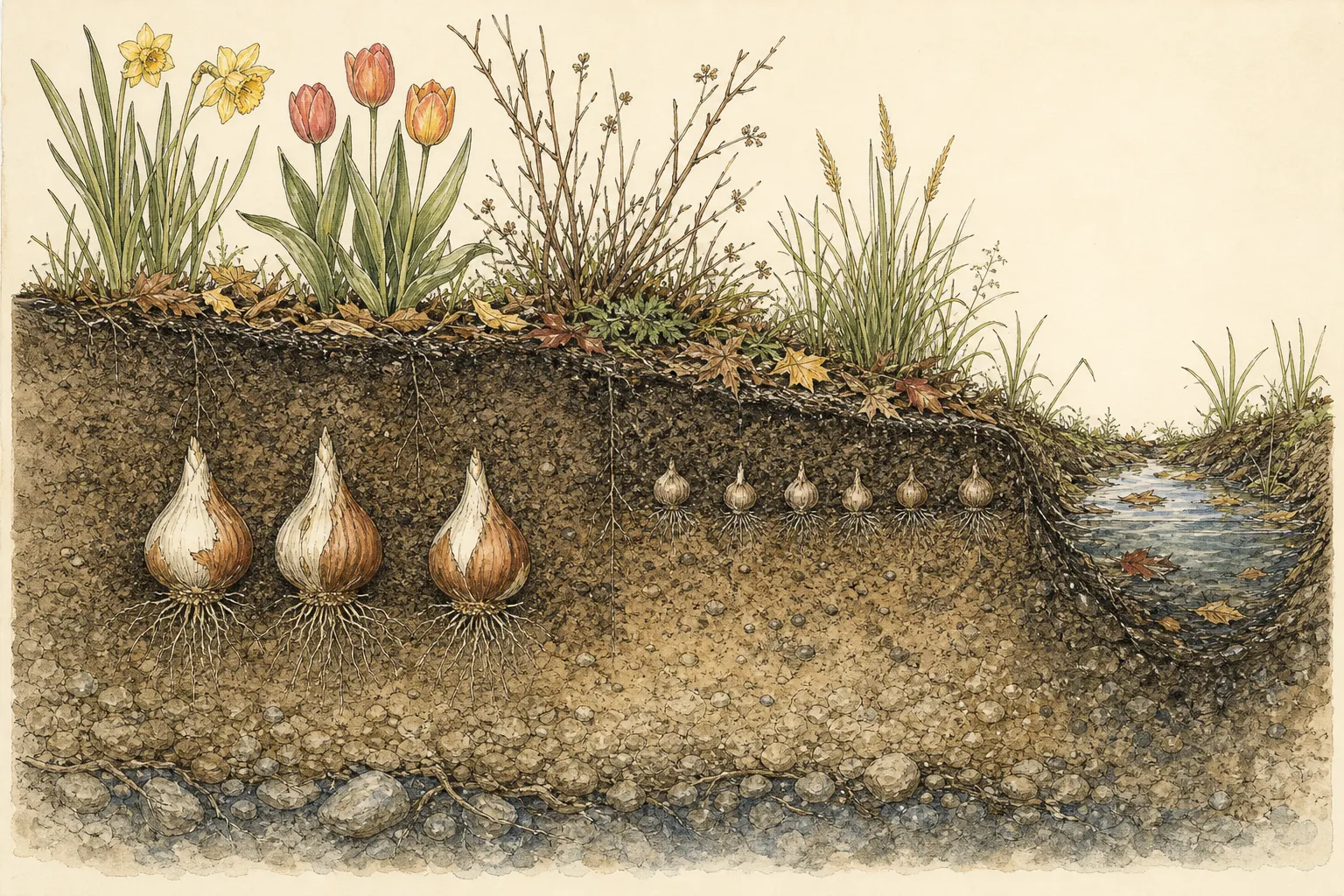
Approve the site during wet weather. A low hollow that holds autumn or winter water is not improved by being difficult to mow. Daffodil bulbs need a draining root zone; standing water and compacted traffic make a poor long-term colony. Probe several points because the lawn surface alone cannot reveal the lower profile. If the bulb planter repeatedly brings up slick, saturated subsoil, shift the drift uphill or into a prepared border; a small amended hole can become a sump in dense soil.
Now consider light through the entire leaf-ripening period. The bare canopy of a deciduous tree can admit generous early-spring light, but a dense canopy that closes immediately after bloom may shorten the useful photosynthetic window. Iowa State advises moving weak, nonflowering daffodils from partial shade to a site receiving at least six hours of direct sun; treat that as a diagnostic benchmark from its guidance, then match the named daffodil and local climate. Evergreen shade is a different constraint because it is present before, during, and after bloom.
Match flower timing to the grass calendar
Choose daffodils that finish flowering early enough for the way this lawn is managed, while remembering that the leaves remain after the flowers. A miniature or early cultivar can keep the uncut interval closer to early spring, but small stature does not erase the ripening period. The RHS lists short-grass choices including ‘February Gold’, ‘Peeping Tom’, ‘Tête-à-Tête’, ‘Hawera’, ‘Jack Snipe’, and ‘Minnow’; its taller-grass list includes later or larger choices such as ‘Actaea’, ‘Carlton’, ‘Ice Follies’, and ‘Mount Hood’. Use those as a starting set, not a universal performance ranking.
Read the supplier's bloom season, mature height, hardiness, and persistence together. A late poeticus daffodil may look graceful in taller meadow grass, yet it postpones the first complete cut. A dwarf cyclamineus hybrid can fit a short-grass edge but disappear from a distant window if scattered too thinly. Confirm that the cultivar is locally hardy and known to return in the region. A naturalized lawn is the wrong place to test a novelty sold chiefly for one showy spring.
Keep one cultivar or a tightly related group within each visible drift. Illinois Extension recommends masses, rejects straight rows, and notes that one variety in a grouping produces a stronger effect and matures together. That synchronized foliage is operationally useful: the patch reaches its mowing threshold as one unit. If a longer season is desired, separate early and late cultivars into distinct islands so the early area can be released while the mower stays clear of green leaves elsewhere.
Draw a drift that can be maintained
Mark the no-mow outline before opening the bulb bags. Use a garden hose, thin rope, or small flags to draw one generous asymmetric shape with a clear edge toward the maintained lawn. Walk the normal route around it and test the mower's turning radius. A narrow waist, isolated single bulbs, and tiny satellites are difficult to see once flowers fade; they invite accidental cutting. One broad crescent or two connected islands are easier to protect than confetti across the turf.
Lay bulbs on the grass in loose concentrations, then adjust the result. The RHS suggests scattering bulbs and planting where they fall, while checking that they are not so close that future crowding reduces flowering. The useful principle is irregularity, not surrendering the design to one toss. Pull bulbs away from an accidental line, widen dense knots, and leave breathing room for offsets. From the main view, the drift should have a concentrated center, broken edges, and a few restrained outliers that still remain inside the marked mowing boundary.
Preserve a mown route as part of the composition. A clean perimeter, curving path, or clipped foreground makes the taller spring patch look deliberate and keeps feet away from soft foliage. It also gives the operator a repeatable line before marker flags become hidden. Sketch the outline, count bulbs by cultivar, and photograph the layout from a fixed point. The record will matter in autumn when there is no foliage to show where the mower stopped in spring.
Wait for a regional planting window
Early September is a good time to assign the lawn zone and secure firm bulbs, but it is not the planting date everywhere. Utah State University Extension places spring-bulb planting after summer heat has left the soil and before the ground freezes, using three to four weeks before freeze as its regional root-development window. The RHS likewise places naturalizing of spring-flowering bulbs in autumn, giving disturbed turf time to re-root before dry or frosty weather. Use current local Extension timing where autumn is warmer, shorter, or nearly frost-free.
Open delivered bulbs promptly. Keep specimens that are firm and full for their type, with a sound basal plate; discard bulbs that are soft or show rot, as the RHS advises. During a short wait for cooler soil, hold sound bulbs in breathable packaging in a cool, dry, ventilated place. Move the shipping carton out of a sunny garage, and plant before healthy bulbs shrivel in pursuit of an ideal calendar date.
Mow the chosen area shortly before planting and remove only loose clippings that would obstruct the work. The grass should be dry enough to cut a clean plug, while the soil below should be moist enough to hold together yet not smear. Postpone if digging creates glossy compacted walls or if heavy rain has filled the proposed root zone. Naturalizing is a long-term installation; one week of waiting costs less than sealing every bulb into damaged wet soil.
Plant through turf and leave the surface level
Before driving a bulb planter or spade into the lawn, identify irrigation, lighting cable, pet fencing, utilities, and tree roots. Use a hand trowel near known shallow services and stop when resistance does not feel like soil. For a modest drift, cut a three-sided turf flap or remove a clean plug wide enough to loosen soil below. A hollow tube planter can be efficient in friable ground, but it is a poor tool if it polishes heavy clay into a narrow sleeve.
Follow the named cultivar's planting direction. Where none is supplied, the retained sources converge on a useful check: about three times the bulb's own height or roughly six to eight inches for many standard daffodils, measured with care from the bulb base to the finished surface. Set the pointed nose upward and the basal plate down on loosened soil. Keep adjacent bulbs separated; several basal plates packed into one narrow hole will crowd as they increase.
Crumble excavated soil back around the bulb, close large air spaces gently, and replace the turf with its crown level to the surrounding lawn. The RHS specifically returns the turf plug level; a sunken lid collects water and catches mower wheels, while a proud plug dries at the edges and creates a scalp point. Water the finished holes enough to settle contact through planting depth when soil is dry, then allow normal autumn moisture to guide further watering. Mark the outside of the whole drift, not every hole with a stake.
Protect the first autumn and limit lawn feed
Keep people and equipment off freshly replaced plugs until roots reconnect the turf. If an edge lifts, press it level while the soil is moist; an added mound of loose topsoil creates another bump. Continue ordinary leaf removal with a rake or a high mower outside the marked drift, taking care not to displace plugs. Remove dense mats of fallen leaves because trapped wet debris makes inspection impossible and can smother the grass surface.
Skip a special fertilizer application made solely because bulbs went into lawn. Iowa State notes that excess fertility near regularly fertilized turf can produce abundant daffodil foliage with little flowering, and regular fertilization is not typically needed in its guidance. Lawn nutrient needs vary with grass species, soil, region, and management. Base amendments on a soil test and current local recommendations, and confirm that any lawn treatment is appropriate around ornamental bulbs before it crosses the drift.
Leave the mapped area otherwise quiet through winter. An early shoot is not a cue to dig, water on a schedule, or add more feed. Protect the surface from repeated foot traffic when thawed soil is soft, and repair only obvious erosion or exposed bulbs. The autumn success check is modest: turf remains level, water drains, markers survive at the perimeter, and the bulb positions remain undisturbed until emergence.
Let leaf condition restart the mower
In spring, begin mowing around the marked drift as soon as the surrounding lawn needs it. Keep the cut line generous because the outer daffodil leaves may lean beyond last autumn's map. A crisp perimeter or a narrow mown path preserves access and makes the taller patch legible as garden design. Remove spent flower heads only if practical, but leave every green leaf open to light; braiding, folding, tying, or flattening foliage reduces the exposed leaf area.
Count six weeks from the end of flowering as a minimum observation point, not an automatic mowing appointment. Inspect several leaves in the center and at the edge. When most have lost green color, turned yellow to straw, and collapse easily with little spring, the bulb's active replenishment period is ending. The RHS supports both the six-week minimum and the yellow, straw-like condition; Iowa State supports allowing complete natural dieback. When in doubt, let the leaves set the date.
Make the first pass high enough that uneven turf is not scalped, then lower the lawn gradually according to the grass species and local practice. Record flowering density, bloom finish, foliage-yellowing date, and the day mowing crossed the patch. If next year's bloom declines, check the record for early cutting, excessive shade during May and June, crowding, planting depth, saturated soil, and excess lawn fertility before buying replacement bulbs. Divide crowded clumps only after foliage has died back, then restore distinct drifts and keep weak bulbs out of new areas.
Steps
- Level
- moderate
- Time
- Two to four hours to map and plant one lawn drift, followed by a delayed-mowing period after spring bloom
- Tools
- Garden hose, rope, or flags for the no-mow outline, Hand trowel, narrow spade, or bulb planter suited to the soil, Ruler or marked planting tool, Watering can or hose with a gentle outlet, Weatherproof perimeter markers
- Materials
- Firm daffodil bulbs suited to the local climate and mowing schedule, Breathable packaging for a short cool, dry hold if soil remains warm, A simple cultivar and planting map
- 1Reserve a low-mow zone
Choose a draining lawn edge outside circulation and play routes where mowing can remain outside the drift for at least six weeks after bloom and until foliage is yellow and straw-like. Reject the project if the whole lawn must stay on a weekly spring cut.
- 2Check drainage and leaf-season light
Observe the site after rain and through deciduous canopy closure. Move the drift away from ponding soil, compacted traffic, persistent evergreen shade, and any place where daffodil leaves cannot receive useful light after flowering.
- 3Select a compatible bloom window
Match cultivar hardiness, mature height, persistence, and bloom season to the local lawn calendar. Keep each drift to one cultivar or a synchronized group so its foliage reaches the mowing threshold together.
- 4Map one maintainable shape
Outline a broad irregular crescent or connected island, test mower turning space, preserve a clipped path or perimeter, then arrange bulbs in loose concentrations free of rows, tiny satellites, and future crowding.
- 5Wait for cooler autumn soil
Use current regional guidance to plant after summer heat leaves the soil but with time before ground freeze. Inspect arrivals promptly and hold only firm, sound bulbs briefly in cool, dry, ventilated conditions.
- 6Open turf and set depth
Locate shallow services first, lift a clean plug or flap, and follow the cultivar's planting direction. Use about three times the bulb's height as a general check when no specific depth is provided.
- 7Restore the lawn surface
Set the basal plate down, close soil around the bulb, replace turf exactly level with the surrounding grass, water to settle dry soil, and mark the outside boundary until spring.
- 8Mow around green foliage
Keep spring cuts outside the drift, leave leaves unbound and open to light, and restart mowing across the bulbs only after the minimum post-bloom interval and visible yellow, straw-like dieback agree.
- 9Record and correct the cycle
Note flowering, shade, yellowing, and first-cut dates. Investigate early mowing, shade, crowding, depth, drainage, or excess turf fertility before replacing a colony that flowers less strongly the following year.
Plants in this guide
Related reading
Sources
- Bulbs: Naturalising in Grass. Royal Horticultural Society. Source record · Accessed 2026-08-29.
- Landscaping with Bulbs. University of Illinois Extension. Source record · Accessed 2026-08-29.
- Putting the Yard and Garden to Bed. Utah State University Extension. Source record · Accessed 2026-08-29.
- Why Won't My Daffodils Bloom?. Iowa State University Extension and Outreach. Source record · Accessed 2026-08-29.