Gardens · november seed head evergreen garden
Design a November Garden with Seed Heads and Evergreens
Build a late-autumn composition from durable seed-head silhouettes, scaled evergreen masses, open ground, and one measured Zone 5b planting plan.
Published Last updated
In this guide
- Design for the month after flowers stop leading
- Compose silhouettes before judging color
- Choose seed heads that persist for different reasons
- Use evergreens as measured counterweights
- Build one measured Zone 5b composition
- Let the moisture pattern shape the planting field
- Edit the border in late winter, not at first browning
- Substitute by silhouette, scale, and site
- Design ideas
Design for the month after flowers stop leading
A November garden is read after summer color has thinned and before reliable snow transforms the ground plane. What remains is proportion: the dark mass of an evergreen, the vertical haze of grass panicles, the hard punctuation of cones, the broad disks of dried flower heads, and the spaces between them. The Morton Arboretum's four-season guidance describes winter as a time when evergreens become more dominant and persistent seed structures carry interest. November is the transition when those roles first need to work together.
Begin from the view that matters on short days. It may be a kitchen window at breakfast, a front path used after work, or a terrace door seen from a warm room. Photograph that view after leaf drop and draw the bed as three height bands: permanent background or anchor masses, standing herbaceous structure, and low foreground. This is more useful than starting with a list of plants because it exposes whether every shape is the same height and whether a shrub is blocking the only important line of sight.
The goal is not to freeze the garden in a tidy autumn pose. Dried stems lean, birds remove seed, snow presses on panicles, and individual perennials disappear at different rates. Build redundancy into each visual job. Three grass columns can lose one and still create rhythm. A group of coneflower cones can thin without leaving the foreground empty. Evergreen structure carries the composition when the herbaceous layer changes, but it should not occupy so much space that November becomes a static conifer planting.
Compose silhouettes before judging color
Reduce a proposed border to black shapes on white paper. A rounded pine is a dense mound, 'Northwind' switchgrass is a tall narrow column with an airy crown, purple coneflower is a field of thin stems ending in small dark cones, and 'Autumn Joy' stonecrop is a shorter cluster ending in broad flat heads. Those four silhouettes stay distinguishable when green, pink, and yellow have faded. A palette of many plants with the same rounded outline will not gain clarity simply because their summer flowers differed.
Scale every silhouette from a reliable mature dimension. North Carolina Extension lists 'Northwind' at about four feet six inches to five feet high and two feet six inches to three feet wide. Missouri Botanical Garden lists Echinacea purpurea at two to five feet high and one and a half to two feet wide. North Carolina gives 'Autumn Joy' a compact one-and-a-half-to-two-foot height and width. Those envelopes place grass above, coneflower through the middle, and stonecrop in the lower field without pretending every nursery pot will remain small.
The evergreen must also be drawn at maturity. Missouri Botanical Garden describes Pinus mugo 'Mops' as roughly three to four feet high and two and a half to three feet wide, with slow growth and a rounded habit. It is a compact pine, not a permanent one-foot bun. Giving it a three-foot envelope keeps paths, perennials, and neighboring pines from being swallowed later. The dark needles then function as a real mass behind skeletal stems, not as a temporary retail-scale dot.
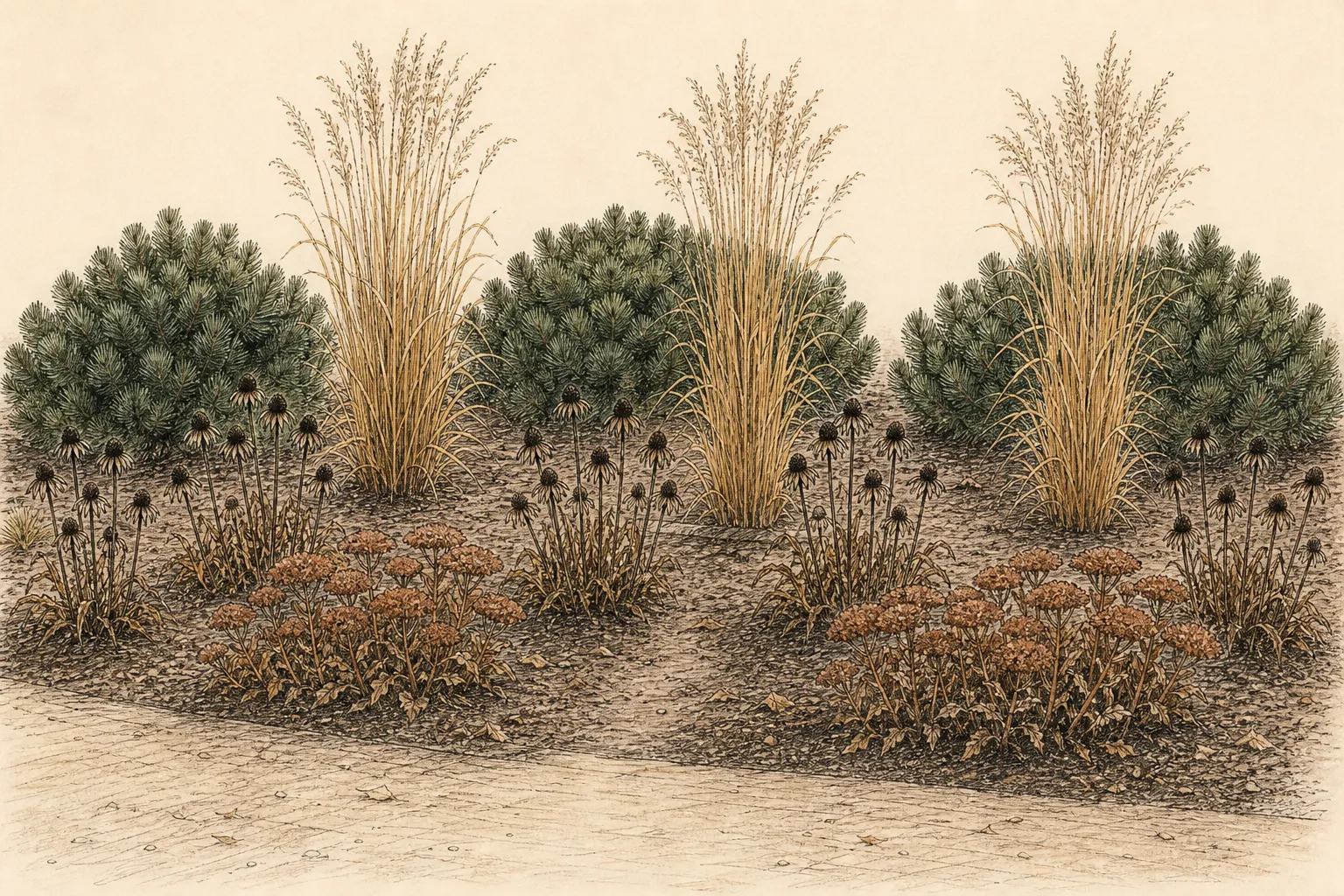
Open ground completes the silhouette system. A strip of mulch, gravel, low dormant foliage, or simply visible soil separates one plant form from the next and makes fallen stems detectable. In November, negative space is not a planting failure. It is the pause that lets a copper disk sit in front of a dark mound and allows a fine grass panicle to register against the sky or fence.
Choose seed heads that persist for different reasons
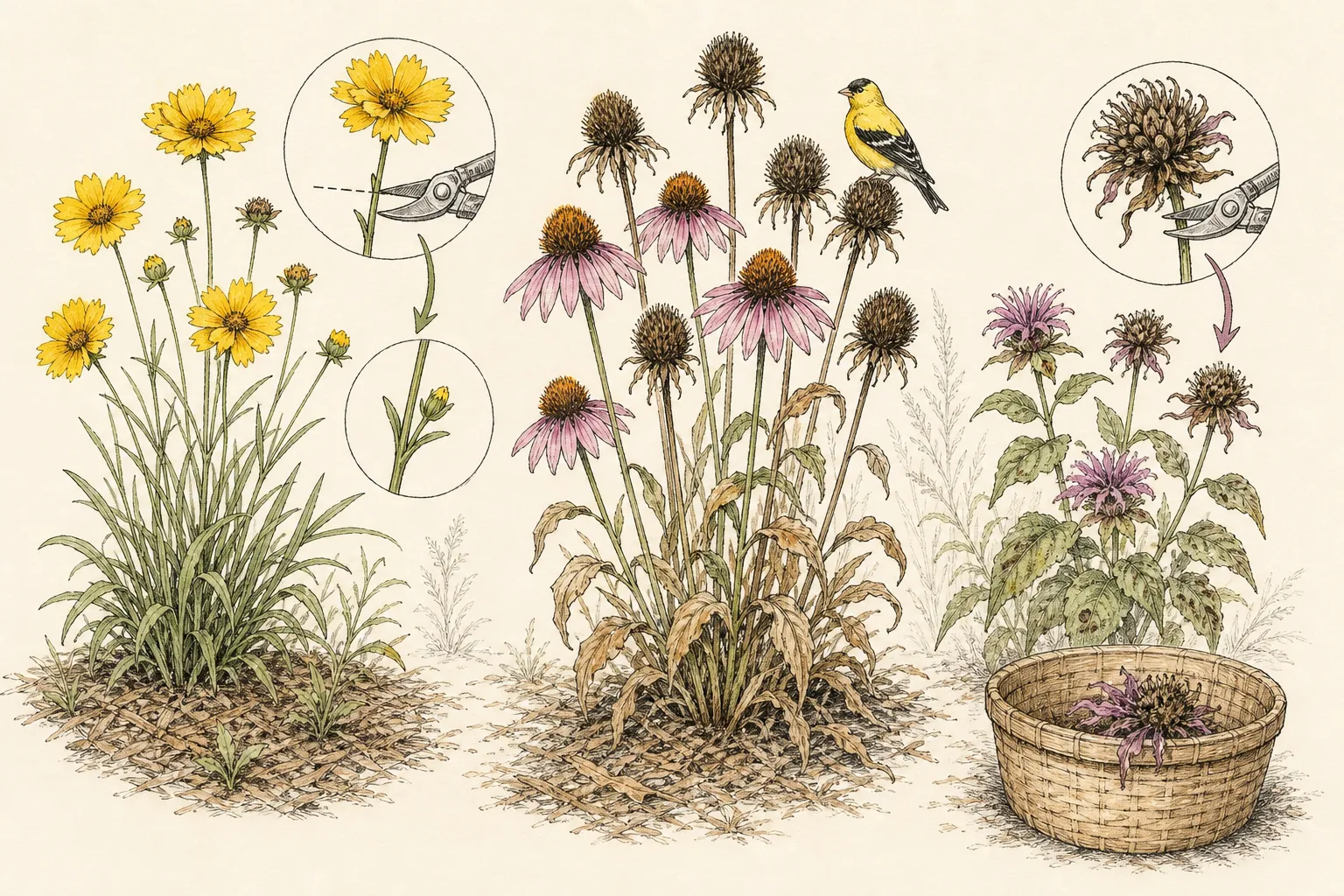
Seed-head persistence is structural, not just botanical. Echinacea purpurea carries a stiff central cone on erect stems; Missouri Botanical Garden notes that dead flower stems can remain upright well into winter and that uncut cones may be visited by seed-eating birds. Expect the number of intact cones to change. The garden should still read when birds empty some heads or wind snaps a few stems, so coneflower works best as a repeated drift instead of a single specimen.
'Autumn Joy' supplies a different geometry. North Carolina Extension documents rounded clumps about eighteen to twenty-four inches high and wide, with browned winter heads that remain ornamental. Its broad cymes make copper-colored platforms close to the ground. Full sun and drainage matter because wet soil can cause rot, and rich or shaded growth may lose the upright form that the November design depends on. Put these plants in a freer-draining part of the bed and let their disks overlap visually, not physically.
'Northwind' adds a veil rather than a dot or plate. The Extension profile describes a dense columnar clump, late-summer branched panicles, following seed heads, and foliage turning yellow-beige. Full sun supports the erect habit. A grass chosen for airy texture loses its design job when crowded into shade and allowed to flop across smaller seed heads. Site each clump where light, moisture, and mature width permit the complete column to stand clear.
Retain only sound structure. Stems already collapsed across a path, diseased foliage that regional guidance says to remove, and wet mushy crowns contribute neither habitat nor design. Selective editing preserves the heads that stand and removes the pieces that create access or sanitation problems. Make this decision plant by plant; an all-or-nothing autumn cutback erases the very distinctions the composition was built to show.
Use evergreens as measured counterweights
Evergreens carry visual mass when deciduous plants become transparent, but a November border needs counterweights rather than a continuous wall. Three repeated 'Mops' pines can establish a dark rhythm across a twenty-foot bed while leaving gaps for tall panicles and low seed heads. Their rounded forms echo one another without becoming a hedge. The eye moves from mound to mound, with herbaceous structure occupying the intervals.
Place each pine according to its sun and drainage requirements, not merely where the drawing needs a dark spot. Missouri Botanical Garden places 'Mops' in full sun to part shade and moist, well-drained loam, with tolerance for sandy soil but not poorly drained wet conditions. The same source notes that mugo pines can struggle in the St. Louis climate and may suffer several pests and diseases. The worked Zone 5b plan therefore assumes cool summers and freely draining soil; a hot humid garden must substitute a locally dependable evergreen with the same three-to-four-foot rounded role.
Keep evergreen color restrained. Medium to dark green pines give coneflower cones and copper stonecrop a stable background. A second gold, blue, or variegated evergreen can compete with the subtle straw and rust range that makes November distinct. If the site already contains a strong blue conifer or bright fence, edit the new palette around that fact instead of adding another accent simply to make the plan look varied on paper.
Evergreen care remains part of the composition. Winter hydration, snow load, salt exposure, and mature access cannot be hidden behind dried perennials. Leave a reachable soil-check point near every pine and a route for selective maintenance that does not require stepping through crowns. A November design is successful when its permanent plants can be inspected after the herbaceous layer closes around them.
Build one measured Zone 5b composition
Use a twenty-foot-long by twelve-foot-deep rectangular bed in USDA Zone 5b, viewed from a path along its south edge. The site receives at least six hours of sun, has cool summers and freely draining loam, and is not exposed to deicing salt. Set the southwest corner as coordinate zero; x runs east across twenty feet and y runs north across twelve. This is a source-bounded demonstration, not a universal package for clay that stays wet, hot humid summers, deep shade, or a region outside the retained plants' hardiness and performance limits.
Place three Pinus mugo 'Mops' at (4, 10), (10, 10), and (16, 10) feet. Six-foot center spacing leaves roughly three feet between their documented mature envelopes and keeps the back line from becoming a hedge. Set three Panicum virgatum 'Northwind' at (3, 7), (10, 7), and (17, 7). Their two-and-a-half-to-three-foot widths remain distinct, and the central grass sits between, not directly in front of, the middle pine so both silhouettes can be read from the path.
In the middle field, plant nine Echinacea purpurea in three loose triangles centered near (5, 4.8), (10, 4.5), and (15, 4.8), with individual crowns about two feet apart within each group. That spacing uses the source's one-and-a-half-to-two-foot spread while allowing the dark cones to read as clustered constellations. Put six 'Autumn Joy' in two offset groups of three centered near (7.5, 2.2) and (13.5, 2.2), each crown about two feet from its group neighbors. Their lower copper disks anchor the path edge without hiding the coneflower stems.
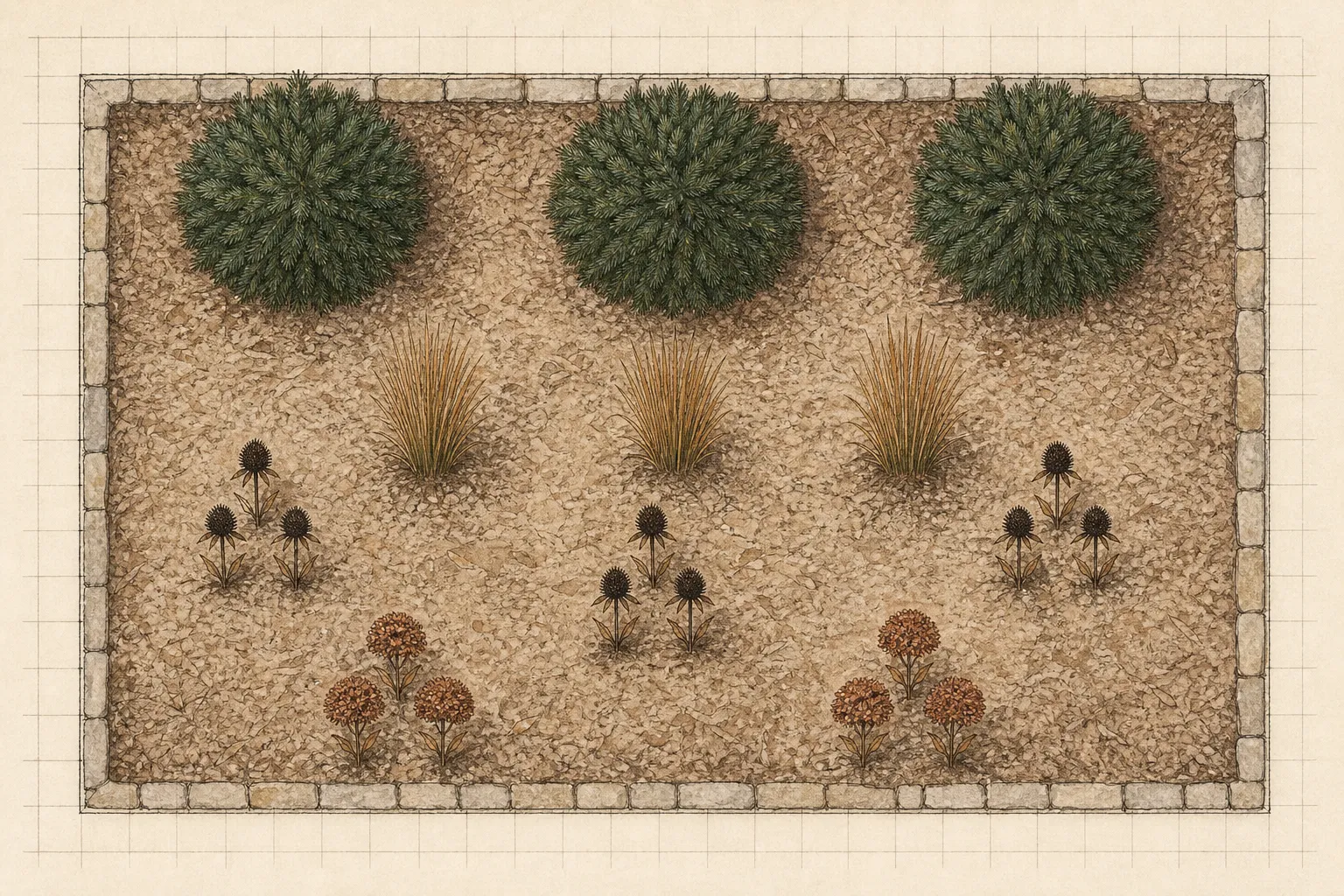
Leave a two-foot maintenance opening into the bed near x=1 and another near x=19, shaping the planted drifts around them. Keep the area immediately around pine crowns visible for moisture checks. The plan totals three pines, three grasses, nine coneflowers, and six stonecrops; it gains richness through repetition and scale, not a long species list. Before planting, mark every mature circle with stakes or hose and view it from the November window or path.
Let the moisture pattern shape the planting field
The four plants share a need for useful light but not an identical moisture preference. 'Autumn Joy' needs good drainage and performs in dry to medium soil; 'Northwind' accepts a broad range and is documented for medium to occasionally wet conditions, though it also tolerates dryness once established. 'Mops' needs drainage and moderate moisture. Echinacea accepts dry to medium well-drained soil. The worked plan assumes one freely draining bed, with stonecrop and coneflower on the slightly higher south half and grass in the ordinary middle loam.
Do not manufacture that gradient with isolated amended pockets. Read where water naturally moves after rain, correct broad drainage problems before planting, and shape the whole surface gently if the site plan allows. A pine sitting in a wet depression and a switchgrass on the driest crown have been placed by drawing rather than by horticulture. Preserve the composition's roles while moving individual centers enough to match real drainage.
Establishment irrigation follows root zones, not the mature visual pattern. Each nursery root ball initially needs direct checks even when a nearby established grass tolerates dryness. As roots expand, water decisions can respond to the bed's broader moisture pattern. A single automatic schedule that keeps stonecrop continuously wet or lets new pine balls dry will undermine the structural qualities selected for November.
Edit the border in late winter, not at first browning
Leave the selected grass, coneflower, and stonecrop structures through November while they remain upright and useful. Inspect after heavy wet snow and wind. Remove stems that break onto the path or collapse over evergreen crowns, and leave the rest. This selective pass maintains access without turning the whole bed into bare mulch after the first storm.
Schedule the main herbaceous cutback for late winter or early spring before new growth, following the exact plant and regional guidance. Missouri Botanical Garden and North Carolina profiles both place grass cutback before spring renewal. Cut material in stages so emerging crowns remain visible and debris does not lodge inside pine branches. Echinacea seedlings can appear where heads were left; edit them while small if the measured plan is losing its open spaces.
Photograph the same view on November 1, after the first hard frost, after the first lasting snow, and just before spring cutback. Mark which heads remained, which grasses leaned, where evergreen mass disappeared behind stems, and where gaps read as intentional or empty. Change one layer at a time the following season. The plan becomes local when observed persistence, not summer memory, guides the edit.
Substitute by silhouette, scale, and site
Outside the worked climate, replace names while preserving the four jobs: a rounded evergreen mass around three to four feet, a narrow standing grass around five feet, a field of small dark cones at middle height, and a low broad seed-head disk. Every substitute needs a verified mature envelope, reliable November structure, and cultural fit. A locally dependable evergreen that grows eight feet wide is not an equivalent just because it is sold as dwarf.
Hot humid regions may need a different compact evergreen than mugo pine. Wet soils may support a different seed-head perennial and remove stonecrop from the plan. Deep shade will change the grass and coneflower layer entirely. Make those substitutions before buying, then redraw every mature circle and the maintenance openings. Keeping the visual grammar while changing the taxa is more faithful to the design than forcing the named Zone 5b plants into an incompatible garden.
A small bed should reduce quantities and perhaps roles, not compress every mature envelope. One pine, one grass group, a coneflower drift, and three stonecrops can carry the same November relationship in a ten-foot border if their future widths fit. A larger bed can repeat modules with variation, but should still include open intervals. Seed heads and evergreens look abundant when their shapes are legible; crowding turns abundance into an indistinct brown screen.
Design ideas
- Style
- Structured late-autumn border with persistent seed heads and rounded evergreen anchors
- Space
- Sunny twenty-by-twelve-foot path-side or window-view border
- Climate
- The worked composition is for a cool-summer USDA Zone 5b site with at least six hours of sun, freely draining loam, no deicing-salt exposure, and a primary view from the south. Substitute every taxon by verified silhouette, mature size, hardiness, moisture fit, and regional reliability when those conditions differ.
- 1Three evergreen punctuation marks
Repeat three rounded evergreen masses across the rear third instead of drawing a solid hedge. In the worked plan, mature 'Mops' pines sit six feet on center, leaving visible air between their roughly three-foot envelopes. The gaps let switchgrass panicles appear against open background and preserve access to inspect each pine's soil and branches.
- 2A narrow grass rhythm
Use three upright 'Northwind' clumps as a vertical counter-rhythm, each with its documented two-and-a-half-to-three-foot width. Keep them out of deep shade and rich floppy conditions. One central column and two offset outer columns create movement without forming a screen that hides the evergreen layer.
- 3Coneflower constellations
Plant Echinacea purpurea as several small triangles rather than a continuous row. About two feet between crowns respects the upper end of the documented spread and allows individual black cones to appear as a group. Birds and weather will edit the heads, so repetition keeps the mid-layer legible when some stems disappear.
- 4Low copper platforms
Place 'Autumn Joy' in two offset groups near the path, where broad dried heads contrast with narrow grass panicles and pointed coneflower cones. Give each plant about two feet, full sun, and freer-draining ground. The lower groups should reveal, not cover, the taller stem field behind them.
- 5Negative space as winter structure
Reserve visible soil or mulch between the mature envelopes and protect two access openings at the bed ends. These gaps separate silhouettes, expose collapsed stems, and keep pine crowns reachable. Fill them only after several November observations prove that the composition lacks continuity rather than because spring nursery pots look small.
- 6A selective autumn edit
Retain upright seed heads and sound grass stems, then remove only material that is diseased under regional guidance, lying on paths, or smothering an evergreen crown. The distinction keeps the designed structure while maintaining access. A full cutback waits until the plant-specific late-winter or early-spring window.
- 7A smaller four-role composition
For a ten-foot bed, reduce the recipe to one correctly scaled evergreen, one group of upright grass, a compact coneflower drift, and three stonecrops. Draw every mature width first. Omitting a role is better than shrinking spaces until plants overlap, and open ground remains part of the late-autumn composition.
- 8Climate-led substitution
Where mugo pine, 'Northwind', coneflower, or stonecrop is unreliable, replace the plant by its visual job and verified mature size. Confirm local hardiness, heat and humidity response, drainage, light, and November persistence. Preserve the mound, veil, cone, and disk relationship while allowing the botanical names to change.
- 9Mature-size sightline stakes
Before planting, set stakes at the outer edge and top height of every mature envelope, then view the mock-up from the window and path that matter in November. Move a center when a pine hides a grass, a grass closes an access gap, or repeated forms align as a rigid row. Keep the source-bounded spacing while adjusting the composition to the real sightline.
Plants in this guide
Related reading
Sources
- Trees and Shrubs for the Four-Season Garden. The Morton Arboretum. Source record · Accessed 2026-08-20.
- Panicum virgatum 'Northwind'. North Carolina Extension Gardener Plant Toolbox. Source record · Accessed 2026-08-20.
- Echinacea purpurea. Missouri Botanical Garden. Source record · Accessed 2026-08-20.
- Hylotelephium spectabile 'Autumn Joy'. North Carolina Extension Gardener Plant Toolbox. Source record · Accessed 2026-08-20.
- Pinus mugo 'Mops'. Missouri Botanical Garden. Source record · Accessed 2026-08-20.