Gardens · small winter garden dwarf conifers
Design a Small Winter Garden with Dwarf Conifers
Design a small winter garden around dwarf conifers by drawing mature size first, spacing strong forms, and using restrained companions to sharpen winter light and structure.
Published Last updated
In this guide
- Start with the winter view, not the nursery bench
- Draw every conifer at ten-year size before naming it
- Build the garden from three habit families
- Use background, drainage, and winter water to sharpen the effect
- Work one source-bounded composition before improvising
- Substitute by role when climate or light changes
- Edit slowly so the garden keeps its winter character
- Check the composition from its winter viewpoint
- Design ideas
Start with the winter view, not the nursery bench
A small winter garden succeeds when the garden is designed from the cold-season view outward, not from a wish list of charming miniature plants. Conifers earn their place in winter because they carry form, color, and structure when the rest of the border is quieter. The RHS guide frames them as year-round structure, especially valuable on darker winter days, and that is the right lens for a small space. Begin by marking the angle from which the garden is actually read in winter: the front path, the kitchen window, the terrace door, or the short approach from the street. That view decides where the strongest form belongs.
Winter use also clarifies the maintenance radius. In a small garden you cannot pretend there is endless invisible service space behind every specimen. Measure how close snow shovels, feet, or hoses will pass. If the bed is raised, rocky, or crevice-like, follow the Illinois rock and crevice garden example and treat drainage, elevation, and narrow planting pockets as part of the design rather than as obstacles. Winter structure looks best when access is clear enough that the garden can actually be maintained through the cold season instead of merely admired from a distance.
This first view-based step prevents one of the most common small-garden mistakes with conifers: planting by collector impulse. Dwarf and miniature conifers are endlessly tempting because each one is distinct. The problem is not that any one plant is wrong. The problem is that a bed of unrelated novelties rarely reads as a winter garden. It reads as a bench collection moved outdoors. If the garden starts with one winter view and one circulation pattern, every later choice about scale, background, mulch, and companion restraint becomes easier to judge.
Draw every conifer at ten-year size before naming it
The word dwarf is relative, not absolute, and Colorado State says so directly: before buying any dwarf or specialty conifer, learn its mature size and plan the site around that dimension. Illinois gives practical scale definitions for small-garden use, calling dwarf conifers those that grow about one to six inches per year and reach roughly one to six feet in ten years, while miniature conifers grow less than an inch a year and stay under a foot in ten years. Those definitions are much more useful than a nursery pot label because they connect smallness to time, not just to current appearance.
Draw the bed with those ten-year or reliable mature outlines before you choose the exact cultivars. This does not mean every plant will remain frozen at a ten-year snapshot forever. It means the composition is built around realistic medium-term proportions rather than around juvenile retail size. A small winter garden does not need many conifers if each one has a clear role and enough space to display its habit. Leaving a gap for a plant to breathe is not wasted area. In winter, that gap is often the negative space that lets color and silhouette read cleanly.
This is also where the article becomes different from a casual plant list. The reason to draw size first is not just to avoid crowding in a vague future. It is to decide what kind of winter composition the space can carry now. A single two-meter golden conifer against a dark fence can be the whole upper register of a tiny bed. A thirty-centimeter mound can anchor the foreground only if something else is not collapsing over it by year five. Scale is the first design decision because every other winter effect depends on it.
Build the garden from three habit families
Small winter conifer gardens read best when the plants do different spatial jobs. Start with one vertical or broadly conical element, then one mounded or globose element, then one low mat or ground-hugging spreader. The exact species change by climate and taste, but the habit contrast is what creates the winter composition. A garden made entirely of cones looks stiff. A garden made entirely of mounds looks static. A garden made entirely of mats disappears. Three habit families are enough to create foreground, middle mass, and a directional accent without turning the bed into a catalog of shapes.
The RHS small-garden conifer list provides excellent examples of how these habits behave in winter light. Thuja occidentalis 'Rheingold' reaches about 2 meters and becomes richer copper-gold in cold weather, especially against a dark background. Pinus mugo 'Ophir' stays low, around 45 centimeters, and turns yellow on the sunlit top while the shaded parts stay darker. Picea mariana 'Nana' forms a restrained mound broader than high, around 30 centimeters tall, and looks strongest against pale gravel or stone rather than dark mulch. These are not random trivia points. They are habit, color, and background instructions.
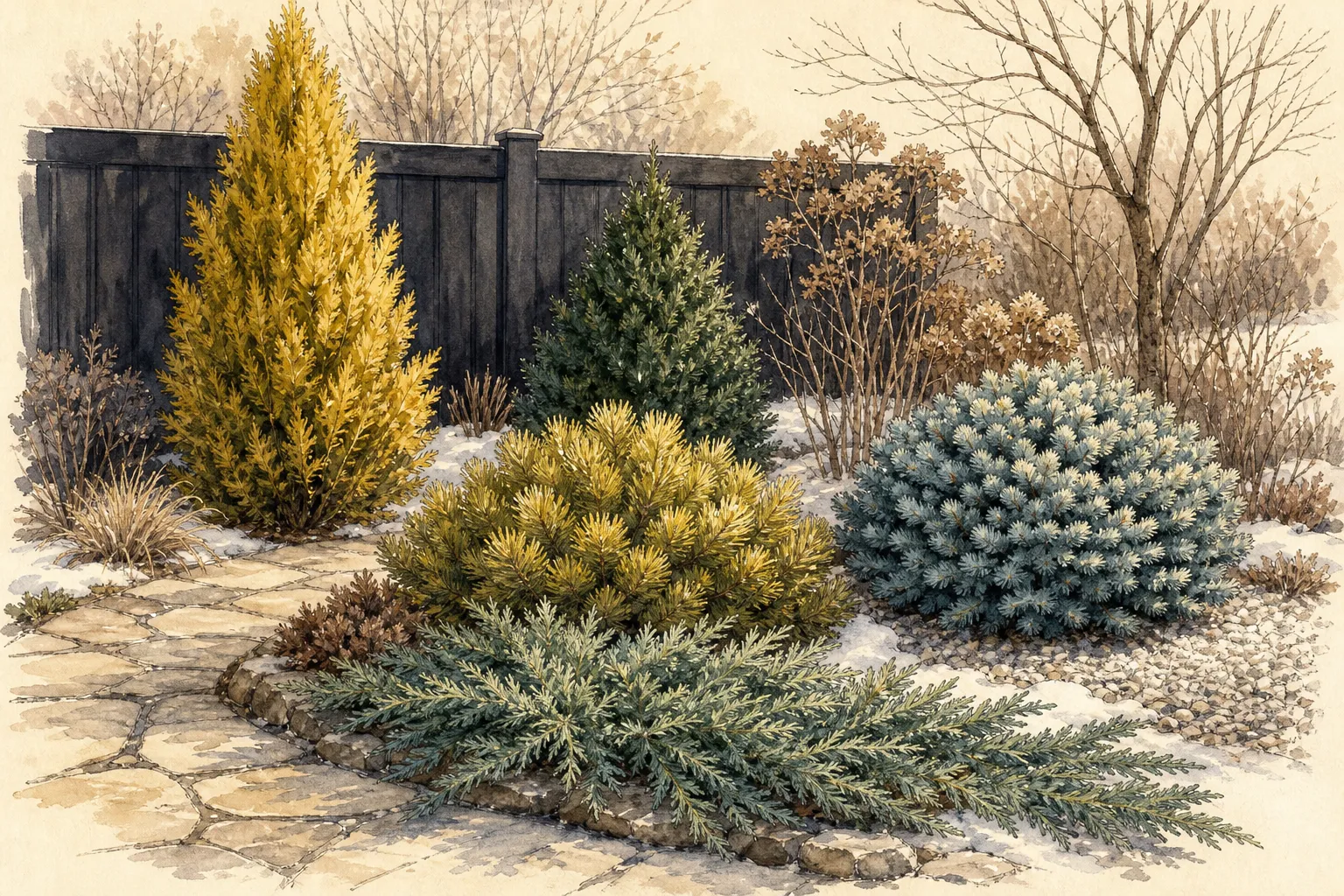
Once habit families are established, spacing becomes more important than plant count. A mat-form juniper such as Juniperus procumbens 'Nana' can be only about 30 centimeters high yet spread far wider, roughly five times as wide as tall according to the RHS article. That means it is not a filler to cram between other plants. It is a design element that needs deliberate room to run. Likewise, a conical dwarf such as Chamaecyparis lawsoniana 'Minima Aurea' is most effective when the eye can read its outline cleanly rather than seeing it merged into the next shrub. In a small bed, form contrast is often the primary ornament.
Use background, drainage, and winter water to sharpen the effect
Conifer color is never seen in a vacuum. The RHS article explicitly notes that 'Rheingold' is brightest against a dark backdrop and that Picea mariana 'Nana' is better against pale gravel, stone, or brick than against dark mulch. Those observations are design instructions, not sales language. If the bed already has a dark fence, hedge, or wall, put the golden winter color where it can glow against that shadow. If the site already has pale gravel or stone, use the blue-green mound where the cool foliage can stand away from the ground plane. The background is part of the planting palette.
Soil preparation and drainage deserve the same level of deliberate design. The Illinois rock, conifer, and crevice example uses improved drainage, raised beds, coarse mineral texture, and pea gravel mulch, while the RHS conifer guide and Colorado State both emphasize that even drought-tolerant-looking conifers still need moisture management and sensible siting. In a small winter bed, waterlogging is often more dangerous than modest dryness because cold saturated soil erases the distinction between ornamental conifer and stressed shrub. Slight elevation, open mineral structure, and a clear runoff path are therefore part of the visual plan, not just the horticultural subtext.
Winter water is the last overlooked layer. Colorado State says dwarf conifers should be watered during warm or dry spells in winter, and the RHS reminds readers that conifers in containers need regular watering even during dry winter periods. This matters because small gardens are frequently container-rich, raised, paved nearby, or otherwise quick to dry when the sun hits them. A winter conifer garden that relies on crisp form still needs the roots kept alive through desiccating spells. The elegant silhouette is only as durable as the drainage and off-season watering that sustain it.
Work one source-bounded composition before improvising
Consider a sunny twelve-by-eight-foot bed in USDA Zone 6, edged by a front path and backed by a dark fence, with freely draining improved soil and winter access from one side. This worked composition is bounded by the sources above and by those site conditions. It is not a universal recipe for every climate. At the back third, place one Thuja occidentalis 'Rheingold' where its mature roughly 2-meter height can stand clear of the path and use the fence as a dark backdrop for winter copper-gold color. Give it space to read as the upper register of the bed rather than as the start of a hedge.
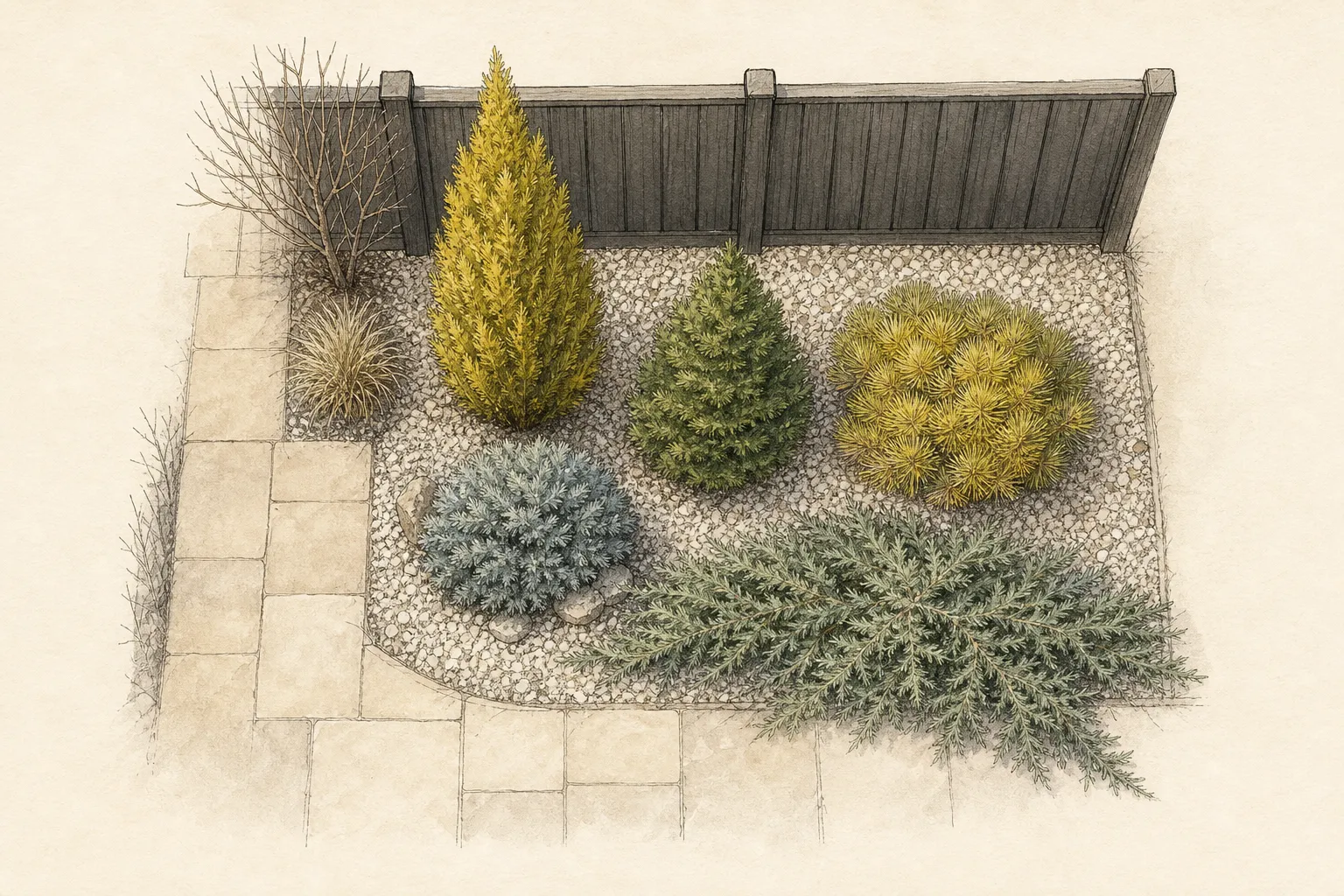
Near the sunniest forward shoulder, place one Pinus mugo 'Ophir' where its low rounded habit and winter yellow top can catch direct light without being crowded from behind. Toward the opposite front quadrant, use one Picea mariana 'Nana' against pale gravel or stone so the blue-green mound shows clearly. Thread a single Juniperus procumbens 'Nana' along the front edge or slightly off-center where a spreading mat can soften the path line without obstructing it. Between those forms, a single Chamaecyparis lawsoniana 'Minima Aurea' can serve as the small upright-conical middle note, staying around 60 centimeters in ten years and only a little over a meter in very long-term scale.
Keep the non-conifer layer deliberately quiet. The Illinois crevice-garden model supports small alpines, sedums, or creeping thymes in narrow pockets, but the winter design point here is not to build a crowded alpine tapestry. It is to keep enough mineral ground and low textural planting that each conifer habit remains readable in December and January. If your climate, site, or plant availability changes, substitute by role: one warm-toned upper accent, one low winter-color mound, one blue-green rock-facing mound, one mat, and one modest conical middle form. Change names when necessary; do not abandon the structure.
Substitute by role when climate or light changes
Not every site can carry the exact sunny Zone 6 composition above. The useful part of the example is its role logic and its explicit limits. If the site receives a little summer shade rather than all-day sun, the RHS article's Taxus baccata 'Standishii' offers a strong substitute for the upright golden note because it keeps a compact columnar habit and prefers a little summer shade to avoid scorch. It is smaller at around 1 meter and can therefore suit even tighter spaces. That shift changes the rhythm of the bed, but not the idea that one vertical or columnar note is needed.
If the whole space shrinks to a trough, terrace, or patio edge, move toward true miniature or very restrained dwarf choices and reduce the number of habit families rather than squeezing them all into a token display. The RHS conifer guide notes that many smaller conifers are good in containers, which is helpful, but containers magnify the watering issue and limit long-term size more severely than in-ground beds. The right response is not to recreate the whole ground composition in miniature. It is to keep one conical or upright form and one low mound or mat so the winter logic survives at a smaller scale.
If the climate is colder, windier, or more drought-stressed than the worked example, hardiness and adapted-site choices override the exact cultivar names. Colorado State's reminder to plan by mature size and sun exposure still applies, and winter watering remains critical. Substitution is responsible only when the new plant does the same spatial and seasonal job. A small winter garden is not improved by insisting on a coveted cultivar that the site cannot support. The better garden is the one whose role structure stays intact while the plant names shift honestly to match local conditions.
Edit slowly so the garden keeps its winter character
Small conifer gardens invite over-editing because every plant is visible and every new cultivar seems plausible. Resist that urge. Illinois notes that size can be influenced by judicious pruning, and the RHS says some size control is possible, but neither source suggests pruning as the answer to careless placement. The best winter conifer gardens look deliberate because the plants were sited for their mature or at least ten-year habit, not because every overgrown branch is clipped back to a remembered outline. Shearing can flatten exactly the contours that made the conifer worth planting.
Use winter photographs from the key viewpoint as your audit tool. Compare the real bed with the drawn plan after two or three seasons, not every few weeks. Ask whether the gold form still has darkness behind it, whether the blue mound still meets pale ground, whether the mat has crossed the path edge, and whether the conical middle form still has air around it. If one plant is beginning to erase another's job, correct the conflict early while the edit is selective. Small gardens reward prompt structural corrections far more than they reward years of denial followed by a severe reset.
The strongest final move is often subtraction. A small winter garden with dwarf conifers rarely improves when another novelty is inserted into every gap. Negative space, mineral surface, and clear view lines are part of the planting. If the bed already offers an upper note, a mound, a mat, and one bridge form, adding a fifth or sixth conifer may reduce the very contrast you worked to build. Winter design feels rich when the eye can separate form, color, and distance. In a small conifer garden, richness usually comes from clarity, not quantity.
Check the composition from its winter viewpoint
Place stakes or empty pots at the proposed mature centers and look from the window, path, or doorway that matters most in winter. The mock-up exposes blocked sightlines and equal spacing that reads as a row. Shift markers until one form leads, another supports, and open ground remains visible between projected crowns.
Design ideas
- Style
- Small structured winter conifer garden
- Space
- Sunny compact path-side or window-view bed
- Climate
- The worked composition assumes a sunny USDA Zone 6 bed with freely draining improved soil, winter access from one side, and a dark fence backdrop. Substitute plants by role when hardiness, sun, drainage, or available space differs.
- 1Dark backdrop for winter gold
Use one golden conifer where winter light can catch it against a dark fence, hedge, or wall. This is where a plant such as Thuja occidentalis 'Rheingold' earns its space, because its cold-weather color intensifies only when it is not visually competing with another bright foreground element. Keep enough distance from the backdrop for air movement and mature spread, and confirm that reflected heat or a roof drip will not turn the visual anchor into the most stressed plant in the bed. Repeat a small amount of its color in stone, bark, or a second low accent rather than adding another equally dominant conifer.
- 2One low winter-yellow mound
Reserve the brightest fully sunny shoulder for a small rounded conifer that changes noticeably in winter, such as Pinus mugo 'Ophir'. The yellowing top should read from the main viewpoint, and the plant needs room around it so the dark lower foliage can act as part of the effect.
- 3A blue-green mound against pale ground
Place a mound-form conifer where stone, gravel, or pale paving can sharpen its color. Picea mariana 'Nana' is especially effective when the bed already contains pale mineral surfaces that let the blue-green needles stand clear of the ground plane.
- 4A true front-edge mat
Give the front edge to a plant that spreads low without trying to become a second mound. Juniperus procumbens 'Nana' needs width more than height, so the design should give it real horizontal territory instead of forcing it into a narrow leftover slot.
- 5A middle conical bridge
Use one modest conical form between the tallest accent and the lowest mat so the composition has a readable middle register. Chamaecyparis lawsoniana 'Minima Aurea' is useful because its ten-year size stays restrained while still giving a crisp conical silhouette.
- 6Raised or crevice drainage where needed
If the native soil stays heavy, borrow from crevice and rock-garden practice with raised beds, improved drainage, and visible mineral mulch. This keeps the winter display from becoming a root problem and also makes the small forms feel intentional rather than stranded in flat mud.
- 7Container reduction, not container imitation
On a terrace or porch, reduce the number of conifer roles instead of miniaturizing every part of a ground plan. One conical form and one low mound may be enough for a winter container grouping, provided watering, drainage, and wind exposure are treated as central design issues rather than afterthoughts.
- 8Shade substitution by role
If the site receives some summer shade, substitute a shade-tolerant upright note such as Taxus baccata 'Standishii' for the gold vertical accent. The point is not to preserve a single named plant everywhere, but to preserve the spatial role of one narrow rising form in the composition.
Related reading
Sources
- 10 award-winning small garden conifers. Royal Horticultural Society. Source record · Accessed 2026-08-19.
- How to grow conifers. Royal Horticultural Society. Source record · Accessed 2026-08-19.
- Rock, Conifer, and Crevice Garden. Illinois Extension. Source record · Accessed 2026-08-19.
- 1704 – Dwarf & Specialty Conifers. Colorado State University Extension. Source record · Accessed 2026-08-19.