Gardens · ornamental grass habit selection
Choose Ornamental Grasses by Habit, Spread, and Seasonal Structure
Compare the mature outline, clumping or running behavior, and year-round structure of ornamental grasses before assigning each one a garden role.
Published Last updated
In this guide
- Start with the job in the garden
- Draw the mature habit, not the nursery pot
- Separate clumping from containment
- Choose a calendar as well as a shape
- Evaluate winter persistence honestly
- Match texture and transparency to viewing distance
- Give each grass a maintenance envelope
- Use named cultivars with precise limits
- Set out the design at full spread
- Edit by behavior, not by sentiment
- Design ideas
Start with the job in the garden
Ornamental grass is a design category, not one predictable shape. A grass may be a narrow vertical marker, an arching fountain, a low mound, a transparent veil of seed heads, a slowly widening clump, or a colony that travels beyond its original point. Decide what the planting needs before visiting a nursery: a view filter, a repeated rhythm, a path edge, a winter silhouette, a moving foreground, or a matrix that covers ground. One plant rarely performs all of those jobs well.
Name the dimensions of the job. A screen needs enough foliage density and height at the season when privacy matters. A path edge needs leaves that do not arch into circulation. A specimen needs space around its outline, while a matrix needs compatible spread and editability. Write the viewing distance and maintenance access on the plan. These details turn attractive seed-head photographs into a practical shortlist rather than a collection of plants with no assigned role.
Keep site limits in the first column. Record summer light, soil drainage, ordinary moisture, wind, reflected heat, hardiness, and regional invasive status. Most familiar ornamental grasses favor sun, but shade-tolerant grasses and grass-like sedges exist, and their forms differ. A grass chosen for the wrong site may flop, thin, scorch, or spread into a stressed open patch. Design value begins with a plant able to keep its characteristic habit under the measured conditions.
Draw the mature habit, not the nursery pot
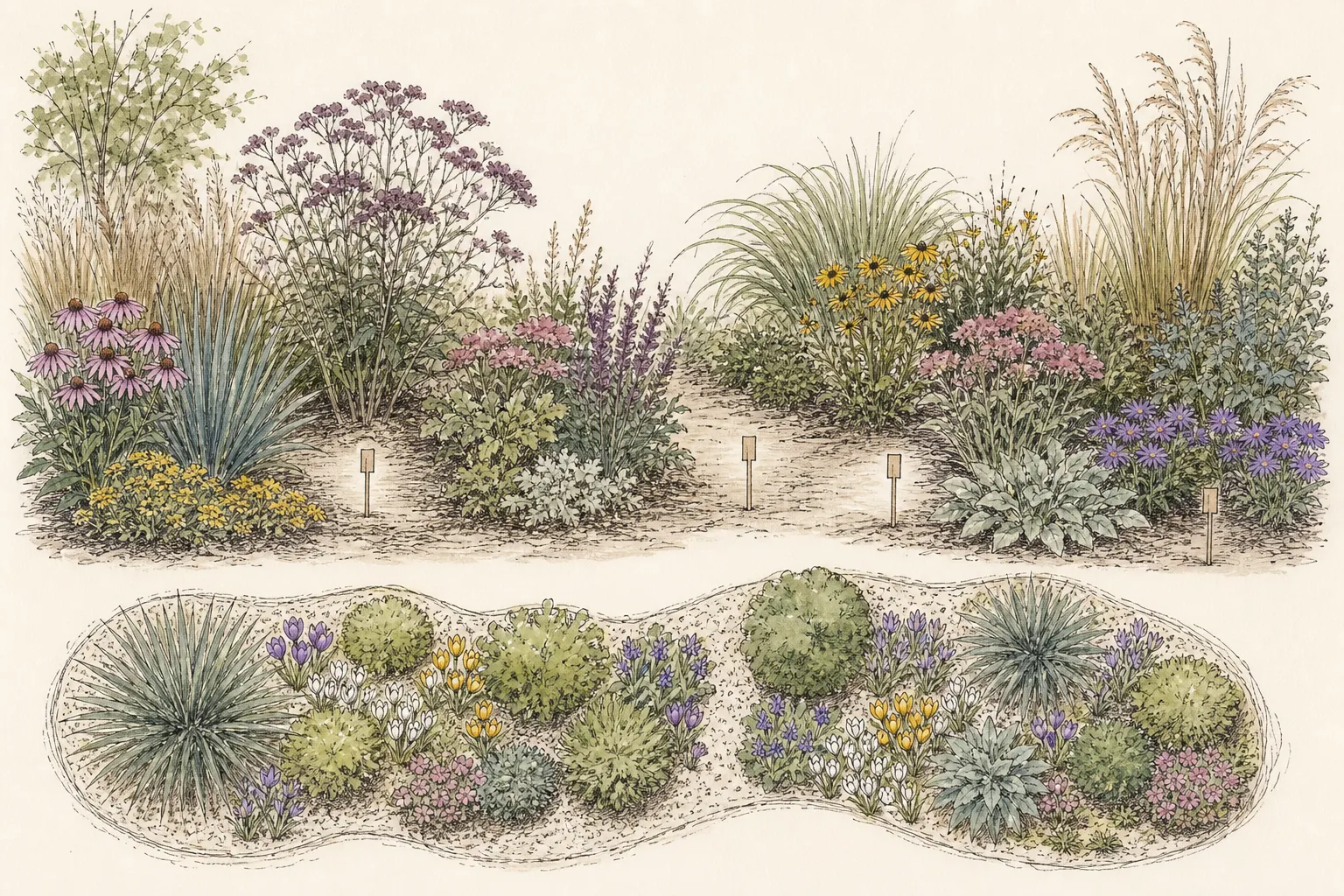
Sketch each candidate as a mature plant in elevation and plan. Draw the leafy base, the widest arch of the blades, and the maximum flowering outline separately. A grass listed as two feet wide at the crown can cast leaves or plumes farther into a path. Conversely, an airy inflorescence may occupy visual space without blocking a view. Use authoritative species or cultivar dimensions and confirm whether listed height includes flower stems.
Sort the silhouettes into useful families. Upright columnar forms hold a narrow vertical line; vase and fountain forms widen toward the top or spill outward; low mounds sit near the ground plane; transparent grasses carry dispersed seed heads above a modest base. These are observational roles, not botanical classifications. Two cultivars of the same species can have different posture, so preserve the full cultivar name whenever a particular outline is the reason for selection.
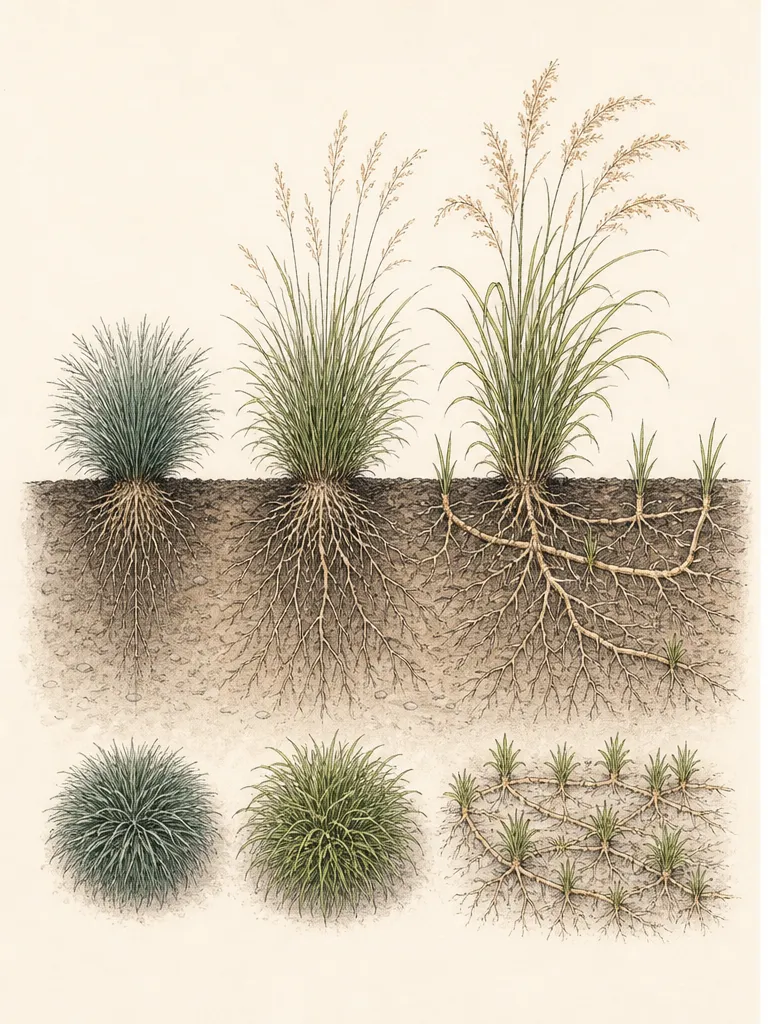
Test the drawing against neighbors at maturity. A fountain placed at the front may cover smaller perennials, while a narrow upright grass can fit between rounded shrubs without swallowing them. Draw winter lean as well as summer perfection. Snow, rain, shade, rich soil, and wind can open a clump. If a path, window, or small companion depends on the grass remaining rigid, choose a form documented for that behavior in your region and leave a margin for natural movement.
Separate clumping from containment
A clump-forming grass enlarges mainly by increasing the girth of its crown. That is useful information, but clumping does not mean fixed at its purchase size or maintenance-free. The crown may become broad, the leaves may arch well beyond it, seedlings may appear, and the center may eventually lose vigor. Reserve the documented mature spread and access for division. A label saying clumping should begin the behavior check, not end it.
Running grasses expand through rhizomes or stolons and can cover ground beyond the original crown. That behavior can stabilize or fill a large area, but it can also invade neighboring perennials, paths, and property boundaries. Ask how quickly the exact taxon moves in comparable soil and climate and how it is controlled. A buried barrier creates future inspection work and may not address seed spread. In a small mixed border, a running habit is usually a decisive limitation rather than a minor note.
Distinguish vegetative spread from self-seeding. A well-behaved clump can still scatter seedlings, and a sterile cultivar may behave differently from the species. Check current regional invasive lists and Extension guidance before purchase, especially for widely planted nonnative grasses. Do not assume a cultivar name makes an invasive species acceptable. When information is uncertain, choose a documented, locally appropriate alternative whose movement can be edited with ordinary surface work.
Choose a calendar as well as a shape
Cool-season and warm-season grasses enter the garden on different schedules. Cool-season forms begin active growth earlier and often flower earlier, while warm-season grasses wait for warmer conditions and develop their strongest display later. The distinction affects the empty spaces around them in spring, the time of peak height, and the companions that can share the view. It does not replace a species-specific calendar, but it helps prevent a late grass from being mistaken for a failed plant.
Draw four seasonal frames for every finalist: early growth, full foliage, flowering and color, and winter or dormant form. University of Wisconsin examples show how an upright feather reed grass can carry stiff heads into winter while a broad arching Hakone grass does not remain upright. Both are valuable, but their assignments differ. A winter screen, a shaded cascade, and a summer cloud should not be filled from one generic list of grasses.
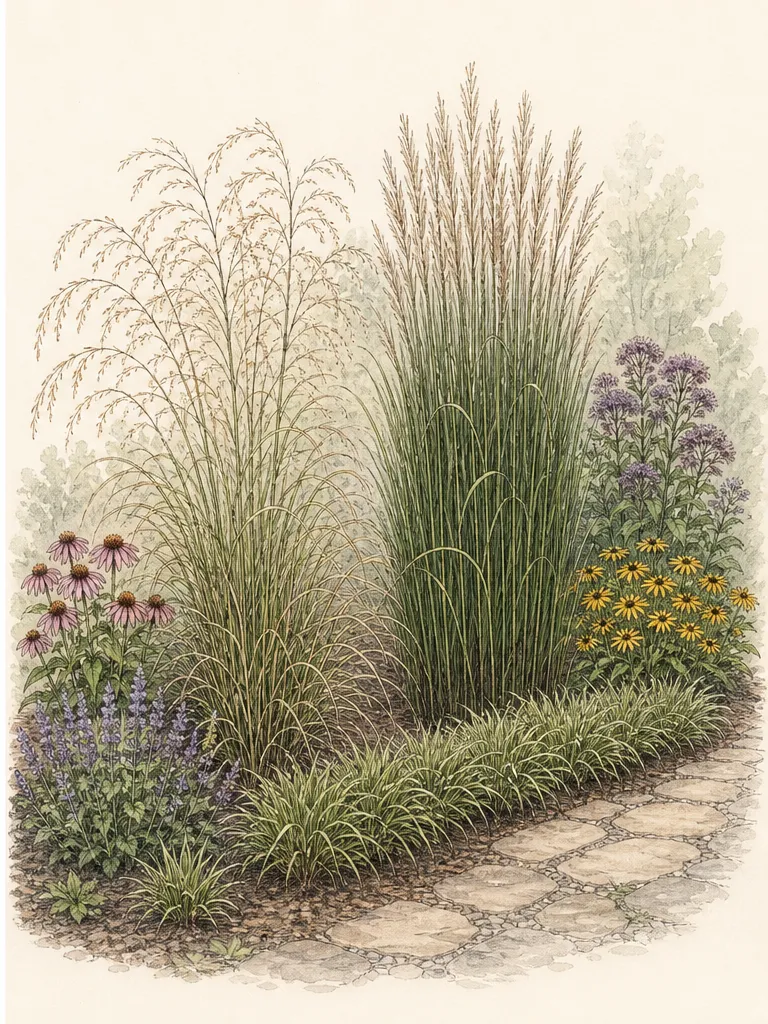
Record when cleanup changes the composition. Many deciduous ornamental grasses are cut back before new growth resumes, creating a temporary low gap. If the grass is the only structure beside a front door, that gap will be conspicuous. Place an evergreen shrub, persistent fern, stone, or early perennial nearby when year-round form matters. Do not keep unsafe or diseased stems solely to satisfy a winter sketch; seasonal structure must remain compatible with plant health and access.
Evaluate winter persistence honestly
Winter interest is a performance trait, not a promise attached to every grass. Examine stem stiffness, clump density, seed-head persistence, expected snow or rain load, and exposure to wind. A plant that stands through a dry Midwestern winter may flatten in a wet, windy coastal garden. Local public gardens and Extension references offer better evidence than a studio photograph. Observe the candidate in late winter, when the difference between a stable frame and collapsed straw is clearest.
Decide what kind of winter structure the composition needs. A single upright accent can punctuate snow; a repeated low mound can hold a path line; transparent seed heads can catch low light without forming a screen. Tan foliage is not automatically interesting when it falls across evergreen neighbors or blocks a step. Leave enough ground around a specimen for its outline to be read and enough access to remove it before spring shoots are hidden.
Plan a fallback for weather damage. Broken or flattened stems can be cut before the usual cleanup date if they obstruct circulation or trap wet material over a crown. The surrounding border should still have a basic structure when that happens. A garden that depends on every plume surviving intact is fragile. Combine grasses with woody lines, evergreen foliage, stone, or persistent perennial stems so winter interest is layered rather than assigned to one vulnerable material.
Match texture and transparency to viewing distance
Fine blades and airy panicles read as movement and haze from nearby, while broader leaves and dense heads make a stronger mass at a distance. Choose texture in relation to the view. A small patio border can reward delicate detail; a deep boundary seen from a house may need larger, clearer silhouettes. Do not confuse fine texture with small size. Some tall grasses remain visually light, and some short dense mounds create a solid edge.
Use transparency deliberately. An open seed-head layer can overlap flowers behind it without fully hiding them, but the leafy base may still be opaque. Draw the sight line at eye level and at the height of seated views. A grass used beside a driveway or walk must preserve required visibility even at full flower. If seasonal stems enter the sight triangle, move the plant; pruning them away would remove the feature for which it was chosen.
Repeat one texture enough to establish rhythm. Three or five widely spaced clumps can connect a border without creating a continuous hedge, while a low matrix can unify larger plants. Keep repetition within the species' behavior and site range. A moisture-loving sedge should not be forced into a dry upper bank simply to continue a line. Match the role with a different compatible plant when the site changes, preserving visual cadence rather than botanical uniformity.
Give each grass a maintenance envelope
Add an access ring to every mature outline. The gardener may need to cut old foliage, lift and divide a crowded crown, remove seedlings, or inspect spreading rhizomes. A large clump pressed between a wall and a thorny shrub cannot be maintained safely even if it technically fits. Keep utility boxes, drains, path edges, and neighboring crowns outside the work zone. The empty access shown on a plan can be occupied by low removable groundcover, but not by another permanent obstacle.
Estimate the debris as well as the living plant. Tall grasses produce a substantial bundle at cleanup, and dry blades can be sharp. Decide where stems will be tied, cut, carried, and processed without dragging them across emerging bulbs. Smaller gardens may be better served by fewer compact clumps with clear approaches. A low-maintenance label does not mean no annual work; it means the necessary work should be predictable and proportionate to the role.
Plan division from the exact taxon rather than a universal schedule. Center dieback, declining vigor, and crowding are better cues than an arbitrary year count. Some grasses are slow to enlarge, while others quickly outgrow their allotted space. Record the planted width and photograph the same view annually. When a clump approaches its access boundary, schedule division in the locally recommended season before leaves and roots are entangled with permanent neighbors.
Use named cultivars with precise limits
A cultivar may be selected for narrower habit, stronger stems, foliage color, earlier bloom, reduced seed, or regional hardiness. Those traits belong to that named selection, not automatically to every member of the species. Keep the cultivar name in the plan, purchase record, and plant label. If a substitution is proposed, compare mature dimensions, behavior, fertility, seasonal timing, and hardiness instead of accepting a similar photograph.
Color can alter vigor and garden use. Gold or variegated foliage may prefer different light from a green species form, and dark foliage can disappear against a shaded background. Evaluate color through the full season, including the ordinary green or tan periods. A spectacular two-week plume should not outweigh a foliage habit that clashes with the space for the rest of the year. The whole-plant calendar remains the selection unit.
Treat regional performance claims carefully. Hardiness zones describe a temperature range, not summer humidity, drainage, snow load, or local invasiveness. Verify the candidate through a nearby Extension source, botanical garden, or current regional list. Where published advice conflicts, resolve it by geography and exact taxon rather than averaging recommendations. A locally proven alternative is more valuable than a celebrated cultivar whose behavior is uncertain in the intended site.
Set out the design at full spread
Mark mature crowns and leaf arcs on the ground with hoops, canes, or hose before planting. Add flowering height with a vertical stake. Walk the path and view the arrangement from windows, seats, and entrances. This rehearsal often reveals an arching grass narrowing circulation or an upright grass hiding a focal plant. Move the marker while the correction costs nothing. Do not space from the edge of nursery pots, which makes an immature group look pleasing but creates future crowding.
Plant repeated groups from one consistent center-to-center rule based on the documented mature spread and desired visual separation. Preserve extra clearance where leaves move into a path or where a crown must be divided. A naturalistic drift can use irregular positions without abandoning mature geometry. Vary the rhythm, not the minimum space each plant needs. Label every group so volunteers and young shoots are not confused during early maintenance.
Keep the crown at the nursery grade, water the root ball and surrounding soil through establishment, and use a modest surface mulch that stays away from the base. Do not overfertilize to accelerate filling; lush growth can weaken the intended habit in some grasses. The design should mature through root establishment and normal growth. Temporary annuals or removable accents can occupy broad early gaps without forcing permanent grasses too close together.
Edit by behavior, not by sentiment
Review each grass against its assigned role after a full growing cycle and a winter. Did the upright marker stay narrow? Did the fountain cover the path? Did the screen arrive when privacy was needed? Did seedlings or rhizomes cross the planned boundary? A beautiful plant can still be wrong for its job. Record the mismatch specifically so the replacement is selected against a clearer requirement rather than another appealing image.
Move or divide a plant during the appropriate season if a better site exists. Remove a running or self-seeding grass before control requires repeated disturbance among valuable neighbors. Where regional invasive status changes, follow current local guidance even if the grass has been part of the design for years. A garden is not a museum of past purchase decisions. Its long-term structure depends on plants whose behavior remains compatible with place and maintenance capacity.
When a selection succeeds, repeat it only in sites that share the relevant conditions. The same cultivar may stand firmly in sun and open in shade, remain compact in lean soil and spread faster in moisture, or persist in one winter exposure and collapse in another. Preserve those observations on the plan. Choosing ornamental grasses well is less about collecting names than about matching mature habit, movement, calendar, and care to a specific piece of ground.
Design ideas
- Style
- Architectural perennial planting built from grass silhouettes, transparency, movement, and dormant-season form
- Space
- Residential borders, path edges, screens, foundation beds, and small naturalistic drifts
- Climate
- Temperate garden with locally verified hardiness, summer light, drainage, wind, winter loading, and invasive status for each exact species or cultivar
- 1Make a four-silhouette shortlist
Draw one narrow upright, one arching fountain, one low mound, and one transparent seed-head form at mature scale. Place each over the proposed garden elevation and reject shapes that block windows, paths, or smaller companions. Only then attach locally suitable species or cultivar names to the silhouettes.
- 2Pair an early and late structure
Combine a grass that contributes early growth with a warm-season form that peaks later, provided both match the site. Let their mature outlines differ but repeat a foliage color or spacing rhythm. Include a non-grass structural element for the brief cleanup gap when both herbaceous plants are low.
- 3Keep a clump ledger
Record crown width, leaf reach, flowering height, self-seeding, winter lean, and division cues for each planted taxon at the same time every year. Photographs from fixed points turn vague impressions into useful behavior data and reveal whether the plant still fits its access envelope.
- 4Frame one transparent view
Place an airy flowering grass where its panicles can overlap a wall, dark hedge, or later perennial without blocking the sight line. Keep the opaque leafy base below the feature being framed. Test the view seated and standing, and preserve required visibility beside paths and drives.
- 5Use runners only with an exit plan
Assign a running grass only to a large, bounded role where its spread is desired, locally acceptable, and reachable from all sides. Mark the inspection boundary and removal route before planting. In a small mixed border, replace the runner with repeated clumps rather than relying on permanent containment.
- 6Design the cleanup route
Draw where dry stems will be tied, cut, gathered, and carried. Keep a direct approach to every large clump and protect early bulbs along that route. A grass whose annual bundle cannot leave the bed without trampling neighbors is too large or poorly placed for the space.
- 7Repeat behavior, not just color
Build rhythm with plants that share a stable clumping habit and compatible seasonal posture, even when their foliage colors differ. A matching color does not compensate for an aggressive spreader beside a slow mound. Let behavior establish the group, then refine hue and texture within that safe shortlist.
- 8Test the flowering outline with stakes
Mark the leafy crown on the ground, then use a cane to show the documented flowering height and a loop of string to suggest plume width. Walk past it and view it from windows before planting. This simple full-scale model reveals blocked sight lines and path conflicts that a nursery pot cannot show.
- 9Assign one winter backup
Beside every grass chosen chiefly for winter presence, place a second structural element that remains useful if stems flatten early. Use locally suitable evergreen foliage, woody branching, stone, or persistent perennial form. Keep the backup outside the grass's mature and division envelope so resilience does not become crowding.
Related reading
Sources
- Ornamental Grasses Enhance Landscapes. University of Wisconsin-Madison Division of Extension. Source record · Accessed 2026-08-19.
- Grasses Galore. University of Illinois Extension. Source record · Accessed 2026-08-19.
- Ornamental Grasses. Missouri Botanical Garden. Source record · Accessed 2026-08-19.