Gardens · groundcover perennial crown matrix
Combine Spreading Groundcovers with Clumping Perennials Without Burying Crowns
Pair spreading groundcovers with clumping perennials by mapping mature crowns, setting inspectable boundaries, and keeping mulch and runners away from living crown tissue.
Published Last updated
In this guide
- Separate the idea of cover from the idea of crowding
- Identify the spreading mechanism first
- Draw crown islands before drawing the carpet
- Choose clumping perennials that declare their bases
- Pair plants by competitive balance
- Make every boundary visible and reachable
- Plant in cells rather than filling all gaps
- Edit the matrix by direction, not by shearing
- Read warning signs at the crown
- Allow the design to retain some open ground
- Mark six plants and keep two crown islands open
- Design ideas
Separate the idea of cover from the idea of crowding
Groundcover is a planting function, not a promise that every visible patch of soil should disappear. Low plants can connect larger perennials, protect the composition from visual fragmentation, and occupy suitable open ground, but a continuous carpet is not automatically the healthiest or easiest outcome. Clumping perennials still need visible crowns, light, air movement, and physical access. Begin by deciding which surfaces should read as covered and which must remain open for plant health or work.
Walk the bed during active growth and in the dormant season. Mark perennial crowns, shrub bases, emerging bulbs, tree roots, irrigation fittings, stepping places, and the direction from which each clump can be divided or inspected. The empty-looking rings around these features are working zones. They may carry a thin appropriate mulch or naturally open soil, but they should not be assigned to an aggressive spreader simply because they are currently unoccupied.
Define the visual goal in words: a low matrix around bold clumps, a few connected patches between repeated perennials, or a stable edge that softens paving. Each goal needs a different amount and speed of spread. Avoid buying a plant described only as fast covering. The useful question is how it spreads, where that behavior can be intercepted, and whether the site lets the gardener see the boundary before the groundcover enters a crown.
Identify the spreading mechanism first
Observe whether a candidate expands by surface stems, rooted nodes, underground rhizomes, stolons, self-sowing, or gradual enlargement of a central clump. These behaviors create different maintenance problems. A visible runner can often be redirected or cut at an edge; an underground spreader may cross a narrow clear ring before its new shoots reveal the move. A prolific self-sower can leap over a barrier entirely. Use exact species and cultivar information from regional institutions rather than relying on the common name.
University of Maryland Extension notes that groundcovers differ in their usefulness and growth, and it warns against invasive choices. Treat local invasive status as a threshold decision, not a later maintenance detail. A plant regulated or recognized as invasive in the region should not be assigned a bounded ornamental role on the assumption that ordinary edging will contain it. Check current local lists and nearby natural areas before choosing a vigorous spreader.
Match speed to the gardener's review cycle. A moderately spreading plant may suit a border checked monthly in active growth but be wrong for a remote bed seen twice a year. Slower expansion leaves more visible surface during establishment but gives perennial crowns time to strengthen and makes errors easier to reverse. The design should be stable under the actual maintenance rhythm, not under an imagined schedule of constant trimming.
Draw crown islands before drawing the carpet
Draw each clumping perennial at mature crown width, not at its nursery-pot size, and surround the crown with an inspectable transition. The transition is not a universal measured ring; its width depends on the perennial's habit, the groundcover's behavior, soil visibility, and access. It must be wide enough to reveal encroachment before stems or accumulated debris lie across living crown tissue.
Connect selected crown islands to a path or stepping seam. A clump that can be seen but not reached will eventually be stepped over, divided from the wrong angle, or ignored while runners enter its base. The access seam can be narrow and visually quiet. Repeated flat stones, a restrained mulch line, or an open strip behind the border can serve, provided it remains continuous at mature plant spread.
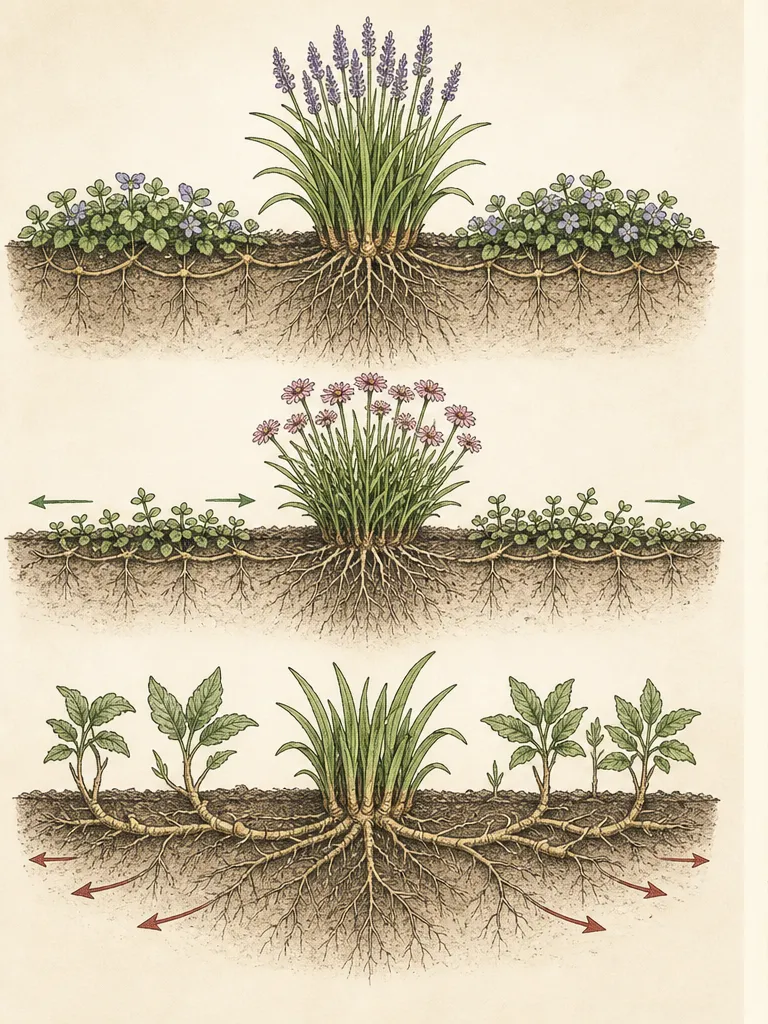
Only after mapping crowns and access should the groundcover cells be drawn. Give each cell an outer stopping point such as paving, a mowable edge, a broad path, or an actively maintained open seam. Do not outline one uninterrupted shape around every perennial. Several smaller cells can read as a connected matrix from the main viewpoint while allowing the gardener to isolate and edit a problem without dismantling the whole planting.
Choose clumping perennials that declare their bases
Perennials with a stable, recognizable crown are easier to protect within a low matrix than plants whose shoots wander unpredictably. Look for a clear point of emergence, a mature footprint compatible with the bed, and foliage held sufficiently above the groundcover for inspection. This is not a rule that every companion must be upright; it is a request for readable structure. The gardener should be able to distinguish the intended clump from the surrounding layer in spring and autumn.
Assign each clump a seasonal role so the groundcover does not carry the entire composition. Durable foliage can anchor spring, flowering stems can rise through summer, and seed heads or autumn leaves can extend interest. Repeat a few strong forms. If every perennial disappears completely at a different moment, the matrix may look like an invitation to fill its vacant crowns unless the plan, markers, and maintenance record make those dormant positions explicit.
Check local light, soil, hardiness, heat, moisture, and disease pressure for every species and cultivar. A perennial stressed by unsuitable conditions will produce a weak, open crown that is easily overtaken. Crowding is then a symptom as well as a design failure. Replace a mismatched clump with a locally suitable plant instead of repeatedly clearing the groundcover from a perennial that cannot establish enough structure to hold its assigned island.
Pair plants by competitive balance
Compare height, rooting behavior, seasonal start, water demand, and response to shade. A very early groundcover can occupy light before a late perennial emerges, while a broad summer clump can later shade the groundcover. That exchange may be useful if neither phase suppresses the other. It becomes unstable when the groundcover forms a dense layer over the emergence point or when the perennial's canopy deprives a sun-demanding carpet of the conditions it needs.
Keep irrigation compatibility in the pairing. A groundcover that expects consistently moist soil should not surround a crown that needs a drier, more aerated surface, and a drought-adapted matrix should not be used to disguise frequent spot watering around a thirsty perennial. Irrigation delivered to one plant affects the shared soil. Select combinations that tolerate the same broad moisture regime, then check individual root zones during establishment.
Use trial cells where competitive behavior is uncertain. Plant one representative clump with a small number of groundcover starts and observe a full active season before repeating it. Record which plant closes first, whether the crown remains visible, and how often the boundary needs editing. A visually promising combination that requires weekly separation has failed the maintenance brief even if both plants remain alive.
Make every boundary visible and reachable
A useful boundary is a place where growth can be noticed and removed without excavating the perennial. Surface runners can be intercepted across a narrow open seam; rooted pieces can be lifted while their origin is visible; seedlings can be removed before flowering where appropriate. Place the boundary in front of the crown transition, not against the crown itself. The clear interval gives the gardener time to act before contact becomes burial.
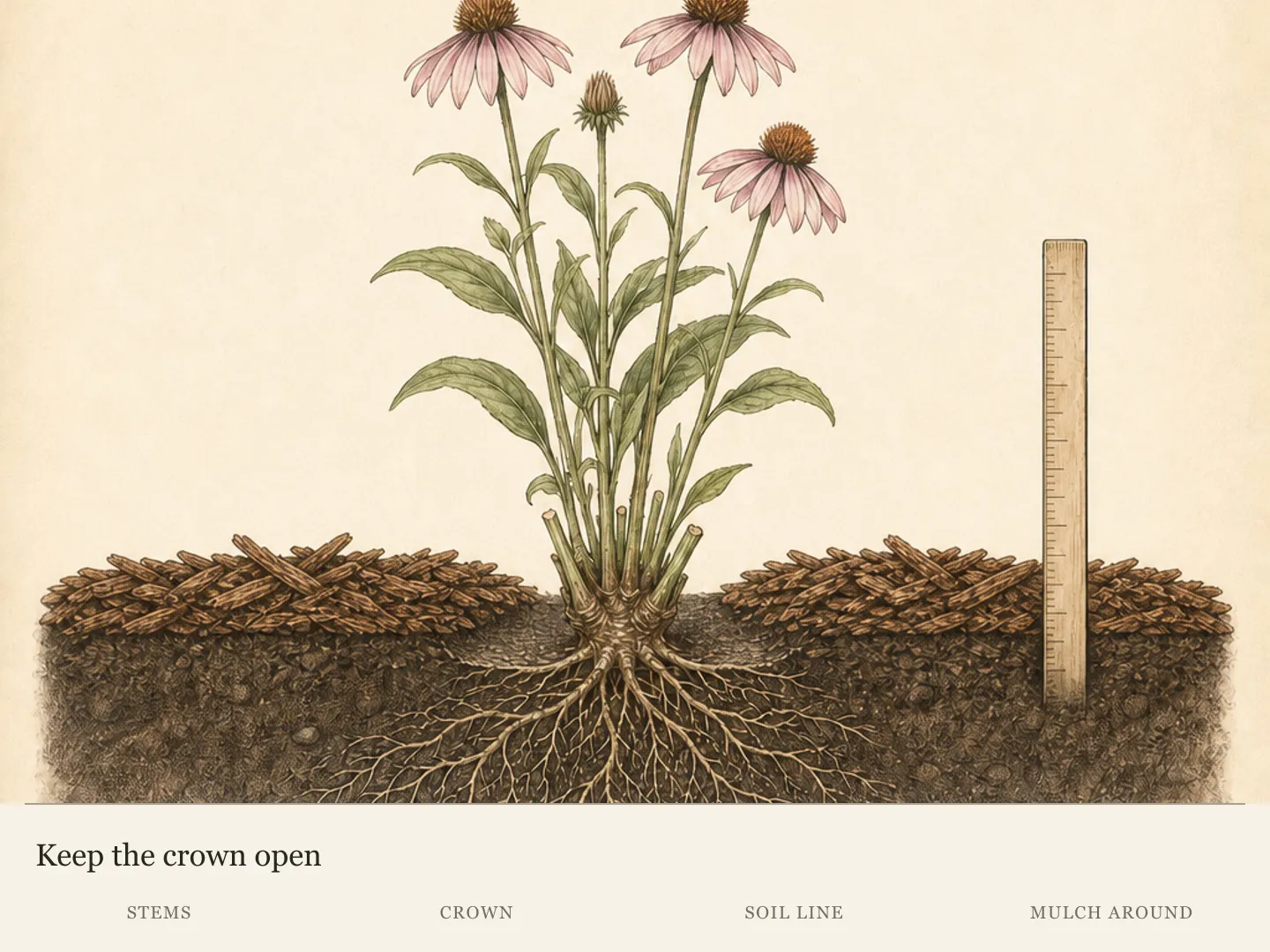
Maintain the surface around living bases conservatively. University of Illinois Extension advises planting perennials with attention to proper depth, and established crowns should not be covered by accumulated mulch, soil, or neighboring growth. Pull mulch away from stems and crown tissue rather than forming a deep collar. Remove fallen leaves or cut debris when they mat over the crown, while leaving site-appropriate organic material where it does not trap moisture against sensitive tissue.
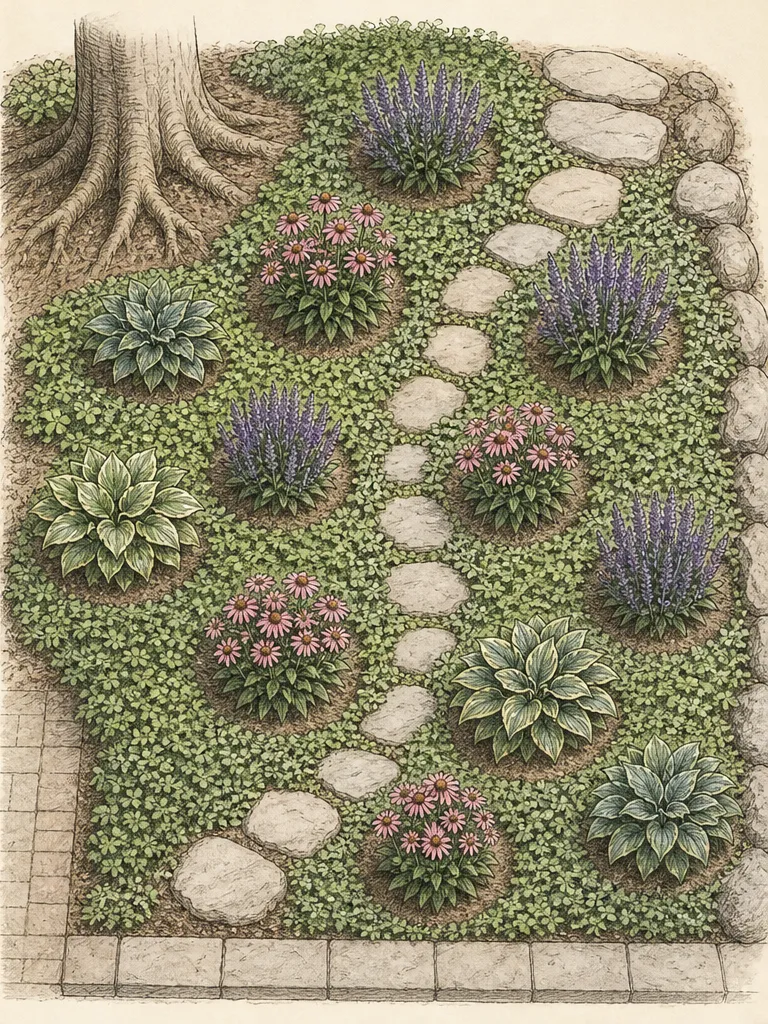
Do not depend on a hidden root barrier unless its installation, depth, material, plant behavior, drainage effects, and future repair have been professionally or regionally evaluated. A visible working seam is easier to inspect and adapt. Where the groundcover crosses it repeatedly, reduce the cell, change the plant, or accept more open ground. Permanent concealment of a spreading problem is not the same as containment.
Plant in cells rather than filling all gaps
Prepare the bed by identifying and removing existing perennial weeds before installing a low layer that will make later access difficult. Correct broad drainage problems and preserve soil level around established crowns. Place groundcover starts within their assigned cells using current species-specific and regional guidance. Avoid pushing starts against the outer edge simply to create an instant outline; their mature spread should perform that work over time.
Leave intentional unplanted intervals between young groundcover and clump transitions. Cover suitable open soil with a light, appropriate mulch if needed, but keep crown tissue visible and do not mound mulch to compensate for small plants. The open intervals are observation space. They show whether the groundcover is advancing evenly, whether weeds are returning, and whether runoff is moving soil toward a crown.
Use temporary markers at dormant crowns and cell boundaries until the pattern is established. A marker should sit outside living tissue and remain findable without becoming a tripping hazard. Record the groundcover's starting positions. Without that baseline, vigorous outward growth can feel successful even when it is moving in the wrong direction, and a gardener may not recognize that an intended clear seam has already narrowed.
Edit the matrix by direction, not by shearing
During active growth, follow stems back to understand how the plant is moving. Remove or redirect growth crossing toward crowns, access seams, drains, paving joints, or neighboring land, while allowing the cell to expand into its assigned open area. A uniform trim across the top may make the planting look tidy without changing the rooted advance beneath it. Directional editing preserves the intended shape and reveals whether the species is realistically manageable.
Use clean, appropriate hand tools and avoid pulling blindly through the crown. A runner rooted beside a perennial may lift new shoots or disturb shallow roots if yanked from a distance. Work from the visible boundary toward the cell, tracing the connection. If identification is uncertain, wait until the intended perennial is clearly marked rather than removing emerging growth indiscriminately.
Time division, cutback, and renovation according to the exact plants and regional conditions. Do not combine every task into one convenient weekend if it exposes a crown during unsuitable weather or interrupts active growth. Keep a short record of how much material was removed and from where. Repeated heavy removal along the same boundary indicates a plant-selection or cell-size problem that should be redesigned, not normalized.
Read warning signs at the crown
Inspect each crown from more than one side. Look for groundcover stems lying across the emergence point, mulch or soil that has migrated inward, dense damp debris, weak or displaced shoots, and a narrowing access route. These observations do not diagnose a disease by themselves. They show that the crown environment or competitive balance has changed and that the gardener should clear the surface and investigate further.
If a clump declines, confirm planting depth, soil moisture, drainage, light, root competition, and species-specific problems before blaming the groundcover alone. A healthy-looking carpet can conceal saturated soil or crown decay, while a sparse groundcover may reflect excessive shade from the perennial. Use regional diagnostic resources for symptoms. Do not treat the article's design cues as a substitute for plant identification or laboratory diagnosis when decline is progressive.
When clearing an overgrown crown, work in stages. Expose the outside of the intended clump, identify live shoots, and remove encroaching growth outward from them. Avoid adding soil or mulch to smooth the resulting hollow. Let the correct grade and crown position remain visible. If the plants cannot be separated without major root disturbance, plan a species-appropriate renovation season rather than forcing an emergency division during stress.
Allow the design to retain some open ground
A mature combination does not need to be sealed. Small visible seams can articulate crown shapes, admit light, support inspection, and make repeated groups legible. They also create a place to stand or set a tool without crushing foliage. Judge the design from normal viewing distance and from the working side. What appears as an attractive continuous layer from the path may contain a practical network of openings up close.
Review the matrix in spring emergence, peak growth, and dormancy. Restore crown islands before adding new plants. If gaps are visually distracting, repeat a foliage shape, adjust a cell edge, or add a locally suitable clumping plant whose mature crown fits the plan. Do not automatically extend the fastest groundcover into every opening; that transfers visual work to the plant with the greatest capacity to erase structure.
The combination succeeds when groundcover connects the border and the clumping perennials remain unmistakable individuals. Their crowns stay uncovered, the direction of spread is visible, and every boundary can be reached before conflict becomes excavation. That balance leaves room for change while preventing a low planting from becoming a buried network of inaccessible crowns.
Mark six plants and keep two crown islands open
A moist, well-drained Zone 6 Pennsylvania shade bed can test the crown-island method in a 14-by-8-foot rectangle. Choose two Hosta plantaginea, each allocated a 4-foot mature circle, and four Tiarella cordifolia, each given an initial 2-foot cell. These are planning allowances based on the retained plant profiles, not promises that a spreading foamflower stops at a drawn line. The combination needs moisture and shade; it is unsuitable for a dry, root-filled strip merely because both plants tolerate shade.
Place hosta centers 4 and 10 feet from the left edge, both 5 feet behind the front edge. Place foamflower centers at 2, 5, 8, and 11 feet along a line 2 feet behind the front. Even the closest hosta/foamflower pair has more space between centers than the sum of its allocated radii. Keep the front edge and both hosta crown boundaries visible. The six-plant total leaves real empty ground for access and growth instead of filling every square foot.
Inspect the foamflower cell edges during growth and clear runners before they enter the marked hosta islands. If repeated clearing is impractical, reduce the groundcover to fewer contained cells or choose a slower locally suitable form. The numerical arrangement is an illustrative trial layout; scale up only after the two plants remain distinct under the actual maintenance routine.
Design ideas
- Style
- Structured naturalistic matrix with distinct clumping forms and restrained low cover
- Space
- Ornamental perennial bed, path edge, courtyard border, or small shaded planting with direct maintenance access
- Climate
- Plant choices must match local hardiness, heat, light, soil, drainage, moisture, disease pressure, spreading behavior, and current invasive-plant guidance; species and cultivar behavior may vary by region
- 1Draw a crown-clear archipelago
Map mature perennial crowns as islands connected to one quiet access seam, then fill only selected spaces between them with groundcover cells. Keep every island edge visible from the seam. The pattern can read as a continuous low layer from the path while remaining physically discontinuous at plant bases. Adjust each transition to the exact plant habits rather than applying a universal ring width.
- 2Use a path edge as the first boundary
Begin a manageable groundcover cell beside paving or another firm, inspectable edge and let it expand inward toward a marked stopping seam. The hard edge makes growth direction obvious and provides stable footing for editing. Keep the cell away from drainage joints and verify that the selected plant is locally appropriate. A reachable edge teaches the gardener the plant's real speed before it surrounds perennials.
- 3Repeat bold clumps through a low matrix
Choose two or three site-suitable clumping perennials with readable bases and repeat their foliage forms across separate groundcover cells. Vary flowering season while keeping crown structure clear. Draw every clump at mature size, including the route needed for division. Repetition supplies coherence, so the groundcover does not need to occupy every gap or carry all of the border's visual interest.
- 4Pair visible runners with a clear seam
Where a non-invasive, surface-running groundcover is suitable, direct it toward an open mulch or stone seam that can be checked easily. Trace and cut runners that cross toward perennial crowns while allowing movement within the cell. This idea depends on exact local behavior and regular access; it is not suitable for underground spreaders, regulated invasive plants, or a bed that cannot be inspected during active growth.
- 5Reserve dormant-crown windows
Mark perennials that disappear seasonally and preserve their windows even when the groundcover remains visible. Use discreet off-center labels tied to a plan, and clear encroaching stems before emergence. The windows may look open in winter, but repeating their shape makes them intentional. Avoid planting bulbs or additional low plants in those spaces until the dormant crowns' full emergence pattern is known.
- 6Trial the most competitive pairing
Install one small cell around one established clump and observe the full active season. Record expansion direction, crown visibility, moisture compatibility, and editing frequency. Repeat only if the pairing remains distinct under the gardener's real schedule. If the groundcover repeatedly enters the transition, enlarge the crown island, reduce the cell, or select a slower plant instead of accepting permanent rescue work.
- 7Echo foliage across an open interval
Leave a necessary access or crown-clear interval unplanted, then repeat a similar leaf shape on either side. The eye bridges the gap even though roots and stems do not. This is useful near irrigation valves, stepping points, and division routes. Keep the interval surfaced appropriately and at correct grade; do not disguise it with deep mulch that can migrate onto nearby crowns.
- 8Make the seasonal edit a design event
At emergence, peak growth, and dormancy, photograph the same crown islands and restore their boundaries. Remove directional encroachment, confirm labels, and note any cell requiring disproportionate work. Use the evidence to change plant choice or cell size. A matrix stays elegant through a few clear decisions made at useful moments, not through constant indiscriminate clipping of every low plant.
Plants in this guide
Related reading
Sources
- Planting and Care. University of Illinois Extension. Source record · Accessed 2026-08-19.
- Groundcovers. University of Maryland Extension. Source record · Accessed 2026-08-19.
- Plants for Ground Cover. Royal Horticultural Society. Source record · Accessed 2026-08-19.
- Fragrant Plantain-lily: Hosta plantaginea. NC State Extension. Source record · Accessed 2026-09-09.
- Tiarella cordifolia. North Carolina Extension Gardener Plant Toolbox. Source record · Accessed 2026-09-09.