Foamflower
Tiarella cordifolia
A practical species profile of Tiarella cordifolia, with identification, garden placement, soil and seasonal care guidance.
Published Last updated
At a glance
- Light
- Partial to full shade
- Water
- Regular moisture
- Soil
- Humus-rich, moist, well-drained woodland soil
- Hardiness
- Zones 3–8
- Bloom
- Spring to early summer
- Height
- 5–12 in · 13–30 cm
In this guide
Overview
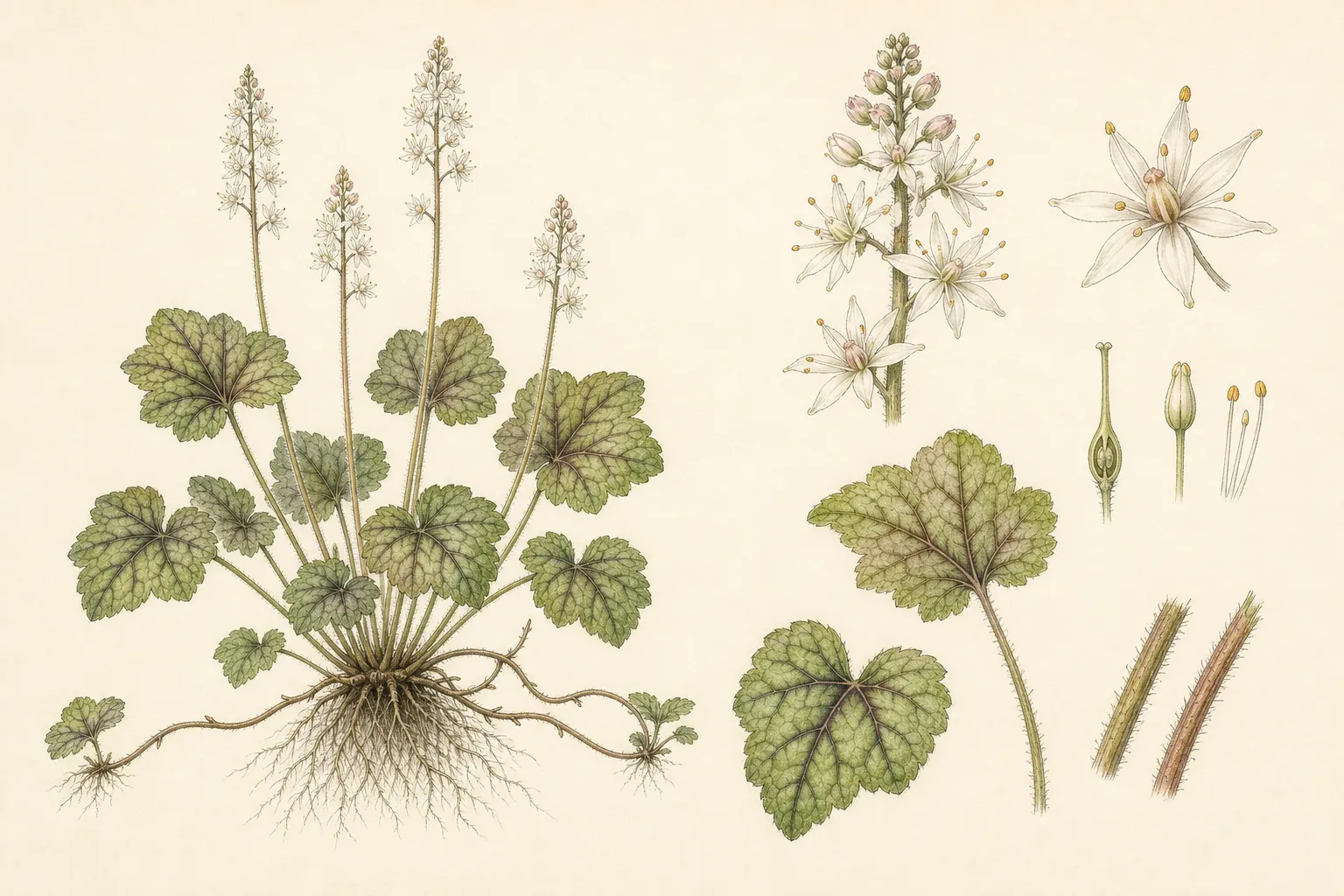
Foamflower is a small eastern North American woodland perennial. Basal, heart-shaped leaves are shallowly lobed like small maple leaves, while leafless stalks lift narrow clusters of white to pale pink flowers above the foliage in spring. The species is usually 5–12 inches tall and 12–18 inches wide before its slender runners begin to join neighboring plants into a colony.
Tiarella cordifolia inhabits moist forests, coves, and well-drained bottomlands. Dappled to full shade suits it, but shade must be paired with humus-rich soil that remains moist. It is not drought tolerant, and a dry mat of surface roots beneath a mature tree is different from the cool woodland soil implied by the light exposure.
The spreading organs are stolons or slender runners, not woody branches. Plantlets form at their ends and need time to establish their own roots. NC State advises allowing at least two growing seasons before separating a plantlet from the mother plant; premature severing converts useful colony formation into an establishment failure.
Species plants and named selections can differ in leaf markings and running behavior. Keep the full label when a cultivar is bought, then place a running form where a soft colony is wanted. A path edge or small mixed container may suit a more compact selection, but repeated shearing is not an appropriate way to confine a stoloniferous species.
Foliage condition changes with winter climate. NC State describes the species as deciduous, while some horticultural references and garden conditions treat it as semi-evergreen. The practical cue is living tissue: retain sound leaves, remove winter-damaged foliage at the beginning of growth, and expect fresh leaves to replace it.
NC State identifies black vine weevil as the notable occasional pest. Otherwise, weak cover usually points first to drought, buried crowns, newly separated plantlets, or competition. Diagnose which part of the colony is affected before removing runners that may still be feeding young rooted plants.
- Family
- Saxifragaceae
- Range
- Eastern North America; exact limits depend on the authority's taxonomic scope
- Soil pH
- 5–7
- Spread
- 12–18 in · 30–45 cm
Planting & careHow to grow foamflower
The retained sources use different circumscriptions: Kew's accepted Tiarella cordifolia range is Maryland to northeastern Georgia, while the NC State horticultural page uses a broader Nova Scotia-to-Alabama-and-Minnesota range. Treat regional nativity claims at state level as a local-flora question rather than extending one source's map universally. NC State lists Zones 3–8; throughout that range, drought intolerance remains the practical garden limit, and deep shade is insufficient where tree roots leave the humus-rich soil dry.
- 1Choose colony or clump behavior
Confirm the species or cultivar and whether the selection runs freely. Reserve 12–18 inches for an initial plant and additional shaded ground for stolons when a colony is intended; use a naturally compact selection where spread would be unwelcome.
- 2Test the shaded root zone
Choose dappled, partial, or full shade and check moisture beneath the surface during dry weather. The soil should be humus-rich and consistently moist while draining after rain, without heavy competition that leaves it powder-dry.
- 3Set the basal crown visibly
Plant the root ball at its nursery depth with the leaf crown at the finished surface. Keep soil and mulch out of the center, and arrange any existing runners over the surface so their plantlets can contact soil without being buried.
- 4Water the complete small root ball
Settle the plant and maintain steady moisture through establishment. Check beneath leaf litter or mulch rather than assuming a shaded surface is moist, and water before drought causes the shallow-rooted foliage to collapse.
- 5Leave space for stolons
Keep neighboring crowns and coarse groundcovers outside the planned colony while runners root. Mark the parent plants so developing plantlets are not mistaken for weeds or severed during routine edging.
- 6Delay plantlet separation
Let a runner's plantlet build its own roots for at least two growing seasons before division, as NC State advises. Confirm that it resists a gentle lift and has an independent root system before cutting the stolon.
Pruning foamflower
Foamflower has basal leaves, flower stalks, and stolons rather than woody branches. At the beginning of the growing season, remove foliage that is genuinely winter-damaged; NC State notes that fresh leaves will replace it. Cut spent flower stalks only if seed is not wanted or appearance calls for it. Retain sound runners until their plantlets have rooted for at least two growing seasons, then sever and move only the established plantlets needed for propagation or boundary control.
Seasonal care
Spring
Trim damaged overwintered leaves at the start of growth and leave healthy foliage in place. Keep crowns exposed, maintain moist woodland soil, and enjoy the white-to-pink flower wands from April into June.
Summer
Prevent drought as tree canopies and roots draw more water. Trace new runners, leave young plantlets attached, and inspect unexplained wilting or root loss for black vine weevil rather than assuming every weak patch needs fertilizer.
Autumn
Water newly rooted sections if autumn is dry and keep fallen leaves from smothering the basal crowns under a wet mat. Map the colony edge and identify which plantlets have completed at least two growing seasons before any future division.
Winter
Expect foliage retention to vary with climate. Leave sound leaves, watch for frost-heaved crowns and standing water, and postpone cleanup until living and damaged tissue can be distinguished at the start of growth.
Safety and garden spread
The retained NC State, RHS, and Kew profiles do not classify Tiarella cordifolia as poisonous. The plant is presented only as an ornamental groundcover; do not infer that leaves, flowers, or stolon plantlets are suitable for people or pets to eat.
Common problems
Drought collapse
- Look for
- Leaves wilting or browning across the driest part of the colony, especially beneath thirsty tree roots or during summer heat.
- Action
- Check moisture below leaf litter, water the whole occupied root zone, and maintain an open organic surface layer without burying crowns. Move the colony if the site cannot remain moist in shade.
Black vine weevil concern
- Look for
- Notched leaf edges, weak or collapsing plants, or root loss that does not match the moisture pattern, particularly in container-grown or dense plantings.
- Action
- Inspect the affected plant and roots and obtain a local identification before treatment. Protect unaffected plantlets, discard severely damaged material as advised, and use only controls current for the diagnosed life stage and region.
Colony crosses its boundary
- Look for
- Rooted stolon plantlets entering a path, neighboring crown, or small bed where a continuous groundcover was not intended.
- Action
- Trace each runner to a rooted plantlet. Leave immature plantlets attached; after at least two growing seasons, lift established offsets for transplanting or remove them. Replace the species with a compact selection if the site cannot accommodate recurring stolons.
Plant details
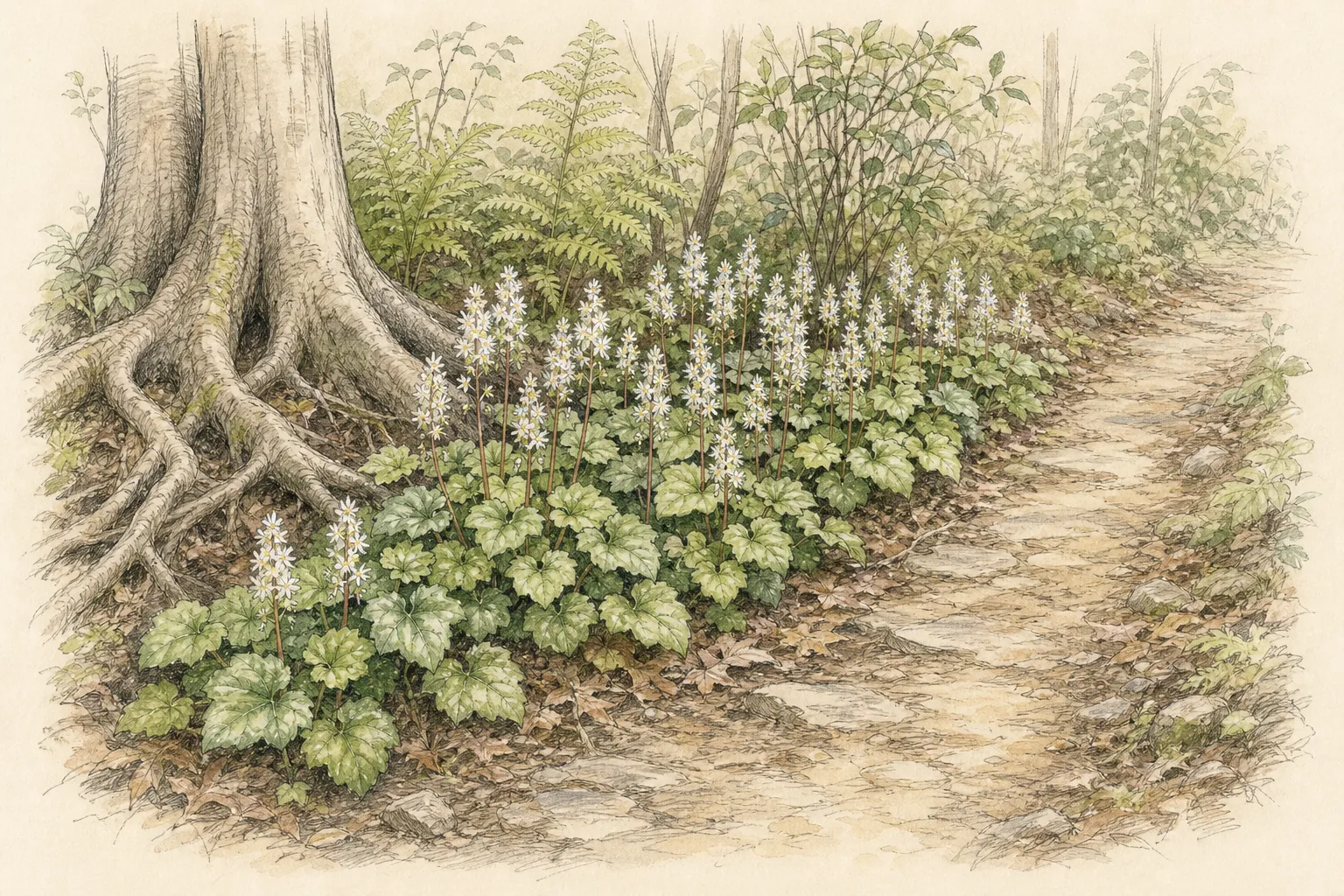
Garden placement study showing mature Foamflower in an ornamental planting
Related reading
Sources
- Tiarella cordifolia L.. Royal Botanic Gardens, Kew. Source record · Accessed 2026-08-30.
- Tiarella cordifolia. North Carolina Extension Gardener Plant Toolbox. Source record · Accessed 2026-08-30.
- Tiarella cordifolia. Royal Horticultural Society. Source record · Accessed 2026-08-30.