Gardens · small tree under utility lines
Select a Small Ornamental Tree Beneath Utility Lines
Choose and site a small ornamental tree under overhead utility lines by identifying the line, following local utility limits, mapping mature height and spread, and preserving access above and below ground.
Published Last updated
In this guide
- Treat the utility corridor as a site limit
- Identify the line and local rule before choosing a tree
- Map mature height, spread, and soil volume
- Choose a tree that fits without repeated reduction
- Match ornamental character to the viewing job
- Keep utility access and pedestrian space open
- Check below ground before any digging
- Plant for establishment, not instant scale
- Review the choice on paper before purchase
- Record a measured no-tree alternative
- Design ideas
Treat the utility corridor as a site limit
A flowering tree beneath wires is not a small version of an unrestricted shade tree. The overhead equipment, pole access, underground services, pavement, buildings, and sight lines define a three-dimensional planting envelope. The tree succeeds only if its normal mature height and spread fit that envelope without repeated utility clearance pruning.
Begin with the reason for planting. A spring flower display, a framed view, light summer shade, autumn color, or a small focal crown may all be possible, but one site may not support all of them. Naming the main job prevents the shortlist from being dominated by a dramatic flower photograph while mature form and infrastructure are ignored.
Do not assume the lowest visible cable is harmless. The International Society of Arboriculture explains that overhead systems include communication, secondary, primary, and transmission lines, and even communication lines can become energized. A homeowner should not classify safe working distance by appearance. The utility identifies its equipment and controls access requirements.
If no tree fits the local envelope, choose shrubs, tall perennials, or another ornamental layer allowed by the utility. A treeless answer is better than planting a species whose natural crown will be cut away repeatedly or whose presence blocks emergency and maintenance work.
Identify the line and local rule before choosing a tree
Contact the serving utility or use its current published planting guide before visiting a nursery. Ask whether the line is distribution or transmission equipment, where the regulated wire zone begins, what mature plant heights are allowed, and what clear access is required around poles, guy wires, cabinets, and easements. Keep the answer with the site plan.
Broad right-tree guidance is useful for understanding zones, but local rules can be stricter. The ISA brochure describes one low-zone framework, while PG&E applies different limits by equipment type, distance, and high-fire-threat district. Those figures are not interchangeable. The serving utility’s current rule and local law take precedence over a national diagram or an article written for another region.
Mark the pole-to-pole line, wire projection, pole base, anchors, and required access on the ground without approaching the conductors. Include the service drop to the house and any neighboring equipment that crosses the site. A planting position that seems offset from one wire may still fall within another maintained corridor.
Do not plan to prune an existing or future tree near energized lines yourself. PG&E states that only qualified line-clearance personnel may work near power lines in its service area. Report tree concerns to the serving utility and follow its safety process. Plant selection is the homeowner’s opportunity to prevent that conflict, not to schedule a lifetime of risky corrections.
Map mature height, spread, and soil volume
Draw the permitted overhead envelope in section and plan view. Then add the candidate tree at its larger credible mature height and crown spread from regional institutional sources and the exact cultivar record. Do not use the size of a young nursery specimen, a ten-year estimate, or the word small as the final dimension. Trees continue to grow beyond the retail display stage.
Fit width as carefully as height. A low broad crown can enter a driveway, building, path, or neighboring property even while remaining below wires. Map branch clearance for pedestrians and vehicles under local requirements. Branches emerge at roughly the height where they formed; a low framework does not rise out of the way simply because the tree grows taller.
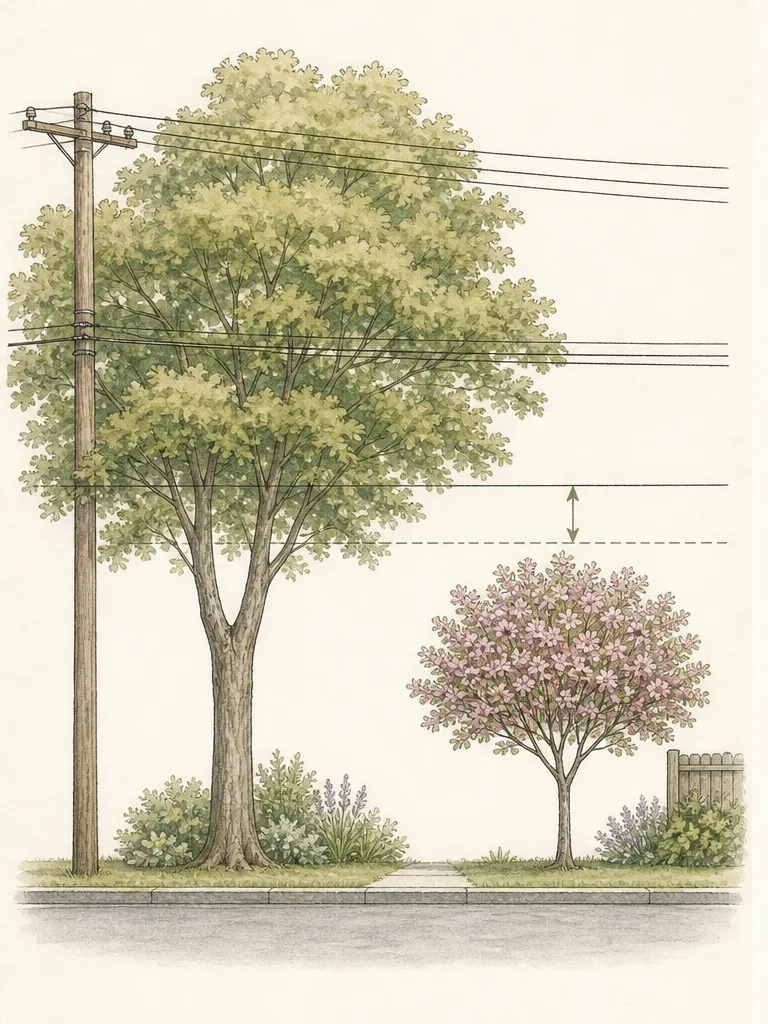
Look below as well as above. The ISA guidance emphasizes sufficient soil area, and Arbor Day guidance asks planters to consider underground utilities and root space. A tiny cutout between pavement and curb may not support even a low tree. Compacted soil, drainage, salt exposure, and restricted rooting volume can make a theoretically short species a poor site choice.
Leave the utility’s maintenance route open. Do not place the trunk, a raised bed, edging, boulders, or dense companion shrubs where crews need to reach a pole, guy wire, cabinet, or marked underground line. Mature root flare and trunk diameter also occupy space, so the access plan cannot stop at the width of the planting hole.
Choose a tree that fits without repeated reduction
Build the shortlist from verified mature dimensions first, then screen for regional hardiness, heat, chilling, soil texture, drainage, pH, moisture, and exposure. A species recommended under lines in Pennsylvania or California may be unsuitable elsewhere. Use local Extension, public-garden, municipal, and utility lists to identify candidates tested for the region.
Prefer a naturally compatible height and crown form over a larger tree marketed as controllable by pruning. Repeated topping or rounding damages structure and does not convert genetics. Utility pruning must prioritize clearance, so a naturally broad or tall crown placed in the corridor may lose the ornamental form that justified planting it.
Compare the exact cultivar. Seed-grown species can vary, and named selections may differ in height, width, branching, flower color, fruit, disease response, and heat tolerance. Confirm that the name on the nursery tag matches the source used for dimensions. A compact cultivar’s size should not be assigned to an unlabeled seedling of the species.
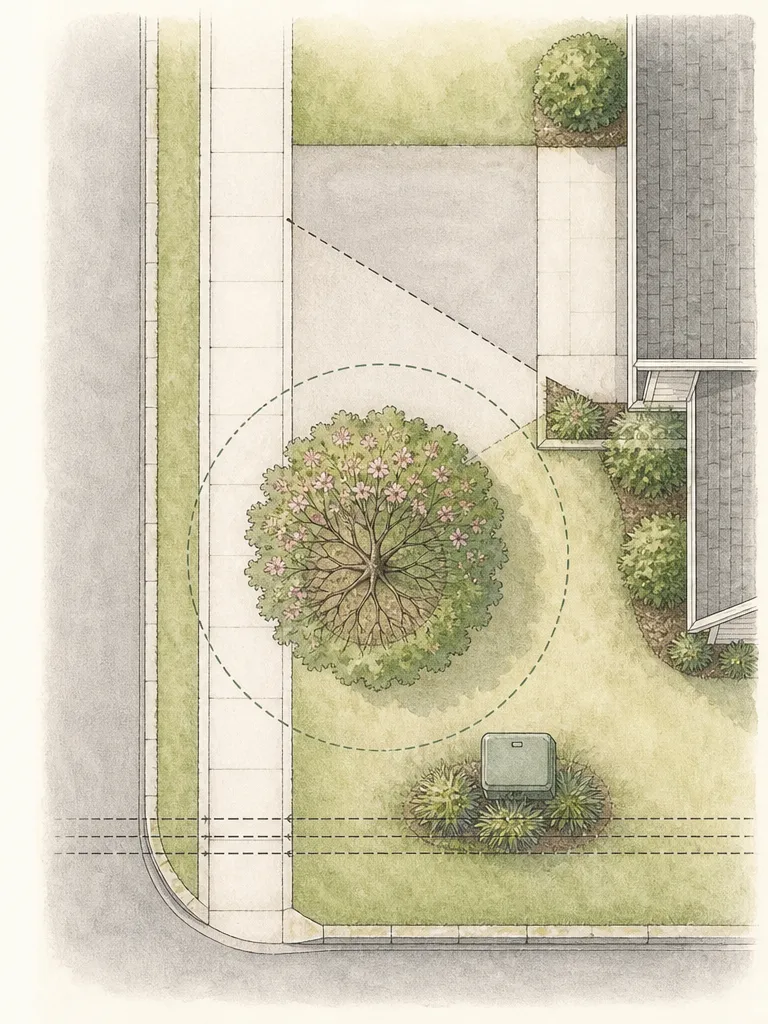
Leave a margin within the local ceiling rather than selecting a tree whose published maximum touches it exactly. Size ranges are not construction tolerances; site vigor and records differ. The required margin should be settled with the utility and regional advisor, not invented from a generic percentage.
Match ornamental character to the viewing job
Once the safe shortlist exists, compare what each tree contributes through the year. Spring flowers may be brief, while bark, branch pattern, foliage, fruit, and autumn color shape the site longer. A small tree seen from a window may justify fine branching and winter silhouette; one beside a walk may need clean fruit and a crown that can provide local clearance without distortion.
Consider flower and fruit litter in relation to paving, parked vehicles, and entrances. Showy fruit can support wildlife and extend interest, but heavy drop may be unsuitable where it creates a slippery surface or stains. Sterile cultivars can have other tradeoffs, and some ornamental species are invasive in particular regions. Check current local status before purchase.
Use form to complement the available volume. A vase-shaped crown may open a view beneath it but spread toward wires or structures; a narrow upright crown may fit width yet grow too tall. A rounded low crown can suit an open lawn panel but crowd a narrow verge. The mature silhouette must fit in all directions.
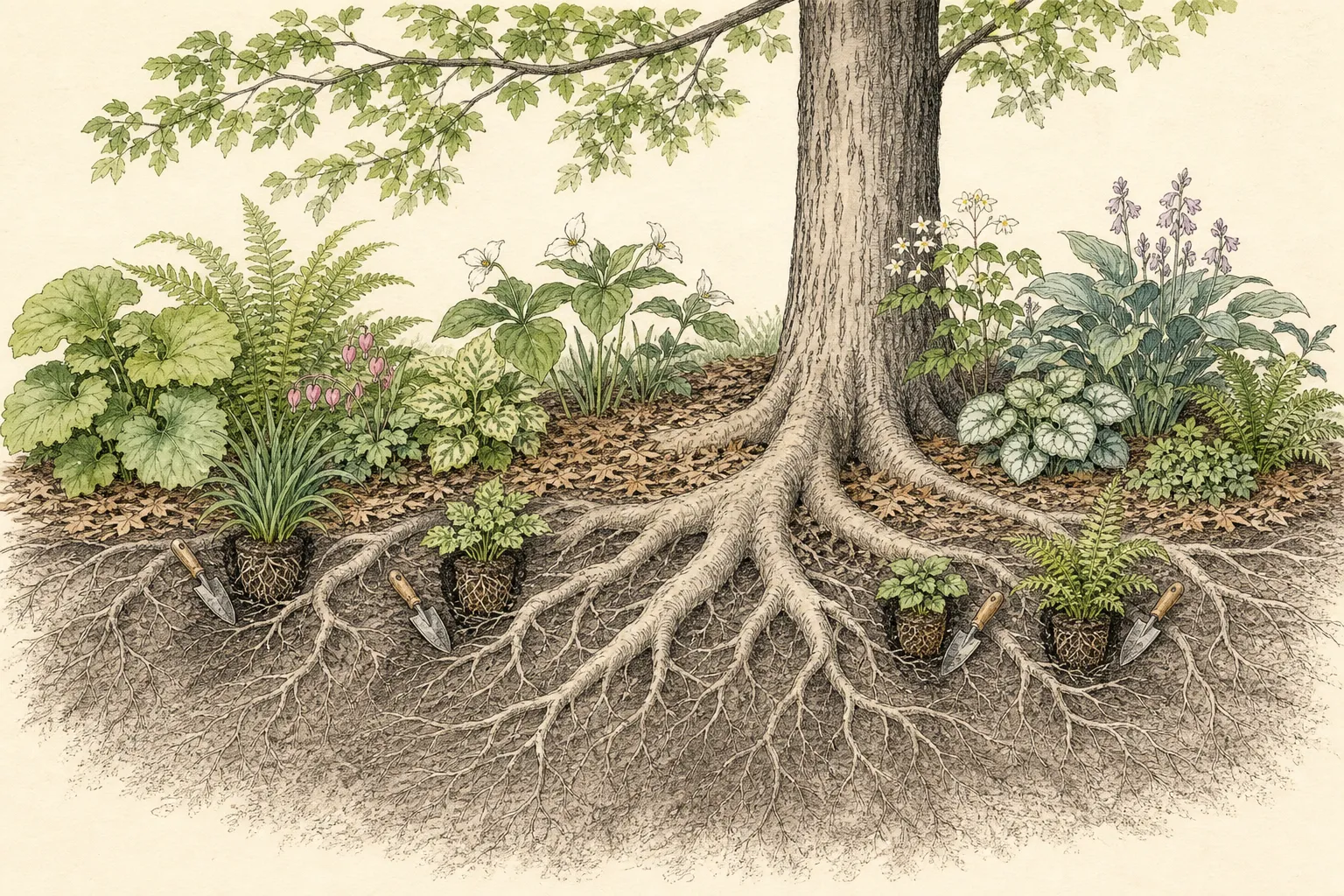
Design the ground layer as support, not camouflage. Keep the root flare visible and utility access open. A restrained ring of regionally suitable low plants or mulch can connect the tree to the garden, but dense permanent planting should not force crews or gardeners to step on roots and crowns during inspection.
Keep utility access and pedestrian space open
Map sight lines from driveways, intersections, doors, and paths under applicable local rules. The tree’s eventual lower branches and trunk are part of that view. Choose a form that can be structurally trained while young without removing a large portion of its crown, and do not place a low weeping selection where people must pass beneath it.
Preserve access around poles, guy wires, transformers, and service equipment according to the utility’s current guide. Requirements differ by equipment and jurisdiction. Do not use the empty ground as a convenient ornamental pocket until the utility confirms what may occupy it. Even low shrubs can obstruct doors, labels, or working clearance.
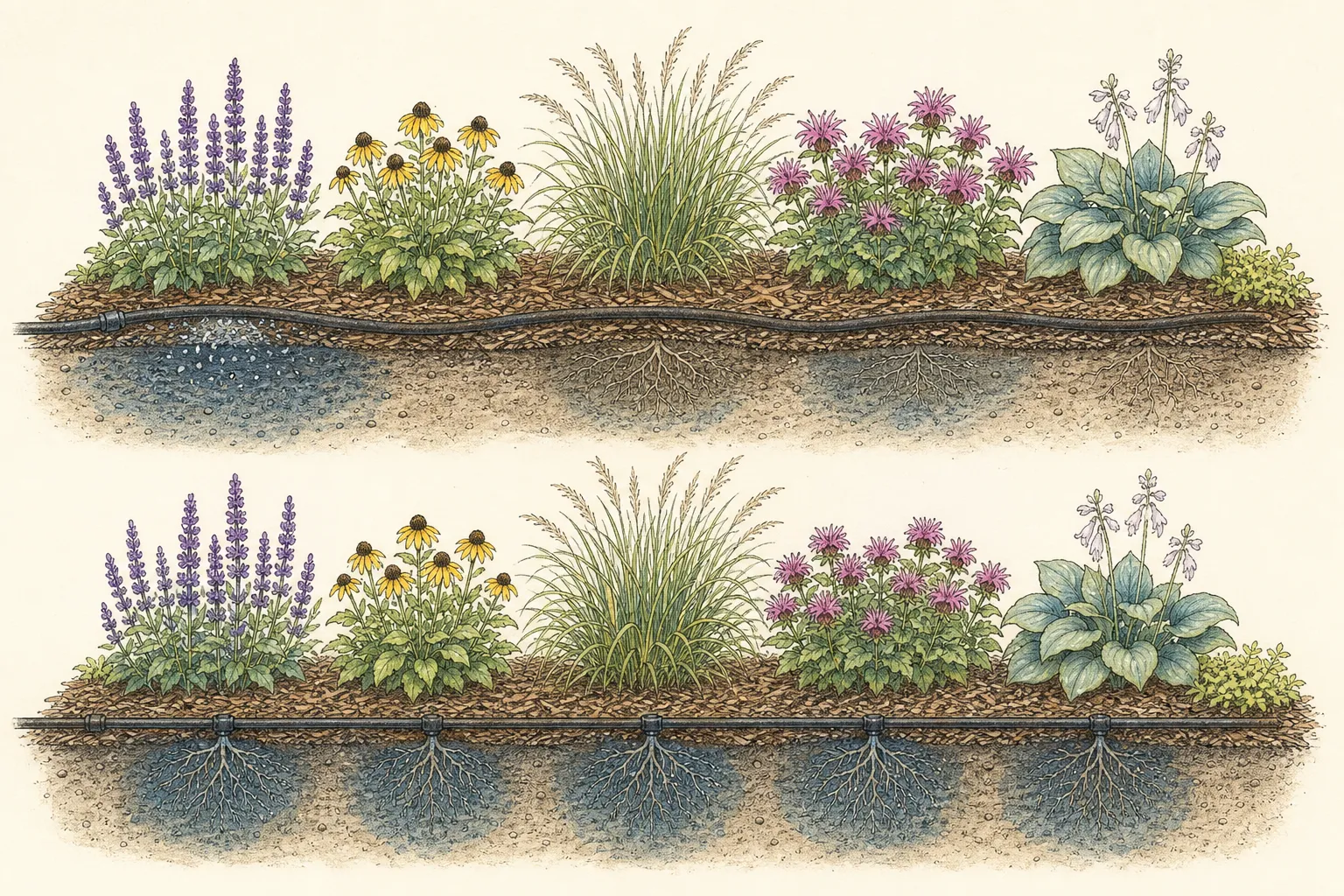
Keep irrigation from saturating equipment bases or washing soil from the root zone. Route tubing where it remains serviceable and cannot become a trip hazard or be severed during utility work. The tree and companion planting should be capable of independent care without attaching lines, lights, or supports to utility poles.
Plan a stable working side for future tree care. An arborist should be able to inspect the trunk and crown from safe ground without standing in traffic or leaning equipment toward conductors. If routine structural pruning cannot be performed safely without entering the utility clearance zone, ask the utility or a qualified arborist whether the site is appropriate before planting.
Check below ground before any digging
Use the legally required utility-locating service before finalizing the planting point, not after the tree has been purchased. In the United States this commonly involves 811; outside the United States, use the local equivalent. Mark private irrigation, lighting, and drainage lines that a public locator may not identify. Never assume a service is deeper than the intended hole.
Treat locate marks as constraints that can change the design. The solution may be moving the tree, selecting a shrub, or abandoning that position. Do not hand-dig closer as a way to override required separation. Ask the utility or locator what the marks mean and what work is permitted in their vicinity.
Assess rootable soil after utilities are marked. A tree needs space beyond the planting hole for structural and absorbing roots. If pavement, compacted fill, pipes, or a shallow soil layer occupy most of that volume, a container or non-tree composition elsewhere may provide better ornamental value without creating infrastructure conflict.
Coordinate the below-ground and overhead plans on one drawing. A spot that clears the wire projection may sit over a service, while a spot clear of the service may place the crown too close to the conductors. The acceptable site is the overlap where both systems, the mature tree, and human access fit.
Plant for establishment, not instant scale
Choose healthy nursery stock with a sound trunk, appropriate branch structure, and a root system that is not dominated by severe circling defects. A smaller well-formed tree is often easier to establish and train than an oversized specimen chosen for immediate impact. Verify the root flare and final planting depth through regional tree-planting guidance.
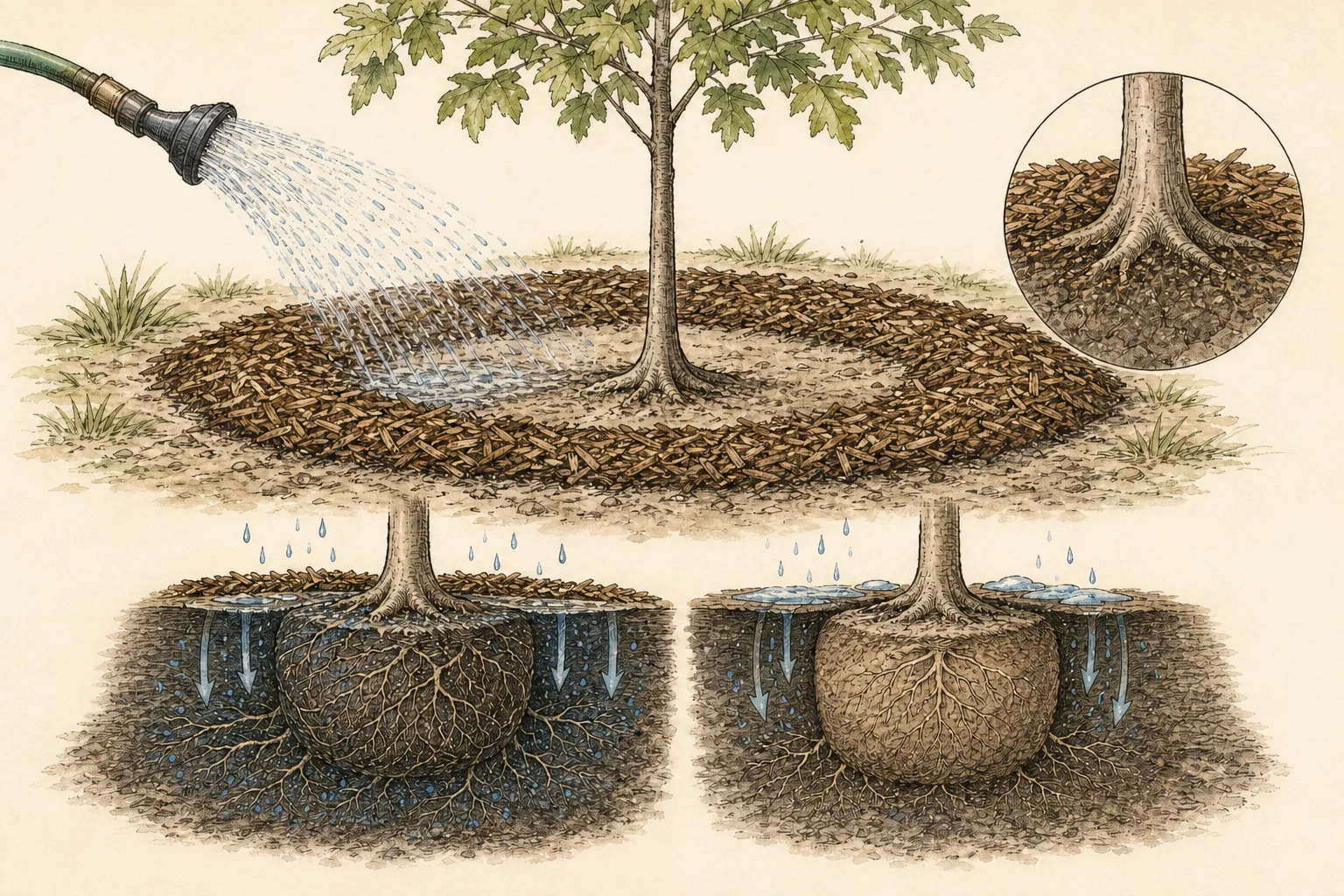
Install the permanent support context first, but never attach the tree to utility equipment. Set the root flare at the proper grade, correct container root defects according to current arboricultural guidance, backfill appropriately, water the root ball and surrounding soil, and mulch broadly while keeping material away from the trunk. These are general principles; exact planting and staking depend on stock type and region.
Keep establishment irrigation visible and adjustable. The original root ball may dry differently from the surrounding soil, so check both. Expand the wetted area as roots grow and avoid directing runoff toward pavement or equipment. A low-utility-zone tree still needs normal tree care; its constrained mature height does not mean a small root system or tolerance of neglect.
Begin structural training while branches are small, using qualified guidance and staying outside all electrical work restrictions. Develop the natural form appropriate to the cultivar rather than shearing the crown to an imagined line. If a branch begins entering the utility zone, contact the serving utility before work approaches conductors.
Review the choice on paper before purchase
Create a one-page decision sheet with the utility’s current rule, equipment type, locate information, measured site, mature height and spread, root-space notes, regional adaptation, ornamental role, litter, and access. Cite the exact cultivar sources. If any field remains unknown, the tree is not ready to buy.
Draw the mature silhouette from the principal views and in section beneath the lines. Add buildings, paths, vehicles, neighboring crowns, pole access, and underground marks. A candidate that fits only when branches are drawn unnaturally narrow or roots are omitted does not fit. Revise the species or the site, not the scale of the drawing.
Ask the utility or a qualified utility arborist to review uncertain conditions. ISA directs readers to local utilities and certified arborists for site-specific questions. Keep the written response with the planting record because ownership, contractors, and utility guidance can change over the life of the tree.
Then choose the best ornamental character among the trees that safely fit. Compare the candidates in winter outline as well as in flower, and place a full-scale marker at the proposed trunk to test the view from doors, paths, and vehicles. Ask whether the mature crown blocks a needed view or directs pedestrians toward equipment, and move the marker before purchase if either conflict appears. This order does not make the design less beautiful; it protects the complete mature form from predictable disfigurement. The finished garden should read as a deliberate small-tree composition, not as a large tree held below wires by repeated loss.
Record a measured no-tree alternative
Suppose utility review has rejected a tree at a Zone 6 Pennsylvania site but explicitly permits one shrub within a particular 8-by-8-foot planting area. A Fothergilla gardenii can be evaluated using NC State's 3–6-foot height and 2–6-foot width: draw a 6-foot circle at the center, leaving 1 foot inside each edge. Moist, acidic, well-drained soil and suitable sun or partial shade remain essential site checks.
The example orders one shrub only after its mature height, suckering behavior, equipment access and location have all been accepted for that specific site. An 8-foot square is an assumed drawing boundary, not a utility clearance rule. If the permission or access envelope is different, change the plan or keep the area unplanted. Recording that rejected-tree decision prevents a future owner from filling the space with an incompatible tree.
Design ideas
- Style
- Infrastructure-aware front-garden composition centered on one naturally small ornamental tree
- Space
- Residential or small public planting site beneath or near overhead utility lines
- Climate
- Local utility rules, equipment type, fire-risk designation, law, regional tree performance, soil, rooting volume, pavement, and weather all control the shortlist; national height-zone diagrams are examples, not universal permissions.
- 1Make the utility map first
Identify the serving utility and equipment, obtain its current planting and access rules, and map wires, poles, anchors, cabinets, and the service drop. Add the legal underground locate before drawing a tree. Keep the map with the property record so a later gardener understands why the planting envelope is constrained.
- 2Draw the full mature silhouette
Use regional institutional dimensions for the exact cultivar and draw both height and crown width at maturity. Add rootable soil, paths, buildings, vehicles, and neighboring plants. Reject any candidate that fits only as a nursery-sized symbol or only after the natural crown has been narrowed on paper.
- 3Shortlist by site before flowers
Filter first for the utility’s mature-height limit, regional hardiness and heat, soil, moisture, rooting volume, and crown width. Only then compare bloom, bark, fruit, autumn color, and winter form. This keeps a compelling flower photograph from overriding a permanent conflict with conductors or pavement.
- 4Use one tree with a quiet ground layer
Center the composition on one compatible tree and repeat a small set of low, regionally suitable plants outside required utility access. Keep the root flare and equipment visible. A restrained ground layer gives the tree presence without turning the pole corridor into an inaccessible thicket.
- 5Frame a view with form, not forced pruning
Choose a naturally rounded, vase-shaped, or upright cultivar whose complete mature outline fits the available volume and the intended view. Reserve a margin beneath the local ceiling through utility review. Avoid selecting a larger tree on the assumption that annual topping will preserve the same ornamental character.
- 6Keep the service side open
Designate one stable approach to the trunk and utility equipment, free of dense shrubs, boulders, raised edges, and permanent irrigation obstacles. Place the strongest ornamental view on the opposite side. The garden can feel layered while still allowing inspection, line-clearance work, and ordinary tree care.
- 7Record the no-tree alternative
If the local rule, root volume, or access leaves no safe tree envelope, design a lower composition of allowed shrubs, perennials, grasses, or seasonal containers. Keep every element beneath the utility's current limits and outside equipment doors, pole approaches, guy wires, and the marked underground corridor. Give the alternative its own ornamental structure: repeat one low foliage mass, place a seasonal accent from the principal view, and retain an open service side rather than filling every gap. Draw each shrub at regional mature spread and verify that maintenance can occur from safe ground without reaching toward conductors. If containers are allowed, place them only on a stable surface outside access routes and plan how they will be watered without hoses crossing the work area. Review the layout at full leaf and after seasonal cleanup, removing any element that begins to narrow the documented service approach. Record why a tree was excluded, along with the utility contact and date, so a future owner does not treat the open volume as an accidental omission. Treat that result as a successful site response, not a compromise awaiting a tree. Recheck current utility guidance before any future change.
Plants in this guide
Related reading
Sources
- Avoiding Tree and Utility Conflicts. International Society of Arboriculture. Source record · Accessed 2026-08-19.
- Yard Safety. Pacific Gas and Electric Company. Source record · Accessed 2026-08-19.
- Planting the Right Tree in the Right Place. Arbor Day Foundation. Source record · Accessed 2026-08-19.
- Fothergilla gardenii. North Carolina Extension Gardener Plant Toolbox. Source record · Accessed 2026-09-09.