Tools · row cover use
Use Floating Row Cover Without Trapping Heat or Blocking Needed Pollinator Visits
Choose row-cover fabric by its protective job, then watch heat, moisture, crop growth, needed pollinator visits, and edge integrity to know when the setup must change.
Published Last updated
In this guide
Protection changes as the bed changes
Floating row cover works only while its protective effect still matches the bed. Cold buffering can become unwanted heat; an insect barrier can block visiting insects from cucurbit flowers that depend on them for fruit set; a sheet that floated above seedlings can rub a taller canopy after its slack disappears. Pair the intended use with the condition that will force the fabric open, onto supports, or off the bed. Porous material passes light, air, and water, yet the space beneath it still needs inspection as weather and plants change.
Cold protection and insect exclusion also fail in different ways. Insulation changes with fabric weight and weather. Exclusion depends on installing before the target pest arrives, checking plants and the prior crop location, and closing every side at ground level. One sheet may serve both purposes, but a loose edge is not an insect barrier and a product’s frost figure says nothing about pests already beneath it.
The useful endpoint is concrete: warm weather raises the covered temperature; cucumber, squash, pumpkin, and melon crops that depend on visiting insects for fruit set need access at flowering; growing tips consume slack and begin to touch the sheet. Some vegetables that do not depend on insect pollination can remain covered longer. Temperature, crop height, moisture, contact, and fabric condition still decide how long “longer” lasts.
Fabric weight trades light for insulation
Fabric weight, light transmission, and stated frost protection belong in one comparison. University of Maryland Extension groups lightweight material around 0.45 ounce per square yard, medium material around 0.5 to 1.0 ounce per square yard, and heavyweight material around 1.5 to 2.2 ounces per square yard. More material generally increases insulation while reducing the light that reaches the crop. The specification on the chosen roll remains the working reference.
In that Maryland classification, lightweight cover transmits about 90 to 95 percent of light and is associated with roughly 2°F of frost protection. Medium cover transmits about 70 to 85 percent and is associated with 4 to 6°F. Heavy cover transmits about 30 to 50 percent and is listed at up to 8°F. Those are source-specific examples, and the combination of lower light and greater heat retention is a reason to reconsider heavy fabric as conditions warm.
The names do not define one universal scale. New Hampshire and Utah Extension use different class boundaries and report frost performance differently from Maryland. Do not blend those figures into a single promise. Read the selected product’s specification, follow the local forecast, and verify the temperature beneath the installed fabric; no grade label guarantees a crop through a particular freeze.
Warm-weather insect exclusion may call for netting instead of medium or heavy row cover. The opening still has to match the target insect, and the netting still has to enclose the bed, but it does not carry row cover’s heat-retention or frost-protection function. Extra fabric is useful only while its insulation still serves the bed; otherwise it brings less light and more retained heat to a task that needs neither.
Width is part of the material decision. The fabric has to cross the bed or its hoops, retain room above the canopy, and reach the ground along both sides and ends. A sheet that spans the current leaves but cannot maintain slack and a closed perimeter is too narrow for the intended installation. A supported bed needs enough width for the arch rather than only the straight distance across the soil.
A useful comparison connects the roll to the bed: material, stated weight, light transmission, intended use, width, and the space required by the crop and supports. A generic grade name cannot show which frost figure applies when institutions and products classify weights differently. Likewise, a width has little value until it is compared with the support arc, growth slack, ground contact, and service opening required by the installation.
An installation with room to inspect
Look over leaves, stems, and transplants before sealing the fabric, and consider what crop family occupied the bed previously. Insects or immature stages already on the crop or in the soil can remain beneath a closed cover, and pest insects that enter through a gap can multiply inside the protected space. A pre-installation check cannot prove that the bed is clear, so continued inspection remains part of physical exclusion.
Floating or supported placement depends on crop height, fabric weight, access, and contact. A sheet may float over short crops when it has enough slack to rise with them. Medium and heavyweight covers are stronger candidates for supports, and hoops keep fabric away from stems and leaves that could be abraded by repeated rubbing. Maryland gives low tunnels 15 to 30 inches high with hoops 2 to 4 feet apart as an example, not a universal frame specification.
Working slack lets a short crop lift floating fabric without pulling a fixed edge away from the ground. A supported cover also needs enough material to cross the full arc, reach the ground on both sides, close both ends, and preserve room for expected growth. Fabric that already rests taut on the leaves or barely reaches its anchors has no allowance for a larger canopy.
Soil, boards, sandbags, rocks, or suitable pins can hold the fabric at the ground. An exposed gap breaks insect exclusion, and a loose edge gives wind a way under the sheet. Gather and secure tunnel ends as deliberately as the long sides. The side reserved for access must return to the same continuous ground seal after every opening.
A service side makes root-zone moisture, weeds, leaf undersides, and fabric contact visible. Rain and hose water can pass through the material, but pulling the cover back gives a clearer view during hand watering. Drip irrigation or a soaker hose can run beneath the sheet and reduce repeated opening for water. Neither method removes the need to inspect moisture and the weeds that may grow quickly beneath the cover.
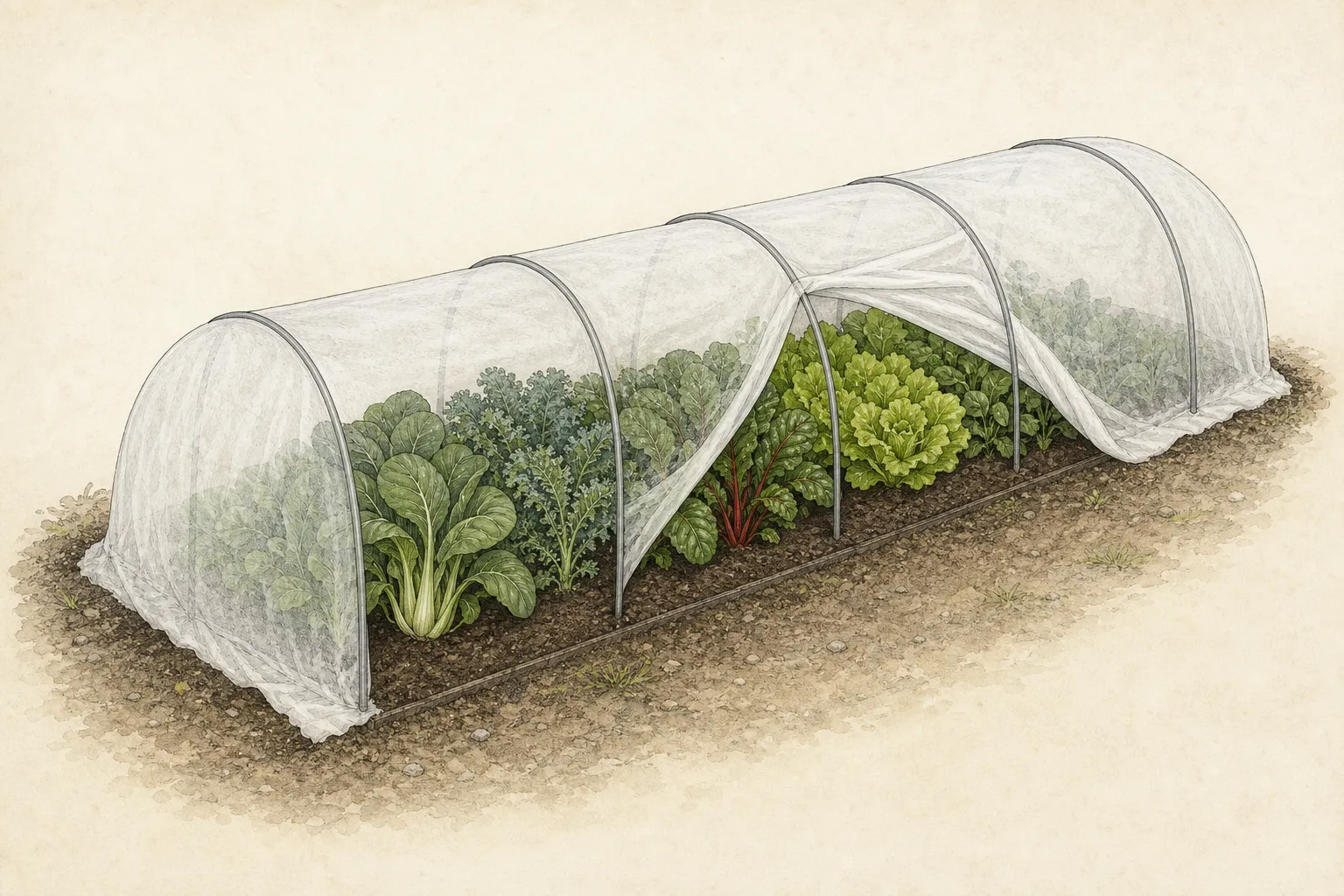
Wind exposes weak anchoring and damaging contact. A lifted edge interrupts the barrier, while fabric moving repeatedly across one stem or leaf can abrade it. A perimeter check therefore covers three different conditions: a continuous ground seal, remaining growth space, and any point where the material is rubbing the canopy.
Support geometry also controls access. Frames should be easy to open or take down because warm-day ventilation, moisture checks, weeding, and crop inspection all require entry. A planned side or end should peel back without dismantling the entire structure, then reseal when exclusion is still needed. For cucurbit crops whose fruit set depends on visiting insects, opening at flowering must be equally practical; access cannot wait for a difficult frame to be rebuilt.
What changes beneath the fabric
The enclosure changes several conditions at once. Air can warm, insects can remain inside, and greater temperature and humidity with less air movement may also increase disease problems, although the Extension evidence is inconclusive. Temperature, pest status, and symptoms therefore need separate observation.
Soil moisture and weeds can change out of sight, and the canopy can reach the sheet. Edge closure, contact, and fabric condition change as the cover is opened and exposed to weather, so each needs its own observation.
Temperature deserves the first check on warm days. Extension guidance reports that summer air under row cover can be 5 to 15°F above the outside temperature. Beans, tomatoes, and peppers may lose flowers or developing fruit when daytime temperatures exceed about 90°F, and retained heat can contribute. A rising under-cover reading is a cue to vent or remove material rather than assume the original cold-buffering purpose still applies.
Moisture needs its own observation. Permeable fabric admits rainfall and irrigation water, yet water on the sheet does not reveal conditions in the root zone. The service opening provides direct access to the soil and to any drip or soaker line hidden below the fabric. Check the bed itself before deciding whether irrigation is needed.
Weeds and insects can also remain out of sight. Weeds may grow quickly beneath the cover. An insect found inside may have been present on a plant, emerged from the soil, or entered through a gap or tear; a closed perimeter cannot identify which path occurred after the fact. Inspect the crop and the enclosure instead of treating the fabric as proof that pests are absent.
Contact and growth complete the inspection. Repeated rubbing can abrade stems or foliage. A canopy that has consumed the slack or reached the supports has outgrown the original enclosure even when the fabric itself remains usable. The next decision is spatial: provide suitable support and additional clearance or end coverage rather than pull the sheet tighter.
Fabric condition is separate from crop growth. A healthy canopy beneath a torn or lifted edge has lost the continuous barrier, while intact fabric rubbing a taller plant has lost its spatial fit. Inspect the full perimeter after wind and ordinary access. If the material cannot remain anchored and closed, do not rely on it for insect exclusion.
Four conditions alter the setup
Excess heat, insect-dependent cucurbit bloom, lost growth clearance, and a broken perimeter require different responses. Heat changes ventilation or material. Insect-dependent bloom changes flower access. Growth changes support or ends coverage. A gap or lifted edge suspends insect exclusion until the perimeter is continuous again. Naming the condition before acting prevents one adjustment from being mistaken for a complete solution.
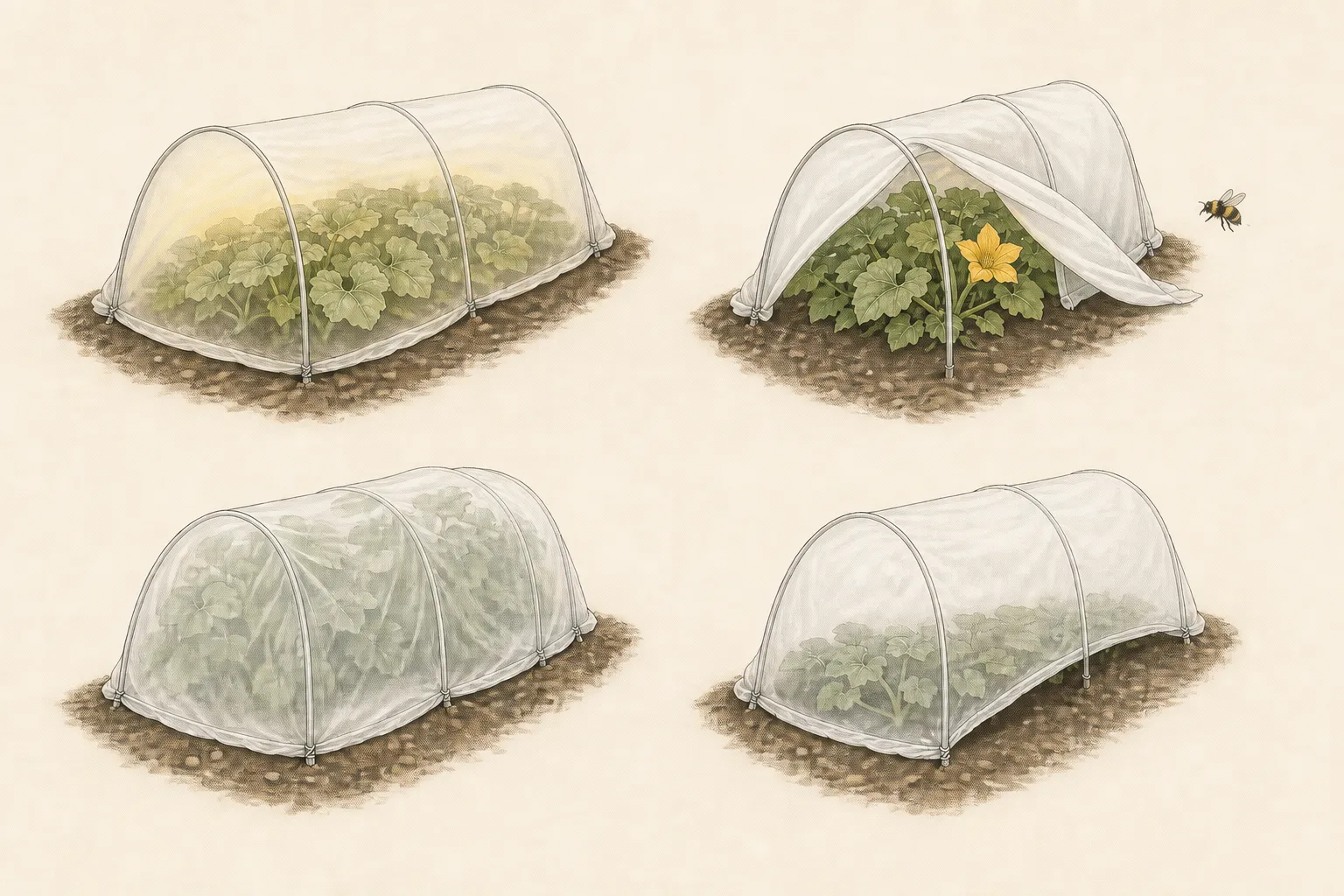
A hot enclosure may need a planned side or end opened for ventilation. That opening also suspends full insect exclusion. Once warming is no longer useful, fine netting with openings suited to the target insect may fit a continuing exclusion job without row cover’s heat retention. Venting and changing material answer different durations of the same heat problem.
When fruit set in a covered cucumber, squash, pumpkin, or melon crop depends on visiting insects, flowering changes the rule: open or remove the cover so those insects can reach the flowers. Crops that do not depend on insect pollination can remain covered longer, but heat, height, moisture, weeds, pests, and crop condition still limit that extension. Flowering is therefore one checkpoint, not the only reason to inspect a covered bed.
Slack is spent when the canopy reaches the sheet or supports. A sound cover may move onto a suitable frame when the enlarged enclosure remains accessible and anchored; otherwise it comes off. Pulling the same sheet tighter does not create growing room and can sacrifice the ground contact needed for exclusion. Recheck contact points after changing the frame.
A gap, tear, or edge that will not remain at the ground ends continuous insect exclusion. Restore the enclosure and recheck it after normal access and wind before relying on the barrier again. If the fabric no longer stays anchored and closed, its age or nominal grade does not restore the missing function.
Two conditions can arrive together. A warm bed may still face insect pressure, or an insect-dependent cucurbit crop may flower while exclusion is still desired. Opening row cover relieves retained heat or admits the insects needed at those flowers, but it also interrupts the barrier. Fine netting can continue only the exclusion job; it cannot preserve a closed insect barrier while giving visiting insects access to the enclosed flowers.
A dry close protects reusable fabric
Clean soil from used row cover with water when needed, then let the material dry completely. Store dry fabric in a sealed bag or container rather than leaving it exposed in a shed, barn, or garage where mice may nest in it. Cleaning, drying, and sealed storage protect the material between installations without promising that it will survive a fixed number of seasons.
Before storage and again before installation, inspect the fabric, its edges, and the places that contacted plants, anchors, or supports. Weather, abrasion, handling, and fabric weight all affect useful life. Reuse for exclusion depends on whether the material can still cover the crop, remain anchored, and maintain a continuous perimeter.
Published lifespan examples vary widely. Maryland gives a typical range of one to three years, New Hampshire says well-kept covers may serve several seasons, and Utah warns that lightweight material may last only a few months. Those descriptions concern different materials and conditions, so none should become a calendar for automatic replacement or reuse.
Let the next intended job decide whether stored material remains usable. A cover kept only for a nominal age has no value as an insect barrier if it will not stay closed at the ground. Conversely, an intact cover does not need to be discarded merely because another product reached the end of a source-specific lifespan example. Condition and the required function, not a universal anniversary, control the decision.
Log the cover against its current job
Record whether the job is cold buffering or pest exclusion, the exact roll specification, crop stage, fabric width and condition, observed temperature, perimeter closure, flower access, inspection date and removal decision. Reassess the record when the crop or weather changes. A label describing a fabric grade cannot substitute for those checks, and an untested cover should not be recorded as having protected the crop.
Tool notes
- Type
- Porous spun-fabric floating row cover for temporary use over a home vegetable bed
- Purpose
- Quick reference for one temporary job: cold buffering or physical pest exclusion over a home vegetable bed. Compare the selected roll’s stated weight, light transmission, frost information, width, and intended use. The status keys classify temperature, fit, flower access, perimeter integrity, direct observations, material condition, storage, and next-use suitability without making a grade name a guarantee.
- Affiliate
- No commercial links
Maintenance
- Perimeter status — Check after installation, an ordinary opening, and wind. ‘Continuous’ means long edges and ends meet the soil, anchors hold, no tear or gap opens the enclosure, and the service edge is resealed. A lifted edge is ‘interrupted’; unseen sides are ‘unverified,’ not continuous.
- Interior status — A complete check includes root-zone moisture, weeds, leaf undersides, insects or immature stages, symptoms, and fabric contact. Wet fabric alone leaves moisture ‘unverified’; a closed exterior alone leaves pest status ‘unverified.’ Each observation remains separate because one acceptable condition does not establish the others.
- Enclosure fit — ‘Adequate now’ means material remains above the tips or full support arc, sides reach the soil, ends close, the service opening works, and contact does not abrade the canopy. ‘Inadequate’ applies when any condition fails. Present fit does not establish season-long clearance.
- Material condition — Exclusion is ‘available’ only while edges, anchor points, support contacts, and crop contacts tolerate ordinary handling without opening the perimeter. Exclusion is ‘unavailable’ when closure damage opens it. Direct floating is ‘available’ without foliage abrasion and ‘unavailable’ when damaging contact begins; other fabric uses may remain possible.
- Season close — ‘Stored’ means clinging soil was rinsed when needed, both sides are dry, and the sheet is enclosed in a bag or container protected from mice. ‘Not-ready’ means soil, moisture, or protected enclosure remains unresolved. Neither status promises service life; next-use suitability still depends on the intended job and observed material.
- Next-use suitability — ‘Identifiable’ means the same roll supplies its weight, light transmission, frost information, width, and intended use. ‘Unidentified’ means those details cannot be tied to that sheet, so it cannot inherit another product’s claim. ‘Suitable’ also requires present edges and fabric to perform the assigned job; a damaged sheet may be reassigned or retired.
Related reading
Sources
- Vegetable Garden Weather and Pest Protection. University of Maryland Extension. Source record · Accessed 2026-08-17.
- Using Row Covers in the Garden. University of New Hampshire Extension. Source record · Accessed 2026-08-17.
- Row Covers. Utah State University Extension. Source record · Accessed 2026-08-17.