Plant problems · japanese beetles ornamental garden
Manage Japanese Beetles Without Turning the Garden Into a Trap
Confirm the metallic adult and skeletonized feeding, protect priority ornamentals with targeted hand removal or barriers, and avoid traps that draw more beetles into the planting.
Published Last updated
In this guide
- Confirm the beetle before responding to the leaf
- Separate active ornamental feeding from a lawn-grub question
- Map priority plants and tolerable damage
- Use hand removal where it can change the outcome
- Protect selected plants instead of treating the whole garden
- Keep lure traps away from plants you value
- Treat pesticide decisions as plant-specific and pollinator-sensitive
- Separate adult feeding from lawn grub decisions
- Close the season with a measured record
- Protect flowers without removing the whole display
- Coordinate with neighbors without multiplying lures
- Use plant replacement only for repeated disproportionate loss
- Define an endpoint for daily hand removal
- Diagnosis
Confirm the beetle before responding to the leaf
Adult Japanese beetles are roughly oval, with a metallic green head and thorax, coppery wing covers, and small white hair tufts along the sides and rear of the abdomen. Photograph one adult from above and the side without filling the frame with a cluster. The white tufts help separate it from other metallic beetles. Identification should rest on the insect’s features, not on the fact that it was found on a rose.
Adults often skeletonize leaves by eating tissue between veins, producing a lace-like brown framework. They may also feed on petals and fruit. Similar-looking leaf damage can be caused by other beetles, sawfly larvae, caterpillars, or slugs. Turn leaves over, inspect at different times of day, and look for the animal making fresh damage. A damaged leaf without its feeder remains a symptom, not a complete diagnosis.
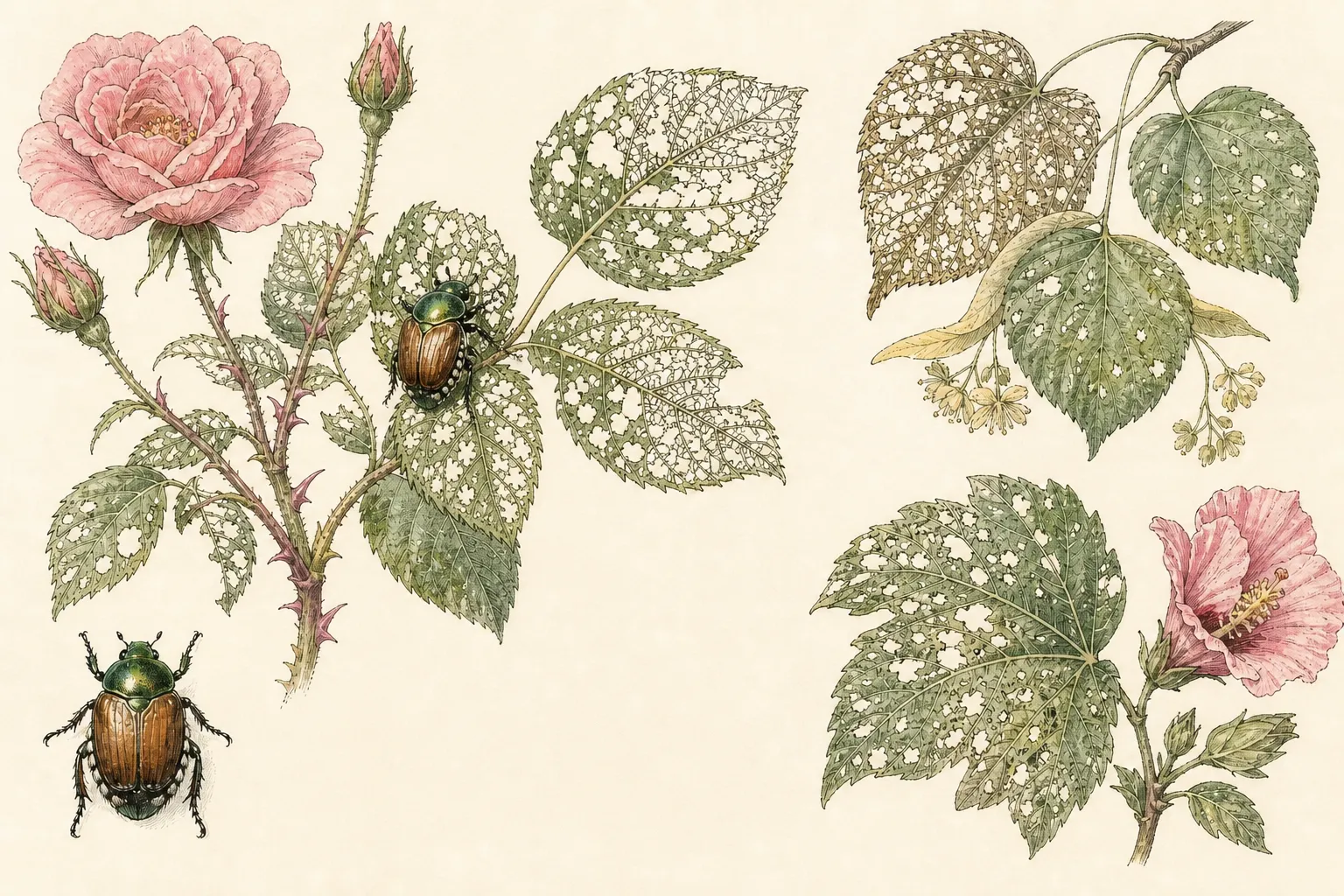
Record plant species, number of adults seen, canopy area affected, and whether damage is increasing. Japanese beetles feed in groups because damaged plants and beetle odors attract more adults. A crowded cluster looks alarming, but the useful management question is whether new foliage, flowers, or a young plant is losing function. Mature established trees can tolerate visible feeding that would be serious on a new rose or small linden.
Separate active ornamental feeding from a lawn-grub question
Confirm adults with fresh feeding on the affected plant and rank its vulnerability before choosing a response. Old skeletonized leaves alone do not measure current pressure. Keep any turf-root problem on a separate sampling route; adult visitors to ornamentals do not demonstrate that the lawn contains a damaging grub population. Judge the next action from current evidence in each location.
Map priority plants and tolerable damage
Walk the garden before removing anything and divide plants into three groups: young or high-value plants needing protection, established susceptible plants that can tolerate some feeding, and flowers that must remain accessible to pollinators. This map prevents the gardener from spending every morning on a large tree while neglecting a newly planted shrub whose entire canopy is within reach.
Mark the beginning of damage on one leaf or shoot and photograph it every few days. Old skeletonized tissue will not refill, so judge management by new feeding and the condition of new leaves. Count beetles at the same time of day for a rough trend. Exact population science is not required; a consistent local observation is enough to show whether hand removal is holding a priority plant.
Avoid removing a plant’s remaining healthy foliage to make the damage look cleaner. Leaves with partial green tissue still contribute to the plant, and broad pruning can expose stems and fruit to heat. Remove only broken, diseased, or completely spent tissue according to the plant’s normal care. Japanese beetle injury is a feeding problem; cosmetic pruning does not reduce the number arriving tomorrow.
Use hand removal where it can change the outcome
Handpicking is practical on small plants and early infestations. Visit in the cool morning when beetles are less active. Hold a container of soapy water beneath the group and tap or pick adults into it. Beetles often drop when disturbed, so the container should be in position before the leaf is touched. Wear gloves if preferred and avoid crushing beetles into flowers and foliage.
Return regularly during the adult flight period. Removing adults from a priority plant reduces immediate feeding and may reduce aggregation cues there, but it does not create a permanent barrier. Work from the top and sunny side where beetles commonly gather, then inspect flowers gently. Keep the session short and repeatable. A ten-minute route through selected plants is more sustainable than trying to clear every host in the landscape once.
Dispose of the container contents after the insects are dead and keep detergent away from garden soil and open water. Plain knocking into water without detergent may allow beetles to escape. Do not pour concentrated soapy water over roots or leaves. The soap belongs in the collection container, not as an improvised spray whose concentration, plant safety, and insect effect are unknown.
Protect selected plants instead of treating the whole garden
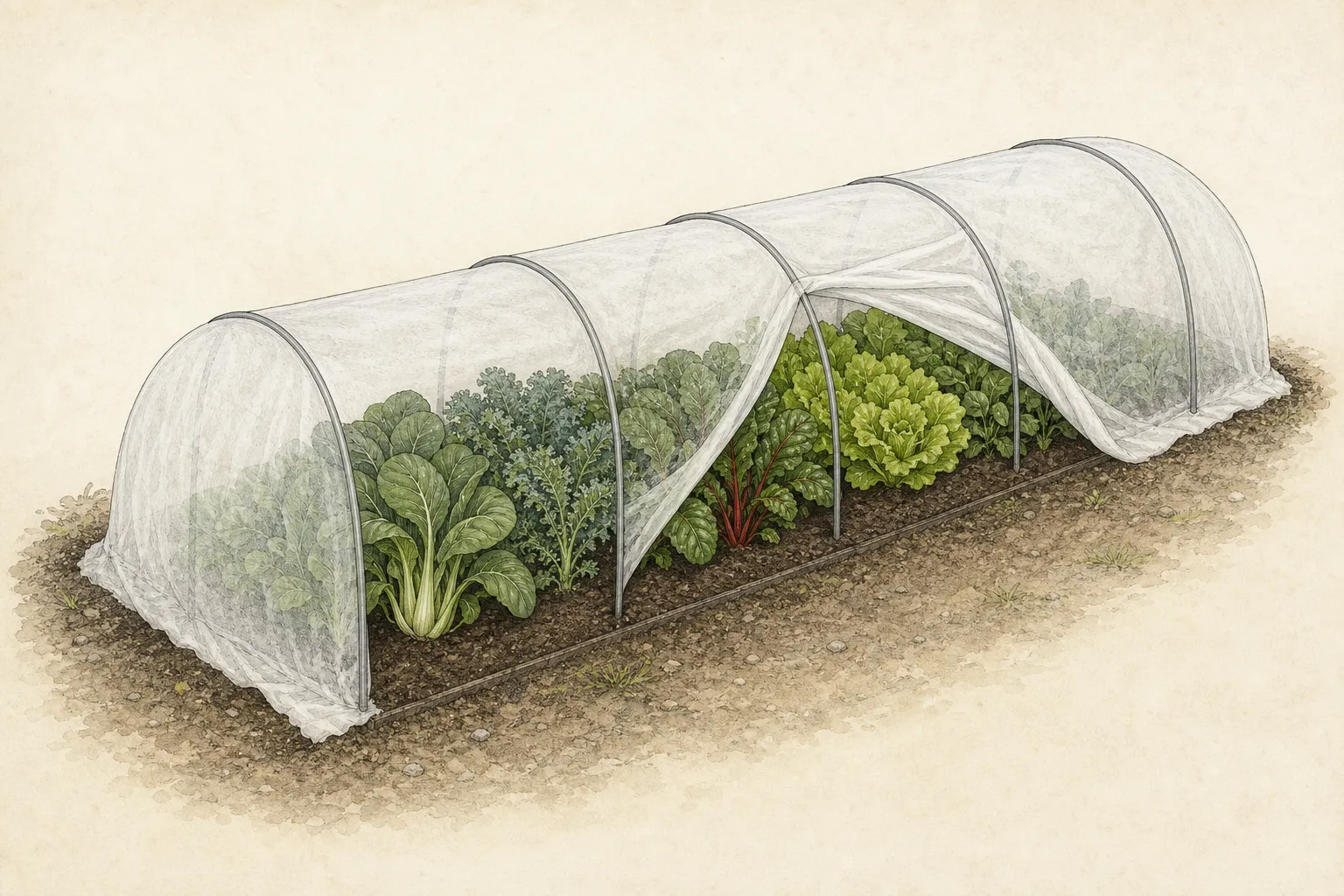
Fine mesh or row-cover material can exclude adults from a small shrub or young specimen when installed before beetles enter and sealed around the support. The structure must hold fabric away from foliage so insects cannot feed through it and wind cannot abrade leaves. Check daily for trapped beetles, heat buildup, broken shoots, and new growth pressing against the cover.
Do not cover a plant that needs insect pollination while flowers are open unless the loss of pollination is acceptable. Roses and many ornamentals may not need pollination for display, but the barrier also removes nectar and pollen access from bees. Use it for a short high-pressure interval on a priority plant and uncover when feeding declines. A garden-wide net is not an ecologically neutral solution.
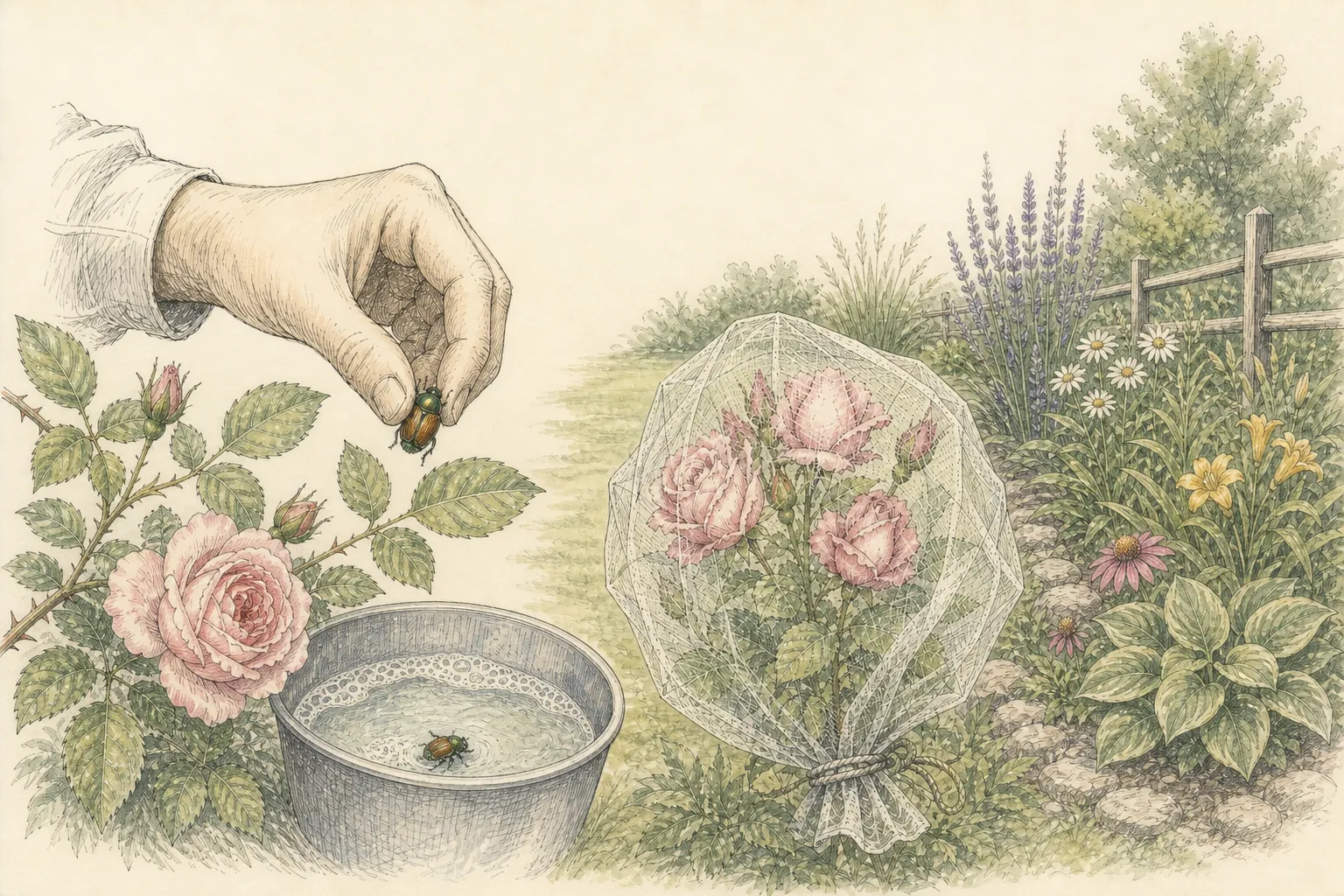
A barrier can protect a canopy but cannot improve drought, poor planting depth, or root stress that makes injury harder to tolerate. Water the root zone according to need, keep mulch away from stems, and avoid excess nitrogen that produces tender growth. Plant health supports recovery; it does not repel beetles. Keep cultural care and direct pest management as separate claims.
Keep lure traps away from plants you value
Commercial Japanese beetle traps use floral scents and sex pheromones that attract adults. Research summarized by Extension sources shows that traps can draw more beetles into an area than they capture, increasing damage near the trap. Hanging one beside a rose bed can turn that bed into the approach route. A full bag proves attraction, not protection.
If traps are used for monitoring or community-scale purposes, follow local recommendations for placement far from susceptible plantings and understand the surrounding landscape. A small residential lot may not provide meaningful distance. Do not infer that two traps near opposite garden edges cancel each other. Their odor plumes can expand the area from which beetles are invited.
Avoid homemade lures and discarded trap bags in garden waste. The better home-garden plan is usually plant prioritization, hand removal, short-term barriers, and tolerance on established plants. If a neighbor uses traps, focus on protecting the plants in your control rather than adding another lure. Document feeding pressure before and after any change so attraction is not mistaken for a sudden regional outbreak.
Treat pesticide decisions as plant-specific and pollinator-sensitive
Insecticides that kill adult beetles can also harm bees and other insects, particularly when applied to flowers or drifting onto blooming plants. Product choice, plant labeling, local registration, timing, residual activity, and pollinator precautions all matter. This guide does not name a universal product. Consult current local Extension guidance and follow the pesticide label exactly; the label is the law.
Never spray an entire flowering border because beetles were found on one rose. Identify the treatment target, remove or avoid open flowers as the label directs, and consider whether hand removal can protect the small area at risk. Systemic products can also reach pollen or nectar depending on active ingredient and timing. “Systemic” does not mean targeted only to the pest.
A large established tree with cosmetic feeding is rarely a sensible target for homeowner spraying. Coverage is incomplete, drift risk is high, and the tree may retain enough green leaf area. Seek a certified professional and local guidance when a young high-value tree is being substantially defoliated. The threshold should be plant function and realistic treatment benefit, not annoyance at seeing beetles overhead.
Separate adult feeding from lawn grub decisions
Japanese beetle larvae are white grubs that feed on grass roots, but adult beetles in an ornamental bed do not prove that the lawn contains a damaging grub population. Adults can fly from elsewhere. Do not apply a lawn insecticide solely because roses have feeding damage. Inspect turf symptoms and sample the soil using locally recommended timing and thresholds before making a separate lawn decision.
Grub treatments vary in whether they are preventive or curative and in the timing required. Some products that are effective against young larvae will not rescue severely damaged turf later, and some broad treatments pose environmental concerns. Current local Extension recommendations and the label should govern any action. Keep the ornamental plant record and turf diagnosis separate even though the insect has two life stages.
Healthy turf practices can improve tolerance, but watering lawns to support grubs is not a management strategy. Likewise, drying turf intentionally can injure grass without controlling adults already feeding in shrubs. A home garden benefits from narrow decisions: protect specific ornamentals from adults and diagnose turf only where turf evidence exists.
Close the season with a measured record
Adult activity eventually declines. Record first and last observation dates, priority plants, the worst feeding interval, and which intervention protected new foliage. Do not count old lace-like leaves every week; track clean shoots and flowers that developed after action. This reveals whether ten-minute handpicking, temporary netting, or simple tolerance produced the best return for each plant.
Review plant placement if one susceptible species requires intensive protection every year. A young rose may become more tolerant as it establishes, while a small high-visibility planting may justify continued hand removal. Repeated severe injury can also support replacing a plant with a less preferred species suited to the site. Diversifying the border reduces the chance that one insect’s favorite host dominates the whole composition.
Leave the garden ready for next season by cleaning collection containers, repairing fine mesh, and recording where traps were absent or distant. Do not promise eradication. Japanese beetles are mobile landscape pests. Success is a garden that keeps its important foliage and flowers through the flight period while avoiding a lure-centered escalation and unnecessary risk to pollinators.
Protect flowers without removing the whole display
Japanese beetles can chew rose, hibiscus, and other petals while foliage remains tolerable. Remove adults from fresh flowers in cool morning conditions and take spent damaged blooms only when the plant’s normal deadheading practice supports it. Do not cut unopened buds because nearby petals were eaten. Mark clusters to see whether direct removal protects the next flowers.
Where a fine barrier is used, enclose buds before beetles enter and remove the cover when flowers need pollinator access or heat builds. Check inside every day. A barrier wrapped around an occupied cluster traps the pest with its food and can abrade petals. Support the fabric beyond the mature bloom outline.
Choose a few high-visibility flowers for protection and tolerate feeding elsewhere. This preserves garden display without turning every preferred host into a treatment target. Record which plants recover and which lose repeated buds; the result can guide future placement or cultivar selection.
Coordinate with neighbors without multiplying lures
Japanese beetles cross property lines, so local trap and treatment choices affect what gardeners observe. Share the reason lure traps are kept away from susceptible plants and coordinate removal only when neighbors are interested. Do not respond to a nearby trap by adding another at the opposite boundary.
A neighborhood can compare first flight, peak feeding, and priority hosts without making unsupported population claims. Consistent dates and plant records help time hand removal and barriers. They do not authorize area-wide pesticide use. Each property must follow labels, local rules, and its own non-target risks.
Keep public-facing paths free of collection containers and temporary netting hazards. Where a community garden is involved, label protected plants and removal routines. Shared clarity prevents someone from opening a barrier or moving a trap next to the crop it was meant to protect.
Use plant replacement only for repeated disproportionate loss
A preferred host should not be removed after one cosmetic year. Compare several seasons, establishment, canopy function, maintenance time, and the plant’s design value. A rose that retains foliage and flowers after short morning checks may remain worthwhile. A small repeatedly defoliated specimen in a difficult site may not.
Choose a replacement from locally suitable species that are less preferred, while matching light, soil, mature size, and the intended garden role. No plant is guaranteed beetle-proof. Diversify rather than replacing one repeated susceptible mass with another monoculture advertised as resistant.
Remove and replant in a suitable season, correcting root-zone and spacing problems. Keep the beetle record. If the new plant also declines without feeding, the original loss included a site problem. Replacement is a design decision informed by recurrence, not a control method for beetles across the landscape.
Define an endpoint for daily hand removal
Handpicking should end when adult counts and fresh feeding fall to a level the priority plant can tolerate. Set a checkpoint such as several consecutive visits with few adults and clean new leaves. Continuing an intensive route after seasonal pressure declines consumes time and disturbs flowers without improving the plant.
Reduce visits gradually and keep one weekly check through the local flight period. If numbers rise again, return briefly to the earlier route. Record the last consequential feeding date rather than the last individual beetle seen. Mobile insects may still appear after the plant no longer needs active protection.
Clean and store the collection container, remove temporary mesh, and restore access. The endpoint is part of integrated management: a targeted action begins from evidence and also stops from evidence.
Diagnosis
An oval beetle with metallic green head and thorax, coppery wing covers, and white hair tufts feeds on roses or other ornamentals while leaves become lace-like between intact veins.
- Check
- Photograph one adult from above and the side, confirming metallic green, copper wing covers, and white lateral tufts. Pair that record with fresh feeding on a known plant. Count adults and mark new damage at the same time of day on several visits so active pressure is separated from old brown leaf skeletons.
- Cause
- Adult Japanese beetles are aggregating on a preferred host and consuming leaf tissue and flowers. Damaged-plant odors and beetle cues can draw more adults to the same plant during the flight period.
- Action
- Handpick adults from priority plants into soapy water during cool mornings, repeat through the flight period, and use a sealed fine-mesh barrier briefly where pollination and heat are managed. Preserve healthy leaf area and root-zone care. Seek local pesticide guidance only when realistic benefit outweighs pollinator and drift risks.
Leaves are skeletonized or notched, but no adult beetles are present during repeated inspections and larvae, caterpillars, sawflies, slugs, or another feeder is found instead.
- Check
- Inspect both leaf surfaces, stems, and the plant at morning and evening. Look for sawfly larvae, caterpillars, beetles, slugs, frass, webbing, and the exact edge of fresh feeding. Preserve a specimen or clear photograph for local identification before choosing a control that targets a different insect group.
- Cause
- Another chewing pest is responsible, or the Japanese beetles have already left and old damage is being mistaken for active feeding. Skeletonization alone cannot identify the current animal.
- Action
- Close the Japanese beetle route until the active feeder is identified. Remove or photograph the organism, compare damage progression, and follow a pest-specific local recommendation. Do not apply a broad insecticide to old damage or to a plant where no current target has been confirmed.
A young or recently planted shrub is losing a large share of its functional canopy, while several mature established hosts nearby retain substantial green leaf area despite visible feeding.
- Check
- Estimate functional leaf area on the young plant and compare new shoots after several days. Check planting depth, moisture, root-zone heat, and recent establishment. Prioritize direct removal or a temporary barrier there, while using observation and tolerance on established plants that retain broad green canopies.
- Cause
- The same amount of feeding has different consequences because canopy size, establishment, drought stress, and plant value differ. The young plant has less reserve and fewer leaves available to lose.
- Action
- Concentrate protection on the young plant, maintain even root-zone moisture and appropriate mulch, and avoid fertilizing to replace eaten leaves. Tolerate cosmetic feeding on established hosts when plant function remains adequate. Reassess new foliage instead of pruning away every damaged leaf.
Beetle numbers and feeding appear greatest around a commercial lure trap placed near susceptible ornamentals, and new adults continue arriving even as the collection bag fills.
- Check
- Map trap distance, susceptible hosts, prevailing access routes, beetle counts, and new feeding before and after the trap is removed. Do not use bag volume as the outcome. The useful measure is whether priority plants receive fewer arriving adults and produce cleaner new growth when the lure is absent.
- Cause
- The trap lure is attracting beetles into the immediate landscape faster than the device captures them. A full bag documents attraction and can coexist with increased plant injury nearby.
- Action
- Remove lure traps from the garden vicinity and do not replace them with homemade attractants. Continue consistent counts on priority plants, use direct removal, and place any monitoring device only under current local guidance at a distance the property can actually provide.
Roses carry adult beetles, but a lawn also has irregular wilted turf that lifts easily with few roots and contains C-shaped white grubs when sampled at the locally appropriate time.
- Check
- Confirm turf wilting, poor root attachment, and live grub counts using local sampling timing and thresholds. Identify grubs where possible and review irrigation and other turf stresses. Keep records independent from the rose inspection so the lawn treatment decision is not borrowed from adult feeding elsewhere.
- Cause
- A separate white-grub problem may be damaging turf roots, but adult ornamental feeding does not prove its presence. Soil sampling and turf symptoms are needed because adults can fly from other properties.
- Action
- Treat turf as a separate diagnosis. Follow local grub thresholds, product timing, irrigation instructions, and every label requirement only after sampling supports action. Adult beetle management on ornamentals continues independently; lawn treatment will not remove adults already flying through the landscape.
Related reading
Sources
- Japanese beetles in yards and gardens. University of Minnesota Extension. Source record · Accessed 2026-08-19.
- Japanese Beetle. Iowa State University Extension and Outreach. Source record · Accessed 2026-08-19.
- Japanese Beetles in the Urban Landscape. University of Missouri Extension. Source record · Accessed 2026-08-19.