Tools · ornamental seed selection germination needs
Choose Ornamental Flower Seeds by Germination Needs
Sort ornamental flower seeds by the real barrier between packet and seedling, from light response and warmth to cold stratification and hard seed coats.
Published Last updated
In this guide
- Start with the obstacle between packet and seedling
- Separate light response from pretreatment
- Use cold stratification only where dormancy actually requires it
- Treat hard seed coats as a mechanics problem
- Match sowing method to transplant tolerance and season length
- Build the shortlist in workable germination batches
- Use source-bounded examples to decide what to buy now
- Trial a counted sample before committing the packet
- Keep pretreatment and emergence in separate columns
- Tool notes
Start with the obstacle between packet and seedling
Gardeners often buy ornamental flower seed by color, height, or cutting appeal and only later discover that the real constraint was never aesthetic. The first constraint was the germination barrier. Some seeds sprout readily if they are simply warm and moist. Others need light on the seed surface, a cold moist rest that mimics winter, a nicked seed coat, or a direct-sown path because they resent root disturbance. Choosing by germination need means identifying that barrier before the packet enters the cart.
This approach is especially useful when indoor space, refrigerator space, grow lights, and attention are limited. A seed that wants three months of cold moist stratification belongs to a different schedule from one that germinates in a week at 70 degrees Fahrenheit under lights. A dust-fine surface-sown seed belongs to a different workbench than a large direct-sown hardy annual. The packet price does not reveal that difference. The germination requirement does.
Once you begin sorting this way, many buying mistakes become visible early. A flower can still be perfect in color and habit yet be a poor fit for your season because it needs pretreatment you will not reliably provide. Another packet may be ordinary in appearance but ideal because it asks only for warmth, light, and a tray you already own. The point is not to make seed starting more technical. It is to make the first decision more honest.
Separate light response from pretreatment
Light requirement and pretreatment are not the same question. A seed may need no cold treatment but still need light at germination, which means it should not be buried under a heavy compost layer. Iowa State's perennial-seed guidance is useful because it shows several ornamental examples clearly. Columbine germinates readily without pretreatment at 70 to 75 degrees Fahrenheit and should not be covered because light is needed. Catmint similarly needs no pretreatment but wants light and usually germinates in about 7 to 14 days at roughly 70 degrees.
Other seeds are the opposite. Purple coneflower needs no pretreatment either, yet Iowa State advises covering it lightly and germinating it at about 65 to 70 degrees Fahrenheit, with emergence in roughly 3 to 4 weeks. Those three examples prove why a single sentence such as 'most flower seeds need light' creates avoidable failure. The useful question is narrower: does this seed need exposure, a light dusting, or full cover to stay correctly moist while it germinates?
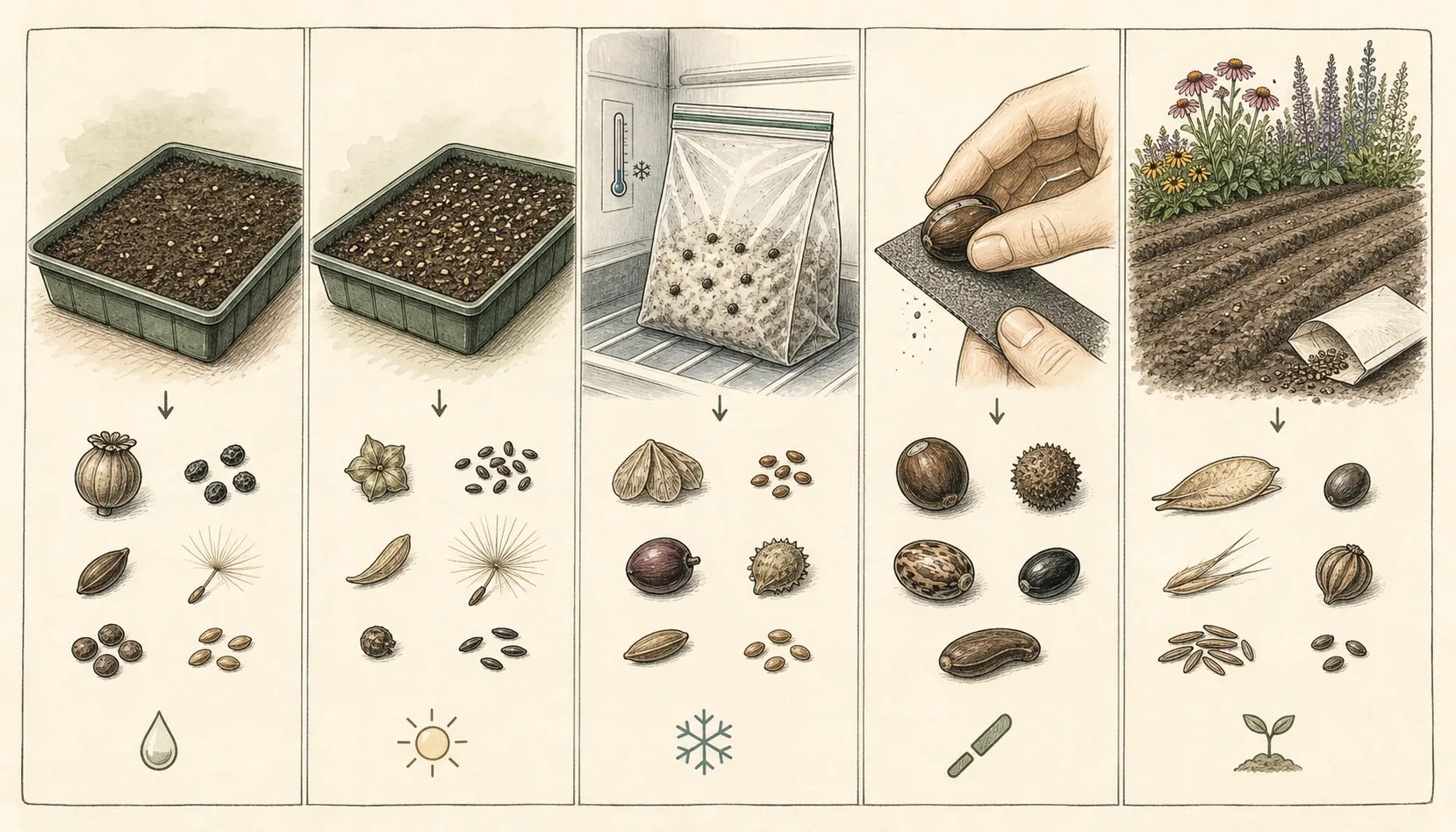
That is why the packet and the propagation note should be read together. A seed can be easy and still belong to a distinct batch. Surface-sown seed needs a prepared flat, labeled watering plan, and a grower who will not let the top dry out. Lightly covered seed can tolerate a slightly different moisture rhythm. Separate those paths at purchase and the tray arrangement becomes calmer before a single seed is sown.
Use cold stratification only where dormancy actually requires it
Cold stratification is one of the most over-applied flower-seed rituals because it sounds horticulturally serious and because many ornamental perennials do need it. Illinois Extension is helpful here: some seeds require a temperature change to break dormancy, but not all. Iowa State's species notes show how specific the requirement can be. Butterfly weed germinates best after roughly 3 to 4 weeks of cold storage at about 40 degrees Fahrenheit. Beardtongue may want 3 to 8 weeks of cold moist stratification. Iris may need something much longer, even about three months, and still emerge unevenly.
Other ornamentals do not need that cold step at all. Columbine often germinates readily without pretreatment, purple coneflower needs none, and catmint can be sown warm and lighted without a refrigerator phase. Stratifying those seeds just because they are perennials adds time without solving a real problem. The category is not annual versus perennial. The category is dormant versus ready. That distinction saves both bench space and patience.
A practical shortlist therefore separates 'cold needed' from 'cold optional' and 'cold not helpful.' The optional class matters because some species improve with chill but do not absolutely depend on it. Anise hyssop is one example Iowa State notes this way. When refrigerator space is tight, those optional packets should not crowd out seeds with a truly mandatory dormancy break. Source-specific sorting is the only clean way to make that decision.
Treat hard seed coats as a mechanics problem
Some ornamental flower seeds do not fail because the temperature was wrong. They fail because the seed coat is physically slow to admit water. Iowa State's perennial-seed article describes mechanical scarification with sandpaper and also notes that hot-water treatment can work for some species. The point is not that every hard-looking seed should be nicked. The point is that some packets belong in a 'coat barrier' batch rather than in the warm-tray batch or the refrigerator batch.
Large-seeded flowers such as sweet peas or certain lupines are often the kinds of packets that push a gardener toward this question. They are visually easy to handle, which makes it tempting to sow them by feel without reading the propagation note. Yet the physical barrier can be the whole reason they lag. If the packet or source guidance points to scarification, treat it as a deliberate step with labeled seed and a fixed method rather than a vague pre-soak done only if you remember.
Mechanical treatment also belongs to the smallest group possible. Do not scarify seed that you are not ready to sow immediately, and do not assume that a hard coat makes a seed universally difficult. Some packets only need a light nick or brief soak; others need nothing if sown fresh. This is another reason to buy by germination need. A workbench filled with physically tough seed should be an intentional batch, not a surprise discovered while the seed trays are already open.
Match sowing method to transplant tolerance and season length
Germination need is not finished once the seed sprouts. The sowing method has to fit what happens immediately after emergence. Penn State's annual-seed guidance and Iowa State's indoor-seed guide both reinforce the same practical divide: some ornamentals are worth starting indoors because they bloom earlier or need a longer run-up, while others are better direct-sown into a prepared bed because transplanting buys little or creates avoidable disturbance. Buying the packet without deciding which route it belongs to is an unfinished choice.
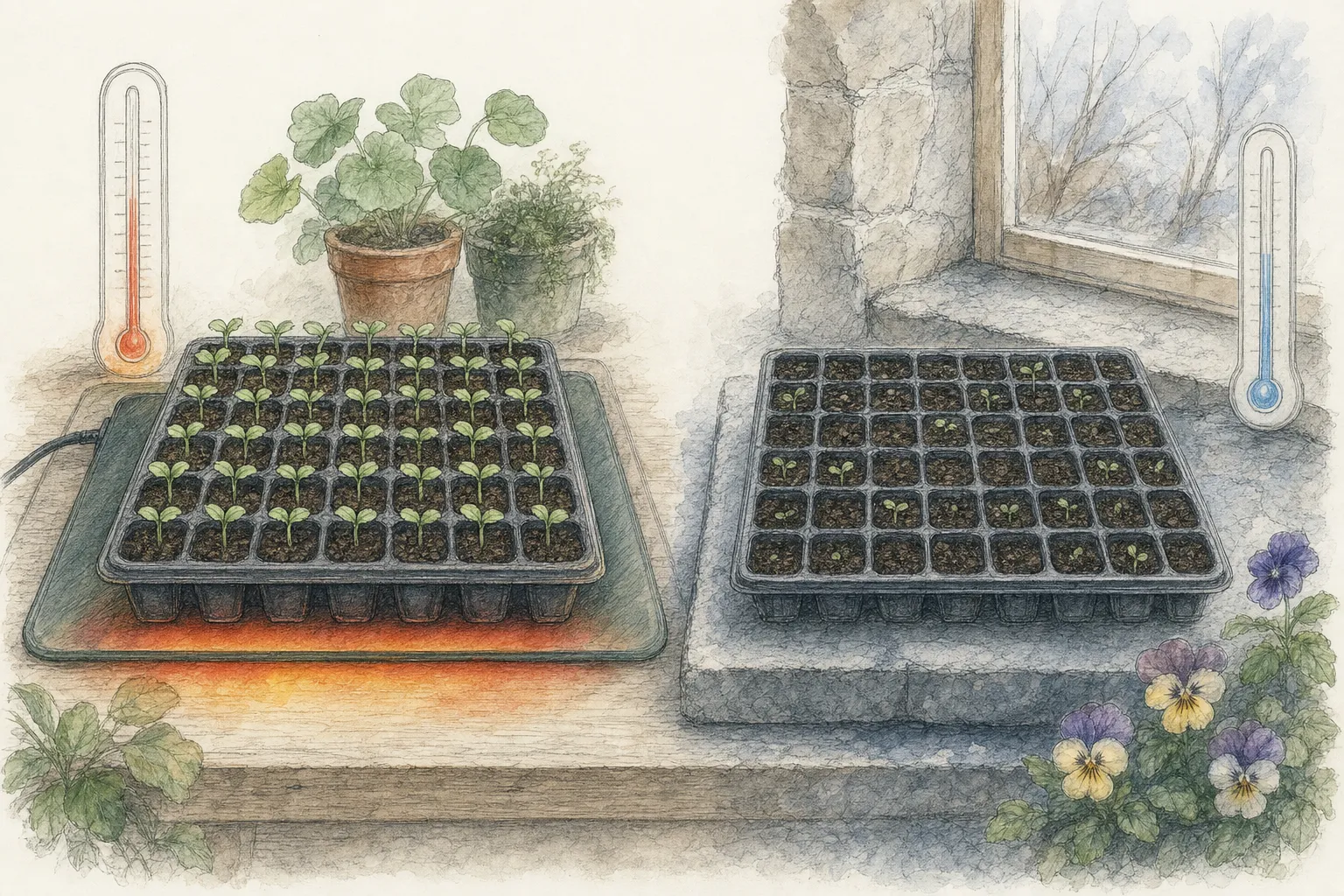
This is where workbench honesty matters. A seed that germinates best warm and under lights is still a poor purchase if you cannot give it abundant light after germination. Iowa State's indoor-starting guide says as much in practical terms: start with clean materials, provide abundant light, avoid over- or underwatering, and warm the germination mix if possible. A packet that needs weeks indoors before transplanting must be matched to that whole system, not just to a hopeful tray on the windowsill.
The reverse is true for direct-sown candidates. If the bed cannot be kept free of crusting, clods, and early weed pressure, the fact that a flower can be direct-sown does not mean it should be your first choice. Buy by the method you can carry through well. A gardener with strong lights but little outdoor seedbed preparation time may do better with indoor-started annuals. A gardener with a prepared cool bed but no room for flats may do better with hardy direct-sown packets.
Build the shortlist in workable germination batches
By this stage the packets should fall into a few practical groups. Group one is 'warm and straightforward': no pretreatment, ordinary germination warmth, clear packet instructions, and manageable transplant timing. Group two is 'surface or near-surface attention': seeds that must be watched at the surface because light improves or is required for germination. Group three is 'cold-storage queue': species that need definite cold moist stratification. Group four is 'coat barrier': seeds needing scarification or another mechanical opening step. Group five is 'direct-sow only or preferably direct-sow.'
That grouped shortlist is far more useful than a pile sorted by flower color. It lets you count real workload. How many trays need the brightest light? How many packets will monopolize the refrigerator for a month? How many seeds need labeling so a scarified lot is not confused with an untouched lot? How many are actually simple enough to sow in one quiet weekend? Once you see the packets this way, overbuying becomes harder because each packet belongs to a real production slot.
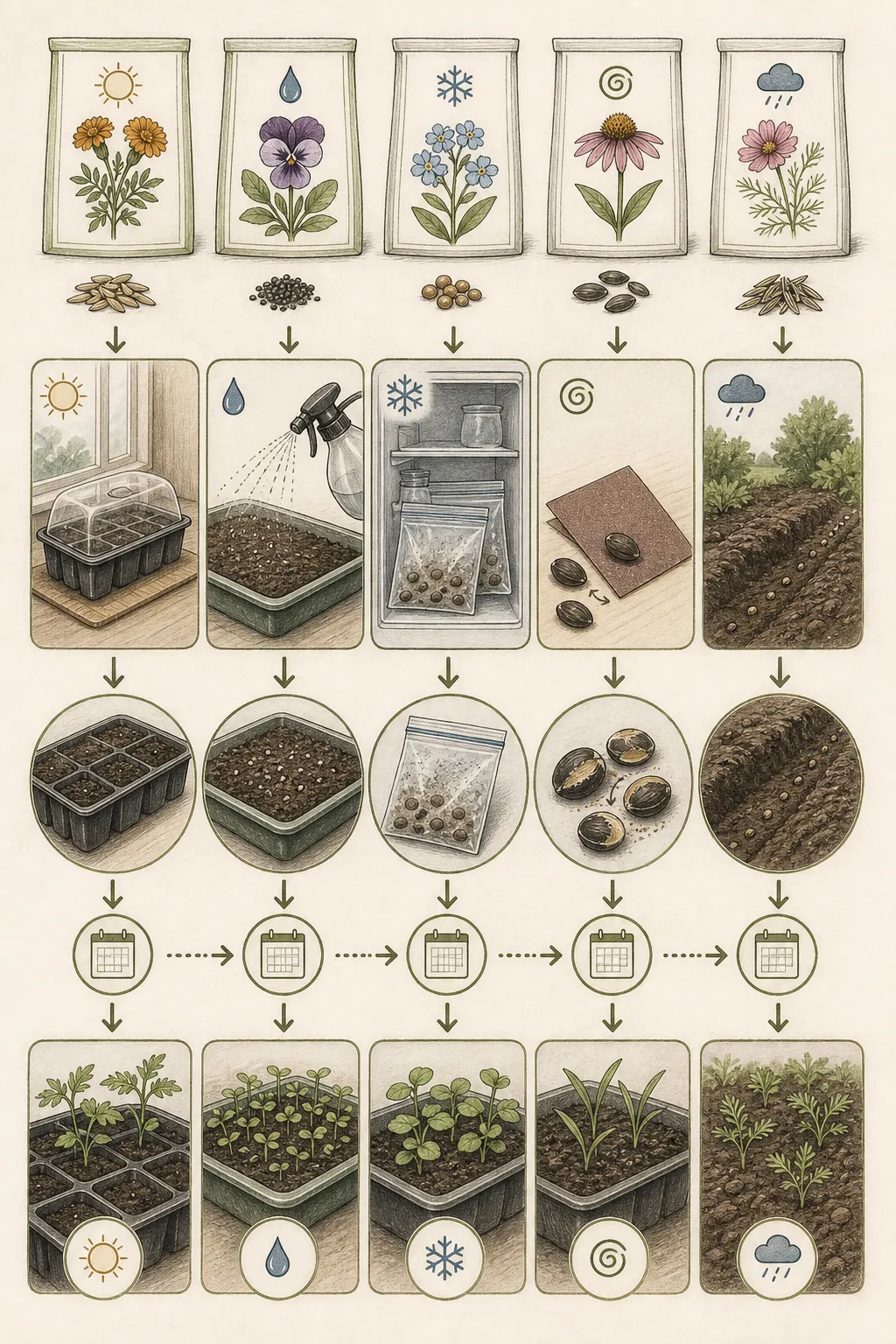
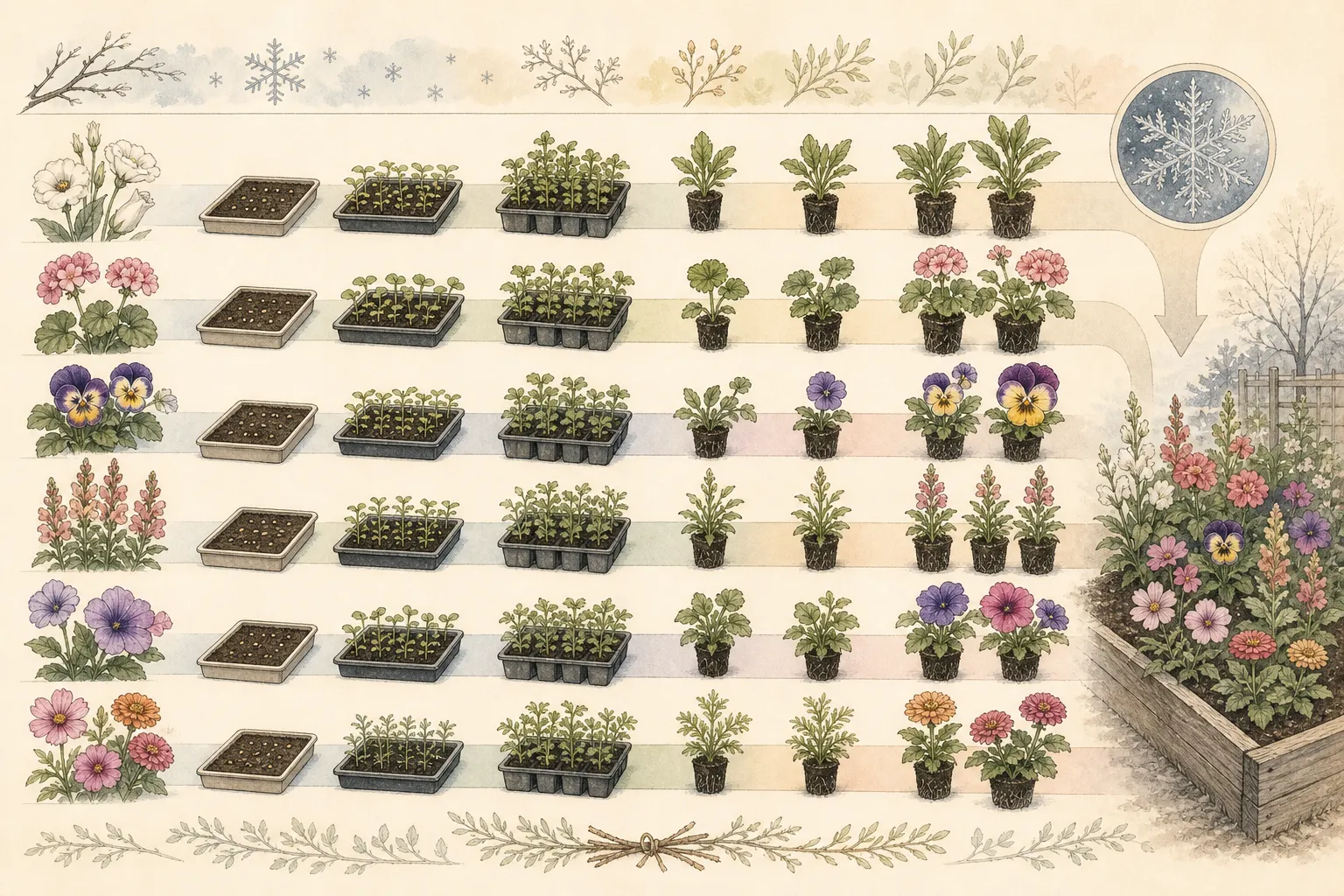
It also helps you stage the season. A batch that needs 3 to 8 weeks of cold moist stratification must start earlier than a no-pretreatment annual that only needs warmth and light. A direct-sown cool-season packet may belong outdoors before the warm indoor batch is even mixed. Germination need is therefore a scheduling tool, a tray-management tool, and a buying tool all at once. The shortlist becomes a map of work rather than a wishlist of flowers.
Use source-bounded examples to decide what to buy now
A few specific species show how this framework changes buying. If you want a quick, uncomplicated ornamental perennial from seed, purple coneflower belongs in the easy class: no pretreatment, lightly covered seed, a germination range around 65 to 70 degrees Fahrenheit, and emergence in roughly 3 to 4 weeks. Catmint is similarly uncomplicated but belongs in a different sowing surface class because it needs light and should not be covered. Those are both 'easy' packets, yet they do not belong in the same tray treatment.
If you want a packet for winter prep rather than immediate sowing, beardtongue, butterfly weed, and many iris types belong in the cold-storage conversation because the dormancy barrier is real. They may be exactly the right purchase for a gardener willing to label, stratify, and wait. They are the wrong impulse buy for someone hoping to sow everything warm on one bench in March. The packet is not bad. The fit is bad.
And if your season or setup is narrow, the most intelligent purchase may be the packet with the plainest flowers and the simplest instructions. Ornamental seed buying gets better when difficulty is measured by the path from dry seed to usable transplant, not by whether the bloom looks sophisticated in a catalog photograph. Germination need turns that path visible before the packet is opened. That is the point of the whole tool.
Trial a counted sample before committing the packet
When directions are uncertain or seed is limited, test a counted sample under the temperature, light, and pretreatment planned for the main sowing. Label the start date and treatment, then record how many seeds emerge and how evenly. A small trial can expose a failed pretreatment, unsuitable temperature, or weak seed lot before it occupies the best propagation space.
Keep an untreated comparison whenever enough seed is available. Unnecessary scarification or prolonged chilling can reduce success just as surely as skipping a required treatment. Move to the main sowing only after the result supports the method, and retain the packet so emergence can be interpreted against the stated species and lot.
Do not discard a labeled trial the moment the first seed emerges. Record the spread between first and last emergence and the proportion of sturdy seedlings, because an erratic batch may require more bench space and a longer transplant window than a quick percentage suggests.
Keep pretreatment and emergence in separate columns
Use one record per seed lot: identity; source protocol; pretreatment; light or covering requirement; temperature guidance; sowing method; start date; seeds sown; first and last emergence; usable seedlings; next transplant checkpoint. Leave unknown requirements unresolved before buying a large quantity. Preserve the spread of emergence dates as well as the total, because the same final count can occupy very different amounts of bench time.
Tool notes
- Type
- Flower-seed packet, propagation note, and batching record
- Purpose
- Select ornamental flower seeds by the pretreatment, light, temperature, and sowing method they actually require, so the packets you buy match the equipment, refrigerator space, light, and calendar you can provide.
- Affiliate
- No commercial links
Maintenance
- Store packet, sowing notes, and any stratification or scarification record together so next year's purchase decision reflects what the seed actually needed. A packet that looked simple in January may reveal itself in practice as a refrigerator project or a high-attention surface-sow batch.
- Retire old or poorly labeled seed lots from the easy batch unless you are willing to run a separate germination test before sowing. Uncertain age and uncertain labeling create a new germination problem that should not be confused with the plant's normal requirements.
- Clean trays and tools between batches so cold-treated, surface-sown, and direct-sown seed do not get mixed by residue or misplaced labels. Cleanliness is also a record-keeping advantage because a clearly separated batch is easier to evaluate honestly after emergence.
- Review which germination classes crowded your bench, lights, or refrigerator this season and reduce the next order accordingly. A good buying system should reveal when you consistently purchase more chilled or surface-sown seed than your setup can support well.
- Keep one current list of packets by pretreatment class, not just by bloom color, so you can see workload before the sowing season begins. That list is what turns a tempting seed order into a realistic propagation plan.
- Update the record after emergence, not just at purchase, because germination speed and ease are part of next year's buying evidence. A packet that emerged evenly in ten days belongs in a different confidence category than one that needed a rescue chill after four warm weeks.
- Separate packets that need immediate sowing from those that can wait for the next suitable season. Seed buying becomes far more accurate when the shelf itself reflects urgency, pretreatment, and likely bench space rather than simply alphabetical order.
Related reading

Sources
- How to Grow Perennials from Seed. Iowa State University Extension and Outreach. Source record · Accessed 2026-08-19.
- Guide to Starting Seed Indoors. Iowa State University Extension and Outreach. Source record · Accessed 2026-08-19.
- Starting seeds indoors. University of Minnesota Extension. Source record · Accessed 2026-08-19.
- Seed stratification: What seeds require cold treatment. Illinois Extension. Source record · Accessed 2026-08-19.
- Sowing Annual Seeds. Penn State Extension. Source record · Accessed 2026-08-19.