Tools · ornamental seed selection mature garden role
Choose Ornamental Flower Seed by Garden Role and Mature Habit
Select flower seed by the mature job it must perform—edge, mass, vertical accent, airy filler, climber, or cut flower—while checking climate, timing, support, and garden capacity.
Published Last updated
In this guide
- Define the empty role before browsing
- Translate the packet into a mature silhouette
- Match climate, site, and sowing method
- Build the border from roles and repeated groups
- Calculate seed quantity from usable plants
- Evaluate commercial claims and substitutions
- Run a small trial and edit the next order
- Turn the shortlist into a role-and-quantity record
- Tool notes
Define the empty role before browsing
Choose the empty garden job before choosing a flower. Mark a low edge that must stay below a view, a broad mass that should read from across the yard, a vertical accent, an airy filler, a climber, or a cut-flower row. Then measure the usable footprint, permitted height, neighboring spread, path clearance, and weeks when the role must be present. A packet qualifies only when its mature plant can occupy that measured envelope. Name one primary role and, at most, one compatible secondary role. An edging plant must remain low and dense enough to define the line; a vertical accent must rise clearly and stay clear of adjacent plants; a climber needs an attachment habit and support that agree. A cut-flower plant also needs harvest access and enough stem production to tolerate removal. A pollinator value claim does not answer any of those spatial questions by itself.
Draw the border at mature midsummer volume, including permanent perennials, shrubs, bulbs, paths, windows, utilities, and irrigation. The Royal Horticultural Society advises measuring the border, assessing soil and seasonal light, and using ultimate height and spread during selection. NC State Extension treats mature scale and user needs as core design decisions. These principles prevent annual seedlings from being assigned space that established plants will reclaim by June.
Set operating limits before shopping. Write how many trays fit under the available lights, how often direct-sown ground can be watered, whether staking and deadheading are realistic, and which access route protects neighbors during spent-plant removal. A role that needs weekly tying, repeated sowing, or a long indoor start is unsuitable when the garden cannot supply that work, even if the finished photograph is persuasive.
Translate the packet into a mature silhouette
Copy the packet facts into a comparison sheet: botanical name, cultivar or strain, annual or perennial life cycle, mature height and width, light, final spacing, sowing method, sowing date, germination expectation, first-flower timing, support, and any treatment statement. Nebraska Extension identifies seed count, plant height, light, sowing time, depth, spacing, and days to maturity as useful packet fields. A missing value stays blank until another direct source supplies it.
Treat the cultivar name as part of the identity. Dwarf, compact, trailing, climbing, bedding, and cutting strains of one species can have very different outlines. Nebraska Extension notes that mature width commonly informs final spacing and that seed size and count can differ by cultivar. Do not transfer the height or spacing of a familiar cultivar to an unnamed mixture or a newly released strain.
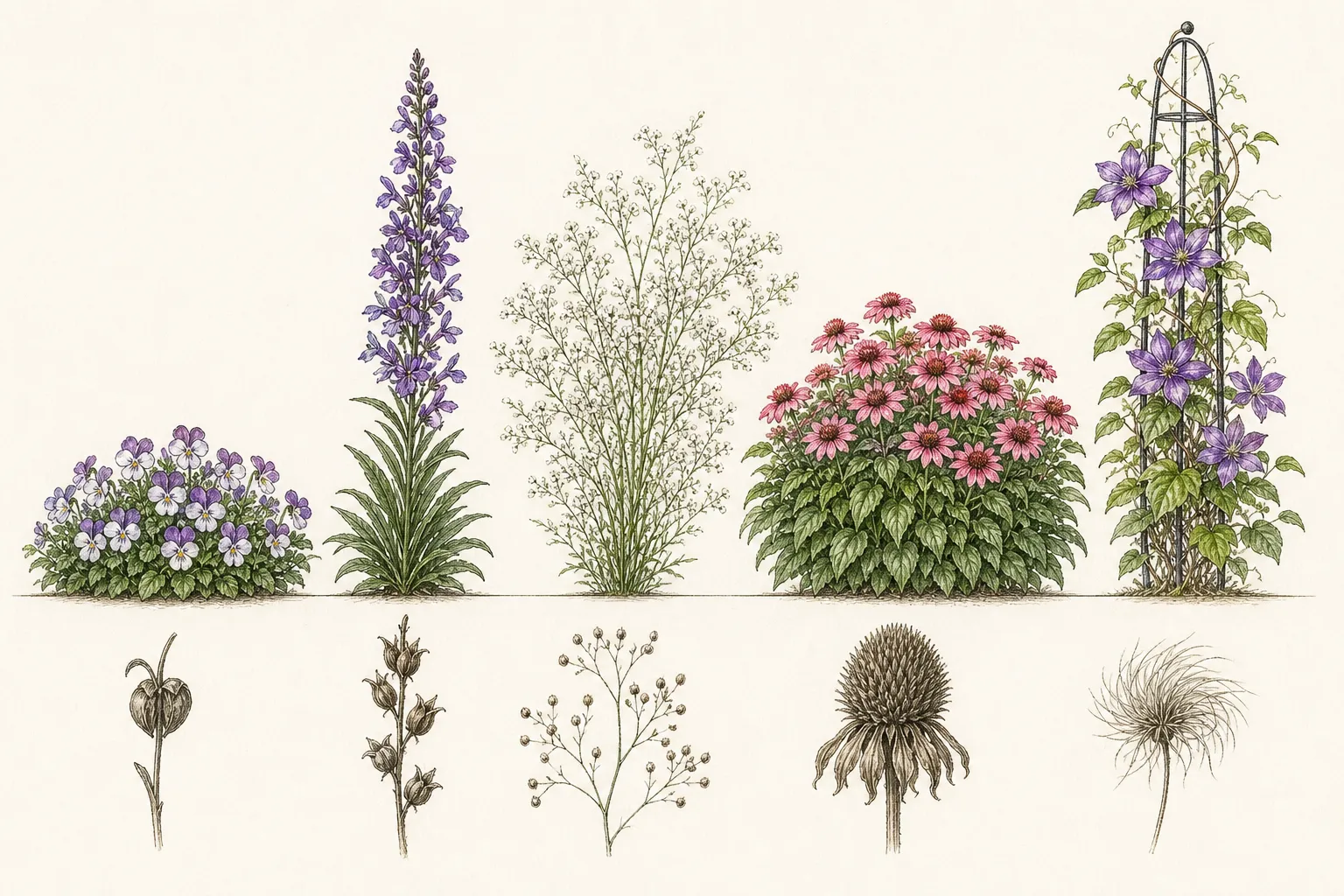
Sketch the mature foliage, not a flower close-up. A low mound occupies a continuous foreground band; an upright spike needs less visual width but can cast shade; a branching filler may be transparent at the base yet broad at shoulder height. A climber occupies support surface and can extend beyond its ground footprint. A cutting strain must be drawn with the aisle and reach needed for repeated harvest.
Record uncertainty beside the silhouette. Supplier photographs may show trial plots, selected peak plants, or a climate unlike the home garden. If mature width, lodging tendency, attachment method, or bloom window remains unknown, assign the packet to a labeled trial instead of the main border. An honest unknown is more useful than converting a marketing adjective such as “compact” into an invented measurement.
Match climate, site, and sowing method
Verify the site's summer sun in hours, soil drainage after rain, prevailing wind, reflected heat, and irrigation reach. NC State defines full sun in its landscape chapter as more than six hours a day, but a packet's own light category and the local climate still control the match. A plant listed for full sun in a cool region may respond differently beside a west-facing wall in a hot climate. Place the packet on a local calendar. Separate hardy annuals, tender annuals, biennials, and perennials, then anchor sowing or transplanting to current regional frost and soil-temperature guidance. Iowa State notes that many annual flowers in its regional winter schedule need six to eight weeks indoors, while some require ten weeks or more. The packet and current local guidance still decide the date for the named taxon.
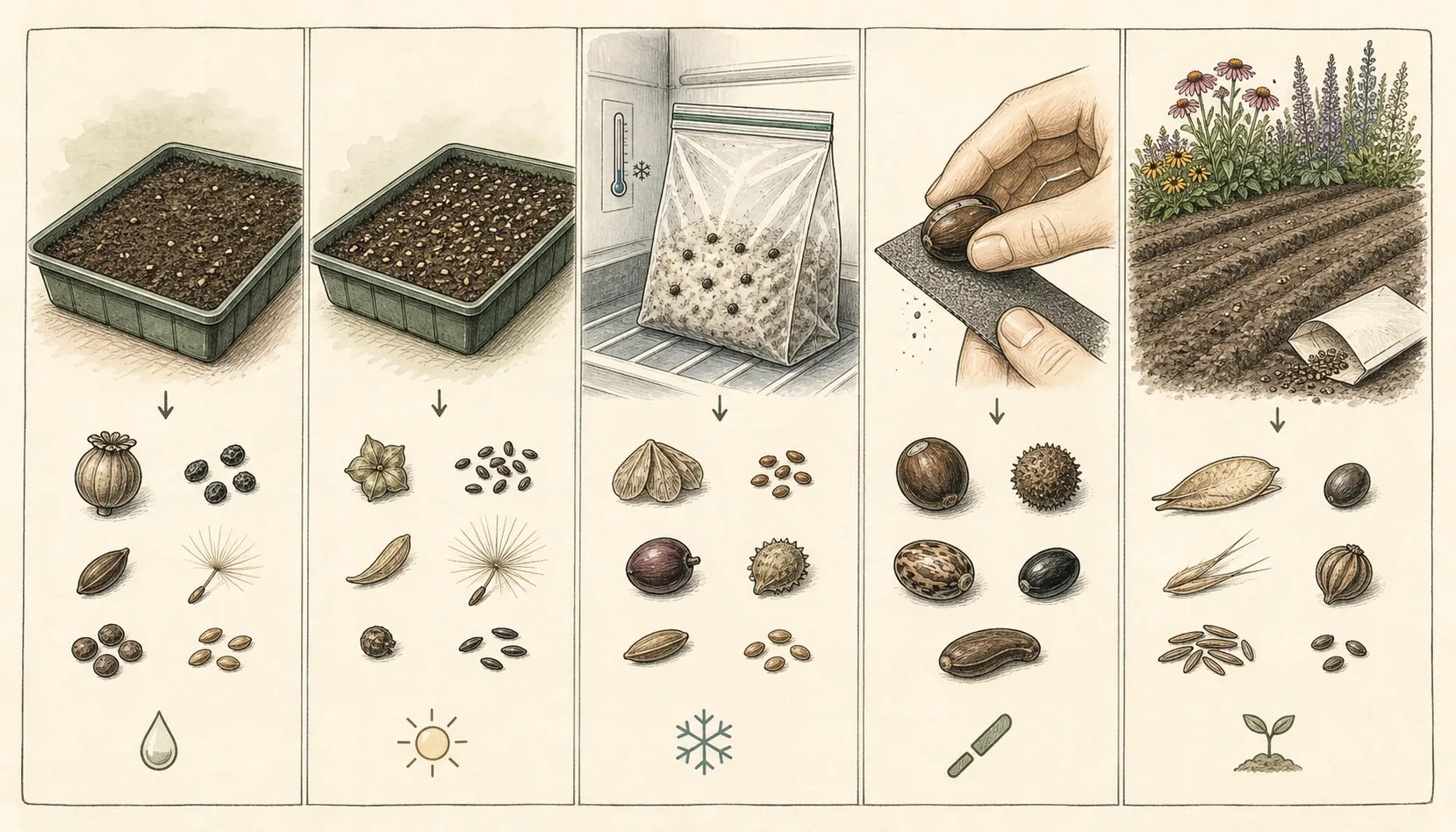
Read every germination requirement before deciding between direct sowing and transplants. Light-dependent seed cannot be buried as if it needed darkness; hard or dormant seed may require scarification or stratification; a species that resents root disturbance may be a poor candidate for a long cell-tray stay. Keep separate trays for taxa with different temperatures and emergence times, because one cover-removal or watering schedule cannot serve all of them.
Test the garden's capacity against the schedule. A packet fails the selection screen when its indoor start exceeds available light or pot space, when the direct-sown bed cannot remain evenly moist, or when the expected first flower falls after the role is needed. Choose a documented faster strain or a different species only after confirming it still matches mature size, site, and maintenance. Earlier sowing cannot repair an unsuitable climate or insufficient light.
Build the border from roles and repeated groups
Place permanent structure and access first, then add annual roles to the measured gaps. The RHS border method starts with large structural plants and repeats groups to create flow. NC State describes rhythm, repetition, unity, and accent as design tools. On a seed plan, that means a few legible groups with assigned jobs, not one isolated specimen from every appealing packet.
Plot final plant positions at the packet's mature spacing. Keep an edging band clear of paving, preserve the sight line past taller accents, and draw the climber's support as part of its footprint. Mark dormant bulbs and late-emerging perennials under the plan. If a direct-sown grid would disturb those crowns during bed preparation or thinning, grow transplants elsewhere or choose another gap.
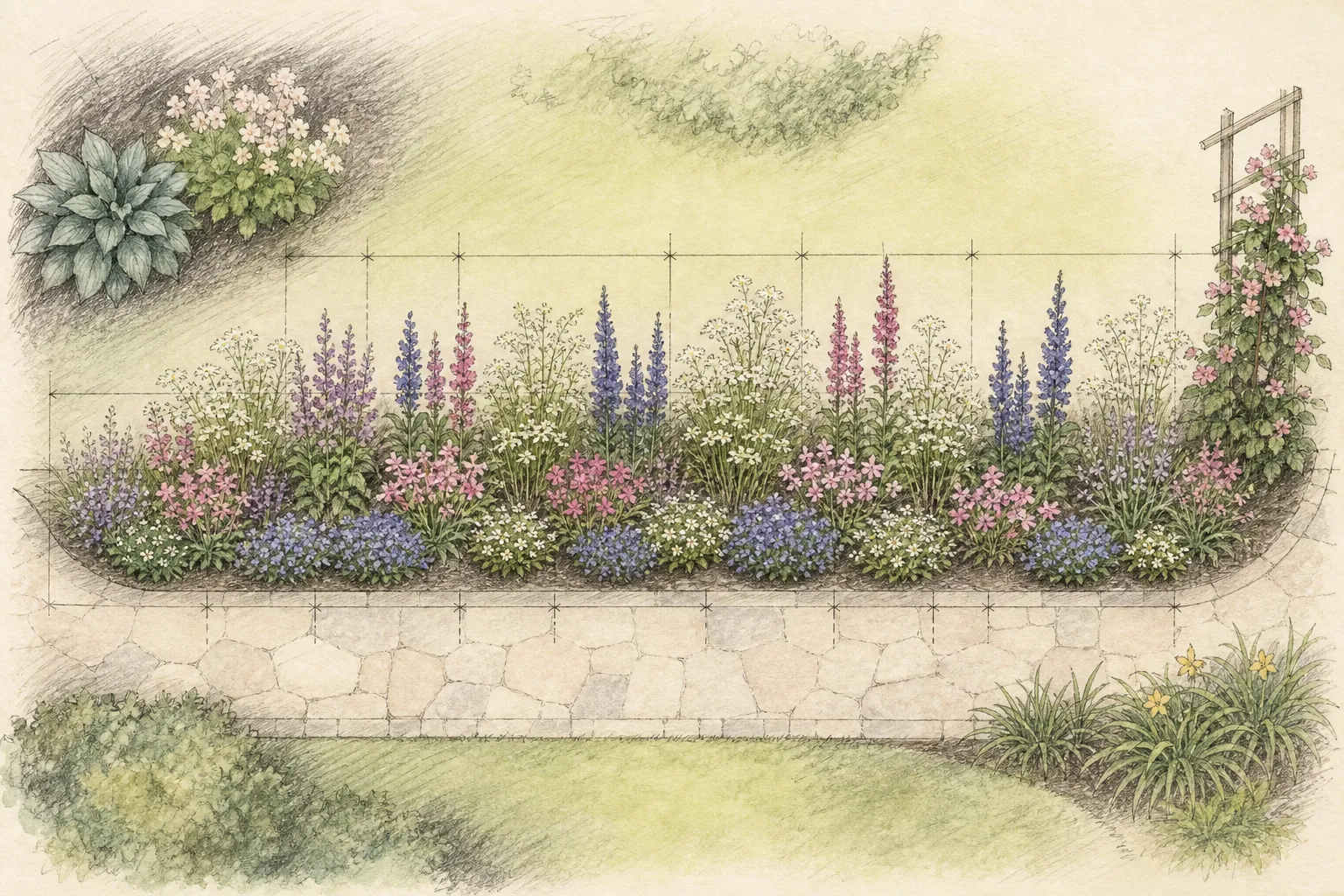
Use bloom timing as a sequence, not a promise that every packet peaks together. Write expected first flower and useful duration beside each group, then identify who occupies the space before and after it. Early hardy annuals may hand the role to a summer species; a long-season annual may need neighboring foliage to cover bare soil while it develops. Leave enough access to remove a failed group while the permanent planting stays intact.
Mix species in one sowing patch only when seed size, sowing depth, germination temperature, emergence speed, thinning, and early moisture are compatible. Otherwise, sow separate labeled blocks and combine them after transplanting. A mixed packet that omits proportions, taxa, or mature specifications cannot be mapped reliably; use it only in a bounded trial where unexpected vigor or prohibited species can be contained.
Calculate seed quantity from usable plants
Count final planting positions from the scaled plan. In an irregular border, actual plotted points are more accurate than dividing total area by one spacing number. Exclude paths, permanent crowns, support bases, and dry edges before counting. The result is the target number of established plants, which is different from packet seed count and from the number of seedlings that fit under lights.
Correct the target for measured germination. Suppose the plan has 24 positions and a current test produces eight normal seedlings from ten seeds, or 80 percent. The germination-only minimum is 24 divided by 0.80, rounded up: 30 seeds. University of New Hampshire Extension gives the same percentage method and recommends testing at least ten seeds, with larger samples producing a more reliable estimate. Add an establishment factor only when the garden has a relevant record. If earlier transplants of the same crop and method established at 90 percent, the calculation is 24 divided by 0.80 and then by 0.90, rounded up to 34 seeds. When that evidence is absent, label a small backup group that fits the available tray and garden capacity instead of inventing a universal loss percentage. Indoor germination does not guarantee outdoor establishment.
Use the packet's stated seed count or weight before ordering. Nebraska Extension notes that count, seed size, cultivar, and pelleting affect how many seeds a package contains. Buy enough for the calculated crop and a justified backup, then stop. Sowing the whole packet can create more thinning, cells, water, and disposal than the role can use, while leaving too little labeled seed for a replacement sowing.
Evaluate commercial claims and substitutions
Translate every adjective into evidence. “Compact” needs mature dimensions for the named strain; “early” needs a starting point and regional trial; “drought tolerant” needs an establishment stage and site conditions; “good for cutting” needs usable stems and harvest response. Keep the claim only when the packet, breeder data, institutional profile, or regional trial defines it well enough to compare with the role sheet.
Choose substitutions by function. Replace an unavailable low edging cultivar with another plant that matches the height ceiling, mature width, site, bloom window, and maintenance limit. Flower color is a later filter. A tall cultivar of the same species can be a worse substitute than a different species with the correct silhouette. Recalculate spacing and seed quantity each time the replacement changes mature spread or germination.
Demand a complete taxon list from mixtures. Check every listed species against current local invasive, noxious-weed, and import guidance before purchase, then verify whether their germination and early care can share one sowing. Reject a product whose contents cannot be identified or whose packet warning cannot be followed in the intended garden. These checks are especially important near natural areas, edible beds, children, and pets.
Compare the short list in one table: role fit, dimensions, site, timing, sowing method, support, maintenance, evidence quality, quantity, and unresolved risks. A candidate with several blanks belongs in a trial, not in the final order. Keep the packet and source date because online catalog descriptions can change between purchase and the season when performance is evaluated.
Run a small trial and edit the next order
Trial an unfamiliar taxon in the actual site before repeating it through a long border. Use a labeled group large enough to reveal the intended habit but small enough that its removal leaves the design functional. Grow it with the same spacing, irrigation, support, and deadheading planned for the full role. Keep another proven plant in the surrounding composition so a failed trial does not erase the season. Measure the traits that decide the role: emergence, transplant establishment, mature height and width, first and peak flower, foliage coverage, lodging after wind or rain, support time, disease symptoms, deadheading response, and end-of-season removal. Colorado State University's flower trials emphasize evaluation under the distinctive Rocky Mountain and High Plains environment. The same principle applies at home: performance belongs to a named plant in stated conditions.
Photograph from the normal viewing point at planting, first flower, peak display, and late season. A close flower image cannot show whether an edge stayed low, an airy filler remained transparent, or an accent dominated its neighbors. Mark the measured outline on the plan and note any path obstruction, shade cast, or support failure. Correct a safety or access problem immediately; leave harmless aesthetic variation for the scheduled review.
Decide the next order after the complete role window. Expand a plant that fit its dimensions, timing, maintenance, and garden conditions; reduce or drop one that needed constant compensation. Control unwanted seed before it leaves the trial, following local guidance for the taxon. Save seed only when its identity and breeding behavior are understood; Nebraska Extension cautions that seed harvested from hybrids can produce plants unlike the parent.
Turn the shortlist into a role-and-quantity record
Give each packet candidate a row for garden role, exact taxon or cultivar, mature height and width, site conditions, useful flowering interval, usable plants required, seed quantity, propagation capacity and expected maintenance. Add observed trial performance in a separate column after the season. Keep a candidate only if its complete role fits; surplus seed or an attractive flower photograph does not supply missing growing space.
Tool notes
- Type
- Ornamental flower seed packet, catalog, and selection record
- Purpose
- Select seed whose mature habit, culture, timing, quantity, and maintenance match a measured ornamental garden role.
- Affiliate
- No commercial links
Maintenance
- File the original packet with the botanical name, cultivar or strain, lot, packed-for year, source, germination statement, treatment, seed count, and purchase date. Add the selected role, bed position, source URLs, and the date each specification was checked. Keep a scan or photograph if the packet will be exposed to weather.
- Update the scaled border plan after germination, thinning, and transplanting. Record the actual final count, spacing, backup location, and any substituted cultivar. Cross out positions that permanent plants reclaim instead of forcing seedlings into a smaller footprint than the mature width allows.
- Store unused seed only under the taxon's documented cool, dry conditions, inside a labeled moisture-resistant container when recommended. Inspect for condensation, insects, mold, and damaged packaging before reuse. Keep the lot identity attached so a later germination test and field result can be traced to the right seed.
- Maintain the trial record on fixed dates: emergence, establishment, first flower, peak display, late-season habit, and removal. Measure height and width from the same representative plants, photograph from the main view, and note wind, heat, or rain events that explain lodging or decline.
- Compare the plant with its assigned role before reordering. Keep a cultivar that met the height limit, filled its plotted width, arrived within the needed bloom window, and stayed inside the maintenance budget. Reduce or remove one that blocked access, required unplanned support, failed repeatedly, or spread beyond its bounded trial.
- At season end, record volunteers, remaining seedheads, disease, disposal effort, and the next year's decision. Follow local guidance for unwanted or restricted plants and retain no anonymous seed. Revise germination and establishment assumptions with the actual lot results before calculating the next order.
Related reading
Sources
- How to plan a border. Royal Horticultural Society. Source record · Accessed 2026-08-30.
- 19. Landscape Design. NC State Extension Publications. Source record · Accessed 2026-08-30.
- Understanding the Seed Packet. Nebraska Extension Publications. Source record · Accessed 2026-08-30.
- Winter Garden Tasks. Iowa State University Extension and Outreach. Source record · Accessed 2026-08-30.
- Tips for Buying Seeds. Nebraska Extension in Lancaster County. Source record · Accessed 2026-08-30.
- Are My Leftover Seeds From Last Year Still Good, or Do I Need to Buy New Ones?. University of New Hampshire Extension. Source record · Accessed 2026-08-30.
- CSU Flower Trial Gardens. Colorado State University. Source record · Accessed 2026-08-30.