Plant problems · conifer winter browning pattern diagnosis
Read Winter Browning Patterns on Garden Conifers
Separate normal interior needle loss from winter desiccation, salt, root stress, and disease by reading where browning sits on the branch, which needles are affected, and how the pattern moves through the plant.
Published Last updated
In this guide
- Map where the browning sits on the branch
- Separate normal needle loss from true dieback
- Read winter browning on exposed surfaces
- Look for stress written in the soil and root zone
- Recognize disease and mite patterns before spraying
- Wait for spring growth before you prune
- Decide when to keep, retrench, or replace
- Diagnosis
Map where the browning sits on the branch
A brown conifer in winter does not announce one diagnosis. The first task is to locate the brown tissue precisely: older needles inside the branch, new tips at the exterior, the lower canopy climbing upward over time, one windward face, or a single branch that turned all at once. The pattern is the message. Gardeners often jump from the color itself to a cause such as winter burn or disease, but conifers keep years of foliage at once, and each age class of needle records stress differently.
Look at more than one branch and more than one side of the plant. A pine with green outer needles and browning on the inner older foliage is telling a different story from an arborvitae with bronzed outer sprays on the south or west side. Colorado State's PlantTalk makes this distinction clearly: if pine needles are turning brown from the interior while the outer needles stay green, there is usually no cause for alarm. That one sentence rules out an enormous amount of panic pruning and unnecessary spraying.
Note the time of year and the weather pattern that came just before the change. Browning discovered in late fall after a dry season, after a deicing cycle, or after a freeze-thaw period may reflect a site problem already in motion rather than a new pathogen. A branch inspected only once is easy to misread. A branch inspected with its timing, exposure, and needle age in mind becomes diagnostic evidence.
Do not prune first in order to see better. Conifers do not all replace old wood freely, and the very needles you want to remove may be showing whether the trouble is interior, tip-based, one-sided, or branch-wide. Reading the pattern intact is more valuable than cleaning up the color on the day you notice it.
Separate normal needle loss from true dieback
Many conifers shed older needles seasonally, and the effect can look dramatic when a gardener expects the plant to stay uniformly green. University of New Hampshire Extension explains that older interior needles are often shed while the younger outer needles remain green. Colorado State extends the same point for pines specifically. That means a flush of inner yellowing or browning, especially in late summer or fall, can be ordinary turnover rather than decline. The branch still looks green at the ends because the living younger needles are where growth is continuing.
True dieback looks different. When the tips of branches brown, when one whole branch turns out of sequence with the rest of the plant, or when the outer shell of foliage is discoloring while the interior remains comparatively normal, the plant is not simply dropping old needles. It is failing to support living tissues where the current season's function should be strongest. That shift from inner older needles to outer active foliage is one of the cleanest diagnostic thresholds a home gardener can use.
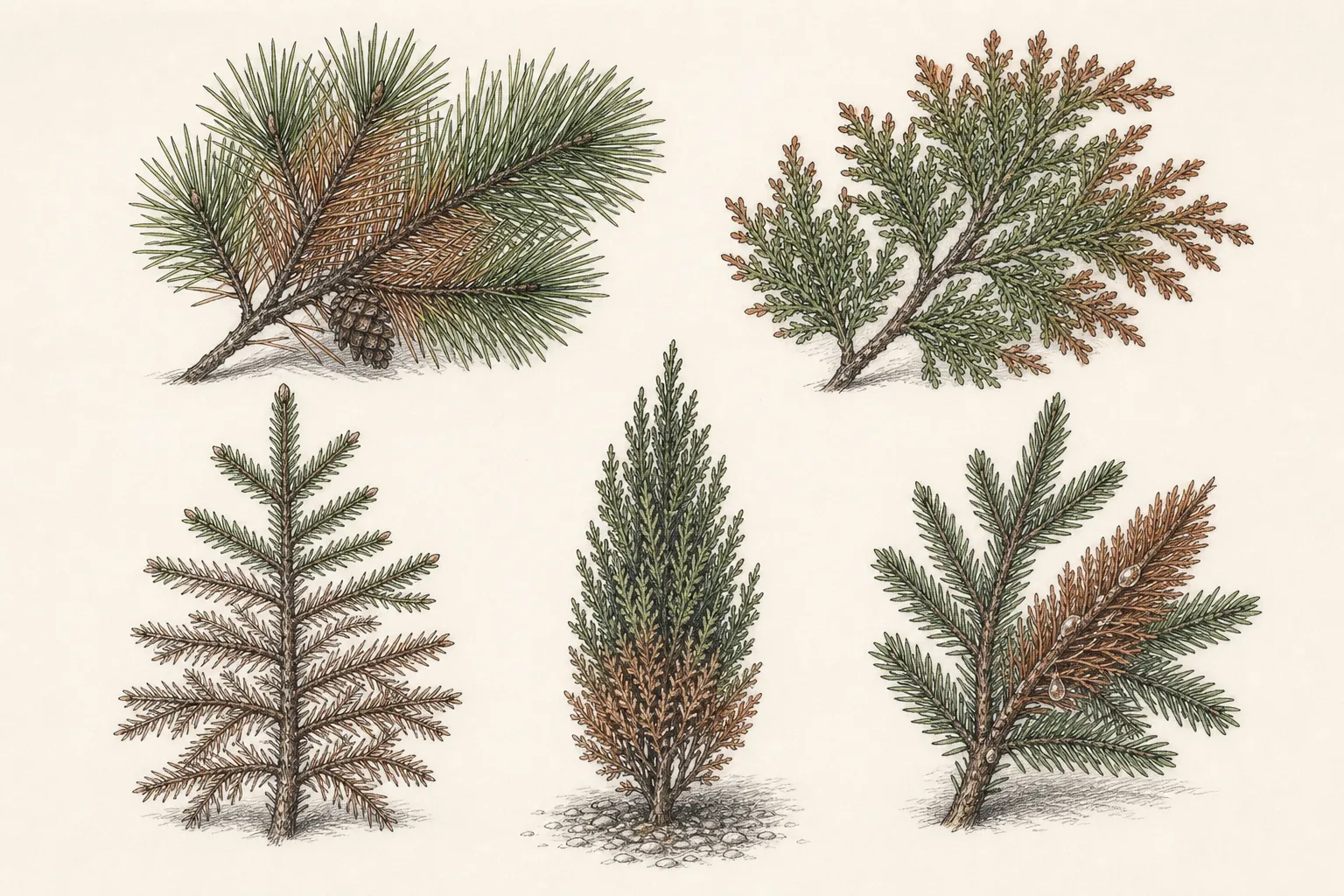
Needle age also differs by species, which is why the same amount of brown can mean different things on different conifers. PlantTalk notes that some pines hold needles only a few years while others keep them far longer, and Iowa State likewise stresses that not every conifer planted in the landscape is well adapted to local conditions. The point is not to memorize every retention span. The point is to compare older inner needles with the active outer canopy before calling the plant damaged.
This distinction keeps maintenance proportionate. A plant showing normal interior drop does not need fungicide, tip pruning, or emergency irrigation. It needs the gardener to confirm that buds, outer needles, and branch tips remain healthy. A plant with outer-tip browning or whole-branch failure needs a fuller investigation before any cleanup occurs.
Read winter browning on exposed surfaces
Winter desiccation and temperature fluctuation often write their damage on the outer exposed portions of the plant. Iowa State describes winter desiccation as especially common on younger, newly planted conifers when needles lose water on sunny or windy winter days and frozen soil prevents replacement. Browning often shows up on the outer tips, on the south or southwest side, or on the windward face. The branch still carries its needles, but the exposed tissue has dried beyond recovery.
Exposure patterns help you distinguish site injury from pathogen spread. If the side facing open wind, reflective pavement, or winter sun is bronzed while the sheltered interior or protected side remains greener, the site is heavily implicated. Iowa State notes that temperature fluctuation damage commonly appears on the south or southwest side, and may also show on the windward side. That means the plant may be acting like a weather map. The gardener's job is to read the exposure before reaching for a disease label.
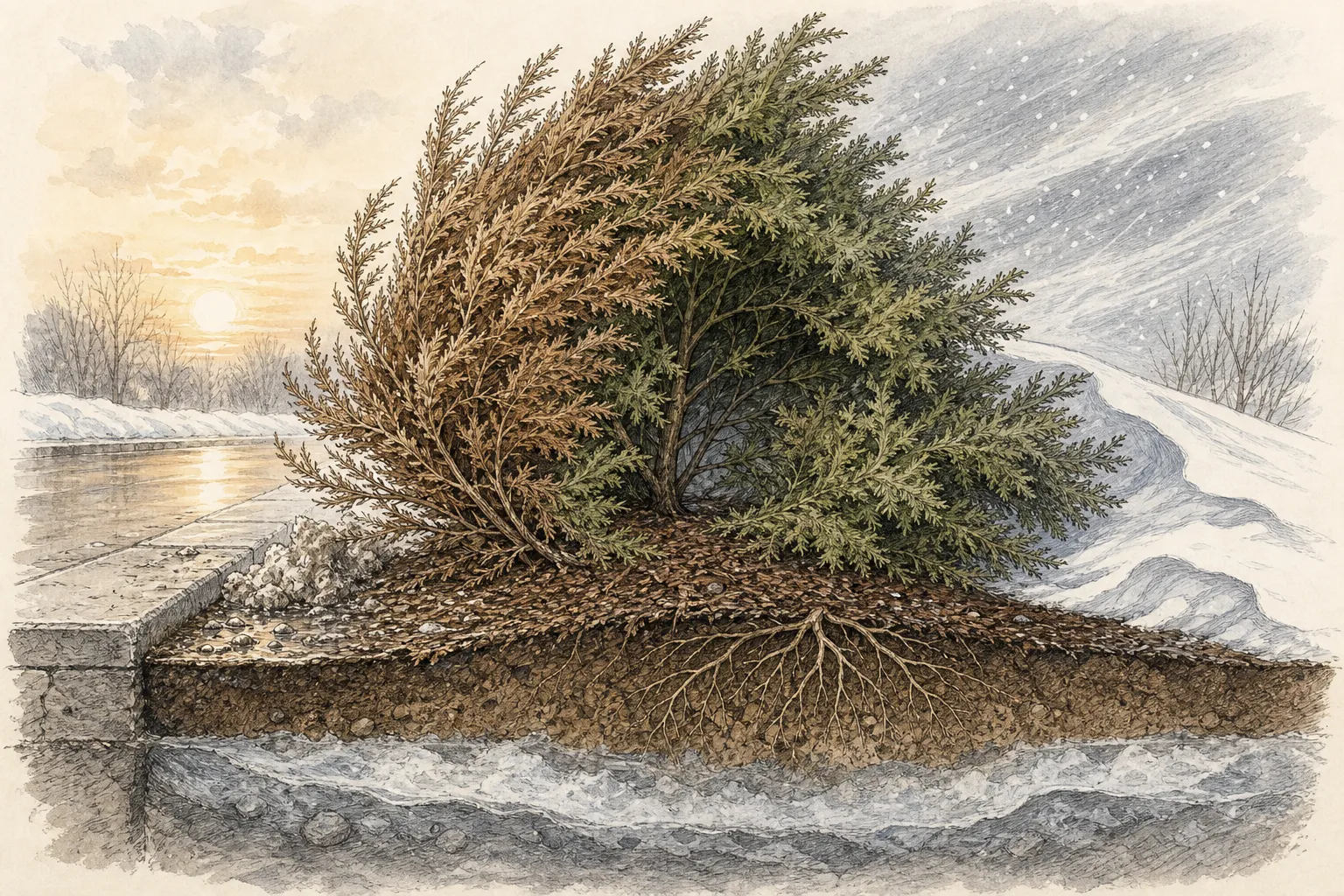
New plantings are especially vulnerable because their root systems are smaller and less established. Iowa's guidance repeatedly returns to that point: newly planted conifers that went into winter dry or late in the season are more likely to brown at the tips and edges. When the plant is older and only one face is affected, the site may still be the driver, but you should ask what changed there: a wall that now reflects more light, snow piled by a plow, or wind made stronger after nearby plants were removed.
Do not correct winter exposure by immediately clipping away all the browned tips. Iowa warns that premature pruning can remove the limited secondary buds a conifer might have available for regrowth. A browned edge in winter is not only damage. It is information about water loss, light, wind, and timing. Preserve that information until spring growth shows which buds and shoots are still alive.
Look for stress written in the soil and root zone
Conifer browning that seems above-ground often begins below the surface. Iowa State points out that dry soil through the growing season can set up winter browning, while overly wet heavy soils can damage roots in a way that later resembles drought. This is why a gardener who sees brown needles and waters reflexively may help one plant and injure another. Root-zone context has to be part of the diagnosis.
Start with drainage, planting age, and watering history. Newly planted conifers with limited root systems can fail from insufficient moisture before and during establishment, yet the same young trees can also decline when the root ball is kept too wet. Iowa stresses checking both the original root ball and the surrounding soil rather than assuming either is representative. Brown tips caused by wet roots and brown tips caused by dry roots can look remarkably similar once the branch is already in distress.
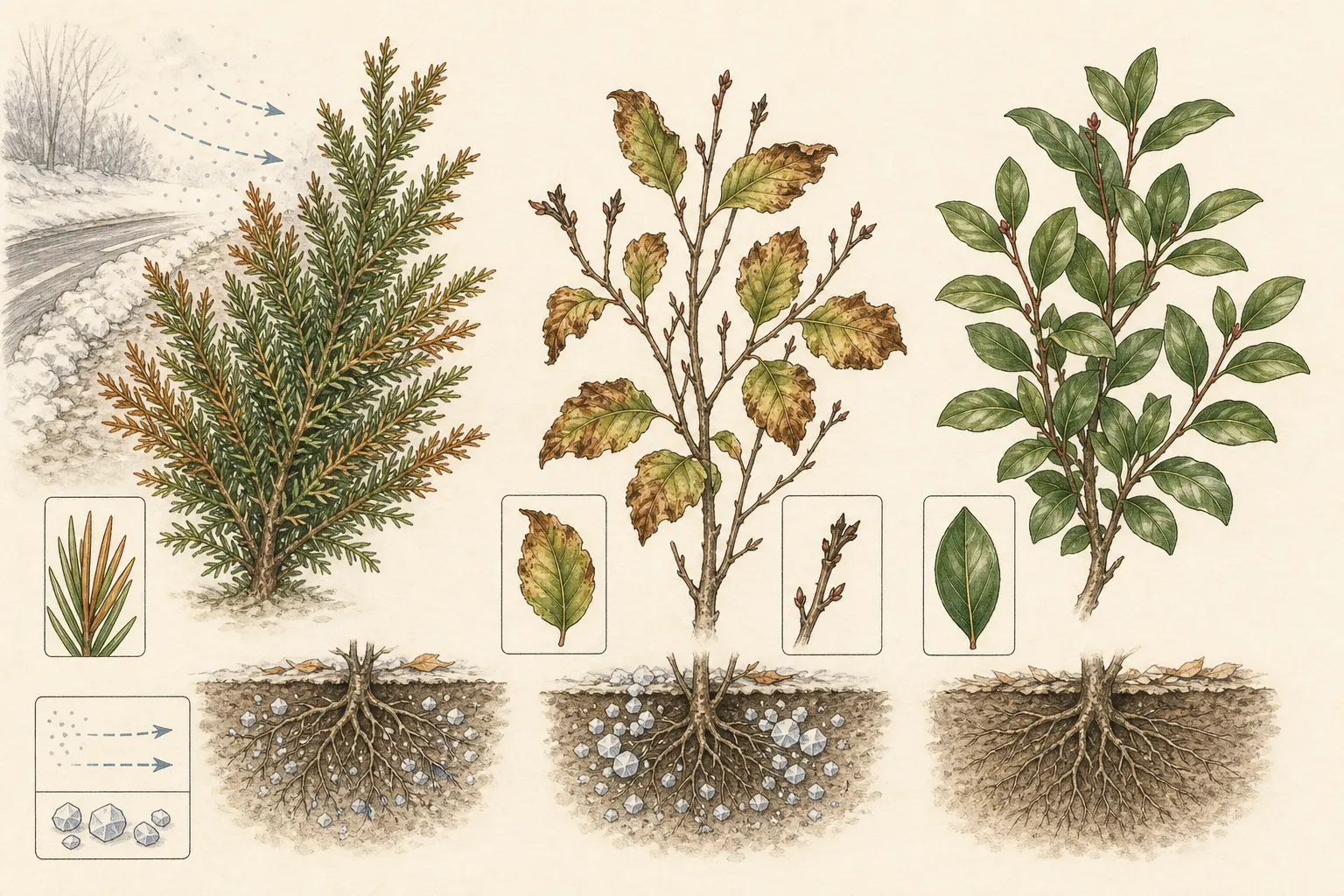
Road salt and reflected runoff create another soil-linked pattern. If the lower or road-facing side of the plant is browning, or if injury follows a walkway, curb, or snow-storage edge, deicing exposure becomes plausible. The point is not to prove salt from color alone but to read the pattern with the site. A plant bronzed evenly from the top after a dry autumn tells a different story from one browned on the splash line next to a drive.
Open the root-zone conversation before you start pruning. Ask where snow is piled, whether irrigation reached the plant during autumn dry spells, whether the tree sits in a basin or compacted clay, and whether a recent change in grade, mulch, or construction altered drainage. Many conifer diagnoses become clear only when branch pattern and root-zone history are read together.
Recognize disease and mite patterns before spraying
Not every brown conifer is suffering winter exposure. Iowa State notes that fungal needle diseases often progress from lower branches upward over time, while environmental stresses tend to appear more broadly across the tree. That direction of movement is useful. A tree that slowly thins from the bottom, year after year, with spotted or banded needles is telling a different story from one that bronzed after one harsh winter event. Likewise, a single branch browned with resin or canker symptoms is not the same pattern as uniform winter scorch.
Look closely at the needles themselves. Iowa points out that diseased pine needles may show spots or banded areas before the tissue beyond those bands dies. Canker problems may leave resin around affected sections and kill scattered individual branches rather than the whole exposed face of the plant. Mites and some insects can also discolor needles before full browning develops. In other words, the texture and progression on the needle often outrank the first broad impression from across the yard.
This is where spraying too early becomes a trap. A fungicide or miticide chosen before the pattern is understood can miss the cause completely and erase some of the evidence you needed to decide. Disease management begins with accurate diagnosis, not with the existence of brown foliage. If the pattern is lower-up, spotted, banded, resinous, or scattered branch by branch, slow down and consider diagnostic help before making a product decision.
One reliable distinction remains useful in home landscapes: environmental browning often follows an exposure or whole-tree stress story, while disease and mite problems frequently create repeated, species-linked, or lower-canopy-biased patterns. The presence of a nearby susceptible species with a similar history is another clue. The key is to let the plant's distribution of symptoms tell you which lane to enter.
Wait for spring growth before you prune
Winter and early spring are the worst times to convert uncertainty into cuts. Iowa advises against pruning browned or burned areas too early because viable buds may still push new growth when conditions warm. This matters especially on conifers, which often have fewer dormant replacement buds than gardeners assume. If you clip back every browned tip before the plant has declared what is alive, you may remove the very points from which recovery would have come.
Use bud condition and new growth to set the pruning line. When new shoots extend past a browned section, you can see what portion truly died. If buds fail, then prune back to living tissue or a viable side branch according to the species and structure. A conifer that remains green in the interior but browned only at the outer edge may recover enough shape that little pruning is needed at all. A branch that never breaks bud can be removed more confidently once the live boundary is evident.
Pruning timing also protects diagnosis. A scattered set of dead branches that appears after the first summer heat may indicate root damage or canker that was not fully visible in winter. If those branches were removed too early, you lose the comparison that would have clarified the pattern. Waiting is not passive. It is how the gardener lets the plant finish telling the story.
Decide when to keep, retrench, or replace
Some conifers recover well enough that the best decision is improved watering, a wind break, and time. Others keep a permanent browned face, lose their leaders, or show a disease pattern that will not be acceptable in the planting even if the tree survives. The choice is not simply life versus death. It is whether the plant can still serve the garden's structure, screening, or specimen role without repeated corrective work.
Use the pattern to match the solution. Normal interior needle drop asks for no intervention beyond confirmation. Winter exposure asks for better siting, autumn moisture, or temporary protection while the plant establishes. Salt or root-zone problems ask for drainage and site correction. Lower-up disease progression or chronic branch-by-branch loss may ask for species-specific diagnosis or replacement with a more suitable conifer. Because each pattern points somewhere different, replacement should follow the evidence rather than the shock of seeing brown.
Keep a record of what browned, when, on which side, and what the plant did by midsummer. That single habit improves future diagnosis more than any generic evergreen calendar. Garden conifers are long-lived structural plants. Reading their winter browning accurately is not only about saving one season's color. It is about deciding whether the site, species, and maintenance pattern still belong together.
Diagnosis
Older needles deep inside the plant turn yellow, tan, or brown while the younger outer needles stay green. The change is most obvious in late summer, autumn, or during the first winter inspection after older inner foliage has been shaded by the current canopy.
- Check
- Part the branch and compare inner older needles with the active outer tips. Confirm whether the buds and current-season foliage at the ends of the shoots remain green. Check several branches and more than one side of the plant before deciding that the browning is generalized decline.
- Cause
- Seasonal shedding of older interior needles as the plant renews foliage. Needle age and timing differ among conifer species, so the same amount of inner browning can be normal on one plant and unusual on another, but green outer tips strongly support routine needle turnover.
- Action
- Leave the plant intact, confirm that outer buds and needle tips remain healthy, and use the pattern as a baseline for the next season. Normal inner needle drop does not need fungicide or pruning; it only needs the gardener to distinguish older interior foliage from active outer growth.
Outer tips, one exposed face, or the windward side of the plant brown after winter weather, while the interior remains greener. Damage may be strongest on newly planted conifers or on the side facing winter sun, wind, or reflected exposure.
- Check
- Map the damage to compass direction, wind exposure, winter sun, recent planting date, and autumn moisture history. Compare the sheltered side with the exposed side and note whether the affected tissue is at the outer canopy where winter water loss would be greatest.
- Cause
- Winter desiccation or temperature-fluctuation injury on exposed foliage, especially where sunny, windy conditions pull water from needles while frozen soil or a small root system cannot replace it. Newly planted conifers are often more vulnerable than established ones.
- Action
- Improve establishment watering until the ground freezes in autumn, protect vulnerable plants from harsh exposure where appropriate, and wait for spring growth before pruning browned tips. Replacement should be considered only if the site repeatedly exposes a sensitive conifer beyond what it can outgrow.
Lower branches thin and brown upward over more than one season, sometimes with spotted or banded needles before they drop. The upper canopy may stay fuller at first, and the decline may concentrate on species known to develop needle-cast problems.
- Check
- Inspect the pattern from the bottom upward and look closely at the needles for banding, spots, or repeated lower-canopy loss. Compare similar nearby plants of the same species and ask whether the decline developed over more than one season rather than after one weather event.
- Cause
- Needle-cast or tip-blight diseases progressing through susceptible species over time, often beginning on lower or interior branches and moving upward. The decline may be encouraged by site stress, but the repeated direction of spread and the details on the needles point beyond weather alone.
- Action
- Obtain a more exact diagnosis before spraying, then follow disease-specific management for the confirmed problem. Improve air flow and site fit where relevant, but do not treat lower-up needle loss as generic winter burn if the pattern and needle details point to chronic disease.
One branch or several scattered branches turn fully brown while the rest of the tree remains mostly green. Resin, cankered tissue, dead shoot tips, or abrupt failure of a branch may be present, and the pattern does not match simple interior seasonal drop.
- Check
- Examine the dead branch from base to tip for resin, canker, cracked bark, or shoot-tip death, and compare it with neighboring live branches. Determine whether the branch failed because the whole tree is stressed, a pathogen or pest is involved, or one section of the structure was uniquely damaged.
- Cause
- Canker, shoot disease, pest injury, or localized structural stress that killed an individual branch or several scattered branches without first bronzing the whole outer canopy. The problem is branch specific rather than the broad surface pattern seen with ordinary winter exposure.
- Action
- Prune the dead branch only after the cause and live boundary are clear, and seek diagnostic or arboricultural help if resin, cankers, or repeated branch death appear. A scattered branch failure pattern should be resolved by identifying the specific branch-level problem, not by broad shearing.
The lower roadside face, the splash line near pavement, or the whole plant on a wet or disturbed site bronzes or browns after thaw cycles. The pattern follows drainage, snow storage, or soil conditions rather than only the age of the needles.
- Check
- Check drainage, planting depth, irrigation history, salt exposure, snow-storage patterns, and soil wetness before watering or pruning. Compare the injury line with pavement edges, plow routes, and low wet ground so the site pattern is considered alongside the foliage pattern.
- Cause
- Salt injury, wet-soil root stress, drought stress carried into winter, or another root-zone problem tied to the site's drainage or maintenance pattern. The foliage is recording a soil or site imbalance, and the location of the browning helps identify which one.
- Action
- Correct the site condition first: manage drainage, salt exposure, or watering practice, and keep the plant observed through spring before cutting. If the root zone remains fundamentally unsuitable or the same browning pattern returns each winter, replace the conifer with one better matched to the site.
Related reading
Sources
- Browning and Dieback on Conifers. Iowa State University Extension and Outreach. Source record · Accessed 2026-08-19.
- Why Are My Evergreens Suddenly Shedding Their Older Needles?. University of New Hampshire Extension. Source record · Accessed 2026-08-19.
- 2123 - Needle Browning of Evergreens. Colorado State University Extension PlantTalk. Source record · Accessed 2026-08-19.