Grow · evergreen shrub selective pruning
Selectively Prune Evergreen Shrubs by Their Capacity to Regrow
Identify an evergreen shrub's growth pattern, test every proposed cut against live foliage, and thin selectively without assuming bare wood will refill.
Published Last updated
In this guide
- Name the plant before naming the cut
- Find the living regrowth boundary before shortening
- Sort the shrub by regrowth system
- Read live foliage before judging winter damage
- Set a stopping line before the first cut
- Thin from the inside before shortening the surface
- Time pruning to growth, flowers, and climate
- Make each cut protect the remaining framework
- Let the next growth cycle judge the work
- Steps
Name the plant before naming the cut
Evergreen describes retained foliage, not one pruning response. A mugo pine, spreading juniper, yew, boxwood, rhododendron, holly, and camellia may all stay leafy through winter, yet they rebuild from cuts in different ways. Confirm the botanical name and cultivar if possible, then note whether the specimen is a needled or scale-leaved conifer, a small-leaved broadleaf evergreen, or a flowering broadleaf evergreen. The label is not clerical detail; it determines what wood can be removed without leaving a lasting vacancy.
Record the intended mature height and spread from a reliable regional or cultivar source. A shrub selected to remain naturally wider than its bed cannot be converted into a narrow permanent resident by occasional pruning. Iowa State warns that many overgrown evergreens cannot be reduced beyond their living exterior because their bare interiors do not initiate replacement shoots. When the mature footprint conflicts with a window, path, utility, or neighboring plant, replacement with a better-scaled selection may be the soundest horticultural decision.
Separate plant identity from garden purpose. A clipped boxwood edge, an informal rhododendron mound, a conifer specimen, and an evergreen screen call for different outlines. Photograph the shrub from the main view and the maintenance side. Write one specific job—remove storm damage, release a path, open a crowded pocket, preserve a formal face, or reduce one wayward branch. If the job is simply make it much smaller, pause until the species' regrowth capacity proves that goal possible.
Find the living regrowth boundary before shortening
Map live foliage and the identified evergreen's capacity to regrow before choosing a shortening cut. A species that cannot reliably refill bare old wood needs that boundary preserved. Remove a defined conflict using an appropriate junction, then stop while the remaining outline still has living structure. Shared winter foliage does not make different evergreens interchangeable pruning subjects.
Sort the shrub by regrowth system
Pines make their annual extension from terminal buds that elongate as candles. Wisconsin guidance limits compacting cuts to those new candles before the needles expand and warns against cutting farther down into older growth, where a pine does not reliably make replacement shoots. Spruce and fir carry lateral buds on their newest growth, so a selected tip can be shortened to a viable lateral bud or branch. These responses belong to the named conifer; a candle technique is not a general treatment for every needled shrub.
The retained Extension sources use materially different wording for juniper and false cypress. Maryland groups them among evergreens that may be headed back or can respond to heavier pruning, while Wisconsin warns not to shear or cut them into non-leafy older wood because the exposed gap can take years to conceal. Maryland's broader category does not document reliable shoot production from every bare interior stem. For a homeowner who has not confirmed a taxon-specific exception, follow the conservative shared boundary: trace the branch to a leafy side shoot, hide the cut at that junction, and leave visible green growth beyond it. Use a more severe heading cut only when current regional guidance for the exact species or cultivar explicitly defines that response.
Yew is the more forgiving conifer in the retained sources because dormant shoots can occur on older stems, yet even yew recovery depends on plant vigor, light, remaining live growth, and climate. Broadleaf evergreens vary just as much. Boxwood can be thinned through its shell to admit light, while a large-leaved rhododendron should be handled with pruners rather than leaf-shredding shears and timed around flowering. Treat the diagram as a sorting key, then verify the exact plant before moving from light maintenance to structural reduction.
Read live foliage before judging winter damage
Brown foliage does not always mark dead wood. Winter desiccation can discolor exposed leaves while buds and cambium remain alive, and some conifers shed older interior foliage as part of ordinary renewal. Wait until the species reaches its normal spring growth window before removing an uncertain branch, unless it is broken or hazardous. Look for swelling buds, flexible twigs, green tissue beneath a tiny test scratch, and new growth elsewhere on the same branch. Compare the damaged side with sheltered growth before declaring the whole section lost.
Trace confirmed dead material back to a living lateral or branch collar. Do not leave a long stub in the hope that foliage will return to it, and do not cut flush into the parent stem. If the dead section reaches the trunk or crown, reassess the whole plant before opening a large window. A single dead branch may be removable; repeated dieback across the canopy may point to unsuitable exposure, root-zone stress, drainage trouble, or another condition that pruning cannot correct.
Mark the boundary between green exterior and bare interior with removable ties on several representative branches. This makes the no-cut zone visible while working inside a dense shrub. The boundary is irregular: one branch may carry a useful inner shoot while the next has only old brown wood. Never infer hidden buds from the foliage on a neighboring stem. Each proposed shortening cut needs its own viable continuation, and each removal needs enough surrounding structure to keep the outline balanced.
Set a stopping line before the first cut
Measure the clearance genuinely needed at the path, siding, window, or companion crown. Add a temporary string or stakes to show that line in space. Then compare it with the nearest live foliage and acceptable side branches. Evergreen genera differ sharply in their ability to replace growth after a cut. If the desired outline lies inside a juniper's brown zone or below all viable pine buds, do not assume pruning can deliver it. Move the boundary, accept a more natural asymmetry, transplant a suitable young plant, or plan replacement. For false cypress or another evergreen outside those cues, confirm taxon-specific regional guidance before cutting beyond green growth.
Choose a conservative first pass: dead and broken wood, one crossing branch, one extension over the path, and a small number of interior stems that block light or access. There is no useful universal percentage for a mixed group of evergreens. Age, vigor, species, climate, previous shearing, and root condition all change the response. A stopping list prevents a series of individually defensible cuts from becoming an unplanned renovation that exposes the entire interior in one session.
Consider what the shrub contributes beyond its green volume. A rhododendron may already carry flower buds; a holly may be valued for fruit; a conifer may screen a winter view; a low branch may be essential to the natural skirt. The cut can remove those features even when the plant survives. Decide which display has priority for this cycle. Seasonal sacrifice may be acceptable, but it should be intentional and should not be described as horticulturally required when the objective is only clearance.
Thin from the inside before shortening the surface
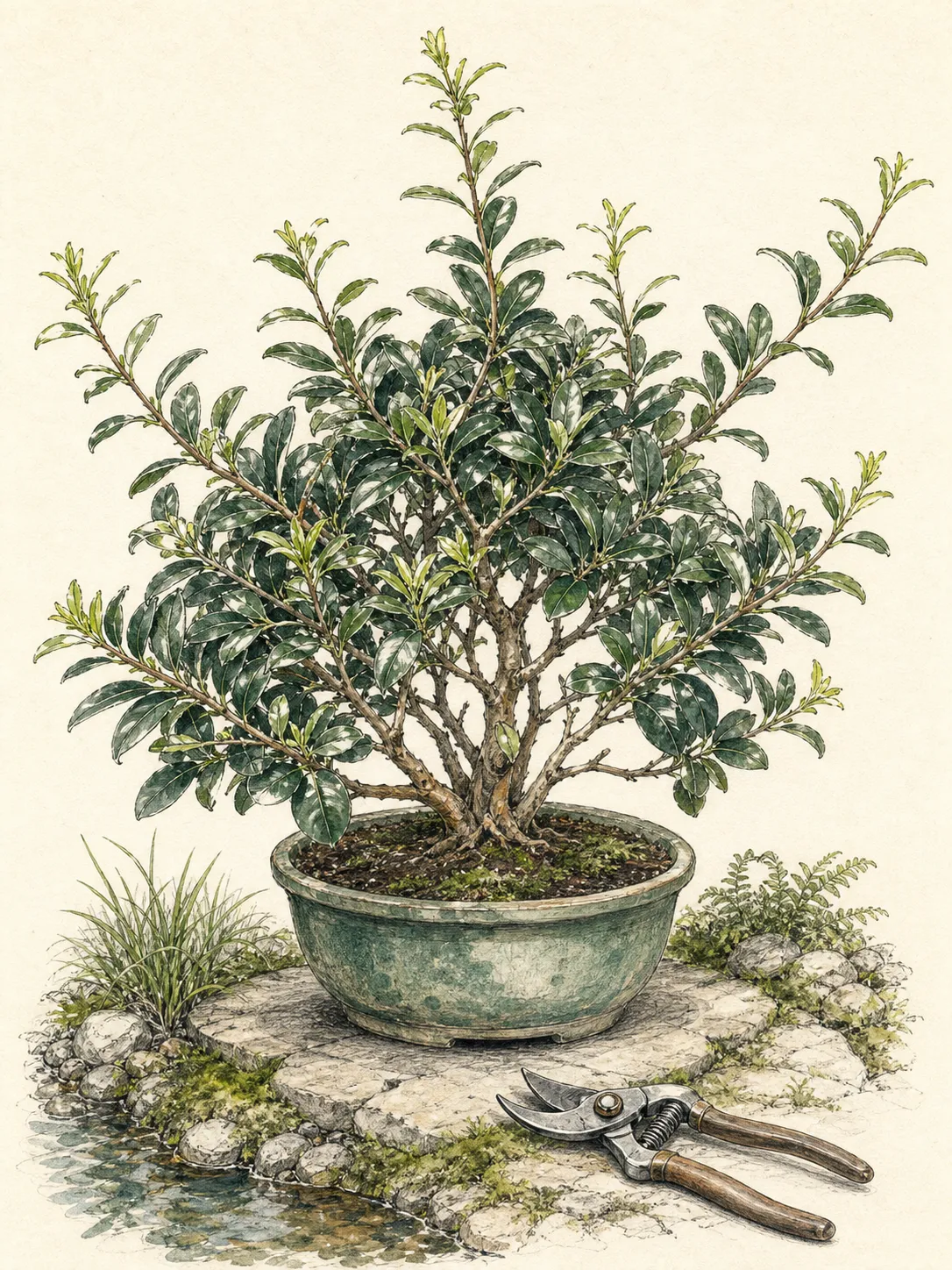
Begin with thinning cuts that remove an entire conflicting shoot or branch to its point of origin or to a substantial leafy lateral. This opens a view into the framework without shortening every terminal. On informal broadleaf shrubs, thinning preserves differences in branch length and keeps a natural layered edge. On juniper and false cypress, the cut can sit beneath retained foliage. Check the result from outside after each removal; a branch that looks expendable from inside may carry a large visible panel of the canopy.
Repeated shearing creates a different plant architecture. Heading every exterior tip stimulates dense growth near the surface where the species can respond, shades the interior, and makes the next trim dependent on an increasingly narrow green shell. Maryland Extension notes that large leaves such as rhododendron foliage are damaged by shears, leaving conspicuous cut blades. Reserve shearing for a deliberately formal, small-leaved hedge whose lower portion remains wider than its top, and combine it with selective interior thinning when plant-specific practice allows.
When one extension must be shortened, follow it to a bud, leafy side branch, or suitable junction that points in the intended direction. The remaining branch should be capable of carrying the line without becoming a weak hook or abrupt club. Keep the natural top and bottom relationship in view. Removing all upper growth to a flat plane can shade the lower foliage, while lifting every low branch can permanently reveal bare stems and turn a shrub selected for ground-level mass into an unintended small tree.
Time pruning to growth, flowers, and climate
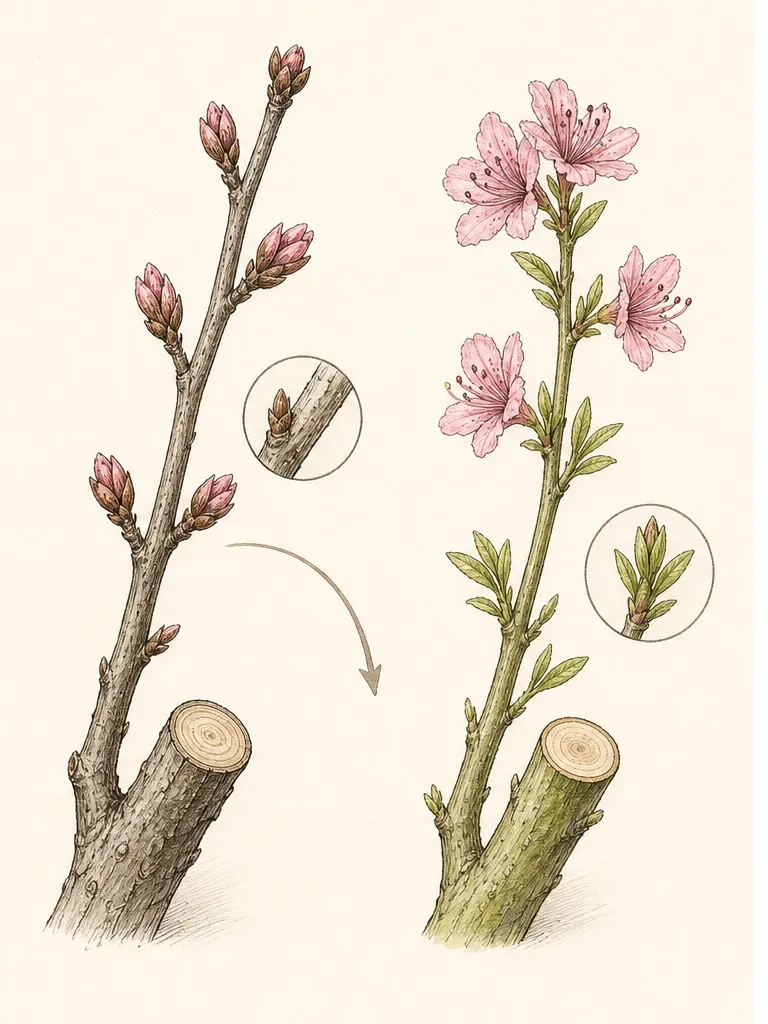
Timing belongs to species and purpose. Wisconsin places pine candle work after candles elongate but before needles expand, while juniper and false-cypress tip work can occur in summer and yew, hemlock, and arborvitae can be pruned around spring growth. Broadleaf flowering evergreens add a bloom clock: rhododendrons commonly receive elective shaping after flowering so the current display is not removed. These are biological stages, not nationally fixed dates. Watch local growth and use current regional guidance.
Avoid late-season pruning that encourages tender growth where winter cold arrives before it can mature. Maryland and Wisconsin both caution against fall or late-summer work for many evergreens. The local cutoff differs with climate, elevation, and species, so May may be active growth in one region and an unsuitable hard-pruning moment in another. In hot-summer areas, a newly exposed interior can also scorch. Preserve enough foliage to shade bark and avoid combining severe pruning with predictable heat or drought stress.
Safety and confirmed damage override an ornamental calendar. A broken branch hanging over a path should not wait for ideal candle development, and dead material can be removed once death is certain. High, heavy, tensioned, utility-adjacent, or structurally important branches belong to a qualified arborist. Shrub-scale selective pruning assumes stable footing and branches within controlled reach. Correct plant timing does not make an unsafe cut appropriate for a hand tool or an untrained gardener.
Make each cut protect the remaining framework
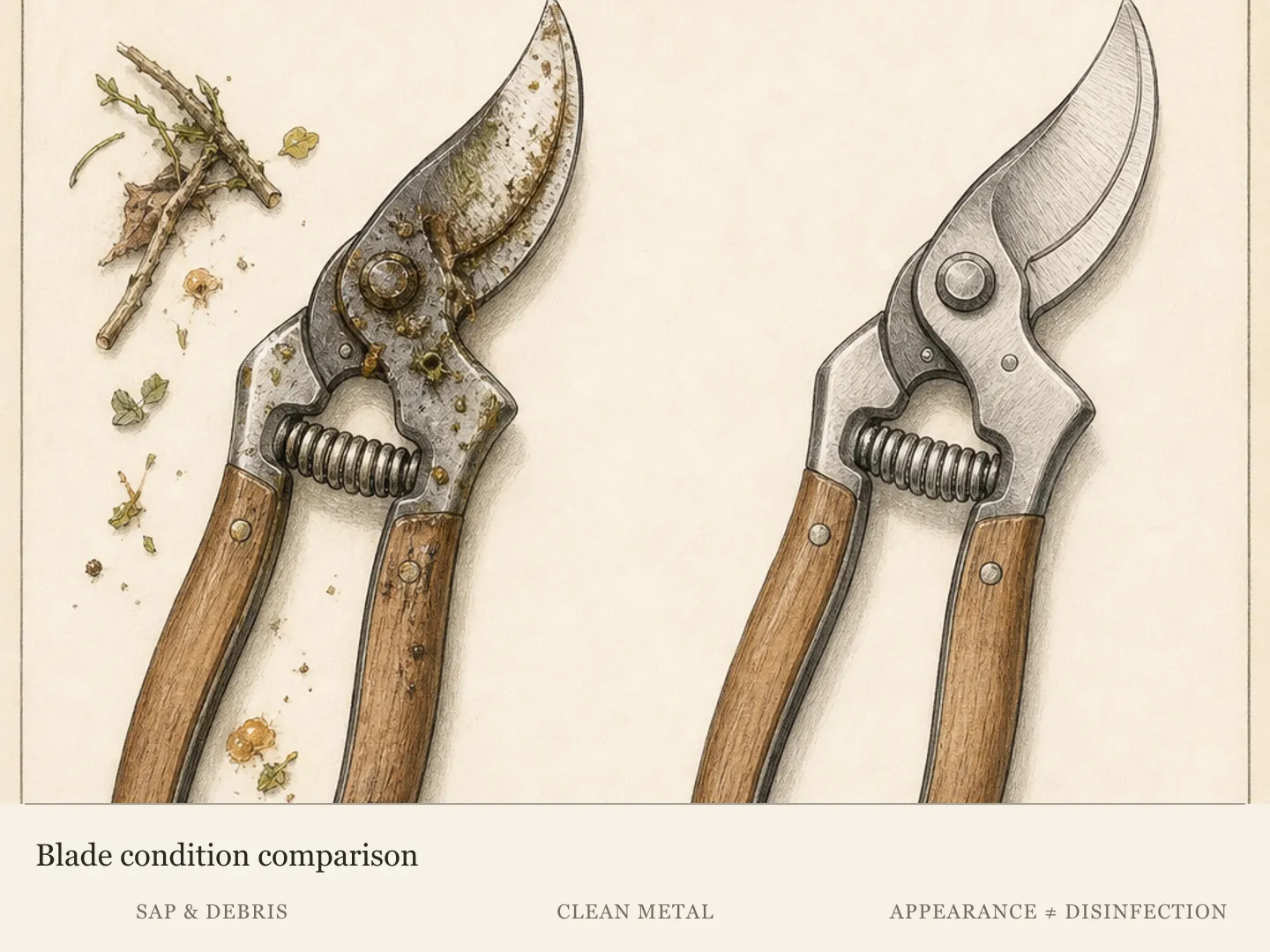
Use sharp bypass pruners for stems within their rated capacity, loppers for suitable larger stems, and a pruning saw when a clean controlled cut requires it. Clear soil and resin from tools before work. Position a thinning cut just outside the branch collar where one is visible, or at the selected lateral without slicing into that continuing branch. Support a heavier offcut so it cannot tear bark, strip neighboring foliage, or swing through the face of the shrub.
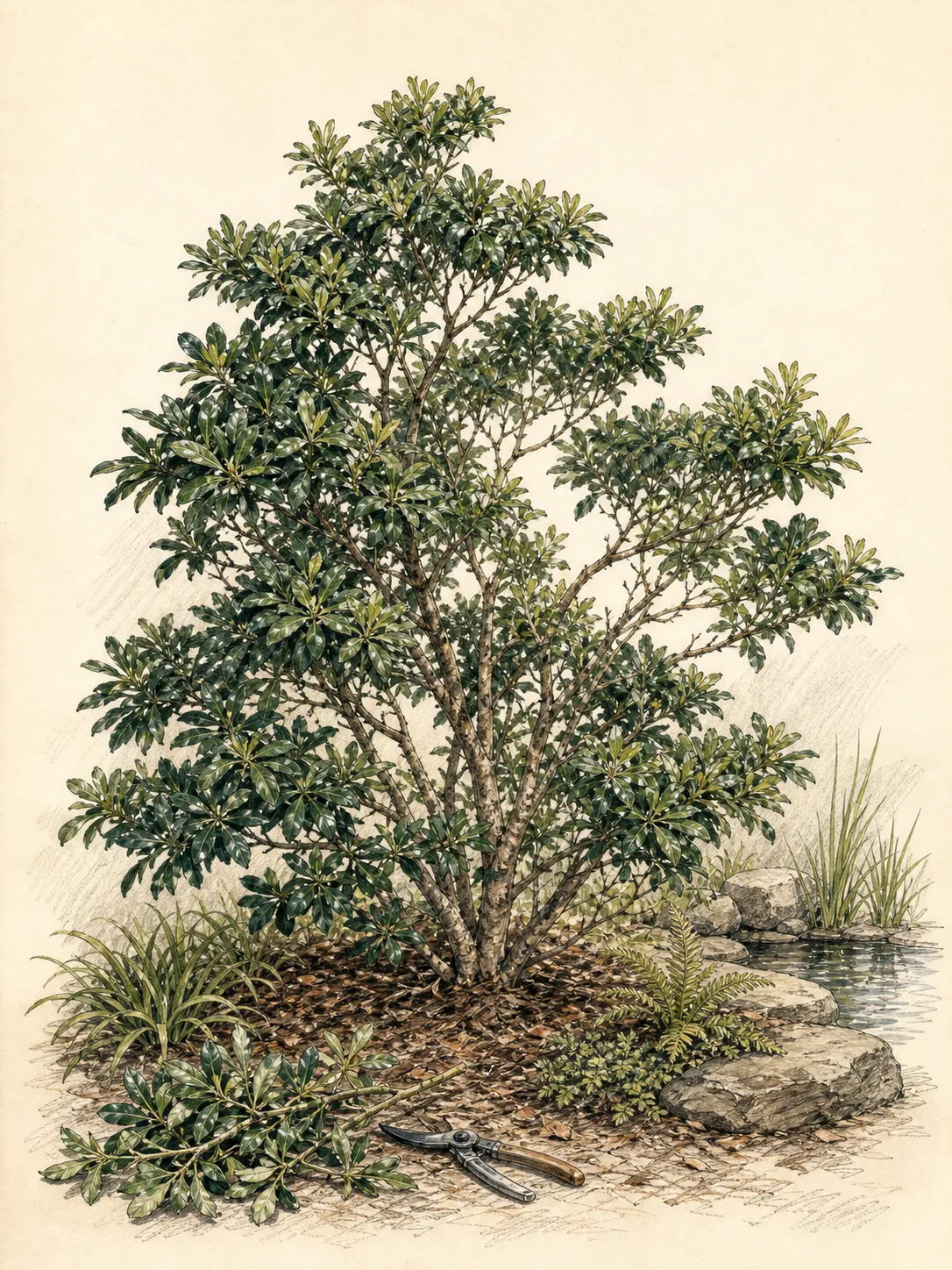
Work in an order that keeps the framework readable: dead and broken material, rubbing branches, inward or downward conflicts, then the few extensions named in the stopping list. Lay each removed branch beside the shrub rather than immediately fragmenting it. The accumulating pile is an honest measure of how much foliage and structure has left the plant. After two or three consequential cuts, walk to every principal view and look through the opening in changing light.
Do not paint ordinary pruning wounds or add fertilizer as an automatic reward. The plant must compartmentalize the cuts with its existing resources. Keep its root zone evenly managed according to species and actual soil moisture, maintain appropriate mulch away from stems, and protect exposed roots from traffic. A stressed evergreen will not regain structure because a high-nitrogen feed was added; excess soft growth can create another round of density while the fundamental site or scale conflict remains.
Let the next growth cycle judge the work
Photograph the finished shrub from the same marked positions used before pruning. Note the species, date, weather, cut locations, flowering stage, and any uncertain branches left for observation. During the next flush, look for growth at retained buds and leafy laterals rather than expecting every exposed stem to refill. A cut edge that remains stable and screened by surrounding foliage is a success even when the plant does not produce a dramatic burst of new shoots.
Watch for failure cues that should stop further reduction: browning that advances beyond a cut, sunscald on newly exposed foliage, a visible hollow from the main view, loss of lower density, or weak shoots clustered at many headed tips. Correct moisture or exposure problems when evidence supports them, but do not chase the outline with another round of cuts. Give the shrub a full appropriate growth cycle before deciding whether a second small thinning pass is needed.
An evergreen has reached its pruning limit when all useful laterals lie outside the required clearance, its living shell is too thin to hide another removal, or recurring shearing is the only way to hold it in place. At that point, replacement is not failure; it is a design correction. The durable result is a shrub whose mature habit fits the site, carries live foliage through its intended outline, and needs only occasional selective work rather than annual rescue from its own biology.
Steps
- Level
- moderate
- Time
- Forty-five to ninety minutes for assessment and a conservative first pass on one accessible shrub
- Tools
- Sharp bypass pruners, Loppers sized for the intended stems, Pruning saw for controlled shrub-scale branches, Gloves and eye protection, Removable ties and measuring tape
- Materials
- Confirmed plant label or garden record, Tarp for collecting prunings, Phone or notebook for before-and-after records
- 1Confirm the evergreen and its intended habit
Identify the botanical name and cultivar, then record mature size, flowering or fruiting value, and whether the design is formal or natural. Distinguish pine, spruce or fir, juniper or false cypress, yew or arborvitae, and broadleaf evergreens such as boxwood or rhododendron. If identity is uncertain, remove only confirmed dead or hazardous material until reliable local identification is available.
- 2Map live foliage and possible regrowth
Trace representative branches from green tips into the interior. Mark candles, lateral buds, leafy side branches, visible inner shoots, and the start of bare brown wood. Treat each branch separately. Never assume that an old stem will bud because another species does, or because a neighboring branch carries one isolated green shoot.
- 3Define clearance and a stopping list
Measure the path, window, wall, or companion plant conflict and compare that boundary with the living canopy. List the smallest useful removals before cutting. If the desired outline lies behind every viable bud or leafy lateral, revise the goal or plan replacement; pruning cannot create a permanently green surface where the plant has no means to rebuild it.
- 4Remove confirmed dead and broken wood
Wait for normal spring growth when winter injury is uncertain, then trace dead material to a living lateral or branch collar. Support the offcut and make a clean cut without a long stub or flush wound. Stop and seek diagnosis if dieback is repeated, unexplained, or associated with root-zone decline rather than one obvious damaged branch.
- 5Thin whole conflicts to useful junctions
Choose rubbing, inward, path-blocking, or overly dense branches and remove each at its origin or at a substantial live side branch. Hide cuts beneath retained foliage where possible. Step out after every few cuts to inspect the main view, lower foliage, and screen function. Preserve enough irregular branch length to retain the shrub's recognizable natural framework.
- 6Shorten only by the species' method
Pinch or cut pine candles only in their appropriate stage; shorten spruce or fir tips to viable laterals; keep juniper and false-cypress cuts within leafy growth; and verify dormant shoots before deeper yew or arborvitae work. On broadleaf evergreens, use hand pruners for large leaves and coordinate shaping with the species' flowering cycle.
- 7Stop before the green shell opens
Compare the removed pile with the living plant and honor the stopping list. Do not continue merely to make both sides mathematically equal. Keep the lower portion of a formal hedge broad enough for light and leave informal plants asymmetrical when that protects live foliage. Postpone the next correction until the plant has shown its response.
- 8Record one complete growth cycle
Photograph cut locations and observe the next flush, summer exposure, winter color, and any flowering or fruit tradeoff. Note where retained buds grew and where bare wood remained bare. Use that evidence for a later light pass. Replace the shrub when maintaining clearance repeatedly requires cuts beyond its living regrowth zone.
Plants in this guide
Related reading
Sources
- Pruning Large, Overgrown Shrubs. Iowa State University Extension and Outreach. Source record · Accessed 2026-08-19.
- Pruning Shrubs and Hedges in the Home Garden. University of Maryland Extension. Source record · Accessed 2026-08-19.
- Pruning Evergreens. University of Wisconsin-Madison Division of Extension. Source record · Accessed 2026-08-19.