Grow · spring shrub flowering wood pruning
Prune Spring-Flowering Shrubs After Bloom by Flowering Wood
Identify where a spring-flowering shrub made its blooms, then thin, shorten or renew the correct wood after flowering without sacrificing next year's display.
Published Last updated
In this guide
- Name the shrub before choosing a date
- Preserve the flowering framework unless a named cut is needed
- Set the pruning job before touching the framework
- Identify the wood that carried this spring's flowers
- Choose thinning before shearing
- Renew multi-stem shrubs as a measured exchange
- Handle tree-like forms and exceptions deliberately
- Make clean cuts from a safe working route
- Use the next flowering cycle as the audit
- Steps
Name the shrub before choosing a date
The safest spring-shrub pruning begins with identity, because a season label does not tell the whole story. Forsythia, lilac, flowering quince and many spring-flowering spireas commonly bloom from buds formed on stems during an earlier growing season. A gardener who cuts those stems in late winter may remove much of the display before it opens. Confirm the botanical name, cultivar where possible and normal bloom period before sharpening the tools.
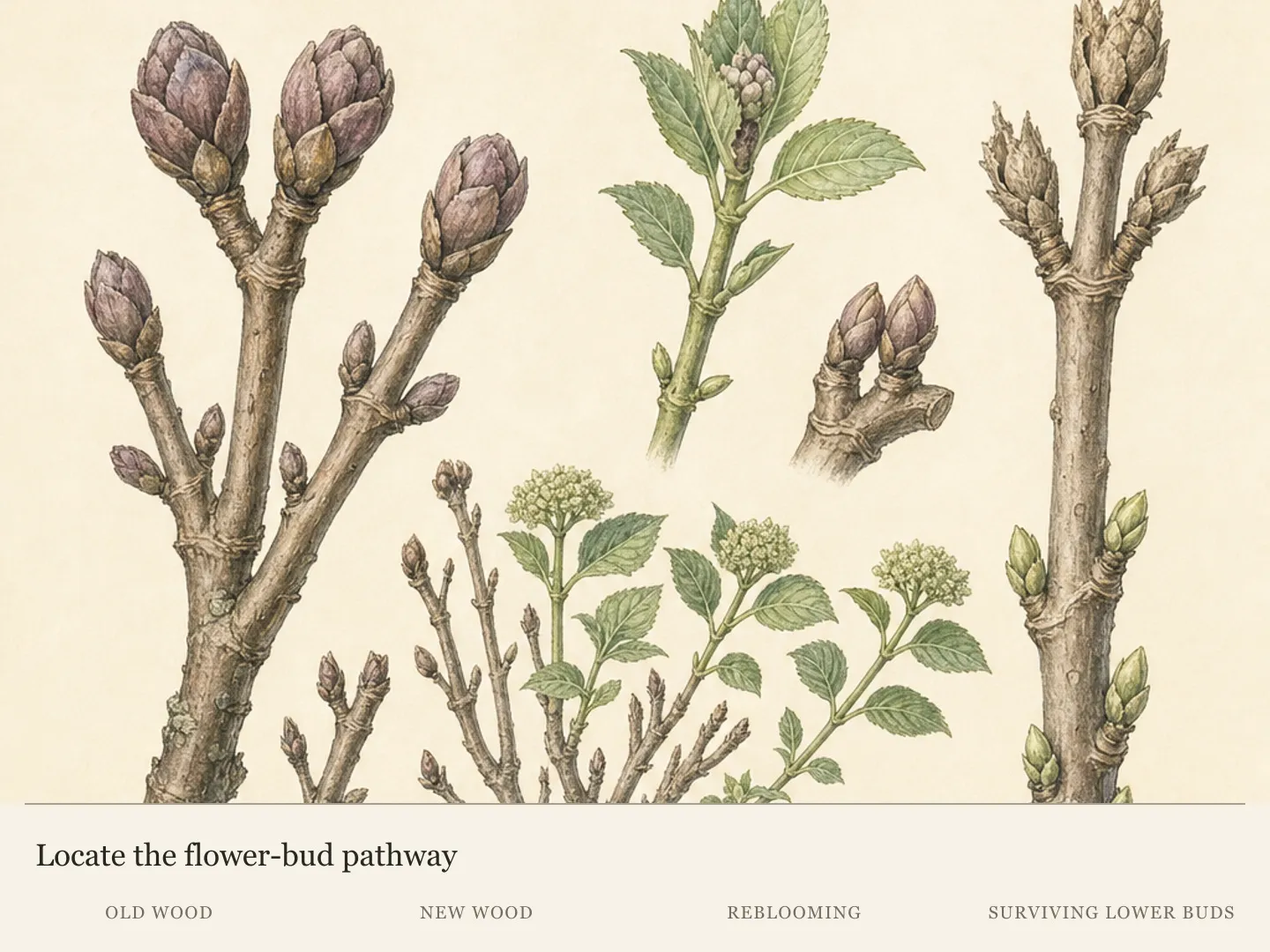
Treat broad plant groups cautiously. Hydrangeas are the familiar warning: species and cultivars differ in whether they flower on old wood, new wood or both. The same restraint belongs around unfamiliar viburnums, ornamental currants and grafted forms. Use a reliable label, nursery record or local Extension identification service. If identity remains uncertain, observe one complete cycle and limit work to damaged wood rather than applying a generic spring-flowering rule.
Regional climate shifts the calendar. The phrase after bloom means after that shrub's principal display in that garden, not a fixed month printed for another latitude. A late frost, warm winter or exposed site can move flowering, while branch dieback can make a normally predictable plant behave unevenly. Watch the flowers and buds on the actual specimen, then check local guidance for hardiness and weather constraints before substantial work.
Cultivar habit matters as much as timing. A compact selection may need only deadwood removal, while an old arching cultivar can carry flowers along long mature stems. Some plants are valued for ornamental fruit that follows bloom; immediate deadheading or shortening would remove it. Decide whether fruit, hips, berries or seed capsules belong in the intended display before treating every spent flower as permission to cut.
Preserve the flowering framework unless a named cut is needed
Identify the shrub and the wood carrying its flowers, then choose the smallest useful job. Thin a conflict at its origin or shorten to a suitable bud or lateral only where that action serves the objective. Keep gradual cane renewal separate from indiscriminate shortening. Record the next bloom before repeating a cut whose effect is still uncertain.
Set the pruning job before touching the framework
Stand back and describe the problem in one sentence: remove a broken branch, open a crowded center, reclaim a path edge, renew an aging multi-stem shrub or correct a branch rubbing the house. A defined job prevents the common drift from one useful cut into wholesale size reduction. Photograph the dormant or flowering outline if it helps, then mark the minimum access and clearance the garden genuinely needs.
Separate health and structure from cosmetic tidying. Dead, broken and clearly diseased wood can demand prompt removal regardless of bloom, but ordinary reshaping of an old-wood spring bloomer is best planned soon after flowering. RHS, Minnesota and Colorado State guidance all connect pruning time to the wood that carries flowers. That timing leaves a growing season in which retained and replacement shoots can mature for a future display.
Assess vigor before considering renewal. A healthy established shrub may respond to selective removal of old stems with useful replacement growth. A drought-stressed, recently transplanted, storm-damaged or declining shrub has less capacity to rebuild. Correct water, root-zone and site problems first, and seek local diagnosis where dieback is unexplained. Pruning cannot repair incompatible soil, a buried crown, root damage or a disease that has not been identified.
Choose a stopping rule. For example, remove the dead branch, two rubbing stems and enough of one leaning old stem to restore the path, then reassess from the viewing point. The stopping rule should be based on visible structure and plant response rather than a universal percentage. Species, age, health and climate change how much living wood can be removed safely in one season.
Identify the wood that carried this spring's flowers
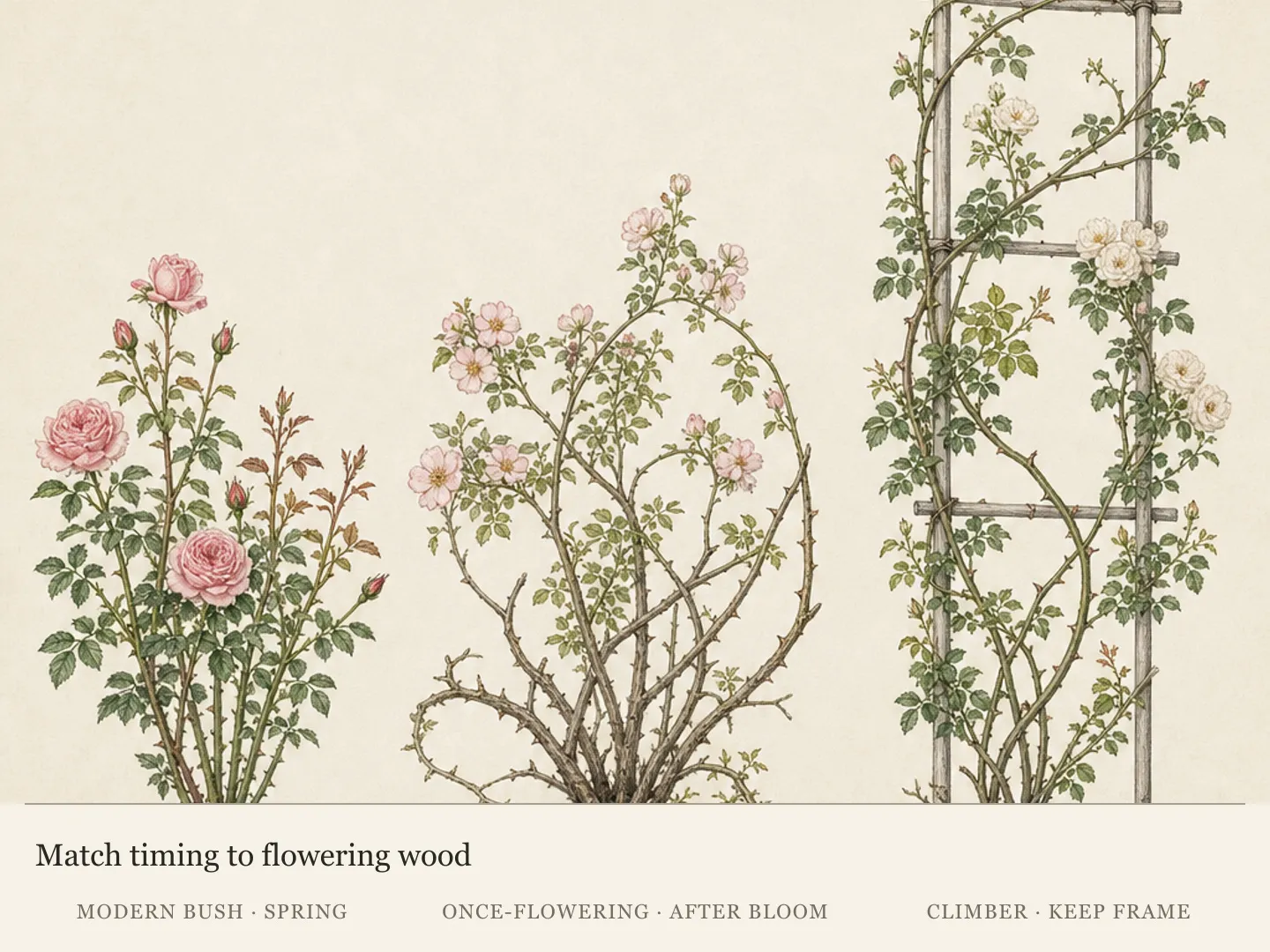
Begin at a spent flower cluster and trace backward. Notice whether flowers sat directly along an older stem, on short side shoots arising from it or near the ends of last season's growth. Follow that stem to a branch union or to the base. The exercise reveals the flowering framework more clearly than looking at a leafless diagram, and it shows exactly which wood a broad heading cut would remove.
Now locate the new growth. Fresh shoots may rise from the base, emerge lower on older stems or extend beyond flowered laterals. They are not automatically all valuable, but they are candidates for the next framework. Keep well-placed, vigorous shoots that can replace an aging or badly directed stem. Remove a new shoot only for a defined reason such as crowding, damage, an unwanted rootstock origin or a path conflict.
Read age through position and performance rather than bark color alone. Older stems often occupy the center, branch repeatedly and carry weaker or shorter growth, but appearance varies by species. A stem that remains healthy and flowers well does not become expendable merely because it looks old. Compare it with available replacements and the shrub's natural habit. Renewal is an exchange, not a ritual purge of the darkest bark.
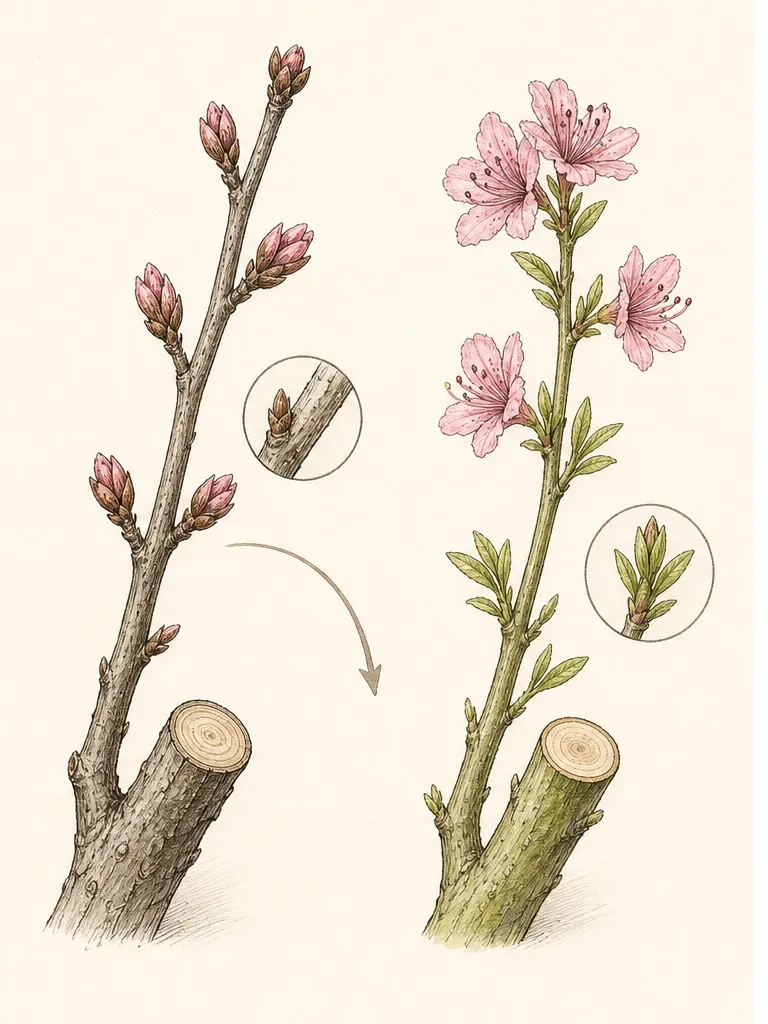
Mark uncertain stems with loose removable ties before cutting. Walk around the shrub and check whether each candidate contributes flowers, screens a view, balances the outline or protects a younger shoot. Remove the ties after the decision. This pause is particularly useful in a dense specimen where a cut made from inside can create an unexpected window when viewed from the terrace or street.
Choose thinning before shearing
A thinning cut removes a stem or side branch at its point of origin: the base, a parent branch or a suitable lateral. Used selectively, it opens crowded structure without stimulating a fringe of shoots at every clipped tip. It also preserves the natural arc, tier or fountain shape of many ornamental shrubs. Make each cut because the removed piece is dead, crossing, congested, poorly directed or ready to be exchanged for a better replacement.
A heading cut shortens a stem to a bud or smaller side branch. It can redirect a vigorous shoot or reduce a specific overlong extension, but repeated heading across the entire surface builds dense twiggy growth. That shell can hide dead material, restrict access and concentrate future pruning at the perimeter. Select a bud or lateral facing the intended direction and keep the cut proportionate to the branch that remains.
Shearing has a limited design role in formal hedges and topiary, where a clipped plane is the stated objective. It is rarely the best default for lilac, forsythia and other shrubs grown for their natural flowering framework. Shearing after bloom may preserve more buds than shearing before it, yet the repeated response can still produce a tight outer layer and bare interior. Match the technique to the intended form rather than to tool speed.
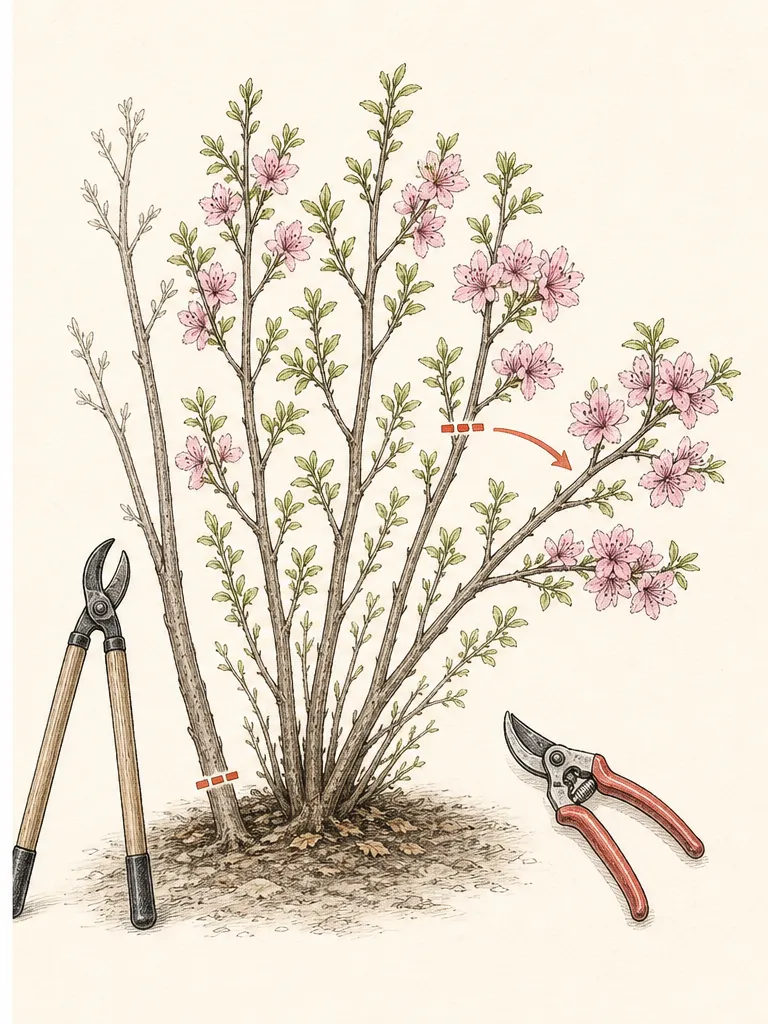
After every few cuts, step back to the principal view and the service side. Check light pathways through the canopy, branch distribution at the base and the remaining flowered wood. An open shrub is not a hollow shrub: foliage should still be distributed through a stable framework. Stop before isolated tufts, exposed weak unions or a sharply flattened side replace the original crowding problem.
Renew multi-stem shrubs as a measured exchange
For a healthy multi-stem shrub with declining central canes, select one or a small number of poorly performing old stems that can be removed near the base without injuring neighboring crowns. Look first for dead sections, heavy crossing, repeated weak branching and stems that lean into access routes. Preserve a range of productive stems and enough foliage to support recovery. The exact amount belongs to the species, plant condition and regional guidance, not a blanket fraction.
Before removing an old cane, identify its replacement. A basal shoot already growing in a useful direction makes the exchange legible. If no replacement exists and the old cane is still sound, postponing the cut can preserve structure while the shrub develops. Conversely, a dead or hazardous stem does not need a replacement to justify removal. Health and safety remain separate from aesthetic renewal.
Cut a selected cane cleanly at the base where the plant's form permits, avoiding a tall stub that will die back and snag debris. Do not gouge the crown or damage adjacent young shoots. On shrubs that sucker from a broader root system, confirm whether a shoot belongs to the desired plant. On grafted specimens, growth arising below the graft may be rootstock and should be managed according to plant-specific advice.
Severe rejuvenation, in which most or all stems are cut low, is not a universal rescue method. Colorado State notes that response varies and that some old, weak shrubs may not recover well. It also sacrifices the immediate flowering framework. Reserve that decision for a correctly identified, suitable and vigorous species, use locally appropriate timing, and accept that replacement can be the better choice for a failing or badly sited plant.
Handle tree-like forms and exceptions deliberately
Some spring-flowering shrubs develop a trunked or small-tree framework rather than many replaceable canes. On these, do not translate basal renewal into removal of a principal scaffold. Trace a crowded branch to an appropriate union, protect the branch collar and preserve balanced permanent structure. Larger, high or load-bearing branches can require an arborist, especially where they overhang people, glass, utilities or property.
Evergreen spring bloomers also need species-specific restraint. Bare old wood on some evergreens may not regenerate readily, and the visual consequences of a deep cut can last for years. Confirm that the plant can break from the proposed point before cutting past green foliage. Broad advice for deciduous forsythia or lilac should never be transferred automatically to rhododendron, camellia or another evergreen framework.
Ornamental fruit creates another exception. If the garden values berries or seed structures, keep selected flowered branches after bloom and prune around that display. The choice may reduce the amount of shaping possible in that cycle. Record it as an intentional trade rather than diagnosing the retained branch as missed work. Wildlife value can be considered without making insects the subject of the pruning plan.
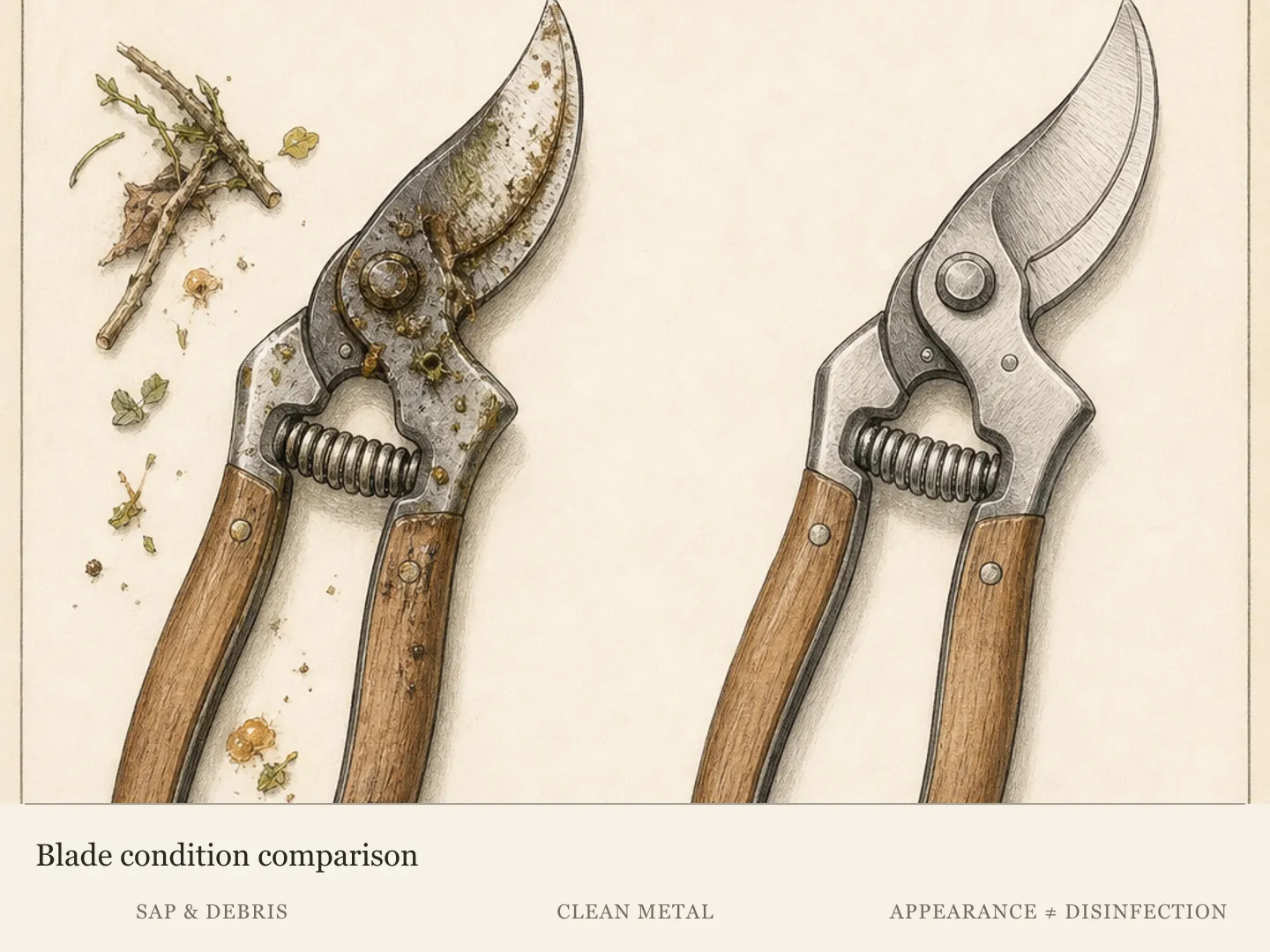
Disease concerns can alter ordinary timing and sanitation. Remove affected material according to a confirmed diagnosis and local disposal guidance; do not compost regulated or persistent diseased tissue merely because it came from an ornamental. Clean soil and sap from tools and follow a disinfectant label where sanitation is recommended. Routine disinfection between every cut is not a substitute for identifying how a particular disease spreads.
Make clean cuts from a safe working route
Clear enough space to reach the branch union without twisting through the canopy. Use sharp bypass pruners for material within their rated capacity, loppers for appropriate larger stems and a pruning saw for branches too large for hand tools. Never force a small tool through heavy wood. A crushed cut and a strained wrist are both signs that the tool, access or branch size needs to change.
For a small branch, cut just outside the branch collar or back to a suitable lateral without leaving a long stub or slicing flush against the parent stem. For a heavy branch, control bark tearing with a staged removal method appropriate to its size. Support the offcut before the final cut so it cannot strip bark, hit retained shoots or swing into the gardener's face.
Work from the inside outward: dead and broken material first, then rubbing and crossing stems, then the selected thinning or renewal cuts. This order often solves enough crowding that later cosmetic cuts become unnecessary. Keep a pile sorted by the location of each removed stem if you are learning the shrub. Comparing the offcuts with the remaining framework makes over-pruning easier to detect before it continues.
Leave the canopy when footing, reach or branch tension is unsafe. Do not climb into a shrub, cut above shoulder height with an uncontrolled tool or work under a branch whose movement is uncertain. Utility clearances, high branches and structural defects belong to qualified professionals. The correct seasonal window does not make an unsafe cut necessary today.
Use the next flowering cycle as the audit
After pruning, water according to species needs and actual soil moisture rather than compensating with constant irrigation. Keep mulch away from stems and crowns, protect fresh basal shoots from foot traffic and avoid a heavy fertilizer response intended to force replacement. Excess soft growth can create new crowding. Normal care and a stable root zone give the retained framework the clearest chance to respond.
Photograph the shrub from the same principal and service views. Record which old stems were removed, which replacements were retained and where heading cuts redirected growth. Through summer, notice whether new shoots receive space and whether the center remains accessible. Tie or brace only when plant-specific practice supports it; do not bind a natural arching shrub into a rigid outline because growth looks temporarily uneven.
During the next dormant season, inspect bud distribution without launching a second shaping campaign. The purpose is to see where buds formed on retained and new wood. When flowers open, compare density and position with the previous record. Gaps may show that too much flower-bearing wood was removed; congestion may show that too few interior stems were thinned or that heading produced excessive branching.
A successful result is not a shrub made smaller at any cost. It is a healthy, identifiable framework with clear access, fewer conflicts, well-placed replacement growth and flowers distributed in a way that suits the cultivar and garden. Let the next display revise the plan. Flowering wood is living evidence, and the best pruning routine learns from it rather than repeating a fixed recipe.
Steps
- Level
- moderate
- Time
- Forty-five minutes for assessment and selective pruning of one accessible established shrub
- Tools
- Sharp bypass pruners, Loppers rated for the intended stems, Pruning saw for appropriate larger branches, Thorn-resistant gloves and eye protection
- Materials
- Loose removable marking ties, Plant label or garden record, Tarp for collecting prunings
- 1Confirm identity and flowering wood
Verify the shrub's botanical name and cultivar where possible, then trace spent flowers to the older stems or short laterals that carried them. Check whether the plant also has new replacement shoots and whether ornamental fruit is part of the intended display. Use the actual end of principal bloom in this garden, plus local guidance, instead of a fixed calendar date.
- 2Define the smallest useful job
Name the problem and mark only the stems involved: deadwood, crossing branches, a crowded center, an obstructed route or an aging cane with a sound replacement. Photograph the outline and choose a stopping rule before cutting. Delay elective renewal on a stressed or unidentified shrub, and seek diagnosis when decline or dieback does not have a clear physical cause.
- 3Clear dead, broken and rubbing wood
Work from health and structure toward appearance. Remove dead or broken pieces with clean cuts, then choose between genuinely rubbing stems while preserving the better placed branch. Reassess from outside the shrub after this pass; the basic cleanup may create enough space that no broad reshaping is necessary. Follow diagnosis-specific sanitation and disposal guidance where disease is involved.
- 4Thin selected stems at their origin
Remove crowded or badly directed stems at a parent branch or, on a suitable multi-stem shrub, near the base. Protect collars, crowns and young replacement shoots, and avoid leaving long stubs. Prefer selective thinning over a uniform clipped surface when the plant is grown for a natural arching or layered habit. Step back after every few cuts to check balance and access.
- 5Shorten only to a useful bud or lateral
Use a heading cut only where a particular extension needs redirection or modest reduction. Choose an outward or appropriately oriented bud or a side branch capable of continuing the line. Do not tip every stem to the same plane. Widespread heading can create a twiggy outer shell and remove the very new growth intended to mature for a later flowering cycle.
- 6Exchange old canes gradually
On a vigorous compatible multi-stem species, select a poorly performing old cane only when the remaining framework and replacement growth can carry the design. Remove a measured number based on plant condition and local guidance, not a universal fraction. Keep healthy productive old wood where no replacement exists, and avoid severe rejuvenation unless the identified species and its vigor make that response appropriate.
- 7Record the response through next bloom
Give normal species-appropriate aftercare, protect new basal shoots and photograph the finished framework. Note summer shoot direction and dormant bud placement without repeatedly reshaping the plant. At the next bloom, compare flower distribution, gaps, congestion and access with the record. Use that evidence to decide whether the following cycle needs another old-stem exchange, a smaller correction or no pruning at all.
Plants in this guide
Related reading
Sources
- Pruning Early-Flowering Shrubs. Royal Horticultural Society. Source record · Accessed 2026-08-19.
- Pruning Trees and Shrubs. University of Minnesota Extension. Source record · Accessed 2026-08-19.
- Pruning Flowering Shrubs. Colorado State University Extension. Source record · Accessed 2026-08-19.