Plant problems · florist cyclamen cool indoor bloom care
Keep Florist Cyclamen Cool and Flowering Indoors
Keep florist cyclamen blooming by protecting cool temperatures, bright indirect light, a dry crown, and even root-zone moisture before warm-room stress aborts the buds.
Published Last updated
In this guide
- Treat florist cyclamen as a cool-season plant, not a warm-room accent
- Separate room heat, wet roots and post-bloom dormancy
- Use temperature as the first diagnostic tool
- Keep the crown dry while the root zone stays even
- Groom for continued flowers and restrained feeding
- Know the difference between stress and dormancy
- Set expectations for the room, then use the diagnosis table
- Let the display location carry the care
- Diagnosis
Treat florist cyclamen as a cool-season plant, not a warm-room accent
Florist cyclamen performs best when the room feels more like a bright winter porch than a heated holiday centerpiece. Ideal guidance from Wisconsin and Clemson sets daytime temperatures at 60 to 65°F with nights around 50°F, while Iowa State gives a general preferred range of 50 to 60°F. These distinct ranges all describe cool-room culture. In a warm home, choose the brightest cool occupied room and verify the temperature beside the pot.
That temperature preference explains why florist cyclamen often disappoints people who are otherwise competent with houseplants. Ordinary room warmth can shorten the bloom cycle, stall buds, or yellow leaves even when the watering routine suits other houseplants. This winter-growing tuber follows a different seasonal pattern from tropical foliage plants. Read its temperature, light, and moisture together, and the care becomes specific and practical.
Light completes that winter-season requirement. Wisconsin, Clemson, and Iowa State support bright indirect conditions, with Wisconsin noting that an east window is often useful and a southern exposure may be better in darker winters. A warm dim room combines two stresses, while harsh sun through hot glass can overheat the pot. Cooler placement is the first correction when warmth is evident; a brighter indirect position then supports balanced growth and flowering.
Separate room heat, wet roots and post-bloom dormancy
Check temperature beside the cyclamen and inspect the pot's drainage before interpreting yellow leaves. Heat during flowering, water trapped around the root zone or crown, and a plant entering its post-bloom rest need different responses. Keep the season and recent flowering record with the symptoms. Do not force every yellowing plant back into active bloom with more water or fertilizer.
Use temperature as the first diagnostic tool
When a florist cyclamen stops behaving, check the room before changing fertilizer or water. Clemson states that buds may fail to develop above 70°F. Wisconsin connects cool conditions to flower quality and bloom-season length. A plant can look acceptable for several days on a warm mantel and then abort buds or fade early without a dramatic watering error. Temperature at the pot reveals whether the display site has moved outside the cool flowering range.
Measure the real conditions if you can. A pot beside a sunny window and directly above a radiator does not share the climate shown by a thermostat across the room. Check for heat vents, fireplaces, forced-air returns, hot afternoon glass, and leaf contact with very cold glass. Diagnose from the temperature around the foliage and tuber before labeling the display too warm or too cold.
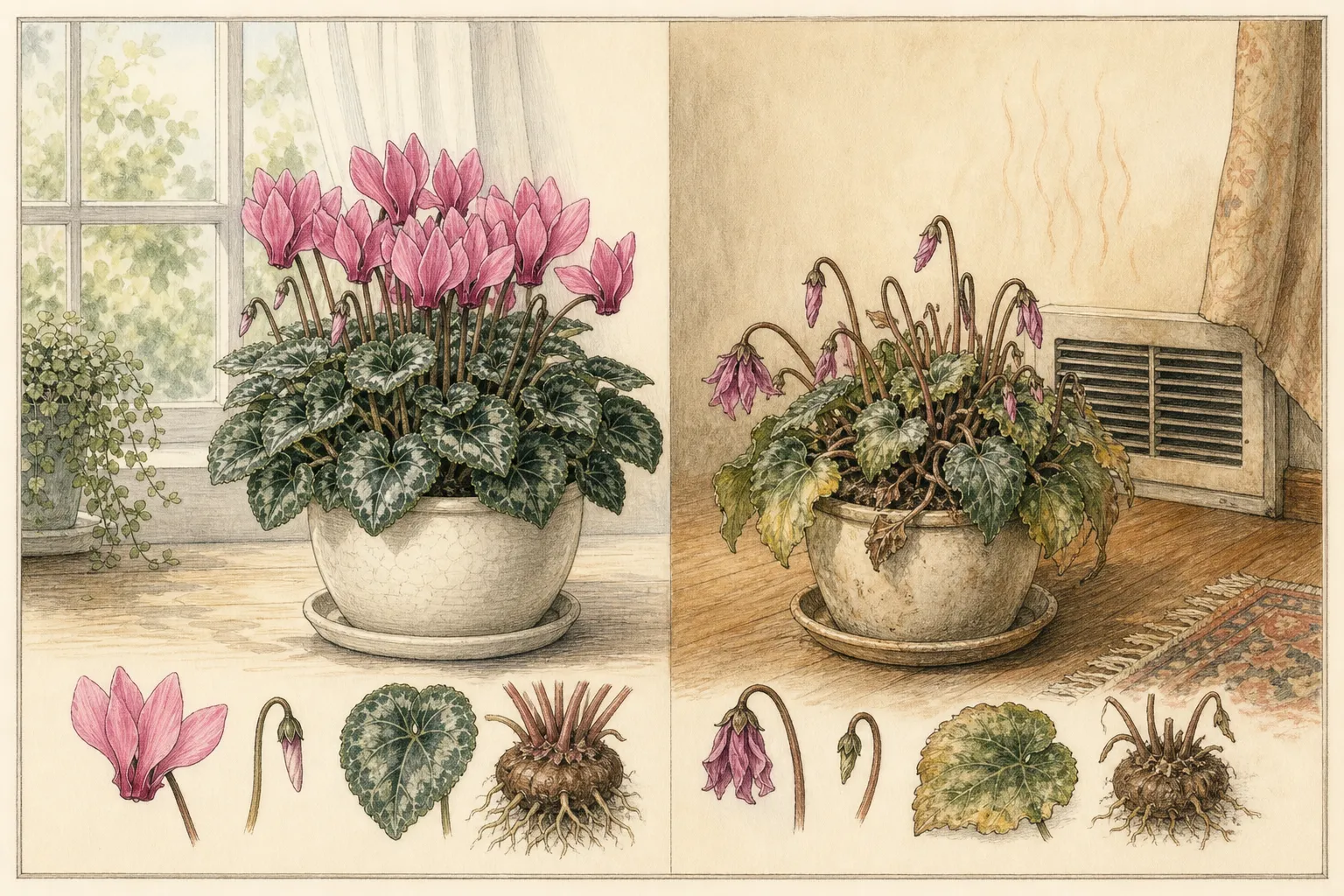
Use a minimum-maximum thermometer at leaf height for one complete daytime and nighttime cycle. Record the highest reading, the overnight low, and the time a heater or direct sun reaches the pot. The 60 to 65°F days with nights near 50°F from Wisconsin and Clemson describe an ideal cycle, while Iowa State's 50 to 60°F range supplies a broader cool-room reference. A reading above 70°F during bud development gives Clemson's bud-failure warning direct relevance to that site.
The practical fix is often simpler than the diagnostic spiral gardeners create. Move the pot to a cool bright sill, a lightly heated guest room, a north or east hall with good daylight, or another place where nights drop naturally and consistently. Keep it clear of freezing door drafts; steady coolness is the goal. Recheck the new position through another day-night cycle, then evaluate moisture and grooming if buds still stall.
Keep the crown dry while the root zone stays even
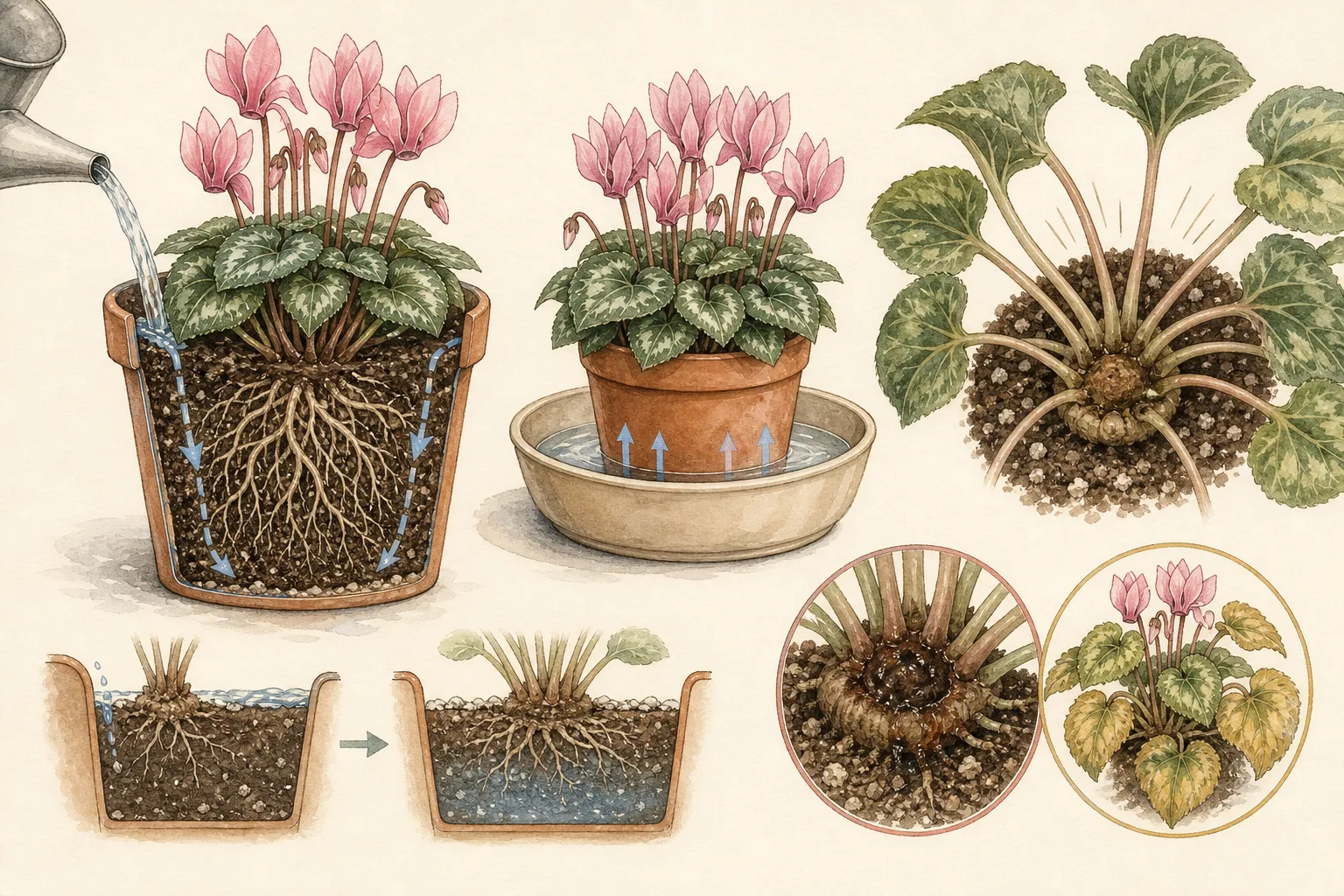
Cyclamen wants moist soil during active flowering, but it does not want a wet crown. That distinction is at the center of every reliable source here. Iowa State says the mix should stay moist but not wet and specifically warns against wetting the corm or crown directly. Wisconsin recommends watering thoroughly when the surface looks and feels dry, then allowing the soil to approach dryness before watering again. Clemson likewise advises watering when the medium feels dry to the touch and doing so along the pot edge or from below. The rule is not tiny sips. It is full watering of the mix while keeping the center dry.
Bottom watering can help when the potting mix is free-draining and the crown is prone to staying damp, but the pot cannot remain in a saucer all day. Wisconsin mentions standing it in water for about fifteen minutes, followed by complete drainage. If the mix stays heavy, foliage softens, or the soil smells stale, inspect for trapped water and declining roots. Repeated severe drying can also soften leaves and shorten the flower display.
Wisconsin suggests a tray of wet gravel to raise humidity around the canopy without submerging the roots. The pot must sit above the water line. Keep the crown open by removing fallen petals and yellow leaves; damp debris in the rosette raises the risk of gray mold and decay. Moisture belongs in the root zone while the tuber surface and crown remain airy.
A daily check is usually more reliable than a rigid weekly schedule because florist cyclamen is often sold in a small pot that can dry quickly near bright glass yet stay wet for too long inside a decorative sleeve. Feel the surface, lift the pot for weight, and glance into the crown before deciding. This short routine is what turns careful watering into consistent watering. The plant is not demanding a drama of constant attention. It is asking for steady observation so the root zone stays evenly moist while the crown remains airy and dry.
Groom for continued flowers and restrained feeding
Continuous flowering depends on grooming as well as room climate. Wisconsin and Clemson recommend twisting a spent flower stem and pulling it cleanly from the base. Clipping only the top leaves a stub in the crown. Removing the entire stem reduces damp debris among tightly packed petioles and keeps new buds visible for inspection.
Fertilizer should support bloom, not produce rank foliage. Iowa State recommends a dilute fertilizer every two weeks while in bloom. Wisconsin also allows regular feeding but warns that too much fertilizer promotes lush growth that is more vulnerable to disease. These are both arguments for restraint. Feed lightly while the plant is actively growing and blooming, then stop trying to solve every slowdown with more nutrients. A dense soft canopy in a warm room is not success. It is often the prelude to yellow leaves, fewer flowers, and crown congestion. The plant should look taut and fresh, not overfed.
This is also where light returns as a bloom-management tool. If the leaves remain firm but the plant produces fewer buds, check whether the room has grown dimmer or warmer before increasing fertilizer. Bright indirect light, cool air, clean grooming, and modest feed act together. The florist cyclamen that holds flowers longest usually lives in a pleasantly cool room, gets checked every day, and stays clear of stale water, trapped petals, and overenthusiastic feeding.
Know the difference between stress and dormancy
Not every yellow leaf means you have failed. The plant grows from a tuber and has a real dormant cycle; Wisconsin notes that flowering commonly stops in late spring as leaves fade and drop. Clemson likewise treats post-flowering dormancy as normal and acknowledges that reblooming a compact florist plant in the home is difficult. Gardeners often fight this seasonal slowdown with more water, heat, or fertilizer. After a strong winter run, general yellowing as the season warms calls for a controlled rest.
Stress looks different from orderly dormancy. A stressed plant may blast buds during winter warmth, yellow unevenly, or soften at the crown while still trying to flower. A plant entering dormancy after a full run tends to yellow more generally as the season warms. Choose one complete rest method. For in-pot rest, Clemson keeps the shaded mix from becoming completely dry until new leaves appear. Wisconsin offers a separate out-of-pot method: store the lifted tuber in dry vermiculite near 50°F for 6 to 12 weeks, then repot when growth resumes.
Restart the selected method without combining its watering rules with the other one. A tuber lifted into dry vermiculite stays out of potting mix for the stated rest, then returns to fresh free-draining mix with its upper half exposed, as Wisconsin directs. An in-pot tuber remains in its shaded container with limited moisture; Clemson moves it into bright light and resumes thorough watering when new leaves emerge, then feeds monthly during renewed growth. Iowa State describes a 6- to 8-week rest and likewise restarts water after the dormant interval. These are rebloom attempts, not guaranteed forcing schedules.
Confirm tuber condition before assigning a plant to either rest method. Clemson describes normal dormancy as leaves yellowing and falling after flowering, while NC State links overwatering with tuber rot. A firm tuber beneath general seasonal yellowing can enter a planned rest. A mushy tuber, sour odor, wet collapsing petioles, or localized crown failure identifies decay and excludes dormancy as the explanation. Separate the affected pot, correct trapped water, and base any salvage decision on the amount of sound tuber that remains.
The practical decision is whether rebloom is worth your space and patience. Gardeners who enjoy the challenge can rest the tuber properly and bring it back into bright growth later. A seasonal indoor display is also a reasonable complete cycle. Problems begin when general dormancy is mistaken for drought and a leafless crown receives repeated flowering-season watering.
Set expectations for the room, then use the diagnosis table
A florist cyclamen can bloom for weeks, not indefinitely, and the duration depends more on the room than on the owner's optimism. Iowa State says several weeks of bloom are possible with good care. Wisconsin notes that both individual flowers and the total season extend when the plant is kept cool. Those claims set a realistic bar. You are not trying to make the plant ignore winter heating, holiday travel, or erratic windowsill weather. You are trying to give it the most cyclamen-like conditions your home can offer, then respond clearly when it signals that the room has stopped cooperating.
This is why a problem-solving format is useful for the plant. Cyclamen rarely fails from one mysterious hidden cause. It usually fails from an identifiable mismatch between cool-season growth and warm-room treatment, or between a moist root zone and a wet crown. Diagnose in that order. First ask whether the plant is too warm. Then ask whether the root zone is too wet, too dry, or both in alternation. Then ask whether grooming and light have slipped. Only after those answers are clear does it make sense to talk about rebloom or dormancy. The table below is meant to keep those questions aligned.
Use each row as one complete set. A symptom, likely cause, check, and solution belong together. Warm-room bud blast gains nothing from extra feed. A sunnier table alone cannot repair crown rot, and dormancy calls for a rest protocol. Keeping those pathways separate makes daily care calmer because one watering can no longer becomes the answer to five different cyclamen problems.
A cool guest room, enclosed porch that stays frost free, or bright hallway can therefore be a better cyclamen room than the cheerful center of family life. If you cannot offer that kind of space, enjoy the bloom for what it is and avoid punishing the plant for not behaving like a heat-loving houseplant. Clear expectations are part of care. They stop the gardener from inventing chores the sources do not support and make the simple environmental fix easier to see.
Let the display location carry the care
A cool bright sill or sunroom within the measured flowering range usually extends the display more effectively than extra fertilizer. Rotate only enough to balance growth, remove spent stems cleanly, and return the plant to its cool station after short decorative use in a warmer room. A merely frost-free space may still be too cold, so check the temperature beside the pot.
ASPCA lists Cyclamen species as toxic to dogs and cats, and NC State identifies the dark tuber of Cyclamen persicum as poisonous. Keep the whole pot, fallen material, and exposed tuber beyond animal reach; a high sill is unsuitable when a cat can jump to it. A closed room or securely inaccessible plant stand is safer than relying on the decorative sleeve as a barrier.
Disturbed mix or a chewed plant establishes a possible exposure even before clinical signs appear. Drooling, vomiting, or diarrhea are reported signs, while large tuber ingestion may cause abnormal heart rhythm, seizures, or death. Contact a veterinarian or animal poison-control service promptly with the plant name, part involved, approximate amount, time, and observed signs. Move the remaining plant and collected debris into a closed room while advice is obtained, preventing a second exposure and preserving material for identification if requested. Waiting for a severe symptom can delay appropriate veterinary advice.
Diagnosis
New buds stay small or stop opening, and open flowers fade unusually fast even though the leaves still look presentable and the plant seems green enough to continue.
- Check
- Check actual daytime and nighttime temperatures where the pot sits, and note whether it is above a vent, near a radiator, pressed against hot glass, or otherwise warmer than the rest of the room after dark.
- Cause
- The room is running too warm, especially at night or near a heating source, so the plant is losing the cool conditions associated with lasting buds and a longer bloom season.
- Action
- Move the plant to a bright room that stays about 60 to 65°F by day and around 50°F at night where practical. Measure beside the pot, and protect it from heating outlets, hot glass, direct contact with cold glass, and freezing drafts.
Outer leaves yellow while the pot alternates between feeling heavy for days or suddenly turning almost weightless and dry, with no steady middle ground in the root zone.
- Check
- Feel the surface of the mix, lift the pot for weight, look for trapped saucer water, and inspect whether decorative sleeves or an outer pot are stopping the root ball from draining freely after each watering.
- Cause
- The root zone is cycling between saturation and drought because drainage is poor, foil or a cachepot traps water, or watering is happening by schedule instead of by the actual state of the mix.
- Action
- Water thoroughly only when the surface has dried, then let all excess drain away. Keep the mix evenly moist through the flowering season, but never let the pot stand in trapped water or stay waterlogged for days.
The center of the plant stays wet, petioles soften near the base, or gray mold begins catching on faded petals and debris packed into the crown.
- Check
- Look directly into the crown for wet spent petals, decaying leaves, mushy stem bases, or water that regularly runs toward the center instead of into the root zone around the outer edge of the pot.
- Cause
- Water is repeatedly hitting the crown or staying trapped in the rosette, which leaves the tuber and the base of the stems prone to rot, fungal trouble, and collapse of otherwise healthy growth.
- Action
- Switch to edge watering or short bottom watering, discard any remaining saucer water, and clear away dead material from the crown so moisture stays in the root zone instead of lingering at the tuber surface.
Flower production slows even though the plant still has a firm leaf canopy, no crown softness, and no clear sign that it has entered its spring dormant phase.
- Check
- Count active buds, remove a few spent stems, and ask whether the position is still bright enough in winter. Then review how often fertilizer has been applied and whether it has remained dilute and restrained.
- Cause
- The plant is getting dimmer light than it needs, spent stems are being left in place, or fertilizer is being used heavily enough to encourage soft foliage instead of steady buds and repeat flowers.
- Action
- Give brighter indirect light, twist spent flower stems out at the base, and feed only lightly with a dilute bloom-oriented fertilizer while growth is active, rather than trying to restart flowering with a heavy dose of nutrients.
After a full flowering run, the whole plant begins yellowing more evenly as the season warms and the plant's annual cycle shifts out of winter growth.
- Check
- Compare the pattern of decline. Orderly whole-plant yellowing after a long bloom run points toward dormancy, while abrupt bud blast, patchy collapse, or crown softness during active winter flowering points toward care stress instead.
- Cause
- The plant may be moving into normal dormancy rather than experiencing a midseason crisis, especially if it has already flowered well and spring warmth is increasing around the room or windowsill.
- Action
- Reduce watering gradually once seasonal dormancy becomes clear, keep the leafless tuber on the dry side, and decide later whether to summer it for rebloom or to end the cycle after a successful winter display.
Leaves remain present but stems and flowers lean toward the window, and the plant loses the compact centered look it had when first bought.
- Check
- Look at the plant from above and from the room approach. If one side is clearly reaching toward a weak window and the buds are no longer centered over the tuber, brightness is part of the problem.
- Cause
- The placement is cool enough but not bright enough, or the light is strongly one-sided, so the plant is surviving rather than flowering in a balanced way.
- Action
- Move the pot closer to a brighter cool window, rotate it modestly for balanced exposure, and keep watering and grooming steady. Judge the correction by firmer centered growth and improved bud development rather than by perfect symmetry.
Related reading
Sources
- Cyclamen. Wisconsin Horticulture. Source record · Accessed 2026-08-30.
- Florist Cyclamen. Clemson Extension. Source record · Accessed 2026-08-30.
- All About Cyclamen. Iowa State University Extension and Outreach. Source record · Accessed 2026-08-30.
- Cyclamen persicum. NC State Extension. Source record · Accessed 2026-08-30.
- Toxic and Non-toxic Plants: Cyclamen. ASPCA Animal Poison Control Center. Source record · Accessed 2026-08-30.