Plant problems · overwintered pelargonium leaf loss diagnosis
Diagnose Overwintered Pelargonium Leaf Loss
Separate ordinary adjustment from low light, watering errors, edema, chilling, root trouble, and disease when overwintered pelargoniums yellow or drop leaves indoors.
Published Last updated
In this guide
- Reconstruct the move indoors
- Identify the winter method before treating leaf loss
- Map which leaves fall and in what order
- Measure the indoor environment at plant level
- Inspect water, medium, and roots
- Separate environmental injury from disease
- Correct the supported cause in one direction
- Judge recovery by new growth and roots
- Diagnosis
Reconstruct the move indoors
This diagnosis applies to common bedding Pelargonium—especially zonal and ivy-leaved types—kept as actively growing potted plants through winter. It does not describe hardy Geranium perennials or a deliberately dormant bare-root pelargonium. Confirm the plant and overwintering method first. Write down when it came indoors, whether roots were dug or disturbed, how much top growth was removed, and when leaf yellowing began. Leaf loss within days of the move points toward transition stress; loss beginning weeks later directs attention to the indoor water, light, or disease environment.
Reconstruct the light change in practical terms. A plant moved directly from an open patio to a windowsill receives much less total light even when the room looks bright. University of New Hampshire Cooperative Extension identifies abrupt reduction in light as a common reason potted geraniums shed leaves after coming indoors and recommends a gradual transition. Note the former exposure, the current window direction, obstructions, day length, and whether stems now stretch toward one side. Lower-leaf loss with lengthening internodes fits a light deficit more closely than a root collapse.
Record temperature at the leaves and pot, not only at the room thermostat. Cold glass, a leaky sill, a door draft, a radiator, and a heat vent can create different microclimates across one plant. UNH also notes that exposure to nights around or below 50°F can contribute to leaf drop. Mark which side loses leaves first and whether the event followed a cold night. An abrupt cold injury pattern should respect the exposed side; whole-canopy decline with wet mix calls for a root and water check.
Before placing the plant among houseplants, inspect leaf undersides, petioles, stems, and the media surface. Isolate specimens with water-soaked spots, V-shaped yellow-brown lesions, blackening stems, spreading wilt, or visible pests. Photograph the complete canopy and representative leaves before cleanup. Keep the cultivar or group name if known: ivy, zonal, regal, and scented pelargoniums differ in habit and disease expression. That identity also prevents advice for dormant storage from being applied to a plant intended to remain in leaf.
Identify the winter method before treating leaf loss
First establish whether the pelargonium is intended to grow actively in a pot or is being held under a different winter method. For active plants, compare the indoor move, light, moisture and leaf-loss pattern. Progressive wilt or suspicious lesions need isolation and diagnosis; keep such a plant out of the cutting supply while its health remains unresolved.
Map which leaves fall and in what order
The order of loss narrows the cause. Even yellowing of older lower leaves soon after the move, followed by compact healthy new growth, is consistent with adjustment to reduced light. Long pale internodes, small leaves, and a strong lean show that warmth is driving more growth than the available light can support. If only the window-facing leaves bleach, scorch, or chill while the room side remains firm, investigate the glass temperature and direct exposure rather than changing the water schedule for the whole pot.
Turn leaves over. Edema begins as small translucent, fluid-filled blisters, usually on older leaf undersides and often near margins. The lesions can enlarge, rupture, and heal as tan or brown corky scars; severely affected leaves may roll, yellow, or fall. Old scars do not spread like an infection, though new leaves can develop fresh edema while the water-transpiration imbalance continues. Record whether the mix was warm and wet while the air was cool, humid, dim, or still.
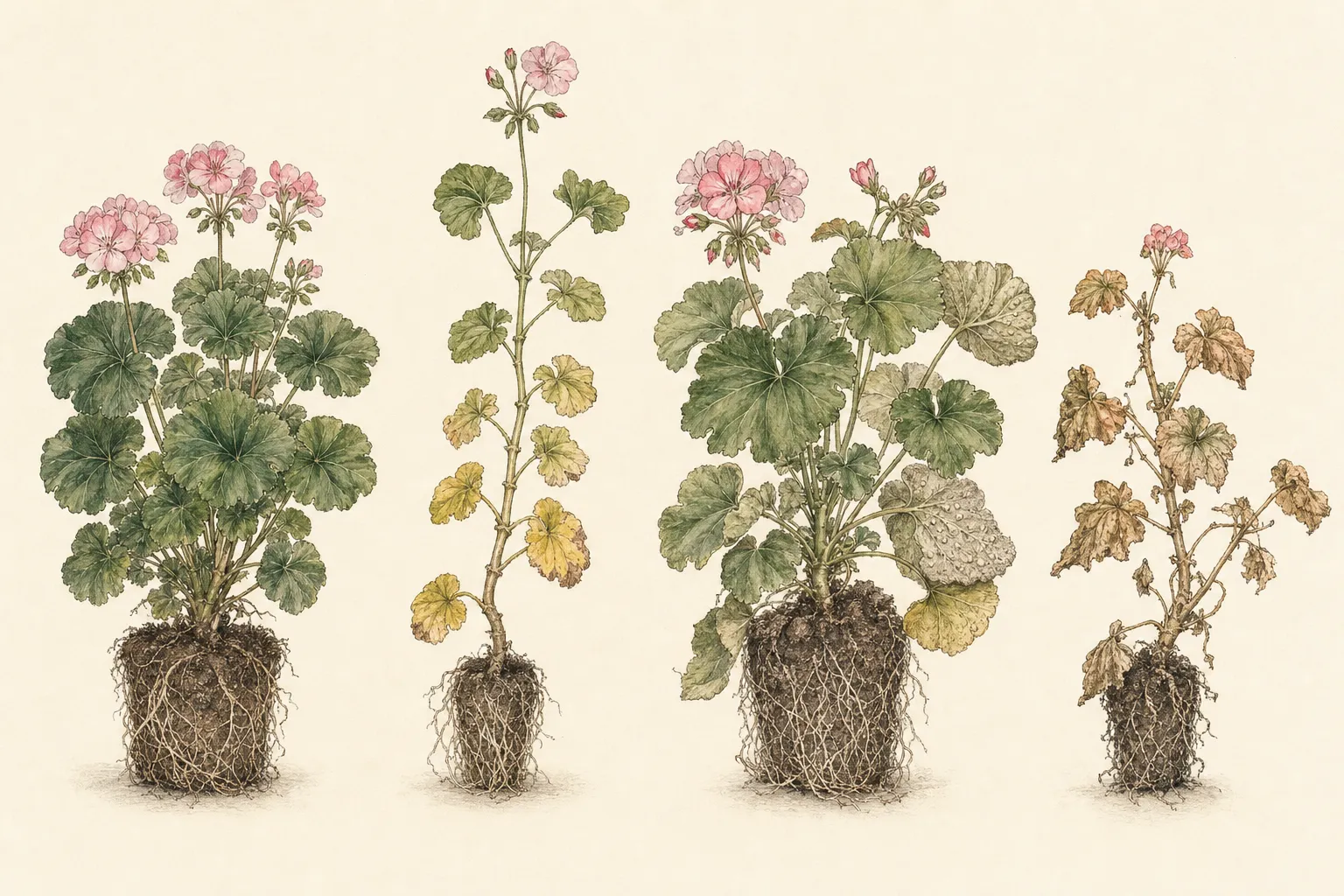
Progressive spots, sector wilt, and stem changes deserve faster isolation. UConn Extension describes bacterial blight signs that can include tiny water-soaked brown spots, V-shaped yellow-to-brown wedges from the leaf margin, an umbrella-like wilt, leaf drop, and healthy-looking roots despite wilt. Symptoms vary by Pelargonium group and temperature, so appearance alone is not a final diagnosis. A whole branch wilting while neighboring branches remain firm, or similar lesions appearing on nearby pelargoniums, is more concerning than uniform loss of old lower leaves.
Measure the indoor environment at plant level
Measure the hours of usable light on the foliage and observe growth form for two weeks. Iowa State recommends a bright sunny window or supplemental lighting for potted overwintered geraniums and warns that warm, poorly lit plants become tall and spindly. Clean the window, move the pot close enough for light without touching cold glass, and keep reflective obstacles and neighboring plants clear of the canopy's light path. If supplemental light is used, follow the fixture instructions for distance, duration, heat, and electrical safety.
For actively growing potted geraniums, Iowa State gives daytime temperatures of 65–70°F with somewhat cooler nights; UNH gives a similar cool-night pattern. Treat those as cultivation references for common annual geraniums, not a universal threshold for every Pelargonium species or dormant-storage method. What matters diagnostically is the combination: warm air with weak light produces soft stretched growth and high maintenance demand, while cold leaves with wet roots slow water loss and increase edema risk.
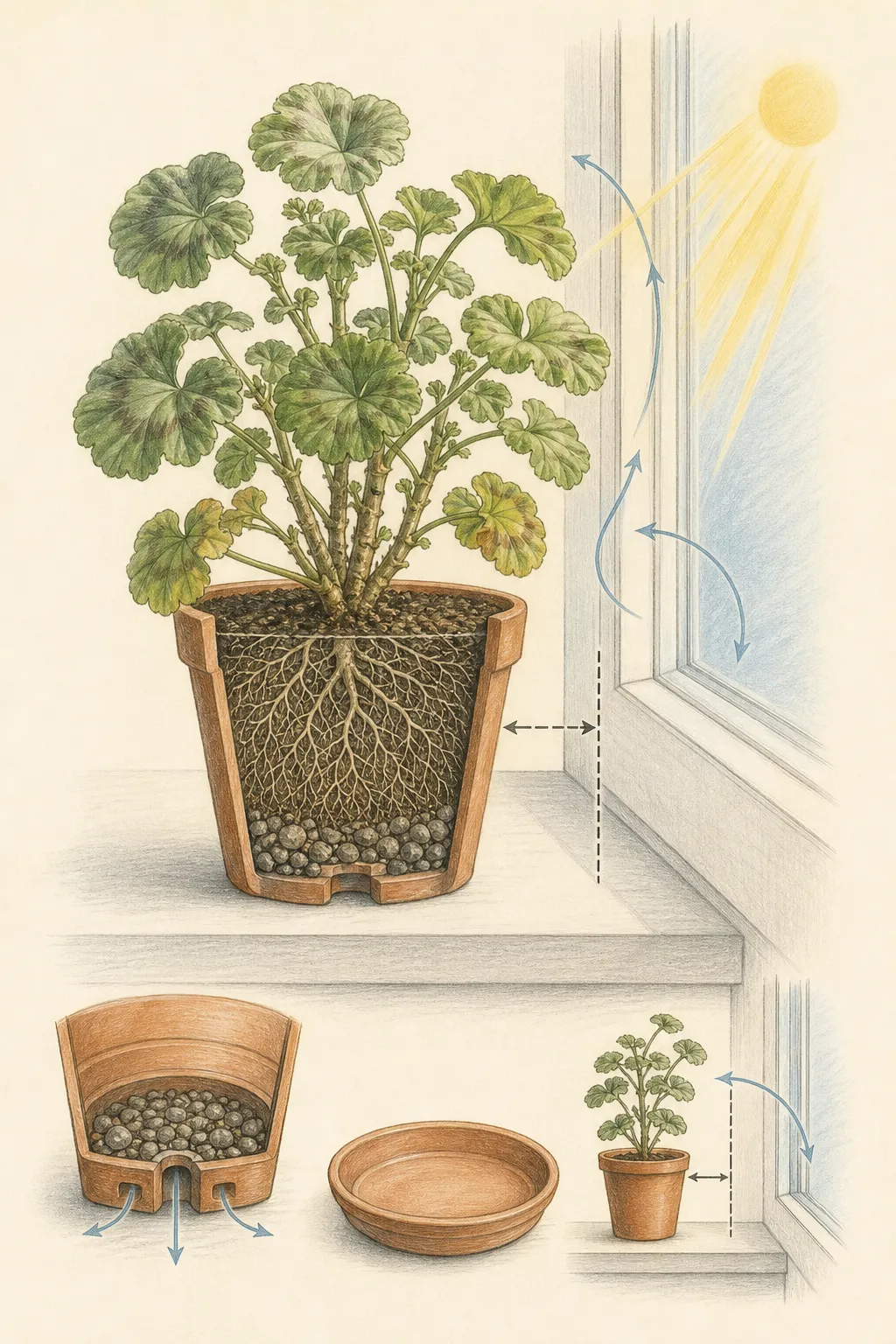
Measure the coldest and warmest points after sunset and before sunrise. A leaf touching glass may experience a much lower temperature than the center of the room, while a pot above a radiator can stay warm and wet even when foliage is cool. Move the plant far enough from glass, doors, and heat outlets to remove the extreme, but keep it in the brightest practical position. Avoid carrying it among different rooms each day; repeated moves change light, temperature, humidity, and handling together.
Air circulation matters most when it corrects humid, stagnant leaf conditions without rapidly drying the root ball. Wisconsin Extension links edema with warm moist soil and reduced water loss under high humidity, low light, cool air, and poor ventilation. Space plants with clear air gaps between leaves, remove standing water from saucers, and use gentle room circulation rather than a strong fan aimed at the pot. Check undersides of the next leaves; absence of new blisters is more useful than waiting for corky scars to disappear.
Inspect water, medium, and roots
Indoor water use is usually lower than it was outdoors. Feel below the surface, lift the pot to judge weight, clear every drainage hole, and empty the cachepot or saucer. Iowa State advises watering actively growing potted geraniums when the soil becomes dry, then watering thoroughly; the container must be allowed to drain. A dry surface over a wet lower root ball is possible in a deep or compacted pot, so use weight and a probe near the edge before adding more water.
Edema is not caused by a pathogen. It develops when roots absorb water faster than leaves lose it, so correcting only one air reading may not be enough. Water earlier in the day, reduce frequency during dim or cloudy periods, improve drainage, increase spacing and gentle circulation, and provide adequate light. Keep the root ball evenly managed rather than alternating saturation with severe drought. New foliage should emerge without fresh blisters; existing corky tissue will remain as a record of the earlier imbalance.
Slide the root ball out only if it can stay intact. Firm, pale roots and a solid crown argue against active decay; dark soft roots, a sour odor, sloughing tissue, or a loose base indicate damage that cannot be diagnosed from leaves alone. Check whether outdoor garden soil was packed into a container, whether the pot lacks drainage, or whether roots occupy only a small part of a large volume of wet mix. Repotting is justified by failed medium or roots, not by ordinary post-move leaf loss.
Winter fertilizer should follow active growth, not replace light. UNH advises pausing fertilizer through winter and resuming as spring approaches for its potted-geranium method. If the plant is dim, wet, or root-damaged, extra soluble fertilizer raises salt exposure without correcting the primary limit. Review previous feeding and look for crust on the media or rim. When roots are healthy and new compact growth resumes under stronger light, restart only at the product's labeled rate and schedule.
Separate environmental injury from disease
Environmental leaf loss usually follows the plant's position or care: old leaves after the move, one cold-facing side, edema on older undersides, or wilt that resolves after a dry root ball is watered and drained. Bacterial disease is more plausible when water-soaked spots enlarge, V-shaped marginal lesions appear, a branch wilts while roots remain sound, stems darken, or comparable symptoms develop on another pelargonium. UConn's disease guidance is written for greenhouse production, but its symptom distinctions and warning about spread through tools and splashing water are relevant to held-over stock plants.
Isolate a suspect plant and stop overhead watering while the diagnosis is open. Do not take cuttings from it. Use separate tools and clean them before handling healthy pelargoniums, collect fallen leaves, and prevent drainage water from reaching another pot. Photograph lesion development and submit fresh leaves, stems, roots, and the care history to a university diagnostic clinic. UConn notes that cultivar and temperature alter symptom expression and recommends testing suspected bacterial blight; a pesticide trial cannot substitute for that distinction.
Correct the supported cause in one direction
For a light-transition pattern, give the plant a stable bright window or properly operated supplemental light, keep it at the cool indoor range used for active potted geraniums, and water according to slower winter use. Remove fully yellow or dead leaves, but retain firm green foliage while the plant rebuilds. New internodes should become shorter and new leaves should hold. If the plant continues stretching, improve usable light before adding fertilizer or warmer temperatures.
For edema, let the upper mix dry appropriately between thorough draining waterings, water earlier in the day, empty the saucer, and improve light, spacing, and gentle ventilation. Do not strip every marked leaf at once; corky scars are permanent, but a leaf may still contribute while new growth develops. Judge success by clean new undersides and stable water use. An edema correction does not require fungicide because the disorder is physiological and does not spread from plant to plant.
For drought, rewet the root ball evenly in stages and let it drain; do not leave the pot standing in water as compensation. For damaged roots, isolate the plant, remove only irreversibly rotten material, and repot in a clean container with open fresh mix if enough firm root and stem tissue remains. Stabilize a chilled plant away from glass and drafts, then wait for nodes to show life before cutting hard. Each pathway changes water differently, so confirm the root condition first.
For suspected bacterial blight, maintain isolation and obtain a laboratory diagnosis. UConn's commercial guidance calls for discarding symptomatic plants and preventing splash and tool spread; a valuable home stock plant should not be propagated or returned to a group while suspicion remains. Follow the clinic's disposal and sanitation instructions. Do not combine a bactericide, fungicide, miticide, fertilizer, repotting, and heavy pruning into an unverified rescue.
Judge recovery by new growth and roots
Recovery is shown by firm nodes, compact normally colored new leaves, no fresh edema blisters or expanding lesions, and a root ball that dries gradually rather than staying sodden. Old yellow leaves and corky scars will not turn green again. Count new leaves that remain attached for several weeks and note the interval between waterings. A plant that keeps losing entire branches, develops dark vascular tissue, or wilts while roots look healthy still needs disease testing.
Pruning belongs after the plant is stable. Iowa State recommends cutting potted overwintered geraniums back in late winter to rebuild a compact plant, while its bare-root method has a different schedule. On an actively growing plant, first confirm sound stems and new growth, then cut above healthy nodes with clean tools. Delay taking propagation cuttings until bacterial disease has been excluded. Severe pruning of a dim, wet, declining plant removes photosynthetic tissue without correcting the condition that caused leaf loss.
Increase water and fertilizer only as day length, light, roots, and shoot growth increase. Before outdoor return, wait until frost danger has passed and acclimate the plant gradually to sun, wind, and wider temperature swings. Indoor leaves can scorch in sudden direct exposure even when the same plant tolerated full summer sun the previous year. Inspect for pests and disease again before it joins other containers, and keep drainage water separate during the first observation period.
Improve the next autumn transition with what the diagnosis revealed. Bring a healthy plant in before damaging cold, inspect it, reduce its light in stages rather than overnight, prepare a bright cool position, and adjust watering as outdoor growth slows. Decide in advance whether the plant will remain actively growing, be stored dormant, or be replaced by cuttings; mixing those methods produces conflicting water and temperature targets. Keep the group or cultivar name with the pot so next winter's care matches the plant.
Diagnosis
Older lower leaves yellow evenly and drop within days of the move from outdoor sun to a warmer, dimmer room. Remaining stems lean or lengthen toward the window, while roots and stem bases stay firm and new lesions do not spread.
- Check
- Compare the move date with onset, measure canopy light and day-night temperature, and inspect internode length and leaf-loss order. Confirm that roots, crown, and retained foliage are sound and that symptoms do not advance plant to plant.
- Cause
- An abrupt reduction in light after the indoor move, combined with warmer air, has left the plant unable to support its outdoor canopy. It sheds older leaves and stretches because active growth exceeds the energy supplied at the window.
- Action
- Provide a stable bright sunny window or correctly positioned supplemental light, use the cool indoor temperature range recommended for active potted geraniums, and water for slower winter use. Remove only dead leaves and let compact new growth confirm recovery.
Older leaf undersides develop translucent fluid-filled blisters that become tan or brown and corky. Affected leaves may roll, yellow, and fall while the mix remains moist and the indoor air is dim, cool, humid, or poorly circulated.
- Check
- Inspect older leaf undersides with a hand lens, distinguish fresh translucent blisters from dry corky scars, and record root moisture, pot temperature, room humidity, light, spacing, and ventilation through a cloudy-to-bright weather cycle.
- Cause
- Edema is occurring because roots absorb water faster than leaves transpire it. Warm moist media combined with cool air, high humidity, low light, or weak ventilation causes cells to rupture and later form corky scars.
- Action
- Reduce watering frequency during dim periods, water earlier in the day, drain completely, empty the saucer, and improve light, spacing, and gentle circulation. Retain useful marked foliage and judge correction by new leaves without fresh blisters.
Leaves wilt or yellow while the lower root ball stays wet; the pot remains heavy for many days. Roots may be dark, soft, sparse, or sour-smelling, and the stem base may lose firmness instead of producing compact new growth.
- Check
- Lift the pot, probe lower-medium moisture, clear drainage, and slide out the intact root ball when safe. Compare firm pale roots with dark soft tissue, check odor and crown attachment, and review container size and standing-water history.
- Cause
- Chronic saturation, blocked drainage, compacted or garden-based medium, an oversized container, or previously damaged roots has reduced root aeration. Declining roots can no longer supply the canopy even though the pot appears abundantly moist.
- Action
- Isolate the plant, restore open drainage, and repot only when root or medium failure is confirmed. Remove irreversibly rotten tissue with clean tools, use fresh aerated mix and an appropriately sized pot, and withhold fertilizer until roots recover.
Leaf margins crisp, the mix pulls from the pot, and the whole plant wilts between irregular heavy waterings. Stems and roots remain mostly firm, and turgor improves after the dry root ball is wetted evenly and drained.
- Check
- Check pot weight, media shrinkage, root color, and the dates and amounts of watering. Apply one thorough draining irrigation, then observe whether turgor returns without renewed wilt, sour odor, or progressive stem-base damage.
- Cause
- The root ball became excessively dry or repeatedly alternated between drought and flooding. Fine roots lost function, so leaves wilt and scorch despite later heavy watering, while compensating with standing water creates a second oxygen problem.
- Action
- Rewet the dry root ball evenly in stages, let all excess water leave, and then base the next irrigation on pot weight and depth moisture. Do not leave the container soaking or alternate long drought with emergency flooding.
Leaf loss follows a cold night, contact with window glass, or a strong draft, with injury concentrated on the exposed side. Buds or leaves may darken there while the room-facing stems remain firm and normally colored.
- Check
- Map damage to the glass, doorway, or draft-facing side, review overnight temperatures, and compare protected leaves. Move the plant to a stable bright position and wait several days before deciding which nodes or stems are dead.
- Cause
- Chilling injury followed exposure to cold glass, a door draft, or an abrupt indoor temperature drop. Common actively growing pelargoniums can shed leaves after cool nights, especially when foliage is wet or already stressed by the move.
- Action
- Move the plant to a bright stable position clear of cold glass, doors, and heat vents. Keep roots appropriately moist, avoid immediate hard pruning, and wait for firm green nodes and new leaves to reveal the living boundary.
Water-soaked spots, V-shaped yellow-brown marginal lesions, sector wilt, darkened stems, or similar symptoms on nearby pelargoniums progress beyond normal lower-leaf aging. Roots can still appear healthy in bacterial blight.
- Check
- Isolate the plant, photograph lesion progression, inspect roots as well as stems, and compare other pelargoniums that shared tools or splash. Submit fresh representative tissue and care history to a university clinic for bacterial testing.
- Cause
- Bacterial blight or another infectious disease is damaging leaves and vascular tissue. Xanthomonas can spread by splashing water, contaminated tools, or infected stock and may cause progressive wilt even while roots still look healthy.
- Action
- Keep the plant isolated, stop overhead splash, use separate sanitized tools, and do not take cuttings. Follow the laboratory diagnosis and local disposal guidance; discard confirmed bacterial-blight plants instead of attempting broad-spectrum chemical rescue.
Related reading
Sources
- Potted Geraniums. University of New Hampshire Cooperative Extension. Source record · Accessed 2026-08-30.
- Growing Annual Geraniums. Iowa State University Extension and Outreach. Source record · Accessed 2026-08-30.
- Edema. University of Wisconsin–Madison Division of Extension. Source record · Accessed 2026-08-30.
- Bacterial Diseases on Geraniums. UConn Extension. Source record · Accessed 2026-08-30.