Plant problems · winter ornamental tree bark crack differential
Diagnose Winter Bark Cracks Before Reaching for Tree Wrap
Distinguish frost cracks, southwest injury, animal damage, cankers, included bark, and old wounds on ornamental trunks before choosing protection or treatment.
Published Last updated
In this guide
- Treat a crack as a symptom
- Describe the wound before naming it
- Separate temperature injury from sun exposure
- Look for animals, hardware, and maintenance injury
- Distinguish cankers and structural seams
- Protect without sealing the injury
- Monitor progression with fixed evidence
- Use professional help for the decisions that carry risk
- Diagnosis
Treat a crack as a symptom
A vertical split found after a cold night is often called a frost crack, but timing does not establish cause. Winter reveals old mechanical wounds, sun-heated bark injury, cankers, weak branch unions, animal feeding, and damage from stakes or guards. Some cracks open and close with temperature; others mark dead tissue that failed months earlier. Begin by preserving evidence and reducing immediate hazards rather than naming the wound from one photograph.
Keep people, pets, vehicles, and snow equipment away from the trunk. If a major limb is hanging, the trunk is newly leaning, roots have lifted, or a crack crosses a loaded union, restrict the area and contact a qualified arborist. Do not stand beneath the defect to examine it. A young ornamental with a superficial bark injury and a mature tree with a structural trunk split require different levels of urgency.
Photograph the whole tree, trunk from four sides, wound close-up with scale, root flare, canopy, and site. Mark the compass orientation. Record recent low temperatures, rapid temperature changes, bright sun following cold, storms, irrigation, construction, mower use, guard installation, and animal activity. Include planting date and nursery form. The sequence often matters more than the dramatic appearance on discovery day.
Do not pry the crack open, trim attached bark, inject products, fill the split, or cover it with household paint. These actions destroy margins a diagnostician needs and can trap moisture or enlarge the wound. Leave stable attached tissue in place. If a loose flap is catching equipment, protect the area from contact until an arborist or local diagnostic service can advise whether any careful trimming is appropriate.
Describe the wound before naming it
Measure the crack’s length, width at rest, depth if visible without probing, height above soil, orientation, and distance from branch unions or old cuts. Note whether it is straight, spiral, forked, sunken, swollen, or bordered by ridges. Trace only what can be seen. A long vertical seam with rounded callus edges may be an old recurring injury; a sharp fresh split with exposed moist wood indicates a different stage.
Inspect the margin. Living callus or woundwood forms raised rounded rolls over time. Dead bark may be discolored, sunken, loose, or sharply bounded; fungal fruiting structures, oozing, or repeated annual ridges can suggest a canker or chronic injury. Color differs naturally among species, so compare with sound bark on the same trunk. Do not scrape large areas to look for green tissue.
Look below and above the visible line. A crack may begin at buried root-flare tissue, continue from an included-bark union, or align with a stake tie. Expose only loose mulch and soil piled against the trunk until the root flare and upper structural roots are visible. Do not excavate aggressively around roots in frozen soil. Photograph any girdling root, constriction, or decay discovered at grade.
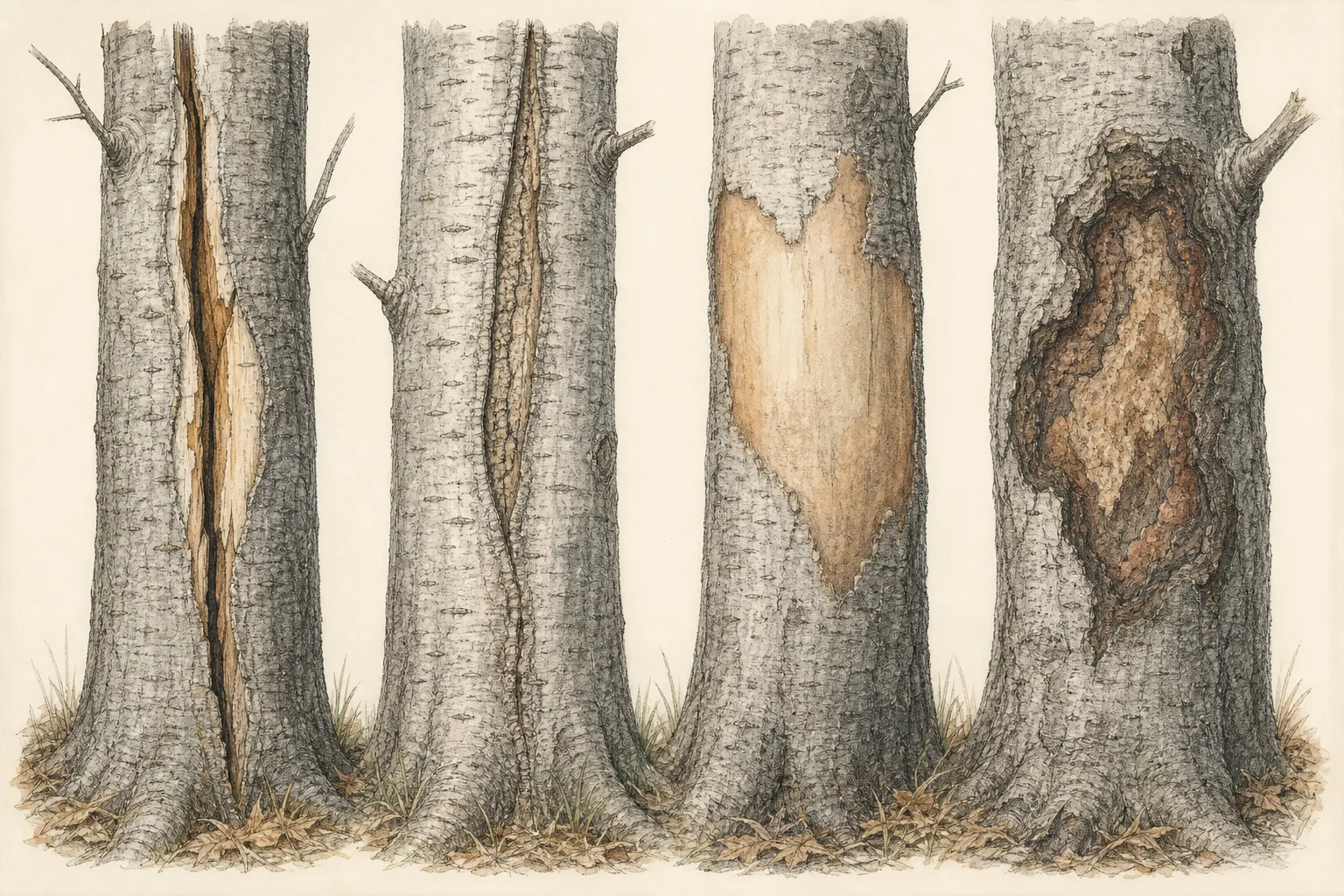
Map associated crown symptoms: dead tips, one-sided leaf loss from the previous season, sparse buds, small leaves, premature autumn color, or normal vigorous growth. Winter twigs can be compared for bud fullness and flexibility. A localized trunk wound on an otherwise sound young tree may be compartmentalizing; progressive canopy decline indicates that roots, vascular tissue, or a disease process may also be involved.
Separate temperature injury from sun exposure
Rapid temperature change can stress wood and bark, and freeze-thaw cycles are associated with longitudinal cracking in susceptible trunks. So-called frost cracks often recur at an earlier wound or weak point rather than appearing in pristine tissue without history. A sharp sound during cold weather is useful evidence but not proof. Examine callus ridges and older discoloration that indicate the site predates the latest freeze.
Southwest injury or sunscald commonly affects the south or southwest face of thin-barked young trees where winter sun warms tissue and rapid cooling follows. The bark may discolor, sink, split, or peel later. Orientation, age, shading history, and weather support the interpretation. Injury can become visible long after the temperature event, so a February crack may reflect repeated exposure rather than last night alone.
Compare neighboring trees only cautiously. Species, cultivar, trunk diameter, bark thickness, water status, nursery history, and reflected heat vary within one bed. A tree newly exposed after removal of a shade plant can be more vulnerable than an established neighbor. Dark trunk guards, reflective walls, and snow surfaces can alter temperature. Record these factors before recommending the same wrap for every trunk.
Temperature injury has no product that restores dead bark. Management protects the tree from additional stress while living margins compartmentalize. Keep the root zone appropriately watered when soil is unfrozen, maintain a broad shallow mulch ring away from the trunk, prevent repeat mechanical injury, and monitor crown response. Severe or expanding wounds need professional assessment, especially on valuable or structurally important trees.
Look for animals, hardware, and maintenance injury
Rodent and rabbit feeding usually leaves tooth marks, clipped edges, or removed bark near snow or ground level. Deer rubbing can shred bark higher on young trunks and bend stems. Snow depth changes apparent feeding height. Inspect around the complete circumference and beneath loose mulch without placing hands into unseen cavities. Search for tracks, droppings, tunnels, browsed twigs, and damage on nearby plants.
Mowers and string trimmers create repeated wounds at a consistent working height, often on the lawn-facing side. A narrow mulch ring does not protect a trunk if equipment still crosses it. Vehicle doors, hoses, snow shovels, and edging tools leave their own patterns. Ask who maintains the site and when. Mechanical damage can crack later as callus forms around dead tissue, making the winter discovery misleading.
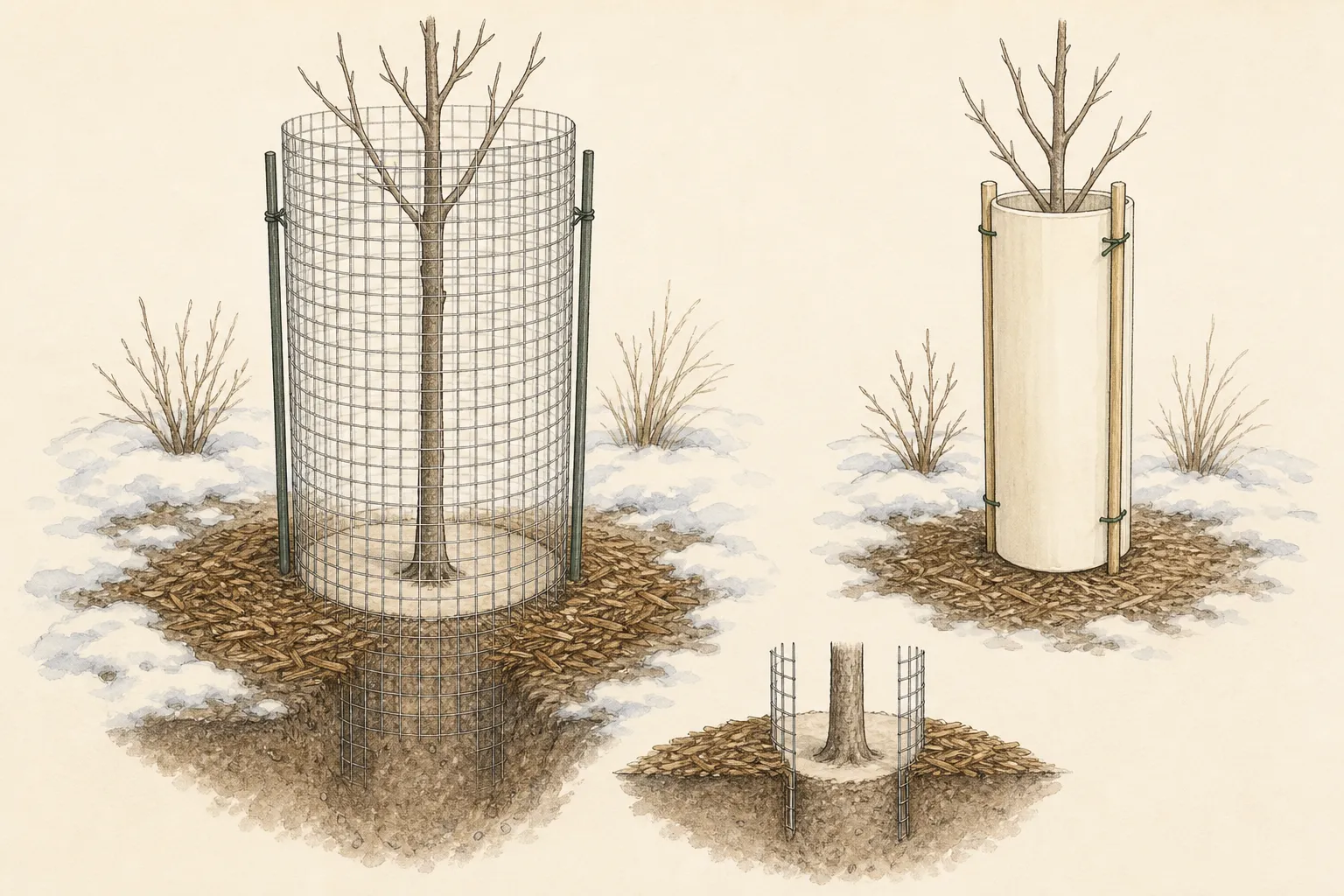
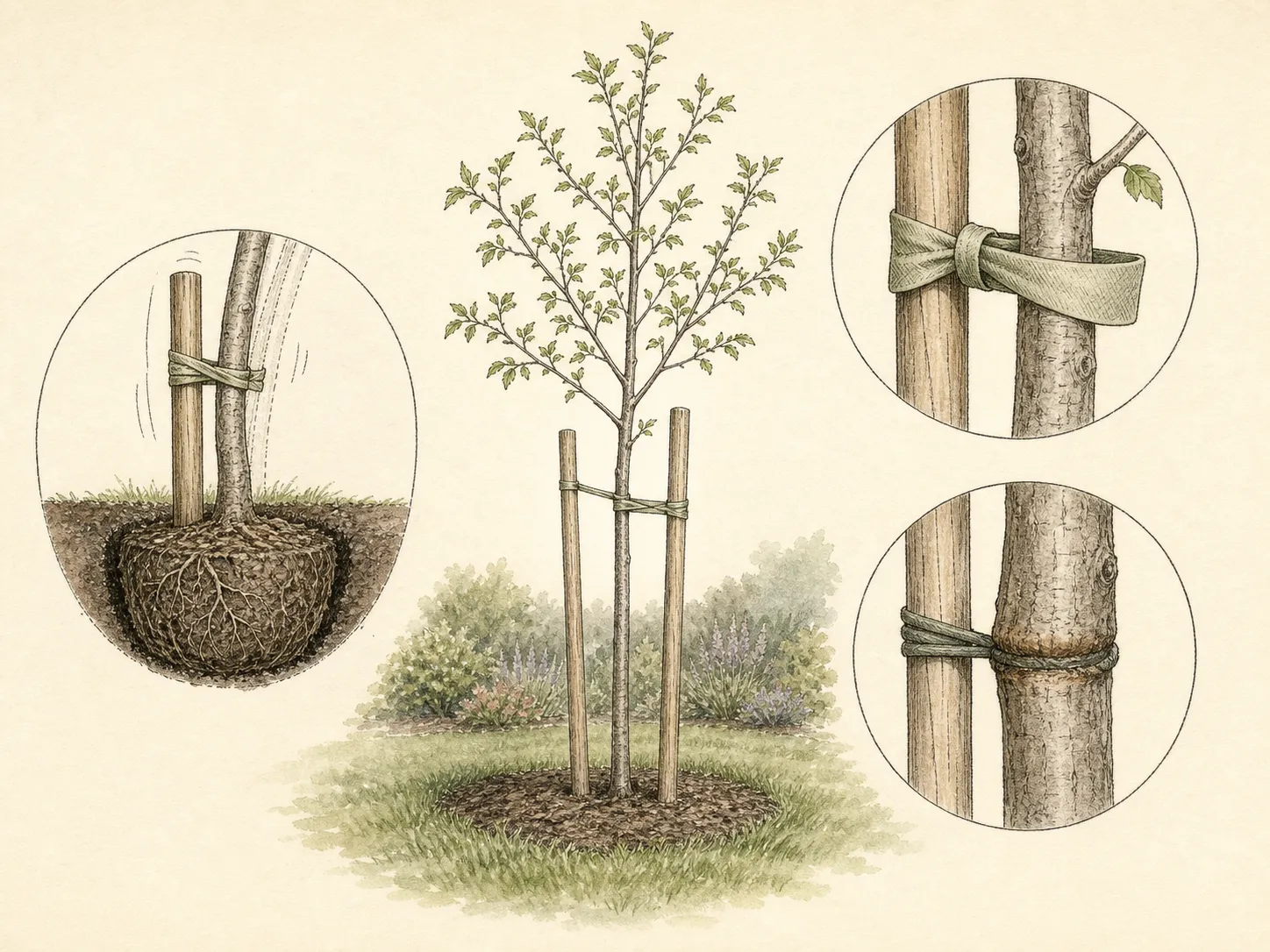
Inspect stakes, ties, labels, wire baskets, guards, lights, and holiday decorations. A forgotten tie can constrict a growing trunk; a rigid guard can rub, trap debris, or hide rodents; wire or cord can become embedded. Remove only hardware that can be taken off without tearing attached bark or destabilizing a newly planted tree. If a support is still needed, replace it with a properly fitted system and schedule removal. Animal and hardware injury can coexist with temperature damage. A dark guard may heat the bark while sheltering rodents, and a mower wound can become the starting line for a recurring crack. Correct each evidenced factor rather than choosing one label. Use a breathable, correctly spaced physical exclusion when animals are active, keep it visible for inspection, and remove or adjust it before growth makes it tight.
Distinguish cankers and structural seams
A canker is a localized area of dead bark and cambium caused by biotic or abiotic injury; some pathogens create expanding sunken lesions, callus ridges, discoloration, or fruiting structures. A crack may run through the dead center. Do not diagnose a pathogen from cracking alone. Photograph the margin and consult a local plant diagnostic clinic, particularly when lesions expand, multiple branches are affected, or similar trees show symptoms.
Avoid sampling before receiving instructions. Diagnostic services may need tissue that includes the active boundary between live and dead bark, and a dry chunk from the lesion center can be useless. Improper cuts also enlarge the wound. Retain fallen material separately if it carries relevant structures, record its origin, and follow local submission and biosecurity guidance. Do not transport suspect material casually among gardens.
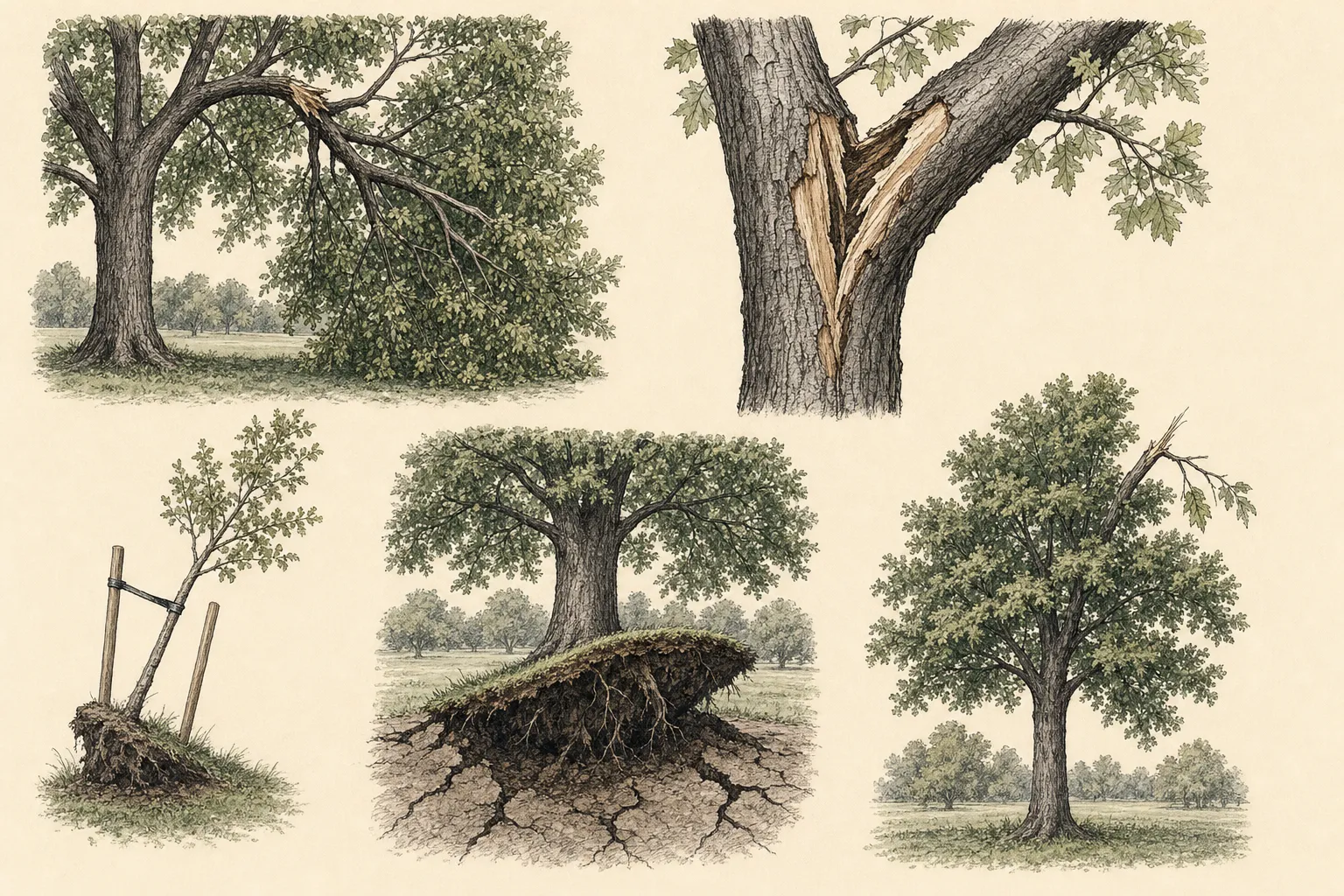
Included bark at a narrow V-shaped union can look like a vertical seam. As two stems enlarge, bark trapped between them prevents a strong wood connection and the union can split under load. Ridges, codominant stems, and movement during wind support structural concern. This is not a wound to strap closed with ordinary hardware. Restrict the target area and seek arboricultural assessment before pruning or installing support.
Old pruning cuts, graft unions, and nursery injuries also form seams and swelling. Identify the cultivar and rootstock if possible, and locate the graft relative to the crack. Suckers arising below a graft, mismatched bark texture, or swelling do not automatically mean failure. The key questions are tissue vitality, progression, structural load, and crown response, all evaluated in the context of that plant’s history.
Protect without sealing the injury
Keep mulch two to three inches deep over the root zone where appropriate, but pull it away from direct trunk contact and expose the flare. Mulch moderates root-zone moisture and reduces mower access; a volcano against bark conceals decay and animals. Extend the protected radius instead of piling material higher. Water during dry, unfrozen periods according to species and soil, allowing excess water to drain.
Where winter sun is a documented repeat risk on a young thin-barked tree, use the prevention method recommended by current regional guidance. A light-colored commercial tree wrap may be used seasonally in some regions, while other guidance emphasizes light guards or site protection. Install from the base upward as directed, avoid constriction, label a removal date, and inspect underneath. Wrap is not a dressing for an existing wet wound.
Animal guards should stand away from bark, be tall enough for expected snow and browsing height, and use an opening size that excludes the target animal without trapping it. Anchor the guard safely and keep the top from abrading branches. Check after storms and through trunk growth. A guard that hides the wound completely prevents monitoring; choose a design that allows light, air, and visual inspection.
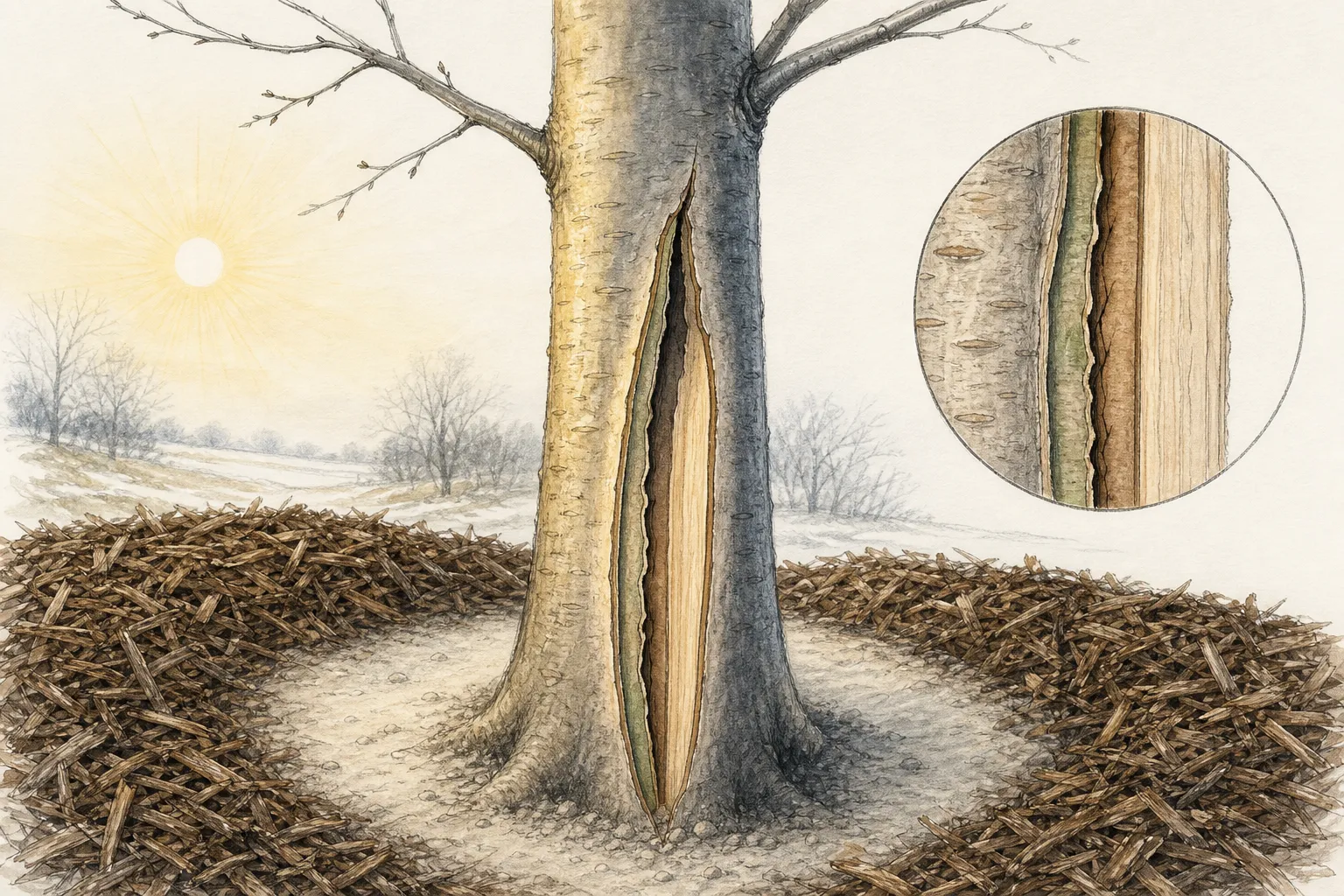
Do not use wound paint, tar, caulk, expanding foam, concrete, or a tight impermeable band unless a qualified professional identifies a specific current use. Trees compartmentalize injury; they do not heal by filling a cavity as skin does. Surface coatings can interfere with drying and examination. The practical work is preventing new injury, supporting overall vigor, and monitoring living margins and structural stability.
Monitor progression with fixed evidence
Set two or three permanent reference points outside the wound and photograph from the same distance with a scale at leaf-out, midsummer, and dormancy. Record width, length, callus development, bark lifting, moisture, fungal structures, and canopy change. Do not mark living bark with nails or deep cuts. A nearby stake, removable measuring strip, or background reference can provide consistency without creating another wound.
Healthy woundwood may slowly roll over exposed wood, but closure rate varies with species, age, wound size, site, and vigor. Fertilizer does not force safe closure and can promote unwanted growth when no nutrient deficiency exists. Use soil testing and local recommendations before amending. Protect roots from compaction, trenching, grade change, and drought because a trunk cannot compartmentalize effectively if the whole tree is declining.
Escalate when the crack lengthens rapidly, margins become soft or foul, fruiting structures appear, sap flow is unusual, the crown dies back, the trunk leans, the root plate moves, or a union opens under load. Also escalate when the potential target includes a house, play area, path, street, or utility. Risk depends on both likelihood of failure and what can be struck.
Close the diagnosis only provisionally. “Likely southwest injury with an older mower wound” is more useful than a confident single label unsupported by testing. State what was observed, what was ruled out, what remains uncertain, and the next review date. The record supports a local diagnostician and prevents future owners from mistaking an old stable seam for a new emergency—or ignoring a genuinely changing defect.
Use professional help for the decisions that carry risk
A local plant diagnostic laboratory answers a different question from a tree-risk assessment. The laboratory can help identify a canker or other causal agent from correctly collected tissue; a qualified arborist evaluates structure, targets, pruning feasibility, support systems, and the condition of the whole tree. Send each professional the photographs, timeline, site history, and weather record already assembled so the visit begins with evidence rather than a stripped or painted wound.
Ask for the uncertainty to be stated. A useful report separates observed facts, likely causes, tests still needed, immediate risk reduction, and long-term monitoring. It should also identify whether a recommended wrap, guard, pruning cut, cable, or removal addresses the cause, prevents recurrence, or only reduces consequences. Retain the report with fixed-point photographs. Future changes can then be compared with a known baseline instead of re-diagnosed from memory after every cold event.
For a young replaceable tree, removal and correct replanting may be more responsible than years of intensive treatment around a severe girdling wound or unsuitable site. For a mature tree with habitat, shade, or landscape value, professional mitigation and monitoring may preserve benefits safely. Cost and sentiment matter, but neither changes the biology or target risk. Choose the least invasive action that addresses the documented problem and can be maintained.
Diagnosis
A long vertical crack opens on a cold day, sometimes along a raised older ridge. Exposed wood may look fresh, while rounded callus at the edges shows that the weak line existed before the latest freeze. The tree can otherwise carry normal dormant buds and no obvious animal marks.
- Check
- Map orientation, length, depth visible without probing, callus ridges, old injuries, recent temperature change, and the complete crown. Compare the crack with older photographs if available. Do not force it open or trim margins; recurring frost-associated cracks often follow a pre-existing weakness.
- Cause
- Wood and bark stress during rapid freezing and thawing, often concentrated along an old injury or structural weakness. Species susceptibility, trunk water status, prior wounds, and repeated seasonal movement can all contribute; the latest cold event may reveal rather than originate the defect.
- Action
- Protect the root zone, prevent new contact, maintain appropriate moisture when soil is unfrozen, and monitor fixed reference photographs. Do not fill or paint the crack. Seek an arborist when the defect is deep, progressing, structurally loaded, or positioned over a target.
Bark on the south or southwest face is discolored, sunken, split, or peeling on a young thin-barked ornamental. The site has bright winter sun, reflected heat, or recent removal of shade, and injury may appear weeks or months after alternating daytime warming and rapid cooling.
- Check
- Confirm compass face, bark thickness, tree age, reflected surfaces, snow glare, shade changes, and timing of visible symptoms. Compare sound bark on the same tree. Look for an underlying mower wound or guard abrasion that may have created the original weak tissue.
- Cause
- Winter sun warms exposed bark and a rapid temperature drop damages living tissue, especially on young thin-barked trees. Reflected light, dark guards, drought stress, recent shade removal, and nursery history may increase exposure. Dead bark later cracks or sloughs.
- Action
- Prevent repeat exposure using current regional guidance for young susceptible trunks, such as an appropriately installed light-colored seasonal wrap or breathable guard. Add a removal date, preserve inspection, and correct reflected heat or lost shade where practical. Protection cannot restore dead bark.
Bark is stripped, shredded, or gnawed near ground or snow height, with tooth marks, tracks, droppings, tunnels, rubbed stems, or browsed twigs. A tight guard, mulch pile, or dense cover may conceal damage around the back of the trunk.
- Check
- Inspect the full circumference and expected snow line, then check nearby plants for feeding. Identify mark width and pattern from a safe distance. Remove loose mulch from direct trunk contact, but do not reach into animal shelter or tear attached bark beneath a guard.
- Cause
- Rabbits, voles, deer, or other animals removed bark or rubbed the trunk, sometimes beneath snow or a protective-looking guard. Lawn equipment, stakes, ties, wire, decorations, and snow tools can create similar localized mechanical wounds or compound animal injury.
- Action
- Install a breathable stand-off exclusion sized for the identified animal and expected snow, widen the mulch ring to exclude equipment, and remove constricting hardware safely. When damage nearly girdles the trunk or crown decline begins, obtain local professional advice promptly.
A sunken or swollen lesion has a sharp advancing margin, repeated callus ridges, staining, oozing, dead twigs, or possible fungal structures. The crack may cross the dead center, and similar lesions may occur on branches or nearby related trees.
- Check
- Photograph the active margin, crown symptoms, and any fruiting structures. Contact a local diagnostic clinic before cutting a sample and follow its instructions for boundary tissue. Review drought, root injury, planting depth, and mechanical wounds that can predispose bark to canker development.
- Cause
- A fungal or bacterial canker, or an abiotic dead area subsequently colonized by microorganisms. Reliable identification usually requires active-margin examination and regional context; cracking, color, or oozing alone does not establish the causal organism.
- Action
- Preserve diagnostic evidence, submit a properly instructed sample, sanitize tools between plants, and remove only tissue or branches recommended for the confirmed problem. Avoid routine fungicides: product choice, timing, host, disease, and label must all match, and many cankers have no curative spray.
A narrow V-shaped union between codominant stems contains a deep bark seam and appears to open under snow or wind. Ridges or bulges flank the union, and a large branch or stem could strike a significant target if the connection fails.
- Check
- Observe the union during calm conditions only, map included bark and stem diameter, and assess the target zone without climbing or loading the branch. A qualified arborist should evaluate structural significance, pruning options, and whether professional support is justified.
- Cause
- Included bark and poor attachment between codominant stems, sometimes worsened by end weight, snow, ice, or wind. An old pruning wound, graft union, cavity, or root-plate problem can also transfer stress into a visible trunk seam.
- Action
- Restrict the target area and obtain a qualified tree-risk and structural assessment. Do not bolt, cable, strap, or heavily prune a major union as a do-it-yourself experiment. Professional mitigation may include selective pruning, support, monitoring, or removal based on defect and target.
Related reading
Sources
- Winter Damage on Landscape Plants. University of Maryland Extension. Source record · Accessed 2026-08-19.
- Abiotic Diseases of Woody Ornamentals. Penn State Extension. Source record · Accessed 2026-08-19.
- Protecting Trees and Shrubs in Winter. University of Minnesota Extension. Source record · Accessed 2026-08-19.